Prayer

Throwback Thursday ~ “Can We Talk?”

Originally published, February 9, 2012

“Thanks for meeting with me, today, Dad,” said the tow-headed six year old as he strode across the study, arm extended for a firm handshake.

Smiling, the father grasped the child’s hand, assuming a hug would follow. When none did, he stood, somewhat dismayed, as his son took the chair opposite the imposing mahogany desk and motioned for him to take his accustomed place behind it.

Oh. This was going to be one of those conversations.

“I only have about five minutes,” said the boy, briskly, as he clicked open the latches on his caramel brown leather brief case and withdrew two copies of a neatly typed agenda, “so let’s get down to business.”

“First, as I’ve mentioned numerous times, I’d like you to get me that big shiny motorcycle I’ve been wanting. And would you please hurry up about it? I’ve been asking for that bike for a long time, and I don’t understand why you haven’t given it to me yet.”

Again with the motorcycle? Doesn’t this kid get that he’s six? There’s no way he could handle a bike that large and powerful, and I love him too much to see his guts splattered all over the pavement. Yeah, that’s gonna be a big, fat “no.”

“Next,” the boy hurried on, “I’m kinda in a jam. You see, there’s this big spelling test tomorrow, and I haven’t had time to study for it. Could you sit by me in class tomorrow and give me all the answers?”

Haven’t had time? Yesterday he played video games for two hours, and the day before that I heard him throwing a tennis ball up against the side of the house all afternoon!

“And finally, Sparky seems to be limping around lately. Could you take a look at his paw and fix it up with some of that special cream?”

Well…sure. You know I’m always glad to help, but…

“Thanks for everything, Dad,” the boy chirped as he hopped off his chair and headed for the door, “I’ve got to run. See you later!”

Bye…Son.


I can just see that Dad standing there, forlorn, missing his son. The son who lives under the same roof with him. The son he watches play ball, play with his friends, and achieve the great feats of six year olds. The son who never really talks to him.

The father longs to have an intimate, “Daddy’s home!” relationship with his child. To have his son run up, give him a hug, and jump in his lap to tell Dad all about his day. He wants to share his child’s joys and sorrows. He wants to hear his heart.

And if the child really thought about it—or even knew such a relationship could exist—he’d want the same thing.

We can have that kind of joyous relationship with our Heavenly Father. It really is possible.

But how?

Well, think about how you relate to the person you love the most in the world. Because you love that person, you want to spend time with him. You’re relaxed around each other. You enjoy being together. You share everything—your deepest secrets, your regrets, your hopes for the future, your concerns for others, your frustrations, your joys, your sorrows, even the mundane, day to day happenings of life.

You’ve probably never read a book, taken a class, or attended a lecture on how to talk to that special someone. And you’ve probably never made a list of conversation topics for your next get-together with him. This is a friendship, not a business meeting.

Now think about how our connection to God is illustrated in Scripture. He’s called our Father (Matthew 6:9); Jesus is our brother (Matthew 12:50) and our friend (John 15:14); the church is the bride of Christ (Revelation 19:7). These are the most intimate relationships we know, and they’re used to describe a bond of love and friendship with God.

So, why do we have so much trouble talking to Him? Why is it that, so often, what’s supposed to be a heartfelt conversation with God feels like a one-sided recitation of a laundry list of prayer requests?

In some ways, we’ve done it to ourselves. There are thousands of books, Bible studies, and other materials on how to pray. Preachers preach on it. Teachers teach on it. There are acronyms you can follow, lists you can make, prayer calendars, even apps and on-line prayer organizers. None of these things are inherently bad, in fact, some are excellent—I’ve used and recommended some of them, myself.

But, I think that, sometimes, when faced with all of these resources and methodologies, one of two things can happen. First, you can become paralyzed by all the choices, not know which one to choose, and give up on prayer because you think it’s too complicated. Or, you might try to use too many prayer resources and become overwhelmed because they don’t work for you or you can’t keep up with all of them. Second, you can fall into the trap of thinking you have to use some sort of prayer resource or methodology. You can become enslaved to the structure, and that stands between you and intimacy with God like a brick wall.

May I make a suggestion here?

Throw out the lists. Put away the prayer calendar. Turn off the app.

Just talk to your Father. Talk to Him like He’s the person you love most in the world. Pour out what’s on your heart to Him.

If you’re not sure how to do that or what to say or whether you might be doing it wrong, tell Him about that, and ask Him to help you. It’s OK to ask God to show you how to talk to Him. The disciples did, and Jesus gladly obliged (Luke 11:1-13).

Don’t become paralyzed by the number of prayer requests you think you have to keep up with, either. I know that some churches have prayer lists a mile long, plus prayer calendars for missionaries, and you have friends and relatives asking you to pray for certain things. Sometimes, our prayer time can feel like we’re the office flunky armed with a long list of orders being sent out to pick up lunch for everybody. “Get those orders right! Don’t forget anything!” But prayer is not about completing a checklist of everyone else’s concerns. It’s about you and God, and it should be governed by God, not ruled by a list.

Wait a minute. This is starting to sound selfish. Aren’t we supposed to pray for others? Well, yes…and, no. What we’re supposed to do is to submit ourselves and our prayer time to God’s word and the leadership of the Holy Spirit.

That sounds great, but what does it mean in practical terms?

  • Study God’s word before you pray. As you do, He’ll begin leading you to the things He wants you to pray about.
  • Ask God what to pray about. Often, I’ll open a prayer meeting by praying that God will lead our prayer time and that He will put all the things on our hearts that He wants us to pray about.
  • Resist the list. Trust God to lead you to the things He wants you to pray about, and let your conversation with Him flow freely from your heart. Don’t worry about forgetting something on your prayer list.
  • Prayer time isn’t self-contained. Usually, my praying for others is done throughout the day rather than during my set prayer time. When someone asks me to pray for something, I’ll stop right then and do it. There are certain missionaries and other Christian ministries that I pray for when I receive an e-mail or Facebook update from them. Most of the time, unless God lays something on my heart during my personal prayer time, I only pray for requests on the church prayer list during the prayer meeting in which I receive them.

Relax. Just talk to Him.

“…the prayer of the upright is His delight.” Proverbs 15:8
Wednesday's Word

Wednesday’s Word ~ Ezekiel 18

For further study on the book of Ezekiel, try my study, Ezekiel.

ez 18 23

Ezekiel 18

The word of the Lord came to me: “What do you mean by repeating this proverb concerning the land of Israel, ‘The fathers have eaten sour grapes, and the children’s teeth are set on edge’? As I live, declares the Lord God, this proverb shall no more be used by you in Israel. Behold, all souls are mine; the soul of the father as well as the soul of the son is mine: the soul who sins shall die.

“If a man is righteous and does what is just and right— if he does not eat upon the mountains or lift up his eyes to the idols of the house of Israel, does not defile his neighbor’s wife or approach a woman in her time of menstrual impurity, does not oppress anyone, but restores to the debtor his pledge, commits no robbery, gives his bread to the hungry and covers the naked with a garment, does not lend at interest or take any profit, withholds his hand from injustice, executes true justice between man and man, walks in my statutes, and keeps my rules by acting faithfully—he is righteous; he shall surely live, declares the Lord God.

10 “If he fathers a son who is violent, a shedder of blood, who does any of these things 11 (though he himself did none of these things), who even eats upon the mountains, defiles his neighbor’s wife, 12 oppresses the poor and needy, commits robbery, does not restore the pledge, lifts up his eyes to the idols, commits abomination, 13 lends at interest, and takes profit; shall he then live? He shall not live. He has done all these abominations; he shall surely die; his blood shall be upon himself.

14 “Now suppose this man fathers a son who sees all the sins that his father has done; he sees, and does not do likewise: 15 he does not eat upon the mountains or lift up his eyes to the idols of the house of Israel, does not defile his neighbor’s wife, 16 does not oppress anyone, exacts no pledge, commits no robbery, but gives his bread to the hungry and covers the naked with a garment, 17 withholds his hand from iniquity, takes no interest or profit, obeys my rules, and walks in my statutes; he shall not die for his father’s iniquity; he shall surely live. 18 As for his father, because he practiced extortion, robbed his brother, and did what is not good among his people, behold, he shall die for his iniquity.

19 “Yet you say, ‘Why should not the son suffer for the iniquity of the father?’ When the son has done what is just and right, and has been careful to observe all my statutes, he shall surely live. 20 The soul who sins shall die. The son shall not suffer for the iniquity of the father, nor the father suffer for the iniquity of the son. The righteousness of the righteous shall be upon himself, and the wickedness of the wicked shall be upon himself.

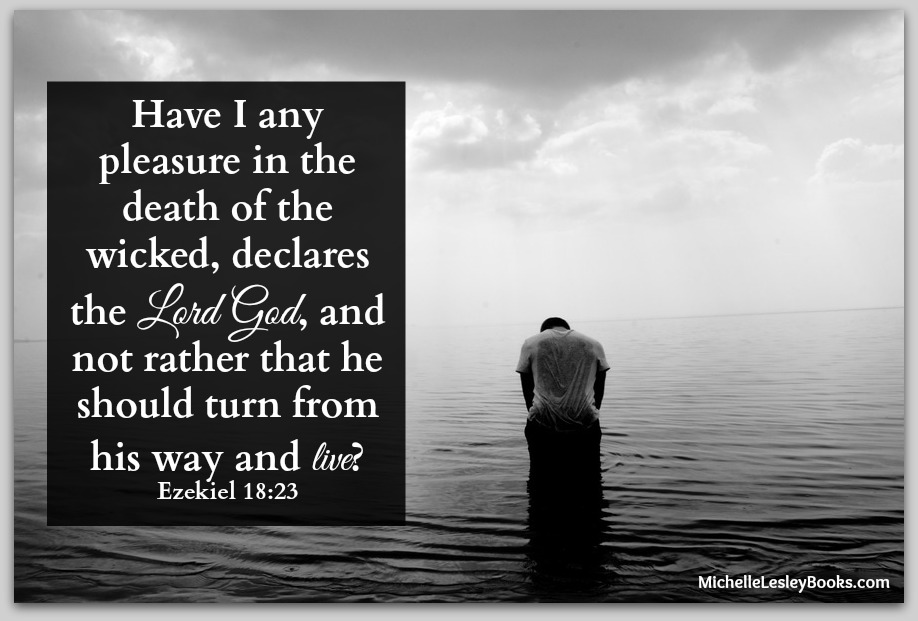
21 “But if a wicked person turns away from all his sins that he has committed and keeps all my statutes and does what is just and right, he shall surely live; he shall not die. 22 None of the transgressions that he has committed shall be remembered against him; for the righteousness that he has done he shall live. 23 Have I any pleasure in the death of the wicked, declares the Lord God, and not rather that he should turn from his way and live? 24 But when a righteous person turns away from his righteousness and does injustice and does the same abominations that the wicked person does, shall he live? None of the righteous deeds that he has done shall be remembered; for the treachery of which he is guilty and the sin he has committed, for them he shall die.

25 “Yet you say, ‘The way of the Lord is not just.’ Hear now, O house of Israel: Is my way not just? Is it not your ways that are not just? 26 When a righteous person turns away from his righteousness and does injustice, he shall die for it; for the injustice that he has done he shall die. 27 Again, when a wicked person turns away from the wickedness he has committed and does what is just and right, he shall save his life.28 Because he considered and turned away from all the transgressions that he had committed, he shall surely live; he shall not die. 29 Yet the house of Israel says, ‘The way of the Lord is not just.’ O house of Israel, are my ways not just? Is it not your ways that are not just?

30 “Therefore I will judge you, O house of Israel, every one according to his ways, declares the Lord God. Repent and turn from all your transgressions, lest iniquity be your ruin. 31 Cast away from you all the transgressions that you have committed, and make yourselves a new heart and a new spirit! Why will you die, O house of Israel? 32 For I have no pleasure in the death of anyone, declares the Lord God; so turn, and live.”


The Holy Bible, English Standard Version Copyright © 2001 by Crossway Bibles, a publishing ministry of Good News Publishers.


Questions to Consider:

1. What is the book of Ezekiel about? Which genre (history, poetry, wisdom, etc.) is the book of Ezekiel? What is the overall theme of chapter 18?

2. How do verses 5-9 describe a righteous man? What kind of heart would such a man have to have in order to consistently live this way? (9)

3. Who is the “he” in verses 11 and 12 referring to? Is this man to be punished for the sins of his son? (13) If the sinful man (14) fathers a righteous son (14-17) is the righteous son to be punished for his father’s sin? (17-18) Which verse(s) in this chapter sum up the principle of individual responsibility for sin? How does this chapter refute the false teaching of generational curses?

4. What can we learn about repentance from verses 21-32? In which does God take delight, pouring out His wrath on the wicked or pouring out His forgiveness on the repentant? (23, 32) How does this passage compare to 2 Peter 3:9?

5. Consider this chapter in light of the gospel. Is any person truly righteous? Where does the Christian’s righteousness come from? How does the New Testament describe Jesus, the righteous Son, being punished for our sin? What effect does this have on verse 4 (“the soul who sins shall die”)?

Politics, Prayer, Throwback Thursday

Throwback Thursday ~ Not Gonna Bow: 5 Reasons Prayer in School Isn’t the Magic Bullet Christians Think It Is

Originally published August 29, 2014Prayer In School

“We need to put prayer back in school!” It’s a well worn mantra that many Christians have been shouting from pulpits, in PTA meetings, and now on social media since the early 1960’s when it was outlawed. No, we don’t need to put prayer back in public schools, and I think if Christians who think that the United States would revert to some idyllic 1950’s utopia by re-instituting classroom prayer would give it five minutes of serious thought, they would run as far as they could from the idea of prayer in public schools.

Now, just so there are no misunderstandings, when I say “prayer in public schools,” I’m not talking about things like a child saying the blessing over his own lunch, or a group of kids who want to pray together during free time, or an after school club that wants to include prayer. Those are all voluntary, private things that should, by all means, be allowed. When I say “prayer in public schools,” I’m talking about a teacher or a student or someone over the loudspeaker leading the entire class in prayer during class time. And we definitely do not want that. Why?

1. What’s good for the Christian goose is good for the Muslim/Mormon/Atheist gander.
There is no way in the current cultural climate –none whatsoever- that any court in this land will re-institute Christian prayer, and only Christian prayer, in the classroom. And even if some well meaning judge did manage to do so, his decision would be overturned faster than you could say “amen.” You want prayer in the public school classroom? You might get Christian prayer, but you’re also going to get Muslim prayer, Mormon prayer, atheist prayer, Hindu prayer, Satanist prayer, and any other sect that comes along and wants to do prayer in the classroom. Do you really want your six year old faced with the choice of participating in a Satanic prayer or trying to get permission to abstain? Neither do I.

2. Why is it so important that we have prayer in schools?
Assuming you don’t work at a church or ministry, does your workplace gather all the employees at the beginning of the day and start with prayer? No? Has that been deeply detrimental to you personally or to your workplace? No? Then why is it so important that schools have prayer?

3. Post hoc ergo propter hoc.
This nifty little Latin phrase means “after this, therefore, because of this.” It refers to the faulty reasoning people sometimes use by assuming that because two events occurred near the same time or seem to be related, one of them must have caused the other.

Time and time again, I have heard Christians bemoan the moral state of this country and wail, “It all started when they took prayer out of schools!”

Post hoc ergo poppycock

If the moral state of this country was so perfect before 1962, then how in the world did prayer ever get taken out of schools in the first place? No, things started going downhill in this country long before prayer was removed from schools. It was as a result of that moral decay that prayer was taken out of schools.

Saying that the removal of prayer from public schools created the mess our country is in today would be like someone sixty years from now saying, “When the Supreme Court legalized gay marriage nationwide, that’s when things started going bad for America.”

Because things are just so morally peachy right now.

4. It isn’t biblical.
It is not the job of a secular governmental institution or employee to monitor or lead our children in prayer, and no one could make the case from God’s word that it is. Scripture tells us that leading in prayer is the job of Christian parents and the church.

Neither would it be biblical for the sake of unsaved children in your child’s class that you’re hoping will somehow get saved by someone leading a prayer every morning. That’s not how people get saved. If you’re concerned about lost children, teach your child how to share the gospel. Befriend the children’s parents and share the gospel with the parents yourself. It’s free, it can be done immediately, without waiting for court decisions (that won’t be coming anyway) and it’s biblical.

5. It’s hypocritical.
It is often Christians who exclaim the loudest, and rightly so, that the government should back off and stop trying to control, regulate, and meddle in every square inch of our lives. Yet with regard to prayer in schools, Christians talk out of the other side of their mouths and practically beg the government to insinuate itself into an issue it has no business touching. (Not to mention that the government does such a bang up job of handling things like this.)

Will those very Christians complain if the government re-institutes prayer and then tries to regulate it just like they do everything else? And what about depending on the government for a handout of prayer when we are the ones who should be doing the work of teaching prayer and sharing the gospel? Isn’t that a sort of prayer “welfare” system? Putting prayer back in public schools would be a nightmare of false religions and government regulations.

We don’t need prayer in schools. We need prayer in homes and in churches. We need people sharing the gospel with their friends, fellow students, neighbors, and co-workers. We need Christians to be the salt and light Jesus called us to be in the world we actually live in rather than pining away for an imaginary ideal that will never come to fruition.


¹I only wish I were clever enough to have come up with this. Kudos to CHRIS ROSEBROUGH’S wife who coined the Phrase.
Guest Posts

Guest Post: Two Faithful Women

If your theology pretty much matches up with mine (as outlined in the “Welcome” and “Statement of Faith” tabs) and you’d like to contribute a guest post, drop me an e-mail at MichelleLesley1@yahoo.com,
and let’s chat about it.
gail slawson two faithful women

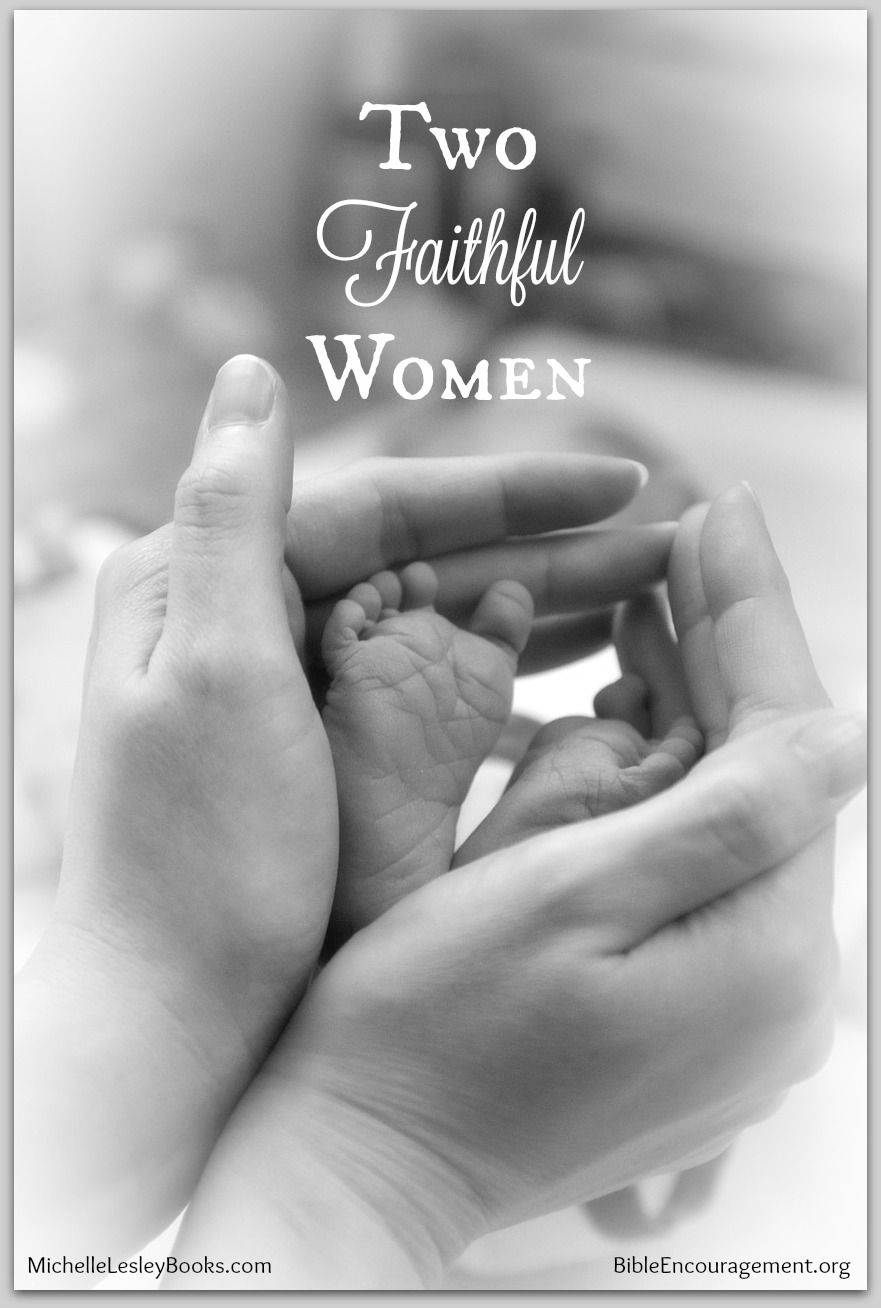
Two Faithful Women
by Gail Slawson

Exodus 1:17 “But the midwives feared God.”

A few years ago I embarked on a two year journey to read through the Bible again. Traveling from Genesis into Exodus, two names suddenly appeared on the printed page—two names recorded nowhere else in the Bible, two obscure names, two names of women. How important are these two women who have their names written in God’s Word?

Further study reveals Shiphrah and Puah were midwives, women who assisted in the birth of the babies of the Hebrew women. Most likely they were older women and the representatives of their profession. During their time in Egypt, the Children of Israel grew greatly in number and strength and Pharaoh felt threatened and became fearful. In an attempt to curtail their growth he ordered the midwives to kill all Hebrew boys at birth. Instead of being the ones who were looked up to for their skill and were trusted to take great care in seeing that the lives of these babies were preserved, they were suddenly thrust into the position of being executioners, deceitful and untrustworthy. But these two women who “feared God,” refused to obey such a law. They reverenced God and obeyed Him rather than man (Exodus 1:17). “They obviously understood that children were a gift from God and that murder was wrong.” (John MacArthur) Like the apostles in Acts 5:29 who said, “We must obey God rather than men,” these midwives had the courage to stand alone and do what was right.

Shiphrah and Puah were ordinary women who devoutly did their humble job, and yet they were used of God to preserve and save a nation that the King of Egypt desired to suppress. Do you have a desire to serve God? Whatever role God has given you to perform in this life, do it faithfully and obediently with love and care and God will bless. In fact, as we read on in the story, we see where it says that God looked favorably on the midwives. Exodus 1:20 says, “Therefore, God dealt well with the midwives,” and verse 21 says, “Because the midwives feared God, He established households for them.” God built them up into families, blessed their children, and prospered them in what they did.

What a wonderful example these two midwives are to us to be obedient. God’s Word tells us in Ecclesiastes 9:10:

“Whatever your hand finds to do, do it with all your might…”

Again God’s Word says,

“Whatever you do in word or deed, do all in the name of the Lord Jesus, giving thanks through Him to God the Father.” Colossians 3:17

Enjoy your work, finding pleasure in it as you honor God and are used for His purpose.


Gail is a 68 year old wife, mother and grandmother. She attended church all her life, but never saw herself as a lost sinner in need of a Savior until she was 28 years old. She has praised Him ever since. Gail’s daily prayer is: “But God forbid that I should glory, save in the cross of our Lord Jesus Christ.” (Galatians 6:14) Follow Gail’s blog, BibleEncouragement.org.


ALTHOUGH I DO MY BEST TO THOROUGHLY VET THE THEOLOGY OF THE BLOGGERS WHO SUBMIT GUEST POSTS, IT IS ALWAYS POSSIBLE FOR THINGS TO SLIP THROUGH THE CRACKS. PLEASE MAKE SURE ANY BLOGGER YOU FOLLOW, INCLUDING ME, RIGHTLY AND FAITHFULLY HANDLES GOD’S WORD AND HOLDS TO SOUND BIBLICAL DOCTRINE.
Guest Posts

Guest Post: A Portrait of the Heaven-Bound Slave

Since I’ve had to temporarily cut back on blogging I’ve asked some friends to contribute guest posts. If your theology pretty much matches up with mine (as outlined in the “Welcome” and “Statement of Faith” tabs) and you’d like to contribute a guest post, drop me an e-mail at MichelleLesley1@yahoo.com, and let’s chat about it.

Kesha talents

A Portrait of the Heaven-Bound Slave
By: Kesha Griffin

When you think of the character of a Christian, what comes to mind? For some, we may think of loving, patient, kindness, giving, self-less, etc. (at least I hope this describes most Christians you know). Although all of these characteristics are important, I think many of us overlook one trait that our Lord often spoke about and held in high regard…faithfulness. In fact, the Bible teaches us that faithfulness (to the Word, to God, to His work) is a mark of a true believer. Sadly, we often hear how faithful God is to us (and He is), but rarely hear about the importance of being a faithful servant to our Master.

The Parable of the Talent is a great depiction of a faithful Christian. In Matthew 25:14-30, Jesus is speaking to His disciples about the kingdom of heaven and begins telling them this parable of the talents. The parable involves a master, his three slaves, and the master’s talents (a measurement of gold, silver, money, etc.).The master represents Christ and the slaves represent believers and unbelievers. The story as told by Jesus, says the master was going away on a journey, and entrusted his slaves with his talents to manage while he was away. When the master returns home from his journey, his slaves show him what they did with the talents they were given.

Let’s examine the slaves in more detail:

#1- The Slave’s Portion
The master gave each slave a talent. The talent did not belong to the slave, it was entrusted to the slave. It belonged to the master (vs 14). Also notice, that the master gave each slave the amount he wanted them to have; One slave had five talents, one had two talents, and the other slave was given one talent. Finally, notice that the amount of the talents given to each slave was given according to their own ability (vs 15). The slaves didn’t ask the master to give them a certain amount of talents, the master decided how much, and to whom.

#2- The Slave’s Character
In the parable, two of the slaves immediately went out and starting working. This implies they had a sense of urgency, didn’t waste any time, and were eager to do the work of their master. It also appears these slaves were hard-working, searched for opportunity, put in effort, for the Scripture says they “went and traded” (vs 16). Lastly, not only did these slaves spend their time working diligently for their master, they found opportunities to make more for their master. They both doubled what was initially given to them.

The parable also reveals the character of the last slave. Although this slave was only given one talent, he went away, dug a hole and hid the money (vs 18). This implies that he didn’t want to work, there was no sense of urgency, and no desire to please his master. In fact, the Scripture says, he was “lazy and wicked” (vs 26). After burying his talent in the ground, he must have spent the rest of his time doing…whatever he wanted to do. His life was free from toiling for his master, he could do as he pleased.

Not only was this slave lazy but he had several excuses as to why he didn’t work for his master. He blamed his master, to the point of attacking the master’s character, saying that his master was a “hard” man (vs 24), and he blamed fear, said he was afraid (vs 25). He also tried to cover up his lack of effort by presenting the master the one talent he was entrusted with, as if he honestly wanted to please his master (vs 25).

#3- The Slave’s Reward
The two slaves who diligently worked for their master, both doubled their portion originally entrusted to them. Notice that although one slave ended up with ten talents, and the other four talents, they both received the same reward. The master commended them both and gave them more. How thrilled the slaves must have been to fulfill their obligated duty to work for the master, and to be rewarded by Him for doing so. What joy to hear their master say “Well done, good and faithful slave. You were faithful with a few things, I will put you in charge of many things; enter into the joy of your master.” (vs 21 and 23)

Sadly, the wicked and lazy slave received condemnation and punishment from the master (vs 26-28). The one talent he had was taken and given to the slave who had the most. His master called him a worthless slave and cast him into outer darkness, a place of “weeping and gnashing of teeth” (vs 30). How tragic.

It seems like a harsh punishment for a slave who was simply lazy right? Well, let me suggest that this lazy slave was not simply lazy. He is a depiction of an unbeliever. A person who is wicked, and who doesn’t have a relationship with the Master. Notice the slave didn’t want to work or even attempt to please the master (buried the talent in the ground). He didn’t appear to know (personally/intimately) the master well, he accused the master of being a hard man. He didn’t make the most of the talent that was given to him, not even investing it in the bank to gain interest (vs 27). He was disobedient, not wanting to do as the master instructed, and lived his life for himself, not for the master.

Faithfulness is a characteristic of a true believer. Although not perfectly, are we truly living for Jesus, working diligently to make the most of all he has given us (our time, spiritual gifts, money, etc.), like a faithful slave? Is it our goal to please our Master? When Jesus comes to “settle the account” with us, will we hear the Master say “Well done my good and faithful slave…enter in”?


Kesha LOVES finding hidden treasures buried in Scripture and learning how to apply them to daily living. Her heart’s desire is that every Christian woman is equipped with sound doctrine, so that she may know God truthfully and intimately, and learn how to fight life with the sword, the Word of God. Follow Kesha at treasuresbykesha.com and on Twitter: @MrsKeshaGriffin and @treasurebyKesha.


ALTHOUGH I DO MY BEST TO THOROUGHLY VET THE THEOLOGY OF THE BLOGGERS who submit guest posts, IT IS ALWAYS POSSIBLE FOR THINGS TO SLIP THROUGH THE CRACKS. PLEASE MAKE SURE ANY BLOGGER YOU FOLLOW, INCLUDING ME, RIGHTLY AND FAITHFULLY HANDLES GOD’S WORD AND HOLDS TO SOUND BIBLICAL DOCTRINE.