Poetry, Sanctification

How a Little Acorn Helped Reassure a Nut Like Me

acorn-1030819_1280

There are two kinds of people in this world, throwers and savers (or hoarders, if your saving has breached the clinical level). I’m a thrower married to a saver, which means I have thrown out some stuff I later wished I’d kept, and my husband has saved a lot of stuff we haven’t used in ages and probably never will. But, recently, I came across something I’m really glad I kept all these years.

I was going through a box of old papers, happily doing my “thrower” thing, when I discovered a manilla folder marked, in my handwriting, “Michelle’s Misc. Creative Writing.” Whatever it was, I didn’t remember saving the folder, nor what it might contain. I opened it up to find a two inch thick sheaf of, well…my miscellaneous writings from years gone by. Sermon notes, creative writing assignments and essays for English classes, poems, song lyrics, short stories, even what looked like the manuscript to a devotional I’d started on.

Fortunately, I had dated most of the papers, so I could see that the bulk of them were written when I was between the ages of about 14 to 21. As I leafed through pages of adolescent script alternating with dot matrix printing, I started noticing a common thread. Nearly all of this writing was about God, faith, the Bible, worship, wanting to know Him more. To be sure, the faith was childlike (if not downright childish), and the theology was often immature and somewhat unbiblical.

But it was there. And all these years I’d wondered whether or not that faith had existed back then at all.

You see, I was raised in a Christian home, and, although I was most definitely a depraved little wretch, my outward behavior was fairly decent compared with some of the other kids my age. I got good grades, never had behavior problems in school, was at church every time the doors were open, never tried sex, drugs, cigarettes, crime, or anything else teens sometimes get into. Overall, I was your basic goodie two shoes. So, when I prayed a prayer for salvation at age 12, there was no great big radical lightning bolt change in my life. Things continued pretty much as usual. Had my heart changed? Looking back all those years later as an adult with terrible recollective abilities, I couldn’t really remember.

But as I skimmed through page after page of longing for God, love for God, wanting to please God, something I told a reader not long ago -who was concerned she might not be saved – hit me like a ton of bricks:

Lost people don’t have that kind of “want to.”

I didn’t have all my doctrine straight or walk in Christian maturity, and I wouldn’t have known an apologetic from an apostate, but I wanted God. I loved Him as best I knew how at the time. I had that “want to.” I was saved. God had used a dusty box of old papers to reassure me and put those doubts to rest. It was one of those precious moments alone with the Lord that you never forget.

So to sort of celebrate that little moment in my walk with the Lord, I wanted to share with you one of the poems I found in that folder. It was undated, but I think I wrote it when I was in high school or college. Now, I’m just going to warn you up front, it’s long and it’s lame and it’s (a)corny, and some of the cadence is off and so is the doctrine, and it just plain needs a lot of editing. But I had a good laugh over it, and I thought you might, too. (Hint- it’s funnier if you read it out loud.)

I Am a Little Acorn

I am a little acorn,
A fact that’s plain to see,
But remember that the might oak
Was once a nut like me.

When I was a baby bud,
I burst forth from a limb,
I grew a little every day,
Out from my little stem.

As I grew older day by day,
An identity crisis hit me.
I searched my heart and searched my soul
To find out just what I should be.

I did not want to be a nut.
I cried, “I cant! I won’t!”
Because sometimes you feel like a nut,
Sometimes you don’t.

I tried to be a button,
And a rolling tumbleweed.
I tried to be a jelly bean,
But still did not succeed.

Oprah, Geraldo, Sally, and Phil*
All let me spill my guts.
“Something other than an acorn?” they asked,
“You can’t! You must be nuts!”

My fame and fortune quickly spread,
I was known both far and wide.
But no one knew my secret dark,
I was lost and scared inside.

Then finally, one day, I turned to the Lord,
And cried out with all my might,
“Why, oh why, do I continue to fail?
Why won’t something go right?”

“Remember to whom you are speaking,” said He,
“I am the Great I Am,
But I’m also the root of David,
And the seed of Abraham.”

“From small beginnings come great things,
This fact is tried and true,
The mighty oak could never be,
Without an acorn like you.”

“All are given different gifts,
And must do as best they can,
To find a way to channel them
According to God’s plan.”

“So cheer up little acorn,
And learn the secret known by few:
Be content with what you’re given,
And let God work through you.”

“I’ll be the best acorn ever!” said he.
“I’ll do as God has led.”
Then standing bold and brave and tall,
The acorn proudly said:

“I am a little acorn,
A fact that’s plain to see,
But remember that the mighty oak
Was once a nut like me.”

(*You’ve probably heard of Oprah. Geraldo Rivera, Sally Jessie Raphael, and Phil Donohue all used to host talk shows, too.)

Don’t despair if you’re still a little acorn in your faith. You keep pursuing that “want to” for God, and He’ll grow you into a mighty oak in Christ.

How do I know? Because He’s doing just that for a nut like me. 🌰


Mailbag

The Mailbag: Is it OK for Christian men to read Christian women’s blogs?

mailbag

As a man, am I not to read or seek to understand anything from your blog because a woman wrote it? (1 Timothy 2:12)

While other female bloggers might answer differently, as far as my personal position goes, the short answer to your question is no. Generally speaking, it’s not biblically problematic for a Christian man to read my blog because the blogosphere is not the gathering of the church body, and I’m not in any position of spiritual or practical authority over male readers (or even female readers for that matter). Additionally, when I write, I’m writing to instruct and edify women, not men. Male readers are sort of “eavesdropping” or “listening at the door.”

But I would encourage male readers to examine their motives for reading my blog. I have a number of godly male readers, including several pastors, who read my blog for a variety of reasons: they’re interested in a female perspective on various church and biblical issues, they want to use my perspective to better understand and help their wives or female church members, their wives or female church members read my blog and they’re keeping tabs on me to make sure those ladies are taught properly, they don’t have time to vet a certain Christian teacher, so they use my information on false and sound teachers as a resource, and there are those who are friends, whom I’ve asked to keep up with my blog so they can offer me correction as needed.

My thought is that any of those (or similar) reasons are fine and don’t even fall under the spirit of 1 Timothy 2:12, much less the letter. What I do feel would fall under the spirit of that passage would be a man seeking biblical instruction from me for his own personal walk with the Lord. For example- I run a Bible study for women every Wednesday on the blog, and the archives of my previous studies are under the “Bible Studies” tab at the top of this page. On my part, I’d feel scripturally uncomfortable if a man were using that as the basis for his quiet time rather than using something written by a man, or just studying his Bible. (By the way, if you’re looking for some godly male preachers and teachers, check the “Recommended Bible Teachers” tab at the top of this page.)

I guess the questions I would ask myself if I were a male reader are: What are my reasons for reading this? Is my motivation to receive instruction in Scripture that should really be coming from a male teacher or straight from God’s word? Is my conscience clear, based on God’s word, to go ahead and read this? How can I best honor God and His word in this situation?

I’ve written more extensively on this topic (and related topics) in these articles:

Adam 3.0: Meanwhile, Back in the Garden, It’s Deja Vu All Over Again

Are Female Bloggers Violating Scripture by “Teaching” Men?

Rock Your Role FAQs (#2)


If you have a question about: a well known Christian author/leader, a Bible passage, an aspect of theology, a current issue in Christianity, or how to biblically handle a family, life, or church situation, comment below (I’ll hold all questions in queue {unpublished} for a future edition of The Mailbag) or send me an e-mail or private message. If your question is chosen for publication, your anonymity will be protected.

Prayer, Top 10

Top 10 Ways to Pray for Your Pastor

Do you pray for your pastor regularly? I hope you do. Being a ministry wife myself, I’ve gotten to know oodles of pastors over the years. The old joke that a pastor only works an hour a week couldn’t be farther from the truth. Ministry is hard. In the midst of the joys it brings, it’s long hours, lots of stress, and dealing with sometimes stubborn (and sometimes downright mean) sheep. In fact, I’ve often said it’s ministry, not the Peace Corps, that’s “the toughest job you’ll ever love.” Here are ten ways you can pray for your pastor.

1. Pray that he will excel at his job.
Ask God to help your pastor “hold firm to the trustworthy word as taught, so that he may be able to give instruction in sound doctrine and also to rebuke those who contradict it.” (Titus 1:9) This is the Bible’s main job description for pastors. Pray that yours will fulfill it well.

2. Pray that he will be a good Berean.
Pray that God will help your pastor prioritize vetting the theology of anyone he quotes in the sermon, whose reference materials he uses when studying, or whose materials the church is considering using.

3. Pray that God will protect his time.
Weddings, funerals, outreach events, meetings, even fixing the leaky toilet in the men’s room- they all take up a pastor’s most precious commodity: time. And time, particularly uninterrupted time, is what it takes to adequately study and prepare sermons and whatever Bible studies he might teach. Pray that God will provide your pastor with the time he needs (and good time management skills) to attend to study, sermon prep, and all his other pastoral duties.

4. Pray for rest.
There are some pastors out there who are working upwards of 60-80 hours a week, but even a 40 hour week of ministry can be exhausting. Pray that God will help your pastor to get the rest he needs and that he will sleep well.

5. Pray for his areas of pastoral weakness.
Some pastors are really good at preaching but are poor administrators. Some are great at marriage counseling but stink at hospital visits. Pray that God will strengthen your pastor in his areas of ministerial weakness, whatever those might be.

6. Pray for wisdom in difficult church circumstances.
The roof of the sanctuary was damaged in the storm and the church can’t afford to have it fixed. A couple everyone thought was married turns out to be living together and needs to be confronted about their sin. Even if it’s something you don’t know about, your pastor is probably dealing with some sort of difficult church situation. Pray that God will give him the wisdom to make the best and most godly decisions possible and carry them out in a biblical way.

7. Pray for his personal walk with the Lord.
Does your pastor have time to get alone with the Lord for his personal relationship with Christ? Maybe he’s struggling against a particular sin or striving to be more committed to prayer. Pray that God will grow your pastor in Christ as an individual.

8. Pray for his joy.
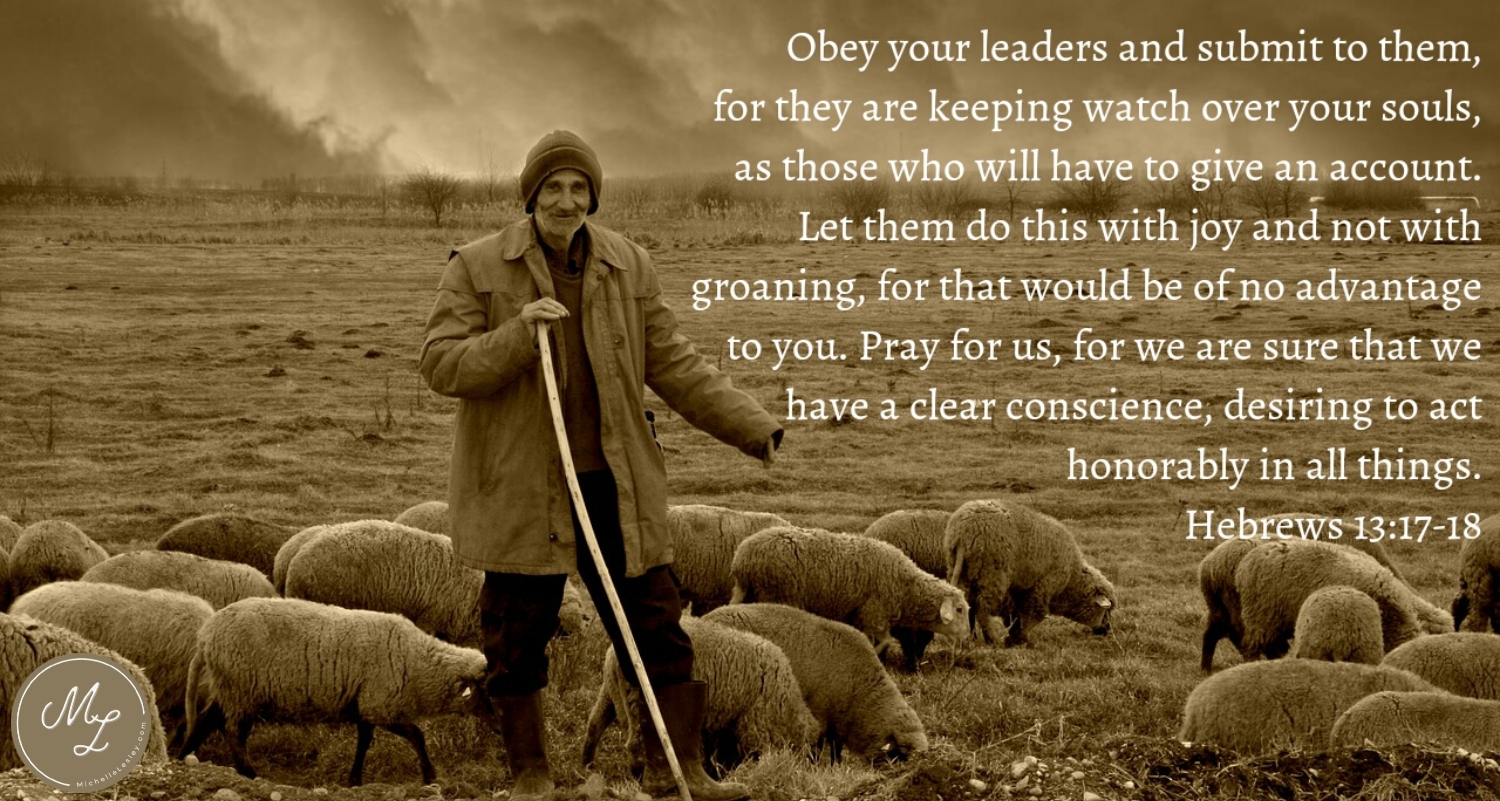
Hebrews 13:17 says: “Obey your leaders and submit to them, for they are keeping watch over your souls, as those who will have to give an account. Let them do this with joy and not with groaning, for that would be of no advantage to you.” It does the church no good to have a pastor who groans at dealing with his sheep because they’re stiff-necked and contrary. Pray that God will make your pastor’s job a joy by praying for the spiritual health and submission of your church.

9. Pray for your pastor’s family relationships.
Before he’s your pastor, he’s her son, her husband, their brother, their father. Pray that God would help your pastor have the time he needs to spend with his family, and to be a godly husband, father, and loved one.

10. Pray about how you can help your pastor.
Pastors have a lot on their shoulders. Is there any way you could take something off your pastor’s plate and allow him to focus on the things only he can do? Could you fix that leaky toilet, teach that class, fill that volunteer slot, counsel that sister, vet that proposed small group study? Could you at least offer him a word of encouragement on a regular basis? Ask God to show you ways you can help out your pastor.

Our pastors need our prayers.
What are some other ways we can pray for them?

Sanctification, Throwback Thursday

Throwback Thursday ~ Abiding in the Vine

Originally published July 30, 2015

abiding-in-the-vine

Ah, the good old summertime! Which, sadly, is rapidly drawing to a close. Summertime brings with it a lot of simple pleasures- a more relaxed schedule, vacations, family reunions, pool parties, and barbecues. But one of the simplest pleasures my husband and I enjoy during the summer is stopping at produce stands to stock up on locally grown fruits and veggies.

In our area, farmers often just fill up the beds of their pick up trucks with watermelons, okra, tomatoes, peaches, or whatever they grow, park on the side of a well-traveled road and sell their wares. As small business owners ourselves, my husband and I like to support other small business owners, plus there’s just something about eating produce that was freshly picked down the road this morning rather than shipped in from across the country a week ago.

Recently, my husband was on his way home from work and ran across a farmer selling cantaloupes. The farmer made him a good deal, so he brought home three of them. Now, my husband loves cantaloupe, but, unfortunately, he forgot that he’s the only one in the family who does. And these were big cantaloupes.

I cut up the first one for him and he finished it in a few days. By the next week he had finished the second one. But by the time I went to cut up the third one for him, there was a soft, mushy spot about the size of a dollar bill along one side.

Nothing untoward had happened to this cantaloupe. It hadn’t been dropped, knocked around, or exposed to extremes of temperature or moisture. The only thing wrong with this cantaloupe was that it had been cut from the vine it was growing on quite some time ago. And the moment it was severed, it started dying.

As I carefully cut away the spoiled area to salvage the rest of the fruit, I was reminded of what Jesus said in John 15:4-6:

purple-grapes-553462_1280

In the first half of John 15, Jesus talks a lot about vines and branches and fruit. The main application of this passage is that Jesus is the vine and we are the branches. The living, fruit-bearing branches are those who have truly been born again. The dried up branches who don’t bear fruit are people who appear to be or claim to be Christians, but aren’t actually saved. But there’s a second layer to this story for those who are genuinely regenerate Christians: obedience. Walking with the Lord day by day and producing healthy fruit.

I looked over at the little stump of cantaloupe branch I had cut off and thrown away. Because it hadn’t been abiding in the main vine, it had dried up. It was no longer bearing new fruit nor was it carrying nutrients from the vine to its already existing fruit, namely, the cantaloupe sitting on my counter, turning to mush.

The same thing happens to Christians when we disobey God by neglecting our relationship with Him. When we go days without picking up our Bibles or praying or gathering for worship with other Believers, we begin to dry out and shrivel up, spiritually. There’s no biblical nutrition flowing from Christ through us, so we’re not bearing any new fruit, and any already existing fruit we’ve produced starts showing signs of rot.

Galatians 5:22-23 tells us:

pineapples-1606852_1280_kindlephoto-18964258

I don’t know about you, but when I’ve skipped my Bible study and prayer time for even a few days, I can tell that I’m not bearing any new spiritual fruit and that I’m less patient, less loving, less self-controlled- more rotten in all of these areas than I normally am. I can tell if my husband is neglecting his time with the Lord, and when my children aren’t having their daily quiet times. I’m surrounded by slowly rotting fruit.

As daughters of Christ, it is imperative that we receive the nourishment He has provided for us in His word, in prayer, through the church, and through obedience to Him so that we can bear good, strong, growing fruit. Because the longer we walk through life at a distance from Christ, the rottener we’ll become. Just ask a cantaloupe.


THIS ARTICLE WAS ORIGINALLY PUBLISHED AT SATISFACTION THROUGH CHRIST.

Colossians Bible Study

Colossians: Lesson 3

Previous Lessons: 1, 2

Colossians 1:15-29

He is the image of the invisible God, the firstborn of all creation. 16 For by him all things were created, in heaven and on earth, visible and invisible, whether thrones or dominions or rulers or authorities—all things were created through him and for him. 17 And he is before all things, and in him all things hold together. 18 And he is the head of the body, the church. He is the beginning, the firstborn from the dead, that in everything he might be preeminent. 19 For in him all the fullness of God was pleased to dwell, 20 and through him to reconcile to himself all things, whether on earth or in heaven, making peace by the blood of his cross.

21 And you, who once were alienated and hostile in mind, doing evil deeds, 22 he has now reconciled in his body of flesh by his death, in order to present you holy and blameless and above reproach before him, 23 if indeed you continue in the faith, stable and steadfast, not shifting from the hope of the gospel that you heard, which has been proclaimed in all creation under heaven, and of which I, Paul, became a minister.

24 Now I rejoice in my sufferings for your sake, and in my flesh I am filling up what is lacking in Christ’s afflictions for the sake of his body, that is, the church, 25 of which I became a minister according to the stewardship from God that was given to me for you, to make the word of God fully known, 26 the mystery hidden for ages and generations but now revealed to his saints. 27 To them God chose to make known how great among the Gentiles are the riches of the glory of this mystery, which is Christ in you,the hope of glory. 28 Him we proclaim, warning everyone and teaching everyone with all wisdom, that we may present everyone mature in Christ. 29 For this I toil, struggling with all his energy that he powerfully works within me.


The Holy Bible, English Standard Version Copyright © 2001 by Crossway Bibles, a publishing ministry of Good News Publishers.


Questions to Consider:

1. At the end of lesson 2 (link above), we saw that Paul gave a brief recap of the gospel (13-14). How was that a good introduction to the passage we’re looking at today? What is the overall theme of today’s passage?

2. Jehovah’s Witnesses use verse 15 to support their idea that Christ was a created (non-eternal) being. Is that what this verse means? What sort of ideas would the term “firstborn” have brought to the minds of first century Jews (and even gentiles)? Verse 15 says that Christ is the firstborn of all creation. Verse 18 says that He is the firstborn from the dead. How do these two positions of Christ “bookend” His supremacy over every aspect of the universe?

3. List the specific roles Christ plays in creation in verses 15-17. Why would it have been important for Paul to emphasize Christ’s role in creation? What did this (as well as verse 19) indicate to his audience about Christ’s deity and His relationship with God the Father?

4. As previous verses emphasized Christ’s deity, what are the references to His humanity in verses 19 and 22? Part of the heresy that was creeping into the Colossian church was elements of mysticism that would later morph into gnosticism. How would the proper Christology Paul was trying to teach them – including Christ being 100% God and 100% man simultaneously (the hypostatic union) – combat that heresy? Why is it important that we, as Christians, believe that Christ was both fully God and fully man? How would it affect Christ’s work on the cross if he had been less than God or less than human? How might understanding the hypostatic union better help you to love Christ more?

5. What do verses 24-29 tell us about Paul’s relationship with and care fo the Colossian church? What was his goal for this church? (28-29) Is this the goal of the leadership at your church? How can verse 28 guide us as we seek to make disciples today? Do we put the same effort and energy into discipleship that Paul did? (29)


Homework:

Read back through the tenets of gnosticism (link in #4). Are there any sort of gnostic beliefs in the church today? Write down some ways biblical Christology (the study of who Christ is, what He did, and why) could combat these false beliefs.