Titus Bible Study

Titus: God’s Order of Service ~ Lesson 2

Welcome, ladies! Just a reminder,ย please do not skip Lesson 1ย (link below). Not only will it answer any questions you may have about the study itself, but if you want to study Titusย properly, you must do the background work contained in Lesson 1.
Previous Lessons: 1

Read Titus 1:1-5

Questions to Consider

1. Review your notes from last weekโ€™s introductory lesson. What are some things to keep in mind as you begin to study the text of Titus today?

As we study the book of Titus, I will sometimes refer to the author as Paul (e.g. “What was Paul teaching pastors in v.6?”) and, often, as God (e.g. “How does God encourage church members in v.7?”). I don’t mean for this to be confusing. My purpose is two-fold: 1) To combat the popular false teaching that anything a biblical author wrote that we don’t like was simply that author’s human opinion, not God’s, 2) To constantly remind us that all Scripture was breathed out by God, not fallible humans, and, as Christians, we are obligated to believe and obey every word of it. If you’re confused, it might help to think of it this way: God is the author of Titus; Paul is the writer of Titus.

2. Examine verses 1-3. Recall from the introductory lesson which genre of biblical literature Titus is (Law? Prophecy? Poetry? etc.). Today, when we write a letter, especially a business letter, we normally close it with our signature and credentials. For example:

Sincerely,

Joe Smith
Acme Widgets, Inc.
Vice President of Doohickeys – Southeastern Division

In first century culture, the style was to open the letter with one’s name and credentials. Compare verses 1-3 with these greetings of other epistles. What are some similarities and differences you notice?

Even our abbreviated modern signatures/credentials, like the example above, give the reader some very important information about the person writing the letter. What type of information can you glean about “Joe Smith” from the signature/credentials above? In what ways is it similar to the type of information in verses 1-3?

Go back to verses 1-3, and break them down. What information do you learn about Paul from his opening signature/credentials?

  • Who is the letter from? (1a)
  • What is his position, and why is he qualified to write this letter? (1a, 3b)
  • What are his three general purposes for this letter? (1b, 2a)
  • By Whose authority does he write this letter? (2-3)
  • What is his view of God’s nature and character, God’s authority, and his relationship to God? (1-3)

3. Let’s go back (see #2 above) to God’s three general purposes for having Paul write this letter. Explain each of these purposes in your own words. How do each of these purposes apply to pastors and elders today?

You’re obviously not a pastor or an apostle, training pastors, or leading a church, but as you’re discipling your children or other women or children in the church, are there biblically appropriate ways in which you can apply each of these purposes? How do you disciple them…

  • for the sake of their faith
  • in their knowledge of the truth, which accords with godliness, and
  • in the hope of eternal life?

4. Revisit verses 1-3 and meditate on the vastness and depth of the faith, the truth, the hope of eternal life, and God’s sovereignty these verses describe. Then consider Paul’s statement, “the preaching with which I have been entrusted by the command of God our Savior”. Do you think Paul felt the weight of that responsibility? Do you feel a similar weight of responsibility when discipling your children or other women and children?

5. Examine Paul’s greeting in verse 4. To whom is this epistle addressed? What is Paul’s relational dynamic with Titus? Notice the picture God paints of that relational dynamic. He doesn’t characterize it as a “master (Paul) / slave (Titus)” relationship or “boss / employee” or even “teacher / student,” but as what? Why do you think that is? What does that metaphor indicate about Paul? About Titus? How does this connect back to Paul’s authority and credentials (see #2 above) for writing this letter?

Go back to verses 1-2. Is it fair to say that this epistle is also addressed to the church? Why or why not?

Why does God use the metaphor of family (“my child in the faith,” “brothers and sisters,” today, we even speak of “my church family,” etc.) in Scripture to characterize the church? Do you have a “true child in the faith” relationship with someone? How does that relationship compare to Paul’s relationship with Titus?

How does “Grace and peace from God the Father and Christ Jesus our Savior” set the tone for the letter, reiterate Paul’s God-given authority in writing the letter, and reference part of the Trinity?

6. Take a look at v.5. Why did Paul leave Titus in Crete? What does Paul mean by “put what remained into order”? What’s a phrase we might use in today’s vernacular to say the same thing? Why did Titus need to appoint elders “in every town”? (You might want to review your notes from lesson 1 – link above.) How would appointing elders have given the churches in Crete structure and order?


Homework

Orderliness. Structure. Hierarchy. This is a major underlying theme of the book of Titus. Spend some time before our next lesson meditating on God’s orderliness, and the structures and hierarchies He has set up in nature, the family, the church, government, etc. Why is orderliness important to God? Why does He think orderliness is so necessary for us that He built it into the fabric of the universe? Jot down your thoughts. Make a list of at least five verses or passages of Scripture that talk about orderliness, structure, or hierarchy. Consider these verses and your thoughts on God’s orderliness in relationship to the church. Why is it important to God that our churches be orderly? Is your church orderly? Does it need to be more orderly? How could it be more orderly according to Scripture?


Suggested Memory Verse
Complementarianism, Rock Your Role

Throwback Thursday ~ Rock Your Role: All Things Being Equal (Galatians 3:28)

Originally published August 21, 2015

Being a church lady can be really confusing at times, am I right? There are so many questions and Scriptures to sort through and figure out. We want to serve the body of Christ in a godly way, but sometimes it’s hard to know how to go about that.

Rock Your Role is a new series I’m starting today that will examine all of the “go to” Scriptures that help us understand our role as women in the church. Some of these passages are – let’s just be honest – tough. Tough to understand. Tough to accept.

As we tackle tough passages like these, it’s important to ask ourselves a few equally tough questions, search our hearts, and answer honestly. Before reading each article in the Rock Your Role series, I’d like to ask you to prayerfully consider these questions:

1. Do I really believe God’s rightly handled, in context, written Word has the final say when it comes to what I (and the church) should believe and do?

2. If so, am I truly willing to “put my money where my mouth is” and back up that belief with action and obedience, even if I don’t initially like or fully understand a certain biblical concept or command?

3. Is this passage a tough one for me because it challenges my preconceived notions and opinions? Am I willing to put my ideas aside and hear what God’s Word has to say so I can obey it?

Ready to dive in? Let’s get started with…

There is neither Jew nor Greek, there is neither slave nor free, there is no male and female, for you are all one in Christ Jesus.
Galatians 3:28

For those of you who have been around the blog for a while, you might be surprised that I’m kicking things off with this verse. I’m about as complementarian as they come, and Galatians 3:28 is the rallying cry for egalitarians. But this verse is foundational to our understanding of the role of women in the church because it tells us who we are in Christ.

Before we zero in on verse 28, though, let’s zoom out and look at the book of Galatians as a whole. Galatians was written by Paul to the churches at Galatia to combat the false doctrine of the Judaizers- those who taught that the Gentiles must first become Jews (be circumcised and follow the Mosaic law) before they could become Christians. The Galatians were being seduced by this teaching, allowing it into their churches, and many were being drawn away from the truth of the gospel. Paul wrote to straighten them out and remind them – and us – that we are justified (saved and made right with God) through repentance and faith in Christ, not by keeping the law.

Galatians 3 is a perfect showcase for Paul’s theme of justification by faith. Take a moment and read the whole chapter now.

Paul reminds the Galatians that they were saved by faith, not works of the law, just like Abraham was. Paul explains that the law came with a curse attached for those who disobeyed it, but that Christ redeemed us from that curse. In fact, the whole purpose of the law was to teach us we can’t keep it and push us to faith in Christ as our only hope for salvation.

Wait a second. What’s all this talk about the law and faith and salvation and stuff? Isn’t this passage about women being equal to men and that they can serve in any capacity or office in the church that men can?

Wait a second. What’s all this talk about the law and faith and salvation and stuff? Isn’t this passage about women being equal to men and that they can serve in any capacity or office in the church that men can? Umโ€ฆno. No, it’s not.

Um…no. No, it’s not. And that’s where the wheels fall off of the egalitarian argument. The entirety of Galatians chapter three is about salvation by faith instead of works. It says nothing about women serving in the same roles in the church as men. Nada. Zip. Zero.

It tells us something better. Something far more precious to the women of that time – and to us – than we realize. Let’s look at verse 28 in its immediate context:

But now that faith has come, we are no longer under a guardian, 26 for in Christ Jesus you are all sons of God, through faith. 27 For as many of you as were baptized into Christ have put on Christ. 28 There is neither Jew nor Greek, there is neither slave nor free, there is no male and female, for you are all one in Christ Jesus. 29 And if you are Christ’s, then you are Abraham’s offspring, heirs according to promise.

Do you see that? We’re no longer under the guardianship of the law. Anyone can come to Christ in repentance and faith- Jew or Gentile, slave or free, male or female, all are welcome. The ground is level at the foot of the cross. No one is more important than anybody else. We are all equally saved, equally loved, equally forgiven of our sin, equally precious in God’s eyes. In a time when women were considered less important, less valuable, less intelligent, less everything than men, this would have been joyous news, indeed. It should be to us, as well.

But equality in salvation does not translate to equality in church roles. A king and a pauper might have worshiped side by side in the Galatian church, but when it came to the role of giving, the church would not have expected the same offering from the pauper as from the king. This didn’t make the king more important than the pauper, it just gave him a different area of responsibility because of who he was. Likewise, men and women are equally saved and forgiven in God’s eyes, but still fulfill different roles in the body of Christ because of who they are.

Equality in salvation does not translate to equality in church roles.

Let me illustrate this another way. My husband and I have 6 children. Each and every one of us are all equally Lesleys even though I married into the family and the rest of them were born into the family. No family member is more loved or important than another. However, we all have different roles, which come with different blessings and responsibilities. My 12 year old might not be able to drive the car, but he doesn’t have to work eight hours a day and pay bills, either. I no longer have to do homework (thank you, Lord!), but I do have to do housework. Our family would not operate in a healthy way if I tried to take on my son’s role or my husband tried to take on my role.

It’s the same way in the church. God loves, forgives, and saves each one of us equally. But he also loves us each individually. And it’s because of that individual love that He gives each of us unique roles to fill in the church so that it will operate in a healthy way. As we’ll see throughout this series, the role of women in the church is precious and vital to the well being of the body of Christ. So is the role of men. They are both equally important, yet God has specially gifted women to fulfill the roles He has designed for us just as He has specially gifted men to fulfill the roles He has designed for them.

Ladies, you have a Savior who loves and values you as a woman, and your role in the church is no less important than any man’s just because it’s different from his role. There are no second class citizens in God’s kingdom.

Ladies, you have a Savior who loves and values you as a *woman,* and your role in the church is no less important than any man’s just because it’s different from his role.

Titus Bible Study

Titus: God’s Order of Service ~ Lesson 1- Introduction

Welcome to our new study, Titus: God’s Order of Service!

What does God think about the way His church should operate? What are the qualifications and character traits of godly pastors, elders, and church members? What is your role in the Body, and why is it so crucial? God is a God of order, and He wants the church to operate in an orderly way โ€“ to glorify Him โ€“ as we worship, work, and witness.

Titus is the New Testament’s third and final pastoral epistle. The pastoral epistles are Godโ€™s instructions to pastors about the way His church should run (kind of like the weekly “order of service,” or bulletin at your church describes how that week’s worship service will run). But pastors arenโ€™t solely responsible for the smooth sailing of the church. We all contribute to glorifying God by learning and robustly filling out our roles in the church in a godly and orderly way. Over the course of approximately 5-8 lessons, weโ€™ll learn how to do that from the book of Titus.

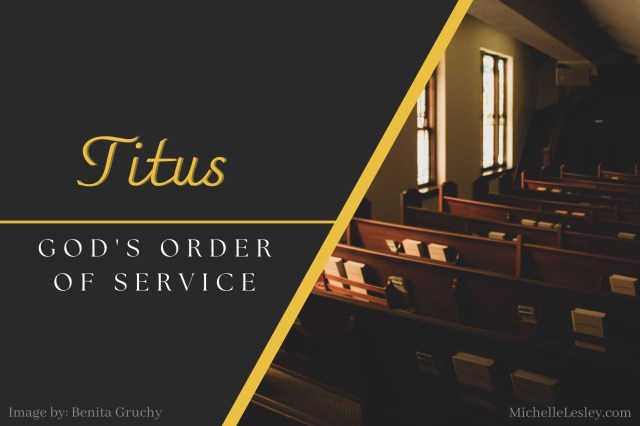
The attractive title image for our study was designed by Benita Gruchy. I liked Benita’s use of the photo of the church sanctuary because the book of Titus is about the gathered body of the church. The word “service” in the title of the study is meant both in the sense of “worship service” – our corporate worship of God – and our “serving” the church body. When I imagine brothers and sisters in Christ assembled together in the pews in that photo, that’s what I think of: worship and service. Finally, the main theme of Titus is “setting things in order” (1:5) in the church, and I thought the rows of pews, with hymnals neatly in their racks, as well as the sleek design and the lines and sections on the left side of the image evoked that sense of orderliness quite nicely. Great job, Benita!

Many thanks to all of those who worked so hard on your entries for our title pic contest. You ladies were very creative and did some outstanding work! 

There were too many entries to share all of them with you, but here are a few “honorable mentions”:

Teressa Campbell
Emily Smith
Melany Goblirsch

If you’re new to using my Bible studies, just a few housekeeping items and helpful hints:

The studies Iโ€™ve written (you can find all of them at the Bible Studies tab in the blue menu bar at the top of this page) are like โ€œtraining wheelsโ€. Theyโ€™re designed to teach you how to study the Bible for yourself and what kinds of questions to ask of the text so that, when you get the hang of it, you wonโ€™t have to depend on other peopleโ€™s books and materials โ€“ even mine โ€“ any more. To that end, I do not provide answers for the study questions in the studies Iโ€™ve written.

My studies are meant to be extremely flexible and self-paced so that you can use them in the way that works best for you. You can do an entire lesson in one day or work on the questions over the course of the week (or longer). You do not need to feel obligated to answer all (or any) of the questions. If the Holy Spirit parks you on one question for several days, enjoy digging deep into that one aspect of the lesson. If He shows you something I haven’t written a question about that captures your attention, dive in and study it! Those are ways the Holy Spirit speaks to us through His Word. This is your time to commune with the Lord, not a school assignment or work project you are beholden to complete in a certain way by a certain deadline.

I will post a new lesson on the blog every other Wednesday, so there is nothing to sign up for or commit to. Simply stop by the blog every other week, or subscribe to the blog via e-mail to have the lessons delivered to your inbox.

I use hyperlinks liberallyThe Scripture passage for each lesson will be linked at the beginning of the lesson. As you’re reading the lesson, whenever you see a word in a different color text, click on it, and it will take you to a Scripture, article, or other resource that will help as you study.

All of the studies Iโ€™ve written are suitable for groups or individuals. You are welcome to use them as a Sunday school or Bible study class curriculum (for free) with proper attribution.

You are also welcome to print out any of my Bible studies (or any article Iโ€™ve written) for free and make as many copies as youโ€™d like, again, with proper attribution. Iโ€™ve explained more about that in this article (3rd section).

From time to time I receive inquiries from men about using my studies for their personal quiet time or for teaching a co-ed or men’s Bible study class. It is my personal conviction that it is more in keeping with the spirit (though not the letter) of 1 Timothy 2:12, Titus 2:3-5, and related passages for men to use Bible study materials authored by men rather than by women. Therefore, on the honor system, I would request that men please not use my studies for personal use, or when teaching a class with male members. (Vetting the studies for your wife, daughter, or the women of your church, is, of course, fine. Encouraged, actually.)


Introduction to Titus: God’s Order of Service

Before we begin studying a book of the Bible, itโ€™s very important that we understand some things about that book. We need to knowโ€ฆ

Who the author was and anything we might be able to find out about him or his background.

Who the audience of the book is: Jews or Gentiles? Old Testament Israelites or New Testament Christians? This will help us understand the authorโ€™s purpose and approach to what heโ€™s writing.

What kind of biblical literature weโ€™re looking at. We approach books of history differently than books of wisdom, books of wisdom differently than books of prophecy, etc.

What the purpose of the book is. Was it written to encourage? Rebuke? Warn?

What the historical backdrop is for the book. Is Israel at war? At peace? In exile? Under a bad king? Good king? Understanding the historical events surrounding a piece of writing helps us understand what was written and why it was written.

When the book was written. Where does the book fall on the timeline of biblical history? This is especially important for Old Testament books which are not always arranged in chronological order.

So this week, before we start studying the actual text of the book of Titus, we need to lay the foundation to understanding the book by finding the answers to these questions.

Read the following overviews of the book of Titus, taking notes on anything that might aid your understanding of the book, and answer the questions below:

Bible Introductions: Titus at Grace to You

Overview of the Book of Titus at Reformed Answers

Summary of the Book of Titus at Got Questions

1. Who wrote the book of Titus? How do we know (or why do we not know) this?

2. Approximately when was Titus written? What is the geographical setting of the book of Titus? Here are some maps (scroll down to โ€œTitusโ€) that may be helpful as you study through the book of Titus.

3. Who is the original, intended audience of the book of Titus? Describe the historical setting (historic events, politics, sociology of the time, etc.) of Titus.

4. Which genre of biblical literature is the book of Titus: law, history, wisdom, poetry, narrative, epistles, or prophecy/apocalyptic? What does this tell us about the approach we should take when studying from this book versus our approach to books of other genres?

5. What is the theme or purpose of the book of Titus?

6. What are some of the major topics of instruction or exhortation in the book of Titus? How do these topics relate to the theme of Titus?

7. What are some ways Titus points to and connects to Jesus?

8. What else did you learn about the setting of this book that might help you understand the text of the book better?

Take some time in prayer this week to begin preparing your heart for this study. Ask God to give you wisdom both to understand the text, and to apply what you learn from Titus as a member of your own church, as we study Titus together.

Our next lesson will be two weeks from today.

Christian women, Church, Complementarianism

Throwback Thursday ~ Unforbidden Fruits: 3 Ways Women MUST Lead and Teach the Church

Originally published April 20, 2018

Ladies, we whine too much.

Like petulant little girls, we look at what’s off limits to us, stomp our Mary Janes on the floor and cry “Why can’t I? I want to!” instead of giddily jumping into all the opportunities God has blessed us with. Instead of being happy and thankful for what we have, our greedy little fingers stretch out to grasp what God has said we can’t have because it’s not good for us or anybody else.

God has instructed pastors – who are, in turn, to instruct us – that, in the gathered body of Believers, women are not to preach to men, instruct men in the Scriptures, or exercise authority over men. And that’s what we focus on, and whine and kick our feet about. That part – the childish rebellion and discontent with the role God has graciously placed us in – that’s on us.

But pastors, we badly need your help on this one. Many pastors do a wonderful job of rightly and biblically explaining what women are not to do (And may I take a moment to say, from the bottom of my heart, thank you. I know how difficult that can be and that you take a lot of undeserved flak for simply teaching God’s Word on this subject.), but that “no” teaching has often not been coupled with the “yes” teaching of what women must do and how they must lead in order for women, and the church, to be healthy and function properly.

The “no” teaching of what the Bible forbids has often not been coupled with the “yes” teaching of what women *must* do and how they must lead in order for women, and the church, to be healthy and function properly.

You’ve loved us well to tell us not to bite at the apple from the forbidden tree, but we also desperately need you to take us on a tour of the Garden and introduce us to the all-you-can-eat buffet of pear and peach and cherry and pecan trees that we have the privilege and the responsibility to feast on.

๐ŸŠ The Other Institution ๐ŸŠ

Did you ever notice that the “do” for women in the church comes before the “don’t”? We tend to totally skip over that enormous little word that kicks off 1 Timothy 2:11: “Let a woman learn…”. We have no idea of, nor appreciation for, how huge and groundbreaking it was for the Holy Spirit, through Paul, to proactively instruct pastors: “Hey, get these women in here, make sure they listen up, and train them properly in the Scriptures so they’ll be equipped to fortify their homes with biblical truth.”

We completely miss the fact that, though God installs men as the teachers and leaders in one of His foundational institutions – the church – He has very much made women the functional, boots on the ground, day to day, teachers and leaders by example – of His other foundational institution – the family. The church didn’t even exist for the first few millennia of human history, but the family has existed since Creation. And people who are members of families populate and lead the church. Raising and molding those people is a tremendous position and responsibility. A position and responsibility God has largely given to women.

Wives pray for our husbands’ growth in Christ. We build them up with Scripture. With a gentle and quiet spirit, we set a godly example for them as they observe our respectful and pure conduct. We encourage and help them in their leadership roles at church.

Moms pray for our children’s salvation. We pour the gospel into them at every turn. We train up our children in the way that they should go – in the nurture and admonition of the Lord – so that when they are old they do not depart from it. We teach them to love and serve and invest in the church both directly and by modeling these things for them.

And our single, widowed, and childless sisters work right alongside us in this labor, praying for church leaders and members, nurturing children at church whose parents are unsaved or unequipped to raise them biblically, encouraging and assisting brothers and sisters in Christ.

We grow and develop, nourish and support, exhort and sharpen the population of the body of Christ.

Men may lead the church, but women raise the church.

Men may lead the church, but women *raise* the church.

๐Ÿ Woman to Woman ๐Ÿ

Essential to the health of any church is the component of women training women, whether in the formal setting of a Bible study class and structured women’s ministry programs or an impromptu “let’s get together for coffee this week” discipleship discussion.

Though we receive instruction in Scripture from our pastors, elders, and teachers, there are some counseling and teaching situations it’s not appropriate for a man to address with a woman, or that a woman understands better than a man. There are issues women face that men just don’t “get” in the same way a sister in Christ does. There are insights and perspectives a woman can use to explain Scripture to another woman that a man just doesn’t have. There are times when a woman needs someone to walk through a long term emotional journey with her that requires a personal intimacy which would be inappropriate for a man to engage in with her. And in the same way men are better equipped than women to train men to be godly husbands, fathers, and church members, women are better equipped than men to train women to be godly wives, mothers, and church members.

God knew all of this back when He breathed out the words of Titus 2:3-5…

Older women likewise are to be reverent in behavior, not slanderers or slaves to much wine. They are to teach what is good, and so train the young women to love their husbands and children, to be self-controlled, pure, working at home, kind, and submissive to their own husbands, that the word of God may not be reviled.

…and, again, 1 Timothy 2:11:

Let a woman learn quietly with all submissiveness.

Women must be trained properly in the Scriptures so we can take that training and pour it into other women, teaching and sharpening them into godly women, wives, mothers, and church members.

๐Ÿ‘ Super Models ๐Ÿ‘

Women instruct our brothers and sisters in the church in biblical truth when we lead by example. When we sin against someone, we go to that person and ask forgiveness. We demonstrate the importance of meeting together with the Body by being faithful in our church and Sunday School attendance. We model servanthood by serving the church and our brothers and sisters. We paint a picture of biblical compassion by ministering to the sick and others in need. We show Christians how to carry out the Great Commission by sharing the gospel. We set an example of trusting God when others see us depending on Him through difficult situations.

And one of the most important biblical concepts women have the privilege and responsibility of teaching the church through our example is submission to authority – a lesson the church is sorely in need of these days.

Because God blessed us by creating us as women, we have an opportunity to model submission to authority in a unique way that God has chosen to deny to men.

Because God blessed us by creating us as women, we have an opportunity to model submission to authority in a unique way that God has chosen to deny to men.

As we submit to our husbands, we teach the church what it means to submit to Christ. How to walk in humility and obey Him out of love. How to put selfishness aside. To trust Him to take care of us. To deny ourselves, take up our cross daily, and follow Him.

When we submit to God’s design for leadership in the church and joyfully carry out the work He has planned for us as godly women, we teach the church to submit to God’s authority and love Him by obeying His commands. We instruct our fellow church members in respecting and submitting to the pastors and elders God has placed in spiritual authority over us.

Submission to Christ, to God’s commands, and to pastors and elders is the bedrock of a healthy church. God has graciously given women the role – and the duty – of teaching these and other biblical principles to our churches in a way that men cannot -through our example as godly women.

Remember the series of fun little nutritional books that came out several years ago called Eat This, Not That? The idea the books centered around was, “Don’t eat that unhealthy thing. Eat this similar but healthy thing instead.”

Sadly, many Christian women have only been getting half the story. “Not that” (preaching to/teaching men and exercising authority over men) is biblically correct, but it’s not biblically complete. If all you tell someone is “Don’t eat that,” without showing her the “Eat this,” part, what she needs to eat to be healthy, she’s going to starve, and the church will be malnourished as well.

Christian women need our pastors to teach us to eat the fat of the land of being properly trained in the Scriptures and drink the sweet wine of leading and instructing the church the way God gifts us and requires us to. Only then will the Body be healthy and well nourished.

Complementarianism

Throwback Thursday ~ Solving Misogyny- You’re Doing It Wrong

Originally published June 8, 2018

Not an endorsement for this movie, just illustrative of the point of this article.

If God is the God of Romans 8:28…

And we know that for those who love God all things work together for good, for those who are called according to his purpose.

…then Satan is the god of the anti-Romans 8:28. He wants to twist anything and everything that’s the least little bit good into harm, especially for those who are called according to God’s purpose.

Several very good things have come out of the #MeToo and #ChurchToo movements. Many victims who previously kept silent out of fear and shame have found the courage to tell their stories and begin healing. We’ve had the opportunity to offer them comfort and encouragement through the gospel. Churches have become more aware of how widespread the problem of abuse is and have begun to respond accordingly. In several cases, abusers have been exposed and brought to justice.

Unfortunately, Satan has also used this movement to harm people. False accusations have been made against innocent individuals. Sweeping accusations have been made against Christian men in general. And now, perhaps worst of all, there are rumblings afoot to right the wrongs of real, and imagined, misogyny by “empowering” Christian women and giving us greater, often unbiblical, positions of church and denominational leadership, either as reparations for past mistreatment of women or prophylaxis against future mistreatment of women, or both. (Pastor Tom Buck wrote an excellent series of articles on this – part 1, part 2, part 3, part 4 – which I urge you to read for more details.)

Don’t fall for it, ladies. This is Eden all over again.

Don’t fall for it, ladies. This is Eden all over again.

In the same way that God created a very good tree, planted it in the midst of the Garden, and put a “do not eat” fence around it, God also created the very good “tree” of Christian leadership, planted it in the midst of the church, and put a 1 Timothy 2:12 fence around it.

God’s restrictions about the tree of the knowledge of good and evil were minimal: don’t eat from it. Eve was free to sit in its shade, admire its beauty, fertilize it, plant flowers around it, pretty much anything, except eat from it. And that one restriction is what Satan used to tempt her to sin.

For women, God’s restrictions on church leadership are also minimal: don’t instruct men in the Scriptures and don’t exercise authority over men. That’s literally all there is to it. There are scrillions of ways women can – and must – serve the Body of Christ without getting anywhere near that fence. But these two small restrictions are what Satan is using to tempt us to sin. And, unfortunately, this time, instead of approaching Eve in the form of a serpent, he’s approaching Christian women in the form of the sinful or misinformed words and ideas of pastors and Christian leaders. “Did God really say you can’t have that particular position of leadership?”

But there’s another issue at play here that needs some airing out.

Power. Leadership. These are the ideals that are being touted as the way to lift women up. Is that what Jesus taught? Is that the example He set? No. Jesus taught and exemplified humility, lowliness, and servanthood:

But they kept silent, for on the way they had argued with one another about who was the greatest. And he sat down and called the twelve. And he said to them, โ€œIf anyone would be first, he must be last of all and servant of all.โ€
Mark 9:34-35

But Jesus called them to him and said, โ€œYou know that the rulers of the Gentiles lord it over them, and their great ones exercise authority over them. It shall not be so among you. But whoever would be great among you must be your servant, and whoever would be first among you must be your slave, even as the Son of Man came not to be served but to serve, and to give his life as a ransom for many.โ€
Matthew 20:25-28

When he had washed their feet and put on his outer garments and resumed his place, he said to them, โ€œDo you understand what I have done to you? You call me Teacher and Lord, and you are right, for so I am. If I then, your Lord and Teacher, have washed your feet, you also ought to wash one another’s feet. For I have given you an example, that you also should do just as I have done to you.
John 13:12-15

God doesn’t think the way we think. We think that the only way someone can be valued and heard is if she has power and prestige in the eyes of her fellow humans. That’s where this “empower women and give them positions of leadership” idea is coming from. It is a worldly way of thinking.

God’s way of thinking about this is that we are already intrinsically valuable in His eyes because we are made in His image. Being valued by God is so infinitely more significant than being valued by other humans, that how we look to others shouldn’t even register on our radar. Letting go of what other people think of us frees us up to live in the holy gratitude to God that says, “It is my joy to serve You because I love You. I will live like Jesus no matter what I have to give up, no matter how much I suffer, no matter how humbling it is. You are worthy of my self-abasement.”

He must increase, but I must decrease.
John 3:30

I would rather be a doorkeeper in the house of my God than dwell in the tents of wickedness.
Psalm 84:10b

In God’s economy, the way to greatness is to be a slave. The way to fame is anonymity. The way to exaltation is humility. Why are Christian women being encouraged to stand up and demand the seat at the head of the table instead of being encouraged to give up their seats for others, serve those at the table, even clean up after the meal? What do these Christian leaders want for women – that they find favor with man or that they find favor with God? Orchestrating outward appearances, such as giving women positions of unbiblical leadership, is merely attempting to fix the very real problem of women being sinned against by putting another coat of whitewash on the outside of a tomb that’s full of dead men’s bones. You don’t fix one sin by creating another. You clean out the tomb.

Orchestrating outward appearances is simply putting another coat of whitewash on the outside of a tomb that’s full of dead men’s bones. You don’t fix one sin by creating another. You clean out the tomb.

In any instance in which women are being sinned against by men, the answer is not to “elevate” women to improper places of leadership. The answer is to exercise biblical church discipline against the men and disciple both the men and the women to humbly serve Christ and the church in accordance with God’s Word. Broken, sinful men do not need to hear what broken, sinful women think about how women should be treated. They both need to hear what the holy, almighty God who created men and women has to say about how women should be treated. And the way God has structured leadership in the church, the responsibility of teaching what God’s Word says about this or any other issue falls primarily to the pastor.

Broken, sinful men do not need to hear what broken, sinful women think about how women should be treated. They both need to hear what the Creator of men and women has to say about how women should be treated.

That’s especially of note in this particular situation. Why would these Christian leaders further burden women they consider mistreated with any part of the responsibility of fixing their mistreatment? Why aren’t they instead urging pastors to step up to the plate and properly train the men of their churches to regard and treat women in a godly way?

Encouraging women who have already been victimized to act in ungodly ways is just victimizing them all over again; this time, spiritually.

This whole idea of solving the problem of alleged misogyny in the church with an “I am woman, hear me roar” groundswell is backwards, wrong, and – ironically – man-centered. And encouraging women who have already been victimized to act in ungodly ways is just victimizing them all over again, this time; spiritually. As the Body of Christ, we must be Christ-centered. God has given us all of the necessary instructions for handling problems in the church and between Believers in His Word. We need only to follow them. And Him. Let’s do this right, church.