Wednesday's Word

Wednesday’s Word ~ 2 Timothy 2

For further study on the books of 1-2 Timothy, try my study 1 & 2 Timothy: The Structure and Spirit of the Church, from which this lesson is excerpted.

2tim

2 Timothy 2

You then, my child, be strengthened by the grace that is in Christ Jesus, 2 and what you have heard from me in the presence of many witnesses entrust to faithful men, who will be able to teach others also. 3 Share in suffering as a good soldier of Christ Jesus. 4 No soldier gets entangled in civilian pursuits, since his aim is to please the one who enlisted him. 5 An athlete is not crowned unless he competes according to the rules. 6 It is the hard-working farmer who ought to have the first share of the crops. 7 Think over what I say, for the Lord will give you understanding in everything.

8 Remember Jesus Christ, risen from the dead, the offspring of David, as preached in my gospel, 9 for which I am suffering, bound with chains as a criminal. But the word of God is not bound! 10 Therefore I endure everything for the sake of the elect, that they also may obtain the salvation that is in Christ Jesus with eternal glory. 11 The saying is trustworthy, for:

If we have died with him, we will also live with him;
12 if we endure, we will also reign with him;
if we deny him, he also will deny us;
13 if we are faithless, he remains faithfulโ€”

for he cannot deny himself.

14 Remind them of these things, and charge them before God not to quarrel about words, which does no good, but only ruins the hearers. 15 Do your best to present yourself to God as one approved, a worker who has no need to be ashamed, rightly handling the word of truth. 16 But avoid irreverent babble, for it will lead people into more and more ungodliness, 17 and their talk will spread like gangrene. Among them are Hymenaeus and Philetus, 18 who have swerved from the truth, saying that the resurrection has already happened. They are upsetting the faith of some. 19 But God’s firm foundation stands, bearing this seal: โ€œThe Lord knows those who are his,โ€ and, โ€œLet everyone who names the name of the Lord depart from iniquity.โ€

20 Now in a great house there are not only vessels of gold and silver but also of wood and clay, some for honorable use, some for dishonorable. 21 Therefore, if anyone cleanses himself from what is dishonorable, he will be a vessel for honorable use, set apart as holy, useful to the master of the house, ready for every good work.

22 So flee youthful passions and pursue righteousness, faith, love, and peace, along with those who call on the Lord from a pure heart. 23 Have nothing to do with foolish, ignorant controversies; you know that they breed quarrels. 24 And the Lord’s servant must not be quarrelsome but kind to everyone, able to teach, patiently enduring evil, 25 correcting his opponents with gentleness. God may perhaps grant them repentance leading to a knowledge of the truth, 26 and they may come to their senses and escape from the snare of the devil, after being captured by him to do his will.


The Holy Bible, English Standard Version Copyright ยฉ 2001 by Crossway Bibles, a division of Good News Publishers.


Questions to Consider

1. What is the purpose of the book of 2 Timothy? Which genre(s) of biblical literature (prophecy, epistle, narrative, wisdom, etc.) is the book of 2 Timothy? What is the historical backdrop for this book?

2. How do the themes of suffering for the gospel, not being ashamed of the gospel, and guarding the deposit from chapter 1 relate to what Paul is about to tell Timothy? Trace the line of entrusting the deposit of the gospel, beginning withย Christ entrusting it to Paul.ย To whomย did Paul entrust it? To whom is Timothy to entrust it? (2)

3. Examine each of the times a form of the word โ€œquarrelโ€ is used in 14-26. (14,23,24) Does this mean that disagreement, controversy, and confrontation are always to be avoided in the church regardless of the issue? What is the difference between these types of controversies and quarrels and the necessaryย factionsย Paul describes in 1 Corinthians? Is rebuking false teachers taking part in โ€œquarrels about wordsโ€ and โ€œfoolish, ignorant controversiesโ€ or being โ€œquarrelsomeโ€?

4. Examine verses 15-19. List the things in verses 16-18 that can bring chaos and disorder to the church. Explain the instructions and precepts in verses 15 and 19. Notice how these instructions and precepts bring stability and unity to the church, and how these two verses โ€œbookendโ€ or contain the chaos in verses 16-18. What does this tell you about the church, and you as an individual, walking in obedience to God?

5. Who is โ€œthe Lordโ€™s servantโ€ in verse 24? How could you walk out the instructions in 24-25a as a mother, leader, Bible teacher, while evangelizing, or while defending the faith? Verses 25b-26 tell us why pastors, teachers, and, yes, even a mom or a woman sharing the gospel should exhibit these characteristics. What is that reason?

Wednesday's Word

Wednesday’s Word ~ Matthew 28

10671419_771108452935926_7529311326555323822_n

Matthew 28:

Now after the Sabbath, toward the dawn of the first day of the week, Mary Magdalene and the other Mary went to see the tomb. 2 And behold, there was a great earthquake, for an angel of the Lord descended from heaven and came and rolled back the stone and sat on it. 3 His appearance was like lightning, and his clothing white as snow. 4 And for fear of him the guards trembled and became like dead men. 5 But the angel said to the women, โ€œDo not be afraid, for I know that you seek Jesus who was crucified. 6 He is not here, for he has risen, as he said. Come, see the place where he lay. 7 Then go quickly and tell his disciples that he has risen from the dead, and behold, he is going before you to Galilee; there you will see him. See, I have told you.โ€ 8 So they departed quickly from the tomb with fear and great joy, and ran to tell his disciples. 9 And behold, Jesus met them and said, โ€œGreetings!โ€ And they came up and took hold of his feet and worshiped him. 10 Then Jesus said to them, โ€œDo not be afraid; go and tell my brothers to go to Galilee, and there they will see me.โ€

11 While they were going, behold, some of the guard went into the city and told the chief priests all that had taken place. 12 And when they had assembled with the elders and taken counsel, they gave a sufficient sum of money to the soldiers 13 and said, โ€œTell people, โ€˜His disciples came by night and stole him away while we were asleep.โ€™ 14 And if this comes to the governor’s ears, we will satisfy him and keep you out of trouble.โ€ 15 So they took the money and did as they were directed. And this story has been spread among the Jews to this day.

16 Now the eleven disciples went to Galilee, to the mountain to which Jesus had directed them. 17 And when they saw him they worshiped him, but some doubted. 18 And Jesus came and said to them, โ€œAll authority in heaven and on earth has been given to me. 19 Go therefore and make disciples of all nations, baptizing them in the name of the Father and of the Son and of the Holy Spirit, 20 teaching them to observe all that I have commanded you. And behold, I am with you always, to the end of the age.โ€


The Holy Bible, English Standard Version Copyright ยฉย 2001 byย Crossway Bibles, a division of Good News Publishers


Questions to Consider

1. What is the purpose of theย bookย of Matthew? Which genre(s) of biblical literature (prophecy, epistle, narrative, wisdom, etc.) is the book of Matthew? What is the historical backdrop for this book?

2. What is the setting for Matthew 28? Briefly describe the events that led up to this chapter. How might the events of this chapter have been different if the women and the disciples had understood and/or believed Jesus the numerous times He told them He would die and rise again?

3. Compare and contrast the way the angel presented himself to the guards (unbelievers) (2-4) with the way he presented himself to the women (believers) (5-7) and the reaction to the angel by the guards (4) and by the women (8). What did the angel tell the women that he didn’t tell the guards? Why didn’t the angel tell the guards not to be afraid, or explain to them what was happening? What was the women’s reaction to encountering Jesus? (9-10) Did the guards get to see Jesus? Why is it good and right for unbelievers to be fearful and hopeless when encountering God, but for Believers to be joyful and reassured when encountering God?

4. Who was the guards’ employer – the Roman government or the chief priests? Yet, to whom did the guards report back after the resurrection? (11) What does 11-15 tell us about how deeply enmeshed the leaders of God’s people had become with pagans? Apply these passages to this relationship between the Jewish leaders and the Roman leaders. What does all of this teach you about your own life? Do you have any yokings (close partnerships or intimate relationships) with unbelievers that you need to reevaluate?

5. Notice the sequence of 16-20: Obedience (16) >> Nearness to Jesus (17a) >> Worship (17) >> Being sent out and used by God to further His Kingdom (18-20). How does this demonstrate the principle of “faithful in little, faithful in much“? What if one of the disciples had decided not to go to the mountain (16)? What would he have missed as a result of his disobedience? How does obedience to Christ draw us nearer to Him, which then fuels our worship of Him? Why should ministry work always be founded on worship?

Why was it important for Jesus to announce His authority (18) before commissioning the disciples (and by extension, all future disciples, including us today)? Does anyone else – pope, pastor, priest, etc. – have the authority to create, establish, or declare the mission of the church and individual Christians? What is the mission of the church and individual Christians? (18-20) Are you carrying out this mission? Is your church?

Forgiveness, New Testament, Sin, Sunday School

Sin-opsis ~ Sunday School Lesson ~ 10-26-14

Sinopsis

These are my notes from my ladiesโ€™ Sunday School class this morning. Iโ€™ll be posting the notes from my class here each week. Click here for last week’s lesson.

Through the Bible in 2014 ~ Week 43 ~ Oct. 19-25
Matthew 15-18, Mark 7-9, Luke 9:18-11:54, John 7-10
Sin-opsis

Sin. That word can cause us to think of a lot of different things, from our sin, to people who have sinned against us, to forgiveness. Today, we’re going to hear what Jesus has to say about five different aspects of sin.

Matthew 18

Causing Another Believer to Sin (1-5, Matthew 20:20-24)
Have you ever noticed that the disciples asked a lot of interesting questions? Why do you think they wanted to know who would be the greatest in the kingdom of heaven? Pride? A desire for clout or recognition? The disciples and Jesus lived in a society in which people were acutely aware of who had rank, recognition, and power (the Pharisees, scribes, Saducees, lawyers, priests, and Levites), and who did not (everybody else, including Jesus and them), when it came to the way Judaism was structured. We talked last week about what people, even the disciples, expected the Messiah to be: a conquering king who would overthrow Rome and restore Israel to prominence and prosperity. Here, as in the case of Mrs. Sons of Thunder asking if her boys could sit on either side of Jesus’ throne (Matt. 20), they were likely thinking of their offices in the new government they imagined Jesus would head up once He reestablished the kingdom.

Once again, Jesus had to set them straight. “It’s not about how high on the power ladder you can climb, Boys. It’s about how humble you can be, as humble as a little child.” And why did Jesus have to set them straight? Because they had been, skandalizo, “entrapped” or “tripped up” as verse 6 puts it, by faulty teaching from those who were responsible to rightly handle God’s word. The disciples would soon be in the position of teacher and preacher themselves. It was imperative they had a correct understanding of God’s word and God’s ways so they could accurately teach the new “little children” coming into the church.

When we share the gospel with others, teach the Bible, offer others advice or counsel, etc., we must make absolutely certain we have a correct understanding of what God’s word says. Otherwise, we might be tripping others up by leading them to believe things that are in conflict with the Bible. Jesus takes that very seriously saying (7) “it would be better for him to have a great millstone fastened around his neck and to be drowned in the depth of the sea.” Pretty strong words.

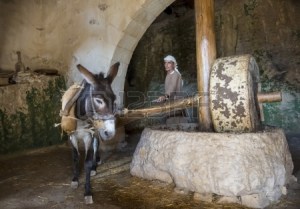
Recreation of a millstone used for pressing olives in Nazareth, Israel.

When I Am Tempted (7-9)
What about when someone else tempts me to sin? Again, Jesus has strong words for anyone who entices someone into any kind of sin: “woe.” What are some ways we can cause people to sin or be drawn into someone else’s sin, even in the church? Gossip, adultery, inciting other church members against the pastor or other leaders, playing “politics”, etc.

But whether tempted by a church member or the world, Jesus paints a serious picture of how we should respond to that temptation. Now, Jesus isn’t suggesting we literally maim ourselves, because, if you think about it, even a blind person can lust. Sin is an issue of the heart. Jesus is saying that we are to get away from temptation to guard our hearts, whatever the cost. Your relationship with Christ is worth it.

What might “gouging your eye out” or “cutting your hand off” look like for someone facing a certain temptation? For a person tempted to drunkenness, it might mean not drinking at all or not going to certain social events where they know the booze will be flowing freely. A person tempted to lust and adultery might need to make certain she is never alone with a man she’s not married to. She may even have to avoid spending any time with certain men she’s attracted to. Sin is serious, and we sometimes have to take big, inconvenient steps to stay out of it, but our relationship with Christ is completely worth it.

When Another Christian Sins (10-14, Romans 8:1)
Our brothers and sisters in Christ are going to sin. There’s just no way around it. How should we respond to a fellow Christian who has wandered off into sin? Ignore it and hope she’ll stop? Stop speaking to to her? Castigate her? No. We are to respond to her the same way Jesus does with the lost sheep:

10– We are not to treat any of our brothers or sisters unkindly; we are to treat all with kindness and love.

12– We remember that Christ came to save the lost from their sin. Of course, He does not want those He has saved to wander off back into their sin. Jesus goes after the wandering sheep to bring it back into the safety of the fold. We are to do the same. If someone wanders off, we don’t just let her go. We go after her in love and concern to bring her back to where she needs to be.

13-14– “If he finds it…” If is kind of an interesting word to use here, since Jesus is the shepherd in the story. Will there ever be a case in which Jesus can’t find someone who has wandered off? No. God is sovereign over all things. He knows where we are, what we’re doing, and the state of our hearts at all times. These verses are referring to the lost sheep who is willing to be found and return to the fold with Jesus. When a Christian repents and returns to Christ, Christ rejoices over her. While there may be consequences of the sin to face, “There is therefore now no condemnation for those who are in Christ Jesus.” (Rom.) Isn’t that awesome? When that repentant sheep comes back to the fold, we are to have the same loving, embracing, and forgiving attitude towards her that Christ has. Christ’s desire is always restoration and reconciliation, and that should be our desire as well.

When Another Christian Sins Against Me (15-20)
One of the most important things we can focus on in this passage is the word “sins”. In the church body, there are going to be times when things happen to us that we don’t like. That doesn’t necessarily mean these things are SIN. Maybe we don’t like the style of music, or a particular mannerism of the pastor. Maybe somebody tells us a truth we need to hear that stings a little, or someone is annoying or inadvertently hurts our feelings. Our feelings don’t determine what sin is, the Bible does. When deciding whether to confront the person, we first need to determine if what she did is sin according to the Bible (not according to our opinion), or if it’s a non-sinful offense, and we can overlook it and extend grace, realizing that people have probably done the same for us on many occasions.

On the other hand, if the person IS sinning, we can’t shy away from an awkward conversation with her about it. Remember the wandering sheep? We need to have the same love for that wandering brother or sister and try to restore and reconcile him/her. First, we go to the person privately -not in front of a group, not on Facebook- one on one, and, remembering the way we would want someone to approach us, kindly and lovingly, yet firmly, talk to her about her sin. If she repents and returns, let the rejoicing and forgiving commence! If she persists, we take a couple of other Believers with us to kindly, lovingly, and firmly approach her again. If she still persists in her sin, the next appropriate and required step is to take the matter before the church body for disciplinary action. If the person still refuses to repent, we are to treat her as “a Gentile and a tax collector.”

What does that mean? Are we supposed to shun her? Hate her? No. Look how Jesus treated Gentiles and tax collectors (like Matthew and Zacchaeus). He loved them, shared the gospel with them, and called them to repent and believe in Him. In other words, He treated them like the unbelievers they were. People who persist in unrepentant sin show us that they are not Believers. When we have exhausted all attempts at restoration, we agree with their behavior that they are not Believers and treat them that way. We remove their names from church membership and remove them from any positions of leadership or responsibility in the church, but we keep loving them, keep sharing the gospel with them, and keep praying for their salvation.

Why We Forgive (21-35, Ephesians 4:32)
This parable can be summed up in the words of Ephesians 4:32:

Be kind to one another, tenderhearted, forgiving one another, as God in Christ forgave you.

Who is the king in this parable? Jesus. Who is the first servant? Me. How big is our sin debt to Jesus? Verse 24 describes it as ten thousand talents. One talent was a unit of money equal to twenty years’ wages for a laborer. Therefore, ten thousand talents would have equaled 200,000 years’ worth of wages, an impossible amount to even begin to repay, just like our sin debt. But when we throw ourselves on the mercy of Christ and repent, He forgives us that enormous debt. Just wipes it right out. Any sin that anyone can commit against us, no matter how egregious, is peanuts (verse 28 calls it 100 denarii, or 100 days’ wages) compared to the grief and agony we put Christ through on the cross. How can we, knowing how hugely we have sinned against Christ, refuse to forgive others anything they might do to us?

The “Sin-Opsis”
There’s an old Carman song that contains the line

“Black is black, and white is white.
And Hell is hot, and sin ain’t right.”

It’s a pretty good “sin-opsis” of the what sin is. It is Christ’s desire that we stay out of sin ourselves, not lead others into sin, rescue others who have fallen into sin, and forgive those who have sinned against us.

Wednesday's Word

Wednesday’s Word ~ Mark 1

For further study on the book of Mark, try my study, Mark: Godโ€™s Good News for the Gentiles, from which this lesson is excerpted.

Mark 1

1 The beginning of the gospel of Jesus Christ, the Son of God.

2 As it is written in Isaiah the prophet,

โ€œBehold, I send my messenger before your face,
    who will prepare your way,
3 the voice of one crying in the wilderness:
    โ€˜Prepare the way of the Lord,
    make his paths straight,โ€™โ€

4 John appeared, baptizing in the wilderness and proclaiming a baptism of repentance for the forgiveness of sins. 5 And all the country of Judea and all Jerusalem were going out to him and were being baptized by him in the river Jordan, confessing their sins. 6 Now John was clothed with camel’s hair and wore a leather belt around his waist and ate locusts and wild honey. 7 And he preached, saying, โ€œAfter me comes he who is mightier than I, the strap of whose sandals I am not worthy to stoop down and untie. 8 I have baptized you with water, but he will baptize you with the Holy Spirit.โ€

9 In those days Jesus came from Nazareth of Galilee and was baptized by John in the Jordan. 10 And when he came up out of the water, immediately he saw the heavens being torn open and the Spirit descending on him like a dove. 11 And a voice came from heaven, โ€œYou are my beloved Son; with you I am well pleased.โ€

12 The Spirit immediately drove him out into the wilderness. 13 And he was in the wilderness forty days, being tempted by Satan. And he was with the wild animals, and the angels were ministering to him.

14 Now after John was arrested, Jesus came into Galilee, proclaiming the gospel of God, 15 and saying,โ€œThe time is fulfilled, and the kingdom of God is at hand; repent and believe in the gospel.โ€

16 Passing alongside the Sea of Galilee, he saw Simon and Andrew the brother of Simon casting a net into the sea, for they were fishermen. 17 And Jesus said to them, โ€œFollow me, and I will make you become fishers of men.โ€ 18 And immediately they left their nets and followed him. 19 And going on a little farther, he saw James the son of Zebedee and John his brother, who were in their boat mending the nets. 20 And immediately he called them, and they left their father Zebedee in the boat with the hired servants and followed him.

21 And they went into Capernaum, and immediately on the Sabbath he entered the synagogue and was teaching. 22 And they were astonished at his teaching, for he taught them as one who had authority, and not as the scribes. 23 And immediately there was in their synagogue a man with an unclean spirit. And he cried out, 24 โ€œWhat have you to do with us, Jesus of Nazareth? Have you come to destroy us? I know who you areโ€”the Holy One of God.โ€ 25 But Jesus rebuked him, saying, โ€œBe silent, and come out of him!โ€ 26 And the unclean spirit, convulsing him and crying out with a loud voice, came out of him. 27 And they were all amazed, so that they questioned among themselves, saying, โ€œWhat is this? A new teaching with authority! He commands even the unclean spirits, and they obey him.โ€ 28 And at once his fame spread everywhere throughout all the surrounding region of Galilee.

29 And immediately he left the synagogue and entered the house of Simon and Andrew, with James and John. 30 Now Simon’s mother-in-law lay ill with a fever, and immediately they told him about her. 31 And he came and took her by the hand and lifted her up, and the fever left her, and she began to serve them.

32 That evening at sundown they brought to him all who were sick or oppressed by demons. 33 And the whole city was gathered together at the door. 34 And he healed many who were sick with various diseases, and cast out many demons. And he would not permit the demons to speak, because they knew him.

35 And rising very early in the morning, while it was still dark, he departed and went out to a desolate place, and there he prayed. 36 And Simon and those who were with him searched for him, 37 and they found him and said to him, โ€œEveryone is looking for you.โ€ 38 And he said to them, โ€œLet us go on to the next towns, that I may preach there also, for that is why I came out.โ€ 39 And he went throughout all Galilee, preaching in their synagogues and casting out demons.

40 And a leper came to him, imploring him, and kneeling said to him, โ€œIf you will, you can make me clean.โ€ 41 Moved with pity, he stretched out his hand and touched him and said to him, โ€œI will; be clean.โ€ 42 And immediately the leprosy left him, and he was made clean. 43 And Jesus sternly charged him and sent him away at once, 44 and said to him, โ€œSee that you say nothing to anyone, but go, show yourself to the priest and offer for your cleansing what Moses commanded, for a proof to them.โ€ 45 But he went out and began to talk freely about it, and to spread the news, so that Jesus could no longer openly enter a town, but was out in desolate places, and people were coming to him from every quarter.


The Holy Bible, English Standard Version Copyright ยฉ 2001 by Crossway Bibles, a division of Good News Publishers.


Questions to Consider:

1. What is the theme or purpose of the book of Mark? What is the historical backdrop for the book of Mark?

2. What two titles does Mark ascribe to Jesus in verse 1? What does the word โ€œChristโ€ mean, and why is it an important title for Jesus? What does it mean that Jesus is the โ€œSon of Godโ€œ? How do verses 21-45 demonstrate that Jesus is, indeed, the promised Messiah, and that He is divine? How does Mark 1:1-20 โ€œcredentializeโ€ Jesus and lay the foundation for what he does in verses 21-45?

3. How does Johnโ€™s message of repentance preceding Jesusโ€™ message of the gospel demonstrate that repentance is a crucial aspect of saving faith in Christ? (1-15) Would God have sent John to preach the message of repentance if He did not consider it a vital part of salvation? What does Mark indicate was the theme of the message Jesus preached? (15) Some people say repentance is not necessary for salvation- that only belief in Jesus is necessary. Did Jesus consider repentance to be part of the gospel? (15)

4. Examine verses 9-11. Since Jesus was without sin, why did He take part in a baptism of repentance? How does Jesusโ€™ baptism set an example for believers to follow Him in being baptized? How does this passage reveal the Trinity (God the Father, God the Son, God the Holy Spirit) to us? How does this passage refute the false teaching of modalism/Sabellianism and show us that God is one God in three Persons?

5. What are the three main categories of ministry Jesus engages in in 21-45? Do you think Jesus would have preferred to be known more for His teaching or for His miracles? Why?

Old Testament, Sunday School

Hezekiah: Who Are You Going to Believe? ~ Sunday School Lesson ~ 8-3-14


Hezekiah
Photos courtesy of: Stickerish.com, WUTT on YouTube.com, and Amazon.com

These are my notes from my ladiesโ€™ Sunday School class this morning. Iโ€™ll be posting the notes from my class here each week. Click here for last week’s lesson.

Through the Bible in 2014 ~ Week 31 ~ July 27- Aug. 2
Isaiah 44-66, 2 Kings 18:9-21:26, Psalm 46, 80, 135
Hezekiah: Who Are You Going to Believe?

2 Kings 18:1-8
This first part of the chapter sets the stage for everything we subsequently learn about and from Hezekiah. Even though he had a despicable, idolatrous example for a father (King Ahaz), Hezekiah somehow turned out to be a godly man and king. Could it have been the way his mother raised and taught him? Possibly. (The Zechariah mentioned in v. 2, is not the prophet in the book of the same name.) It could also have been one of the priests or Levites brought in to train him as part of his childhood education. Scripture doesn’t tell us specifically, but we should never discount the importance of a godly mother or teachers, and we should strive to take hold of every opportunity we have to impact children’s lives for Christ.

At any rate, Hezekiah was off to a good start. Notice that this passage talks much more about Hezekiah’s relationship with the Lord than his actions for the Lord. It says, “he did what was right in the eyes of the Lord” (3), “he trusted in the Lord,” (5). He held fast to the Lord, did not depart from the Lord, and kept the Lord’s commandments (6). “And the Lord was with him.” (7)

His actions followed his faith: he tore down idol worship paraphernalia, rebelled against the king of Assyria, and struck down the Philistines.

9-12
This passage continues to set the stage by reminding us that during the first few years of Hezekiah’s reign in Judah, the king of Assyria captured Samaria (capital of Israel) and carried Israel away to Assyria because they had rebelled against God.

13-16 (2 Chronicles 20:12)
Sennacherib (king of Assyria after Shalmaneser, who had captured Israel) wasn’t wild about Hezkiah rebelling against him, so he attacked Judah and captured all the stronghold cities except Jerusalem (the capital), which was next on the hit list.

What was godly, faithful Hezekiah’s response. Did he pray? Seek out Isaiah or another prophet or priest for godly counsel? No. Here, Hezekiah showed us an example of what we are not to do. Before, we read that Hezekiah did what was right in God’s eyes. Here, he simply reacted to his circumstances in the way that was right in his own eyes, the way that was most expedient and practical. It was exactly what his father and others before him had done when they became vassals of Assyria or other kings. Instead of following in their footsteps, he would have done better to pray as his predecessor Jehoshaphat did:

“O our God, will you not execute judgment on them? For we are powerless against this great horde that is coming against us. We do not know what to do, but our eyes are on you.โ€ (2 Chron.)

What determines our response?
When we face an impossible situation like Hezekiah did, we have two options: we can let our circumstances dictate our response, or we can let God’s word dictate our response. Hezekiah didn’t consult God’s word. So, since he didn’t know what God would have him do in this situation, his only remaining option was to let circumstances dictate his response.

17- 37 (Isaiah 30:7, 10:5-6)
What happened? The 11 tons of silver and 1 ton of gold that Hezekiah sent Sennacherib, king of Assyria weren’t good enough for him. So Senaccherib sent his goon squad over to make Judah an offer it couldn’t refuse.

The Rabshakeh (commander) did his best to demoralize and talk Hezekiah’s men into surrendering. Notice that he didn’t really have to lie to them very much. Much of what he said was actually true:

Egypt was weak and would be of no help in fighting off Assyria (21,24). In fact, Isaiah had already told them this (Is. 30).

Even if Assyria herself supplied Judah with horses for battle, Judah was still too weak to defeat even the weakest of Assyria’s troops, so Egypt certainly wouldn’t be of any help. (23-24)

Whether the Rabshakeh knew it, or was just boasting and stumbled on the truth, Assyria was to be God’s arm of wrath against his people (25). Judah knew this because Isaiah had already told them (Is. 10)

From man’s point of view, and in his own flesh, Hezekiah would lose this battle and the people would be carried off to captivity in Assyria (29-32).

The false gods of the other nations had not been able to save them from Assyria (33-35).

But the truth was mixed with falsehood and fallible human wisdom:

The Rabshakeh didn’t know that the places of idol worship that Hezekiah had torn down were to false gods, not the true God. (22)

God might have been against Judah, but he wasn’t with Assyria (25).

The Lord is trustworthy and able to defeat any enemy (30, 32b, 35).

Hezekiah’s officials delivered the message to him. Would he believe the Rabshakeh? Would he react the way he did last time?

19:1-7
Hooray for Hezekiah! This time, he responded the right way. The first thing he did was to grieve before God and head to His house to pray (1). The second thing he did was to send his staff to Isaiah to seek God’s word. (2-4).

And what was God’s word? Do not be afraid; this dude’s going down. (6-7)

8-13
The Rabshakeh left and went back home only to find Sennacherib fighting with one kingdom and under impending attack from another. So, just to let Hezekiah know he hadn’t forgotten about him, Sennacherib sent another threatening message: “I may be busy right now, but I’m still coming for you. And don’t forget– none of the gods of these other countries saved them and your God isn’t going to save you.”

Hezekiah had a choice to make. Who was he going to believe, the Rabshakeh or God? The Rabshakeh had said a lot of stuff that was true. He even said that God had sent him. It would have made sense to listen to him, do what he said, and surrender.

14-34
But that’s not what Hezekiah did. He again turned to the Lord in prayer. While he was praying, Isaiah heard from the Lord, who reiterated and expanded on his earlier promise: God would defeat Assyria in this battle, and would even give Hezekiah a sign that confirmed His word.

35-37 Even though it seemed reasonable to believe Sennacherib, and even though he had talked about God sending him, Hezekiah chose to believe God’s word. He believed God’s word even though the situation seemed impossible. Even though he was scared. Even though it didn’t make sense.

Who are we going to believe?
God calls us to do the same thing as believers. We encounter a lot of situations these days in which people say things that seem to be reasonable, might even be true, and tell us they come to us in the name of the Lord:

“Pastors” and “theologians” who tell us that evolution or homosexuality or abortion or female pastors/teachers (of men) are OK with God, or that the Bible isn’t infallible.

Christians who tell us about trips to Heaven they have taken or “God told me ______” even when it conflicts with Scripture.

But no matter how strong the evidence might appear to be or how convincing the argument, it all comes down to this question:

Who are we going to believe?

Are we going to believe fallible, sinful human beings, or are we going to believe God’s word, even when it’s hard, even when we don’t fully understand it?

For Christians, SCRIPTURE ALONE is our final authority for what to believe, think, and do. It doesn’t matter what we (or someone else) have personally experienced, what our feelings or opinions are, what science says, what conventional wisdom says, or what political correctness says. God’s word stands, and let the chips fall where they may.

Sanctify them in the truth; your word is truth. John 17:17

This Godโ€”his way is perfect; the word of the Lord proves true; he is a shield for all those who take refuge in him. Psalm 18:30