Random Ramblings Ruminations Resources

Random Ramblings, Ruminations, and Resources

My flesh is in a bad 👏mood 👏 today. (Do you like the claps? I like the claps. Some people don’t like the claps. What can ya do?) It’s one of those rainy days where it doesn’t just rain and get it over with and then the sun comes out. It stays grey all 👏day 👏long 👏 and rains just lightly and intermittently enough to make you crazy. That is, if the heat and the million per cent humidity hasn’t already put you over the edge. Good ol’ summertime in south Louisiana.

But God is good even on the yuckiest of days and Random Ramblings, Ruminations, and Resources is a fun way to cheer up and focus on stuff that’s way more important than the weather. Let’s dive right in, shall we?

 

Listen Up, Feed Back

I dropped the word on Facebook and Twitter a couple of days ago that Amy Spreeman (yes, that Amy Spreeman from Berean Research, Fighting for the Faith, etc.) and I are looking into doing a podcast together. So I need some feedback from y’all on two questions:

1. If we did do a podcast, would you listen?

2. Can you help us think of a name for the podcast? (We will be talking about a variety of biblical topics.)

A while back, I had said a great name for a podcast like this would be Discerning Women, a play on the title of the 80’s sitcom Designing WomenBut the more I thought about it, the more I realized a significant portion of our potential listeners have probably never heard of that show (I’ve only seen a few episodes myself), so it wouldn’t work. So help us think of a good title and drop it into a comment here or on social media.

 

Bad Dad David?

I recently finished reading through the life of David during my quiet time. When we think of David, the first thing to jump to mind is probably “and Goliath” or “and Bathsheba” or maybe that he was a king or a psalmist. But have you ever thought of David and the first thing to come to mind was “lousy father”? I haven’t. And the Bible doesn’t explicitly tell us that he was a bad dad. And, let’s face it, even the most godly parents in the world can have a kid or two who turn out to be prodigals. But if you look at how some of David’s children turned out, you have to at least wonder about his parenting skills.

First you’ve got Amnon – as disgusting a specimen of a human being as ever walked the planet. He makes himself physically ill lusting day after day for his half sister, Tamar. That’s a lot of lust. But at least – at least – he keeps it to himself. For a while, that is.

Amnon’s got an equally disgusting cousin, Jonadab – who, instead of smacking him senseless when Amnon shamelessly confesses his dastardly daydreams – devises a scheme to help Amnon indulge his foul and festering flesh by tricking David into making Tamar available to him. David sends Tamar to Amnon’s house, and Tamar pleads with him not to force himself on her.

(While Tamar is pleading with her pustule of a brother, she says something interesting: “Please speak to the king, for he will not withhold me from you.” Now, arguably, it’s likely she was just saying whatever she could think of in the moment to get away from Amnon and didn’t really believe David would allow Amnon to marry her. But if she did believe that to be true, that definitely says something about David. Because, by that time in Israel’s history, intermarriage between two people who shared a parent was big-time illegal with severe consequences for the offenders. And David and everybody else in the kingdom knew that. Did David’s children think he would break the law for them and excuse them from punishment? And for such a nauseating reason?)

But Amnon ignores Tamar’s heartbreaking pleas and forcibly rapes her. He rapes his sister. David finds out what happened and is understandably angry. But does he follow the law and have Amnon executed? Nope. (So we at least have our answer to the question of whether or not David would break the law for his children.) If David did anything about the situation, the Bible doesn’t record it.

Fast forward two whole years. David has still not made his rapist son face the music, so Absalom, Tamar’s full brother, metes out his own brand of justice, putting Amnon to death.

Fast forward a few more years and Absalom thinks, “I believe I’d make a better king than dear old Dad.” So he sets about manipulating and stealing the hearts of his countrymen away from David and stages a bloodless coup. David ends up having to flee for his life from his own son. Meanwhile, Absalom moves into the palace, sets up a love nest on the roof where everybody can see, and sleeps with David’s concubines. Then, Absalom gathers up an army to hunt David – his father – down in order to kill him and secure his throne.

David’s men fight valiantly for him, risking their own lives. Joab, the commander of David’s army – perhaps considering David’s command to “deal gently” with Absalom as ludicrous after all Absalom has done – seizes an opportune moment, and kills Absalom. David flips out in grief, so much so that Joab has to rebuke him: all these men risked their lives to save you, David, and you’re crying and moaning over this wretch who was trying to kill you! Snap out of it or they’re going to turn on you! Fortunately, David has the sense to listen to him.

After some more wars, some famine, and a “sin-sus,” Adonijah decides he can pull off the coup his brother Absalom so spectacularly failed at. David is old and sickly, and it should be easy for Adonijah to make a grab for the throne. And in the description of Adonijah, here’s what was said that initially got me thinking David wasn’t Dad of the year:

His [Adonijah’s] father [David] had never at any time displeased him [Adonijah] by asking, “Why have you done thus and so?” 

Are you picking up what the author of 1 Kings is laying down? David was an indulgent father. He had never at any time questioned his son’s actions or intervened in a way that upset him. He let Adonijah run wild and do what he wanted to do. And the way Amnon and Absalom acted, it’s reasonable to surmise that David raised them the same way, along with all the rest of his children. It’s a miracle Solomon turned out as well as he did (at least until his wives drew him away from the Lord into idol worship). Reading the first nine chapters of Proverbs, I can’t help but wonder if Solomon observed David’s parenting and was determined not to follow his poor example. Listen to my instructions, son. Get wisdom. Don’t be a fool.

Sometimes Bible characters set a great example for us. David, a man after God’s own heart, set many. But sometimes God lets us see their poor and sinful behavior so we can learn not to follow their example. Moms and Dads, let’s make sure we are men and women after God’s own heart when it comes to parenting our kids.

Happy Father’s Day, y’all.

And Speaking of David…

It seems like there’s never anything decent on TV in the summertime – I need something to watch while I’m folding the laundry to make it bearable – so I’ve taken to watching old movies in the summer instead of TV. David and Bathsheba (1951) happened to be on recently, so I recorded it, thinking, “The Ten Commandments, Ben Hur, The Robe, etc. were all good. Gregory Peck and Susan Hayward…how bad could it possibly be?”

Well let me just tell you – it was a stinkeroo from the word go.

I’m really going to date myself here, but…remember when the newspaper used to have those fun little puzzles in the comics section? One of them was a picture and you were supposed to look at it and find everything that was wrong with the picture: a car with a doughnut in place of a tire, a swing with only one chain, etc. That’s what this movie was like. So much ridiculous and crazy stuff thrown in, and even the parts that were true to Scripture were chronologically out of order.

I like Bible story movies, and I have no objection to the writers “filling in the blanks” of a Bible story as long as whatever they fill in is biblically and culturally plausible and doesn’t conflict with anything in Scripture. God already wrote the script – stick to it!

I give David and Bathsheba five boos and a hiss, because it was also very monotone, too long, and just plain dull much of the time. (How anybody can make that story dull is beyond me, but they managed it somehow.) If you’re looking for a more biblical version of this story, even VeggieTales’ King George and the Ducky would fit the bill. If you like those “what’s wrong with this picture” puzzles and you want to work one for two hours straight, knock yourself out:

But honestly, read the book. It was so much better than the movie.

And Speaking of Movies…

If you have Amazon Prime Video, there are a lot of free Christian movies and videos available to you. Logic on Fire: The Life and Legacy of Dr. Martyn Lloyd-Jones was phenomenal. There are also some very good movies, biographies, and documentaries on Martin Luther, John Hus, John Knox, John Bunyan, Charles Spurgeon, William Tyndale, and others. You’ll even find things like Ligonier Conference session videos, biblical archaeology, apologetics, and various Bible study materials. Unless you’re looking for something specific, put broad topics like “Christian” or “Bible” into the search bar, and you’ll be able to see a lot of what is available.
One word of caution – just like when you walk into the “Christian” section of a bookstore, you’ll need to have your discernment radar on full alert. Some of the “Christian” videos at Prime are materials put out by false teachers, Mormons, New Agers, etc.

Ladies and Gentlemen

In the midst of the war on the biblical roles of men and women that’s raging right now, a thought occurred to me that I don’t believe I’ve heard anybody else bring up.

As complementarian women, we’re not only blessed that God has not burdened us with teaching men, He has also blessed us by allowing us to receive biblical instruction from both men and women.

Think about that. As a godly woman, you can attend a conference where the speakers are all male, all female, or a mix of both. You don’t need to worry about whether your Sunday School teacher is a man or a woman. You’ll of course, need to concern yourself with other issues, like whether the woman teacher is also teaching men, or is teaching false doctrine, but as far as the sex of the person teaching you, there’s nothing to worry about. Godly men don’t have that option. When the Bible is being taught in the church setting, their only option is a male teacher. Ever think about that? It’s a pretty nice perq!


1&2 Timothy Bible Study

1 & 2 Timothy: Lesson 8

Previous Lessons: 123456, 7


Last week, we finished up the book of 1 Timothy. Today, we’re doing our preliminary background work on the book of 2 Timothy before diving into the text. You might want to review lesson 1 (link above) and compare the background information on 1 Timothy to the background information on 2 Timothy. How are they similar? How are they different?


Introduction to 2 Timothy

Before we begin studying a book of the Bible, it’s very important that we understand some things about that book. We need to know…

Who the author was and anything we might be able to find out about him or his background.

Who the audience of the book is: Jews or Gentiles? Old Testament Israelites or New Testament Christians? This will help us understand the author’s purpose and approach to what he’s writing.

What kind of biblical literature we’re looking at. We approach books of history differently than books of wisdom, books of wisdom differently than books of prophecy, etc.

What the purpose of the book is. Was it written to encourage? Rebuke? Warn?

What the historical backdrop is for the book. Is Israel at war? At peace? In exile? Under a bad king? Good king? Understanding the historical events surrounding a piece of writing help us understand what was written and why it was written.

When the book was written. Where does the book fall on the timeline of biblical history? This is especially important for Old Testament books which are not always arranged in chronological order.

So this week, before we start studying the actual text of the book of 2 Timothy, we need to lay the foundation to understanding the book by finding the answers to these questions.

Read the following overviews of the book of 2 Timothy, taking notes on anything that might aid your understanding of the book, and answer the questions below:

Bible Introductions: 2 Timothy at Grace to You

Overview of the Book of 2 Timothy at Reformed Answers

Book of 2 Timothy at Got Questions

1. Who wrote the book of 2 Timothy? How do we know this?

2. Approximately when was 2 Timothy written? What is the geographical setting of the book of 2 Timothy? Here are some maps (scroll down to “2 Timothy”) that may be helpful as you study through the book of 2 Timothy.

3. Who is the original, intended audience of the book of 2 Timothy? Describe the historical setting (historic events, politics, sociology of the time, etc.) of 2 Timothy.

4. Which genre of biblical literature is the book of 2 Timothy: law, history, wisdom, poetry, narrative, epistles, or prophecy/apocalyptic? What does this tell us about the approach we should take when studying this book versus our approach to books of other genres?

5. What is the theme or purpose of the book of 2 Timothy?

6. What are some of the major topics of instruction in the book of 2 Timothy? How do these topics relate to the theme of 2 Timothy?

7. What are some ways 2 Timothy points to and connects to Jesus?

8. What else did you learn about 2 Timothy or the setting of this book that might help you understand the text of the book better?

Take some time in prayer this week to begin preparing your heart to study 2 Timothy. What are some ways your pastor and church could be encouraged by the instruction of 2 Timothy? What might you learn that could make you a healthier church member? Do you have any areas that need improvement when it comes to the way you serve God or your brothers and sisters in Christ? Ask God to grow you in those areas as we continue to study 1 & 2 Timothy: The Structure and Spirit of the Church.

Podcast Appearances

Throwback Thursday ~ Scripture Matters Podcast Guest Appearance: Women In Ministry

Originally posted December 8, 2017


Recently, I had the opportunity to sit down and chat with Richard Swartz, host of the Scripture Matters podcast. Listen in as we talk about some of the major issues in women’s ministry today, women’s discipleship, false teachers, and “golden calf tipping”. Richard and I also discussed the importance of husbands, fathers, and pastors protecting the souls of the women in their lives, so there’s something edifying for everyone!


Got a podcast of your own or have a podcasting friend who needs a guest? Need a speaker for a women’s conference or church event? Click the “Speaking Engagements” tab at the top of this page, drop me an e-mail, and let’s chat!

1&2 Timothy Bible Study

1 & 2 Timothy: Lesson 7

Previous Lessons: 1, 2, 3, 4, 5, 6

Read 1 Timothy 6

Questions to Consider

1. Examine verses 1-2, putting yourself in the sandals of a first century house servant who is a Christian. Explain God’s instruction that you’re to obey in each of these verses. What are the reasons God gives for these instructions in each verse? (Hint: after “so that” (1), after “since” (2)).

We often talk about how Ephesians 5 explains that the wife portrays to the world how the church is to relate to Christ, and how the husband portrays how Christ relates to the church. Explain what the Christian servant, by obeying the instructions in verses 1-2, portrays to the world about how a Christian relates to her master, Christ. How can these principles apply to the Christian employee’s behavior and attitude toward her boss in today’s world?

2. Read verses 3-10 from a “helicopter view” (big picture, main ideas). What are the two main concepts this passage deals with in 3-5a and 5b-10? How does this passage connect false doctrine and greed?

3. Carefully read verse 3. In the church today, many will say that as long as someone agrees to the most fundamental doctrines of soteriology (the things you must believe at the most basic level in order to be saved), that person should not be labeled a false teacher (even if they persist in teaching other unbiblical things despite correction, ex: homosexuality is OK, women preachers are OK, etc.). Does verse 3 seem to agree with that idea? Explain the terms “sound words of our Lord Jesus Christ,” and “teaching that accords with godliness.” Compare and contrast “different doctrine” with “different gospel” in Galatians 1:6-10. Are there different “levels” of unbiblical teaching?

4. How does 4a describe the false teacher? What is the fruit of teaching false doctrine? (4b-5) Compare this fruit to the fruit of false teachers described in Matthew 7:15-20. What kind of fruit does doctrinally sound teaching produce? Compare the fruit of false teaching with the fruit of doctrinally sound teaching. Matthew 7:20 says we will recognize false teachers by the fruit their ministry produces. You are the fruit of the pastors and teachers you sit under. If someone were examining your life, would she conclude that you sit under false teachers or doctrinally sound teachers?

5. Carefully examine verses 6-10. What do these verses teach us about contentment? How is godliness with contentment a great gain? How do greed and coveting rob us? How can we find our contentment and satisfaction in Christ?

6. Ephesians 4:21-32 explains the concept of “putting off” the old self and “putting on” the new self. We “put off,” or stop doing, something that is sinful (ex: lying, 4:25a), and “put on,” or proactively seek ways to do, the opposite, biblical thing (ex: proactively tell the truth 4:25b). Examine verses 11-21 in light of the Ephesians passage. What does “these things” in verse 11 refer to (the two major concepts in question #2)?

Make a list of the ways verses 11-16 and 20-21 instruct us to “put off” false doctrine and “put on” sound doctrine. Notice the imperatives (flee, pursue, fight, etc.) Paul uses. How does this wording convey the idea that these instructions are commands that require intentional action on our part?

Make a list of the ways verses 17-19 instruct us to “put off” greed and coveting and “put on” giving, generosity, and contentment in Christ, again noting the imperatives.

How can corporately putting off greed and false teaching, and putting on contentment and sound doctrine benefit and protect the structure and spirit of the local church?

7. Two of our recurring motifs in the book of 1 Timothy are back, and kind of overlap in verses 13-16. Can you identify these two motifs (Hint: If your memory needs jogging, see lesson 6, question 7 and lesson 5, question 9) and explain their significance? How are they similar or different to the previous instances of these motifs?


Homework

As we’ve studied 1 Timothy, one of the themes we’ve seen is the hierarchical structure of authority in the church (and even in the world), where each of us fits in that hierarchy, and how we’re to submit to those in authority over us. Can you think of other biblical passages that deal with these themes? Why do you think God made authority one of the major themes of this book and of the Bible?


Suggested Memory Verse

1&2 Timothy Bible Study

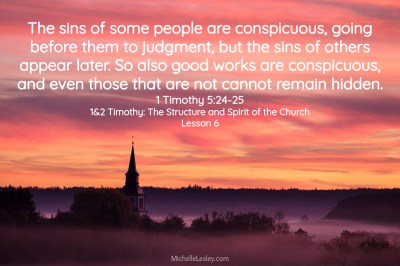
1 & 2 Timothy: Lesson 6

Previous Lessons: 1, 2, 3, 4, 5

Read 1 Timothy 5

Questions to Consider

If you have completed the Imperishable Beauty study, you may wish to look over your notes from lessons 10, 13, and 15, since we examined part of today’s passage (1 Timothy 5) in those lessons.

1. Notice the section heading at the beginning of this chapter and be reminded of the purpose and audience of this epistle. Who is the individual Paul is primarily addressing? What is his position in the church? What do these instructions pertain to?

2. How does God instruct Timothy (and every pastor) to treat the older/younger men and older/younger women he shepherds? (1-2) How do these instructions, if followed, benefit and protect the pastor, the church at large, and individual church members? Give a practical example of how a pastor could treat an older man, a younger man, an older woman, and a younger woman the way this passage instructs.

What does this passage not mean? For example – what if an older man is living in open sin? Does verse 1 mean the pastor should not confront him about that? What if a pastor is single and he and a woman five years his junior desire to get married? Does verse 2b prohibit that? Is there anything else this passage does not mean? Explain your answers with applicable Scripture.

3. Examine verses 3-16. What is the two word phrase used in both verse 3 and verse 16, that “bookends” this passage? Make a list of the things that qualify a woman as “truly” a “widow”. (4-16a) Now, go back over your list and highlight the character traits and activities that a godly woman will be exemplifying or practicing, and the ungodly traits and activities she will avoid, even before she becomes a widow. How can you continue to, or begin to, exemplify or practice each of these godly traits and activities and avoid the ungodly ones?

Compare the list of personal requirements and character qualifications of those who are “truly widows” (3-16) with the list of personal requirements and character qualifications for pastors and deacons in 3:1-13. What are the similarities and differences? How does this speak to the necessity of these men and women leading by setting a godly example in their character and practices for the rest of the church, and the rest of the church following their example? Explain how the role of leading by example is a vital role of leadership women must carry out in the church. How can women and men in the church learn from a godly woman who sets a good example?

What are the examples God gives of things women should be busying themselves with (14,16) in order not to fall into sin and set a bad example (11-13,15)?

4. Note how many times Paul speaks of the family’s duty to care for their widowed family members in 3-16. What are the various responsibilities of the family that he mentions? How are godly women particularly well suited to this kind of ministry? (16) What is the role of the pastor (7,9,11) and the church (16b) in this passage?

5. In 1 Timothy 2, (lesson 3, link above) God explained the two ways women may not minister in the church. What are those two ways? In 5:3-16, God lists many ways women can and must minister in the church. Make a list of each of those ways, and give a practical example of how a woman could carry out each of those ways in the church today (ex: What might “washing the feet of the saints” look like in the church today?) while still being obedient to God’s instructions for women in chapter 2.

6. Examine verses 17-20. Explain the church’s responsibilities regarding godly elders who righteously carry out their duties (17-18) as well as the church’s responsibilities regarding elders who persist in sin (19-20). (Use your cross-references.) Compare the instructions in verses 19-20 to the current idea in some corners of evangelicalism of “touch not My anointed“. How would you refute this false teaching from verses 19-20?

7. Explain the meaning of the charge God gives in verse 21, and the gravity and weightiness it conveys to pastors. Make a mental note of this, as this kind of charge will come up again in 1&2 Timothy.

8. After the weighty charge of verse 21, do the rapid fire instructions in verses 22-25 seem like a “P.S.” (and a P.P.S., a P.P.P.S, etc.) to a letter? Explain each instruction and why it was important to Paul and to the Holy Spirit to make sure it was included.


Homework

Think about a recent, sinful, evangelical “current event” (or an incident from your own church) you’re familiar with. For example: the egalitarian movement, a pastor falling into sin and having to step down, sexual abuse in the church, pastors spiritually abusing (intimidation, anger, threats, manipulation, etc.) their church members or congregation, false doctrine in the church, etc.

How could obedience to one or more of God’s instructions to pastors and to the church (from today’s lesson or previous lessons) have partially or completely prevented this incident?


Suggested Memory Verse