Wednesday's Word

Wednesday’s Word ~ Ezra 3

For further study on the book of Ezra, try my study, Ezra.

ezra 3 11

Ezra 3

When the seventh month came, and the children of Israel were in the towns, the people gathered as one man to Jerusalem. 2 Then arose Jeshua the son of Jozadak, with his fellow priests, and Zerubbabel the son of Shealtiel with his kinsmen, and they built the altar of the God of Israel, to offer burnt offerings on it, as it is written in the Law of Moses the man of God. 3 They set the altar in its place, for fear was on them because of the peoples of the lands, and they offered burnt offerings on it to the Lord, burnt offerings morning and evening. 4 And they kept the Feast of Booths, as it is written, and offered the daily burnt offerings by number according to the rule, as each day required, 5 and after that the regular burnt offerings, the offerings at the new moon and at all the appointed feasts of the Lord, and the offerings of everyone who made a freewill offering to the Lord. 6 From the first day of the seventh month they began to offer burnt offerings to the Lord. But the foundation of the temple of the Lord was not yet laid. 7 So they gave money to the masons and the carpenters, and food, drink, and oil to the Sidonians and the Tyrians to bring cedar trees from Lebanon to the sea, to Joppa, according to the grant that they had from Cyrus king of Persia.

8 Now in the second year after their coming to the house of God at Jerusalem, in the second month, Zerubbabel the son of Shealtiel and Jeshua the son of Jozadak made a beginning, together with the rest of their kinsmen, the priests and the Levites and all who had come to Jerusalem from the captivity. They appointed the Levites, from twenty years old and upward, to supervise the work of the house of the Lord.9 And Jeshua with his sons and his brothers, and Kadmiel and his sons, the sons of Judah, together supervised the workmen in the house of God, along with the sons of Henadad and the Levites, their sons and brothers.

10 And when the builders laid the foundation of the temple of the Lord, the priests in their vestments came forward with trumpets, and the Levites, the sons of Asaph, with cymbals, to praise the Lord, according to the directions of David king of Israel. 11 And they sang responsively, praising and giving thanks to the Lord,

“For he is good,
    for his steadfast love endures forever toward Israel.”

And all the people shouted with a great shout when they praised the Lord, because the foundation of the house of the Lord was laid. 12 But many of the priests and Levites and heads of fathers’ houses, old men who had seen the first house, wept with a loud voice when they saw the foundation of this house being laid, though many shouted aloud for joy, 13 so that the people could not distinguish the sound of the joyful shout from the sound of the people’s weeping, for the people shouted with a great shout, and the sound was heard far away.


The Holy Bible, English Standard Version Copyright © 2001 by Crossway Bibles, a publishing ministry of Good News Publishers.


Questions to Consider:

1. The book of Ezra deals with the second wave (out of three) of Israelites returning from exile in Persia after the destruction of Jerusalem. Why was it important to them (3) to set up the altar? Why did they begin keeping the feasts and offering sacrifices before the temple was rebuilt?

2. What was the Feast of Booths (4), and which event in Israel’s history did it commemorate? What are some similarities between the Exodus and Israel’s recent return from exile which might have made this celebration of the Feast of Booths especially meaningful for the people? Which attributes of God are on display in both the Exodus and the return from exile?

3. Why would it have been important for the Levites (8) to supervise the work on the temple? How does this show the people’s reverence for God’s house and their desire to do things “decently and in order“?

4. Try to put yourself in the shoes of the average Israelite in verses 10-11. Think about what your experience in exile might have been like and how you might feel finally back, free, in your homeland. Now, the temple is at last being rebuilt so you can worship God – maybe for the first time in your life – in the place and the way He intended. What emotions might you be experiencing? What sorts of things might you be praising God for? Take some time to thank God for some specific things about your own church.

5. For what reasons might the old men have been weeping? (12-13) How could both tears and joy be proper expressions of worship in this passage and in worship today? What gives you joy in worship? What brings you to tears when you worship?

Doctrinally Sound Teachers

10 More Biblically Sound Blogs and Podcasts by Christian Women

10 blogs

This article has been updated and moved. You can now find it at:

Doctrinally Sound Christian Women to Follow – 2

Wednesday's Word

Wednesday’s Word ~ Colossians 2

For further study on the book of Colossians, try my study, Colossians.

col 2 4

Colossians 2

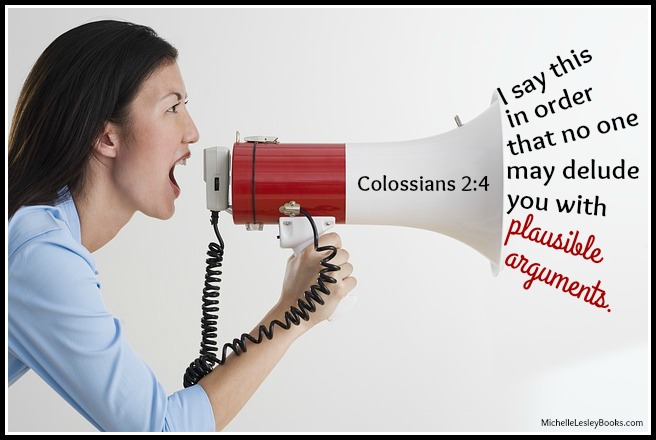
For I want you to know how great a struggle I have for you and for those at Laodicea and for all who have not seen me face to face, 2 that their hearts may be encouraged, being knit together in love, to reach all the riches of full assurance of understanding and the knowledge of God’s mystery, which is Christ, 3 in whom are hidden all the treasures of wisdom and knowledge. 4 I say this in order that no one may delude you with plausible arguments. 5 For though I am absent in body, yet I am with you in spirit, rejoicing to see your good order and the firmness of your faith in Christ.

6 Therefore, as you received Christ Jesus the Lord, so walk in him, 7 rooted and built up in him and established in the faith, just as you were taught, abounding in thanksgiving.

8 See to it that no one takes you captive by philosophy and empty deceit, according to human tradition, according to the elemental spirits of the world, and not according to Christ. 9 For in him the whole fullness of deity dwells bodily, 10 and you have been filled in him, who is the head of all rule and authority. 11 In him also you were circumcised with a circumcision made without hands, by putting off the body of the flesh, by the circumcision of Christ, 12 having been buried with him in baptism, in which you were also raised with him through faith in the powerful working of God, who raised him from the dead. 13 And you, who were dead in your trespasses and the uncircumcision of your flesh, God made alive together with him, having forgiven us all our trespasses, 14 by canceling the record of debt that stood against us with its legal demands. This he set aside, nailing it to the cross. 15 He disarmed the rulers and authorities and put them to open shame, by triumphing over them in him.

16 Therefore let no one pass judgment on you in questions of food and drink, or with regard to a festival or a new moon or a Sabbath. 17 These are a shadow of the things to come, but the substance belongs to Christ.18 Let no one disqualify you, insisting on asceticism and worship of angels, going on in detail about visions, puffed up without reason by his sensuous mind, 19 and not holding fast to the Head, from whom the whole body, nourished and knit together through its joints and ligaments, grows with a growth that is from God.

20 If with Christ you died to the elemental spirits of the world, why, as if you were still alive in the world, do you submit to regulations— 21 “Do not handle, Do not taste, Do not touch” 22 (referring to things that all perish as they are used)—according to human precepts and teachings? 23 These have indeed an appearance of wisdom in promoting self-made religion and asceticism and severity to the body, but they are of no value in stopping the indulgence of the flesh.


The Holy Bible, English Standard Version Copyright © 2001 by Crossway Bibles, a publishing ministry of Good News Publishers.


Questions to Consider:

1. What “plausible arguments” was Paul afraid the Colossian Christians would be “deluded” (4) by? (see 8, 11, 13, 16) How could the things Paul said in verses 2-3 prevent this? Had they already been led astray by false teaching? (5)

2. One of the major false teachings of Paul’s day was gnosticism. Which words/phrases in verse 8 might be speaking of gnosticism? Of the Judaizers? How does Paul refute the major tenets of gnosticism in verses 9-10? How can Christians apply verse 8 today?

3. In verses 11-13, which New Testament rite does Paul compare with the Old Testament rite of circumcision? How are these two rites similar? How are they different? Do these verses mean that Christians should not circumcise their baby boys? Did Paul think baptism was important?

4. What does verse 16 mean in light of the agenda the Judaizers were pushing? What does verse 17 tell us about the Old Testament feasts, ceremonies, sacrifices, etc.? How did they point to Christ, and how did Christ fulfill them? What does this tell us about the Hebrew Roots Movement and other “Christian” pastors or churches who say we must observe Old Testament ceremonies, calendars, or holidays?

5. What is the overall point Paul is trying to make in this chapter about Christianity versus false teachings such as gnosticism and the teachings of the Judaizers? (4, 10, 13-15, 19, 23) How can we apply this point today?

Book

A Fond Farewell to Jacob

UPDATE: Writing Jacob was an incredible experience, but, should you still be able to find a copy somewhere, I would not recommend you buy it or use it. I did not have very good hermeneutics when I wrote it and it will not teach you to handle God’s Word properly.

I do not plan to rewrite or re-release Jacob. You can find all of my other (and much better!) Bible studies for women -for free- in the Bible Studies tab in the blue menu bar at the top of this page.

jacobcover

Yesterday, I got word from my publisher that they are taking my book, “Jacob: Journaling the Journey” out of print due to low sales.

I just wanted to say thanks to those of you who bought a copy or wrote a review. As you know, all of my author royalties from book sales go to the International Mission Board to take the gospel to an unreached people group in the Middle East. So, my Bedouins thank you, too. (You can still donate to the designated fund for this UPG if you like. Just click on the Unreached People Group tab at the top of this page and follow the directions.)

I’m not sure at this point whether or not I will try to place “Jacob” with another publisher, or self-publish it, or look into other options. The publication process can be long and arduous. As for my blog and social media, everything will remain the same except that my book won’t be available for purchase.

Thanks again to all of you for your loyal readership and friendship on social media. I may not know all of you personally, but you are still an encouragement and a blessing to me, as I hope to be to you.

Old Testament, Wednesday's Word

Wednesday’s Word ~ 2 Chronicles 15

2 chron 15 15

2 Chronicles 15

The Spirit of God came upon Azariah the son of Oded, 2 and he went out to meet Asa and said to him, “Hear me, Asa, and all Judah and Benjamin: The Lord is with you while you are with him. If you seek him, he will be found by you, but if you forsake him, he will forsake you. 3 For a long time Israel was without the true God, and without a teaching priest and without law, 4 but when in their distress they turned to the Lord, the God of Israel, and sought him, he was found by them. 5 In those times there was no peace to him who went out or to him who came in, for great disturbances afflicted all the inhabitants of the lands. 6 They were broken in pieces. Nation was crushed by nation and city by city, for God troubled them with every sort of distress.7 But you, take courage! Do not let your hands be weak, for your work shall be rewarded.”

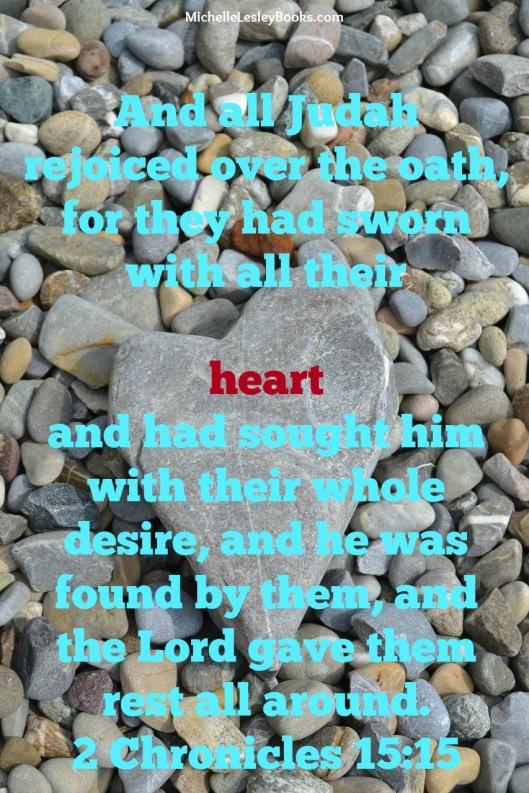
8 As soon as Asa heard these words, the prophecy of Azariah the son of Oded, he took courage and put away the detestable idols from all the land of Judah and Benjamin and from the cities that he had taken in the hill country of Ephraim, and he repaired the altar of the Lord that was in front of the vestibule of the house of the Lord. 9 And he gathered all Judah and Benjamin, and those from Ephraim, Manasseh, and Simeon who were residing with them, for great numbers had deserted to him from Israel when they saw that the Lord his God was with him. 10 They were gathered at Jerusalem in the third month of the fifteenth year of the reign of Asa.11 They sacrificed to the Lord on that day from the spoil that they had brought 700 oxen and 7,000 sheep.12 And they entered into a covenant to seek the Lord, the God of their fathers, with all their heart and with all their soul, 13 but that whoever would not seek the Lord, the God of Israel, should be put to death, whether young or old, man or woman. 14 They swore an oath to the Lord with a loud voice and with shouting and with trumpets and with horns. 15 And all Judah rejoiced over the oath, for they had sworn with all their heart and had sought him with their whole desire, and he was found by them, and the Lord gave them rest all around.

16 Even Maacah, his mother, King Asa removed from being queen mother because she had made a detestable image for Asherah. Asa cut down her image, crushed it, and burned it at the brook Kidron. 17 But the high places were not taken out of Israel. Nevertheless, the heart of Asa was wholly true all his days. 18 And he brought into the house of God the sacred gifts of his father and his own sacred gifts, silver, and gold, and vessels. 19 And there was no more war until the thirty-fifth year of the reign of Asa.


The Holy Bible, English Standard Version Copyright © 2001 by Crossway Bibles, a division of Good News Publishers.


Questions to Consider:

1. Who was Asa? Was he a godly or ungodly man? What are the two alternatives and their consequences that Asa was given by Azariah in verse 2?

2. Why did Azariah recite Israel’s history for Asa in verses 3-6? Why was Israel “without the true God, and without a teaching priest and without law” (3) for a long time? (Hint- see verse 8). What happened when Israel repented? (4)

3. Why was it so important to get rid of all the idols (8) to the point that the death penalty was imposed on anyone who would not seek the Lord (13)? Does God really take idolatry that seriously? If God considers idolatry so awful, how does this apply to the church, and individual Christians, today?

4. Getting rid of all the idols was an act of r_______. This was followed by sacrifices to God and an oath that the people would seek only Him. These were acts of w_______. How do the “big picture” ideas in this chapter of sin, followed by repentance and faith, followed by forgiveness and worship, foreshadow the gospel?

5. How do verses 12 and 15 connect to Matthew 22:34-38? How do Asa’s actions in verse 16 relate to Matthew 10:34-37?