Wednesday's Word

Wednesday’s Word ~ James 4

james 4 4

James 4

What causes quarrels and what causes fights among you? Is it not this, that your passions are at war within you? You desire and do not have, so you murder. You covet and cannot obtain, so you fight and quarrel. You do not have, because you do not ask. You ask and do not receive, because you ask wrongly, to spend it on your passions. You adulterous people! Do you not know that friendship with the world is enmity with God? Therefore whoever wishes to be a friend of the world makes himself an enemy of God. Or do you suppose it is to no purpose that the Scripture says, “He yearns jealously over the spirit that he has made to dwell in us”? But he gives more grace. Therefore it says, “God opposes the proud, but gives grace to the humble.” Submit yourselves therefore to God. Resist the devil, and he will flee from you. Draw near to God, and he will draw near to you. Cleanse your hands, you sinners, and purify your hearts, you double-minded.Be wretched and mourn and weep. Let your laughter be turned to mourning and your joy to gloom. 10 Humble yourselves before the Lord, and he will exalt you.

11 Do not speak evil against one another, brothers. The one who speaks against a brother or judges his brother, speaks evil against the law and judges the law. But if you judge the law, you are not a doer of the law but a judge. 12 There is only one lawgiver and judge, he who is able to save and to destroy. But who are you to judge your neighbor?

13 Come now, you who say, “Today or tomorrow we will go into such and such a town and spend a year there and trade and make a profit”— 14 yet you do not know what tomorrow will bring. What is your life? For you are a mist that appears for a little time and then vanishes. 15 Instead you ought to say, “If the Lord wills, we will live and do this or that.” 16 As it is, you boast in your arrogance. All such boasting is evil. 17 So whoever knows the right thing to do and fails to do it, for him it is sin.


The Holy Bible, English Standard Version Copyright © 2001 by Crossway Bibles, a publishing ministry of Good News Publishers.


Questions to Consider:

1. Who wrote the book of James? What was his purpose in writing the book? To whom was it written? What type of literature (historical narrative, epistle, poetry, prophecy, etc.) is this book? Is James a mostly descriptive or prescriptive book?

2. In verses 1-10, what sin(s) does James indicate is at the root of our conflicts with others (1-2), problems in our prayer life (2-3), and rifts in our relationship with God (4-10)? How would you summarize this passage in one sentence?

3. What is “friendship with the world”? (4) Does this mean we can’t associate with lost people? Why does James call his audience “adulterous people”? (4) What Old Testament events or Scriptures might this term have brought to mind for James’ Jewish readers? Why does God make such a big deal about worldliness?

4. How do verses 11-12 fit with other New Testament passages on judging? Is it “speaking evil” of someone to lovingly call her to repentance?

5. In verses 13-16, is James saying we can never make plans in advance? What does this passage teach us about God’s sovereign control over the universe and our lives? What perspective should we have about our lives in relationship to God’s sovereignty, and how should this lead us to greater humility? How does verse 17 define the concept of a “sin of omission”?

Guest Posts

Guest Post ~ A Lady First: Being a Pastor’s Wife

If your theology pretty much matches up with mine (as outlined in the “Welcome” and “Statement of Faith” tabs) and you’d like to contribute a guest post, drop me an e-mail at MichelleLesley1@yahoo.com,
and let’s chat about it.

kesha-griffin-lady-first

A Lady First: Being a Pastor’s Wife
by: Laurel J. Davis

Reality TV makes a mockery of Christianity and I as a pastor’s wife am fed up, especially with what a lot of pastors’ wives are doing in real “real life” to perpetuate the problem.

And why are most of them Black? As an African-American pastor’s wife myself, that just adds insult to injury. Overall, the professing Christians on The Sisterhood, (cancelled, yay!), Preachers’ Daughters, Preachers of L.A., Preachers of Detroit, and Preachers of Atlanta are embarrassing. Not all pastors are about the bling. And not all pastors’ wives are arrogant, entitled, self-centered, elitist, patronizing, untouchable, I-can-do-what-I-want-I’m-the-first-lady, got-to-be-the-best-dressed, biblically illiterate, gossiping busybodies.

But a lot of us are. A lot of pastors’ wives abuse the title of “first lady in the church” (a long-held tradition in so-called African American churches). And it falls right in line with what 2 Timothy 3:6-7 warns about gullible women being taken captive.

Special attention and favor do inevitably come with being married to the most respected person in the local church. The problem is when pastors’ wives get caught up in the hype instead of gently resisting people’s natural tendency to put them on a pedestal. Allowing yourself to be called “First Lady” in the first place is the beginning of that problem.

I’m thinking about two examples. First is “Lady” Myesha Chaney, married to Pastor Wayne Chaney of Antioch Church of Long Beach, California, featured on Preachers of L.A. In one episode he needed a second in command and she wanted the job. When he hesitated, partly because the church board was against the nepotism and partly because of his own concerns about whether she could balance it with her existing responsibilities at home and church, she started crying. Her husband then, um, submitted.

Not to belittle Mrs. Chaney’s real feelings, but I’m concerned for a church where: 1) the second in command cries when she doesn’t get her way; 2) the senior pastor is easily moved by it because it’s his wife; 3) she shows such lack of trust in his God-ordained leadership; and 4) he submits to his wife and not vice-versa when it comes to a major church decision – which makes me wonder how much she was running things behind the scenes already.

The second example is “Lady” Bridget Hilliard, wife of Pastor I.V. Hilliard of New Light Christian Center in Houston, Texas. The church’s website dedicated a whole micro-site to her 50th birthday bash for $100 per person admission price, and even included gift ideas of “monetary gifts, designer handbags (Gucci, Chanel and Louis Vitton) and gift certificates (Neiman Marcus, Saks Fifth Avenue, Escade).” (Houston Press) Mrs. Hilliard was already driving a Bentley with the license plate, “Mrs. Attitude.” (Guess what was on her husband’s.) Enough said.

Am I being arrogant or elitist? Anything I think I know is not because I think I have any superior insight or privileged wisdom. I am no more capable than anybody else to just, simply, measure up everything against the test of the final authority of God’s Word.

Am I gossiping? No, because I’m not addressing anything that isn’t already public knowledge.

Am I being unloving? No. My hope is that those women and their admirers will be helped out of this unbiblical way of thinking in the church. And that’s very loving, indeed.

Am I jealous? Hardly. I don’t want the title “First Lady.” Being called “Mrs. Davis” is plenty satisfying enough, thank you very much. Furthermore, I’m trying to live by Luke 12:15; Matthew 6:19 and 1 Timothy 6:6-8.

Too many “first ladies” fail to see that being a pastor’s wife is a privilege, not an entitlement. It’s a calling, not a status level. It’s a position of support and service, not of being served. It’s an opportunity to bless, not control. It’s about modeling a pricelessly adorned spirit, not the latest Gucci bag. It’s a responsibility to give God all the glory, not share it with Him.

I’ve been a pastor’s wife for almost 23 years. With all of its perks come a lot of pitfalls. Don’t seek the role unless you know you’re called by God, because a pastor is supposed to be a servant, and so are you as his biggest supporter and closest disciple. Plus, you’ll have to endure a lot of sacrifice, scrutiny, trials, tests, second-guessing, attacks, betrayal, and loneliness. The fruits of the Spirit (Galatians 5:22-24) will have to be in operation on double-time.

Being a pastor’s wife also means seeing the blessing of the fruit of your labor in serving, guiding your precious sisters and young women (Titus 2:3-5), and first and foremost being a fitting helpmate to your husband both at home and at church.

In short, be a “lady first.” Be a woman – pastor’s wife or not – after God’s own heart, first. Like the Proverbs 31 woman, a “lady first” is content with her husband and children honoring her even if no one else ever does (cf. verses 28-29). Then, it’s her good deeds — not her title, position, possessions or fashion style — that garner admiration from outside the home (verses 30-31). And like the Titus 2 woman (verses 3-5), she knows her responsibility to younger women, lives holy, avoids idolatry, shuns gossip, teaches biblically, is level-headed, loves and yields to her husband, nurtures her children, and makes her home a refuge – all so that she will not open up the Word of God to be maligned, cheapened or discredited.

It’s a constant striving already to be the Proverbs 31/Ephesians 5/Titus 2/1 Peter 3 woman even without the added responsibility of supporting a husband’s ministry. But being a lady first, more than being a first lady, is what is most beautiful in the eyes of your husband, your children, your church and, most importantly of all, your Heavenly Father.

-Originally published at The Reluctant First Lady


Laurel Davis is a pastor’s wife in Los Angeles. A freelance magazine writer, she also writes for Got Questions? and Blogos, and has her own blog, The Reluctant First Lady. Laurel and her husband Charlton, who produces and co-hosts What Does the Bible Say?, have been married for almost 29 years, have four grown children, one grandchild and another one on the way. Follow Lauren on Facebook or email her at reluctantfirstlady@gmail.com


ALTHOUGH I DO MY BEST TO THOROUGHLY VET THE THEOLOGY OF THE BLOGGERS WHO SUBMIT GUEST POSTS, IT IS ALWAYS POSSIBLE FOR THINGS TO SLIP THROUGH THE CRACKS. PLEASE MAKE SURE ANY BLOGGER YOU FOLLOW, INCLUDING ME, RIGHTLY AND FAITHFULLY HANDLES GOD’S WORD AND HOLDS TO SOUND BIBLICAL DOCTRINE.
Movies

Guest Post: Movie Review- Risen

RISEN_600x230
Photo courtesy of RisenMovie.com

Movie Review- Risen
by Michael Coughlin

I was privileged to see the Risen movie in advance courtesy of Sony Screenings. I enjoyed the movie, generally speaking, and there were a few parts where the story on the screen and my thoughts of my own relationship with Christ brought me to tears of joy over my salvation and sadness over my sin. Risen was entertaining. The acting and cinematography was stellar. The characters were believable and their interactions told the story well without a need for narration.

It is rated PG-13 for its gruesome depiction of crucifixion, a war battle, and blood and death. It isn’t gratuitous, though. It is part of the story and done in a way which makes sense. But I wouldn’t take a young child or someone who has PTSD or some kind of issue dealing with death or gruesome violence. I had to cover my 11 year old’s eyes on several occasions as it was too much gore for her.

Where the movie seems to try to communicate Biblical truths, I’d say it succeeds. Well, I’d give it a B or B+.  But let me caution anyone who will see it, you will walk away with ideas from the movie that you will not find in the Bible. In some cases, things are just shown in a chronology that doesn’t fit with the biblical accounts. I would not recommend this movie as an ‘evangelistic tool.’ But if a nonbelieving friend or coworker wanted to see it, it could be a launchpad for discussion. Furthermore, I would not recommend this movie for a new Christian or a child who isn’t already very discerning and biblically knowledgeable.

I think where many reasonable people will be disappointed is the lack of a clear call to repent and believe in the Jesus in the story. He is undoubtedly depicted as God in the flesh, the suffering Savior and a loving and gentle shepherd. His resurrection and ascension are unmistakably testified to. What is missing is any real depiction of His wrath and imminent judgment. He is the “all love” Jesus. It is hard to know from watching this move whether a person would have enough truth communicated to them about their need for a Savior to cause them to run to the Savior.

The obvious emphasis was on Jesus’ teaching about loving others and his earthly ministry, especially miracles. We know from the New Testament that many people who witnessed Jesus’ miracles did not follow Him (John 6), yet the movie makes the implication that it was those miracles that kept at least one Apostle around.

To be fair, many true accounts from the Bible were very well portrayed. And, usually, where the makers took liberty, I thought they were fair and faithful to what is known from Scripture. But, as I wrote earlier, the mixture of extra-biblical and biblical, with no clear delineation can muddy the waters.

This movie is clearly an evidentialist’s idea of leading people to Christ. The concept of becoming a follower of Jesus, and even evangelizing the world is clear. But I’m afraid that the author doesn’t seem to think it is God’s Word that saves people and the hearing of the gospel. I think the presupposition is that somehow if we could get people to believe in a resurrection, they’d believe. It is in this way, the movie may fail the most. By creating a Forrest Gump style documentary with fiction interspersed with real history, they give the nonbeliever an easy out. A person can watch this movie and not be challenged by God’s truth, but rather see God’s truth as just one piece of fiction as part of a larger piece. Oh how much we lose when we don’t stick to the Word!

Finally, the movie is not entirely clear what exactly Jesus died for. There is no reference to God’s wrath for sinners being poured out on Jesus. Nor is there a definite explanation of faith, especially sola fide. I do not think a Roman Catholic, a Mormon or any number of other false “Christian” systems would have any problem with this movie. I suppose it is intentionally non-polarizing. This didn’t totally bother me, but I know some people for whom this would be the deal-breaker. That aspect actually made me think of how much we have in common with faithful Roman Catholics, and how that should affect our evangelism

When I walked out, I told my wife via text that it was better than The Passion of the Christ and not as good as any Kendrick brother movie (I haven’t seen War Room). It’s just sorta there: it will have nowhere near the impact upon eternity the makers may really hope it has, but I doubt it will lead anyone to terrible heresy or into forms of sin either. My recommendation is that you wait for the movie to come out on DVD. (If you really want to spend some money, then send it to a doctrinally sound missions or evangelism ministry. Here’s my suggestion.) But if you are a moviegoer, I also don’t see any harm in checking it out. As always, compare what you see with Scripture and you will be OK.


Michael Coughlin is a street evangelist from Ohio. He and his wife, Erin have 5 children. You can find him on Twitter, at his blog, or on Sermon Audio.


ALTHOUGH I DO MY BEST TO THOROUGHLY VET THE THEOLOGY OF THE BLOGGERS WHO SUBMIT GUEST POSTS, IT IS ALWAYS POSSIBLE FOR THINGS TO SLIP THROUGH THE CRACKS. PLEASE MAKE SURE ANY BLOGGER YOU FOLLOW, INCLUDING ME, RIGHTLY AND FAITHFULLY HANDLES GOD’S WORD AND HOLDS TO SOUND BIBLICAL DOCTRINE.

Please keep in mind that this is a guest post. While I respect Michael’s perspective and observations about the movie, I have not seen it yet and will not be able to answer any questions about it or Michael’s thoughts pertaining to it. I’m going to take Michael’s advice and wait until it comes out on DVD. Find out more about Risen here. Answers in Genesis has also posted a review, Risen Movie Upholds Scripture.

Have you seen Risen yet?
What did you think of it?

Prayer

Throwback Thursday ~ “Can We Talk?”

Originally published, February 9, 2012

“Thanks for meeting with me, today, Dad,” said the tow-headed six year old as he strode across the study, arm extended for a firm handshake.

Smiling, the father grasped the child’s hand, assuming a hug would follow. When none did, he stood, somewhat dismayed, as his son took the chair opposite the imposing mahogany desk and motioned for him to take his accustomed place behind it.

Oh. This was going to be one of those conversations.

“I only have about five minutes,” said the boy, briskly, as he clicked open the latches on his caramel brown leather brief case and withdrew two copies of a neatly typed agenda, “so let’s get down to business.”

“First, as I’ve mentioned numerous times, I’d like you to get me that big shiny motorcycle I’ve been wanting. And would you please hurry up about it? I’ve been asking for that bike for a long time, and I don’t understand why you haven’t given it to me yet.”

Again with the motorcycle? Doesn’t this kid get that he’s six? There’s no way he could handle a bike that large and powerful, and I love him too much to see his guts splattered all over the pavement. Yeah, that’s gonna be a big, fat “no.”

“Next,” the boy hurried on, “I’m kinda in a jam. You see, there’s this big spelling test tomorrow, and I haven’t had time to study for it. Could you sit by me in class tomorrow and give me all the answers?”

Haven’t had time? Yesterday he played video games for two hours, and the day before that I heard him throwing a tennis ball up against the side of the house all afternoon!

“And finally, Sparky seems to be limping around lately. Could you take a look at his paw and fix it up with some of that special cream?”

Well…sure. You know I’m always glad to help, but…

“Thanks for everything, Dad,” the boy chirped as he hopped off his chair and headed for the door, “I’ve got to run. See you later!”

Bye…Son.


I can just see that Dad standing there, forlorn, missing his son. The son who lives under the same roof with him. The son he watches play ball, play with his friends, and achieve the great feats of six year olds. The son who never really talks to him.

The father longs to have an intimate, “Daddy’s home!” relationship with his child. To have his son run up, give him a hug, and jump in his lap to tell Dad all about his day. He wants to share his child’s joys and sorrows. He wants to hear his heart.

And if the child really thought about it—or even knew such a relationship could exist—he’d want the same thing.

We can have that kind of joyous relationship with our Heavenly Father. It really is possible.

But how?

Well, think about how you relate to the person you love the most in the world. Because you love that person, you want to spend time with him. You’re relaxed around each other. You enjoy being together. You share everything—your deepest secrets, your regrets, your hopes for the future, your concerns for others, your frustrations, your joys, your sorrows, even the mundane, day to day happenings of life.

You’ve probably never read a book, taken a class, or attended a lecture on how to talk to that special someone. And you’ve probably never made a list of conversation topics for your next get-together with him. This is a friendship, not a business meeting.

Now think about how our connection to God is illustrated in Scripture. He’s called our Father (Matthew 6:9); Jesus is our brother (Matthew 12:50) and our friend (John 15:14); the church is the bride of Christ (Revelation 19:7). These are the most intimate relationships we know, and they’re used to describe a bond of love and friendship with God.

So, why do we have so much trouble talking to Him? Why is it that, so often, what’s supposed to be a heartfelt conversation with God feels like a one-sided recitation of a laundry list of prayer requests?

In some ways, we’ve done it to ourselves. There are thousands of books, Bible studies, and other materials on how to pray. Preachers preach on it. Teachers teach on it. There are acronyms you can follow, lists you can make, prayer calendars, even apps and on-line prayer organizers. None of these things are inherently bad, in fact, some are excellent—I’ve used and recommended some of them, myself.

But, I think that, sometimes, when faced with all of these resources and methodologies, one of two things can happen. First, you can become paralyzed by all the choices, not know which one to choose, and give up on prayer because you think it’s too complicated. Or, you might try to use too many prayer resources and become overwhelmed because they don’t work for you or you can’t keep up with all of them. Second, you can fall into the trap of thinking you have to use some sort of prayer resource or methodology. You can become enslaved to the structure, and that stands between you and intimacy with God like a brick wall.

May I make a suggestion here?

Throw out the lists. Put away the prayer calendar. Turn off the app.

Just talk to your Father. Talk to Him like He’s the person you love most in the world. Pour out what’s on your heart to Him.

If you’re not sure how to do that or what to say or whether you might be doing it wrong, tell Him about that, and ask Him to help you. It’s OK to ask God to show you how to talk to Him. The disciples did, and Jesus gladly obliged (Luke 11:1-13).

Don’t become paralyzed by the number of prayer requests you think you have to keep up with, either. I know that some churches have prayer lists a mile long, plus prayer calendars for missionaries, and you have friends and relatives asking you to pray for certain things. Sometimes, our prayer time can feel like we’re the office flunky armed with a long list of orders being sent out to pick up lunch for everybody. “Get those orders right! Don’t forget anything!” But prayer is not about completing a checklist of everyone else’s concerns. It’s about you and God, and it should be governed by God, not ruled by a list.

Wait a minute. This is starting to sound selfish. Aren’t we supposed to pray for others? Well, yes…and, no. What we’re supposed to do is to submit ourselves and our prayer time to God’s word and the leadership of the Holy Spirit.

That sounds great, but what does it mean in practical terms?

  • Study God’s word before you pray. As you do, He’ll begin leading you to the things He wants you to pray about.
  • Ask God what to pray about. Often, I’ll open a prayer meeting by praying that God will lead our prayer time and that He will put all the things on our hearts that He wants us to pray about.
  • Resist the list. Trust God to lead you to the things He wants you to pray about, and let your conversation with Him flow freely from your heart. Don’t worry about forgetting something on your prayer list.
  • Prayer time isn’t self-contained. Usually, my praying for others is done throughout the day rather than during my set prayer time. When someone asks me to pray for something, I’ll stop right then and do it. There are certain missionaries and other Christian ministries that I pray for when I receive an e-mail or Facebook update from them. Most of the time, unless God lays something on my heart during my personal prayer time, I only pray for requests on the church prayer list during the prayer meeting in which I receive them.

Relax. Just talk to Him.

“…the prayer of the upright is His delight.” Proverbs 15:8

Wednesday's Word

Wednesday’s Word ~ Ezekiel 18

For further study on the book of Ezekiel, try my study, Ezekiel.

ez 18 23

Ezekiel 18

The word of the Lord came to me: “What do you mean by repeating this proverb concerning the land of Israel, ‘The fathers have eaten sour grapes, and the children’s teeth are set on edge’? As I live, declares the Lord God, this proverb shall no more be used by you in Israel. Behold, all souls are mine; the soul of the father as well as the soul of the son is mine: the soul who sins shall die.

“If a man is righteous and does what is just and right— if he does not eat upon the mountains or lift up his eyes to the idols of the house of Israel, does not defile his neighbor’s wife or approach a woman in her time of menstrual impurity, does not oppress anyone, but restores to the debtor his pledge, commits no robbery, gives his bread to the hungry and covers the naked with a garment, does not lend at interest or take any profit, withholds his hand from injustice, executes true justice between man and man, walks in my statutes, and keeps my rules by acting faithfully—he is righteous; he shall surely live, declares the Lord God.

10 “If he fathers a son who is violent, a shedder of blood, who does any of these things 11 (though he himself did none of these things), who even eats upon the mountains, defiles his neighbor’s wife, 12 oppresses the poor and needy, commits robbery, does not restore the pledge, lifts up his eyes to the idols, commits abomination, 13 lends at interest, and takes profit; shall he then live? He shall not live. He has done all these abominations; he shall surely die; his blood shall be upon himself.

14 “Now suppose this man fathers a son who sees all the sins that his father has done; he sees, and does not do likewise: 15 he does not eat upon the mountains or lift up his eyes to the idols of the house of Israel, does not defile his neighbor’s wife, 16 does not oppress anyone, exacts no pledge, commits no robbery, but gives his bread to the hungry and covers the naked with a garment, 17 withholds his hand from iniquity, takes no interest or profit, obeys my rules, and walks in my statutes; he shall not die for his father’s iniquity; he shall surely live. 18 As for his father, because he practiced extortion, robbed his brother, and did what is not good among his people, behold, he shall die for his iniquity.

19 “Yet you say, ‘Why should not the son suffer for the iniquity of the father?’ When the son has done what is just and right, and has been careful to observe all my statutes, he shall surely live. 20 The soul who sins shall die. The son shall not suffer for the iniquity of the father, nor the father suffer for the iniquity of the son. The righteousness of the righteous shall be upon himself, and the wickedness of the wicked shall be upon himself.

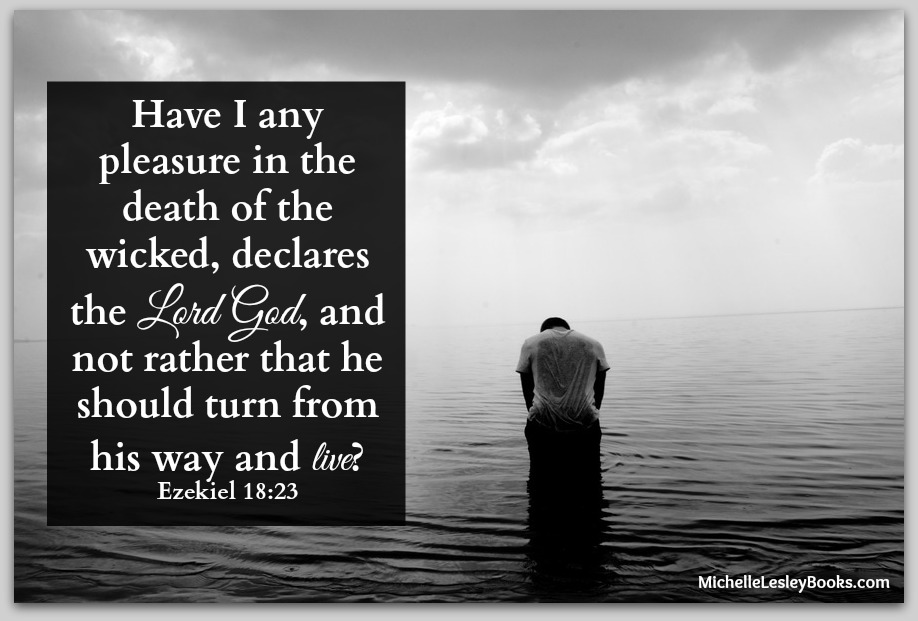
21 “But if a wicked person turns away from all his sins that he has committed and keeps all my statutes and does what is just and right, he shall surely live; he shall not die. 22 None of the transgressions that he has committed shall be remembered against him; for the righteousness that he has done he shall live. 23 Have I any pleasure in the death of the wicked, declares the Lord God, and not rather that he should turn from his way and live? 24 But when a righteous person turns away from his righteousness and does injustice and does the same abominations that the wicked person does, shall he live? None of the righteous deeds that he has done shall be remembered; for the treachery of which he is guilty and the sin he has committed, for them he shall die.

25 “Yet you say, ‘The way of the Lord is not just.’ Hear now, O house of Israel: Is my way not just? Is it not your ways that are not just? 26 When a righteous person turns away from his righteousness and does injustice, he shall die for it; for the injustice that he has done he shall die. 27 Again, when a wicked person turns away from the wickedness he has committed and does what is just and right, he shall save his life.28 Because he considered and turned away from all the transgressions that he had committed, he shall surely live; he shall not die. 29 Yet the house of Israel says, ‘The way of the Lord is not just.’ O house of Israel, are my ways not just? Is it not your ways that are not just?

30 “Therefore I will judge you, O house of Israel, every one according to his ways, declares the Lord God. Repent and turn from all your transgressions, lest iniquity be your ruin. 31 Cast away from you all the transgressions that you have committed, and make yourselves a new heart and a new spirit! Why will you die, O house of Israel? 32 For I have no pleasure in the death of anyone, declares the Lord God; so turn, and live.”


The Holy Bible, English Standard Version Copyright © 2001 by Crossway Bibles, a publishing ministry of Good News Publishers.


Questions to Consider:

1. What is the book of Ezekiel about? Which genre (history, poetry, wisdom, etc.) is the book of Ezekiel? What is the overall theme of chapter 18?

2. How do verses 5-9 describe a righteous man? What kind of heart would such a man have to have in order to consistently live this way? (9)

3. Who is the “he” in verses 11 and 12 referring to? Is this man to be punished for the sins of his son? (13) If the sinful man (14) fathers a righteous son (14-17) is the righteous son to be punished for his father’s sin? (17-18) Which verse(s) in this chapter sum up the principle of individual responsibility for sin? How does this chapter refute the false teaching of generational curses?

4. What can we learn about repentance from verses 21-32? In which does God take delight, pouring out His wrath on the wicked or pouring out His forgiveness on the repentant? (23, 32) How does this passage compare to 2 Peter 3:9?

5. Consider this chapter in light of the gospel. Is any person truly righteous? Where does the Christian’s righteousness come from? How does the New Testament describe Jesus, the righteous Son, being punished for our sin? What effect does this have on verse 4 (“the soul who sins shall die”)?