If your theology pretty much matches up with mine (as outlined in the “Welcome” and “Statement of Faith” tabs) and you’d like to contribute a guest post, drop me an e-mail at MichelleLesley1@yahoo.com, and let’s chat about it.
The Ministry of Encouragement, Part 2 by Pam Carney
Before reading this post, you need to read this previous post for context. Click Here. In God’s providence, Michael and Pam were at the same conference in early April, 2016! Here is Pam’s version of the same story told by Michael in the other post.
Michael’s words to me at the Final Four 2015 did not fall on as humble a heart as he may have thought. That day, I was still in my pride of “taking matters into my own hands” attitude, although I did not show it. I listened to him and did appreciate what he was saying, but all the while I was thinking I knew better. Deep down inside, I knew he was right, but was suppressing the truth by my own unrighteousness. The Holy Spirit was at work bringing about conviction. When I saw Michael this past weekend at Ohio Fire, I confessed to him that I had had resentment in my heart from that encounter. It felt so good to tell my brother that.
Not only was I being convicted, but the Genesis account of Abraham and Sarah that Michael reminded me of, by God’s grace, took root and shortly after our talk on the street that day, I did end up becoming free from that particular sin. After that Final Four weekend I received more disciplining and was granted repentance by God to turn from preaching on the street and usurping authority over men.
The freedom comes from letting the men be the men and do their job the way God made them to do it. Talk about “women’s lib!” I was liberated from my own selfish ambition to preach the Gospel in a way that godly women ought not. The freedom to be who God made me to be, and to fulfill the work He has for me, as a woman. The freedom from rebelling against my Creator.
The bottom line is that God didn’t make women to take on the role of preaching on the street. I was usurping God’s authority and sovereignty by preaching, and that is the worst sin of all.
The most beautiful lesson from this is that Christians must keep speaking God’s word, the truth, into one another’s lives. God put Michael in my path that day and used him to accomplish His purpose for me.
I praise our Lord Jesus for lovingly sanctifying me through my sin and doing the work in me that only He knows how to do; and only He can accomplish.
Pam Carney was called to be a disciple of Jesus at age 42. She is involved with street evangelism in Detroit and surrounding metro, door to door in Dearborn to Muslims, and abortion mill ministry. She also works in a secular industry. Her passion is to share Christ anytime, anywhere. Please visit Turn2Christ, run by Pam and her bretheren from church.
ALTHOUGH I DO MY BEST TO THOROUGHLY VET THE THEOLOGY OF THE BLOGGERS WHO SUBMIT GUEST POSTS, IT IS ALWAYS POSSIBLE FOR THINGS TO SLIP THROUGH THE CRACKS. PLEASE MAKE SURE ANY BLOGGER YOU FOLLOW, INCLUDING ME, RIGHTLY AND FAITHFULLY HANDLES GOD’S WORD AND HOLDS TO SOUND BIBLICAL DOCTRINE.
Should Christians do yoga? What about Holy Yoga or other “Christianized” forms of yoga?
Before I give my answer to this question, I’d like to ask a couple of questions.
Have you ever heard anyone ask the question, “Should Christians do aerobics/zumba/spinning?”
Ever heard of Holy Weight Lifting, Christian Calisthenics, Redeemed Running or another “Christianized” version of a particular form of exercise?
There’s a reason for that.
If you’ve ever participated in youth or Christian school activities with a dress code, a rule of thumb that’s frequently used to help kids determine whether a particular outfit is too short, too low-cut, etc., is, “If you have to ask, it’s probably not appropriate.”
I think the same thing could be said about yoga.
The reason the question “Should Christians do yoga?” is even being asked is because there’s doubt in the minds of the Christians asking the question that yoga is kosher with God.
That’s a healthy doubt because yoga is a Hindu worship practice.
Hindu Swami Parham on the Hinduism of yoga and why Christians shouldn’t participate
Now, before we go any further, let’s just let that sink in a minute. This activity is used by a pagan religion for worshiping false gods. Would you, as a Christian, participate in any other pagan religious activities used for worshiping false gods? Would you participate in Mormon baptism for the dead? Have a shrine to Buddha in your home? Take part in the fast of Ramadan, one of the five pillars of Islam?
No? What if the water the Mormons use had some special property that soothed your eczema? What if the kids started behaving better every time you set up the Buddha shrine? What if you lost weight while fasting during Ramadan? Would those benefits make participating in pagan religious practices OK even if, in your heart, you were only doing it for the benefits and not actually worshiping those false gods?
No, it would not. Neither is participating in yoga for the health benefits. Not convinced? Give the Old Testament another read.
Time and again, the Israelites were chastised and judged by God for idolatry. And not just full-blown idol worship, but all the steps leading up to it. It was not OK with God that they participated in a “Judaized” form of golden calf worship. When Israel entered the Promised Land, God told them to utterly destroy every last vestige of idol worship. It didn’t matter that they had no intention at the time of worshiping those false gods. Israelites were not to marry foreigners lest they be tempted to idolatry. God didn’t give any special permission to marry foreigners to those who promised not to worship the pagan gods of their spouses, He just said “don’t”. The first two – one fifth – of the Ten Commandments are prohibitions against idolatry. And there aren’t any instances in the Bible of God being fine with his people “Christianizing” idol worship.
This is not a God who’s OK with His people dabbling in paganism.
This is the God who loves us so much He sent His Son to be tortured to death for our sin so that we might be clothed with His righteousness, be saved from an eternity in hell, and inherit eternal life. Doesn’t He deserve better than sons and daughters who want to justify their involvement, at any level, in a religion that, ultimately, worships Satan? Doesn’t He deserve our highest, unsullied loyalty- a devotion that says, “I’m willing to give up anything that doesn’t please You, no matter the cost to me.”?
Yoga isn’t the only game in town. Let’s choose something else. Something that allows us to exercise, and worship God, with a clean conscience.
If you have a question about: a well known Christian author/leader, a Bible passage, an aspect of theology, a current issue in Christianity, or how to biblically handle a family, life, or church situation, comment below (I’ll hold all questions in queue {unpublished} for a future edition of The Mailbag) or send me an e-mail or private message. If your question is chosen for publication, your anonymity will be protected.
Rock Your Role is a series examining the “go to” and hot button Scriptures that relate to and help us understand our role as women in the church. Don’t forget to prayerfully consider our three key questionsas you read.
Every man who prays or prophesies with his head covered dishonors his head, but every wife who prays or prophesies with her head uncovered dishonors her head, since it is the same as if her head were shaven… Judge for yourselves: is it proper for a wife to pray to God with her head uncovered? 1 Corinthians 11: 4-5, 13
In this series, we’ve been examining the biblical passages that define and give shape to our role as godly women in the church. We’ve taken a look at the different roles God has laid out for men and women in the church and the passages of Scripture people commonly like to twist to argue against the clear teaching of God’s word about those roles.
But aside from a very small minority of folks, no one is arguing that Christian women need to wear some sort of head covering in church or while praying. Most of us seem to instinctively know that the first half of 1 Corinthians 11 is not a command that is binding on 21st century American women. So why even bring up this passage in this series?
Because much like the tiresome “Leviticus also prohibits eating shellfish and wearing garments of mixed fibers!” argument repeatedly trotted out by those offended when Christians rightly call homosexuality a sin, 1 Corinthians 11 is used by feminists, egalitarians, and others as a “gotcha” passage against Christians who rightly uphold the biblical roles of men and women in the church. “If you believe women shouldn’t preach, teach men, or hold authority over men in the church,” they say, “then why don’t you wear a head covering? See? You’re a hypocrite! You pick and choose which Scriptures you’ll obey!”
What they (and often we) don’t realize – because this passage takes some digging and study – is that women who obey Scripture’s parameters for biblical womanhood (submitting to their husbands, following God’s role for women in the church, etc.) are “wearing a head covering.”
First Timothy 2:11-15, the most commonly cited biblical prohibition against women teaching or exercising authority over men in the church, works hand in glove with 1 Corinthians 11:1-16. Both passages deal with male and female roles and authority in the church. But, whereas, in 1 Timothy God gives only universally applicable, unchanging reasons for His instruction that women are not to teach or exercise authority over men in the church (the creative order {verse 13}, and the deception of Eve {verse 14}), in 1 Corinthians, He gives both universal reasons (3, 8-9, 11-12) and transient, man-made, cultural customs (head coverings and hair length) as an additional illustration of the principle He is teaching.
First Corinthians is something of a “policy and procedure manual” for the church. Through Paul’s letter, the Holy Spirit is instructing the church at Corinth, and, subsequently, us, on everything from orderliness in the worship service, to love, lawsuits, marriage, idolatry, and other issues of importance. Chapter 11 fits right in with the flow of instruction. God decided the church needed to be taught about authority and gender roles and inspired Paul to pen this section.
As chapter 11 opens, Paul commends the church at Corinth for keeping God’s word as Paul had taught them (2), but, apparently, something was out of whack with the authority structure and the way men and women were behaving in the church, because Paul immediately pivots to say,
“But I want you to understand…” (3)
In other words, “You’ve been doing pretty well in these other areas, but this area needs some improvement so I’m going to give you very clear instruction about it. Listen up.”
If you’ve ever taken a composition class, you know that persuasive or instructive writing often follows the format of presenting a thesis statement (the main point of your paper) and then supporting or proving that thesis statement with evidence, examples, or logical arguments. This is the format Paul seems to follow in this section.
Why is this important?
Because those who use this passage to argue against the biblical roles of men and women either misunderstand or ignore the main point the Holy Spirit is trying to teach in these verses.
The thesis statement of this passage of Scripture is not found in the verses mentioning head coverings and haircuts. It is found in verse 3:
But I want you to understand that the head of every man is Christ, the head of a wife is her husband, and the head of Christ is God.
In other words, the entire point of this section of Scripture is not that women should wear head coverings, the point is the biblical line of succession of authority. Head coverings, head shaving, short haircuts, and long hair are examples, illustrations, and logical arguments supporting the main point in verse 3.
God is the head of Christ, Christ is the head of man, and man is the head of his wife. And, similar to the way that Christ has a different role in the godhead than God the Father, yet is not in any way inferior to Him, women have a different role in marriage and the church than men, yet are equal to them in value, worth, and salvation. (11) Paul proceeds to explain this by using head coverings and hair lengths- commonplace marks of apparel whose function and significance would have been easily understood by his first century audience -to illustrate his point.
At that particular time, in that particular locale, among those particular people, a head covering was worn by married women to signify a) that they were married, and b) that they respected and were in submission to their husbands. For the women of the church of Corinth, it was a symbol that they understood and embraced their role as godly wives. A woman who pointedly refused to wear her head covering in church would have been making a statement akin to, “I can do what I want. I don’t have to do what my husband, my church leadership, or even God says.” (Kind of like women in the church today who argue against biblical womanhood so vehemently.) By doing so, she dishonored both her own head (herself) and the “head” of her home, her husband. Worst of all, she rejected and rebelled against the authority structure God Himself established.
In a way, refusing to wear the head covering would have been similar to a wife today who takes off her wedding ring and flings it at her husband when she’s angry or leaves her ring at home when she goes out because she’s on the prowl for another man. It’s not the mere act of removing the ring itself that is intrinsically wrong, but, rather, the symbolic statement she makes by removing it.
Head coverings are no longer a cultural norm in Western society. Christian women today do not have to wear a literal head covering, but even from the earliest Old Testament times godly women have always adorned themselves with “a symbol of authority” (10) on their heads: their humility and submission to their husbands and to Christ, in the home, in the church, and in the world.
Do not let your adorning be external—the braiding of hair and the putting on of gold jewelry, or the clothing you wear— but let your adorning be the hidden person of the heart with the imperishable beauty of a gentle and quiet spirit, which in God’s sight is very precious. For this is how the holy women who hoped in God used to adorn themselves, by submitting to their own husbands, as Sarah obeyed Abraham, calling him lord. And you are her children, if you do good and do not fear anything that is frightening. 1 Peter 3:3-7
If you’re following in Sarah’s footsteps, striving to love Christ and obey His written word in all you do, you are already “wearing a head covering.” So the next time someone tries to use this passage of Scripture against you, asking, “Why don’t you wear a head covering?” you can confidently answer, “I do. Why don’t you?”
Additional Resources:
Here are some great resources that get into more of the specific details of this passage.
It seems to be a common dilemma among new Christians, Christians who have never developed the habit of daily Bible study, and even those whose current Bible study methods or materials just don’t seem to be “working.” You know you need to be studying God’s word efficiently and effectively every day, but you aren’t quite sure how to get the ball rolling.
Let me just say right off the bat that getting over that ginormous hurdle between knowing you ought to study your Bible today and actually doing it is normal. Every Christian goes through that at least occasionally. So don’t worry that your flesh balking initially when it’s time to open your Bible means you aren’t saved or you don’t have enough faith, or whatever. But don’t let it stop you either. There are some things you can do to get off to a good start with setting up and sticking to a daily Bible study time. What can you do to set yourself up for success?
Prioritize It
Take a little time to get alone with the Lord, and be honest with Him and yourself. Is daily Bible study actually important to you – something you want to do? Why or why not? Do you feel like you should be studying, but you don’t really have a desire to? Ask God to help you understand your motivations and submit them to Him. Ask him to give you a passion for His word. Ask Him to help you to be obedient to Him in making His word a priority in your life.
Pair It
Pair your study time with something you already do faithfully, and at roughly the same time, every day. Study while you’re eating lunch, during the baby’s nap time, right after you exercise, as soon as you get up in the morning, etc. Piggybacking onto something that’s already built in to your schedule helps you stay faithful and keeps you from forgetting.
Plan for It
Do your best to block off your schedule for your Bible study time and guard that time from interruptions. Turn your phone off and get away from social media. Don’t schedule other appointments or activities that might run long and impinge on your study time. Take care of any possible contingencies that could come up before you get started.
Be Purposeful About It
The Bible should be studied in an orderly way so you can understand and apply it properly. I usually recommend simply picking up the Bible and studying it rather than using Bible study books and workbooks, and having a systematic plan of study is essential, not only to proper understanding and application of God’s word, but also to keep you from wasting time trying to figure out what to study each day. Choose a book of the Bible, start at the beginning, and work your way through it, or choose a plan for working your way through the New Testament, Old Testament, or whole Bible.
Pare It
Bible reading plans are great, but some of them can simply require so much daily reading that you don’t have time to slow down, take it all in, and linger over what you need to linger over. You don’t have to read the whole Bible in a year, but if a plan interests you, you could tweak the timing of it or pare it down in some way so you’re not biting off more than you can chew. Go for quality rather than an overwhelming quantity. Many beginners find that a chapter a day (unless it’s Psalm 119!) is just about right.
Partner with Someone
Check in regularly with a friend or your husband and discuss what each of you is learning from God’s word and how He’s using what you’re studying to make you more like Christ. It’s great fellowship and will help keep you both accountable to staying in the Word.
Positively Reinforce It
It’s true that studying God’s word is its own reward, but sometimes disciplining yourself to stick to a schedule needs a little extra boost of incentive, especially when you’re just starting out. How about making a deal with yourself that you can get on social media, watch TV, have dessert, etc., only after you’ve had your Bible study time? Or that if you don’t miss any days of studying your Bible for a whole week, you’ll reward yourself with an ice cream cone, a bubble bath or some other small treat?
Pursue It
Realize from the get go that there are going to be some days when you’re going to forget to study your Bible, or oversleep, or have an emergency, or just plain old give into temptation to skip it. Take a breath. It’s OK. If there was sin involved, repent and ask God’s forgiveness. If there’s still time left in the day, and you’re able, go ahead and pull your Bible out, even if it’s not your regularly scheduled time. If not, just get back up on that horse tomorrow. God’s mercies are new every morning (Lamentations 3:22-23).
Prize It
Above all, whether it’s a day when you’ve had a fantastic time in God’s word or a day when you’ve messed up royally, keep your eyes on the prize and see the long term value in spending time in the Scriptures each day. God is using His word to grow you in holiness and make you more Christlike.
All Scripture is breathed out by God and profitable for teaching, for reproof, for correction, and for training in righteousness, that the man of God may be complete, equipped for every good work. 2 Timothy 3:16-17
For further study on the book of Jonah, try my study, Jonah.
Jonah 3
Then the word of the Lord came to Jonah the second time, saying,2 “Arise, go to Nineveh, that great city, and call out against it the message that I tell you.”3 So Jonah arose and went to Nineveh, according to the word of the Lord. Now Nineveh was an exceedingly great city, three days’ journey in breadth.4 Jonah began to go into the city, going a day’s journey. And he called out, “Yet forty days, and Nineveh shall be overthrown!”5 And the people of Nineveh believed God. They called for a fast and put on sackcloth, from the greatest of them to the least of them.
6 The word reached the king of Nineveh, and he arose from his throne, removed his robe, covered himself with sackcloth, and sat in ashes.7 And he issued a proclamation and published through Nineveh, “By the decree of the king and his nobles: Let neither man nor beast, herd nor flock, taste anything. Let them not feed or drink water,8 but let man and beast be covered with sackcloth, and let them call out mightily to God. Let everyone turn from his evil way and from the violence that is in his hands.9 Who knows? God may turn and relent and turn from his fierce anger, so that we may not perish.”
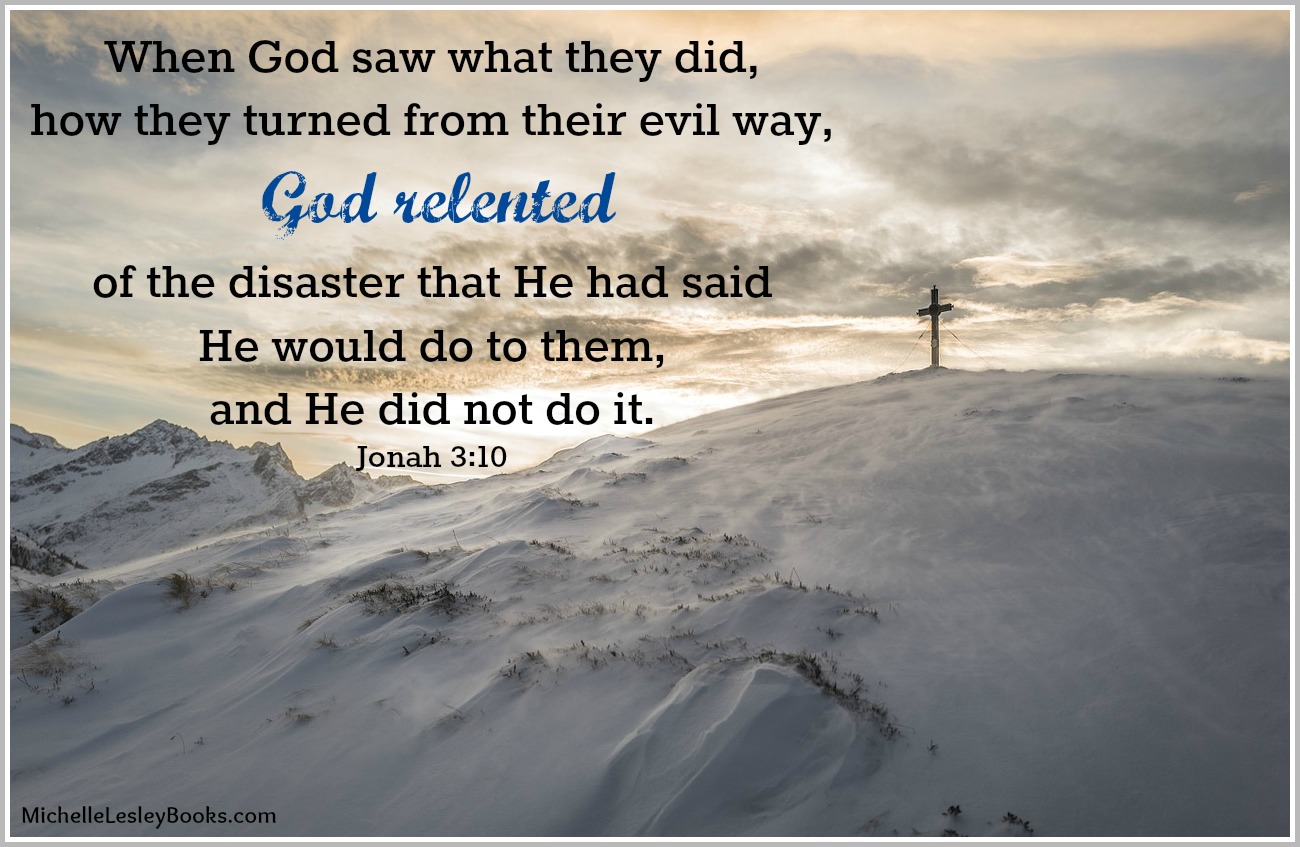
10 When God saw what they did, how they turned from their evil way, God relented of the disaster that he had said he would do to them, and he did not do it.
1. Jonah is officially considered a book of prophecy, but what other category of biblical literature (apocalyptic, epistle, wisdom, historical narrative, etc.) does it seem to fit into? What is the theme or purpose of the book of Jonah? Who are the main characters?
2. Verse 1 says this was the second time the word of the Lord came to Jonah. What was His word the first time, and what happened? How was Jonah’s response to God different this time? (3)
3. What was Jonah’s message to Ninevah? (4) Who were first to hear and respond to Jonah’s message, the people or the king? (5-6) Who initiated the fasting, sackcloth, and repentance? (5-6) Whom does verse 5 say the people believed?
4. What does verse 9 seem to indicate was the king’s primary motive for repentance, at least initially- avoiding the consequences of sin, or sorrow that he and his people had grieved God? Compare the king’s words with these passages. Explain the Bible’s emphasis on repentance from the heart.
5. In what ways does Jonah prefigure Christ? How was Jonah’s ministry in this passage similar to Jesus’ ministry? Compare the people they preached to and the message they preached. How does the mercy God showed the Ninevites (10) point ahead to His mercy toward us, through the cross, when we repent and place our faith in Christ?
Jonah is a fantastic little book. If you’d like to check out my 12 lesson, on line study of Jonah, click here.