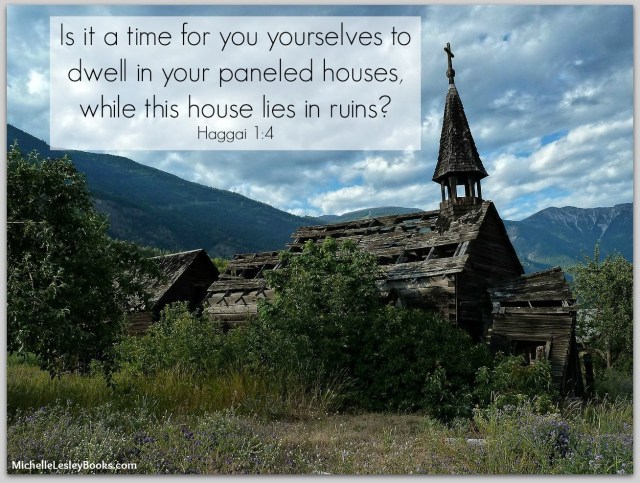
Wednesday's Word

Wednesday’s Word ~ Haggai 1

haggai 1 4

Haggai 1

In the second year of Darius the king, in the sixth month, on the first day of the month, the word of the Lord came by the hand of Haggai the prophet to Zerubbabel the son of Shealtiel, governor of Judah, and to Joshua the son of Jehozadak, the high priest: “Thus says the Lord of hosts: These people say the time has not yet come to rebuild the house of the Lord.” Then the word of the Lord came by the hand of Haggai the prophet, “Is it a time for you yourselves to dwell in your paneled houses, while this house lies in ruins? Now, therefore, thus says the Lord of hosts: Consider your ways. You have sown much, and harvested little. You eat, but you never have enough; you drink, but you never have your fill. You clothe yourselves, but no one is warm. And he who earns wages does so to put them into a bag with holes.

“Thus says the Lord of hosts: Consider your ways. Go up to the hills and bring wood and build the house, that I may take pleasure in it and that I may be glorified, says the Lord. You looked for much, and behold, it came to little. And when you brought it home, I blew it away. Why? declares the Lord of hosts. Because of my house that lies in ruins, while each of you busies himself with his own house.10 Therefore the heavens above you have withheld the dew, and the earth has withheld its produce.11 And I have called for a drought on the land and the hills, on the grain, the new wine, the oil, on what the ground brings forth, on man and beast, and on all their labors.”

12 Then Zerubbabel the son of Shealtiel, and Joshua the son of Jehozadak, the high priest, with all the remnant of the people, obeyed the voice of the Lord their God, and the words of Haggai the prophet, as the Lord their God had sent him. And the people feared the Lord. 13 Then Haggai, the messenger of the Lord, spoke to the people with the Lord‘s message, “I am with you, declares the Lord.” 14 And the Lord stirred up the spirit of Zerubbabel the son of Shealtiel, governor of Judah, and the spirit of Joshua the son of Jehozadak, the high priest, and the spirit of all the remnant of the people. And they came andworked on the house of the Lord of hosts, their God, 15 on the twenty-fourth day of the month, in the sixth month, in the second year of Darius the king.

The Holy Bible, English Standard Version Copyright © 2001 by Crossway Bibles, a publishing ministry of Good News Publishers.

 Questions to Consider:

1. What is the purpose of the book of Haggai? Which genre(s) of biblical literature (prophecy, epistle, narrative, wisdom, etc.) is the book of Haggai? What is the historical backdrop for this book?

2. What was the people’s position on rebuilding the temple? (2) Did God agree with them? What did God say about the priority of rebuilding the temple? (3-4) Read Acts 7:48-50. If God doesn’t need a building to live in, why was it so important to Him, and to the people, that they rebuild the temple? What are the two reasons God gave for rebuilding the temple? (8)

3. List the negative consequences the people experienced for neglecting to rebuild the temple. (6,9,10-11) What reason did God give for sending these negative consequences (9), and what was their intended purpose? What does God mean when He says, “Consider your ways,” in verse 5? In verse 7?

4. What were the two ways the people responded to the prophecy? (12) What were the two ways God responded back to them? (13-14) How is this similar to God’s response to our repentance? How would the words “restoration” and “reconciliation” apply in both this passage and in our repentance today?

5. What does this passage teach us about prioritizing our relationship with Christ, and our obedience to His word, above all other temporal concerns and activities? What can we learn about the negative consequences of sin? Has God ever used the negative consequences of sin to get your attention and draw you to repentance? What is God’s response to our repentance and obedience?

Wednesday's Word

Your input needed for the next phase of Wednesday’s Word.

13221149_1091405254239576_5911044701918356749_o

Ladies-

If you follow my Wednesday Bible Study on the blog (Wednesday’s Word), you may have noticed that, for the past year or so, I’ve been working my way through every book of the Bible, choosing a chapter from a different book each week.

Believe it or not, there really has been a method to my madness. My purpose was threefold:

  • To make sure readers got a taste of every single book of Scripture in hopes that you would discover a book you’d never given much thought to, and study it.
  • To demonstrate that every single book of Scripture is valuable and worth studying.
  • To encourage readers to delve more into the Old Testament in order to beef up familiarity with the broad overview of Scripture.

We’re just about to finish up this arc of Wednesday’s Word, and, starting June 1, it’s on to something new! We’re going to begin a study of a single book of Scripture, starting at the beginning and working our way through to the end. The only question is, which book will we study? The answer: You tell me!

The guidelines:

I’ve already written studies on Jonah and 1 John.

I’ve already covered all the “one chapter” books (Jude, Philemon, Obadiah, 2&3 John) during the last year of Wednesday’s Word.

I’d like to stay away from Daniel and Revelation for now.

And, if we’re going to do a numbered book (Kings, Timothy, Corinthians, etc.), I’d like to do the first one prior to subsequent ones.

So, let’s hear it. Which book of the Bible would you like to study on Wednesday’s Word? Comment below or head on over to Facebook and comment.

Calvinism/Arminianism, Mailbag

The Mailbag: What is Calvinism?

mailbag


What is Calvinism?

Calvinism, or Reformed theology (most people use the two terms interchangeably) is a theological framework, drawn from Scripture, for understanding the Bible, salvation, the nature of man, and the character of God. There are five basic tenets, or “points,” of Calvinism (also known as “the Doctrines of Grace”) which are often presented via the acronym “TULIP” (Please note that these are very brief, general descriptions. See the resources below for more nuanced information and scriptural support.):

Total Depravity: Due to the Fall (Adam’s sin in the Garden of Eden), all people are sinners from birth and in need of salvation.

Unconditional Election: God sovereignly predestines certain people to salvation. tulip-1227493_960_720Whether or not a person is predestined, or “elect,” has nothing to do with her merit or good deeds. God’s reasons and criteria are known only to God. We have no way of knowing who is elect and who is not, only that people who are genuinely saved were predestined to it.


Limited Atonement: The atonement for sin that Christ made on the cross applies only to those who are, or will, in the future be, saved.

Irresistible Grace: Those who are predestined to salvation are drawn to Christ by God and will desire and accept, rather than reject, God’s offer of grace for their sin.

Perseverance of the Saints: (Sometimes called “eternal security,” or “once saved, always saved.”) Those who are truly saved will continue in the faith for the rest of their lives. Someone who “used to be a Christian” was never truly saved in the first place.

I don’t describe myself as a “Five Point Calvinist” or a “three pointer,” etc., because, while I pretty much agree with all five points (and don’t reject any of them outright), I simply think these doctrines are far more nuanced than they are often presented by Calvinists. We don’t have everything all cut-and-dried figured out about what’s going on in the mind of God about electing people. With regard to human will, we don’t know precisely what God does in a person’s heart, and how He does it, at the exact moment of regeneration. We believe what Romans 9 says about election while simultaneously believing 2 Peter 3:9, that it’s not God’s desire for anyone to perish.

And you know what? That’s OK. It’s OK to hold those things in tension while we’re here on earth. We believe what Scripture says God does, but, where the Bible is silent as to how He does it, His reasons for doing it, etc., well, we trust God and believe Scripture there, too, because it says:

The secret things belong to the Lord our God, but the things that are revealed belong to us and to our children forever, that we may do all the words of this law. Deuteronomy 29:29

So that’s where I am, theologically speaking (I’ve written a little more about it here.) I guess you could say I’m a Reformed gal who leaves room for the mysteries of the mind of God.


Additional Resources:

What are the Doctrines of Grace? at Got Questions

Calvinism at Theopedia

What is Calvinism? at Ligonier Ministries

TULIP and Reformed Theology: An Introduction at Ligonier Ministries

Why I Am a Calvinist by Phil Johnson


If you have a question about: a well known Christian author/leader, a Bible passage, an aspect of theology, a current issue in Christianity, or how to biblically handle a family, life, or church situation, comment below (I’ll hold all questions in queue {unpublished} for a future edition of The Mailbag) or send me an e-mail or private message. If your question is chosen for publication, your anonymity will be protected.

Christian women, Men

Feminist Infiltration and the Emasculation of Christian Men

I hate radical secular feminism. I really do. Don’t get me wrong, I deeply appreciate the right to vote and own property. I think that men and women with the same amount of experience and education should be paid the same amount of money for doing the same job. And, I love seeing women study and develop their minds (particularly in the area of sound biblical doctrine.)

But what I don’t like is some of the methods that have been employed to achieve these things, the biblical values that have been sacrificed along the way, and the emasculating impact feminism has had on men.

Turn on any television show, watch a commercial, go to the movies, read the news, scroll through your social media feed, and examine the way men are generally viewed, spoken of, and being treated by others.

If a female character on a TV show slaps her husband or punches him in the arm, we laugh or sympathize with her anger, depending on the scenario, but if the roles were reversed we’d call the same behavior from a man abuse.

Men are frequently portrayed as bumbling incompetents as fathers, husbands, and employees, with a heroine mom, wife, or co-worker stepping in to save the day.

We see women wearing the pants in the family and treating their husbands like an extra child, and we see men who respond in kind: acting like children, obeying their wives’ commands, and, often, indulging in hours of childish pastimes, like video games, instead of working hard and caring for their families.

It’s not Father Knows Best anymore. It’s Father’s a Moronic Buffoon to Kick Around.

It’s not “Father Knows Best” anymore. It’s “Father’s a Moronic Buffoon to Kick Around”. And what’s alarming is that these attitudes have been creeping into the church for years.

And what’s alarming is that these attitudes have been creeping into the church for years.

Just as women rebelled against the law and social conventions to gain equality with men, “Christian” women now rebel against Scripture by becoming pastors and instructing and holding authority over men in the church. (In fact, this has been going on so long that many in the next generation aren’t even aware that the Bible prohibits this.)

Just as men in secular society have stepped back to avoid being run over by headstrong women, or even joined them in their quest for female dominance, evangelical men have abdicated their God-given positions of leadership in the church and home, sometimes even joining women in their violation of Scripture by inviting them into unbiblical positions of leadership and by sitting under their teaching and preaching.

Those are the things that are overt and visible. But it’s happening on a more subtle level, too, even among complementarian men, women, and churches.

Have you ever heard a man attempt to praise his wife by saying, “I married up,” or “way up,” or “way over my head,” and then proceed to describe himself as, basically, a bucket of slime in comparison to his wife? Most of the men I’ve heard say this have been good, godly men, including my husband, who has made similar remarks in the past.

Have you ever heard a man attempt to praise his wife by saying, “I married up,” or “way up,” or “way over my head,” and then proceed to describe himself as, basically, a bucket of slime in comparison to his wife?

I don’t know about the rest of you ladies, but I don’t want to hear anyone putting my husband (or any of my godly male friends) down, even my husband himself. The truth is, for believers, the cross is the great equalizer. We all marry equally up and equally down, because we are all redeemed, yet broken, sinful human beings- simultaneously saint and sinner.

The cross is the great equalizer. We all marry equally up and equally down, because we are all redeemed, yet broken, sinful human beings- simultaneously saint and sinner.

And what about things like this?

There are some really great messages in this video:

Being a mom can be tough, and husbands should appreciate all the hard work their wives do as mothers.

God wired women differently from men in a way that uniquely equips us for motherhood, and these differences are good and should be valued.

Dads need to step in and give moms a break every now and then.

It’s just supposed to be a lighthearted “moms are precious” video. I get that. But how are the makers of the video achieving the “lighthearted” part? By portraying dads as silly and hapless.

Where are we getting this idea that men have to be torn down in order to build women up? Not from the Bible, but from secular feminism. That’s their modus operandi, not God’s.

Where are we getting this idea that men have to be torn down in order to build women up? Not from the Bible, but from secular feminism.

We always look at Proverbs 31:10-31 with regard to what it says about excellent wives, but have you ever noticed what it says about husbands?

The heart of her husband trusts in her,
and he will have no lack of gain.
She does him good, and not harm…

Her husband is known in the gates
when he sits among the elders of the land…

Her children rise up and call her blessed;
her husband also, and he praises her:
“Many women have done excellently,
but you surpass them all.”
11-12a, 23, 28-29

We always look at Proverbs 31:10-31 with regard to what it says about excellent wives, but have you ever noticed what it says about husbands?

Here, in the quintessential passage praising godly wives, do we see a silly cartoon character of a husband? Do we see a husband being belittled so his wife can look good? No. We see a godly wife who does her husband good and inspires and encourages him to go out and conquer the world. We see a respectable man with a good reputation. And, we see a man who trusts, appreciates, and praises his wife without a hint of self deprecation.

The world’s way is that for women to be winners, men must lose. God’s way is iron sharpens iron. When wives are godly, it influences their husbands to be godly, and vice versa. When women fulfill the roles God has ordained for them at church, it frees and encourages men to be the leaders God has called them to be. We build each other up without tearing ourselves down. Nobody has to lose in order for somebody else to win. Godliness is truly a win-win situation.

The world’s way? For women to win, men must lose. God’s way is “iron sharpens iron”. We build each other up without tearing ourselves down. Nobody has to lose in order for somebody else to win. Godliness is truly a win-win situation.

Godly women are important, specially crafted by God for our roles, and worthy of honor and respect. But so are godly men. Let’s be sure, in the family and in the church, that we’re taking our cues from Scripture, not the world, when it comes to valuing women and men.

Ministry, Throwback Thursday

7 Ways to Encourage Your Minister of Music

Originally published November 18, 2014

Numerous articles have been written about how you, as a church member, can be an encouragement to your pastor- how you can constructively praise his sermon, pray for him, get him a great gift for Pastor Appreciation Month, etc. These are good things. Please be sure to support your pastor. Being a pastor is one of the toughest and most thankless jobs out there, and if you’ve read the statistics you know pastors need and deserve all the encouragement they can get.

Your preaching pastor isn’t the only person on your church’s staff who needs your support. So does your minister of music.

But your preaching pastor isn’t the only person on your church’s staff who needs your support. So does your minister of music. And, having been married to one for over twenty years, I can tell you there aren’t many articles out there letting you know how church members can encourage their ministers of music. Ready to show some love? Here are seven ways you can be an encouragement to your minister of music.

1.
Make practice a priority.

Before you join the choir or praise team or volunteer to play an instrument, find out how much of a time commitment it will be, and consider whether or not you can diligently keep that commitment. Once you’ve joined or volunteered, attend rehearsals, worship services, and performances faithfully, and be sure to arrive on time. You have no idea how much it means to your minister of music that he can count on you.

2.
Get to church on time.

Think about how you would feel if you planned a dinner party, worked hard all week cooking and cleaning, and then one of the couples you invited carelessly showed up halfway through the meal. You’d probably think that was kind of rude and feel somewhat discouraged. That’s sort of the way a minister of music can feel when people (especially the same people every week) habitually arrive late to church for non-emergency reasons. Not only that, but it’s a distraction to others when you come in late, plus you’re missing out on praising God and getting your heart prepared to receive His Word during the sermon. Being on time and ready for worship benefits everybody!

3.
Sing!

If you were in a meeting at work or in a college class, would you pick up your knitting, clip your nails, walk around the room chatting with friends, or bury your nose in your phone the whole time? Probably not, yet, over the years I have seen church members do all these and more during the music portion of the worship service. It’s disrespectful to the God we’re supposed to be worshiping and to the minister of music who is trying to do the work God has called him to. On the other hand, I love it when we get in the car after church and my husband says, with a smile on his face, “Wow, they were really singing today!” We have an incredible Savior who has given us the privilege of praising Him, so let’s take Him up on it. Sing out! You can worship and be an encourager all at the same time.

4.
Smile!

It’s pretty disheartening for a minister of music to stand up front, giving it all he’s got, and then look out over the congregation and see a bunch of people looking like they’d rather be at the dentist. Think about Who you’re singing to and all the reasons why you’re singing to Him, and I challenge you to keep a frown on your face! Just the simple act of smiling while you’re singing will do wonders for your minister of music (and for you!).

5.
Think before you complain.

Has your minister of music said or done something that’s clearly a sin or false doctrine? If so, you have a biblical obligation  to go to him -kindly and in love- and talk to him about it directly.

Is your complaint a matter of personal preference- style of music, whether or not he wears a tie, etc.? Give it 24 hours. Does it still seem just as important? Could you possibly be a servant to him (and others in the congregation whose opinion is the opposite of yours) by overlooking an offense and not complaining?

If you do feel the need to voice your concern (and there are valid concerns that aren’t sin-related), approach your minister of music the way you would want to be approached. Instead of, “Turn that dadgum volume DOWN!” how about, “I was wondering if it would be possible to ask the sound tech to lower the volume in the house speakers a little? My baby’s ears are very sensitive and she gets fussy when it’s that loud. I hate missing worship when I have to take her out to the lobby.” Instead of, “Hymns are so boring. I don’t see why we have to sing them half the time,” how about, “I really loved those two worship songs we sang this morning! Do you think we might be able to sing more songs like that soon?” Christ wants us to be kind to one another, so show your minister of music a little “Golden Rule” love.

6.
Speak encouraging words often.

It’s been our experience, and seems to be the general consensus among ministers of music, that the most common kind of feedback they get is negative feedback. People are much quicker to complain than affirm. Buck the trend. Did he choose one of your favorite songs for the service? Did a certain song help you to understand one of God’s attributes better? Did the choir do a nice job on their anthem? Are you praying for him? Tell him. He appreciates it more than you know.

7.
Show tangible appreciation.

It is amazing what even the smallest gift can do to lift my husband’s spirits. A card of appreciation (I have come across cards that he has saved for years), something related to one of his hobbies, a church member buying him lunch at a fast food place. They might be small items monetarily speaking, but their message is, “I care about you, and I appreciate your hard work.” And that’s priceless.

We have been blessed over the last two decades to serve at several churches that had members who were very good at encouraging their minister of music. Their love and support made my husband’s ministry a joy. What are some ways you can think of to encourage the minister of music at your church and spread that same kind of joy?