The Ten (10 Commandments Bible Study)

The Ten: Lesson 6

Previous Lessons: 1, 2, 3, 4, 5

Exodus 20:8-11

โ€œRemember the Sabbath day, to keep it holy. Six days you shall labor, and do all your work, 10 but the seventh day is a Sabbath to the Lord your God. On it you shall not do any work, you, or your son, or your daughter, your male servant, or your female servant, or your livestock, or the sojourner who is within your gates. 11 For in six days the Lord made heaven and earth, the sea, and all that is in them, and rested on the seventh day. Therefore the Lord blessed the Sabbath day and made it holy.

Exodus 31:13-17

โ€œYou are to speak to the people of Israel and say, โ€˜Above all you shall keep my Sabbaths, for this is a sign between me and you throughout your generations, that you may know that I, theย Lord, sanctify you.14ย You shall keep the Sabbath, because it is holy for you. Everyone who profanes it shall be put to death. Whoever does any work on it, that soul shall be cut off from among his people.ย 15ย Six days shall work be done, but the seventh day is a Sabbath of solemn rest, holy to theย Lord. Whoever does any work on the Sabbath day shall be put to death.ย 16ย Therefore the people of Israel shall keep the Sabbath, observing the Sabbath throughout their generations, as a covenant forever.ย 17ย It is a sign forever between me and the people of Israel that in six days theย Lordย made heaven and earth, and on the seventh day he rested and was refreshed.โ€™โ€


Matthew 12:1-14

At that time Jesus went through the grain fields on the Sabbath. His disciples were hungry, and they began to pluck heads of grain and to eat. But when the Pharisees saw it, they said to him, โ€œLook, your disciples are doing what is not lawful to do on the Sabbath.โ€ He said to them, โ€œHave you not read what David did when he was hungry, and those who were with him: how he entered the house of God and ate the bread of the Presence, which it was not lawful for him to eat nor for those who were with him, but only for the priests? Or have you not read in the Law how on the Sabbath the priests in the temple profane the Sabbath and are guiltless? I tell you, something greater than the temple is here. And if you had known what this means, โ€˜I desire mercy, and not sacrifice,โ€™ you would not have condemned the guiltless. For the Son of Man is lord of the Sabbath.โ€

(And he said to them, โ€œThe Sabbath was made for man, not man for the Sabbath.โ€ Mark 2:27- This verse is included in Markโ€™s account of the grain story.)

9ย He went on from there and entered their synagogue.ย 10ย And a man was there with a withered hand. And they asked him, โ€œIs it lawful to heal on the Sabbath?โ€โ€”so that they might accuse him.ย 11ย He said to them,ย โ€œWhich one of you who has a sheep, if it falls into a pit on the Sabbath, will not take hold of it and lift it out?ย 12ย Of how much more value is a man than a sheep! So it is lawful to do good on the Sabbath.โ€13ย Then he said to the man,ย โ€œStretch out your hand.โ€ย And the man stretched it out, and it was restored, healthy like the other.ย 14ย But the Pharisees went out and conspired against him, how to destroy him.


Luke 13:10-17

Now he was teaching in one of the synagogues on the Sabbath. 11ย And behold, there was a woman who had had a disabling spirit for eighteen years. She was bent over and could not fully straighten herself.12ย When Jesus saw her, he called her over and said to her, โ€œWoman, you are freed from your disability.โ€13ย And he laid his hands on her, and immediately she was made straight, and she glorified God. 14ย But the ruler of the synagogue, indignant because Jesus had healed on the Sabbath, said to the people, โ€œThere are six days in which work ought to be done. Come on those days and be healed, and not on the Sabbath day.โ€ 15ย Then the Lord answered him, โ€œYou hypocrites! Does not each of you on the Sabbath untie his ox or his donkey from the manger and lead it away to water it? 16ย And ought not this woman, a daughter of Abraham whom Satan bound for eighteen years, be loosed from this bond on the Sabbath day?โ€ 17ย As he said these things, all his adversaries were put to shame, and all the people rejoiced at all the glorious things that were done by him.


Colossians 2:16-17

Therefore let no one pass judgment on you in questions of food and drink, or with regard to a festival or a new moon or a Sabbath. 17 These are a shadow of the things to come, but the substance belongs to Christ.

Acts 2:42,44

And they devoted themselves to the apostles’ teaching and the fellowship, to the breaking of bread and the prayers…44 And all who believed were together and had all things in common.

Hebrews 10:24-25

And let us consider how to stir up one another to love and good works, 25 not neglecting to meet together, as is the habit of some, but encouraging one another, and all the more as you see the Day drawing near.


The Holy Bible, English Standard Version. ESVยฎ Permanent Text Editionยฎ (2016). Copyright ยฉ 2001 by Crossway Bibles, a publishing ministry of Good News Publishers.


Questions to Consider:

1. Examine the two Exodus passages. What was the purpose of the Sabbath for humans? (15) What did God mean by “labor” and “work”? (9-10, 14-15) What was the penalty for breaking the Sabbath? (14-15) What two things was the Sabbath to remind Israel of? (11,17; 13) How would remembering these two things lead the people to worship and honor God? Which word do verses 8, 11, and 14 use to characterize the Sabbath day itself? How would having a holy day of rest and worship, a reminder of God as Creator and that Israel was specially set apart by God, be a witness to the one true God to the pagan nations surrounding Israel?

2. Study the Matthew and Luke passages. Jesus was frequently called on the carpet by the Pharisees for “working” on the Sabbath. Most of the Old Testament verses regarding the Sabbath don’t specify what constitutes “work,” but a few do. The Pharisees had made many additional and burdensome rules about what constituted “work”- you could only walk a certain number of steps, you couldn’t drag a chair across a dirt floor (it would create a furrow, and that was “plowing”), etc. Considering the verses linked above and the Exodus passages, was Jesus really “working” on the Sabbath in the Matthew and Luke passages? Whose rules was Jesus breaking- man’s or God’s? What did Jesus say it was lawful to do on the Sabbath? (Matt. 12:12)

3. Review the purposes of the Sabbath in question 1. What did Jesus mean when He said the Sabbath was made for man, not man for the Sabbath? (Mark 2:27) How might this idea relate to overextending yourself with church activities? How busy are your Sundays?

4. In the Matthew and Luke passages, Jesus gives two examples of how the Pharisees care for their animals on the Sabbath. What are those examples? What message was He trying to get across to them? Would you say the Pharisees cared more for rule-keeping or people? How might Jesus’ “breaking” of the Sabbath in such a public way have been a threat to the Pharisees power and position?

5. What does the Colossians passage tell us about the Old Testament feasts and the Sabbath? (17) If Christ is the fulfillment of these foreshadowings, must Christians still observe the Jewish Sabbath?

6. Which day of the week was the Old Testament Sabbath? (Ex. 31:15) Why? (Ex. 20:11) Which day of the week do Christians worship on? Why? Compare and contrast the Sabbath pointing to God as Creator and Christians’ Sunday worship pointing to Christ as Savior.

7. What components should characterize Christian worship, according to the Acts and Hebrews passages? What can we glean from God’s Old Testament instructions about the Sabbath about things like rest, worship, and holiness that still apply to our Christian worship today?

What does “not neglecting to meet together” mean? Why does God say it is important that we regularly meet together? What is the heart attitude of a “non-neglector”?
a) I love my church family, worship, serving, and being taught God’s word. Why would I want to miss all that?
b) I like church. I’ll go if nothing more important pops up. I’m there about half the time.
c) Church is OK. I go when I wake up on time and feel like it. That’s about once a month or so.
d) You don’t have to go to church to be a Christian, so I don’t really need it. Maybe on Christmas and Easter, but that’s about it.

Which of these most closely matches your heart attitude about attending church? Is your attitude about faithful church attendance pleasing to God?


Homework:

If you were to keep a calendar of your church attendance, what would it look like? Are you at church each week unless Providentially hindered (emergencies, illness, etc.)?

  • If you know your attendance could be better in God’s eyes, repent and commit to being at church every week. What are some practical, proactive steps you could take (setting an earlier alarm, laying your clothes out Saturday night, etc.) to set yourself up for success?
  • If you are already faithful in your church attendance, are there any areas of service at your church that you could fill?
  • Are you faithful in your church attendance, and overextending yourself in serving? Consider the importance God placed on the Sabbath being a day of rest. Do you need to cut back on the number of church activities you’re committed to?

Evangelism

Sharing Christ with the Muslim Immigrant Next Door

share-christ-muslim-immigrant

Earlier this year, I published a guest post from Stacy, a missionary in Vienna, about ministering to refugees. It’s a great article, and I’d encourage you to read it if you haven’t yet: What Can I Do About the Refugees?

A reader commented on the article, understandably upset and afraid at the prospect of potential persecution of Christians and acts of terrorism – that, quite realistically, may happen with an influx of Muslim refugees – and expressed the need to prevent their entry into the U.S. (You can read her full comment by clicking on the title of the article above if you’d like.)

I’d like to share my response to her with you. Terrorism and persecution are things this generation has never had to face on U.S. soil until recently, but we need to face the reality that it will probably become commonplace within our lifetimes. How will we face our enemies in a Christlike way?

“I understand your fear. I really do. I live near New Orleans, a major, international port city which would be one of the first gateways for Muslim immigrants to enter this country. The city I live in is home to industries that are ripe targets for terrorist attacks.

And thereโ€™s nothing โ€“ absolutely nothing โ€“ I can do about it. Yes, I can vote and I can call and email my legislators and urge them to make laws I think are appropriate, but the bottom line is that theyโ€™re going to do whatever it is they want to do, and I have no control over that. Neither do you. Neither does Stacy.

So letโ€™s set aside the idea of โ€œallowingโ€ or โ€œwelcomingโ€ Muslim immigrants into our country (which is different from welcoming individual Muslims into our homes, when appropriate, or ministering to them in other venues). As average citizens, we donโ€™t have the power to allow or prevent them from coming in.

I want to clarify again, as I did above, that is not the point of this article.
Stacy is talking about ministering to people God places in your path no matter how they got there. No matter who they are. Have you not read Jesusโ€™ parable of the Good Samaritan? (Luke 10:25-37) Muslim immigrants who are already here or who, whether we want them to or not, may come here in the future, are our neighbors. Should we be wise and be careful? Of course. Should we allow our fear to keep us from obeying Christโ€™s command to share the gospel with others and minister to them? No way.

You said, โ€œLoving our enemies means sacrifice, pain, and even death.โ€ Youโ€™re absolutely right, and that is the kind of โ€œdie to self, take up your cross and follow Meโ€ love that Christ calls us to have for others. Because that is what He did for us. While we were at enmity with Him, He laid down His life for us. (Romans 5:8)

Christ gave His life to save Caiaphas and Pontius Pilate and the mob who screamed for His death and the enemy Roman soldiers who mocked Him, whipped Him, and drove thorns into His brow and nails into His hands and feet, so that their greatest need โ€“ the forgiveness of their sin โ€“ could be met.

The apostles got this (and they got it far better than we do today). They rejoiced that they were counted worthy to suffer for the name of Christ. (Acts 5:40-42) How can we not look upon loving, serving, and evangelizing our neighbors in the name of Christ in the same way?

Safety and caution are important, but they are not the Christianโ€™s number one concern. Our number one concern is to follow Christ and obey Him wherever that may lead us and whatever it may cost us. Where would we be if Christ had not done that for us?”

Christmas

Pondering God’s Promises

But Mary treasured up all these things,
pondering them in her heart. Luke 2:19

Ponder. It isnโ€™t a word we use very often, is it? It means to spend some time in reflection, considering, thinking deeply about things. Christmas is a time for pondering, and no one knew that better than Mary.

Luke 2:19 finds Mary, Joseph, and Jesus alone in the stable, at the culmination of a whirlwind of mind-boggling events.

Think about all Mary had been through in the last few months…

  • After 400 years of silence from God, between the close of the Old Testament and, now, the opening of the New, an angel showed up – a staggering event in and of itself – and brought her a nearly incomprehensible message. Mary was going to be the mother of Godโ€™s promised Messiah. And that’s not all. She would be the only woman ever to conceive by the Holy Spirit.
  • At some point Mary had to break the news to her parents that she was pregnant. Were they godly people of faith, as quick to believe as Mary had been? Or, did Mary fear they might be skeptical and shocked?
  • Next to hear the news was her betrothed, Joseph. Incredulous, his first thought was to obtain a quiet divorce. But God sent another angel and reassured him personally.
  • How did Mary’s friends, loved ones, and community react to her pregnancy? Did she have to endure long months of whispers, stares, and gossip? Was she in danger of stoning or other punishmentย as prescribed by Levitical law?
  • A visit to Elizabethโ€™s house yielded even more amazement as Mary’s cousin related her own incredible pregnancy story.
  • Next on the agenda was a long, uncomfortable trip to Bethlehem and the pain and danger that came with first century childbirth.
  • Before she was anywhere near ready for visitors, the shepherds arrived and regaled the little family with their fantastic story of a sky full of angels proclaiming the birth of the Savior to them.
  • And to top it all off, lying in her arms was a brand new, precious baby- her first. All of us who are moms remember the weightiness, and sometimes, panic, of holding our first baby. “What do I do first? How will I take care of this child? What if I mess it all up?” And Mary’s first child was God incarnate. King of the universe. Savior of the world. Think she felt a tad inadequate?

Maryโ€™s had quite a year, to put it mildly. And now the shepherds have left and she has a moment to catch her breath and reflect on all these events that led up to God fulfilling His promises to her, to Israel, and to the whole world. The promise of the Messiah- Jesus.

And just as Mary pondered the fulfillment of Godโ€™s promises in Christ, Christmas time is an oh-so-appropriate time for us to ponder the promises He has made to us in Christ.

Sometimes, it can be difficult to know exactly what God has promised us. If you peruse the books at your local Christian retailer or flip on your TV or radio to many of the โ€œChristianโ€ stations, youโ€™ll hear all sorts of things that God has supposedly promised us, things like: a bigger house, a better job, healing from every disease, that youโ€™ll be able to hear Godโ€™s voice speaking to you, miracles, restored relationships, a better life…

But does God really promise us all these things?

How do we find out what God has really promised us? We go straight to the source- Godโ€™s word. It is the only truly trustworthy source for knowing what God has promised us.

But there are a lot of promises in the Bible. Some of them are for us today and some of them arenโ€™t. For example, did God promise you that you would conceive by the Holy Spirit and give birth to the Messiah? No. That promise was only for Mary. Did God promise the United States Army that if they would go march around an enemy city and blow some horns that the city walls would fall down and they would conquer that city? No. That was for only for Joshua and Israel, and only that one time.

We learn which promises are for us by being good students of Godโ€™s word. By picking up our Bibles (and I would urge you, the best way to learn Godโ€™s word is to study Godโ€™s word, not somebody elseโ€™s book). We pick up our Bibles and study them in context, in a systematic way, rightly dividing the Word of truth, paying attention to who God is talking to in each passage.

So, as itโ€™s Christmas time and we reflect back on the Christmas story – maybe even pondering some of the same things that Mary did – what are some of the things God has promised us in Christ?

God has promised us forgiveness from our sin in Christ

When the angel came to visit Joseph and told him to go ahead and take Mary as his wife, the angel said:

Romans 5:8 says:

but God shows his love for us in that while we were still sinners, Christ died for us.

And 1 John 1:9 says:

If we confess our sins, he is faithful and just to forgive us our sins and to cleanse us from all unrighteousness.

The Bible says that all of us are dirty, rotten, wretched sinners. None is righteous, no not one. And since all of our good deeds – never mind the bad ones – are like filthy rags, thereโ€™s no way we could ever hope to make up for our sin by being a good person or doing good things.

And God, in His beautiful mercy and grace, doesn’t even require us to try. He reached down into our filth and sent His own Son to take the death penalty you and I deserve for our sin. He absorbed Godโ€™s wrath toward us, so that we can stand before God clean if weโ€™ll just repent and trust what Christ did for us on the cross. God promises to remove our sins as far as the east is from the west, to drop them in the depths of the sea, and to remember them no more. God promises us forgiveness in Christ.

God promises us trials and persecution

Doesn’t sound very Christmasy, does it? But perhaps we’ve forgotten the part of the Christmas story in which Mary and Joseph had to take Jesus and flee to Egypt because Herod wanted to kill Him.

And just as Jesus faced persecution and hardship, we can expect to face it too. Second Timothy 3:12 tells us:

Indeed, all who desire to live a godly life in Christ Jesus will be persecuted,

And John 16:33 says:

In this world you will have tribulation.

Just as Herod hated Christ, the world will hate us because of Christ. Just as Christ suffered because He was born into a broken and sinful world, so, we will suffer various trials and tribulations. In this world, you will have tribulation. But is that the end of that verse? No – praise God! – it is not.

The remainder of John 16:33 says โ€œBut take heart; I have overcome the world.โ€ The trials and tribulations and persecutions we face are all just light and momentary afflictions, because Christ has overcome the world- and our hope is not in this world.

One day, we will shuffle off this mortal coil and see Christ Jesus face to face. And when we look upon the beautiful face of Christ, if we even remember the troubles of this world, we wonโ€™t complain or whine or ask, โ€œWhy did You allow me to go through those things?โ€ or โ€œWhy didnโ€™t you give me my best life now?โ€  

Weโ€™ll say:

It was worth it.

And in the meantime, God promises to walk through that suffering with us. โ€œI will never leave you nor forsake you,โ€ He says, โ€œLo, I am with you always, even to the ends of the age.โ€ God promises us trials and persecution, but He promises to walk through them with us.

God promises us joy

When the angel appeared to the shepherds to announce the birth of Christ, he said:

โ€œAll the people.โ€ Thatโ€™s us, too! When we think about the good news of the gospel, it should bring us great joy.

Galatians 5:22 tells us that joy is part of the fruit that comes from the Holy Spirit indwelling us:

But the fruit of the Spirit is love, joy…

First Peter 1:8 says:

Though you have not seen him, you love him. Though you do not now see him, you believe in him and rejoice with joy that is inexpressible and filled with glory.

And why is that joy โ€œinexpressible and filled with gloryโ€? Why is it joy that will never fade away? Because our joy is found in Christ: who He is and what He has done for us. Joy isnโ€™t found in temporary circumstances- when youโ€™re healthy, when you have a lot of money in the bank, when your kids are all successful, when your job is going well. Those things can all be taken away in the blink of an eye.

But if your heart, your mind, and your life have been transformed by the good news of the gospel, you can have joy even in the midst of devastation and heartbreak, because Christ isnโ€™t going anywhere. He will always hold you and keep you and comfort you. He hears you when you pray and does whatโ€™s best for you. He takes care of you. He allows you to draw close to Him and discover more and more about Him through the study of His word. He gives you fellowship with your brothers and sisters in Christ.

That is the kind of joy God promises us in Christ.

God promises to provide for us

I wonder if Mary, while she was pondering all of these amazing things, reflected on the many ways God had provided for her. He provided a husband to take care of her, a cousin to encourage her, protection throughout her pregnancy, and a place to stay in Bethlehem.

God promises to provide for us, too. Philippians 4:19 says:

And my God will supply every need of yours according to his riches in glory in Christ Jesus.

And Jesus said in Matthew 6:31-33:

Therefore do not be anxious, saying, โ€˜What shall we eat?โ€™ or โ€˜What shall we drink?โ€™ or โ€˜What shall we wear?โ€™ For the Gentiles seek after all these things, and your heavenly Father knows that you need them all. But seek first the kingdom of God and his righteousness, and all these things will be added to you.

God is a good and loving Father. He knows all of our needs even better than we do. He wants us to work hard and ethically, make wise financial decisions, and be good stewards of the resources He has given us, but He wants us to trust Him and depend on Him – not a paycheck or a job or insurance or a savings account – to take care of us.

God provided manna in the wilderness every day. He owns the cattle on a thousand hills. The earth is the Lordโ€™s and the fullness thereof. And He has promised to provide for us.

Those are just a few of the wonderful things God has promised us. One of the great things about His promises is that there are so many of them. I could go on and on about Godโ€™s promises of peace, contentment, hope, love, Heaven, justice…

But Iโ€™d like to close with my favorite promise. Itโ€™s the promise that is foundational to all of Godโ€™s other promises:

All of God’s promises from Genesis to Revelation are fulfilled in Christ. God keeps His promises, and He keeps them in Christ.

As Mary pondered all the things God had promised her about Jesus, she didnโ€™t have to wonder if they were true or not. She had seen them come true with her own eyes.

How can we know that God keeps His promises to us in Christ? Because He proved it to us. He backed up His word with action:

Jesus Christ- the second Person of the Trinity, creator and ruler of the universe, King of Kings, Lord of Lords, the prince of Heaven, worshiped by angels, all powerful, all mighty, all knowing, worthy of all glory, honor, and praise – did not consider these things as things to be grasped or held tightly to.

But He emptied Himself and took on the form of a servant, being born in the likeness of men. Born, not into wealth, power, prestige, or position; not into a mansion or a palace, but born to plain, simple, anonymous people. And in humility, for most of His years, He lived a plain, simple, anonymous life. Resisting every temptation in thought, word, and deed, that He might become the perfect sacrifice for our sin.

And in the fullness of time, He was despised and rejected by men. Subjected to a kangaroo court, he was tried and convicted for crimes he did not commit, and sentenced to death- even death on a cross

Harsh, sinful men took Jesus out and smashed a crown of thorns down on His head. They mocked and scorned Him. They pulled His beard out. They pummeled Him with their fists. And then they whipped Him nearly to death.

They laid the rough, splintery cross beam across Jesus’ bruised and bloodied shoulders and led Him in humiliation through the streets of His beloved Jerusalem, outside the city gates, to be executed like a common criminal.

Those evil men used the very hands Jesus Himself had knit together in their mothersโ€™ wombs to reach down, pick up hammers, and drive spikes through wrists and feet of their Creator.

And Jesus hung there on that cross for hours in excruciating pain to to endure the holy, just, and righteous wrath of God toward our sin, to take the punishment that we deserve- and He did not.

Later that day, while Mary mourned, and the disciples scattered, and Satan thought he had finally conquered the God he hated, they took Jesus’ bloody, broken body down off the cross, laid him in a cold, dark, lonely cave, and rolled a stone across the opening.

Friday…

Saturday…

But Jesus didnโ€™t stay there, did He?

On that bright, beautiful, first Easter Sunday, Jesus left behind the sting of the grave and the bonds of death, and He walked out of that tomb conquering sin, death, hell, and the grave FOREVER.

FOREVER.

And He did it for you, and He did it for me. And any God who goes to those lengths for you and for me can be trusted to keep His promises. ALL of His promises.

Godโ€™s word is true, ladies- all of it. God can be trusted- He proved it in Christ. You can stake your life on His promises. You can stake your eternity on His promises. 

Ponder that.

The Ten (10 Commandments Bible Study)

The Ten: Lesson 5

Previous Lessons: 1, 2, 3, 4

Exodus 20:7

You shall not take the name of the Lord your God in vain, for the Lord will not hold him guiltless who takes his name in vain.

Leviticus 19:12

You shall not swear by my name falsely, and so profane the name of your God: I am the Lord.

James 5:12

But above all, my brothers, do not swear, either by heaven or by earth or by any other oath, but let your โ€œyesโ€ be yes and your โ€œnoโ€ be no, so that you may not fall under condemnation.


Jeremiah 14:13-14

Then I said: โ€œAh, Lord God, behold, the prophets say to them, โ€˜You shall not see the sword, nor shall you have famine, but I will give you assured peace in this place.โ€™โ€ 14 And the Lord said to me: โ€œThe prophets are prophesying lies in my name. I did not send them, nor did I command them or speak to them. They are prophesying to you a lying vision, worthless divination, and the deceit of their own minds.

Matthew 7:21-23

โ€œNot everyone who says to me, โ€˜Lord, Lord,โ€™ will enter the kingdom of heaven, but the one who does the will of my Father who is in heaven. On that day many will say to me, โ€˜Lord, Lord, did we not prophesy in your name, and cast out demons in your name, and do many mighty works in your name?โ€™ And then will I declare to them, โ€˜I never knew you; depart from me, you workers of lawlessness.โ€™


Psalm 111:9

He sent redemption to his people;
he has commanded his covenant forever.
Holy and awesome is his name!

Philippians 2:9-11

Therefore God has highly exalted him and bestowed on him the name that is above every name, so that at the name of Jesus every knee should bow, in heaven and on earth and under the earth, and every tongue confess that Jesus Christ is Lord, to the glory of God the Father.

Matthew 6:9

Pray then like this: โ€œOur Father in heaven, hallowed be your name.”


John 14:6

Jesus said to him, โ€œI am the way, and the truth, and the life. No one comes to the Father except through me.

Acts 4:12

And there is salvation in no one else, for there is no other name under heaven given among men by which we must be saved.

Romans 10:31

For โ€œeveryone who calls on the name of the Lord will be saved.โ€


Colossians 3:17

And whatever you do, in word or deed, do everything in the name of the Lord Jesus, giving thanks to God the Father through him.


The Holy Bible, English Standard Version. ESVยฎ Permanent Text Editionยฎ (2016). Copyright ยฉ 2001 by Crossway Bibles, a publishing ministry of Good News Publishers.


Questions to Consider:

1. Think about the phrase “in vain.” What does it mean? Sometimes we can get a better understanding of the Commandments if we turn the “thou shalt nots” into “thou shalts.” For example, “You shall not commit adultery,” could be restated, “You shall be faithful to your spouse.” “You shall not bear false witness,” could be restated, “You shall be honest.” How would you restate, “You shall not take God’s name in vain” as a “thou shalt”?

2. What is God’s response to those who take His name in vain (Exodus 20:7b)? Recalling that, at this point in history, God is in the process of setting His people apart from pagan nations and establishing Israel as a nation, why would it have been important for His people to revere and honor God’s name? Imagine you’re an Israelite at this time. Think back on what God has done for you and your people thus far. What should be your heart attitude toward God’s name?

3. Leviticus 19:12 and James 5:12 are cross-references to Exodus 20:7. How do these verses define taking God’s name in vain? How does swearing falsely (invoking God’s name and then lying or not following through with your promise or oath) profane God’s name? What does it say about a person’s esteem or reverence for God when she swears falsely? How would the pagan neighbor of an Israelite have viewed God if an Israelite swore falsely? How might lost people view Christians who swear falsely?

4. Leviticus 19:12 says that swearing falsely profanes God’s name. Examine these Scriptures. What were some other examples of Old Testament behavior that profaned God’s name? What are some ways Christians profane God’s name besides swearing falsely?

5. Examine the Jeremiah 14 and Matthew 7 passages. How did Old Testament false prophets and New Testament false teachers (as well as false teachers of today) misuse, dishonor, profane, and take God’s name in vain? How does their invoking of God’s name (“thus says the Lord,” “I declare ___ in Jesus’ name,” etc.) to give credibility to their message or ministry point to the power of using God’s name and why we are not to use it flippantly or misuse it? Do you think people are more likely to believe or give credibility to something when God’s name is attached to it?

6. Consider the Psalm, Philippians, and Matthew 6 passages. What do these verses indicate about the nature and character of God’s name (and God Himself)? What does this tell you about how we should treat the name of God? Can you think of any other verses that describe God’s name? (Hint- go to Bible Gateway and search phrases such as “name of the Lord,” “Jesus name,” etc.)

7. What do the John, Acts, and Romans verses teach us about the name of Christ as it relates to salvation? What does it mean that salvation is in His “name”? How is the role Christ’s name plays in salvation an indicator that we should treat His name as high and holy?

8. The New Testament says that Christians are “ambassadors for Christ.” We bear His name (Christ-ian) and are His representatives on earth. Colossians 3:17 says we are to do “everything” in the name of the Lord Jesus. Is it fair to say that when we sin while bearing His name and representing Him, that we are misusing His name and taking it in vain? Give some specific examples of how you, as an ambassador for Christ, have taken God’s name in vain by sinning.


Homework:

Many people think taking God’s name in vain is restricted to using God’s name as profanity, an expletive, or an exclamationย (“Oh my G-d!” “J-sus Chr-st!” “OMG,” etc.). As we’ve seen, there are many other ways to take God’s name in vain, but it still includes profanity, expletives, and exclamations. Examine your vocabulary this week. Do you use God’s or Jesus’ name (Interesting how we never hear the Holy Spirit’s name invoked this way, isn’t it? I wonder why.) in any of these ways? Repent, ask God to change your speech, and work on speaking God’s name reverently.

Cussing, Profanity, and OMG at A Word Fitly Spoken

Speaking Engagements

Report Back: Chicago

15380870_1483790701661859_4323964281052367505_n-edited

As many of you know, last week I flew from Baton Rouge to Chicago to speak at Water’s Edge Bible Church’s annual ladies’ Christmas banquet. I had a lovely time, and, since many have asked, I wanted to share a bit about it with you.

I arrived in Chicago Wednesday afternoon and had the privilege of attending Wednesday night church at WEBC, which made me feel right at home (because that’s what I would have been doing Wednesday night if Iย had been at home): dinner and fellowship, followed by prayer time and Bible study. A perfect match to my own church’s Wednesday night schedule.

I attended the women’s Bible study class, taught by Pastor Jayson York’s wife, Lindsay. What a pleasure! Lindsay taught straight from the Bible and handled God’s word expertly. And I was very impressed by how biblically knowledgeable the ladies in the class were. It was a perfect example of how women’s Bible studyย ought to be done.

cypxtnqxgaae175Jayson and Lindsay York and me

Thursday was the only day during my short trip that I had time to do anything touristy, so Lindsay and a few of the other ladies from WEBC graciously took me out for authentic Chicago deep dish pizza for lunch. (My bucket list consists mainly of eating and visiting various churches- what can I say?) It was awesome! I enjoyed getting to know Lindsay and the other ladies better and hearing their stories. And, of course, the pizza was delicious. Lots of cheese- my favorite!

15400406_1483790801661849_6025104277336049938_n15380772_1483790761661853_1371765955812390123_n-edited

If they’d had more cheese, I would have taken it.

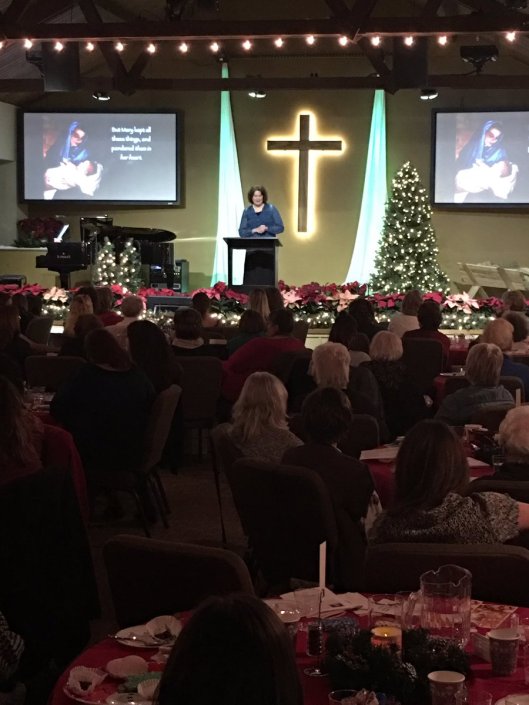
Thursday evening, I spoke to about a hundred ladies. Now this is a church that runs about 120 on Sunday mornings, so it was quite an encouragement to have that many women there. WEBC uses this annual event partly as an outreach, so a significant percentage of the attendees were not members of WEBC, and many of them were unsaved.

cyoxie-xeaedyr4Some of the 100+ lovely ladies in attendance

The theme for the evening was “Pondering the Promise,” taken from Luke 2:19:

But Mary treasured up all these things, pondering them in her heart.

I spoke about some of God’s promises that Mary may have been pondering that are also God’s promises to us today that we should ponder, mainly the promise of the gospel. (I’ll share the entirety of my speech in article format here on the blog this Friday.)

15380847_1483790848328511_9018555034775383392_nIt cracked me up to see this on the door of
the ladies’ room- and in the stalls!
Smart way to advertise!

I was so blessed to speak to several of the ladies after the event who were thankful that the unsaved friends they had invited got to hear a clear presentation of the gospel. Another of the ladies e-mailed one of the event coordinators the following (identifying details removed for anonymity):

“[My two unsaved friends] and I had a very meaningful conversation after the event…if you communicate with Michelle Lesley again, please let her know that the prayers of the people in her church and our prayers were heard! [These two unsaved friends] are the two that always seemed to be the most interested in Christ of my friends…They are interested in knowing more about the gospel and reading the Bible!”

This sweet lady mentioned that my church had been praying. I didn’t go to Chicago as some sort of Lone Ranger. My church sent me out, and to me, that’s deeply meaningful. I’m humbled and grateful to my Sunday School class and my pastor for praying for me and the event, for the ladies who sent encouraging texts while I was gone, and for the opportunity to share about how it went when I got back. I’m also very touched and thankful for those of you who prayed for me and encouraged me. (And for those who have asked, I had no problems with stage fright at all- praise God!) Thank you for holding the rope.

15253573_1483790661661863_3061748588269341143_n-editedBeautiful Christmas cookies for dessert!

Though I was glad to get back home to my family, I regretted having to leave Chicago so soon. My host family, Mr. Ken and Mrs. Kathy, as well as Jayson and Lindsay, and everyone I met at WEBC were so kind, gracious, and hospitable. I think just about every member of the church came up to me at some point and told me he or she had been praying for me and for the event. If such things can be measured, I’m sure they were all much more encouraging to me than I was to them. If you find yourself in the Chicago area and looking for a good church to attend, I couldn’t recommend Water’s Edge Bible Church more highly.

If your church is ever in need of a speaker for a women’s event, I’d love to come share with your ladies as well. Click here for more information.