Basic Training, Church

Basic Training: 7 Reasons Church is Not Optional and Non-Negotiable for Christians

For more in the Basic Training series, click here.
It’s a disturbing trend that’s spreading like the plague among evangelicals who claim to be Believers:

“I’m a Christian but I refuse to attend church.”

These aren’t people who can’t attend church due to health reasons, caring for an ill or disabled loved one, who have no other choice but to work some Sundays, or who live in an area with no reasonably doctrinally sound church to attend. They’re people who could get plugged in to a decent local church, but intentionally shun the body of Christ.

Usually, the decision to opt out of church boils down to one of two scenarios: a) a Believer who was hurt by a previous church and yet isn’t ready to risk being hurt again or b) someone (often a false convert) who doesn’t grasp the concept that being joyfully joined to a local body of believers is part of what defines someone as a Christian.

I can tell some of y’all have already fired up your e-mail programs or mentally formulated a corrective comment. Hang on, and please read what I’m about to say so we’re all on the same page here. I am not saying, have never said, and will never say that attending church, joining a church, serving at a church, or being baptized into a church is what saves a person, even in part. Going to church doesn’t make you a Christian. Everybody with me? Scripture is clear that salvation is by grace alone through faith alone in Christ alone, and that good works, such as church attendance, play zero part in a person’s salvation.

What I am saying is that one of the signs, or fruits, that someone is already saved is that she has a heartfelt love and affection for the things of God, which includes the gathering of the saints for fellowship, worship, encouragement, and edification. For a Believer, love for the bride of Christ is a natural extension of loving Christ, Himself. A Believer doesn’t have to be talked into attending church; there’s no place on earth he or she would rather be.

For a Believer, love for the bride of Christ is a natural extension of loving Christ, Himself. A Believer doesn’t have to be talked into attending church; there’s no place on earth he or she would rather be.

We’ve all been in difficult situations with difficult people at church that can hurt, sometimes deeply – believe me, I’ve been there – and can leave us in need of taking a few Sundays off to recover, or possibly the need to change to a healthier church. But if you’ve harbored antipathy toward the church, as a whole, for years, have never taken joy in fellowshipping and worshiping with fellow believers, don’t see any particular need for gathering with the Body, or are generally apathetic in your attitude toward church, you’re in a very dangerous place, spiritually, and you need to question your salvation. Those are symptoms of being lost, not fruit of being saved.

For Christians, being joined to a local church is not optional and non-negotiable. Why?

1. God Says So

Just in case the entirety of the Bible isn’t clear enough that God wants His people meeting together for fellowship, worship, and the Word, He says so very bluntly in Hebrews 10:24-25:

And let us consider how to stir up one another to love and good works, not neglecting to meet together, as is the habit of some, but encouraging one another, and all the more as you see the Day drawing near.

The HCSB puts it this way: “not staying away from our worship meetings, as some habitually do,” and NASB says: “not forsaking our own assembling together.” God says we are not to neglect, stay away from, or forsake, the meeting of the church body. For anyone who claims to be a Christian, that reason alone ought to be good enough. When God tells us to do something, we do it. Period.

2. The Church is God’s Plan for Christians

God doesn’t need or want your help devising the best methodology for your life and growth as a Christian. He already has a plan. He already established that plan. That plan is the church. There’s no plan B nor any cafeteria-style options. If you’re a Christian, God’s plan for you is to be a faithful part of a local body of Believers. The Bible never suggests that it’s OK for you to be a “Lone Ranger Christian.” There are no explicit statements to this effect, nor even one example of a New Testament Christian who lived life apart from the church. The New Testament assumes Christians will be part of a church. If not, the majority of Matthew through Revelation would be moot. If you reject membership in the local church, you’re rejecting God’s Word and His way in favor of your own way.

If you reject membership in the local church, you’re rejecting God’s Word and His way in favor of your own way.

3. Jesus Values the Church

You claim to love and follow Jesus, right? Well, Jesus founded the church. Jesus is the head of the church. Jesus loves the church. Jesus died for the church. Jesus is the Savior of the church. Jesus nourishes, cherishes, and sanctifies the church. How could anyone claim to love and follow Jesus and yet cavalierly toss aside something He values so much that He laid His life down for it? If you really love Jesus, you’ll value the things He values, and, clearly, He values the church.

If you really love Jesus, you’ll value the things He values, and, clearly, He values the church.

4. Being Joined to the Church Is an Indicator of Salvation

First John 2:18-19 makes no bones about it. Forsaking the church is an indicator that you’re not saved:

…now many antichrists have come…They went out from us, but they were not of us; for if they had been of us, they would have continued with us. But they went out, that it might become plain that they all are not of us.

Want to make it plain that you’re not of Christ? Step one is to leave the church.

5. The Church is the Dispensary for the Word and the Ordinances

The preaching and teaching of God’s Word. Baptism and the Lord’s Supper. In order to preserve their purity and sanctity, God established a hierarchical structure of ecclesiastical authority and placed the responsibility for administering Scripture and the ordinances with the church, not isolated individuals. Do we have women’s Bible studies and Sunday School classes? Of course. But only under the oversight of our pastors and elders, as an outflow of, and in keeping with, the preaching and teaching ministry of the church. Do we share the gospel with the lost we encounter during the week? You bet! Our churches enable us to do so by training us in the Word, and we bring new Believers back to our churches so that they may be discipled.

6. The “One Anothers”

Love one another. Comfort one another. Forgive one another. Serve one another. Bear one another’s burdens. Confess your sins to one another and pray for one another. Have you ever stopped to think which people “one another” is referring to? It’s easy to see when you look at these verses in context. It’s our brothers and sisters in Christ. All of the New Testament “one anothers” are written to the church. You need brothers and sisters to minister the “one anothers” to you, and your brothers and sisters need you to minister the “one anothers” to them. We cannot properly carry out the “one anothers” outside the church because they were meant to be practiced first and foremost within the church.

We cannot properly carry out the “one anothers” outside the church because they were meant to be practiced first and foremost within the church.

7. Sheep Need Shepherds

The Bible often uses sheep as a metaphor for God’s people. And since we know that God is the author of Scripture, we know God handpicked that metaphor to describe us. Ever notice that God never describes a sheep wandering off on its own as though that were a good thing?

All we like sheep have gone astray; we have turnedโ€”every oneโ€”to his own way;
Isaiah 53:6a

I have gone astray like a lost sheep; seek your servant,
Psalm 119:176a

When he saw the crowds, he had compassion for them, because they were harassed and helpless, like sheep without a shepherd.
Matthew 9:36

What do you think? If a man has a hundred sheep, and one of them has gone astray, does he not leave the ninety-nine on the mountains and go in search of the one that went astray?
Matthew 18:12

Sheep who leave the flock to make their own way in the world are in danger from wolves, the pitfalls of sin, and any number of other perils, especially the trials and tragedies of life. I can’t tell you how many e-mails I’ve received from distraught Christian women in dire personal circumstances who desperately need pastoral counsel. Sadly, when I tell them I’m not equipped to help them with such a complicated problem from so far away and that they need to make an appointment with their pastor for one on one, face to face counseling, the response is often, “I haven’t been going to church. I don’t have a pastor.”

We need the protection of the sheep pen, the brotherhood of the flock, and the leadership of our shepherds, our pastors, to help guide us. God knew we needed those things. That is one reason He established the church and created the position of pastor. Christ is our Good Shepherd, but until He returns, He has appointed godly men to watch over and protect the flock in His absence:

When they had finished breakfast, Jesus said to Simon Peter, โ€œSimon, son of John, do you love me more than these?โ€ He said to him, โ€œYes, Lord; you know that I love you.โ€ He said to him, โ€œFeed my lambs.โ€ He said to him a second time, โ€œSimon, son of John, do you love me?โ€ He said to him, โ€œYes, Lord; you know that I love you.โ€ He said to him, โ€œTend my sheep.โ€ He said to him the third time, โ€œSimon, son of John, do you love me?โ€ Peter was grieved because he said to him the third time, โ€œDo you love me?โ€ and he said to him, โ€œLord, you know everything; you know that I love you.โ€ Jesus said to him, โ€œFeed my sheep.
John 21:15-17

And he gave…the shepherds and teachers, to equip the saints for the work of ministry, for building up the body of Christ,
Ephesians 4:11-12

So I exhort the elders among you…shepherd the flock of God that is among you, exercising oversight, not under compulsion, but willingly, as God would have you; not for shameful gain, but eagerly; not domineering over those in your charge, but being examples to the flock. And when the chief Shepherd appears, you will receive the unfading crown of glory.
1 Peter 5:1-4

You can’t shepherd yourself. That internet pastor you listen to – even the most doctrinally sound one – can’t shepherd you. You need to be part of a flock led by a shepherd who knows you and cares for your soul.

Do you take joy in gathering regularly with your brothers and sisters in Christ for worship, the Word, the ordinances, building one another up, and serving one another? If not, the solution is not to leave the church altogether. The solution is to examine your heart against Scripture to discover whether or not you’re truly saved, and then to find a healthy church you can pour yourself into. Christ has given believers the local church as a blessing and a benefit, not a burden and a bore. Love and embrace this precious gift He has lavished on you.


Additional Resources

Searching for a new church?

What the Bible Says About Church Membership

Six Ways Not to Forsake the Assembly 

7 reasons worshipers need the church at The Cripplegate

Mailbag #49: Home Groups Over Church at 9Marks

My Jesus, I Love You; Your Bride I Despise! at Reformation21

Why You May Be Tempted To Neglect Your Church by Tim Challies

Five Essential Reasons for Christians to Gather in Public Worship at Ligonier

Prioritize Your Church by Tim Challies

Is a โ€œChurchless Christianโ€ an Oxymoron? at Ligonier

The Plight of Churchless Christians at The Cripplegate

40 reasons to be part of a local church at The Cripplegate

Church Attendance Is Not Optional on the G3 Podcast

Is it Necessary for Me to Join a Local Church? at G3 Ministries

Sanctification, Throwback Thursday

Throwback Thursday ~ With the First Fruits (and all the subsequent ones, as well)

Originally published July 22, 2010

Honor the LORD with your wealth
and with the firstfruits of all your produce;
Proverbs 3:9

Ouch. God really convicted me of something yesterday. The verse above, in its proper context, is clearly talking about honoring God with our material increase: our money, our possessions, the tangible fruit of our labor.

I’m a stay at home mom. My paycheck does not come in the form of dollars and cents, but in hours and minutes. My wealth is time, and lately, I haven’t been honoring God with it.

I confess, I have workaholic tendencies. I hit the ground running when I get up and don’t stop until I go to bed. We just moved into a new house. There’s a mountain of work to be done, and that’s how I’ve been spending my wealth of time. I have squeezed God in when it was convenient for me. I have given God the leftovers of my time; the scraps from the table He Himself has seen fit to bless me with. I have pushed Him aside and lavished my wealth on work.

I don’t want to “make time for God” any more. I want Him to so consume my heart, my mind, and my spirit that I can’t tear myself away. I want to be engulfed in passion for communion with Him. He is only honored when I give Him what He is rightfully due– everything.

Bible Study

Bible Book Backgrounds: Why You Need Them and Where to Find Them

It’s time for your daily Bible study. You’ve decided to study Habakkuk or Philippians or Lamentations.

When you pick up a random book of the Bible to study it, how do you know…

…what’s going on in biblical history at the time the book was written
…when the book was written and by whom
…who the intended audience was
…where, geographically, the action takes place
…cultural aspects of the period that will help you better understand allusions and customs?

Unless you’ve done a considerable amount of study in the field of biblical history and the ancient Middle East, the answer is: you probably don’t know all of those things. And, as a result, your study of the book you’ve chosen probably isn’t going to be as fully-orbed as it could be.

Not having done any advanced study in those areas myself, I learned a while back to rely on those who have, and who have taken the time to share their knowledge with the rest of us. When I study, teach, or write a study on a book of the Bible, I always start out by delving into the “story behind the story.” How?

Macro Bible Study 

Reading every book of the Bible is the best way to get a good grip on the meta-narrative of Scripture. Because the books of the Bible aren’t always arranged in order of the events they contain and because many books overlap in their events and timing, I highly recommend a chronological read-through of the Bible at least every few years.

Pay Attention to the Text

Sometimes the details you’re looking for are in the text itself. Perhaps a certain month and day are mentioned, or “during the reign of King ____.” If the text specifies a certain city or country, look it up on a good Bible map to get your bearings. Sometimes a particular custom or expression is explained as an aside, such as in 1 Samuel 9:9. Some books specify who they’re written to in the first few verses. Also be sure to use your Bible’s footnotes and cross reference notations, and look up any related verses that can bring clarity.

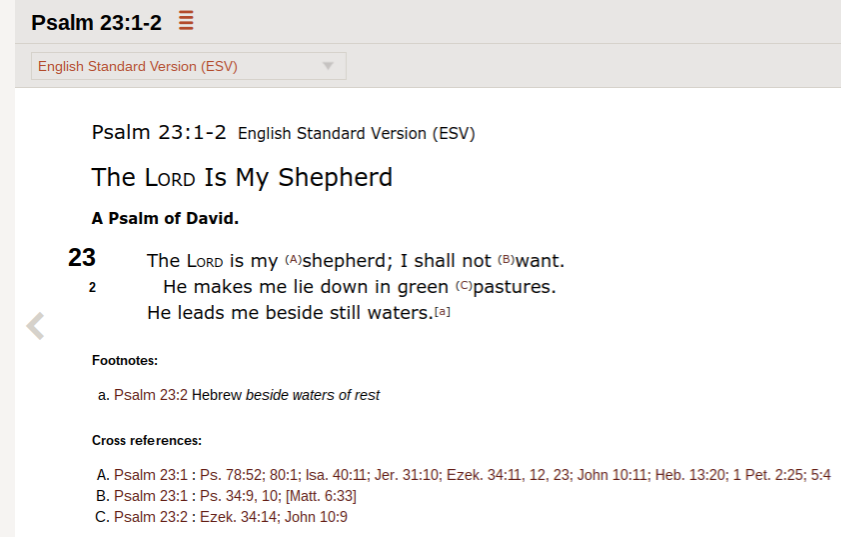
Footnotes explain wording.
Cross references suggest related passages.
(BibleGateway.com)

Study Bibles

There are some fantastic study Bibles out there (and also some duds you’ll want to avoid). Here are a few I highly recommend:

  • The MacArthur Study Bible Great theology, clear explanations. The only thing I would improve if I could is that I wish there were more notes on the Old Testament. (Also see “Bible Introductions” below.)
  • The Faithlife Study Bible app It’s free! Lots of great notes, articles, and diagrams, and because itโ€™s an app, itโ€™s got links, videos, and other great features.
  • The ESV Study Bible Super comprehensive. Itโ€™s like having a set of commentaries and the entire text of Scripture in one book.
  • The ESV Archaeology Study Bible This one is really good for getting a feel for what life, culture, and customs were like in biblical times – food, family, work, neighboring pagan nations, etc. It’s also very helpful with biblical geography.

“Bible Book Backgrounds”

This would be an overview, or survey, to read before you begin the book of Scripture you’ll be studying. I’ve found it’s helpful to use a survey of the book as a foundation and framework for subsequent study of the text.

While some commentaries contain an introduction to each book of the Bible, many do not. But I’ve found several online sites that provide helpful Bible Book Backgrounds:

Bible Introductions at Grace to You- A thorough overview of every book of the Bible, written by John MacArthur. These are the same introductions you’ll find in the MacArthur Study Bible.

Bible Book Overviews at Reformed Answers- Just put the name of the book you’re looking for in the search bar, followed by the word “overview.” You’ll also find overviews of the literary divisions of the Bible, such as an overview of the epistles, wisdom literature, etc.

Bible Surveys at Got Questions- Use the search bar to find the book survey you’re looking for. All surveys except the four gospels are entitled, “Book of ____ – Bible Survey.” You’ll find Matthew, Mark, Luke, and John as, “Gospel of ____.”

Helpful and (mostly) free Greek and Hebrew resources you might not know about at The Cripplegate- Sometimes getting some help with the original languages can also aid in your understanding of the book’s background and setting.

Dig in. Study. Search it out. Doing a “background check” on the book you’re studying is a great way to gain a deeper understanding and appreciation of God’s word.

Sermons

Do Christians and Muslims Worship the Same God?

Pluralism. It’s a popular idea these days- that all religions ultimately lead to God. But is it true? Do Muslims actually worship the God of the Bible, just in a different way? And, if so, is their worship acceptable in God’s eyes? If not, why has Rick Warren been encouraging Christians for several years to downplay our theological differences with Muslims and unite with them in our so-called areas of similarity? Wouldn’t God want us to share the gospel with Muslims instead?

Click below to listen in as Pastor Chris Rosebrough teaches on this aspect of the second Commandment (“You shall have no other gods before Me.”) as it applies to ecumenism between Christians and Muslims.

Do Christians and Muslims Worship the Same God?

Mailbag

The Mailbag: A Lost Husband, a Saved Wife, and an Apostate Church

My husband is unsaved, so I’ve had to take on the spiritual leadership of our home. As I’ve been growing in my discernment, I’ve learned that the churches we have been attending are not doctrinally sound. Thus, we have changed churches several times. My husband will attend church with our family, but is comfortable at our current church and doesn’t want to change again. Unfortunately, our current church is also doctrinally unsound. I feel very uncomfortable here and want to find a new, doctrinally sound church, but I’m concerned: a) that I won’t be submitting to my husband if I insist we leave, and, b) that my husband will refuse to attend church any more if I insist we leave this one. What should I do?

This question is actually an amalgam of two e-mails I’ve recently received asking basically the same question, which leads me to believe there are many other Christian women out there in similar circumstances.

It is heartbreaking when a husband and wife, whose souls God meant to be knit together as one, are separated by the gulf of eternity. It’s an unavoidable situation when two lost people get married and one subsequently gets saved, but it is completely avoidable if you’re saved before you get married. Single ladies, please be wise and learn from the pain your unequally yoked sisters have gone through: do not marry, or even date, someone you aren’t certain (as certain as you can possibly be, anyway) is a believer.

Normally, this is the type of question I decline to answer because it’s a situation that’s best handled by pastoral counsel. I don’t know all the nuances of the situation, the personalities involved, the doctrine of the particular church, etc. However, the readers who have asked my advice have both indicated that they’re in doctrinally unsound churches, so I can’t, in good conscience, refer them to “pastors” who may do more harm than good with their counsel. So, the best I can do is provide some biblical food for thought for these ladies to consider as they make their decisions.

Pray
God is so gracious and kind to remind us that if we need wisdom to handle things and make decisions, He will give it to us. When you’ve asked God for that wisdom, trust Him to give it to you and to guide you.

Additionally, ask God to provide you with a godly friend, pastor, or counselor to help you walk through this situation. You may wish to seek out a doctrinally sound church and set up a counseling appointment with the pastor or an elder. You could also look for an ACBC certified Biblical Counselor in your area (not just a “Christian counselor/therapist”- ACBC counselors are trained to help you apply correctly handled Scripture to your situation in a doctrinally sound way).

Finally, don’t neglect to pray for your husband’s salvation, and that God would soften his heart to attend a doctrinally sound church.

Study God’s Word
If you’re a believer, this should already be part of your daily life. Stay in the Word to keep yourself spiritually nourished, to gain biblical wisdom, and to be led by the Holy Spirit. It may be of some comfort to you to know that in the early days of the church, many Christian women (and men) were going through the exact same situation- being married to an unbeliever. There are a couple of passages that address this situation which you may want to give some extra study:

Likewise, wives, be subject to your own husbands, so that even if some do not obey the word, they may be won without a word by the conduct of their wives, when they see your respectful and pure conduct. Do not let your adorning be externalโ€”the braiding of hair and the putting on of gold jewelry, or the clothing you wearโ€” but let your adorning be the hidden person of the heart with the imperishable beauty of a gentle and quiet spirit, which in God’s sight is very precious. For this is how the holy women who hoped in God used to adorn themselves, by submitting to their own husbands, as Sarah obeyed Abraham, calling him lord. And you are her children, if you do good and do not fear anything that is frightening.
1 Peter 3:1-6

If any woman has a husband who is an unbeliever, and he consents to live with her, she should not divorce him. For the unbelieving husband is made holy because of his wife, and the unbelieving wife is made holy because of her husband. Otherwise your children would be unclean, but as it is, they are holy. But if the unbelieving partner separates, let it be so. In such cases the brother or sister is not enslaved. God has called you to peace. For how do you know, wife, whether you will save your husband? Or how do you know, husband, whether you will save your wife?
1 Corinthians 7:13-16

Submission? As the 1 Peter passage above makes clear, biblical submission is one of the ways Christian women can prepare the way of the Lord in the life of an unbelieving husband. We should certainly submit to our husbands in anything that doesn’t conflict with Scripture. However, our first loyalty and submission are to Christ, so a Christian woman cannot “submit” to her husband if he is asking her to do something that Christ has clearly said not to do in His written Word (I’ve written more about the issue of submission in other situations here and here.).

As you consider submitting to your husband in the various aspects of this situation, study these passages regarding sitting under the instruction of false teachers. Do your husband’s desires about staying in a doctrinally unsound church conflict with what God’s word says? That’s something you will have to pray about, study about, and, if possible, get some godly counsel about.

Practical observations/suggestions
Here’s something to take into consideration: It doesn’t do any good for someone to go to a “church” that teaches false doctrine just for the sake of being able to say that person attends church. In fact, it may actually harden his heart to the truth of the gospel.

Regarding false converts (people who think they’re Christians but actually aren’t), it’s often said, “Before we can get them saved, we first have to get them unsaved.” In other words, we have to do the hard work of “undoing” the false doctrine they’ve been taught, which has convinced them they’re saved, so they can come to terms with the fact that they aren’t actually saved, in order to correctly teach them the gospel so that they can truly be saved. Consider whether, by continuing to attend a church that teaches false doctrine with your husband, you might be doing something right now that will be difficult to undo later. A garden variety lost person who doesn’t attend church is no more lost than a lost person attending a church that teaches false doctrine.

Would your husband be open to staying home from church on Sunday for several weeks or months while you visit churches alone until you find one you’re confident is doctrinally sound?

Many churches have midweek, Saturday, and Sunday evening services. Perhaps you could explore another church on your own during non-Sunday morning services for a time until you’re sure it teaches sound doctrine, and then ask your husband if he’d be willing to change to that church.

Your husband probably views his church attendance as something he’s doing for you or for the kids. Is there any kind of “deal” you could work out where he changes to a doctrinally sound church “for you,” and, in exchange, you do something for him (make his favorite meal every week, take over a chore he hates, etc.)? He might be more willing to change churches if he thinks there’s a benefit to him for doing so.


If you have a question about: a Bible passage, an aspect of theology, a current issue in Christianity, or how to biblically handle a family, life, or church situation, comment below (Iโ€™ll hold all questions in queue {unpublished} for a future edition of The Mailbag) or send me an e-mail or private message. If your question is chosen for publication, your anonymity will be protected.