Sanctification, Sin

6 Reasons to Recapture Righteous Anger

Do you ever get the sense that anger is a problem in the church these days? It’s more apparent if you’re on social media, but even if you’re not you’ve probably seen Christians acting in anger in your church and Christian groups you belong to. Maybe even among your Christian family and friends.

In the evangelical social construct today’s Christian women have built and immersed themselves in where “being nice” is the highest attribute we can attain to, anger – any anger whatsoever – is usually seen as sin. The antipode of the sweet, effervescent, always-positive, don’t-rock-the-boat church ladies we’re “supposed” to be.

In the evangelical social construct today’s Christian women have built and immersed themselves in where “being nice” is the highest attribute we can attain to, anger – any anger whatsoever – is usually seen as sin.

Time to pick up the biggest rocks we can find and smash that pretty pink stained glass window, ladies.

The problem with anger in the church is not anger itself, but that Christians get angry about the wrong things instead of the right things, and act on that anger – sometimes even anger over the right things – in the wrong way. There are many things Christians should be angry about. Indeed, if Christians got angry about the things we’re supposed to get angry about and acted on that anger in a biblical way, the church would be better – and more Christlike – for it. But what are the right and godly reasons for getting angry and acting on that anger?

If Christians got angry about the things we’re supposed to get angry about and acted on that anger in a biblical way, the church would be better – and more Christlike – for it.

1.
Anger Is an Attribute of God

No character trait God exhibits can ever be considered intrinsically sinful because God is holy and perfect. God displays anger numerous times in the Bible, yet we know God is without sin. Therefore, we know that the emotion of anger itself is not a sin. It can’t be, or that would make God a sinner, and, by definition, not God. God’s anger demonstrates for us that there are times and situations in which anger is holy and good, and that there are godly ways to act on that anger.

God’s anger demonstrates for us that there are times and situations in which anger is holy and good, and that there are godly ways to act on that anger.

2.
Imago Dei

People are made in the image of God. The creation reflects – albeit dimly and sinfully – the Creator. No one has to teach us how to feel anger or love or justice or desire. Those things are just there, hard wired into us from the womb simply because we’re image bearers. Our sin nature is where the train jumps the tracks with those attributes, because sin causes us to apply those attributes to the wrong objects (loving an idol, desiring someone else’s spouse) and to express those attributes in wrong ways (vengeance, abuse).

3.
Multi-Tasking Attributes

God is simultaneously perfect in love, power, wrath, kindness, compassion, anger, justice, mercy, grace, patience, and all His other attributes. When we see Him pouring out His wrath, that doesn’t mean His attributes of love and compassion have disappeared. When God executes judgment, that doesn’t mean He has ceased to be a merciful and patient God. All of God’s attributes are 100% present and potent all of the time. And – though filtered through our sinful flesh – the same is true for Christians. Expressing anger over the right things in a godly way does not cancel out the fact that you’re also loving, kind, patient, peaceful, or joyful. God created us to reflect His nature by simultaneously exhibiting His attributes in a godly way.

God created us to reflect His nature by simultaneously exhibiting His attributes in a godly way.

4.
Symbiotic Anger

How can we know whether we’re getting angry over the right things or the wrong things? It is right and good to be angry over the things that anger God – idolatry, the defaming of His name, false doctrine, sin in the church, people who harm or take advantage of the innocent and vulnerable, dishonesty, cruelty, deception, the failure to do what is right – first and foremost when we see these sins in our own hearts and lives, but also against others who perpetrate these sins. But we may not be angry for sinful reasons such as pride, selfishness, impatience, self-righteousness, inflexibility, greed, hate, bigotry, lust, and personal preferences. What the Bible shows God getting angry about we should be angry about, too.

What the Bible shows God getting angry about we should be angry about, too.

5.
Anger Versus Sadness

A few months ago on social media, I mentioned an incident in which a male member of a certain church sinfully took advantage of several female members of that church. Without exception, every Christian woman (and many of the men) who commented on the incident made the statement (or some variation of it), “That’s so sad.” There are many aspects of a sinful situation over which it’s appropriate to feel sad. It was right to feel sad for this man’s completely innocent wife and children, as well as his victims and the church, who all suffered as a result of his sin. Jesus wept over the effect sin had on His beloved Jerusalem and the rift that sin created between God’s people and Himself. But, interestingly, both Matthew and Luke show us an instance of Jesus’ sorrow over sin immediately preceding or followed by an instance of Jesus’ anger over sin. It’s fine to feel sad for the people who innocently suffer as a result of someone else’s sin. It’s godly to grieve over the general effects and ultimate consequences of sin. But don’t stop there. We should also be angry at sin and at those who blaspheme the name of God and harm others by committing sin. The biblical instances of God being angry over sin and those who perpetrate it far outnumber the instances of God grieving over the effects of sin. Sadness is good, but it shouldn’t replace godly anger toward sin.

Sadness over sin is good, but it shouldn’t replace godly anger toward sin.

6.
Harness the Wild Stallion

Up until now, we’ve mostly been looking at the emotion of anger, but the emotion of anger usually leads to action. The fact that the emotion usually leads to action doesn’t mean the emotion always should lead to action. Sometimes it shouldn’t lead to action at all. Sometimes it shouldn’t lead to action right away. Sometimes it shouldn’t lead to action from you, but from a more appropriate person.

But most of the time, if you’re experiencing righteous anger over the right things, that godly anger should motivate you to take godly action using godly methods. And one of those godly methods is understanding the difference between letting the wild stallion of anger tear madly around the corral and putting a bit and bridle in its mouth to harness and guide all of that energy into plowing a field or pulling a wagon. Venting your anger to a friend might make you feel better temporarily, but it does nothing to fix the problems created by the sin you’re angry about. Harness your anger with the fruit of the Spirit and use that anger as a tool to energize and motivate you to help the victims of sin, call the sinner to repentance, set up a plan to prevent this sin from happening again, and repair the damage done by sin.

How often do you become righteously angry over sin? When you hear a false teacher twist God’s Word, do you blow it off as no big deal? Does it faze you at all when church members refuse to submit to your pastor’s biblical leadership? Do you lend an ear when your best friend verbally eviscerates her godly husband to you?

Ladies, there are things WORTH getting angry about. Righteous anger is not a bad, unloving, or unladylike thing.

Ladies, there are things worth getting angry about. Righteous anger is not a bad, unloving, or unladylike thing. If someone intentionally hurt your child, you would come unglued because you love him so much. What does it say about our love for the Lord when we defend people who mock Him, give the benefit of the doubt to those who defame Him, or yawn apathetically when people rebel against Christ and His Word? When someone blasphemes the name of the holy God of the universe, the Savior who willingly endured the cross for your sin, why wouldn’t you get angry about that? When someone attacks, betrays, or perpetrates evil upon a fellow image bearer – especially if that person is a brother or sister in Christ – you are right to be angry at both the sin and the sinner.

Anger over sin and evil is good and holy. God exhibits anger over sin and evil, and we, as His image bearers, should share His indignation. When Christians are angry over the right things and use that anger to fuel a godly response to sin it makes the church more biblically healthy and grows it to greater Christlikeness.

When Christians are angry over the right things and use that anger to fuel a godly response to sin it makes the church more biblically healthy and grows it to greater Christlikeness.

Uncategorized

Our Next Bible Study…And a Contest!

Happy Wednesday, Ladies! I hope you all enjoyed our study of the book of Mark. I’m not starting a new study today for a couple of reasons:

1) To allow a bit more time to catch up for those who might be behind in Mark.

2) I wanted to do something a little different to kick off our new study, the title of which is…

โ˜™โ˜™โ˜™โ˜™โ˜™โ˜™โ˜™โ˜™โ˜™โ˜™โ˜™โ˜™โ˜™โ˜™โ˜™
The Women of Genesis
โ˜™โ˜™โ˜™โ˜™โ˜™โ˜™โ˜™โ˜™โ˜™โ˜™โ˜™โ˜™โ˜™โ˜™โ˜™

Over the next few months, we’ll read through the entire book of Genesis, stopping along the way to give special attention to women like Eve, Sarah, Rachel, and others. We’ll examine their roles in biblical history, how their stories point us to Christ, and what we can learn from them as Christian women, wives, or mothers today.

Here’s where you (or maybe a friend) come in…

You’ve probably noticed that I design a title picture for each Bible study I write. Here are a few past title pics:

(You can see the rest of them at the Bible Studies tab, if you like.)

And as I was contemplating a title pic forย The Women of Genesis, I thought it might be fun to get some of y’all involved in the design process.

Do you enjoy and have a knack for photo editing? Know someone who does? If so, I’m accepting submissions for title pictures forย The Women of Genesis study. If your submission is chosen it will be used each week of the study, and you’ll be credited (name or web site) by watermark. I’d love to be able to offer a huge cash prize, but, hey, we’re small potatoes here. This is just for fun and maybe a little publicity for your site, if you have one.

Contest Guidelines

โ˜™ย You must use images that don’t require attribution. Pictures you’ve taken yourself are fine, as are images from sources such as Pixabay, Pexels, Freely, Unsplash, StockSnap, or other free stock photo web sites. Please include the image source web sites you use along with your submission. (You cannot just grab and use any old picture off the internet. Photographers own their images and usually require permission, attribution, and often a fee, for their use.)

โ˜™ Title picsย should be landscape (a horizontal rectangle) with a width of 640-1500 pixels and proportionate height. I prefer JPG images, but PNG is fine, too, if necessary.

โ˜™ย Your title pic must contain the full title of the study:ย The Women of Genesis.

โ˜™ย If your submission is selected, I’ll be glad to watermark it with your web site address (please submit your picture without any watermarks) as long as your web site doesn’t conflict with my statement of faithย or my beliefs outlined in the Welcome tab.

โ˜™ย Deadline for submissions is 11:59 p.m. Monday, November 6, 2017.ย 

โ˜™ E-mail your title pic submission along with your full name, web site address (if any), and the source(s) you used for your image(s) to MichelleLesley1@yahoo.com.

โ˜™ย Please don’t be offended if your submission isn’t selected. If I peruse all the submissions and I’m just not “feeling it,” I may still elect to design one of my own.

โ˜™โ˜™โ˜™โ˜™โ˜™

Feel free to share this around with friends who have an interest in photo editing. If you want to take a whack at it for fun but don’t know where to start, play around with Be Funky, PicMonkey, or Canvaย and see which one works best for you. Think about the book of Genesis and try to capture the feeling of the title,ย The Women of Genesis, in your image.

Happy designing!


Mailbag

The Mailbag: Help! There’s a pushy lady at my church!

There is a lady in my church who has become very involved in a certain form of parachurch Christian ministry. She is extremely gung ho about it and pressures church members to participate. She has also organized a conference, bringing in speakers from the national level of the ministry.ย The elders/pastors approved it, but there is some disagreement about bringing in outside speakers, charging attenders so much for tickets, and the fact that it is mainly drawing people from outside our church who are already involved in this ministry, not necessarily discipling our own church members, yet our church members bear the work of the conferences.

We, her friends, have watched her continue to insistently push this ministry agenda. She freely admits to being pushy and asks us to keep her accountable, but she continues to push and becomes frustrated when challenged. I have met with her one on one and discussed this, and she now avoids me. I guess my question is, is it right/OK for me to now keep my distance from her? Is it OK for a woman to push a ministry agenda in the church?

Every once in a while a situation arises at church that leaves you feeling like, “Church is great…except for the people.” I’ve felt that way many times over the years, and I’m certain many people have felt that way about me. Personality conflicts at church can be difficult to deal with, but they’re a great “homework assignment” from God that – if we approach them biblically – can help grow us and the other person in Christlikeness. Let’s take a look at some of the aspects of this reader’s situation.

Doctrinal clarity on the ministry:
I think the first question on the minds of many of those reading this article is going to be, “What kind of parachurch ministry is this?”. Because, if it’s a ministry that centers around false doctrine or is led by false teachers, that’s your answer right there.

I edited out references to the particular ministry the woman is involved in a) to protect my reader’s anonymity and b) because the reader assures me the issue isn’t the ministry itself, it’s the agenda pushing. I’m very familiar with this specific parachurch ministry. It’s doctrinally sound. The situation would be similar to someone getting very involved in pro-life ministry, for example.

Doctrinal clarity on the behavior:
From what the reader has described in her e-mails, the woman’s behavior, while annoying and possibly concerning, does not sound like it has reached the level of actual sin. The parachurch ministry is doctrinally sound, and she thinks it would be beneficial to her church. She has received approval from church leadership. It doesn’t sound like she’s being deceptive in any way or doing anything the Bible clearly prohibits; she’s just very excited about this ministry and wants others to be as excited and on board as she is. That’s not sin, it’s just off-putting to others who aren’t interested. We need to be clear on the biblical fact that just because somebody does something that aggravates us doesn’t necessarily mean it’s sin. And if it’s not sin, it shouldn’t be treated as though it were. (I’m not saying the reader is doing that, just a general concept all of us should be mindful of.)

Church leadership:
If this woman is bringing in conferences, speakers, and other events that utilize the church facility, she’s not doing it without the approval of the pastor and/or someone in leadership. What that means is, as much as other church members may not like it, the buck stops with the pastor/elders, and they have given their approval to the activities thus far. If they are having a problem with this woman being pushy with them, it is their responsibility as pastors and elders to sit down with her and put a stop to that. If the pastor/elders are aware of, and have a problem with ticket prices, church members doing all the work, and the other problems you mentioned, it is their job to address that. I understand your concerns, dear reader, and having dealt with people like this before, I certainly empathize, but if you insert yourself between this woman and the elders – regarding her pushiness with them or issues it’s their responsibility to address – you run the risk of becoming pushy yourself and stepping in where you don’t belong.

If you think the pastor and elders are unaware of pertinent information regarding this situation, talk to your husband about it, and pray together for wisdom as to if and how you, he, or both of you should approach them with the information, remembering that, as a godly wife, you need to respect and defer to your husband’s decision. If the pastor and elders receive the information and continue to approve the parachurch ministry conferences and activities, then your disagreement is with the pastor and elders, not the woman pushing the agenda.

Body parts:
You’ve asked if it’s OK for a woman to push a ministry agenda in the church. No, it’s not. It’s not OK for men to do so either. First Corinthians 12 compares church members to the various parts of the body. While “The eye cannot say to the hand, ‘I have no need of you,'” neither can the hand say to the eye, ear, nose, foot, mouth, etc., “You have to be a hand, just like me.”

It is absolutely fine to be excited about a ministry or a project at church and to invite and encourage people to participate in it, but crossing the line from inviting and encouraging to pressuring and badgering is not appropriate, biblical, or loving. It puts your brothers and sisters in the awkward position of either having to knuckle under and do something they don’t really want to do in order not to hurt your feelings, or having to say no and run the risk of hurting your feelings. It ends up making the decision to serve in a particular ministry all about you, the pushy person, rather than about whether or not God wants that person in that ministry at this time. And not only should we not be basing our decisions about whether or not to serve on pleasing man rather than on pleasing God, it is unloving and unkind to back a brother or sister into a corner, forcing them into a no-win situation. If you love your brothers and sisters in Christ, you’ll want them to serve because they’re convinced God wants them to serve, not because you want them to serve.

Woman to woman:
As far as your personal relationship with this woman goes, it sounds like you have tried to reach out to her and help her, which is commendable. We all have weaknesses, and it sounds like this lady’s weakness might be lack of self-awareness and social skills. Sometimes, no matter how gently and lovingly we approach someone about a personal issue, she will get defensive or avoidant. Maybe she just needs some time to settle down. People rarely stay at fever pitch about something forever.

Is it OK for you to keep your distance from her? Well, I don’t think you need to proactively pursue spending time with her, but I also don’t think you should avoid any of your normal church activities that would bring you into contact with her. And, of course, you should be kind and loving to her when you see her in passing. If she continues to press you about the ministry whenever she sees you, there’s nothing wrong with politely changing the subject or excusing yourself. And if she wants to know what’s going on, just kindly and lovingly be honest with her. For example: “Jane, I’m so glad you’ve found a ministry you’re excited about and enjoy, but it’s just not my cup of tea. Maybe we could talk about other things when we get together?”

Sanctification:
As I said in the beginning of this article, personality conflicts in the church aren’t easy to deal with, but if we submit to God and His Word in the situation, they can be very sanctifying.

When I have to deal with a Christian I find difficult it helps me to remember a few things. First, this is a sister in Christ, made in the image of God. God knit her together in her mother’s womb, breathed the breath of life into her, and bled and died on a cross for her sins just like He did for me. We areย allย sinners, and weย allย have various personality issues that sometimes rub others the wrong way. Second, for every person I run into who bugs me, there are probably a dozen who are buggedย by me. I’m not any better than the person I’m dealing with just because I don’t bug people the same way she does. I also try to keep in mind that Jesus had to deal with a lot of difficult people during His earthly ministry. And, while I frequently fail, I do my best to follow His example of how to treat people.

The people we’re in membership with at our local church are our family. Every family has a crazy grandma or a know it all uncle or a cousin who constantly drops the ball. But we don’t just give up on family because they annoy us. Pray – daily and fervently – for those crazy, annoying, frustrating, challenging brothers and sisters at your church. Pray that God will help you love them the way they need to be loved. Consider setting aside some time to just sit and listen to them pour out their hearts. Many people act out simply because they feel invisible, lonely, and unheard. Be patient with them. Be kind. Do something unexpectedly generous and loving for them. Exercise forbearance. Find a way to help. Scripture after Scripture shows us it’s God’s will for us to love the unlovely, just like we want others to love us when we’re unlovely. This is one of the reasons why we’re in the church.


If you have a question about: a Bible passage, an aspect of theology, a current issue in Christianity, or how to biblically handle a family, life, or church situation, comment below (Iโ€™ll hold all questions in queue {unpublished} for a future edition of The Mailbag) or send me an e-mail or private message. If your question is chosen for publication, your anonymity will be protected.

Church

Twelve Songs for Reformation Day

Reformation Day, October 31, is the annual observance of the anniversary of the Protestant Reformation. Celebrate the day with these songs showcasing each of the Five Solas of the Reformation, or use them as a guide for your Reformation Sunday worship set. (I’ve also compiled the videos below into a YouTube playlist entitled Reformation Day.) Soli Deo Gloria!

Sola Scriptura

Scripture alone – not church traditions, the teachings of man, or extra-biblical revelation – is what we base our beliefs and worship practices on.

O Word of God, Incarnate

The B-I-B-L-E

Sola Fide

We are not saved by good works, by by faith alone.

On Faith Alone I Stand

Let Us Plead for Faith Alone – Sola Fide

Sola Gratia

We are saved by God’s grace alone, not by any merit or righteousness of our own.

Grace Alone

Grace Greater Than Our Sin

Solus Christus

There is salvation in no other name but that of Christ alone.

In Christ Alone

The Church’s One Foundation

Soli Deo Gloria

To God alone be the glory for our salvation!

Soli Deo Gloria

Glorious is Thy Name

๐ŸŒท๐ŸŒท๐ŸŒท๐ŸŒท๐ŸŒท

Reformation Hymn

A Mighty Fortress is Our God

What’s your favorite Reformation Day song?


I have not exhaustively vetted these musicians and songwriters. please make sure to examine against Scripture any of them you choose to follow and make sure they are doctrinally sound.

Mark Bible Study

Mark: Lesson 24

Previous Lessons: 1, 2, 3, 4, 5, 6, 7, 8, 9, 10, 11, 12, 13, 14, 15, 16, 17, 18, 19, 20, 21, 22, 23

Mark 16

When the Sabbath was past,ย Mary Magdalene,ย Mary the mother of James, andย Salomeย bought spices, so that they might go and anoint him.ย 2ย And very early on the first day of the week, when the sun had risen, they went to the tomb.ย 3ย And they were saying to one another, โ€œWho will roll awayย the stone for us from the entrance of the tomb?โ€ย 4ย And looking up, they saw that the stone had been rolled backโ€”it was very large.5ย Andย entering the tomb, they saw a young man sitting on the right side,ย dressed inย a white robe, andย they were alarmed.ย 6ย And he said to them,ย โ€œDo not be alarmed. You seek Jesus of Nazareth, who was crucified. He has risen; he is not here. See the place where they laid him.ย 7ย But go, tell his disciples and Peter thatย he is going before you to Galilee. There you will see him,ย just as he told you.โ€ย 8ย And they went out and fled from the tomb, for trembling and astonishment had seized them, and they said nothing to anyone, for they were afraid.

[Some of the earliest manuscripts do not include 16:9โ€“20.]

9ย [[Now when he rose early on the first day of the week,ย he appeared first toย Mary Magdalene,ย from whom he had cast out seven demons.ย 10ย She went and told those who had been with him,ย as theyย mourned and wept.ย 11ย But when they heard that he was alive and had been seen by her, theyย would not believe it.

12ย After these thingsย he appeared inย another form to two of them, as they were walking into the country.13ย And they went back and told the rest, but they did not believe them.

14ย Afterwardย he appearedย to the eleven themselves as they were reclining at table, and he rebuked them for theirย unbelief andย hardness of heart, becauseย they had not believed those who saw him after he had risen.15ย And he said to them,ย โ€œGo into all the world andย proclaim the gospel toย the whole creation.ย 16ย Whoever believes and isย baptizedย will be saved, butย whoeverย does not believe will be condemned.ย 17ย Andย these signs will accompany those who believe:ย in my name they will cast out demons;ย they will speak in new tongues;18ย they will pick up serpents with their hands; and if they drink any deadly poison, it will not hurt them;ย they will lay their handsย on the sick, and they will recover.โ€

19ย So then the Lord Jesus,ย after he had spoken to them,ย was taken up into heaven andย sat down at the right hand of God.ย 20ย And they went out and preached everywhere, whileย the Lord worked with them and confirmedย the messageย by accompanying signs.]]


The Holy Bible, English Standard Version. ESVยฎ Permanent Text Editionยฎ (2016). Copyright ยฉ 2001 by Crossway Bibles, a publishing ministry of Good News Publishers.


Questions to Consider

1. Jesus was crucified and buried on a Friday afternoon. What day did the women go to the tomb to anoint His body? (2) Why did they wait until Sunday instead of going on Friday evening or Saturday? (1) How does verse 1 say the women obtained the spices? Would they have been able to purchase them or do the work of anointing Jesus’ body on the Sabbath? What was the purpose of anointing a dead body with spices?

2. Read verses 1-5, focusing on the women’s actions and conversation. Do their words and behavior indicate that they expected Jesus to be dead or alive? Why would they not have expected His resurrection since He prophesied it multiple times?

3.ย Why was there a stone sealing the entrance to Jesus’ tomb? (3-4) Compare what Pilate and the chief priests believed about Jesus’ resurrection, and their subsequent actions, with what the women believed about Jesus’ resurrection, and their subsequent actions. How did the unbelief of the two groups differ?

4. Even though Jesus had prophesied his resurrection many times, the women didn’t have much of a frame of reference for someone rising from the dead. How does God sending the angel to explain things to them (5-7) instead of scolding them for their failure to grasp the situation demonstrate His mercy and understanding of their human frailty? What was their emotional reaction (8) to all these events? In light of the recent events of the crucifixion, and the actions of people such as Pilate and the Jewish leaders, explain why the women might have reacted (8) the way they did.

5. Imagine the book of Mark ends with verse 8. Who and what is the focus of the last chapter of Mark’s gospel? Why is Jesus’ resurrection crucial to the Christian faith, and to you personally as a Christian?

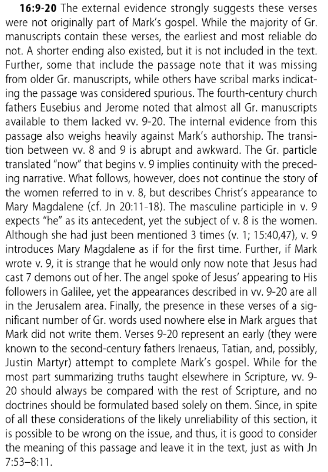
6. What does the notation between verses 8 and 9 mean? Read the following note on verses 9-20 from the MacArthur Study Bibleยน

What evidence does Dr. MacArthur cite that Mark may not have written verses 9-20 and that it may have been added later? Does this in any way mean that the Bible is unreliable or inerrant? What are some precautions Dr. MacArthur suggests we should take with 9-20, and how should we handle this text comparatively?

7. Compare verses 9-20 with Matthew 28, Luke 24, and John 20, and any cross references (on 9-20) your Bible lists. Is there anything in verses 9-20 that isn’t mentioned elsewhere in Scripture? Is it “safe” to believe everything in 9-20 that matches up with other Scripture?

8. What has been the most important thing you’ve learned from our study of the book of Mark?


ยนJohn MacArthur,ย The MacArthur Study Bible, English Standard Version, (Wheaton, IL:ย Crossway, 2010), p.1464-1465

Homework

Read the following resources on the ending of Mark:

The Fitting Ending to Mark’s Gospelย by John MacArthur

The Ending of Mark by Robert Stein

Should Mark 16:9-20 be in the Bible? at Got Questions?


Suggested Memory Verse

And he said to them,ย โ€œDo not be alarmed. You seek Jesus of Nazareth, who was crucified. He has risen; he is not here. See the place where they laid him.
Mark 16:6