Book Reviews, Guest Posts, Salvation

Guest Post: A Review of “From Death to Life: How Salvation Works”

If your theology pretty much matches up with mine (as outlined in the “Welcome” and “Statement of Faith” tabs) and you’d like to contribute a guest post, drop me an e-mail at MichelleLesley1@yahoo.com,
and let’s chat about it.
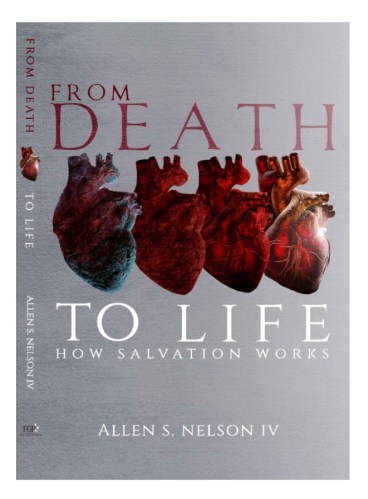
photo credit: Stephen J. Melniszyn

A Review of Allen S. Nelson IV’s
From Death to Life: How Salvation Works
by Katy B.

The most agonizing, frustrating experience in my ministry to women is the woman who claims to be “saved” but gives no evidence of it. No interest in talking about Jesus, no interest in holiness, reading the Bible, going to church, serving God’s people. She has a salvation testimony (often dramatic and self-glorifying) that is superficial, shallow, and devoid of any real repentance for her sin. I suspect she’s a false convert. And I find it exceptionally difficult to talk to false converts.

In From Death to Life, Pastor Allen Nelson confronts the disaster of false conversions, linking them to a false understanding of salvation: what it is, what it does, and how it works. He writes, “Ask fifteen people what it takes to be saved and it’s not out of the realm of possibility that you’ll get twenty different answers.” (Loc 173

He makes the bold statement that “there is no spiritual life in many who claim to be Christians in America.(Loc 247) He calls them the “walking dead”.

How does that happen? What would cause a person to wrongly believe he or she is a Christian? He lays some of the responsibility at the feet of churches that use methods such as external manipulation, diluted gospel presentations, the altar call, and the sinner’s prayer to lead the walking dead to their false professions of faith and their false assurances of salvation. He blisters easy-believism practices that, even if well-intentioned, have done damage to churches more influenced by a fallen culture than by God’s own Word.

So how does salvation work? The author has narrowed the answer down to five main points:

1. The gospel must be proclaimed.

2. God must move.

3. The sinner must respond in faith and repentance.

4. God justifies the sinner.

5. The sinner grows in the Lord over a lifetime.

Pastor Nelson not only unpacks, but folds, hangs up, and neatly puts away each of these main points in a few short chapters. In doing so, he poses and then answers questions such as, “What is the true gospel?”, “What is biblical repentance?”, “What is saving faith?”, and “What exactly is justification?” His answers are delivered in a direct, engaging, accessible style with plenty of biblical illustrations and scriptural references. No theological dictionary needed.

The book includes “howto’s” but doesn’t read like a “howto” manual. The tone is pastoral, sometimes comfortable, sometimes convicting, but never harsh. At times, the reading felt like sitting over coffee with Pastor Nelson, asking questions about various evangelistic situations, and receiving useful advice on how to respond.

A destitute woman in a homeless shelter, eyes pallid, needle tracks running down her arms, naturally incites my heart instinct to put my arms around her, tell her Jesus loves her, and give her some money. But Pastor Nelson reminds us:

“People need to hear more than “Jesus loves you,” What they need to hear today is what they’ve always needed: to know that they are sinners, that they need a Savior, that Jesus is that Savior, and until and unless they come to Him in faith, they will justly spend an eternity facing the punishment of their sins.” (Loc 2413)

He points out that it is vital that we all (not just the “trained professionals”) know what to say when the time comes to share the gospel of Christ. And while there is no formula, it is essential that the facts of the gospel are understood. The book helpfully guides the reader in a biblical understanding of how salvation happens and presents realistic examples of responses that can be used with unbelievers/false converts in evangelistic conversations.

The chapter “Plant, Water, Trust God, Repeat” is a compelling warning to stick to a biblical approach to evangelizing the lost. (Throughout the book he gives examples of unbiblical approaches.) In this encouraging chapter, he discusses applying how salvation works in real life scenarios, acknowledging that it is not always easy. He doesn’t present himself as a superhero evangelist.

This is a serious book, but the author can also be funny. I got a laugh out of his response to the command to “ask Jesus into your heart”. His tone, however, is utterly serious when discussing repentance:

“God doesn’t beg people to repent so they can be the star player on His team. He demands repentance. He owes mankind nothing. What a fearful and insolent game we play by making repentance an optional feature to becoming a Christian, refusing to properly define it in hopes of sneaking people into the kingdom, or by flat out dismissing it altogether.” (Loc 1164)

He spends a good bit of time parked on repentance, emphasizing that biblical repentance is necessary for any person to become a Christian. He asserts, “Remorse does not equal repentance” and goes on to give what he calls the bare necessities of repentance.

Is it possible to know if a person has actually been converted? In the chapter on sanctification, the author acknowledges that while we can’t see the heart, we can use the discernment God gives us to see evidence of true conversion. He provides a practical alliteration method to assist in discerning whether or not the gospel has actually taken root in a person’s heart and the changes we would expect to see in a truly converted person.

He warns the church against haphazardly affirming people as Christians without exercising grace-filled discernment:

“Often, we claim that the problem in our churches is that too many people are immature believers when the real problem is that many we call immature, actually have no life in Christ at all. They aren’t growing because they aren’t living.” (Loc 1878)

The sanctification chapter, my favorite, thrust me to a fresh examination of my own life using his alliteration template. What evidence of salvation would others see in me? What would they discern as my motivation for life? There is plenty of self-application for the reader.

The book has three appendices. Appendix 1: The Sinner’s Prayer, Appendix 2: Acts 2 is Not an Altar Call, Appendix 3: Putting “Baptist” Back in Your Church. In these appendices, the author makes some “say whaaaat?!? observations that will rock your world if your church endorses these practices.

This is a short book. Although the print version is only 200 pages, there is nothing shallow about the content. The reader will step into a deep pool. Did I know how salvation works before I read the book? Yes. Have I been guilty of using unbiblical methods to try to bring about a conversion? Yes. I finished the book with an unanticipated, heart wrenching reorientation to the gospel as the power of God unto salvation. I bet I’m not the only reader who closed the book and repented.

I began by saying I find it exceptionally difficult to talk to false converts. What do you say to someone who believes she is saved when it is clear that she is not? Pastor Nelson is immeasurably supportive in reinforcing that “we must proclaim the gospel. Without it, people will go to hell. It’s as simple as that.” (Loc 441)

The book left me feeling hopeful, energized, looking forward to my next evangelistic encounter. God saves sinners. God saves sinners. And he uses sinners like me to do so.

Pastor Nelson writes, “Every single one of us is charged with sharing the gospel with those God providentially places in our life.” What a calling, what a staggering privilege. God could sovereignly call His own to Himself without us, but He has chosen to work through us. This book will certainly help us in our evangelism. I recommend it for everyone.

¹Katy reviewed the Kindle edition of the book and used Kindle location numbers rather than page numbers.


Allen “Cuatro” Nelson, IV, author of From Death to Life, is the pastor of Perryville Second Baptist Church in Perryville, Arkansas, and co-host of The Rural Church Podcast. Contact Him directly via Twitter to receive a free study guide with your order of From Death to Life or a discount on bulk orders. You can also order from Amazon.

Katy can’t remember when she became a Christian but is assured that, by the grace of God alone, she is a Christian. She ministers to women in her OPC church, in homeless shelters, in a prison, and sometimes at the grocery store. She is an executive with a United States health care corporation and enjoys her work, although she would rather be reading. You can find Katy on Twitter at @KatyvonBora.


ALTHOUGH I DO MY BEST TO THOROUGHLY VET THE THEOLOGY OF THOSE WHO SUBMIT GUEST POSTS, IT IS ALWAYS POSSIBLE FOR THINGS TO SLIP THROUGH THE CRACKS. PLEASE MAKE SURE ANYONE YOU FOLLOW, INCLUDING ME, RIGHTLY AND FAITHFULLY HANDLES GOD’S WORD AND HOLDS TO SOUND BIBLICAL DOCTRINE.
Mailbag

The Mailbag: How can the problems in the SBC (or any denomination/church) be fixed?

I read your article, It’s Time for a Reformation in the SBC – 3 Issues We Need to Set Right. In that article you only covered the issues needing correction, not the solutions. How would you suggest the Southern Baptist Convention, or any other church or denomination with similar problems, address those issues?

One of the reasons I addressed only the issues in that article is that a discussion of the issues and the solutions would have made the article extremely long. Another reason is that I know most of my readers are probably not Southern Baptist. Some of the solutions that first came to my mind would have been very “in house” to the SBC and would not have been of interest – nor made sense, without a lot of explanation (making the article even longer), of Southern Baptist polity – to those outside the SBC. However, the more I thought about the spiritual side of the issues, the more my perspective on the solutions changed. And addressing spiritual issues is relevant to every church and denomination.

As I mentioned in the previous article, the three most pressing issues I see facing the SBC are the sufficiency and authority of Scripture, false teachers/false doctrine, and disfellowshipping errant churches.

Because of the SBC’s commitment to the autonomy of the local church, I don’t think any of these things are going to be corrected from the top down with resolutions and studies and committees and appointed/elected leaders. I can only speak from my own perspective, and others may disagree, but I don’t see those things making any of these issues better, and in some cases they’re making things worse. I think turning the ship around is going to have to be a “bottom up” thing, starting at the church level.

So, what are some grassroots steps we can take?

✢ We’re going to have to stop giving lip service to prayer and actually start doing it. Individual prayer, yes, but what I’m really talking about is corporate prayer. Not “organ recitals”, not Bible studies or worship services that we call “prayer meetings”, but actual, protracted corporate prayer meetings where we concentrate on praying for the spiritual health of our own church, other churches, and our denomination at large. The problems we’re facing are, at their root, spiritual problems, and only God can change people’s hearts. It’s high time we started crying out to Him to do so.

I know it’s hard to get people to show up for actual prayer meetings. I used to be the Associational Prayer Coordinator for my local SBC association. Believe me, I get that it’s like pulling teeth. Pastors are going to have to get as many of their teachers and leaders as possible on board and start by praying with them. Next, we need our pastors to spend some weeks and months training their people in how to pray, why we pray, what we pray for, the importance of prayer, and what the Bible says about prayer. And then we’ll need pastors to proactively encourage people to be there. In my experience, corporate prayer has to be pastor initiated and led. If it’s delegated to a lay person or even an associate pastor, the rest of the church will see it as just one more optional program.

✢ We have to emphasize the authority of Scripture over every aspect of church life. Is the church considering buying a new piece of property? Sending messengers to the annual meeting? Joining with another church in a particular endeavor? Planning a mission trip? Receiving a new member? Having a potluck? Whatever is going on in the life of the church, the very first thing that needs to be brought to the table at committee meetings, business meetings, even just casual discussions or brainstorming sessions, is an open Bible and the question, “What does Scripture say about this?” I think many times we’re either assuming that most people already know what the Bible says about it, or we’re doing what we think is best without consulting God’s Word, neither of which is healthy. We need to make sure we’re doing what we do because the Bible says to do it, but approaching church decisions this way also trains individual members to think and act the same “What does Scripture say about this?” way in their own lives. That grows a healthier and more mature church body.

This helps drive home the concept of the sufficiency of Scripture, too. If your church is laser focused on “What does the Bible say?”, it’s going to biblically train your people how to find the answers they need for their own lives, and church life, in the Bible. Instead of “God told me” extra-biblical revelation, instead of taking polls and surveys, sometimes even instead of forming a committee or having one more meeting, the Body will begin to depend on God’s Word as its sufficient source for making decisions.

✢ Another way to emphasize the sufficiency of Scripture is to stop being so dependent on “canned” Sunday School curricula and Bible study books, workbooks, DVDs etc., and simply teach straight from the Bible expositionally (it’s cheaper too).

This scenario has played itself out in hundreds of SBC churches over the years: The women’s ministry committee gets together to decide what the next women’s Bible study will be. This author is suggested. That DVD series is suggested. Finally one brave soul pipes up and says, “Why don’t we just study Ephesians?”. The looks on the other women’s faces demonstrate that studying straight from the Bible is a totally foreign concept.

My husband is a minister of music. He was on staff at a small church many years ago that was in a budget crunch. Something was going to have to be cut. I suggested cutting out Sunday School literature and just teaching the Bible. They opted instead to slash my husband’s salary (which was pretty paltry to begin with).

When we’ve become so dependent on materials other than the Bible that church members have never heard of simply studying from the Bible or that the church would rather hurt one of its pastors than give up its literature, we’ve become too dependent on outside resources and we’re not viewing the Bible as sufficient.

✢ If and when we do decide to use a curriculum or a study, we must vet the study itself and the author(s). I know this is an unpopular thing to say among Southern Baptists, but I was asked for solutions, so I’m going to say it: LifeWay sells some materials authored by false teachers and some materials that contain false doctrine. You can’t just assume that because LifeWay sells it, it’s doctrinally sound. Get some discerning church members and put them to work reading the materials and comparing them to Scripture, and examining the fruit of the author’s life.

✢ We’re going to have to be good Bereans and stop being so flippant and laissez-faire about false teachers and false doctrine. Eradicating false doctrine and false teachers from the house of God is a major theme of the Bible. If it’s that serious to God, it should be that serious to us.

If somebody mentions that a certain Christian author, pastor, or teacher is a false teacher, don’t mock, insult, and blow that person off as “one of those crazy discernment people.” We don’t have to (and shouldn’t) just blindly believe her, but we shouldn’t just dismiss the allegation out of hand, either. Look into it. Do the research. Examine the evidence. Compare that teacher’s life and teaching to rightly handled Scripture, and if she’s not walking blamelessly and teaching what accords with sound doctrine, stop allowing her and her materials into your church.

✢ [Note: This part is more SBC-ish. Most other denominations have a process and governing body for dismissing errant churches. But because the SBC is technically not a denomination but a group of cooperating churches, the leadership of the SBC has very little ecclesiastical authority, including the authority to disfellowship churches.] As far as disfellowshipping errant churches goes, first, we need to make sure our church isn’t one of them. We need our pastors to exposit the Word, not entertain. We need to make sure we equip our membership in rightly handling God’s Word, prayer, evangelism, worship, and caring for one another. We need to make sure our church is biblically healthy.

Next, get involved with the local association and, whatever the procedure is, formulate a set of criteria for disfellowshipping errant churches, employ it when necessary, and pursue it to the state and national convention levels when possible. There are a variety of doctrinal issues that could be included (A couple I would suggest: disfellowshipping churches that violate tenets of the Baptist Faith and Message 2000 and/or teach any of the historic heresies {Arianism, Modalism, etc.}), but as I mentioned in the above linked article there’s got to be a higher standard than just giving money and being on the right side of homosexuality. We should be holding up the highest standards of biblical doctrine for churches who want the right to be called Southern Baptist, not minimizing and reducing our requirements to the least common denominator.

Pray long and pray hard. Build spiritually healthy and mature churches and church members. Get them involved at the associational and state convention level. Then send them to represent your church at the annual meeting. If God is pleased to change hearts, and if we get enough healthy churches and church members working together, that’s what will bring change at the national level.


If you have a question about: a Bible passage, an aspect of theology, a current issue in Christianity, or how to biblically handle a family, life, or church situation, comment below (I’ll hold all questions in queue {unpublished} for a future edition of The Mailbag) or send me an e-mail or private message. If your question is chosen for publication, your anonymity will be protected.

Sanctification

The Christian Introvert: Putting Off Social Anxiety, Putting On Serving Others

A lot of people don’t believe me when I tell them this, but I’m kind of an introvert. On Sundays, after Sunday School, church, then Sunday dinner with my extended family, I usually go home and get straight in the bed for some quiet time and a nap, often with muscles aching from stress. I love my church, my family, and spending time with people, but for some reason, social interaction can be a bit draining for me after several hours.

And interacting with people I don’t know very well? Don’t get me started on all the different levels of anxiety that, for me, go hand-in-hand with introversion. My gut-level reaction to walking into a room full of strangers is to turn around and run as far away as possible.

But all of this sort of thinking is very self-centered. When I entertain those anxious thoughts and feelings, I’m focusing on me. My fear of man. My worries about what others will think of me. My discomfort and desire to be somewhere else. Me. Me. Me.

So how do we handle introversion and/or social anxiety in a godly way? Ephesians 4:21-24 gets right to the point:

assuming that you have heard about him and were taught in him, as the truth is in Jesus, to put off your old self, which belongs to your former manner of life and is corrupt through deceitful desires, and to be renewed in the spirit of your minds, and to put on the new self, created after the likeness of God in true righteousness and holiness.

We’re to put off our old, corrupt self, renew our minds, and put on the new, godly self.

First, we “put off”, or stop giving in, to those feelings, thoughts, and behaviors of anxiety:

“There are plenty of people talking to that person who’s visiting our church this morning. She doesn’t need to meet me. I’ll pass.”

“I need to go to that meeting, but I really don’t want to, so I’m going to stay home.”

“Nobody at this fellowship would be interested in talking to me, so I’ll hang out in the kitchen and ‘help’.”

Next, we “renew our minds” with what Scripture says about how we’re to regard ourselves and how we’re to regard others.

Giving in to me-centered fears and anxieties is the exact opposite of God’s instruction to Christians. We are to be about the business of putting others first. Dying to self. Serving others. Encouraging others. Loving and focusing on others with the intensity of the love and focus we lavish on ourselves. Philippians 2:3-4 puts it this way:

Do nothing from selfish ambition or conceit, but in humility count others more significant than yourselves. Let each of you look not only to his own interests,
but also to the interests of others.

Notice that, while the world’s solution to introversion would be that you need to improve your self-esteem, and think better – and more – about yourself…

…that’s not the Bible’s solution. The Bible instructs us to be humble, stop the navel-gazing, take the focus off ourselves, and put the focus on loving and serving others.

Putting off and renewing our minds is where a lot of us stop when we’re dealing with sinful thoughts and behaviors. But if you’ve ever stopped there, you’ve probably gotten stuck and frustrated in the sanctification issue you’re dealing with. That’s because a vacuum demands to be filled. When you take something away, you have to replace it with something else, or you’re just going to go back to your old ways again.

That’s where putting on “the new self, created after the likeness of God in true righteousness and holiness” comes in. What, exactly, does that mean? Let’s break it down a little bit.

🆕Since we’re new creatures in Christ, we don’t wallow in the old self, we put on the new self. Whereas our old nature was about pleasing ourselves, our new nature desires to please, obey, and imitate Christ.

🆕To understand what it means to be created after the likeness of God, think about what God is like. Does God fearfully hide Himself away from people? Does He avoid interacting with us? Quite the opposite! God “put Himself out there” to the extent that He became flesh and dwelt among us. He tells us we are welcome to confidently approach His throne and talk to Him non-stop

🆕To walk in true righteousness and holiness is to imitate Christ. It’s to put shoes on being “created after the likeness of God”. How can I walk in the same way in which He walked in this situation? How can I best obey Christ’s commands? How can I die to self in order to live to Him?

Putting on the new self is proactively looking for ways to carry out the “do’s” of the Bible in place of the “don’ts”. To act instead of react. To seek opportunities to do the opposite of what the old self would do.

What are some practical ways to die to self, and to love, focus on, encourage, and serve others as an introvert?

Go. The first step, and sometimes the hardest one, is just showing up. Obviously, you don’t have to go to every social event, meeting, or activity in existence. You know the ones you need to go to. Make yourself go. Simply seeing your smiling face in the room might be an encouragement to someone else who struggles with social anxiety. And your presence sends the message to the host that you care enough about her and the activity to attend. That means a lot to people.

Smile and say hello. Small talk. Ugh. If you’re an introvert, it’s probably near the top of your list of anxiety-producers. Do it anyway. If it’s extremely difficult for you, before you arrive, set a goal of a minimum number of people to greet, shake hands with, and exchange a few pleasantries with. Can’t think of anything clever to say? “It’s nice to see you,” or a simple, genuine compliment like, “You look great,” or “I love those earrings,” makes people feel valued and worthwhile.

Help out. As long as you’re not using helping out as a way to hide out or avoid people, channeling that nervous energy into an activity can work wonders to get your mind off yourself and your fear, give you a topic of conversation with others who are helping (“Wow, I didn’t know our church had this many folding chairs!” “I think we need more cups at the beverage table.”), and tangibly serve people.

Listen. When I was working on my master’s degree in family counseling, I learned an extremely important skill. Listening – really listening. In a counseling situation, you can’t let your mind just drift off. You have to be laser focused on what the client is saying, paying attention to every word. Occasionally, you encapsulate in your own words what she has said and reflect it back to her, or ask an open-ended question that will lead her to expand on a particular aspect of what she has been telling you.

For therapists, this is called “active listening” or “reflective listening”. In Christianity, I would call it “compassionate listening” instead, because this same kind of listening is a way to show Christlike compassion and concern for others. You’re not listening because you’re getting paid for it, you’re listening because you care. The more I compassionately listen to others, the more I realize how much of a need for it there is.

We live in a noisy, fast-paced, sound bite, 280 character world. People have a need to be heard. Angry people ultimately scream, not about an issue, but out of a need for someone to take the time to listen. Lonely people need to know someone cares about them.

There aren’t many people in the world who take the time to sit down with someone, show an interest in what she’s saying, and let her take the time to express herself completely. When you do that for someone, you are serving her by giving her a rare and precious gift. Maybe one that she’s never received before. When you sacrifice your time to pay attention to someone, she might be doing most of the talking, but she’s hearing something important, too. She’s hearing, “I love and care about you,” “You matter to me because you matter to Christ,” “You are valuable in God’s eyes and in mine.” How can we withhold that kind of kindness and compassion from someone just to give in to our fears and make ourselves more comfortable?

Pray and check in. As you’re compassionately listening to someone, make a mental note of something you could pray for her about. Make that part of your prayer time until you see her again. The next time you cross paths (or if it’s going to be a long time, call or text her after a few days), let her know you’ve been praying for her and ask her how that situation is going (and listen compassionately as she tells you!). Think about how much it would mean to you for a sister in Christ to listen to you, remember what you said, take the time to pray about it, and then ask you how things were going. That’s how much it would mean to her.

It can be easy to give in to social anxiety and introversion, avoiding people and situations that make us uncomfortable. But Christ doesn’t call us to do only the things that are easy. He set the example for us of doing what’s godly even when it’s difficult. Obeying Christ when it’s hard helps us to grow in spiritual maturity, and gives us opportunities to serve others. And isn’t that really what following Him is all about?


Additional Resources:

Just Stop It: How to Repent of ____ A Multi-part “Put off/Renew/Put on” series by Clint Archer at The Cripplegate


Do you tend toward introversion or social anxiety?
What are some practical ways you’ve found for “putting off”
those things and “putting on” serving others instead?

Women of Genesis Bible Study

The Women of Genesis: No New Lesson Today


Sorry, ladies. No new lesson today. Life intervened yesterday and I was unable to get the study written.

Use today to get caught up or revisit any lessons you wanted to go back and spend more time on.

Lord willing and the creek don’t rise, we’ll be back on track next week.

Share Your Testimony

Testimony Tuesday: Bekki’s Story

Bekki’s Story

Part One – MY LIFE IN ADAM.

I was born, raised and educated in a religion. I attended church weekly and then some. I married my husband, Jeremy, in 1996 and when we decided to start a family, we discovered I had health issues. Naturally, without knowing God, I took control of the situation and was determined to resolve my own problems. I turned to self-help books, spiritual gurus and all sorts of herbs, teas and magic tonics. Despite my miserable efforts, God graciously gave us our son, Ace in 2002. You would think I would have seen God’s hand in all of this and given Him the glory, but sadly, “blind men don’t see nothing”! So I continued my downward spiral. In 2012, my dad passed away suddenly. Foolishly, I thought my “advice” was helping my dad. Not so.

Later that same year, I had an appointment with one of these self-help gurus. Oddly enough, this appointment was very different from the rest – instead of my physical health being the issue, he began asking me questions about my spiritual health: who I thought God was, who Jesus Christ was, who I prayed to and the like. I was speechless! (a special moment for my husband, no doubt). :o)

No one had ever contested nor questioned me on my faith up to this point in my life. Each time I stumbled through with an answer to his question, he then responded with a Scriptural text and added, “But, don’t believe me, read this!” all the while patting his hand on a Bible laying nearby. Something was changing. I left there that day and actually began to ponder over the questions he asked me about God. For the very first time in my life, even though apprehensive, I actually wanted to see and to know what was in the Bible (remember, this is after 12 years of religious education).

I asked Jeremy if he would read the Bible with me. He said “Sure – but can you find me a really dumbed-down version”? Being the loving wife I am, I replied, “Absolutely” while I searched for a Bible loaded with colorful pictures!

Seriously! You can’t make up something like this! A paraphrased version and a picture Bible most third graders would be envious of!

Part Two – MY LIFE IN CHRIST

On January 1, 2013 we opened our Bibles for the very first time as husband and wife and began reading. We read daily, finishing on June 5, 2013. How could we have prepared ourselves for the authority, the power, the vitality coming forth from the pages of the written Word? I remember growing up being told that I could never understand the Bible. Yet, here we sat, day after day, in our living room, reading the Bible and beginning to understand. It was so real. In retrospect, we now know, the Word was coming alive and active to our darkened souls. It was like God, through His Word, was unfolding and explaining our lives – to us.

There I stood convicted, in awe of a Holy, Holy, Holy God I had never known. I saw myself truthfully, as He did. The pedestal I had been standing on for nearly 40 years was knocked out from under me. I knew I needed to be saved! I repented and trusted in Jesus Christ and His finished work. No longer did I see Christ as dead, hanging on a crucifix (as I had all those years in the church I grew up in) but He was now alive – in reality and in my own heart!

Seeing Jesus Christ in His full majesty through the gospel has been nothing short of a miracle in our lives!

Who could have imagined?

For the first time in our lives, we actually care about the things that God cares about. The things we used to think were so important, we have lost track of. We now genuinely care what people know about God. And His Son. Who would have thought that we would one day walk away from the religion, the traditions, we had both been brought up in for 40 years? Who could have known we would one day sit in a church where the Word of God is expounded verse by verse? Who would have ever imagined that we would now be sharing the gospel – even to a young Muslim man helping us load our TV – in Walmart’s parking lot! Who could have known that the power of the gospel would lead us to joining our first Bible study ever? And, that we LOVED it? And that study would lead to the next…and the next…and the next! How could we ever imagined that reading God’s Word – the double edged sword – would expose and convict us of our sins? How could we have known the Little Missouri River, along which Jeremy was raised, would one day be our place of baptism? As believers! How could we have ever taught our son about the Lord Jesus Christ…had we not first been taught?

Who could have ever imagined?

But God!

If it were not for the gospel…the very power of God through His Living Word – we would have never known LIFE from DEATH!

As a side note, in case you are wondering: Jeremy and I have moved on to Big People’s Bibles now! :o)

May I leave you with this: I know Jeremiah is called “the weeping prophet” but I love his passion/depth in his words and I think he says best what my heart, my new life in Christ, the LIVING WORD says: “But if I say, I will not mention Him or speak any more in His name, HIS WORD is in my heart like a fire, a fire shut up in my bones. I am weary of holding it in; indeed, I cannot.” (Jeremiah 20:9)


Ladies, God is still at work in the hearts and lives of His people, including yours! Would you like to share a testimony of how God saved you, how He has blessed you, convicted you, taught you something from His Word, brought you out from under false doctrine, placed you in a good church or done something otherwise awesome in your life? Private/direct message me on social media, e-mail me (MichelleLesley1@yahoo.com), or comment below. Try to be brief (3-4 paragraphs or less) if possible. I’ll select a few to share on the blog another time. Let’s encourage one another with God’s work in our lives!