Sanctification

Throwback Thursday ~ Discipleship Requires Relationship

Originally published September 30, 2016

discipleship-relationship

Go therefore and make disciples of all nations, baptizing them in the name of the Father and of the Son and of the Holy Spirit, teaching them to observe all that I have commanded you. And behold, I am with you always, to the end of the age.
Matthew 28:19-20

You probably know the verses above as the “Great Commission.” Jesus spoke these words to His disciples after His resurrection and before ascending back into Heaven, and they are still our marching orders as Christians today. It’s an action-packed passage, wouldn’t you say? Go. Make. Baptize. Teach. We are to be about the Lord’s business, not sitting around doing nothing or busying ourselves with other things to the exclusion or neglect of the task to which Christ has called us: sharing the gospel with the lost and training the saved to follow Christ.

But how do we put shoes on the Great Commission? What does it look like to “Go ye therefore” and carry out this action plan of making and teaching disciples of Christ in our day to day lives? Like so many other aspects of working out our own salvation with fear and trembling, there is no one size fits all checklist of specific, “do it this way” tasks to choose from. Why? Because God created you as a unique individual with a particular background and placed you in a certain life venue. Yours doesn’t look like mine, and mine doesn’t look like yours. And that’s aย good thing. God has woven all of those elements together in our lives to place us in the exact spot He wants us in to glorify Him, grow in our own faith, and make the disciples He has specifically assigned us to reach in the way He wants us to reach them.

But while you may be counseling a fellow church member about her marriage and I might be teaching my children the book of Colossians and another sister might be praying with a hospitalized co-worker, there’s one thing that’s foundational to all these divergent discipling situations: relationship. You can’t disciple someone unless you have a relationship with her.

Now let me stop and clarify something here. I’m not saying you have to have a relationship with someone before you canย evangelize her. We should absolutely be sharing the gospel with lost friends, family, and others we already have relationships with, but we can (and should) share the gospel with complete strangers we’ll never see again as well. When Jesus first called His disciples and said, “Come follow Me,” He didn’t, humanly speaking, know any of them, as far as we know.

But Jesus didn’t stop with the call, just like we’re not to stop with the conversion. He gathered those twelve guys to Himself and they literally did life together for the next three years. They lived together, ate together, traveled together, went to the temple together. Everything. Together. For three years. That’s what turned them into disciples- true followers: time spent together with Christ, learning from Him.

There were three main ways Christ discipled the Twelve: formal teaching (as with the Sermon on the Mount), situational teaching and correction (as when James and John wanted to sit on His right and left in the Kingdom), and setting an example (as when the disciples watched Jesus minister to Zacchaeus), andย all of those methods required Jesus to spend time with and bond with the disciples. These weren’t mere acquaintances of His, they were brothers.

Is that what God is calling us to do today? Should we quit our jobs, gather up a dozen ladies, move in together, and disciple them? (Goodness, it almost sounds like a reality TV show, doesn’t it?) Probably not (Especially if you’re married and have children. In that case, your family members are your live in disciples.). But we do need to make sure we’re clearing time in our busy schedules to bond with women or children who need a “big sister” in Christ. Time to disciple them in the same ways Jesus did: formal teaching, situational teaching and correction, and setting an example. Work through a book of the Bible together, be a shoulder to cry on, pray with her when she’s had a bad day, go to the movies together, let her watch while you share the gospel with someone, have a cup of coffee. Develop that close, trusting relationship that creates a safe haven for confession of sin, sharing fears and inadequacies, instruction, rebuke, encouragement, grief, and rejoicing.

And it’s important that we do this, not only at the individual level, but at the church level as well. My church is somewhat large, with a few hundred or so in attendance each week. A few months ago, I hosted a fellowship for the ladies of my class, just so we could have some fun and get to know each other better. During the evening, I asked if anyone would be interested in a weekly women’s Bible study. Most indicated that it wouldn’t work out with their schedules, and we went on with the evening, sharing various things that were going on in our lives, and even stopping to pray for a few of the ladies who were struggling. Later, one of the ladies pulled me aside, told me how much she had enjoyed the evening, and said something so wise I’ll never forget it: “A weekly Bible study would be nice, but this evening is the kind of thing we need. We get good teaching in church and in Sunday School, but we never get to just sit around and talk and share our joys and struggles- our lives.” And she was right.

Yes, sometimes churches can go overboard on fellowship, but we’ve got to be careful not to swing too far the other direction to the point that we’re a group of isolated individuals who happen to be in the same place at the same time each week to receive good teaching and all go our separate ways when it’s over. Good, biblical, corporate teaching and worship are only one aspect of discipleship- the “theory” aspect of discipleship, if you will.

But what about the “applied” aspect of discipleship, where the rubber of the sermon meets the road of life’s circumstances? That’s where relationship comes in.ย There are women and children in your church who are fairlyย starving for someone to reach out to them, listen to them, help bear their burdens, explain how the Scriptures apply to what they’re going through today, give them a hug and an encouraging word. Is your church creating space for this to happen between individuals and in small groups? Are you encouraged to get involved in one another’s lives and walk through joys and sorrows together on a personal level?

Making disciples. Teaching them to observe all that I have commanded you.ย It takes time. It takes effort. It takes intentionality. It takes relationship. Jesus was willing to invest those precious resources into the lives of His disciples. Are we?


world-991082_1280

Prayer Bible Study

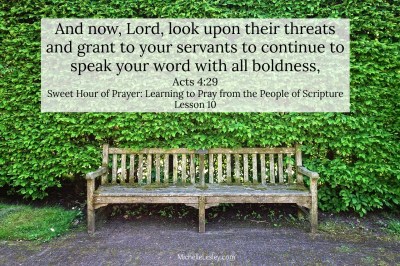
Sweet Hour of Prayer: Lesson 10

Previous Lessons: 1, 2, 3, 4, 5, 6, 7, 8, 9

Read Acts 4:24-31

A Prayer of the Early Believers

Questions to Consider

1. To acclimate yourself to the book of Acts, choose a Bible Book Background to review. In today’s Scripture link, the entirety of chapter 4 is provided for context. Today’s questions will mostly pertain to the Believers’ prayer in 24-31.

2. Briefly summarize the events leading up to the Believers’ prayer. (1-23)

3. Is this an individual prayer or a corporate (group) prayer? (24)

4. How does this prayer address God? (24) Which words and phrases in this prayer demonstrate God’s sovereignty? Considering the events (1-23) that inspired this prayer why do you think the Believers would focus on God’s sovereignty in their prayer?

5. Explain the connection between verses 25-26 and 27-28. How do prophecy and the fulfillment of prophecy each demonstrate God’s sovereignty? What are some prophecies you see being fulfilled today? Have you ever prayed about them in the way the Believers did in their prayer?

6. Clearly the church was already experiencing persecution at this time. Did the Believers ask God to take the persecution away? What did they ask God for? (29-30) Why? Did God answer their prayer? (31) How? What did God’s answer to their prayer enable them to do? (31)

7. Did the Believers spend more time praying about God’s sovereignty and prophecy or more time presenting their request to Him?

8. What are some ways this prayer can inform our corporate prayers at church? How does this prayer teach us to view, and pray about, persecution?


Homework

This week, declare God’s sovereignty in your prayers and present your requests to Him through the “filter” of His sovereignty.


Suggested Memory Verse


Abortion, Movies

Movie Tuesday: Babies Are (Still) Murdered Here


What’s really going on behind the scenes in the pro-life movement? Why incrementalism instead of abolition? What’s the real solution to the tragedy and outrage of abortion?

Recently released from Apologia Studios, Babies Are Still Murdered Hereย is the follow up documentary toย Babies Are Murdered Hereย (see below – you may want to watch it first if you haven’t already seen it). It explores the inner workings of pro-life politics, explains more efficient ways to work through the system to end abortion, and demonstrates why the gospel is the real solution to abortion. You’ll hear from pastors and politicians, parents and practitioners, as they point us to the urgent need to do away with abortion altogether, now.

Babies Are Murdered Here was released almost six years ago. It is an overview of abortion culture, BAMH clinic ministry, and a biblical response to abortion.

(For those like me who have a more sensitive nature, there are no visual images of aborted children in these films. There are a few, very brief verbal descriptions of abortion technique and a brief news clip of the Kermit Gosnell story.)

To find out more about these films and how you and your church can get involved in helping to completely end abortion in your community, visitย End Abortion Now.

Gratitude, Holidays (Other), Mailbag, Thanks/Thanksgiving

The Mailbag: When Negative Nelly Comes to Thanksgiving Dinner

What are some ways we can remain thankful when dealing with a family member that is quite often a โ€œnegative nellyโ€?

Thanksgiving is just around the corner, and for most of us, that means spending time with family members. Family members who sometimes rub us the wrong way. How to maintain an attitude of gratitude while Negative Nellie natters on? Try this:

1. Remember that God created Nellie in His image just like He created you, and keep that thought pinned to the front of your brain whenever you’re engaged in conversation with her. This is someone God loves, and He desires for her to know Him, despite all her faults and foibles, the very same way God loves you and desires for you to know Him.

2. And right next to that first thought at the front of your brain, pin this one up too:

And as you wish that others would do to you, do so to them.
Luke 6:31

It’s the Golden Rule we’ve been hearing since childhood: “Treat other people the way you would want to be treated.” Although I frequently fail at carrying out this command, one thing that helps me is to remember that for every person who gets on my nerves, there are probably ten people whose nerves I’m getting on. How would I want those people to treat me?

3. The more people I talk to, the more I’m convinced that the longing of many folks’ hearts is just to be heard. We don’t take a lot of time to simply sit and listen to others any more. That leaves many people feeling lonely and invisible. Sometimes the best way we can show someone she is loved is just to hear her out.

Additionally, taking the time to listen to someone benefits you in a couple of ways.

First, you might gain some insight into why Nellie is constantly complaining or pessimistic. Maybe she’s lonely, or in a lot of pain from an illness, or there are problems in her marriage. If you get a better grip on what the underlying problems are, maybe there’s a way you could serve her, help her, counsel her, or pray for her.

Second, when you invest time in listening to someone, she’s much more likely to listen to you when you speak to her. (Which, of course, should not be your main motivation for listening to her.) And that means you’ll hopefully have a much more receptive audience with her when you…

4. Share the gospel with Nellie. If she’s lost, that’s one of the reasons she’s being negative. She’s burdened down with sin and its consequences and she doesn’t have the hope, joy, and peace that only Christ can give. Be kind, compassionate, and understanding, and steer the conversation toward the cross.

5. Pray three ways:

โ€ขIf you know you’re going to be seeing Nellie at Thanksgiving dinner, start praying for her, the needs in her life, and how you can minister to her, now. It will prepare your heart for interacting with her, it will change your heart attitude toward her, and it will help you to continue being thankful instead of getting bogged down in Nellie’s negativity.

โ€ขStay thankful by offering a silent prayer of gratitude to God whenever Nellie starts nay-saying. Thank Him for giving you the opportunity to minister to her, thank Him for protecting you from whatever circumstances she’s complaining about, thank Him for her.

โ€ขIf Nellie has been going on in a negative vein for a while, take a moment when she pauses to offer a few genuine words of kindness and compassion and then ask if you can pray for her about the situation, right there, right then. Don’t do this often enough to be annoying, but do it more than once, if the opportunity presents itself. She will either be touched by your compassion and reminded to be thankful instead of grousing, or she may be averse to the idea and stop complaining to you so you won’t keep asking to pray for her. Either way, win-win. (And, of course, you can still pray for her in your heart.)

6. Set an example of thankfulness. Before Nellie even has a chance to open her mouth in negativity, you start – and set the tone for – the conversation. Tell her the latest in your life and remark on what you were thankful for in that circumstance. When someone else, or even Nellie, is telling her story, gently “bring out the blessing” in her tale: “Wow, God was so good to heal you from that cold!” “How wonderful that your son took the time out of his busy schedule to come visit you!” “I know how annoying it is when your cat runs away, but it’s so awesome that your neighbor found her and brought her back to you!”.

7. If Nellie is a Believer, it might be time for a gentle, biblical rebuke and encouragement to thankfulness. You’ll have to be extra vigilant to use godly wisdom in doing this at a family gathering (and you may want to just wait until after the holidays), choosing just the right moment, being careful to speak to Nellie privately and to cloak your words in kindness and understanding (see #2). (Also, keep in mind that sometimes the things we do are so habitual we don’t even realize we’re doing them. She might be totally clueless that she’s constantly complaining or looking at every glass as half-empty.) A great way to start a conversation like this is with a few questions. You might say something like this:

Nellie, I was just wondering, are you doing OK?

Of course. Why do you ask?

Well, from the things you’ve been telling me (cite an example or two) – maybe you don’t even realize this – but it sounds like you might be struggling a little with joy and thankfulness. Is there anything I can do to help? Any way I can pray for you? As your sister in Christ, I love you and I want to be an encouragement to you. I’m concerned that you might be experiencing some bitterness or discontent in your heart, and I just wanted to step in, offer you some love, help, and encouragement, and hopefully help you keep that bitterness from taking root. I want that joy and peace for you that are ours in Christ Jesus. I want you to be able to give thanks in all circumstances. Is there any way I could be helpful to you with that?

It can be difficult, depressing, and frustrating to be around someone who always sees the black cloud behind the silver lining. But if we keep in mind that, as Believers, it’s really not about our feelings of discomfort, it’s about God presenting us with an opportunity to show love and minister the gospel to someone, we can face those negative nellies in our lives with a whole new Christ-centered perspective. Happy Thanksgiving!


If you have a question about: a Bible passage, an aspect of theology, a current issue in Christianity, or how to biblically handle a family, life, or church situation, comment below (Iโ€™ll hold all questions in queue {unpublished} for a future edition of The Mailbag) or send me an e-mail or private message. If your question is chosen for publication, your anonymity will be protected.

Discernment

Amanda Bible Williams and She Reads Truth

If you are considering commenting or sending me an e-mail objecting to the fact that I warn against certain teachers, please click here and read this article first. Your objection is most likely answered here. I won’t be publishing comments or answering emails that are answered by this article.


This article is kept continuously updated as needed.

I get lots of questions about particular authors, pastors, and Bible teachers, and whether or not I recommend them. Some of the best known can be found above at my Popular False Teachers tab. The teacher below is someone I’ve been asked about recently, so I’ve done a quick check (this is brief research, not exhaustive) on her.

Generally speaking, in order for me to recommend a teacher, speaker, or author, he or she has to meet three criteria:

a)ย A female teacher cannot currently and unrepentantly preach to or teach men in violation of 1 Timothy 2:12. A male teacher or pastor cannot allow women to carry out this violation of Scripture in his ministry. The pastor or teacher cannot currently and unrepentantly be living in any other sin (for example, cohabiting with her boyfriend or living as a homosexual).

b) The pastor or teacher cannot currently and unrepentantly be partnering with or frequently appearing with false teachers.ย This is a violation of Scripture.

c) The pastor or teacher cannot currently and unrepentantly be teaching false doctrine.

I am not very familiar with most of the teachers I’m asked about (there are so many out there!) and have not had the opportunity to examine their writings or hear them speak, so most of the “quick checking” I do involves items a and b (although in order to partner with false teachers (b) it is reasonable to assume their doctrine is acceptable to the false teacher and that they are not teaching anything that would conflict with the false teacher’s doctrine).ย Partnering with false teachers and women preaching to men are each sufficient biblical reasons not to follow a pastor, teacher, or author, or use his/her materials.

Just to be clear, “not recommended” is a spectrum. On one end of this spectrum are people like Nancy Leigh DeMoss Wolgemuth and Kay Arthur. These are people I would not label as false teachers because their doctrine is generally sound, but because of some red flags I’m seeing with them, you won’t find me proactively endorsing them or suggesting them as a good resource, either. There are better people you could be listening to. On the other end of the spectrum are people like Joyce Meyer and Rachel Held Evans- complete heretics whose teachings, if believed, might lead you to an eternity in Hell. Most of the teachers I review fall somewhere in the middle of this spectrum (leaning toward the latter).

If you’d like to check out some pastors and teachers I heartily recommend, click theย Recommended Bible Teachers tab at the top of this page.


Amanda Bible Williams
Not Recommended

Amanda Bible Williams is co-founder and CCO (Chief Content Officer) of She Reads Truth (SRT), โ€œa worldwide community of women who read Godโ€™s Word together every day. Founded in 2012, She Reads Truth invites women of all ages to engage Scripture through curated daily reading plans, as well as online conversation led by a vibrant community of contributing writers.โ€ Amandaโ€™s co-founder of SRT is CEO, Raechel Myers. Amanda and Raechel have co-authored two books and collaborated on the She Reads Truthย Bible and theย He Reads Truth Bible.

I first learned of Amanda and SRT a few years ago through my friend Elizabeth Prataโ€™s excellent blog. Check out part 1ย andย part 2ย of her articleย She Reads Truth, IF: Gathering, and Women Bible Teachers.

Though SRTโ€™s โ€œWhat We Believeโ€ section boldly proclaims, โ€œwe believe Godโ€™s Word is Truth,โ€ Amanda has disregarded the Bibleโ€™s truths about false doctrine and the biblical role of women in the church by inviting female โ€œpastorsโ€ and false teachersย such asย Sharon Hodde Miller (more on Sharon here), Erin Rose, andย Lisaย Harper (more on Lisa here) to beย SRT contributing writers.

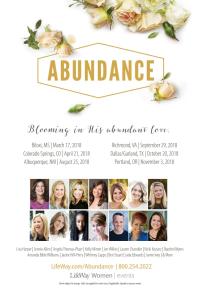
Amanda has appeared at several of LifeWay Women’s Abundance Conferences alongside the likes of Christine Caine, Jennie Allen, ย Lisa Harper, Lysa Terkeurst and Curtis Jones (Beth Moore’s son-in-law/pastor who allows her to preach on Sunday mornings) and others.

Amanda has been featured on IF: Gathering’s YouTube channel. Amanda’s and Raechel’s book, She Reads Truth, is sold on IF’s website.

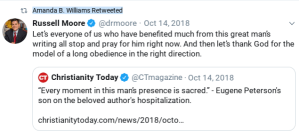
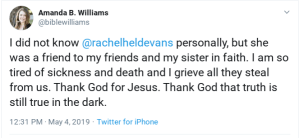
On Twitter, Amanda has retweeted and/or shown public affinity for several false teachers including Beth Moore (tweet, tweet), Ann Voskamp (tweet), Eugene Peterson, and Rachel Held Evans.

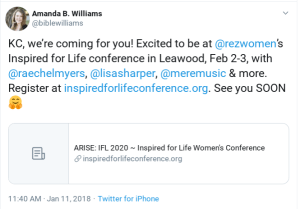
In 2018, Amanda’s SRT partner, Raechel, was a featured speaker at the Inspired for Life Conferenceย alongside an advocate for female pastors and a social justice activist. (See article on Raechel for more details.) Amanda both attended and helped promote the event on Twitter:

For someone with such a well known ministry, Amanda has a very small online footprint, so it was difficult to find pertinent information on her for this article. She doesn’t seem to have a blog or website separate from the SRT website (which has minimal information about her). She doesn’t post often on social media, and when she does, it’s usually about her family, which, frankly, I find charming and refreshing. But that means there’s scant information on events she speaks at or participates in and her ministry associations with others. This could be a positive sign. Perhaps we’re not seeing online evidence of her, for example, preaching to men, because she’s not. On the other hand, perhaps she is associating with or following far more false teachers than we know of but she isn’t posting about it on social media, so there’s no evidence of it. It’s simply impossible to tell.

With so little information available on Amanda, and with very little knowledge of her own theology and handling of God’s Word, I want to give her the benefit of the doubt and withhold the label of “false teacher” until such time as more evidence is available that would support that label. That being said, I believe there is enough evidence that Amanda is sorely lacking in discernment that it would not be wise to follow her, use her materials (and certainly not SRT’s materials, considering their contributors), or attend her speaking engagements.

Furthermore, consider her ties to female “pastors” and false teachers. As I said in the introduction to this article, it is reasonable to assume Amanda’s doctrine is acceptable to these female “pastors” and false teachers and that she is not teaching anything that would conflict with their doctrine. If she were, they would not associate with her. If she were, she would not associate with them.