Keep a sharp lookout, for you do not know when I will come, at evening, midnight, early dawn, or late daybreak. Don’t let Me find you sleeping.
Today’s Movie Time is a double whammy: evangelical pop culture and homework. A Thief in the Night was my generation’s Left Behind. It’s the reason Christians my age, who grew up in church experience a split second of terror when we walk into the house and it’s unexpectedly empty. (Did the rapture happen and I didn’t make it?)
So grab your Bible and your popcorn and experience Christianity of yesteryear. Look up the passages that are mentioned in the movie and read them in context. Does the movie rightly handle those passages? Do you agree or disagree with this eschatology? Why? Are movies like this helpful, or do they just scare people into becoming false converts?
And most importantly, whatever way you think the Lord is coming back, He is coming back. Are you ready?
For you yourselves are fully aware that the day of the Lord will come like a thief in the night. 1 Thessalonians 5:2
Bonus!
Check out this review / reaction to A Thief in the Night from my friend, Pastor Keith Foskey:
Welcome to another “potpourri” edition of The Mailbag, where I give short(er) answers to several questions rather than a long answer to one question. I also like to take the opportunity in these potpourri editions to let new readers know about my comments/e-mail/messages policy. I’m not able to respond individually to most e-mails and messages, so here are some helpful hints for getting your questions answered more quickly. Remember, the search bar can be a helpful tool!
In these potpourri editions of The Mailbag, I’d also like to address the three questions I’m most commonly asked:
“Do you know anything about [Christian pastor/teacher/author] or his/her materials? Is he/she doctrinally sound?”
I saw this video making the rounds on social media. It appears as though Benny Hinn is repenting of teaching the prosperity gospel. Is this true, or too good to be true?
Briefly, it is not true, and his behavior and teaching bears this out. He has made similar claims in the past and continues to teach the same old lies from the same old pit of Hell. The YouTube video making the rounds is 4½ minutes long. What it doesn’t show is that for an hour and a half prior to this 4½ minute snippet Benny conducted one of his regular “healing” services. Furthermore, prosperity teaching is not the only heretical aspect of Benny’s theology, so even if he had repented of teaching the prosperity gospel, he would remain a heretic to avoid.
Repentance doesn’t just mean a blase admission that something is wrong. Repentance is a total change of lifestyle. If Benny were to repent, what we would see would be genuine, long lasting grief over his sin. He would step down from, and dismantle his “ministry,” cancel all of his tours, crusades, and speaking engagements, take all of his books out of print, shut down all of his online platforms and do everything in his power to scrub the internet of his false teaching (at the moment, he has said he’s planning to keep his “most popular” teachings available online for those who want them), return the money he has scammed from people, and park himself in a solid church so he can learn the gospel, be saved, and be discipled in sound doctrine.
If you’d like to believe Benny has repented, OK. Check back up on him in about six months and see if he has done any of the things above to “bear fruit in keeping with repentance.”
For the longer version of the answer to this question, see the resources below.
I’m encouraged to see him express a refutation of prosperity theology, & even admit to wrong teachings on that topic. Now, pray for undeniable, lasting fruit that exemplifies genuine repentance. Truth & time go hand in hand (Psalm 51:17; Luke 19:1-10; Luke 3:8).
[In your “Welcome” tab,] you describe yourself as…….A genuinely regenerated Protestant, Southern Baptist, Calvinist/Reformed Baptist…I am just getting in on the Reformed Baptist conversation. As a Southern Baptist, why do I need to add all the other titles. Why or what did you reform? I am confused. Why can’t you just be Southern Baptist?
You don’t need to use a bunch of labels if you don’t want to, I just want to be specific and clear to my readers what my theology is in case they’d like to know, and so they will know what to expect when they read my articles.
Reformed Baptist theology is different from Arminian (or what Southern Baptists like to call “Traditionalist” theology). If you are Southern Baptist and unfamiliar with Calvinism, you are most likely in a Traditionalist church (you may want to ask your pastor). I think you’ll find the answers to many of your questions in this article (be sure to read the additional resources at the end, too.) I’d also encourage you to read the 1689 London Baptist Confession of Faith.
(Just a reminder to my regular readers, I don’t engage in or allow Calvinism/Arminianism debates and arguments in the comments sections of my articles or on social media. Please review my comment parameters at the “Welcome” tab at the top of this page before commenting.)
I am, for now, the choir director at my church. I lead the choir and my husband leads the congregational hymn singing. In one question I read [on your blog], I should not be doing that- the answer to the question of whether woman should serve as worship leaders or music ministers was a simple “no”. It would help a great deal to have an extended answer, and then I’ll know whether to tender my resignation and find another way to serve. I can happily go back to just singing in the choir. Thank you for your insight.
It’s so encouraging when I hear from women who want to do the biblical thing! I’m not sure which of my articles you were reading where I simply said “no” to the question of whether or not women should serve as worship leaders, but I have addressed that question in greater length in this article (see #4).
Of course, this article doesn’t address a woman only directing the choir, but rather, serving as the minister of music. I can see some situations in which it might be biblically OK for a woman to only direct the choir.
For example, if it’s an emergency situation like the minister of music getting sick at the last moment on Sunday morning and he has been the one to lead the choir through rehearsals, explain the text of the music to them, etc., and the only person capable of stepping in and directing the choir that morning (just the choir, not the congregation) is a woman, I don’t think that would be a problem. Another example: At my church, the choir occasionally does anthems that center around a tenor solo, which our minister of music (who directs the choir) will sometimes sing. He will step up to the pulpit to sing the solo, and a lady in the choir will direct the choir part of the anthem. I don’t think that’s problematic, either.
Of course, you will need to pray about it and talk it over with your husband and pastor, but, for what it’s worth, my thought on your situation is that if your husband is Scripturally qualified (as well as musically qualified) to step into the pastoral role of minister of music (because men should not hold positions of leadership they’re not biblically qualified for either), and he is overseeing the choir – selecting the music, leading rehearsals, etc. (all the pastoral type things mentioned in the article), then it would not be a problem for you to simply direct them on Sunday morning. Especially if, as it sounds like might be the case, the two of you are temporarily filling in until a permanent minister of music can be found and hired. But, really, the best case scenario would be for your husband (and/or another biblically qualified man to) lead the congregation and the choir. And it would probably be a load off your shoulders!
I have a question that I haven’t been able to find a clear answer to including in your blog. Can women teach men in Bible study say on a Thursday night?
The 1 Tim 2:12-13 Scripture points to Adam being created first then Eve therefore, therefore I would deduct that women should not teach or exercise authority over a man whether it be in church, Sunday School or in a Thursday night Bible study. Am I wrong?
DING! DING! DING! You are absolutely RIGHT!Tell her what she’s won, Johnny! :0)
Yes, you’re correct. You’ll notice in 1 Timothy 2:11-15 that there’s no exception for any day of the week. The prohibition against women teaching men is for any day ending in a Y.
And, you didn’t say where this Thursday night Bible study is meeting, but those types of gatherings of the Body often meet in homes, and there’s no exception for meeting in a home (or anywhere else) versus meeting inside the four walls of a church building, either. When 1 Timothy was written, there were no church buildings. The church was largely meeting in people’s homes. I say “the church was meeting,” because the church is the gathering of Believers, not the building in which they meet. So it’s not OK for women to teach Scripture or preach to a co-ed gathered body of Believers, whether that’s in a church building during worship service or a smaller class or group, or at a Christian conference, retreat, parachurch event, or at a Bible study at someone’s home on a Thursday night.
You’re also correct that I’ve never addressed this specific question directly, but I have touched on it here, here (2nd question), and here (#7 – I just hopped over to this article and added home, workplace, and coffee shop Bible studies to question 7). So let me grab the salient points from those articles and put them together in a more helpful way:
“Teaching” includes any situation in the gathering of the body of Christ in which women would be giving instruction to men in the Scriptures and/or on spiritual matters (which, in a biblical church gathering, would necessarily include Scripture), whether in an official position of teacher (pastor, teaching elder, Sunday School/Bible study teacher, or other leadership position) or any other situation requiring exhorting, teaching, or explaining of the Scriptures.
We need to remember what the definition of “church” is. The church is not a building, it is a body of born again believers gathered for the purpose of worship, prayer, the ordinances, and/or the study of God’s word. Those things can take place in a church building, a home (as with the first century churches in Acts), in a campus or office building, outdoors, in a conference center, in a sports arena, or anywhere else. So, when a body of believers comes together for these purposes, regardless of the building in which they meet, or whether you call it “church” or not, they are the church, and the biblical parameters about women teaching and holding authority over men applies.
I don’t mean this to sound facetious or anything, but sin is sin no matter what time of day or day of the week it takes place on.
Today, I came across a book I had purchased in the past – Practicing the Presence of God from Brother Lawrence. Taking a quick look at the book, I’m inclined to throw it away. It reminds me of Buddhist thinking or New Age garbage. As a monk, Brother Lawrence’s Catholic theology conflicts with biblical Christianity.
Before I became a Christian, I was into New Age thinking and practices. Just reading bits and pieces of this book makes me think New Age thinking instead of what I know from the Bible. I’m going to throw it away…I don’t see any redeeming Christian theology in it thus far. I don’t want to expose anyone else to wrong theology. Just wondered if you have any thoughts on this book?
Unlike the vast majority of books I’m asked about, I have actually read this one. However, it has probably been ten years ago or more since I read it. All I remember is that it was fairly short (which is probably why I read it), and that one of his main points was keeping our thoughts focused on God at all times. And I mean all times. Every waking moment of the day, we are to be consciously, actively thinking about God or we’re not pleasing Him. I remember trying to put that into practice. Even while doing something as mindless as washing the dishes, it was impossible and exhausting. (It did, however demonstrate to me how much of the time our brains are on auto-pilot.)
You’re correct in your assessment of the theology of the book. Brother Lawrence was a Roman Catholic mystic. Roman Catholic doctrine – as it is laid out in their own documents – is patently unbiblical, as is mysticism. Christians should not receive any sort of spiritual teaching from someone with that theological pedigree.
If you have a question about: a Bible passage, an aspect of theology, a current issue in Christianity, or how to biblically handle a family, life, or church situation, comment below (I’ll hold all questions in queue {unpublished} for a future edition of The Mailbag) or send me an e-mail or private message. If your question is chosen for publication, your anonymity will be protected.
If your theology pretty much matches up with mine (as outlined in the “Welcome” and “Statement of Faith” tabs) and you’d like to contribute a guest post, drop me an e-mail at MichelleLesley1@yahoo.com, and let’s chat about it.
On the Subject of Abortion by Lisa Matthews
A Brief Word from Michelle:
When Lisa first contacted me about writing a guest post on abortion, she sent me this video of a speech she made at a recent pro-life rally. I thought it was so powerful and inspiring that I wanted to include it with her article. Lisa’s speech starts around the 16 minute mark.
We are the only creation of God’s with “choice” or free will. Our animal friends have natural instincts and generally do not have the mental capacity to change their behavior. Human beings do. We make decisions and act based on those decisions. As believers, we understand that our behaviors should freely be submitted to the will of God. However, in our society today, we are led to believe that all choice is autonomous; in the world’s view we are under our own authority. This is one of Satan’s many lies.
Unbelievers have not placed themselves under the subjugation of the Lord. They are blinded and live as subordinates to the god of this world, that god being Satan. Dear brothers and sisters, we must not be blinded; we are children of the King and must live as such. Our birthright establishes freedom in Christ and freedom from the bondage of the lost. Therefore, you and I are required to manifest outwardly what we have inwardly become.
The church overwhelmingly assists the poor, hungry, widowed and homeless. We have school supply drives, Thanksgiving dinners and celebrate our Lord’s birth with gifts to the fatherless and single mothers. We exist, in part, to show the love of Christ to a dying world. However, on the subject of abortion, our silence is deafening. The third Sunday in January is “National Sanctity of Life Sunday”, but a drive around my large city sadly reveals a mere handful of the more than 1,500 churches participating in this solemn day. The scourge of abortion has ravaged our world and has silenced our church. Where are we? As a body, do we even know the “National Sanctity of Life Sunday” exists?
Abortion is unquestionably the murder of the unborn; it is the biblical equivalent to the children sacrificed to the pagan gods. It is a life created by God and taken unlawfully by man. The 6th Commandment states, “Thou Shall Not Murder” (Exodus 20:13). It seems straightforward as Christ followers to recognize the cruel and vicious act of abortion. Sadly, our inactivity is revealing; it’s revealing of our hearts and our relationship with Jesus. How can we justify what God condemns? How can we remain silent when the blood of innocents cries out?
I come from a place of experience and not of condemnation. I was a young woman afraid and ashamed. That shame silences many of us and the guilt keeps us in the shadows when we are given the opportunity to stand for life. False teachings and the church’s unresponsiveness to the harsh reality of abortion provide justification. Our guilt and shame stems from being complicit. We have family, friends and church members who have played a part in the death of an unborn child. We hide our faces in humiliation and remorse. We’ve also suffered trauma and consequences stemming from our actions. I admit and accept responsibility for the sin of abortion. Thank God for His grace, mercy, forgiveness and a post-abortive healing Bible study.
As a Christian and a Black American, it’s personal to me. In the United States of America 36% of abortions are performed on Black women while they make up less than 7% of the population (source, source). The act of abortion in our nation would be considered genocide in any other context. Our children are being murdered at an alarming rate; we can no longer remain silent or indifferent.
On June 4, 2019, the fourth abortion mill was opened in Charlotte, North Carolina. This Planned Parenthood is located squarely in a historically Black neighborhood. Today, Planned Parenthood is continuing the racist and eugenics policies of their founder Margaret Sanger. In New York City, more Black children are aborted than born.
Ephesians 1:7 says, “In Him we have redemption through His blood, the forgives of our trespasses, according to the riches of His grace.” There is hope! We can turn from our sin and stand in the gap for the unborn. We can reject the sin of indifference and join our hardest hit communities and protest. The body of believers does not have the option to be reticent. Titus 2:3-5 tells older women to teach to younger women. The truth about abortion is no exception. We are tasked to speak to our sisters and friends, our daughters and neighbors, our discipleship partners and mentees. The testimony of our lips should mirror the testimony of our lives.
With regard to abortion, society of today’s message is loud, forceful, unrelenting and false. Pray that our message continues to be hope and love solely based on the gospel. When our hearts and minds agree with God, He will equip us for every task He places before us. In Esther chapter 4, Mordecai warned Esther about being silent. We too, are in precarious times. As residents of the United States, we live in a constitutional republic. We are afforded rights and access to real participation in government. Use your voice to speak for the voiceless, comfort the broken-hearted and vote for protections for our unborn children.
If you have been through the trauma of abortion, thankfully, you are not alone. If you have an unexpected pregnancy, want to get involved in the pro-life movement or need healing for post-abortive trauma, there is help. There are many godly organizations and resources available to you.
Surrendering the Secret, founded by Pat Layton, directs those heart broken by a past abortion to Biblical healing. God’s Ballot provides a resource for Christians “to honor God with their votes during every election.” Love Life is committed to “creating a culture where families stop running to abortion centers and start running to the local church.” Lastly, Care Net provides a national directory of pregnancy resource centers. Local pregnancy resource centers provide real alternatives to abortion and connect expectant mothers with churches, individuals and other organizations to assist with any needs that may arise in their lives.¹
Jesus was clear in Luke 12:48, “Everyone to whom much is given, of him much will be required…”. Our salvation and adoption into the family of God is a tremendous gift. It’s more than we deserve and more than we can ever repay. Jesus has paid our debt; out of gratitude we live a life of service. Please join me in supporting the broken, protecting the unborn and appointing legislators who respect our God’s design.
¹Note from Michelle: I am not very familiar with any of these organizations/resources and do not endorse any of them which deviate from Scripture or my theology as outlined in the “Welcome” and “Statement of Faith” tabs at the top of this page. As with any organization/resource, please thoroughly vet the theology of these before joining or using them.
Lisa was a single mother for 15 years before meeting her husband of 7 years, David. They are parents to one adult daughter. A Volunteer Chaplain at the Mecklenburg County Jail, an Area Coordinator for the Search for Jesus Internet Evangelism ministry, President of the Mecklenburg Black Republican Club and a Voter Registration Chair for the Mecklenburg County Republican Party.
My friend, who’s also in women’s ministry, and I were discussing a phenomenon we’re seeing more and more among professing Christian women (and among men, too, I’m sure). I call it “Sinatra Sin-drome”.
Most of us are too young to be able to remember Frank Sinatra in his heyday, but one of the songs he was best known for was My Way. The lyrics open with a man who’s near death looking back over his life. He recounts his adventures and regrets, the good times and the bad, but no matter what came his way, he faced life on his own terms. “I did it my way,” is the refrain woven into the fabric of the entire song. The last stanza is especially telling:
For what is a man, what has he got?
If not himself, then he has naught
To say the things he truly feels and not the words of one who kneels
The record shows I took the blows and did it my way.¹
This man kneels all right. He kneels at the altar of self. Nobody else is going to tell him what to do. He’s going to do what he wants to do.
Most of the women my friend and I were discussing are either savvy enough or self-deceived enough that they would never dream of even thinking in these clear-cut terms, much less stating them so boldly. And yet, for many, their hearts beat to the rhythm of My Way.
One example of this kind of mindset – though it may have been an isolated incident in the lives of some women – came out in some of the comments on my recent Mailbag article, Should Christian women cover up while breastfeeding?. The sentiment behind the words from several women was, “What the Bible says about the shame of nakedness and denying self to serve others means less to me than: the law that says I have a right…the culture where I live that says it’s OK…my personal experience with the way my baby nurses that demands that I not cover up.”
It came out in a rather puzzling conversation I had with a reader, “B”, who sent me the link to my article on Priscilla Shirer and demanded to know why I think Priscilla is a false teacher (even though the article, which “B” claimed to have read, clearly demonstrates from Scripture why she’s a false teacher). It wasn’t that “B” didn’t have the information and Scriptures right in front of her, it was that she didn’t like what Scripture says about Priscilla. She loves Priscilla Shirer, so she’s willing to put her own feelings above what Scripture says.
It comes out constantly with the issue of women preaching to, teaching, and exercising authority over men in the church setting in violation of 1 Timothy 2:12. “I feel called to preach.” “It’s OK if I teach this co-ed Sunday School class because I have my pastor’s/husband’s permission.” “I can preach a sermon to a mixed audience at this event, because it’s not in a church, it’s at a Christian conference.”
And it always comes out when the topic is Christian women dressing modestly. “I can wear what I want! If men have issues with lust, that’s their problem. They can just avert their eyes.”
Now, let’s be clear, any time you or I or anyone else sins, we are – consciously or subconsciously – saying through that sinful thought, word, or action, “I don’t care what the Bible says about this, I want to do what I want to do.” I’m sure my own words and actions have shouted that rebellion against God loud and clear on many occasions.
But there’s a difference between…
A Developing Disciple A Christian who is striving to do things God’s way, who occasionally stumbles into sin or gives in to a momentary weakness of the flesh. When confronted with what Scripture says on the subject, she sorrowfully repents and submits to God’s Word.
and
A Sinatra Saint A person who claims to be a Christian and generally aligns with what the Bible says as long as it agrees with her. When confronted with what Scripture plainly says about her beliefs or actions, she doesn’t repent, but digs in her heels and attempts to justify herself, often with claims like, “Well that’s just your opinion/interpretation,” or “That’s not really what that passage means.”
Sometimes it can be hard to come to grips with a difficult passage of Scripture that challenges something you’ve believed or done your whole life. (Hey, I’ve been there. It’s no picnic.) But the difference between a Developing Disciple and a Sinatra Saint is that the Developing Disciple will grapple with the passage with an overall desire to properly understand and submit to that Scripture, even if it’s hard, while, for the Sinatra Saint, it’s a no-brainer. Her opinions, feelings, or personal experiences win. Because it’s not just that one isolated issue, it’s her whole outlook and approach to life.
Am I saying that a woman who thinks it’s OK to let it all hang out while she’s nursing her baby isn’t saved? Of course not. What I’m saying is that if your general approach to life is, “I’m doing it my way and if the Bible wants to align with me, fine, and if not, that’s fine, too,” you’d better start examining your heart pretty carefully against Scripture to discover whether or not you’re actually saved.
And I will give you a new heart, and a new spirit I will put within you. And I will remove the heart of stone from your flesh and give you a heart of flesh.
Ezekiel 36:26
Therefore, if anyone is in Christ, he is a new creation. The old has passed away; behold, the new has come.
2 Corinthians 5:17
This isn’t just flowery, poetic language. When Christ saves a person, he literally changes that person into a new type of creature with a different way of thinking, different likes and dislikes, different goals, different responses.
Imagine if you had a magic wand and could change a house cat into an elephant. When the cat was a cat, he wanted to chase mice. Now that he’s an elephant, he’s afraid of mice. As a cat, he craved tuna, but as an elephant, he turns his trunk up at meat, preferring an herbivorous diet. No more baring his claws to scratch at an enemy; now he tramples and uses his tusks to ward off danger. The coziness of hearth and home? Nope. The elephant prefers the wide open savanna.
And all of that is nothing compared to the radical transformation that takes place in the heart of someone who has been genuinely regenerated by Christ.
Christ changes our mindset from the mind set on the flesh to the mind set on the Spirit:
For those who live according to the flesh set their minds on the things of the flesh, but those who live according to the Spirit set their minds on the things of the Spirit. For to set the mind on the flesh is death, but to set the mind on the Spirit is life and peace. For the mind that is set on the flesh is hostile to God, for it does not submit to God’s law; indeed, it cannot. Those who are in the flesh cannot please God. You, however, are not in the flesh but in the Spirit, if in fact the Spirit of God dwells in you. Anyone who does not have the Spirit of Christ does not belong to him.
Romans 8:5-9
Christ changes our will – from desiring what Satan desires to desiring what God desires:
You are of your father the devil, and your will is to do your father’s desires.
John 8:44a
Now may the God of peace…equip you with everything good that you may do his will, working in us that which is pleasing in his sight, through Jesus Christ, to whom be glory forever and ever. Amen.
Hebrews 13:20a,21
Christ changes our behavior from willful disobedience to joyful obedience:
“Why do you call me ‘Lord, Lord,’ and not do what I tell you?”
Luke 6:46
If you love me, you will keep my commandments. John 14:15 Whoever has my commandments and keeps them, he it is who loves me. John 14:21a For this is the love of God, that we keep his commandments. And his commandments are not burdensome. 1 John 5:3
Whoever says “I know him” but does not keep his commandments is a liar, and the truth is not in him,
1 John 2:4
And by this we know that we have come to know him, if we keep his commandments.
1 John 2:3
Christ changes us from His enemies to His friends:
You adulterous people! Do you not know that friendship with the world is enmity with God? Therefore whoever wishes to be a friend of the world makes himself an enemy of God.
James 4:4
They are…haters of God…
Romans 1:29b,30a
The friendship of the Lord is for those who fear him, and he makes known to them his covenant.
Psalm 25:14
You are my friends if you do what I command you. No longer do I call you servants, for the servant does not know what his master is doing; but I have called you friends, for all that I have heard from my Father I have made known to you.
John 15:14-15
Christ changes us from believing Satan’s lies to believing God’s truth:
Why do you not understand what I say? It is because you cannot bear to hear my word. You are of your father the devil, and your will is to do your father’s desires. He was a murderer from the beginning, and does not stand in the truth, because there is no truth in him. When he lies, he speaks out of his own character, for he is a liar and the father of lies. But because I tell the truth, you do not believe me. Which one of you convicts me of sin? If I tell the truth, why do you not believe me? Whoever is of God hears the words of God. The reason why you do not hear them is that you are not of God.”
John 8:43-47
Has there been a radical transformation like that in your heart and life as a result of repenting of your sin and placing your faith in Christ? You can be your own authority and have “I did it my way,” as the theme song of your life, but you can’t do that and be a Christian too. The two are mutually exclusive. It doesn’t matter if you’ve walked an aisle, made a “decision”, prayed a prayer, been baptized, joined a church, are a “good person”, and do all sorts of good deeds, if your heart and your desires aren’t generally oriented toward Christ, growing toward in Him and away from self, you aren’t saved.
But that can be remedied right now. The gospel is right there, ready for you to repent of your sins and believe. Take some uninterrupted time alone with God and measure your life and your heart against the plumb line of His Word. Is it “I did it my way,” or “I’ll do it Thy way.”?
1. Are you familiar with what is going on in the history of Israel at this time? If not, use this synopsis (or another Bible Book Background) to bring you up to speed.
2. Carefully read verses 1-9. In your own words, briefly summarize the circumstances in Hannah’s life leading up to her first prayer (in 10-11).
3. Examine verses 10,15,16. What words are used to describe Hannah’s emotional and spiritual state? It has often been said that prayer shouldn’t be our last resort – that we shouldn’t wait until circumstances are desperate before we pray. Does it seem like that’s what’s going on here with Hannah, that she only turned to God as a last resort, or that this was the culmination of many prayers over the years? On what, from chapter 1, are you basing your answer? Compare 10,15,16 with 18b. How did Hannah’s emotional and spiritual state change after pouring her heart out to God? What can we learn from Hannah’s first prayer about pouring our hearts – our feelings – out to God?
4. Where did Hannah go to pray? (9-10) Why do you think it was important to her to pray at the temple? (Hint: Examine what she says about the house of the Lord and the “presence of the Lord” in 21,22,24). Could God only hear her, or would He only be willing to answer her, if she were praying in His house? True or false: God hears us better and our prayers carry more weight if we’re praying in church, or at the front of the sanctuary (at the “altar”) during a special time of the worship service, than if we’re praying at home, in the car, etc.?
5. Examine the content of Hannah’s first prayer. (11) What is Hannah praying for, and for whom? Is it OK to pray for the things our hearts long for? Why or why not?
“O Lord of hosts,” – How does Hannah start off her prayer? How does she address God? Compare this with the beginning of the Lord’s Prayer. How should this inform our own prayers?
“if you will indeed look on the affliction of your servant and remember me and not forget your servant” – What is Hannah seeking in this part of her prayer? Compare Hannah’s thoughts and request here with Hagar’s characterization of God as, “a God of seeing…I have seen him who looks after me.”
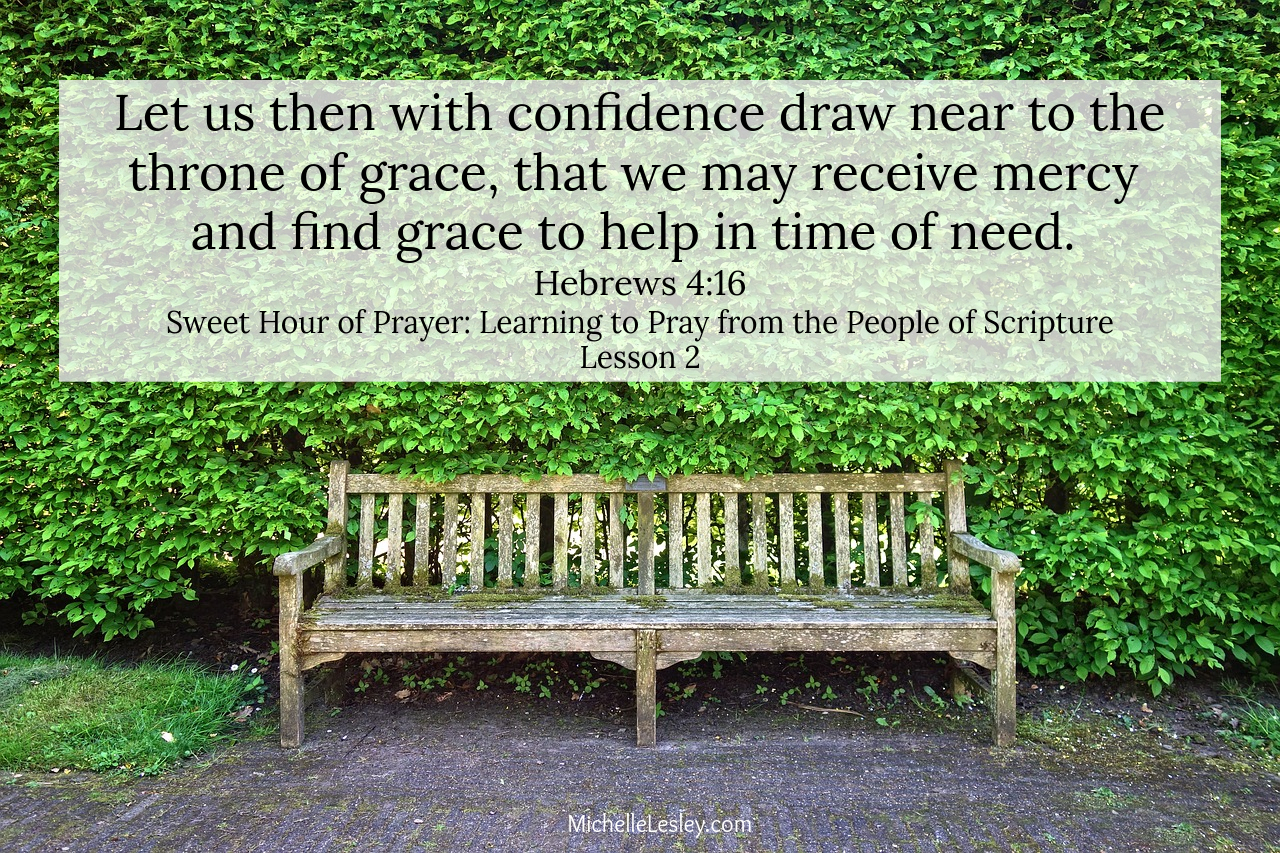
“but will give to your servant a son,” – How would you describe Hannah’s request? Is she timid and equivocating, or bold, direct, and specific? How does Hebrews 4:16 relate to this part of Hannah’s prayer?
“then I will give him to the Lord all the days of his life, and no razor shall touch his head.” – (Use your footnotes and cross references if you’re not familiar with what Hannah is talking about here.) Hannah includes a vow, or promise to God, with her prayer, which is not something we’re accustomed to doing. Most of us have probably heard the story of the guy on his deathbed who promises God that if He will just let him live, he’ll live a good life, go to church every week, etc. We’ve been taught that’s “bargaining with God” and that we shouldn’t do that. Is Hannah bargaining with God in that same sense? What, from today’s passage would lead you to say “yes” or “no”? Have you ever made a vow to God in prayer? Did you keep that vow? Why might it be wise or unwise to make a vow to God when requesting something in prayer? Look up the word “vow” in a concordance. Does vowing seem to be more of an Old Testament thing or a New Testament thing? Why do you think that is?
6. Examine verse 19. Did Hannah go in to worship the Lord before or after He answered her prayer? Was her worship an attempt to manipulate God into giving her what she wanted, a response to knowing for a fact that He was going to give her what she wanted, or was her worship simply part of who she was as someone who loved God, regardless of whether or not He gave her what she wanted? Do you worship God continuously, whether or not He gives you what you’ve asked for in prayer?
7. Read 19-20. Did Hannah and Elkanah sit idly by and wait for God to provide a miraculous conception? What did they do? If you need a job, do you pray for God to send you a job and then sit on the couch watching TV and waiting for someone to call and ask you to come work for them, or do you ask God to provide a job and then read the want ads, fill out applications, and go on interviews? Explain how God blesses and answers prayer through the normal, day to day means and methods He has established. Is it any less “miraculous” for God to answer prayer through normal means and methods than to answer prayer in extraordinary way? Why? How did Hannah honor and recognize God for answering her prayer? (20b) How was Samuel, for the rest of his life, just by virtue of his name, a testimony to God answering prayer?
8. Study 21-28. Did Hannah keep the vow she made to the Lord? Why is this important? What was Hannah’s testimony of God’s answer to her prayer? (26-28) How do you think this impacted Eli? How can it be an encouragement to your pastor and your brothers and sisters in Christ to share with them how God has answered your prayers or worked in your life? We often share prayer requests. We don’t often share God’s answers. How might sharing God’s answers to prayer encourage others to pray?
Homework
•Think about one of the aspects of Hannah’s prayer we studied today – pouring out your heart to God, honoring His name in your prayers, worship, God’s work through normal means, etc. – and apply this aspect to your own prayer life this week.
•How has God answered a prayer or worked in your life in some way? Encourage your pastor, and share it with him!
Suggested Memory Verse
(Every week of our study, you’ll see a suggested memory verse like the one above. You are welcome to grab the memory verse pic to use as your screensaver or wallpaper on your phone or computer, print it out and stick it somewhere you’ll see it frequently, or use it in any other way you wish to help you memorize the verse.)