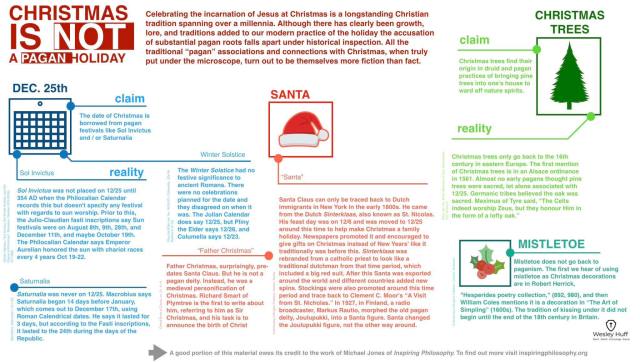
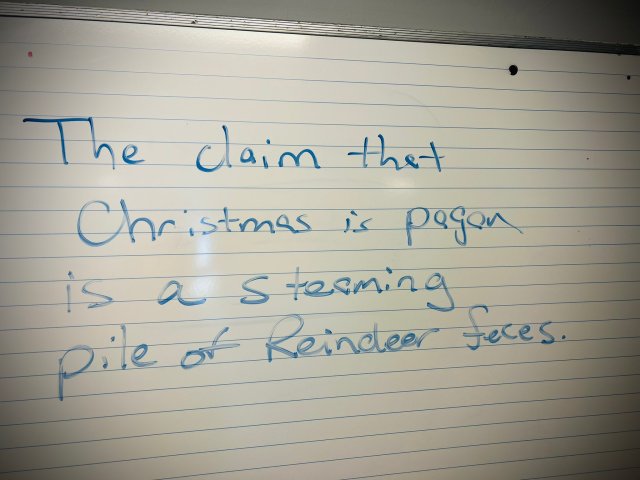
If you’re a Christian, you might have heard the anti-Christmas rumblings on social media, or maybe even in real life: Christmas has pagan origins…Santa’s elves started out as demons…the Roman winter solstice celebration of Saturnalia morphed into Christmas…Mithras…Krampus…the “naughty list” about the origins of Christmas goes on and on. Are these things true? Should Christians celebrate Christmas?
There’s an old story about a woman who made a ham every year for Christmas dinner. As she was preparing it one year, her daughter asked, “Mom, why do you cut off the end of the ham before you put it in the oven?” The woman answered, “That’s the way my mom taught me to do it.” The woman thought about her daughter’s question all day long, and finally decided to call her own mother to ask about it. When the woman got her mother on the phone, she asked, “Mom, why did you teach me to cut off the end of the ham before putting it in the oven?” The woman’s mother said, “That’s the way my mom taught me to do it.” Intrigued, the woman called her grandmother and asked once again, “Grandma, why did you cut off the end of the ham before putting it in the oven?”. Her grandmother replied, “Because I didn’t have a roasting pan large enough for a whole ham.”
Human beings are creatures of habit and tradition, so it’s always important to examine why we do the things we do. As Christians, whether it’s putting up a tree every year, a beloved hymn we’ve been singing since we could talk, or the annual church picnic, our brains should never be on autopilot, unquestioningly taking part in activities by rote.
Do some aspects of the celebration of Christmas find their origin in millennia-old paganism? Possibly. But are you participating in that paganism if you put up a tree or give gifts at Christmas? Probably not. The “Christmas is pagan” lore is so ancient and uncertain that most people aren’t even aware of it. How could you possibly be participating in paganism if you’re not even aware of its existence, you have no intention of participating in it, and it has nothing to do with your reasons for celebrating?
Did you know that many of our days of the week and months of the year were originally named for pagan idols and gods? “Sun”day was originally a pagan Roman holiday, and the sun was an object of worship for many ancient peoples. Should we stop having church on Sunday because of that? Are we somehow participating in paganism by holding the Christian day of worship on an ancient pagan feast day? Of course not. Ancient pagans don’t own certain days on the calendar or any particular object or symbol. The Bible tells us, “The earth is the Lord‘s and the fullness thereof.” When godless people take a day or an object God has created and use it for evil, they are the ones in the wrong, not godly people who come after them and want to use that same day or object for a godly purpose. To say that Christians can’t use a certain day or object for celebrating Christmas because pagans used that day or object for pagan purposes is to give those ancient pagans power over Christians. Power they have no business holding.
To say that Christians can’t use a certain day or object for celebrating Christmas because pagans used that day or object for pagan purposes is to give those ancient pagans power over Christians. Power they have no business holding.
Tweet
Furthermore, just because pagans used a day, an object, or a symbol for their wicked practices hundreds or thousands of years ago does not mean those days, objects, or symbols carry the same meaning today. Think about the way a mere word can change meanings in such a short time. The 1890’s were known as the “Gay Nineties.” The song, “Deck the Halls” contains the phrase “don we now our gay apparel.” The primary meaning of the word “gay” – just 100-150 years ago in our own country – was “happy, merry, or festive.” Now it means “homosexual.” But the “Christmas is pagan” folks would have us believe we’re supposed to attach centuries old definitions and foreign cultural practices surrounding Christmas and other winter observances to our 21st century American celebrations? Santa may have had demon elves hundreds of years ago in another country and culture, but in our culture today, they’re just his happy little helpers – no demonic strings attached. The meanings of cultural practices and symbols change over time.
And if anyone should understand that, it ought to be Christians. We took the cross – “the emblem of suffering and shame” to everyone in the known world at the time of its use – and turned it into a symbol of victory and triumph. The Romans wanted people to look at the cross and think, “criminal.” Today we look at the cross and think “Christ.” They wanted the cross to evoke fear. To us it means freedom. The cross used to mean humiliation. Now it reminds us to honor our glorious Savior.
The Romans wanted people to look at the cross and think, “criminal.” Today we look at the cross and think “Christ.”
Tweet
Certainly, there’s no biblical requirement for Christians to observe Christmas in any way, so anyone who doesn’t want to observe the holiday doesn’t have to. Conversely, there’s nothing in the Bible that says we can’t celebrate Christmas, so Christians are free to do so as long as we aren’t violating any of the clear commands and principles of Scripture. But whatever conclusion we come to, it’s crucial that we base everything we do on God’s Word correctly applied to our actions and motivations, not supposed connections between Christmas and paganism. There are probably dozens of objects in our homes, traditions we observe, and days on the calendar that can, if we go back far enough and look hard enough, be traced back to one pagan religion or another. Don’t be ruled by that. Christians are ruled by God’s Word, not fears and superstitions.
Christians are ruled by God’s Word, not fears and superstitions.
Tweet
So let’s be sure we take some time to examine our Christmastime traditions. Why do we put up a Christmas tree every year? What do we tell our children about Santa Claus? What do the words of those Christmas carols mean? Are we doing anything that conflicts with Scripture? If so, it’s incumbent upon us to stop, repent, and make sure “whether [we] eat or drink, or whatever [we] do, do all to the glory of God.” Because it’s not about what pagans did centuries ago a world away, it’s about what we’re doing today, why we’re doing it, and whether or not it glorifies God.
It’s not about what pagans did centuries ago a world away, it’s about what we’re doing today, why we’re doing it, and whether or not it glorifies God.
Tweet
Scriptures to Consider:
Additional Resources:
(Scroll down for “Is Easter Pagan?”)
Should Christians Celebrate Christmas at Truth Be Known Podcast
No, Christmas is NOT PAGAN with Keith Foskey
Is Christmas Sinful to Celebrate? by Chris Rosebrough
Myths on the Myths of Santa Claus at When We Understand the Text
Other Christmas Myths at When We Understand the Text
Christmas at Got Questions
The Bible reveals Xmas day on the 25th-not from paganism by Agustin Astacio
Christmas Is Not Pagan at Christian Answers for the New Age
Is Christmas a Pagan Holiday? at When We Understand the Text (WWUTT)
Are Christmas Trees Pagan? at When We Understand the Text (WWUTT)
And since some of the “Christmas is pagan!” folks will be back in the spring with “Easter is pagan!”:
Is Easter a Pagan Holiday? at When We Understand the Text (WWUTT)
Is Easter a pagan holiday? at Got Questions
Is the Name “Easter” of Pagan Origin? at Answers in Genesis