Church, Top 10

Top 10 Features Your Church Website Needs

One of my favorite parts of this ministry can be found at the Searching for a New Church? tab at the top of this blog. Whether you’re moving to an unfamiliar area or you’re forced to leave your current church due to false doctrine, it can be difficult to find a doctrinally sound church to join.

I’m trying, in my own small way, to make that easier. In addition to providing church search engines and biblical resources delineating the things you should look for in a church, I’ve asked my readers to recommend any doctrinally sound churches they’re familiar with. They have generously given of their time to respond, and I’m overjoyed to report that we’ve had many happy “matchmakings” of brothers and sisters in Christ to wonderful church families.

I recently culled through and organized the nearly 250 reader-recommended churches into an easily navigable master list. I wanted to make sure the list was as helpful as possible, so I provided the web site of every church on the list. Which means I’ve looked at a lot of church websites lately. Most have been very helpful and well-designed. A few, well… let’s just say there was room for improvement.

If you want your church’s website to be helpful to visitors considering your church, as well as to your members, here are ten features (in no particular order…well, except #1) that would be beneficial:

1.
A Website

In other words, your church needs to have a website. All of the 250 churches on my master list have a website (or at least a Facebook page), so I’m guessing that means the vast majority of churches have some sort of website. However, in the past, I have attempted to find information on a particular church only to discover that they had no online presence.

When somebody puts your church’s name into Google and the only hits they get are Yelp or Yellow Pages listings, that communicates something about your church: “We don’t really care whether outsiders can find out information about our church in order to visit.” or “We are stubbornly digging our heels in against technology, even though it would benefit others.” or “We are an elderly congregation that won’t make the effort to understand how to use technology.” (Please don’t try to tell me technology is too complicated for elderly folks. My 97-year-old grandmother has a Facebook page and understands computer guts better than I do.)

Also, while having a Facebook page for your church is great (see below), I would recommend that you also have a web site. Many people, for various reasons, are not on Facebook, and even if your page is public, they have no idea how to navigate a Facebook page if they land on it. There are many free and simple web site hosts out there with a wide variety of designs such as WordPress, Free Church Websites, Doodlekit, and others. Ask around at other churches, examine a variety of church websites, or just Google “website builder”, and play around with the results until you find something that works for your church.

Finally, make the web address for your church simple, logical, and as brief as possible. If the name of your church is First Baptist Church of Anytown, make it something like FBCA.com or FirstBaptistAnytown.org, not PleaseComeVisitOurChurch.com or John316.org.


2.
A Facebook Page

What? I thought you just said we needed a website! Right. It’s very helpful to have both, for potential visitors as well as members. For visitors, a Facebook page has a friendlier, more interactive feel to it than just a web page. On your website they get “Just the facts, ma’am”: your address, statement of faith, staff, etc. On your Facebook page, they get to see the day to day goings on that members are involved in, comments from members, pictures, and so forth. For members, a Facebook page means up to the minute announcements and prayer requests, and a way to stay connected with their church family between Sundays.

But just as having no website can send the wrong message, having only a Facebook page and no website can also send a negative message: “We’re a young, hip church. We don’t care enough about the non-tech savvy crowd to make our information easily available to them.” or “Senior citizens aren’t welcome here.”

And notice, I specifically said a “Facebook” page. Yes, there are problems with Facebook, but it is the platform the majority of people on social media use. Maybe you personally prefer Google+ or Twitter, but if you want to reach the greatest number of people, go with Facebook. And be sure to post your Facebook address on your website, and your website address on your Facebook page, so that anybody landing on one will easily be able to click over to the other.


3.
The Church’s Accurate, Specific Physical Address

“Off Highway 20, just past the tire factory” isn’t specific enough for people who aren’t familiar with the area and are trying to input your address into their GPS or maps app. Give the specific, correctly spelled, street name and number, and be sure to include Dr., Ave., St., etc., especially if there’s another street in your town with an identical name (ex: Oak Dr. and Oak St.). Then, if you want to give additional landmarks, that would be helpful. Also include the full, correctly spelled name of your city and state (believe it or not, I’ve run across a few church websites that never mention which state they’re located in). People unfamiliar with your area may not know what DFW, NOLA, or Jax means.

Be sure that if the address of your church has recently changed, or if you’re temporarily meeting in another location for some reason, that you immediately update this information on your website, social media, etc. If people make the effort to get up, get dressed, and visit your church, only to arrive at your abandoned, old location, that’s a surefire way to make a bad first impression and practically guarantee that they won’t come back.

Put your physical address on the home page in an easily visible spot. Most of the church websites I visited did this beautifully, but it was annoying that some of them required me to hunt around for the address for several minutes. Was it on the “contact” page? The “about” page? The “FAQ” page? Don’t you want people to be able to find your address so they can visit?

4.
The Church’s Contact Information

This should include the church e-mail address, phone number, and mailing address at a minimum. It’s preferable to have these on the home page, but if that’s absolutely impossible, at least put them under a clearly marked, easily accessible tab marked “contact information”. Not under something less specific like the “about”, “learn more”, or “Got questions?” tab. Not under something cutesy or vague like a “Walk the journey with us” tab. Contact information. If you don’t have your social media icons on your home page, this would be a good place for those as well. You want potential visitors as well as members to be able to get in touch with your church, and most people don’t use phone books anymore.

If you use a website contact form rather than providing an actual e-mail address, be sure somebody in the church office is assigned to check those messages daily and respond to them in a timely manner. I’ve had the misfortune of trying to contact several churches through their website forms and never receiving a response. Likewise, someone should be checking and returning voice mails in a timely manner. Failing to respond to messages makes a bad impression on potential visitors and aggravates your members.


5.
Statement of Faith And Denominational Affiliation

It disturbs me that so many churches seem to be trying to hide their denominational affiliation or are being vague about their statement of faith in order to be “seeker sensitive” and not “turn people off”. That foolishness needs to stop. It’s deceptive, which is another word for lying, which is a sin. Churches need to unashamedly tell people who they are and what they stand for. If you’re so ashamed of the denomination you’re affiliated with that you feel the need to hide it from people, you don’t need to be part of that denomination any more.

Don’t depend on your church’s name to state your denomination for you. “Calvary Baptist” could mean Southern Baptist, Independent Baptist, American Baptist, Missionary Baptist, Reformed Baptist, etc. You can offer any caveats or explanations you like, but be up front about which tribe you belong to. If I’m specifically looking for a Southern Baptist church, I want to know if that’s what you are before I waste a bunch of time slogging through your website in an attempt to find out. And the same holds true if I definitely don’t want a Southern Baptist church. Don’t bait-and-switch me.

Your statement of faith should be specific, biblical, and include Scripture references. I think the Baptist Faith and Message 2000 is an excellent template to follow. And, indeed, if the denomination you belong to has a solid, specific statement of faith on its website, why reinvent the wheel? Just link to it and say, “this is what we believe.” The same goes for any creeds or confessions your church holds to. Give the text or link to a site that gives the full text.

Having no statement of faith or a flimsy statement faith on your website raises immediate red flags. Not having a statement of faith says you’re hiding what you believe, or what you believe is so unimportant that you forgot to put it on the website. A flimsy statement of faith (A handful of short, extremely broad statements with no Scripture references like, “We believe the Bible is God’s Word.” Yeah? So do about 80% of Americans, most of whom aren’t even Christians.) says your church is doctrinally flimsy or wishy-washy.


6.
A Gospel Presentation

Most of the time, people perusing church websites to find information on how to visit your church are already Christians, but sometimes a false convert or a run of the mill lost person will happen upon your site. Christians should seize every opportunity to share the gospel with the lost, and putting a gospel presentation on your website is an easy way to do so.

If it’s a written explanation of the plan of salvation, make sure it’s long enough to be specific and accurate, but short enough that people will actually read it. Or, you could post a video like the one to your upper left, or maybe one that your pastor has recorded. Or, if your denomination’s website has a good gospel presentation page, you could link to that.


7.
Sermons

Christians looking for a new church want to know what the preaching is like. Church members who are out sick or traveling want to listen to any sermons they might have missed. A lost person who “stumbles across” (hey, we all know that’s Providence, right?) your website could listen to your pastor preach and get saved.

If you have the technology to record your pastor’s sermons and put them on the church website, do it! It can only serve as a benefit and a blessing. And if you don’t have that recording technology, prayerfully consider investing in it.


8.
Staff

It helps potential visitors feel more at home if they can get to know a little bit about the pastor they’ll be listening to or the youth director who oversees their children’s Sunday School department. A little personal information is nice, but be sure to also include some “resume” type of information, such as where he went to seminary and how many years of experience he has. A few websites I’ve looked at have included  the names of well-known pastors and authors or books that have been influential on the pastor’s spiritual life or philosophy of ministry. I find those very insightful.

9.
What to Expect

Some churches include a page on their website that gives all the details a first time visitor would want to know. If you have a welcome center where they can meet someone who will show them around, explain where it is and which exterior door is closest to it. Do you have visitor parking? Give directions to it or post a diagram. What time and in which room(s) are the worship service, Sunday School classes, etc.? Where is the nursery? Are there special accommodations for disabled visitors? Is next Sunday the monthly potluck? How do people usually dress for the worship service? Is a map or directory of the campus available? Ask new members what information they found helpful on your church’s website and what improvements could be made.

10.
Updates

If your church website has the same interface it had in 1997, it’s time for an update. Get a more streamlined, user-friendly, contemporary looking layout. It doesn’t have to look like something out of Star Wars, but it shouldn’t look like the site you had when the internet was brand new and AOL was the hottest thing going, either.

Make sure that when people click on the “about” or “contact information” or “staff” tab that there’s actually something there once they get there, not a “404 Error. This page does not exist.” type of thing. Old looking websites with pages that don’t work are not the way to introduce your church to the world. They send the message that, “Nobody here really knows what they’re doing, technologically speaking. Somebody tried to put a web page together about 20 years ago, but it was too hard, or she got too busy, and she gave up, and nobody else cared enough to handle this project.”

Additionally, keep the information on your website up to date. Sermons should be posted within a week or two max. Your calendar page should be the current month with up to date events, not the calendar from last September. If a staff member has left, the staff page shouldn’t look like he’s still there. As previously mentioned, all of your contact information should be kept up to date.

Not Absolutely Necessary, But Extremely Helpful:
Recommended Resources

More and more churches are dedicating a section of their website to a list of recommended books (and sometimes, blogs, websites, and music, as well) on various theological topics such as salvation, eschatology, marriage, etc. I’m sure this is a wonderful resource for their own members who want to study up on these topics, but I’ve found it is the fastest and easiest way to tell where a church stands, theologically, depending on which authors’ materials are recommended. If I were looking for a new church, the book page of the church’s website is the first page I’d check out. It often says more, specifically, about the church’s theology than the statement of faith page.


Your church website can be wonderfully helpful to potential visitors and church members alike. Take some time to make it the best, most welcoming and informative introduction to your church you can.

What are some helpful things you think should be included
on church websites for potential visitors? For church members?


Church, Encouragement, Ministry, Top 10

Top 10 Ways to Appreciate Your Pastors During Pastor Appreciation Month

I’m so glad somebody thought up the idea of Pastor Appreciation Month and made it a thing. If you’ve never been a pastor (or been married to one), it’s difficult to adequately convey just how simultaneously challenging, joyful, devastating, frustrating, and fulfilling it can be. If you have a good pastor, who rightly divides God’s Word and is a man of godly character, you are very blessed. And that goes for your minister of music, associate pastor, youth pastor, etc., too. Be sure you show all of them (there’s nothing worse than being left out while everybody else is being appreciated) your appreciation for their hard work, and your encouragement, support, and love not just during Pastor Appreciation Month, but all year through. Here are ten ways you can do just that.

1. Pray for your pastors.
Time and again, when pastors are surveyed about what their church members can do to bless them the most, the number one answer is, “Pray for me.” Your pastors need you to pray for them personally, in their work, for their marriages and families, and for the health of your church. Pastor Appreciation Month is a perfect time to make a commitment to pray for your pastors on a regular basis. (And don’t forget to periodically tell them you’re praying for them!) Need some suggestions on how to pray? Check out my article Top 10 Ways to Pray for Your Pastor.

2. Words of encouragement
Pastors get a lot of complaints, criticism, and words of discouragement. Brighten your pastor’s day by telling him something specific you learned during the sermon. Tell your minister of music you really enjoyed the choir anthem this morning. Repeat to your youth pastor something positive your child has said about him or the youth group. Drop your pastor a note, e-mail, or social media message of support. Make a point of looking for ways – all year long – that you can offer “a word fitly spoken.”

3. Babysit
If your pastor and his wife have young children, offer to babysit so they can have a date night or go Christmas shopping for the kids. 

4. Gift cards
Perhaps along with the offer to babysit, you could give your pastor and his wife a gift card to a local restaurant. Gift cards to his favorite specialty store (outdoorsman stores, music stores, etc.), a Christian retailer, or one of his favorite online stores (or a more general site like Amazon if you’re not sure of his preferences) make great tokens of appreciation, too.

5. Honorary offerings
Is there a certain missionary or mission project that’s near and dear to your pastor’s heart? A crisis pregnancy center? A church plant he’d like to support? What about donating Bibles in his honor to an evangelistic organization? Put out the word to the congregation, take up a special offering (or simply give as an individual), and make a donation in your pastor’s name.

6. Make sure his needs are met.
Your pastors shouldn’t be living like televangelists, but they shouldn’t be struggling to survive, either. Surprisingly, many people have unbiblical opinions about pastors’ salaries, from the notion that anyone in any kind of ministry should be doing it for free, to the downright evil concept of keeping the pastor near the poverty level to make sure he stays humble (yes, really). The Bible says pastors have a right to make their living from preaching the gospel, and that a workman is worthy of his hire. Check with your church’s finance and/or personnel committee. Is your pastor making an appropriate salary? Are his housing and insurance needs being met? Is he receiving adequate vacation and sick days? If not, see what you can do to help rectify the situation.

7. Conferences
There are lots of fantabulous Christian conferences out there that your pastor would probably love to attend, but it’s not in the church budget and he can’t afford it, personally. Find out his favorite or choose a great one (make sure you vet the speakers first to make sure they’re doctrinally sound), take up a special offering, and send him there, all expenses paid (conference admission and fees, travel, meals, lodging, and some extra “walking around money” for purchasing books, gifts, souvenirs, etc.).

8. Volunteer
One of the things that can be stressful for pastors is empty positions that need godly people to fill them. Volunteer to teach that Sunday School class, play the piano at the nursing home, help chaperone the youth trip, work in the nursery, get trained and run the sound board. Find out where you’re needed at your church and jump in and serve.

9. Help out around the house.
Pastors have those “fix it” needs around the house just like everybody else does. Are you good at repairing cars, fixing roofs, mowing grass, maintaining air conditioning units, cooking meals, or another special skill? Save your pastor some time, money, and effort by putting your experience to work for him at his home. 

10. Set the example of a healthy church member.
What could be more encouraging to a pastor than biblically healthy church members? Study your Bible. Be faithful in your church attendance. Pray for your pastor and the church. Serve where you’re needed. Don’t complain or criticize your pastor and others over petty matters. Avoid controversies and personality conflicts, and be a peacemaker. Walk in humility and selflessness, and give glory to God. Show appreciation for your pastors by setting a godly example for other church members and encouraging them to do the same. 

💥Bonus!💥 Get on social media, e-mail, or the phone and share this article around so your pastors don’t have to!

What are some other good ways we can show appreciation for,
and encourage, our pastors?

Top 10

Top 10 4th of July Twisted Scriptures

Independence day is my favorite of the non-major holidays. Fireworks, picnics, barbecues, and what other holiday has such grand music that nearly the whole country can enjoy and sing together? It’s the one day of the year when we, as Americans, can set aside our political differences and bickering and celebrate our God-given freedom to have political differences and bickering.

It is good to thank God for the blessing of liberty. It is right to be patriotic and celebrate our nation’s founding. It is evangelistic to use Independence Day as a springboard for explaining to people how they can find real freedom in Christ.

And with that freedom – our freedom in Christ and our freedom as American citizens – comes great responsibility. Namely, the responsibility not to throw all of those things into the Cuisinart at once and turn them into an Americhristian smoothie with red, white, and blue sprinkles.

There is a vast difference between American political freedom and the spiritual freedom found only in Christ. But when we lift Bible verses out of their context and stick a flag behind them in celebration of Independence Day, we conflate the two. Weaker brothers and sisters in the faith who already muddle American citizenship with heavenly citizenship are further confirmed in their confusion. We should be making these distinctions clearer, not encouraging their commingling.

Yet this is exactly what happens on Christian web sites, social media, and even in our churches as the 4th of July draws near. Sisters, this should not be so.

None of the verses in the Bible which contain words like “freedom” and “liberty” are referring to American political freedom. None. The verses containing these words are usually speaking of freedom from sin in Christ, freedom from Mosaic Covenant law, or freedom from literal slavery. We must use and understand them in context, or we are doing violence to the text and treating God’s holy Word with apathetic irreverence.

Here are the top 10 Scriptures I observed being twisted on the 4th of July.

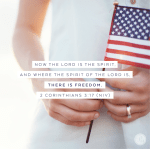
1. Now the Lord is the Spirit, and where the Spirit of the Lord is, there is freedom. 2 Corinthians 3:17

Most of the memes using this verse omit the first phrase, because even including those six extra words tends to give too much context to the verse for the person trying to make it about American freedom. If you read all of chapter three, or even just verses 12-18, you can see that this verse is about being set free in Christ from the demands of the Mosaic Covenant. Although 2 Corinthians 3:17 was misused by many, the first place I saw it was was from Lysa TerKeurst’s Proverbs 31 Facebook page – emblematic of why Christian women should not receive Bible teaching from anyone associated with this organization.

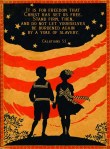
2. For freedom Christ has set us free; stand firm therefore, and do not submit again to a yoke of slavery. Galatians 5:1

Most incorrect citations of this verse include only its first phrase. Indeed, Christ has set us free for freedom, but freedom from what? English tyranny? Political oppression? No, as the rest of the verse goes on to say, Christ has set us free from the yoke of slavery to the Law. In Christ, we are free to stop striving to be good enough to earn right standing with Him, and to rest in His finished work on the cross to clothe us in His righteousness. That’s way better than American constitutional freedoms because that kind of freedom is available to anyone, in any country, at any time in history who repents and places her faith in Christ for salvation.

3. For you were called to freedom, brothers. Only do not use your freedom as an opportunity for the flesh, but through love serve one another. Galatians 5:13
This is a great verse that Christians can live out in service to our families, our church families, and even our fellow Americans. But we need to understand that when this verse says we were “called to freedom” it’s not talking about the rallying cry of the American Revolution. The freedom we were called to – as with Galatians 5:1 – is the freedom from striving to obey the Law to obtain righteousness. But just because we’re no longer under the constraints of the Law doesn’t mean we can go out and sin at will, or indulge the flesh by doing whatever we feel like doing. That’s antinomianism. Instead we’re to use our freedom from the Law as an opportunity to deny self and serve others.

4. if my people who are called by my name humble themselves, and pray and seek my face and turn from their wicked ways, then I will hear from heaven and will forgive their sin and heal their land. 2 Chronicles 7:14

I’ve written at length on this verse in my article Is 2 Chronicles 7:14 God’s Promise to American Christians Today? The short answer is “no,” it is not about America. Although there’s plenty that Christians can learn from this verse, it is a promise to Israel, as the surrounding context clearly indicates.

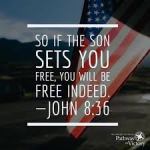
5. So if the Son sets you free, you will be free indeed. John 8:36
Even adding just two verses (34-35) to this one give enough context to help us understand that Jesus is talking about being freed from slavery to sin through the salvation only He can provide – the salvation that is about to cost Him the agony of scourging and death on a cross. It is appalling that this verse – spoken by our Lord Himself, about the earth-shattering, awe-provoking amazingness that is the forgiveness of sins by the grace of God in Christ – should be so lowered and sullied as to try to make it refer to American freedom.

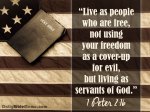
6. Live as people who are free, not using your freedom as a cover-up for evil, but living as servants of God. 1 Peter 2:16
The context of this verse is similar to Galatians 5:13 (#3 above), but it adds a couple of extra facets. If you read verses 9-17 of 1 Peter 2, you’ll notice the same instruction to live as people who have been set free in Christ and to use that freedom in Christ to serve others. Why? “…So that when [the Gentiles] speak against you as evildoers, they may see your good deeds and glorify God… For this is the will of God, that by doing good you should put to silence the ignorance of foolish people.” (12,15) When we use our freedom in Christ to serve and do good, it is a testimony of the gospel to the lost. This passage also exhorts us to be subject to our government and our political leaders. And if you know anything about the first century Roman Empire, you know its Christian citizens (Peter’s audience) knew nothing of the political freedoms American Christians experience.

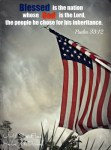
7. Blessed is the nation whose God is the Lordthe people whom he has chosen as his heritage! Psalm 33:12

In the immediate context and application of this verse, “nation” and “the people” is referring to Israel. Examining verses 10, 16, and 17 alongside verse 12, it’s a safe assumption that the psalmist had observed some part of Israel’s history that included war against neighboring nations. And, certainly, any Old Testament Scripture referring to the people God “has chosen as His heritage” could only be speaking of Israel. America didn’t even exist at that time, nor has God, at any point in Scripture, said that America is His chosen people or His heritage. If you want to think of a New Testament “nation” or “people” God has blessed and chosen as His “heritage,” that would be the church- the worldwide body of born again believers. While, ostensibly, any nation whose God is the Lord would be blessed, we have only to look back at Old Testament history to see how unlikely it would be for America’s God to be the Lord. Israel was God’s chosen people and heritage. They were “the nation whose God is the Lord”- literally. They were a theocracy – under the direct rule of God Himself – yet they rejected Him in favor of earthly kings and repeated cycles of idol worship. And we think America is capable of becoming “one nation under God”?

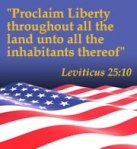
8. And you shall consecrate the fiftieth year, and proclaim liberty throughout the land to all its inhabitants. It shall be a jubilee for you, when each of you shall return to his property and each of you shall return to his clan. Leviticus 25:10
It’s pretty easy to see why only the phrase “proclaim liberty through the land to all its inhabitants” is lifted out of this verse. It is obviously talking about Israel’s Year of Jubilee which has never been practiced in America because we are not, and never have been, under the Mosaic Covenant. Even Israel doesn’t observe the Year of Jubilee any more. The use of this verse is simply a case of someone looking for a Scripture to attach to a patriotic meme, doing a concordance search for the word “liberty,” and whittling away everything in the verse that is obviously un-American.

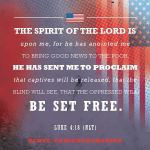
9. The Spirit of the Lord is upon me, because he has anointed me to proclaim good news to the poor. He has sent me to proclaim liberty to the captives and recovering of sight to the blind, to set at liberty those who are oppressed, Luke 4:18

Except for the fact that this verse includes the word “liberty” or “free,” depending on your translation, it’s incomprehensible to me that anyone would see this as a verse to use in the celebration of Independence Day. This verse doesn’t even make any sense when applied to America. It’s not about a country, it’s about a person: Jesus. Jesus spoke these words. He’s quoting Isaiah 61:1-2, which is a prophecy of the Messiah to come. If you read a mere three more verses of Luke 4, you’ll see in verse 21 that Jesus says, “Today this Scripture has been fulfilled in your hearing.” Meaning what? Jesus is saying, “You know that Messiah you’ve been waiting on for centuries, Israel? I’m it. I’m here.” And the liberty or freedom He’s talking about? Once again, it’s freedom from sin and freedom from the Law. Because that’s what Jesus came to give us.

10. Out of my distress I called on the Lord; the Lord answered me and set me free. Psalm 118:5 

Nope, this one isn’t about American political freedom either. A couple of things to notice: first, this is clearly set in the context of Israel’s Old Testament history, as verses 2-3, with their references to “Israel” and “Aaron”, indicate. Next, look at the personal pronouns, not only in verse 5, but also in verses 6-7: “I,” “me,” “my.” This verse is not about America being set free from England, or even about Israel being set free from one of its enemies. This is a descriptive passage about an individual – the psalmist – being in some sort of distressing situation, and God answering his prayer for deliverance. Have you ever prayed that God would deliver you from a difficult time in your life? If He did, do you think that unique situation is applicable to anyone else, much less an entire country? This passage is kind of the same thing. The psalmist is sharing something God did for him, not commenting on politics or even assuring other individuals that God will do the same for them.

Memorial Day Bonus:

Greater love has no one than this, that someone lay down his life for his friends. John 15:13
Memorial Day is a solemn and precious day to honor those who have laid down their lives for our freedom as Americans. Every male member of my immediate family has served or is serving in the military, and I know just how blessed I am that they have all returned safe and sound. It takes a special kind of person to make the ultimate sacrifice for his country, and I certainly don’t want to take anything away from that. But as meaningful as that is, it can’t – and shouldn’t – compare to Christ laying down His life to make sinners His friends. And that’s what this verse is about. For twelve verses, Jesus has talked to His disciples about abiding in Him because He loves them so much. In verse 13, He talks about the proof of His love for them: He’s about to give His life as the atoning sacrifice for their sin. He wants them to love each other the same way – that for Christ’s sake, in Christ’s name – they would be willing to die for the sake of the gospel. Eleven of the twelve of them would go on to do so. When we use this verse in reference to Memorial Day – as deeply consequential as that day is – it tarnishes the infinitely more important sacrifice of Christ by comparing a mere man’s offering of his life for temporal, earthly freedom, to God’s offering of His sinless Son to purchase for eternity the redemption of sinful rebels.

I’m proud and grateful to be an American. I’m thankful for this nation and the freedoms we have as citizens. But for everyone who’s a citizen of the Kingdom of God, our loyalty and reverence must lie with Him first and must surpass all other loyalties – to family, to friends, and even to country. That means we reverence God’s holy Word by being good students of it and handling it correctly, by preserving and standing up for its meaning and intentions, and by refusing to manipulate it for our own lesser purposes- even such a noble purpose as patriotism.


Photo Credits
The references below are for the purpose of photo credits only. I have not examined most of these sites and do not endorse any which contradict my beliefs as cited in the Statement of Faith and Welcome tabs at the top of this page.

1. https://www.facebook.com/Prov31Ministries/photos/a.390955286960.162138.99550061960/10154692176801961/?type=1&theater
2. https://stjosephslanc.com/july-5-2015-the-fourteenth-sunday-in-ordinary-time/
3. https://www.facebook.com/ConcernedWomenforAmerica/photos/a.119423980992.123545.77903485992/10155305900670993/?type=3&theater
5. https://twitter.com/robertjeffress/status/746696996208074752
6. http://dailybiblememe.com/tag/1-peter-216/
7. http://simplylkj.blogspot.com/2016/07/happy-4th-of-july.html
8. https://thepatriotstrumpet.com/
9. http://www.klove.com/
10. http://heavy.com/news/2016/07/patriotic-bible-verses-quotes-scripture-independence-day-4th-fourth-of-july/
Memorial Day Bonus: http://unitetheusa.org/id165.html

False Doctrine, False Teachers, New Apostolic Reformation, Throwback Thursday, Top 10

Throwback Thursday ~ Top 10 NAR* and Seeker-Driven Buzzwords

Originally published November 14, 2014buzzwords

I study false teachers pretty often. I watch their videos, listen to their sermons, and read their articles. And I’ve noticed that there are some common buzzwords that New Apostolic Reformation* and Seeker-Driven false teachers tend to use over and over again. Naturally, these words are just that: words. Just because you hear your pastor, Sunday School teacher, or favorite Christian celebrity utter one or more of them doesn’t necessarily mean he or she is a heretic. But if you’re constantly hearing these words and phrases, it could be a red flag that you need to vet the person you’re listening to more carefully and see whether or not his or her theology matches up to what the Bible says. So, here, in no particular order are 10 such buzzwords and some of the false teachers who are fond of them:

1. The Glory

Photo Credit: Revival Magazine


“Sometimes as I stand in the glory my hands and feet will begin to drip with supernatural oil, representing the miracle anointing of God.” ~ Joshua Mills


 2. In The Natural

Photo Credit: Awesome God Ministries


“I learned that even when we are in a place of obedience, we often have no way in the natural of knowing for sure whether we are right or wrong.” ~ Joyce Meyer


3. Shaking/Shifting

Photo Credit: Apprising Ministries

“If we continue to pray and call out to God, the nation will shift.”

“There is terror in Tampa, Tallahassee and Miami – a ring of terror; but, God has a ring of fire. Shaking, shaking, shaking.” ~ Cindy Jacobs


4. Decree

images
Photo Credit: Do Not Be Surprised


“Decree and declare… THE FAMINE IS OVER!” ~ T.D. Jakes


5. Declare

Photo Credit: Amazon


“I declare that I am a ‘no lack’ person and receive every blessing You have prepared for me.” ~ Joel Osteen


6. Spirit-man

Photo Credit: Jennifer LeClaire Ministries


“Pray always and when you catch your mind trying to reason out a prophetic revelation, let your spirit man rise up and take control.” ~ Jennifer Leclaire


7. Holyspirit

the-holy-spirit-364251_640

A number of NAR personalities refer to the third Person of the Trinity as “Holyspirit” -as though that were His first name- instead of the Holy Spirit. For example, “Holyspirit said to me the other day…”

It is nearly impossible to isolate a text example of this as a) it is usually verbal and b) search engines always include the word “the” in search results.


 8. In the heavenlies

Photo Credit: The Elijah List


“War in the heavenlies. We can battle against the enemy’s strategies through prayer and declaration of the Word. This wins the battle in the heavenlies before it hits the earth.” ~ Patricia King


9. Come into agreement/alignment

Photo Credit: The Elijah List


“…the Bible states that God, before time, determined your zip code—that spiritual place and geographical location; when you get into that spot, everything around you will begin to come into alignment.” ~ Cindy Trimm  


10. Cast vision

Photo Credit: FBC Jax Watchdogs


“Sure, I cast vision—but it has taken every staff member and volunteer we have to pull it off.” ~ Perry Noble


What are some common words and phrases
you often hear false teachers use?

Thanks/Thanksgiving, Top 10

Top Ten Songs for Thanksgiving

Isn’t Thanksgiving a wonderful holiday? It’s a whole day set aside for feasting and thanking God for all of the glorious things He has done for us. And what’s a celebration without great music? Here, in no particular order, are my top 10 picks for beautiful and joyful songs of Thanksgiving. (Click on the titles of the videos without screen lyrics for a lyric sheet in case you’d like to sing along!)

And if you prefer a playlist format, I’ve compiled all of the songs below into my YouTube Thanksgiving playlist.

Thanksgiving is a whole day set aside for feasting and thanking God for all of the glorious things He has done for us. And what’s a celebration without great music?

1. We Gather Together

It’s the iconic song of Thanksgiving, and for good reason. Won’t it be amazing to one day “gather together” with our brothers and sisters from all over the world to offer thanks and praise to our great and glorious God?

2. O Give Thanks

This was a new one for me this year, but it’s already a favorite. With its phenomenal theology and singability, this one is probably already a Thanksgiving staple in many churches.

3. Now Thank We All Our God

“With hearts and hands and voices.” We thank God in our hearts and by singing and praying to Him, but let’s not forget to serve Him, and others, as an act of thanks as well.

4. Give Thanks

This song quickly became a Thanksgiving standard in the 90’s. I love the way it points us to the simple truth of being thankful for Christ.

5. Come, Ye Thankful People, Come

Sit down and read over the lyrics of this one if you have a moment. The hymnist beautifully weaves together the idea of harvest time and God’s provision for us with the idea that we are God’s “crop,” wheat and tares sown together. And one day “the Lord our God shall come, and shall take the harvest home.”

6. Thank You, Lord, for Saving my Soul

Did you know this song had verses? I have to say I feel a little cheated. I’ve been singing this song all my life and never knew of the three precious verses about thankfulness in this song. We need to bring them back!

7. For the Beauty of the Earth

How often do we forget to thank God for the simple things? The beauty of the earth, the love of family and friends, the church, and Christ, God’s best gift of all.

8. I Thank You, Lord

I’m sorry, but if this song doesn’t have you dancing across the kitchen with the turkey, you’d better check your praise thang to make sure it ain’t broke. “I thank you Lord. You’ve been so good to me.” Not a thing wrong with that! (Sorry, I couldn’t find a lyrics sheet.)

9. Count Your Blessings

What a lovely treat from the chorale of The Master’s University. When’s the last time you counted your blessings? Thanksgiving is a great day to start, but don’t forget to keep counting (and thanking God) all year through!

10. He Has Made Me Glad

Drawn from Psalm 100 and 118, this sweet little song reminds us of the joy of simply being in God’s presence and thanking Him for who He is.

What’s your favorite Thanksgiving song, or song of thanks and praise to God?

What’s your favorite Thanksgiving song,
or song of thanks and praise to God?


I have not exhaustively vetted these musicians and songwriters, and I do not endorse any of them whose lives or beliefs conflict with Scripture or my beliefs as outlined in the Statement of Faith or Welcome tabs at the top of this page.