Mailbag

The Mailbag: Should I attend seminary?


For the past few months, I’ve felt a strong desire to attend seminary. After a lot of prayer, Scripture reading, and reaching out to my pastor and trusted, older, Godly friends for counsel, I began the process of applying [to a doctrinally sound seminary].

I’m in my early 30s, have never been married, and have no children. I lead middle school youth girls, women, and children in various classes at church, and work as a part time staff member in my church. I have a strong desire to pursue further education, and to teach and lead women and students. I am incredibly excited at the prospect of going to seminary.

I would like to know your thoughts about how a woman might know for sure she is being called to full-time ministry and what part attending seminary should or could play in that.

Great question, and one I wish more doctrinally sound women were asking!

Some might wonder, “What is the point of a woman getting a seminary degree if she can’t, biblically, become a pastor, elder, or exercise authority over men in the church?”. Because there are tons of other ways women can serve the Body of Christ, maybe in parachurch ministries or missions or as an author, or maybe by simply striving for godly excellence as a Christian woman, wife, mom, or church member.

Learning as much as you possibly can about the Bible, the church, and Christianity isย never a waste, even if you don’t go into some sort of formal, paid position of ministry. If you’re a woman with time and resources on your hands, I’d encourage you to consider taking a seminary class or two, or even getting a degree, just for all the valuable things you’ll learn. Some seminaries will allow non-students to audit courses. Others offer degree and certificate programs specifically designed for women, online degree programs, and free online (non-degree) classes. A couple of good ones to check out are Southern Baptist Theological Seminaryย and Reformed Theological Seminary. The Master’s University, while not a seminary, offers many courses and degree programs which are open to women. (The Master’s Seminary does not admit women as their scope is limited to preparing men for the pastorate.) Ligonier Ministries doesn’t offer a seminary degree program, but does offer many theologically richย online classes.

Whether you opt for a non-credit online course or move into campus housing and pursue a degree, be sure you keep your discernment radar on high alert, even at a doctrinally sound seminary. Believe it or not, even multi-degreed seminary professors can lack discernment or teach unbiblical doctrine. Don’t be intimidated by a string of letters and decades of experience behind someone’s name. If what he’s saying doesn’t match up with rightly handled, in context Scripture, he’s wrong.

Now let’s address a few of the more specific points the reader mentioned:

I think we way over-mysticalize this whole “call to ministry” thing. We think there’s got to be some kind of supernatural “road to Damascus” experience that we can point back to and say, “There! That’s the moment God ‘called’ me into ministry!”. But the Bible doesn’t really talk about a call to ministry in those kinds of terms. Remember, the account of Paul’s (and other Bible characters’) conversion and call experience isย descriptive, notย prescriptive. The prescriptive passage looks like this:

The saying is trustworthy: If anyone aspires to the office of overseer, he desires a noble task. 1 Timothy 3:1

No mention of God speaking to you or a particular feeling or goose bumps or feeling “a peace about it.” Scripture just says if a man has the desire to be a pastor, that’s a good and noble goal. Just an objective statement of fact. So, by the same underlying principle, if a woman wants to dedicate her life to full time ministry, that’s a good desire.

The next step is to see if you’re biblically qualified to be in full time ministry. Simply wantingย to be in ministry does not mean youย shouldย be in ministry or that God thinks you’reย qualified to be in ministry. A few biblical passages any woman considering seminary or a career in ministry should consider:

๐Ÿ“–ย 1 Timothy 2:11-15ย You cannot, without sinning, pursue the office of pastor, elder, associate pastor, or any other position which requires you to teach Scripture to men, or hold authority over men, in the gathered body of Believers. If you’re a woman who’s going to seminary in order to pursue such a position, you are already biblically disqualified from ministry.

๐Ÿ“–ย Galatians 5:22-23ย How’s your fruit looking? If your life generally doesn’t reflect the Fruit of the Spirit, you’re probably not ready for seminary or ministry. (In fact, you might want to examine yourself against Scripture to see if you’re really saved.)

๐Ÿ“–ย 1 Timothy 3 and Titus 1ย These may be qualifications specifically for pastors, elders, and deacons (which are all offices restricted to men) but the underlying principles would extend to anyone in a position of Christian leadership, and nearly all of them apply to Christians in general. Indeed, Paul says in 1 Timothy 3:15 that he is writing these things so that “you may know how one ought to behave in the household of God.”

๐Ÿ“–ย Genesis 2:18, Ephesians 5:22-33, Titus 2:3-5, 1 Timothy 3:4-5ย If you are married and/or have children, Scripture is clear that it is your primary calling to be a helper to your husband, raise godly children, and manage your household well. Any seminary classes or degrees or ministry positions you pursue may not interfere with or impede your first calling. Additionally, if your husband objects to you attending seminary or pursuing a career in ministry, Scripture mandates that you submit to him and respect his decision.

๐Ÿ“–ย 1 Corinthians 7:32-35ย If you’re single with no children, God has given you the precious gift of being able to serve and focus solely on Him, and it may be the perfect time for you to attend seminary or serve Him in full time ministry.ย 

If you have a strong desire to attend seminary or pursue a career in ministry and you meet the biblical qualifications, the next step is exactly what our reader has done: pray about it, search the Scriptures, seek wise counsel, consider and evaluate the ministry you’re already doing in your church (If you don’t already love being a faithful, serving member of a local church, why on earth would you want to go to seminary or into full time ministry?), realize that there are a lot of things about ministry that are difficult and that seminary doesn’t prepare you for, and if you still want to go to seminary or seek out a ministry position, trust God to guide you and go for it.

Yes, it really is that simple. Desiring to dedicate your life to the service of our Lord or to study more about Him in seminary is a good and God-pleasing desire. If you can accomplish those goals within the parameters Scripture has laid out for godly women, whyย wouldn’t you pursue it?


If you have a question about: a Bible passage, an aspect of theology, a current issue in Christianity, or how to biblically handle a family, life, or church situation, comment below (Iโ€™ll hold all questions in queue {unpublished} for a future edition ofย The Mailbag) or send me anย e-mail or private message. If your question is chosen for publication, your anonymity will be protected.


Mailbag

The Mailbag: Potpourri (Female officiant, JMac attack, Google 101…)


Welcome to another “potpourri” edition of The Mailbag, where I give short(er) answers to several questions rather than a long answer to one question. I also like to take the opportunity in these potpourrri editions to let new readers know about my comments/e-mail/messages policy. Iโ€™m not able to respond individually to most e-mails and messages, so here are some helpful hintsย for getting your questions answered more quickly. Remember, the search bar can be a helpful tool!


I noticed you’ve written lists of recommended teachers and false teachers. Just curious if you could help in the same way with Contemporary Christian music and artists.

I took a stab at that in my articleย False Doctrine in Contemporary Christian Music. I will add any CCM artists I stumble across in the future that I think need to be warned against or recommended, but I’m afraid that article is going to be the extent of any “list” of doctrinally sound or unsound Christian musicians. It’s not an issue I research much, and CCM isn’t a music genre I enjoy listening to. I’m really more of a podcast gal. I would, however, highly recommend the Additional Resources I’ve listed at the end of that article as well as the comments section.


I was recently invited to a wedding where the officiant will be a female “pastor”.ย I’m not close to the bride, but I honestly can’t bear the thought of attending even if we were close. Your thoughts, please?

This is really less of a biblical question than it is an etiquette question. Fortunately for all of us, I have read a lot of Miss Manners in my day :0)

Since you’re not close to her, that makes things a lot easier than if it were a family member or close friend. If the invitation contains an RSVP card, you can just send it back with “regrets” or “will not attend” (or whatever) marked and not say anything else about it.

If it’s a situation like she’s a co-worker you see face to face frequently and she asks point blank if you’re coming, you could say something, like “I’m so sorry, but I have a conflict that prevents me from attending.” It’s not necessary to go into any further detail.

If she’s pushy and presses you about it, you could either say something like, “I’m sorry, it’s personal,” or you could kindly, gently, and briefly get into the actual theology of why a woman shouldn’t be serving in the position of pastor, explain that this conflicts with your beliefs as a Christian, and that you wouldn’t feel comfortable attending. Ask God to give you wisdom as to what is the best approach with this particular person.

Just bear in mind, a social invitation isn’t a subpoena and it’s really nobody’s business why you won’t be attending.


Can a church use Hillsong or Bethel/Jesus Culture music in the worship service as long as the lyrics of the particular songs that are selected don’t conflict with the Bible?

If I were queen of the evangelical world and it were up to me to make a binding law about this, my answer would be no. No church would use any music by any heretical organization or doctrinally unsound musician. I briefly addressed my reasons for this in my articleย False Doctrine in Contemporary Christian Music:

Itโ€™s imperative for churches to be discerning about the CCM they use in worship. If Jane Churchmember hears a CCM song in church and likes it, sheโ€™s likely to Google the song (probably right there in church- Iโ€™ve done it!), find out who sings it, and begin following that artist. Worship pastors who use CCM have a responsibility to vet the artists who perform the songs they select for the worship service to make sure theyโ€™re not sending Jane into the arms of a heretic. Additionally, music costs money, and you donโ€™t want your churchโ€™s offerings supporting false doctrine.

I think the principles and Scriptures in this article generally apply to this question as well:ย Four Reasons Why It Matters Who We Share, Pin, and Re-Tweet


Today on Facebook, I saw a post saying John MacArthur is a false teacher. Can you enlighten me please? After being part of your blog and being more discerning of who I read, I’m bummed. I even purchased the John MacArthur ESV Study Bible on your recommendation and also read the Grace To You blog.

Let me start by saying this: Just because someone (including me) says a certain teacher is a false teacher doesn’t mean you should automatically believe her.

I can assure you that John MacArthur is not a false teacher. In fact, he is one of the finest and most doctrinally sound teachers out there today, and I highly recommend him. But you shouldn’t just blindly take my word for that any more than you should just blindly take the word of the Facebook post you saw that says he is a false teacher. You shouldn’t believe anything in Christianity because a person says so, but because the Bible says so. Every Christian should be discerning about every sermon she listens to, every book she reads, and every pastor or teacher she follows, including the pastor at her own church. Weย must each practice biblical discernment for ourselves, comparing everything to rightly handled Scripture and discarding anything that doesn’t match up to what the Bible says in context.

I’m not familiar with the Facebook page you mentioned by name in your e-mail, but my guess is that it is a group that incorrectlyย and unbiblically believes that Reformed theology (or Calvinism) is false doctrine. John MacArthur is a Calvinist, so naturally they believe he is a false teacher. They’re judging his sound doctrine by their own false doctrine. That’s what people who hold to false doctrine do. Extreme anti-Calvinists believe Calvinists are false teachers, New Apostolic Reformationists believe doctrinally sound cessationists are false teachers, Catholics believe that Protestants are false teachers, and so on. It helps to know what kind theology (or false theology) someone is coming from when he labels a person as a false teacher.

I would encourage you to do the biblical work of discernment for yourself. Compare John MacArthur’s materials to Scripture and be convinced by God’s written Word whether or not you should follow him.

Here are a couple of articles I think you will find helpful on this issue:

Clinging to the Golden Calf: 7 Godly Responses When Someone Says Youโ€™re Following a False Teacher

Is She a False Teacher? 7 Steps to Figuring it Out on Yourย Own


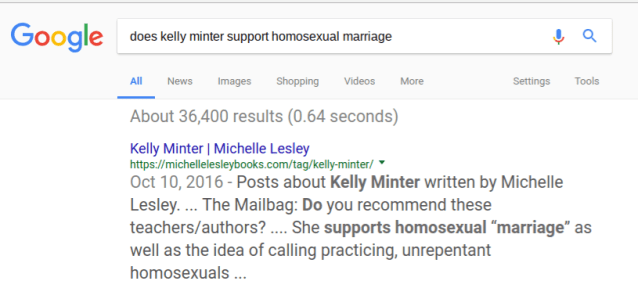
You had this Google result that talks about Kelly Minter supporting gay marriage:

I have searched the Internet and your website and I can’t find it. I’m thinking of doing her Bible study on Nehemiah but don’t want to do it if this information is true so I need to see her exact quote myself in order to decide.

This is the first time I’ve received a question like this, but it concerns me that a lack of understanding of how Google works might lead someone to think I’ve said something I haven’t, and if there are others out there who are drawing the same kinds of conclusions as this reader just because they need a little help understanding the mechanics of Google, I’m glad to give a little tutorial.

It looks like you may have Googled something like “Does Kelly Minter support homosexual marriage?” but didn’t click on my article that popped up.

(Here’s the top result I got when I Googled the phrase “Does Kelly Minter support homosexual marriage”.)

When you Google something, Google pulls the key words from your search and that’s what it displays in boldtype in the result. You have to click on the article and read it to get the full picture.

Here is the direct link to my article that contains information about Kelly Minter. My article doesn’t say Kelly Minter supports homosexual marriage, but there is another teacher in the article who does. Your Google result pulled Kelly Minter’s name from the section on her and the “supports homosexual marriage” phrase from the section on Rachel Held Evans.

To my knowledge, Kelly Minter does not support homosexual marriage, however, I would still urge you not to use her materials for the reasons given in the article. Just because someone doesn’t support homosexual marriage doesn’t mean everything else she’s teaching is biblical, and this is certainly the case with Kelly Minter. Her materials would be detrimental to your spiritual growth. I would strongly recommend that you simply pick up the Bible and study it for yourself rather than relying on someone else’s book.

You might find the “Popular False Teachers” tab, “Recommended Bible Teachers” tab, and “Bible Study” tab (all at the very top of this page) helpful.


If you have a question about: a Bible passage, an aspect of theology, a current issue in Christianity, or how to biblically handle a family, life, or church situation, comment below (Iโ€™ll hold all questions in queue {unpublished} for a future edition of The Mailbag) or send me an e-mail or private message. If your question is chosen for publication, your anonymity will be protected.
Mailbag

The Mailbag: Help! There’s a pushy lady at my church!

There is a lady in my church who has become very involved in a certain form of parachurch Christian ministry. She is extremely gung ho about it and pressures church members to participate. She has also organized a conference, bringing in speakers from the national level of the ministry.ย The elders/pastors approved it, but there is some disagreement about bringing in outside speakers, charging attenders so much for tickets, and the fact that it is mainly drawing people from outside our church who are already involved in this ministry, not necessarily discipling our own church members, yet our church members bear the work of the conferences.

We, her friends, have watched her continue to insistently push this ministry agenda. She freely admits to being pushy and asks us to keep her accountable, but she continues to push and becomes frustrated when challenged. I have met with her one on one and discussed this, and she now avoids me. I guess my question is, is it right/OK for me to now keep my distance from her? Is it OK for a woman to push a ministry agenda in the church?

Every once in a while a situation arises at church that leaves you feeling like, “Church is great…except for the people.” I’ve felt that way many times over the years, and I’m certain many people have felt that way about me. Personality conflicts at church can be difficult to deal with, but they’re a great “homework assignment” from God that – if we approach them biblically – can help grow us and the other person in Christlikeness. Let’s take a look at some of the aspects of this reader’s situation.

Doctrinal clarity on the ministry:
I think the first question on the minds of many of those reading this article is going to be, “What kind of parachurch ministry is this?”. Because, if it’s a ministry that centers around false doctrine or is led by false teachers, that’s your answer right there.

I edited out references to the particular ministry the woman is involved in a) to protect my reader’s anonymity and b) because the reader assures me the issue isn’t the ministry itself, it’s the agenda pushing. I’m very familiar with this specific parachurch ministry. It’s doctrinally sound. The situation would be similar to someone getting very involved in pro-life ministry, for example.

Doctrinal clarity on the behavior:
From what the reader has described in her e-mails, the woman’s behavior, while annoying and possibly concerning, does not sound like it has reached the level of actual sin. The parachurch ministry is doctrinally sound, and she thinks it would be beneficial to her church. She has received approval from church leadership. It doesn’t sound like she’s being deceptive in any way or doing anything the Bible clearly prohibits; she’s just very excited about this ministry and wants others to be as excited and on board as she is. That’s not sin, it’s just off-putting to others who aren’t interested. We need to be clear on the biblical fact that just because somebody does something that aggravates us doesn’t necessarily mean it’s sin. And if it’s not sin, it shouldn’t be treated as though it were. (I’m not saying the reader is doing that, just a general concept all of us should be mindful of.)

Church leadership:
If this woman is bringing in conferences, speakers, and other events that utilize the church facility, she’s not doing it without the approval of the pastor and/or someone in leadership. What that means is, as much as other church members may not like it, the buck stops with the pastor/elders, and they have given their approval to the activities thus far. If they are having a problem with this woman being pushy with them, it is their responsibility as pastors and elders to sit down with her and put a stop to that. If the pastor/elders are aware of, and have a problem with ticket prices, church members doing all the work, and the other problems you mentioned, it is their job to address that. I understand your concerns, dear reader, and having dealt with people like this before, I certainly empathize, but if you insert yourself between this woman and the elders – regarding her pushiness with them or issues it’s their responsibility to address – you run the risk of becoming pushy yourself and stepping in where you don’t belong.

If you think the pastor and elders are unaware of pertinent information regarding this situation, talk to your husband about it, and pray together for wisdom as to if and how you, he, or both of you should approach them with the information, remembering that, as a godly wife, you need to respect and defer to your husband’s decision. If the pastor and elders receive the information and continue to approve the parachurch ministry conferences and activities, then your disagreement is with the pastor and elders, not the woman pushing the agenda.

Body parts:
You’ve asked if it’s OK for a woman to push a ministry agenda in the church. No, it’s not. It’s not OK for men to do so either. First Corinthians 12 compares church members to the various parts of the body. While “The eye cannot say to the hand, ‘I have no need of you,'” neither can the hand say to the eye, ear, nose, foot, mouth, etc., “You have to be a hand, just like me.”

It is absolutely fine to be excited about a ministry or a project at church and to invite and encourage people to participate in it, but crossing the line from inviting and encouraging to pressuring and badgering is not appropriate, biblical, or loving. It puts your brothers and sisters in the awkward position of either having to knuckle under and do something they don’t really want to do in order not to hurt your feelings, or having to say no and run the risk of hurting your feelings. It ends up making the decision to serve in a particular ministry all about you, the pushy person, rather than about whether or not God wants that person in that ministry at this time. And not only should we not be basing our decisions about whether or not to serve on pleasing man rather than on pleasing God, it is unloving and unkind to back a brother or sister into a corner, forcing them into a no-win situation. If you love your brothers and sisters in Christ, you’ll want them to serve because they’re convinced God wants them to serve, not because you want them to serve.

Woman to woman:
As far as your personal relationship with this woman goes, it sounds like you have tried to reach out to her and help her, which is commendable. We all have weaknesses, and it sounds like this lady’s weakness might be lack of self-awareness and social skills. Sometimes, no matter how gently and lovingly we approach someone about a personal issue, she will get defensive or avoidant. Maybe she just needs some time to settle down. People rarely stay at fever pitch about something forever.

Is it OK for you to keep your distance from her? Well, I don’t think you need to proactively pursue spending time with her, but I also don’t think you should avoid any of your normal church activities that would bring you into contact with her. And, of course, you should be kind and loving to her when you see her in passing. If she continues to press you about the ministry whenever she sees you, there’s nothing wrong with politely changing the subject or excusing yourself. And if she wants to know what’s going on, just kindly and lovingly be honest with her. For example: “Jane, I’m so glad you’ve found a ministry you’re excited about and enjoy, but it’s just not my cup of tea. Maybe we could talk about other things when we get together?”

Sanctification:
As I said in the beginning of this article, personality conflicts in the church aren’t easy to deal with, but if we submit to God and His Word in the situation, they can be very sanctifying.

When I have to deal with a Christian I find difficult it helps me to remember a few things. First, this is a sister in Christ, made in the image of God. God knit her together in her mother’s womb, breathed the breath of life into her, and bled and died on a cross for her sins just like He did for me. We areย allย sinners, and weย allย have various personality issues that sometimes rub others the wrong way. Second, for every person I run into who bugs me, there are probably a dozen who are buggedย by me. I’m not any better than the person I’m dealing with just because I don’t bug people the same way she does. I also try to keep in mind that Jesus had to deal with a lot of difficult people during His earthly ministry. And, while I frequently fail, I do my best to follow His example of how to treat people.

The people we’re in membership with at our local church are our family. Every family has a crazy grandma or a know it all uncle or a cousin who constantly drops the ball. But we don’t just give up on family because they annoy us. Pray – daily and fervently – for those crazy, annoying, frustrating, challenging brothers and sisters at your church. Pray that God will help you love them the way they need to be loved. Consider setting aside some time to just sit and listen to them pour out their hearts. Many people act out simply because they feel invisible, lonely, and unheard. Be patient with them. Be kind. Do something unexpectedly generous and loving for them. Exercise forbearance. Find a way to help. Scripture after Scripture shows us it’s God’s will for us to love the unlovely, just like we want others to love us when we’re unlovely. This is one of the reasons why we’re in the church.


If you have a question about: a Bible passage, an aspect of theology, a current issue in Christianity, or how to biblically handle a family, life, or church situation, comment below (Iโ€™ll hold all questions in queue {unpublished} for a future edition of The Mailbag) or send me an e-mail or private message. If your question is chosen for publication, your anonymity will be protected.

Mailbag

Throwback Thursday ~ The Mailbag: Give Me Church Ladies, or I Die?

In honor of the 500th anniversary of the Protestant Reformation coming up next Tuesday, an homage to my favorite Reformer:

Originally published May 2, 2016

mailbag


What does the tag line at the top of your blog, “Give me church ladies, or I die” mean?

JohnKnox150
Photo courtesy of ReformationHistory.org

The tag line on my blog, “Give me church ladies, or I die” is sort of an homage to John Knox, the key figure in the Scottish Reformation, who famously prayed, “Give me Scotland, or I die.” Knox had a passion for his people to know Christ, read the Bible for themselves, and for false doctrine to be eradicated from the church.

I admire John Knox, and share those same desires for my people (“church ladies”- Christian women and women who, unfortunately, have been deceived into thinking they’re Christians):

  • I have a passion for women to know and grow in Christ.
  • I want Christian women to break free of the “women’s ‘Bible’ study system” which keeps them enslaved to false teachers who spoon feed them false doctrine, and study the Bible for themselves.
  • I, too, want to see false doctrine eradicated from our churches and for sound doctrine to prevail.

Additionally, I am also Reformed, and my ancestry is Scottish, so I thought it was a fitting tag line for my blog.

John Knox was a fascinating man. Read more about him with these great resources:

Give Me Scotland or I Die by Burk Parsons

John Knox:ย Scottish Reformer at Christian Classics Ethereal Library

John Knox:ย Reformation Becomes a Reality at Reformation History

The Mighty Weakness of John Knoxย by Douglas Bond and Steven J. Lawson


If you have a question about:ย a well known Christian author/leader, a Bible passage, an aspect of theology, a current issue in Christianity, or how to biblically handle a family, life, or church situation, comment below (Iโ€™ll hold all questions in queue {unpublished} for a future edition of The Mailbag) or send me an e-mail or private message. If your question is chosen for publication, your anonymity will be protected.

Mailbag

The Mailbag: Should churches use praise teams?


I question the use of praise teams. I have noticed the singers chosen are always very attractive as well as being very talented. I also notice they seem to be performers instead of leaders of worship. It seems the majority of churches that use praise teams are in the process of transitioning into the emergent church movement. I would appreciate your thoughts.

Okie dokie, let’s start off with some definitions and caveats. In the interest of full disclosure, my husband is a minister of music. We have usually served at smaller traditional churches (100-120ish in attendance on Sundays), some with only choirs, some with only praise teams, and some with both. I have always sung in those choirs and praise teams.

If you’re not familiar with praise teams, a praise team is a group of about four to eight singers – usually headed up by a worship leader or minister of music – that stand toward the front of the stage and do what choirs used to do: lead (by example) the congregation in singing. Some churches (usually the more traditional ones) use a choir and praise team. Some (the more contemporary ones, or small traditional churches that can’t support a full choir) use only a praise team. In more contemporary churches, the praise team, worship leader, guitar, drums and other instruments are often lumped together as a single entity – the worship “band”.

When pastors, elders, ministers of music, and others in church leadership are trying to decide what should or should not be included in the worship service, the first place they need to go is the Bible. If the practice in question is either specifically commanded or prohibited by Scripture, it’s quick and easy to make a decision. We do the things required by Scripture (such as baptism and the Lord’s Supper) and we don’t do the things prohibited by Scripture (such as women preaching or the worship of other gods). (If your church isn’t doing the “do’s” or is doing the “don’ts,” it isn’t a church. You need to find a real church – a biblical one – pronto.)

Your pastor and other leaders should also examine their motives for wanting to implement (or do away with) a particular practice. In the case of starting a praise team: Are we doing this because we want to look cool and attractional to the outside world? Is it a wiser stewardship of our music budget to switch to a small praise team instead of a large choir? How will a praise team make our worship service more God-glorifying? Not only should the practice itself line up with Scripture, but the leaders’ motives for implementing the practice should line up with Scripture.

As church members, when we take a look at what’s going on in the worship service at our church, we also need to make the Bible our first stop. First we need to examine whether or not the practice in question is biblical. If the practice in questionย is biblical (or at least isn’t unbiblical), we need to look at another passage of Scripture:

Obey your leaders and submit to them, for they are keeping watch over your souls, as those who will have to give an account. Let them do this with joy and not with groaning, for that would be of no advantage to you.
Hebrews 13:17

I think a lot of Christians forget this principle of authority in the church. Church isn’t Burger King where you can “have it your way” and you get to gripe all over the place when you don’t like something. If your pastor and other leadership are godly, biblically trustworthy men and they implement something that’s in line with scriptural principles, but rubs your personal tastes and preferences the wrong way, trust them, support them, submit to them, and give it a chance without complaining.

There’s nothing in the Bible that either prohibits or commands praise teams, so if your church leadership implements one, and their reasons line up with Scripture, that’s not ungodly or sinful in and of itself. It’s a decision each individual pastor has to prayerfully make as he seeks to do what is best, wisest, and most godly for his particular church.

That being said, let’s take a look at some of your more specific concerns:

“I have noticed the singers chosen are always very attractive…”
This may be the case in your church or churches you have watched on TV, but I can assure you it’s not the case in every church that uses a praise team. My own church “beta tested” a praise team in our traditional (choir and hymns) service several months ago. Because most of the people who attend that service (including the choir from which the praise team was chosen) are older, the praise team was of the middle aged to senior citizen demographic. I didn’t think any of them were unattractive because they’re my church family and I love them, but they weren’t 18 year old supermodels either. And I’ve seen plenty of other praise teams made up of people who are average looking, older, overweight, disabled, etc.

“…as well as being very talented.”
Maybe I’m misunderstanding what you mean here, but I’m not seeing the problem, either biblically or logically, with people who are talented in a certain area serving the church in that area. If you were going to put together a rotation of people to cook the fellowship meal prior to your midweek service, would you recruit the people in your church who are known to be good cooks or the ones whose casseroles everyone avoids at the monthly potluck? Do you ask people who can’t balance their own checkbooks to serve on the finance committee? If you’re putting together a music team, you want people who are talented and skilled in music, not the ones who are tone deaf, have no rhythm, and can’t read music. There’s biblical precedent for using people with certain talents to serve in certain capacities in God’s house.

“I also notice they seem to be performers instead of leaders of worship.”
I appreciate your use of the phrase “seem to be.” It’s extremely subjective and unfair to make a judgment call on whether a person is “worshiping” or “performing” based solely on his appearance, facial expression, and singing style during his time on the stage. The minister of music needs to be pastoring the praise team (this is why we need to have pastoral ministers of music instead of lay “worship leaders”) toward spiritual maturity in selecting, rehearsing, and ministering to them. He needs to ensure that the people on his team are genuinely regenerated Believers who exemplify humility and the desire to serve Christ and His church, not people who see singing on the praise team as merely a stepping stone to an appearance on The Voice.

“It seems the majority of churches that use praise teams are in the process of transitioning into the emergent church movement.”
That has not been my experience, but I don’t doubt that that’s true for some churches that use praise teams. But praise teams are not the linchpin on which churches turn to apostasy. There are hundreds, maybe thousands, of perfectly doctrinally sound churches that use praise teams and have no intention of going emergent. And, there are doctrinally unsound “churches” heading toward becoming emergent that also happen to use praise teams. It’s the doctrine and theology of the church, and its view of and fidelity to Scripture, that causes a church to either strive toward being a biblical church or becoming apostate, not whether or not it uses a praise team.

In summary, there is nothing patently unbiblical about praise teams themselves. The fact that some doctrinally unsound churches use them should no more preclude doctrinally sound churches from using them than doctrinally unsound churches having small groups should preclude doctrinally sound churches from having small groups. Personality, spiritual, and doctrinal issues affecting a praise team should be dealt with biblically in the same way these issues are dealt with in other groups in the church. Whether or not to have a praise team is an issue the pastor of each church must study Scripture and pray about and decide for himself. It’s not something we can biblically make a blanket statement for or against.


If you have a question about: a Bible passage, an aspect of theology, a current issue in Christianity, or how to biblically handle a family, life, or church situation, comment below (Iโ€™ll hold all questions in queue {unpublished} for a future edition ofย The Mailbag) or send me anย e-mail or private message. If your question is chosen for publication, your anonymity will be protected.