Mailbag

The Mailbag: How to Leave a Church


What is the biblical way to leave a church?

This is a great question that I’ve received from several readers. There are a lot of different circumstances that might cause someone to leave her church, and there are right ways and wrong ways to leave. I’ve been so grateful to hear from women who want to handle things biblically.

First, a couple of words of counsel that generally apply to nearly all situations when you’re considering leaving a church:

•In most circumstances, even bad ones, I would counsel against “ghosting” your church – simply disappearing with no explanation or goodbyes to anyone. When you’re preparing to leave, as appropriate to your particular situation, tell your pastor how much he has meant to you. Say a special goodbye to dear friends. Speak words of encouragement to your leaders and teachers. Search your heart for anyone you may have sinned against, repent, and apologize. Leave graciously.

•If you’re married, you and your husband will need to talk and pray together about whether or not to leave and how to do so. Be sure to remember that your husband is responsible for making the final decision and you are responsible for submitting to him.

Let’s talk about some of the more specific reasons you might have to leave a church, and what it would look like to leave well in each situation.

Death

If you’re a faithful member in good standing and you die unexpectedly, you’re off the hook. It’s OK to “ghost” your church. :0)

If you’re a faithful member in good standing and have a terminal illness, use some of your remaining time (if you’re able) to make a gracious exit. Take some time for special goodbyes. Discuss your funeral service and details with your pastor if applicable. Consider leaving a gift to your church in your will.

Moving or Temporarily Relocating

If you’re moving too far away to continue attending your church, let your pastor and those you’re close to at church know.

Do you know your new address and/or e-mail address? Provide it to the church office if you’d like them to keep sending you the church newsletter and any other mailings, and let them know if it’s OK to give that information out to other church members who would like to stay in touch. Make sure you have correct phone numbers and e-mail addresses for church friends you want to stay in contact with. If you’re not yet connected to a church in your new hometown, ask your pastor if he can suggest a good church in the area.

For those who are temporarily relocating (for example, college students or military families) and want to keep your membership in your home church, yet be active members of a church in your new location, find out if your new church has any sort of dual membership option (sometimes called “watchcare”). This allows you to maintain your membership in your home church while giving you membership benefits (voting, teaching, communion, or whatever your new church’s policies are) in your new church.

Switching from a good church to a church that’s a better fit for your family

Maybe the church you’ve been attending is a good one, but you’ve recently become more Reformed in your soteriology and you’d like to join another church in town that you more closely align with, theologically. Perhaps there’s a nearby church that has started offering programs and accommodations your disabled child could benefit from that your current church isn’t equipped to offer. Maybe, though doctrinally sound, your current church has switched to a genre of music that, even after giving it a good faith effort, still grates on you to the point of distracting you from worship, but another local church has music you’re more in harmony with.

None of these are reasons you absolutely have to leave a church. In fact, if your church is teaching sound doctrine, and the reason you’re considering leaving is a matter of preference or convenience, I would encourage you to try to work things out and stay at your current church if at all possible. It might be that God would have you start programs and accommodations for the disabled at your current church, or that He will begin to use the new music style in your life in some way. At the very least, when it comes to non-doctrinal issues like these, give it plenty of time, prayer, and serious thought before you leave.

Talk to your pastor (or appropriate elder) when you start thinking about leaving. This should not be an “If you don’t change X,Y, and Z, we’re outta here!” type of conversation. Be kind. Express your concerns or needs lovingly and biblically. Find out if there’s any information you need to know that would affect your thoughts about leaving. For example, maybe the pastor has also started becoming more Reformed and needs you to stay and support him as he begins transitioning the church in that direction. Maybe a lot of other church members have expressed discomfort with the new direction the worship music has taken and the leadership is considering changes that would make it easier for you to stay. You never know until you discuss it with your pastor.

If you come to the decision that you really need to move to another church, talk with your pastor again and let him know your decision. Take care of all of your church responsibilities before leaving: if you’re teaching a class with a definite end date, finish it. If you’re teaching a permanent class, let whoever is in charge of securing teachers know when you’ll be leaving so a new teacher can be found. Wrap up any projects or turn them over to the appropriate person. Resign any positions you hold. Don’t leave your brothers and sisters in the lurch.

When you say your goodbyes, it’s not necessary to disclose to everyone every detail of your reasons for leaving, but, if possible, try to stop any gossip before it starts by making sure people understand you’re not leaving because of someone else’s sin, unresolved conflict, false teaching, etc.

Leaving due to sin or false doctrine

The chairman of deacons is having an affair and nothing has been done about it. Your pastor just finished Bill Johnson’s book and is starting to teach New Apostolic Reformation false doctrine. Women have been preaching from time to time on Sunday mornings.

The most crucial time not to simply disappear from your church is when there’s sin or false doctrine in the camp. Jesus and the Apostles did not handle sin and false doctrine by avoiding it or ignoring it. They loved the people committing the sin and teaching the false doctrine enough to confront them – sometimes harshly, if needed – so that they might repent and be reconciled to Christ. We don’t run. We reconcile.

Just as God placed Esther in exactly the right position at the right time to help rescue His people, it could be that God has placed you in your church and given you a biblical understanding of the situation for such a time as this.

In cases of both sin and false doctrine, you should usually* follow the steps for church discipline outlined in Matthew 18:15-20:

1. If your brother sins against you, go and tell him his fault, between you and him alone. If he listens to you, you have gained your brother. (15)

2. But if he does not listen, take one or two others along with you, that every charge may be established by the evidence of two or three witnesses. (16)

3. If he refuses to listen to them, tell it to the church. (17a)

4. And if he refuses to listen even to the church, let him be to you as a Gentile and a tax collector. (17b)

(*If you have knowledge that someone is imminently about to commit sin, especially if that sin will victimize someone else, and time is of the essence, gather the appropriate leaders and/or church members and intervene immediately. If a crime has been committed, alert law enforcement.)

In my article, The Mailbag: How should I approach my church leaders about a false teacher they’re introducing?, I’ve outlined some steps to take when approaching your pastor or lay leaders about using materials authored by false teachers. Most of this information can be adapted for dealing with issues of sin and church discipline as well.

If the sin or false teaching issue is resolved biblically, praise God, forgive, do whatever you’re able to do to be at peace with all involved, and stay at your church if at all possible.

If you have done everything you’re able to do to help bring about a biblical resolution to the situation and the sin or false doctrine is being allowed to continue, it’s probably time to leave and find a spiritually healthy church. Talk to your pastor or elders, and let them know you’ve decided to leave and why.

Attempt to leave as graciously as possible, taking care of your teaching/serving responsibilities, saying goodbye, making arrangements to stay in touch with friends, etc.

You will need to prayerfully consider the biblically appropriate way to explain to fellow church members and leadership why you’re leaving. Don’t slander people, make an unnecessary scene, or disclose inflammatory details indiscriminately on your way out, including on social media. However, it may be a situation in which those left behind need to know what’s going on so they can make an informed decision about how to address the situation or whether to stay or leave themselves. It may be appropriate to write out a calm, objective, scripturally annotated letter explaining your reasons for leaving, and mail or hand deliver copies of it to the appropriate people. You might need to talk to the denominational leadership board or organization that oversees your church. There are so many different possible scenarios it would be impossible for me to make a blanket statement as to what would or would not be biblically wise and appropriate in every single situation.


No matter your reasons for leaving your current church, your search for a new church to join with needs to begin as soon as you’ve made the decision to leave. If you need some help, ask your pastor or trusted Christian friends for suggestions of good churches, or explore the Searching for a new church? tab at the top of this page. Whatever you do, don’t succumb to the sin of staying out of church, because for the Christian, Church is Not Optional. And that’s Non-Negotiable.


If you have a question about: a Bible passage, an aspect of theology, a current issue in Christianity, or how to biblically handle a family, life, or church situation, comment below (I’ll hold all questions in queue {unpublished} for a future edition of The Mailbag) or send me an e-mail or private message. If your question is chosen for publication, your anonymity will be protected.

Mailbag

The Mailbag: What’s In a Name?

How should my child and I refer to a child who is transitioning (girl to boy)? This is not a child with whom we are close. She is the granddaughter of a neighbor and visits them once or twice a year. Because she and my daughter are near the same age (tweens), they spend time together while she is visiting. 

She recently arrived for a visit and informed my daughter that she is transitioning and wants to be called Brandon* instead of Shannon from now on. She now dresses like a boy and has a male-looking haircut.

I have already talked to my daughter about the biblical issues at play and have explained that we need to be loving and kind to her friend, but also not cooperate with her delusion of becoming a boy.

I don’t want to use the pronoun “he” to refer to this child because it is not biologically possible and it is sinful to try to change the gender God gave you. But what about her transition name (Brandon)? People change their names and I don’t think that’s sinful. But to change it for the purpose of denying your God-given gender would be.

Would you call her by her given name or her new name?
*Names changed

This is such a heartbreaking situation, and it’s happening way too often. So called “gender reassignment” is physically, psychologically, and spiritually abusive. Children in sexual identity sin need loving, kind, supportive, biblical help, not for someone, especially their parents who are supposed to protect them and do what’s best for them, to enable them in their dysfunction.

You didn’t ask about this, and you might already be doing it, but could I suggest two things before we get into the names and pronouns? Pray fervently for this child. Pray by yourself, with your daughter, with your whole family. Pray for her parents and grandparents. Pray for opportunities to share the gospel with all of them. This child is in for a very painful life, physically, emotionally, and spiritually.

In addition to loving her and sharing the gospel with her, try to do little things that will subtly continue to keep Jesus in front of her eyes whenever she’s with your family: say the blessing before meals, invite her to go with you to the church picnic or youth activities at church, do a mother-daughter Bible study every morning and ask her if she’d like to join you and your daughter. Don’t beat her over the head with these things or stop doing things with her that she would consider “normal” (going for a swim or out to get hamburgers), but try little avenues like this for introducing her to Christ.

Now as far as calling this little girl “Brandon” and using male pronouns for her, I would probably land very close to where you are on the issue. The way we use and understand language as human beings is very impactful, which is precisely why we’re starting to see people getting fired from their jobs for refusing to use male pronouns for women who think they’re men, and vice versa. Changing the language changes the tide of the movement. Once the people pushing this agenda get the language changed, changing laws, hearts, and attitudes is much easier for them. They even think it can change reality – that a woman can actually become a man and a man can actually become a woman.

As Christians, we should recognize better than anyone how integral someone’s name can be to her identity. God’s name is I AM. It’s not just an arbitrary label chosen for its mellifluous lilt. That is the essence of who He is. Matthew gives us two names for God’s Son – Jesus, “Yahweh saves,” and Immanuel, “God with us” – these names tell us His true identity and purpose. And all over the Bible, we see the importance of a person’s name to his or her identity. People’s names often had ontological meaning. And sometimes God changed a Bible character’s name at a milestone moment to indicate that that he was moving into a new phase of life. Abram to Abraham. Sarai to Sarah. Jacob to Israel.

Interestingly, there’s even an incident in the Bible that parallels the name-changing issue today. When Nebuchadnezzar took the people of Judah captive and changed the names of Daniel, Hananiah, Mishael, and Azariah to Belteshazzar, Shadrach, Meshach, and Abednego, he did so as a method of forcibly assimilating them into their new identity as Babylonian slaves in Babylonian culture. He was attempting to change their entire identity – the way they thought about themselves – from sons of God to conquered slaves of Babylon and make that new identity a reality. And that’s what’s going on with Shannon as well as the sexual identity agenda “pronoun police.” The change of name and pronouns is an attempt to change the new identity of the person into a reality. But every time someone uses the biologically correct name and pronouns for someone in sexual identity sin, that person is jolted out of her delusion of being the opposite sex and right back into the inescapable reality of the sex God created her to be. (It’s the sexual identity sin version of the positive confession aspect of Word of Faith theology: If you just believe hard enough and say all the right things and never the wrong things, you can speak your desires into existence. Scary, huh?)

So when someone in sexual identity sin asks you to call her by an opposite sex name and pronouns, it’s not some “no big deal” kind of thing. Whether that person realizes it or not, she is asking you to help perpetuate her delusion and protect her from being confronted by the reality of the way God created her, so that she can continue believing that what she wants to be true actually is true.

I have said on previous occasions that Christians shouldn’t use opposite sex names or pronouns (or made up/incorrect pronouns like “ze,” “fae,” or “them/their”- referring to an individual) for all of the aforementioned reasons and more. I do understand that for various reasons of employment, family peace, and so on, there are godly people out there who may decide in their own circumstances to use opposite sex names and pronouns for people in sexual identity sin, and I want to make clear that, while I almost certainly would not agree with those decisions, I don’t necessarily think those godly people are, across the board, sinning by doing so. This is a tough issue to navigate because the Bible doesn’t explicitly tell us what to do in this situation. We need to prayerfully examine the issue and the Scriptures and follow our biblically informed consciences in our particular situations. So please hear me clearly: this reader asked what I would do in her particular situation (which doesn’t involve the possibility of losing a job, being arrested, etc.) so that’s how I’m going to answer.

I could not, without violating my biblically informed conscience, call Shannon Brandon and start using male pronouns for her. However, I would also realize that she is going to feel hurt by not being called Brandon, which could cause her to distance herself from my family and the gospel influence we could have upon her.

The way you worded your e-mail, it sounds like Shannon came in and sort of announced or told your daughter that her name is Brandon now or that’s what she’d like to be called. Shannon announcing this is not the same thing as you and your daughter agreeing to comply with it.

Personally, what I would do, is just skip using formal names and not worry about the pronouns. The pronouns will be easier to dispense with because he/him/his and she/her/hers are third person pronouns. In other words, you use them when talking about someone (to another person), not when you’re talking to someone. When you’re talking to someone, you use second person pronouns (you/your/yours) which are already gender neutral.

Avoiding using Shannon’s formal name may also be easier than you realize, especially since you don’t see her very frequently. Think about how often you actually use your husband’s, children’s, or friends’ names when speaking directly to them in conversation. Usually, we don’t start a conversation with someone we’re sitting across from by saying, “Bob, let me tell you about my day,” we just start talking. We also use pet names (sweetie, kiddo, my friend) and nicknames (Green Eyes, Tiger, Boss). Some people are in the habit of calling others by their last names, military style. If Shannon’s “boy name” and “girl name” started with the same letter (ex: going from Shannon Johnson to Steve Johnson) you could call her by her initials.

One of the main reasons people in my house call each other by name is if we’re trying to get that person’s attention or call them from another room. Instead of your daughter calling to Shannon from another room or through a closed door, “Shannon, would you like a drink?”, teach your daughter to walk up to Shannon, tap her on the shoulder, or wait until she comes into the room, and ask her the question once the two have made eye contact. (She’s probably already good at this since most kids that age have earbuds in all the time!) Among kids, “Hey!” “Yoo hoo!” or a yoo hoo-type whistle to get her attention can also work. Keep all of these kinds of things lighthearted and casual, and Shannon might not even notice. Meanwhile, you can keep on loving her and sharing the gospel with her.

Anyway, that’s the kind of thing I would do unless Shannon point blank says something like, “I want to be called Brandon. Will you please call me that?” or “Why aren’t you calling me Brandon?”. At that point, you or your daughter will need to lovingly and briefly explain that in the same way Shannon feels uncomfortable being called a girl name, your daughter feels uncomfortable calling her a boy name. Ask Shannon if there’s some kind of compromise she and your daughter could make (initials, nickname, “secret code names” they can have fun making up, etc.) that would make both of them feel comfortable.

If she wants to know why you/your daughter feel uncomfortable, lovingly tell her the truth. “We love God. God made you a girl. If we call you by a boy’s name, we feel like we would be saying He did something wrong or made a mistake, or that we would be lying about how He made you. But we do still love you and still want to be friends.” If you feel like it would be appropriate or helpful, you might want the grandparents to be present while you have this conversation. You and your daughter might also want to role play this scenario ahead of time so that she will feel prepared when it’s time to have this conversation.

When you have this conversation with Shannon, you need to understand that it most likely won’t be well-received and that it could very well be the last conversation you have with her. Her grandparents may be angry with you. Her parents may be angry with you. As Christians who stand firmly and lovingly on Scripture, we should expect the world to hate us.

If the world hates you, know that it has hated me before it hated you. If you were of the world, the world would love you as its own; but because you are not of the world, but I chose you out of the world, therefore the world hates you. Remember the word that I said to you: ‘A servant is not greater than his master.’ If they persecuted me, they will also persecute you. If they kept my word, they will also keep yours. But all these things they will do to you on account of my name, because they do not know him who sent me. John 15:18-21

Do not be surprised, brothers, that the world hates you. 1 John 3:13

But Christ calls us to separate ourselves from the world and be loyal to Him even if it costs us everything- including those we love the most:

Whoever loves father or mother more than me is not worthy of me, and whoever loves son or daughter more than me is not worthy of me.
Matthew 10:37

The gospel divides. And Christians are always called to stand on Christ’s side of the divide.

But we should also remember Christ’s promises to us:

Blessed are you when others revile you and persecute you and utter all kinds of evil against you falsely on my account. Rejoice and be glad, for your reward is great in heaven, for so they persecuted the prophets who were before you. Matthew 5:11-12

But rejoice insofar as you share Christ’s sufferings, that you may also rejoice and be glad when his glory is revealed. If you are insulted for the name of Christ, you are blessed, because the Spirit of glory and of God rests upon you. But let none of you suffer as a murderer or a thief or an evildoer or as a meddler. Yet if anyone suffers as a Christian, let him not be ashamed, but let him glorify God in that name. 1 Peter 4:13-16


If you have a question about: a Bible passage, an aspect of theology, a current issue in Christianity, or how to biblically handle a family, life, or church situation, comment below (I’ll hold all questions in queue {unpublished} for a future edition of The Mailbag) or send me an e-mail or private message. If your question is chosen for publication, your anonymity will be protected.

Mailbag

The Mailbag: Christian Women Working, Using Birth Control, and Limiting Family Size


I have a question [as] to what your convictions are about a woman working at all in the first place, in reference to your answer to the question “Is it ok for a woman to make more than her husband?

What also is your position on birth control or having a planned family size? You are very openly pro life, and amen to that, but it seems you also are supportive of a woman working outside of her home, and with that I can only generalize and forgive me if I am wrong, that you also support a woman limiting her family size because a mother of many children, which is usually the natural order of things when no contraceptives are used, would very difficultly work and also be able to look well to the ways of her household. Can you clear your position up for us wondering? Thank you Michelle! God bless you!

Thank you so much for your questions and kind remarks. These are important issues that women and their husbands need to prayerfully consider in order to arrive at a biblical conclusion for their family.

One thing it’s imperative to remember is that situations differ vastly from family to family. We can easily slip into a pattern of thinking that “every family is just like mine so every family ought to make the same decisions we’ve made,” and even to consider our family’s decisions as the biblical standard for every family. That’s not the case, and that’s not a biblical way of regarding others. It’s important to broaden our view to realize there are scads of family difficulties, logistics, and situations that we’ve never had to face before and that two families can make different decisions on these issues – due to the unique circumstances God has placed them in – and still both be in obedience to God.

The reason it’s possible for two families to make different decisions on these issues is because the Bible doesn’t give any clear cut commands that women should never “work at all in the first place,” or that family size should never be limited, or that no form of birth control should ever be used. We may have strong convictions about these things, but God does not specifically prohibit them in His Word, and that’s what we have to go by, not only when making decisions about our own families, but also when considering the decisions other families have made.

I took a closer look at what God’s Word says (and doesn’t say) about women working in my Mailbag article Stay at Home Dads? I would encourage you to read that article and look up the Scriptures I referenced, but, long story short, the Bible does not make an across the board prohibition that no woman may ever work to earn income. In fact, we see several examples of women in Scripture working, and God does not condemn these women for doing so. In some circumstances, it is perfectly biblical for women to work.

I think the confusion you may be experiencing stems from the fact that you’re assuming several “facts not in evidence” when it comes to women working outside the home. Your questions seem to be predicated on the idea that “working woman” necessarily means a married woman who has small children and who doesn’t want children to get in the way of her career. That may be the case for some women who work but it’s not the case for every woman. Not every woman is married. God has not blessed every woman with children. Some women have children who are grown and on their own. Some women are single mothers and have no choice but to work. Some women have disabled husbands who can’t work. Some women can work part time from home (or outside the home) and their jobs don’t interfere with raising their children and managing their households. Occasionally, when a couple marries, the wife is already well established in a lucrative career, while the husband hasn’t had the same educational/career opportunities, and regardless of how hard he works, and considering all other circumstances, the wife and husband agree that it just makes more financial sense for a particular season of their family’s life for her to work and for the husband to stay home with the kids. We cannot make a blanket statement that godly women in these circumstances, working outside the home (or from home), are necessarily violating Scripture. As I said, we need to be aware of the vast array of circumstances taking place in various families, and not judge those families by our own.

Your next question was about birth control and limiting family size. Again, we must look to Scripture to see what it says.

Since the Bible was written in a time before birth control pills and surgical sterilization were invented, naturally it does not address those specific types of birth control, or, really, any type of birth control. People have tried to make the case that a couple of passages address the issue of what we might call “natural family planning”:

The story of Onan describes Onan engaging in coitus interruptus (withdrawal) and God subsequently putting Him to death. This passage is sometimes offered as evidence that God is against even “natural” birth control. However, all you have to do is read the passage in context, and it’s clear that it wasn’t that particular sexual act itself that cost Onan his life, but his selfishness in refusing to obey what would later become the law of levirate marriage.

1 Corinthians 7:5 permits husbands and wives to engage in mutually agreed upon periods of abstinence which could be stretched like Silly Putty into a biblical endorsement of the rhythm method (natural family planning), but again, the context of the verse makes it clear that the abstinence mentioned in this verse is not for the purposes of birth control, it’s for the purposes of concentrated prayer, sort of a “fasting from sex” idea.

So birth control, even natural forms of it, is not really addressed in Scripture. It’s neither prohibited nor endorsed. And as a consequence, limiting the size of one’s family isn’t addressed either because that wasn’t normally, biologically-speaking, a realistic option.

The Bible does, however, speak to the issue of abortion. Abortion is the murder of an innocent human being, so all the biblical passages prohibiting murder also prohibit abortion. This includes any form of birth control that kills an already conceived baby.

Another biblical principle I think it’s important to take into consideration is that the Bible seems to assume that procreation is one of the main goals of both sex and marriage. While God created sex to be pleasurable, gratifying our desire for physical ecstasy is dessert, not the main course of sex, as our libidinous 21st century sexual ethic would have us believe. God created marriage as the boundary lines for sexual activity, and the foundation for creating families. The Bible knows nothing of a man and woman getting married and proactively deciding for fleshly or selfish reasons (career, travel, freedom, spending habits, etc.) not to have children. The Bible takes for granted that married couples who are physically able will form families by having children. That is His plan for propagating human life.

The Bible also views children as a blessing to families and views motherhood as an honor, a vocation worthy of respect and value. I’m very disturbed at the increasing attitude in our society, and even among some Christians, that children are an annoying inconvenience and a hindrance to women pursuing their own personal goals. I remember seeing a billboard ad for condoms a few years ago that featured a picture of a screaming toddler emblazoned with the caption, “You should have used X Brand condoms.” Recently I saw a TV commercial for an IUD that said something along the lines of, “It’s easier to make an appointment with your doctor to get this IUD than to deal with a thee year old.”

And just last night, I saw part of a sitcom in which a stay at home mom comes home from a night out with friends (all career women) and complains to her husband that ever since the kids were born she’s been stuck at home, that her friends are doing exciting things and all she’s doing is raising kids, that she needs to get out of the house and do something. So she decides to get a job. As if being a mother is an unexciting burden and she’s not really doing anything worthwhile.

Children are a precious gift of God and deserve to be treated with love and dignity, to feel like they’re wanted and valued by the person they love most in the world – Mom.

So taking all of these things into consideration, where does that leave us when it comes to making godly decisions about these three issues of women working, birth control, and limiting the size of one’s family?

Here are some biblical conclusions we can draw:

•Christians should not have abortions or use any type of abortifacient birth control. Barrier methods, true contraceptives (birth control that prevents conception), surgical sterilization (tubal ligation/vasectomy), and natural family planning are not sinful in and of themselves, but we need to prayerfully consider whether or not we have sinful or selfish reasons for wanting to use them.

•As with any decision, Christians should examine their motives for wanting to use birth control, limit their family size, and for wanting Mom to work outside the home. Are these motives sinful, fleshly, selfish, based on a lack of trust in God? If so, that’s the root issue that needs to be dealt with, because Christians should have biblical and godly motives for their decisions, not sinful ones. Godly decisions spring from godly motives.

•Generally speaking, in families with children at home, God’s pattern is for Mom to stay home, manage the household and raise the children, and for Dad to support the family financially. For many couples today, that will necessitate limiting the size of their family at least to a degree. The Duggars might be able to support 20 children on Jim Bob’s salary alone, but that is not the case for most families. Most couples will, at some point, have to make a decision as to whether or not they are physically and financially able to care for additional children, or if having additional children will force Mom to get a job, leaving a day care or someone else to raise the children.

•Because God’s general pattern for families is for Mom to stay home and Dad to work, husbands and wives should try to follow this pattern if at all possible. Explore all possibilities of reducing expenses, bringing in extra income, and keeping Mom at home:

  • Cut your expenses- Move to a cheaper area or into cheaper, possibly smaller, housing. Get a cheaper vehicle. Cut extraneous expenses like cable, going out to eat, recreational shopping, buying name brands, mani-pedis, gym memberships, organizations that require dues, lawn and housekeeping services, etc.
  • Think outside the box when it comes to employment. Bringing in income doesn’t have to mean working outside the home 9 to 5 as someone else’s employee. What about working online or starting your own business? Creating/crafting things and selling them online? Taking in laundry, ironing, or sewing? Babysitting? Homeschooling other people’s children? Working a late night or early morning shift while the kids are sleeping?
  • I highly recommend the late Larry Burkett’s book Women Leaving the Workplace: How to Make the Transition from Work to Home. It came out in 1995, before the internet was really a thing, so it doesn’t have much information on working online, websites you can go to, etc., but most of the practical advice he gives is timeless, and it’s easy to think of online alternatives to some of the “analog” things he mentions.

•Christian wives need to remember to obey Scripture’s instruction to submit to their husbands. If your husband does not want you to work outside the home or has made another decision (that does not violate clear Scripture) about one of these three issues, you are to lovingly and graciously submit to that decision. Remember, there isn’t an explicit biblical command (outside of the prohibition of abortifacients) one way or the other about any of these three issues, but there is an explicit command that you’re to submit to your husband.

•Pray. Making wise and godly decisions about things that aren’t prohibited or endorsed by Scripture can be tough, but this is one of the ways God grows us in dependence on Him. Ask Him for guidance and wisdom. He delights to answer such prayers.

•Get counsel. Set up an appointment with your pastor for counseling or contact a biblical counselor. It can be very helpful to get objective biblical advice when you’re working through these issues.

In some seasons of life and family circumstances it can be perfectly biblical for a woman to work, as long as her home and family remain her first priority and do not suffer because of her working. Abortifacients should never be used by Christians, and Christians should carefully and prayerfully consider whether or not they have godly motives for wanting to limit their family size or use non-abortifacient types of birth control. Christian couples need to make certain they aren’t violating any explicit commands of Scripture, seek to align themselves with biblical principles, and prayerfully make the wisest and most godly decisions for their families that they can about each of these issues.


If you have a question about: a Bible passage, an aspect of theology, a current issue in Christianity, or how to biblically handle a family, life, or church situation, comment below (I’ll hold all questions in queue {unpublished} for a future edition of The Mailbag) or send me an e-mail or private message. If your question is chosen for publication, your anonymity will be protected.

Mailbag

The Mailbag: Potpourri (Tithing, Beth Moore on abortion, wife earning more than husband…)

Welcome to another “potpourri” edition of The Mailbag, where I give short(er) answers to several questions rather than a long answer to one question. I also like to take the opportunity in these potpourri editions to let new readers know about my comments/e-mail/messages policy. I’m not able to respond individually to most e-mails and messages, so here are some helpful hints for getting your questions answered more quickly. Remember, the search bar can be a helpful tool!

In these potpourri editions of The Mailbag, I’d also like to address the three questions I’m most commonly asked:

“Do you know anything about [Christian pastor/teacher/author] or his/her materials? Is he/she doctrinally sound?”

Try these links: 
Popular False Teachers /
 Recommended Bible Teachers / search bar
Is She a False Teacher? 7 Steps to Figuring It Out on Your Own
(Do keep bringing me names, though. If I get enough questions about a particular teacher, I’ll probably write an article on her.)

“Can you recommend a good women’s Bible study?”

No. Here’s why:
The Mailbag: Can you recommend a good Bible study for women/teens/kids?
The Mailbag: “We need to stop relying on canned studies,” doesn’t mean, “We need to rely on doctrinally sound canned studies.”.

“You shouldn’t be warning against [popular false teacher] for [X,Y,Z] reason!”

Answering the Opposition- Responses to the Most Frequently Raised Discernment Objections


Any good info you can send in about tithing? Is it for NT believer? Are we in sin if we don’t?

Great question – and it’s one that a lot of Believers probably wonder about. For the long answer, check out my article To Tithe or Not to Tithe… (and don’t forget to click on the links in that article to the helpful resources I’ve included).

The short answer is no. Christians are not required by Scripture to tithe. The main Scripture that covers the principles for New Testament giving is 2 Corinthians 9:7:

Each one must give as he has decided in his heart, not reluctantly or under compulsion, for God loves a cheerful giver.

We are to give thoughtfully, decisively, generously, willingly, and gladly. Now, if you consider your finances and the needs of your church, you and ask God to help you make a wise decision about how much to give, and ten per cent is the prayerful conclusion you come to, then by all means, give ten per cent. If it’s fifty per cent or two per cent or 97 per cent or some other amount, give that. New Testament giving is about glad generosity of heart and godly decision-making, not rote fulfillment of a non-applicable Mosaic Covenant law.

Are you in sin if you don’t tithe? It depends on the reason you’re not tithing. If you’re not tithing (or giving) because you’re selfish and greedy and you don’t want to give anything to the church, then, yes, you’re sinning. If you’re not tithing because you’re barely scraping by and can only afford to give five per cent to the church, which you give with a joyful and generous heart, no, you’re not sinning. But for sure, if your pastor or someone else is attempting to coerce or compel you to tithe, he is putting you under the yoke of the law, he is violating 2 Corinthians 9:7, and he is in sin.


What is Beth Moore’s position on abortion?

I received this question from several readers in connection with the publication of An Open Letter to Beth Moore (which you can still sign if you haven’t yet, ladies).

I don’t know what Beth’s position on abortion is. I Googled “Beth Moore abortion” and the closest thing I came up with was a tweet thread from 2016 that had something to do with the presidential election and whether or not Beth supported Hillary Clinton (it wasn’t 100% clear since some of the tweets have since been deleted or made private). Some questioned Beth in that thread about her stance on abortion since they believed she supported Clinton, but while Beth clearly said she did not support either candidate, unless I missed a tweet or it was deleted, she did not state what her position on abortion was.

If you want to know Beth’s position on abortion, you will have to ask her. Since she is Southern Baptist, you may wish to ask her if she agrees with the portion of Article XV of the Baptist Faith and Message (BFM2000– the SBC’s statement of faith) which states,

“We should speak on behalf of the unborn and contend for the sanctity of all human life from conception to natural death.”

It is possible Beth would be willing to give a pro-life answer since it is likely much more acceptable among her followers for her to stand against abortion than to stand against homosexuality. But since she has already demonstrated that she is unwilling to take a firm biblical stand on an issue when doing so might diminish her popularity, I imagine she will respond to questions about abortion the same way she responded to our questions about homosexuality: ignore the questions as much as possible, or answer them in an obfuscatory or cryptic manner when pressed.


As a woman, am I sinning by witnessing to a man?

Nope. Not under the auspices of 1 Timothy 2:12, anyway. What you’re doing is carrying out the Great Commission, Jesus’ mandate to all Christians. A couple of articles that explain more and that you might find helpful:

Rock Your Role FAQs (#11)

The Mailbag: Is it biblical for women to carry out The Great Commission?


One of my loved ones says she hears God’s voice, still small voice, a new revelation from Him and so on. How can I search your website to get information on this?

May God bless you for wanting to help your loved one! I think these articles will help:

Basic Training: The Bible Is Sufficient

Basic Training: The Bible Is Our Authority

The Mailbag: Potpourri (Michelle’s a money-grubber, Still small voice, Husband of one wife…)


Wondering what kind of instruction you received to teach what [you] have on your website. I have studied the Scriptures for many years, but am disappointed that I did not spot some of the false and lacking “teachers” you have written about. I found you, thankfully, by following a rabbit trail regarding false teachers. Thanks.

Thanks for asking! The biblical instruction I’ve received:

•Sitting under good preaching and teaching at my own church

•Studying straight from the Bible itself (not workbook/DVD studies, etc.) during my daily Bible study time

•Listening to good sermons and Bible teaching online

•Reading good, solid theological books by doctrinally sound authors.

I have audited one or two online seminary classes, but I’ve never been enrolled in a seminary, nor do I have a seminary degree.

I’ve explained a bit more about how I got started learning discernment here. Many of the authors, pastors, and teachers I’ve listened to can be found in the sidebar to your left (Blogs and Podcasts I Follow and Links I Love) and at the Recommended Bible Teachers tab at the top of this page.

This is part of the reason I’m forever hounding women to put aside the “canned” studies and systematically study straight from the Bible for themselves and to get faithfully invested in a doctrinally sound church – it’s not only biblical, it works.


Biblical views on a wife making more than her husband financially?

To my knowledge, there is no passage in the Bible that explicitly prohibits a woman from having a larger salary than her husband’s, assuming that they are both employed in a manner that doesn’t violate biblical standards. (Readers- For the purposes of this question, let’s assume that neither spouse is neglecting his/her biblical duties to the marriage, children, or home by being employed in this season of his/her life.)

In other words, if they’re both employed full time and her position or field just happens to pay more than his position or field, that doesn’t violate any Scripture I’m aware of. Or there could be situations such as: a husband is ill or disabled and unable to work full time (or at all), or the husband has had to reduce his workload temporarily to care for an ill family member, go back to school, etc. However, if it’s a situation like the wife is making more money because the husband is a lazy bum who refuses to work enough hours (or at all) to support his family, that would be sinful on his part.

If there’s nothing unbiblical about the wife’s or the husband’s employment situation but it bothers one or both of them that her salary is larger, they should sit down, talk it out, and pray through the issue to discover and resolve the problem. I would also recommend setting up an appointment with their pastor or a biblical counselor for counseling (see Biblical Counseling Resources tab at the top of this page).


If you have a question about: a Bible passage, an aspect of theology, a current issue in Christianity, or how to biblically handle a family, life, or church situation, comment below (I’ll hold all questions in queue {unpublished} for a future edition of The Mailbag) or send me an e-mail or private message. If your question is chosen for publication, your anonymity will be protected.
Mailbag

The Mailbag: Questions about the Open Letter to Beth Moore

 Since the publication of the Open Letter to Beth Moore, several questions have arisen that I’d like to address in today’s edition of The Mailbag.

(Ladies who would like to add your signature to the letter- click the link above, scroll all the way down, and add a comment in the comment box. Your comment will not appear immediately, since I manually approve comments.) (You are welcome to leave a comment, but I am no longer adding signatures to the letter.)

If you’re not familiar with the context of this article, please read An Open Letter to Beth Moore – Timeline of Events.


1. Michelle, why did you write the letter?
I didn’t
(long-time readers can probably tell from the format and phraseology), and it was not my idea. I was asked to give input on the letter, be one of the original signers, and help publicize the letter, and I agreed to do so. Most of the original signers have also posted the letter at their websites.

2. What is the purpose of the letter?
The purpose of the letter should be self-evident if read carefully in its entirety. It is to learn Beth Moore’s position on homosexuality in light of the fact that she has been virtually silent on this issue.

3. Why is Beth Moore’s position on homosexuality any of your business?
Ironically, the people who have asked this question consider it their business to know why it is our business.

First of all, let’s clarify something. This is not a personal question like, “Boxers or briefs?” or “How’s your relationship with your husband?”. Those are questions that can rightly be answered with, “None of your business.” The questions we have asked are more akin to asking a politician, “What is your position on the First Amendment?” If someone asked a politician that question in a public setting, we would find it very odd if he did not answer and his supporters told the questioner it was none of her business.

Beth Moore has said repeatedly that she has been a Bible teacher for forty years. Asking a Bible teacher questions about what she believes about the Bible is perfectly reasonable, especially when that Bible teacher has decades of experience, is an evangelical celebrity, and publicly shares what she believes about the Bible on various topics every day on Twitter. Asking what Beth believes about homosexuality is a legitimate biblical question that cannot be credibly answered with, “None of your business.”

One of the reasons I personally believe it is very much my business is not mentioned in the letter. (Again, I did not write it, though I do not fault the author for omitting this point.) It is my business and that of every single one of the 14.8 million other Southern Baptists out there.

Largely because the world has made homosexuality the litmus test of “Are you for us or against us?” the Southern Baptist Convention has, not unwisely, also made it a litmus test (see Article III.1.1) for whether or not churches can be in cooperation with the SBC and whether or not LifeWay will carry an author’s materials (we’ve seen this with Jen Hatmaker, Eugene Peterson, etc.).

Beth Moore is the best known Southern Baptist in the world, hands down. I have no doubt that she influences more Christians than the president of the SBC, the heads of all SBC entities, and all SBC pastors. If the SBC is going to make homosexuality the iconic issue on which we judge churches and authors, why should Beth, as LifeWay’s best selling author, and the best known and most influential Southern Baptist in the world not have to make it clear where she stands on homosexuality? If any Southern Baptist should have to clearly and publicly declare where she stands on the issue of homosexuality, it’s Beth. I mean, if any Southern Baptist church member walked into her pastor’s office and asked him these questions and he equivocated, refused to answer, or couldn’t biblically answer them, he would be flirting with violating the SBC requirement that churches hold a biblical stance on homosexuality or face being disfellowshipped. But Beth Moore doesn’t have to answer? No, she owes it to every Southern Baptist to clearly state where she stands on this issue – especially to LifeWay and to the women and churches who use her materials.

But, as original signer of the letter, Elizabeth Prata, asks, “Does the SBC and Lifeway apply a double standard to Beth Moore?

But Beth also owes it to her followers to make it clear where she stands on this important biblical issue. I’m surmising – from the comments of several people who have defended her – that some of her followers are practicing homosexuals or are affirming of homosexuality. If she is a Bible teacher, it is her obligation (whether she answers the letter directly to us or not) not to “shrink from declaring to [them] the whole counsel of God” (Acts 20:27), which includes the Bible’s teaching on this currently ubiquitous issue. Certainly, any Christian must broach this issue lovingly and compassionately, but it must be broached, and broached clearly, firmly, and unashamedly. It is not loving to neglect or decline to call sinners to repentance for fear of hurting their feelings when those people could die in their sins and spend an eternity in Hell. Beth has a large platform and could bring biblical clarity to this issue to her many followers. We are prayerfully hoping she chooses to steward her platform to the glory of God by helping those in her sphere of influence to understand the Bible’s clear teaching on homosexuality.

4. Beth is under no obligation to answer this letter.
Of course she’s not, and no one ever said she was. She does not answer to me, personally, or any of the other signers of the letter. We have also not “demanded” as some have put it, that she respond to the letter. We have merely asked a few simple questions. Speaking for myself, it is immaterial to me whether or not she ever directly responds to me and the other signers of this letter. But as I mentioned above in #3, she is under obligation to Southern Baptists and to her followers to make her position on homosexuality known and clear. The venue or method she chooses for doing so (i.e. a direct response to the letter, writing a Bible study on homosexuality, a letter to Southern Baptist leadership explaining her position, etc.) is unimportant.

5. Why didn’t you contact Beth privately as Matthew 18:15-20 says to do?
The Matthew 18 passage on church discipline does not apply in the case of public discourse in the public square or to asking a Bible teacher questions about the Bible. It is about sin in the local congregation where you actually know the offender personally and have access to him/her. It has to do with correcting sin in the local church and removing the offender from the local church if she refuses to repent. Jesus, Paul, and others addressed public teaching and other issues publicly many times without following the (again, inapplicable) steps in Matthew 18. D.A. CarsonJosh Buice, and Randy Alcorn have each written excellent articles further explaining the inapplicability of this passage to public teaching. The only way to apply the Matthew 18 passage on church discipline in this situation would be if Beth’s own church and pastor applied it to her.

Furthermore, even though the Matthew 18 passage does not apply to asking someone questions or teaching in the public square, many people (including me) have tried to contact Beth privately on numerous occasions only to have their e-mails ignored. One of the ladies who added her signature to the letter mentioned that she has known Beth personally since the days when she was in Beth’s aerobics class (before Beth became a Bible teacher) and has tried several times to contact her about concerns over her teachings, and even her e-mails have gone unanswered.

6. I don’t think the “open letter” format is the appropriate venue for addressing issues like this.
I’m not crazy about open letters myself, but consider the following:

1. As I mentioned in #5 above, even though this is not a Matthew 18 issue, many have tried to contact Beth privately numerous times about various issues and have been ignored, including at least one woman who has known Beth personally for decades. There is no reason to expect that she would respond to this issue in private correspondence.

2. Southern Baptist and/or LifeWay leadership has either not held her publicly accountable on this issue or she has refused to be held accountable by them.

3. Beth has not answered public social media questions about this issue.

4. Beth has not spontaneously/voluntarily made her position on this issue clear.

Since none of these venues have been effective, and some feel the open letter format is inappropriate, what is the appropriate venue?

Original signer of the letter, Elizabeth Prata, has more to add here concerning Beth’s availability to be contacted.

I would also remind those objecting to the open letter format that Beth herself wrote an open letter on her own blog about a year ago. It’s still on her LPM blog and is titled “A Letter to My Brothers” if you’d like to read it. It would be inconsistent to object to our use of the open letter format without also objecting to Beth’s use of the open letter format.

7. If Beth makes an unequivocally clear biblical statement on homosexuality, does that mean she is a doctrinally sound Bible teacher?
No. If Beth makes an unequivocally clear biblical statement on homosexuality, we would rejoice that God’s Word has been rightly proclaimed on that issue to all who hear or read it, and we would offer our thanks and encouragement to Beth for doing so. It would be a wonderful, courageous step in a godly direction for Beth’s theology.

We hope that wonderful step would be her first step down the road of submitting to and teaching sound biblical doctrine in three other major problematic areas of Beth’s theology which render her doctrinally unsound: mishandling God’s Word, preaching to men, and partnering with false teachers.

8. So what if Beth is friends with Jonathan Merritt and Jen Hatmaker? People can be friends with people they disagree with.
Of course people can be friends with people they disagree with. That’s not the question. The question is – does Beth actually disagree with them? She hasn’t said so. And if she does disagree with them, why has she not made this clear to her followers? When someone is a public figure and Bible teacher she has to be very careful and circumspect about her associations and the example she sets. Beth’s followers look up to her and consider her their teacher. When public adulatory interactions take place between Beth and those who have clearly affirmed homosexuality (especially when Beth has been virtually silent on this issue), many of her followers will take that as a tacit agreement (or at least not disagreement) with their theology.

9. Who is Martha Pearce?
It’s not Martha PeaRce, who was one of the original signers of the letter, it’s Martha Peace. Like “peace on earth.” Martha Peace is well known in doctrinally sound women’s ministry and biblical counseling circles. I believe a few articles and/or broadcasts may have spelled or pronounced her name incorrectly. It’s my hope that journalists, interviewers, etc., will make sure they have her name correct since the fact that she signed the letter will be impactful to many women.

10. Has Beth responded the letter or the questions yet? Do you anticipate that she will?
As of this time, no, Beth has not responded to the letter or the questions yet in any meaningful way.

She posted a cryptically vague Facebook post warning her followers about “Bible beaters void of the Holy Spirit” roughly coinciding with the release of the letter, but while this may have been a visceral reaction to the letter, I personally (I believe some of the other original signers may have differing opinions), do not consider it a response, or answer, to the letter. It did not mention or even allude to the letter, any of us who signed the letter, anyone or anything mentioned in the letter, or the topic of homosexuality.

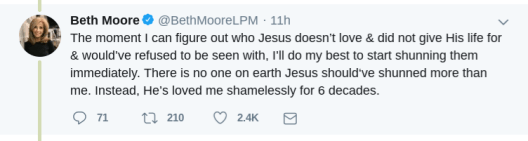
Beth also posted this tweet thread, which may seem to sort of answer the letter, but actually does not. A couple of excerpts from the thread:

Let’s review the questions from the letter:

1. Do you believe homosexuality is inherently sinful?

2. Do you believe that the practice of the homosexual lifestyle is compatible with holy Christian living?

3. Do you believe a person who dies as a practicing homosexual but professes to be a Christian will inherit eternal life?

4. Do you believe same sex attraction is, in and of itself, an inherently sinful, unnatural, and disordered desire that must be mortified?

5. Why have you been so silent on this subject in light of your desire to “teach the word of God?”

There is nothing anywhere in the questions or the letter addressing who Jesus “didn’t love,” “did not give His life for,” or “would’ve refused to be seen with.”

There is not even a hint of a suggestion in the questions or the letter that she, or anyone else, should “shun” anyone.

Assuming this tweet is responding to the letter (we have to assume because she doesn’t say one way or the other and, again, she never mentions homosexuality in this thread), this is a passive aggressive ad hominem dig at the signers of the letter.

Why would I ask Beth to clarify her tweet (which she has yet to respond to)? Well, for starters, you’ll notice she intentionally chose a verse that does not use any form of the word “homosexuality,” even though she is undoubtedly familiar with the ones that do. Why? Why not use 1 Corinthians 6:9-10 (also written by Paul) which uses the more specific term?

For those of us who are familiar with Galatians 5:19 and the Greek behind it, we already know that “sexual immorality” covers all sexual activity outside the monogamous heterosexual marriage bed, which does include homosexuality. Therefore, many of Beth’s followers from a conservative church background will take her quotation of this passage in Galatians 5 to mean, “Yes, I agree with the Bible that homosexuality is a sin.”

However, as I pointed out earlier, Beth also has homosexual and homosexual affirming followers, many of whom likely subscribe to the “gay Christian” movement’s ideology that the verses in the Bible that condemn homosexuality are only speaking of homosexual temple prostitution and assorted other perversions, not loving, faithful, monogamous homosexual “marriages” or relationships. Additionally, as the letter cited, Beth’s friend Jen Hatmaker has made it abundantly clear that she believes homosexual unions can be “holy” and that unrepentant, practicing homosexuals can be Christians, which Beth has never publicly refuted. Beth’s adulatory friendship with Jen and Jonathan are likely seen by many of her homosexual/homosexual affirming followers as a tacit endorsement of their errant theology. People who believe all of these errant ideas about homosexuality are not going to to see the term “sexual immorality” as applying to faithful homosexual relationships (How could a relationship be “holy” and “immoral” at the same time?), so they will see Beth’s tweet as saying that she considers “sexual immorality” a sin, but not that that term includes “moral” homosexual relationships.

So we’re basically right back where we started. This tweet is not an answer, and it doesn’t clarify her position on homosexuality. It is an obfuscation in an attempt to deflect any further questioning of her position on the issue.

Personally, and I believe most of the other original signers would agree, I do not anticipate that Beth will respond directly to the letter or clearly answer the questions. As I stated earlier, it seems to be her practice to ignore e-mails and social media comments that request biblical accountability from her, and I don’t see why our letter would be treated any differently.

11. You’re just trying to get attention, make a name for yourself, or build up your own ministry by publishing this letter.

DebbieLynne Kespert, one of the original signers of the letter helpfully answers this false accusation in her article Did I Publish The Open Letter To Beth Moore In Order To Get People To Read The Outspoken TULIP?


The question we should all be asking ourselves is – whyWhy is Beth afraid to answer these very simple questions that she knows the answers to? Why has she avoided answering them for five days? Why, when she finally “responded,” did she give such an evasive answer instead of clearly stating her position on homosexuality as she has on many other issues? If you took these questions to your pastor or Bible study teacher at church and he responded to them the way Beth Moore responded, what would you think?

Whether Beth chooses to answer our letter directly or not, it is our prayer (and we are praying for her) that she will boldly and unashamedly take a clear biblical stand on the issue of homosexuality in order to help her followers better understand the truth of God’s Word – that sinners may be saved, that saints may be properly discipled, and that God may receive all the glory.


If you have a question about: a Bible passage, an aspect of theology, a current issue in Christianity, or how to biblically handle a family, life, or church situation, comment below (I’ll hold all questions in queue {unpublished} for a future edition of The Mailbag) or send me an e-mail or private message. If your question is chosen for publication, your anonymity will be protected.