Christmas, Church

The 25 Churches of Christmas

This Christmas season, I’d like to offer you an opportunity to help me give our brothers and sisters in Christ a gift – a gift that won’t cost you a dime.

If you’ve followed me for a minute, you know I’m passionate about helping people find doctrinally sound churches to join. And if you’ve ever perused my list ofย Reader Recommended Churches, you’ve probably noticed that we have tons of listings for churches in some states, only one or two for others, and hardly any for countries outside the U.S.

What I’m hoping to do is add 25 doctrinally sound churches to the list in the states and countries that are lacking. Of course anyone is welcome to recommend a church anywhere, but in order for it to “count” toward The 25 Churches of Christmas, it needs to be a recommendation for a church:

โ›ช๏ธ in one of our U.S. states that has two or fewer recommendations (currently: Alaska, Connecticut, Delaware, Massachusetts, New Hampshire, North Dakota, Rhode Island, West Virginia)

OR

โ›ช๏ธ a church in any country besides the U.S.

I’ve made the list, you check it twice. If recommendations are naught, be nice and make one! :0) If you have a personal connection to a solid church that’s not on the list, comment below with:

๐ŸŽ„The full, correctly spelled name of the church
๐ŸŽ„The city and state, or city and country it’s located in
๐ŸŽ„The church’s website (please, please, please include this – it saves me a lot of time).

Think we can add 25 churches by Christmas Day? Let’s give it a shot and make it a merry Christmas for our brothers and sisters who are searching for a new church! Thanks for your help! :0)

Christmas, Mailbag

The Mailbag: My kid knows the truth about Santa. What if he tells his friends who don’t?

We have raised our five year old to know that Santa Claus isn’t real. Now that he’s getting old enough to have conversations with his little friends, how do we explain to him what to say to them when they talk about believing in Santa? I don’t want him to crush their dreams but I also don’t want to teach him to perpetuate the lie for his friends.

This is a great question, and one my husband and I also had to address with our own children, since we raised them to know that Santa Claus isn’t real.

Before I tackle your question, I’d like to address Christian parents who tell their children Santa Claus is real, that he is the one who brings their presents, etc.:

I’m sure you have the best of intentions and only want to make Christmas fun for your children, but when you tell them these things about Santa Claus, you are lying.

Santa Claus isnโ€™t real. If you tell your children he is, or that he is the one who brings their presents, or that he knows whether theyโ€™ve been naughty or nice, youโ€™re lying. The Bible says that lying is a sin, period. Thereโ€™s no exception for jolly old elves who pass out toys (or for tooth fairies or Easter bunnies, either, for that matter). And not only is lying a sin, it is extraordinarily hypocritical to lie to your children about Santa Claus and then turn around later and punish them when they lie about something. Lying to your children about Santa Claus teaches them that itโ€™s OK to lie (i.e. sin) when you want to or when it would be to your advantage.
Excerpted from: The Mailbag: What should we tell our kids (and grandkids) about Santa Claus?

And this reader has raised another ripple effect of your sin of lying. You’ve now put your brothers and sisters in Christ in the difficult position of figuring out how not to blow your cover when their child (who knows the truth) interacts with yours. Do they teach their child to take part in your lie, or do they risk their child telling the truth, disappointing your child and possibly angering you? And think about the pressure on a five year old child to try to keep something like that a secret, knowing someone will be disappointed if he doesn’t. You’ve created a no-win situation for people you are supposed to self-sacrificially love, encourage, and edify.

Our sin always negatively affects others.

We did our best to thread the needle by teaching our children to stay out of it. Every year, we reminded our kids – before family gatherings, play dates, etc. – that some kids believe Santa is real. If a friend inquired, “What did you ask Santa for this year?”, our kids could reply, “I asked my parents for a bike.” If any of their friends asked them if Santa was real, we told our kids to tell their friends to ask their parents.

You might want to give something like that a try, or maybe you can come up with a different solution that’s helpful to the situation. Don’t fret about it, though. Most kids learn the truth about Santa between ages 5 to 10, and most of them learn it from their friends. If you have a friend who freaks out at you because your five year old told the truth about something, it could be time to reevaluate that friendship, or at least the level of intimacy of that friendship. (And if it’s a family member, well…this, too, shall pass.)

However you teach your child to handle the situation, be sure you’re not conveying the idea that we cover up the sin (the lie that Santa is real) of others. We tried to go at it from the angle of our kids telling the other kids, “That’s a topic that should stay between you and your parents.” It’s pretty much the same way we later handled the situation of what to do if your friends ask you where babies come from (“You need to ask your parents about that.”)

Also keep in mind that, even though it may feel like you’re the Grinch if your child spills the beans about Santa, you’re not, despite the fact that others may treat you that way. If you’re humbly doing what is right in God’s eyes and the other person is doing what is wrong, you’re not the problem in that situation.


If you have a question about: a Bible passage, an aspect of theology, a current issue in Christianity, or how to biblically handle a family, life, or church situation, comment below (Iโ€™ll hold all questions in queue {unpublished} for a future edition of The Mailbag) or send me an e-mail or private message. If your question is chosen for publication, your anonymity will be protected.

Christmas

7 “Stocking Stuffers”

I’m filling the stockings early, but no lumps of coal for my awesome readers! Here are some great little miscellaneous Christian goodies I’ve come across recently. Enjoy!

Crossway has a Bible reading challenge for the holiday season called Simply Read. It will take you through the books of Luke and Acts in 8 days.

Is your church perfect and problem-free? No? Then be sure to give this article a read. Maybe even print it out and stick it on the fridge or in your Bible. The Cripplegate’s When Your Church Disappointsย by Eric Davis offers godly counsel on how to biblically think about and approach problems at your church. It was very helpful for me, and I hope it will be for you, too.

The Gospel Project wants to give you a Christmas present! Aย FREEย e-book! “A Christmas Question is Charles Spurgeonโ€™s famous Christmas-day sermon from Exeter Hall in 1859.”

Anotherย FREEBIE? Why not? Beautiful Eulogy is offering their albumย Worthy for you to download at no cost. Rap isn’t really your thing? Mine either. Check out tracks 5 (a lovely instrumental), 9 (a fantastic devotional from Art Azurdia), and 11 (a slower paced spoken word piece).

Can Christian parents do Santa Claus with their children? My answer in yesterday’s edition of The Mailbag was, yes, as long as Santa keeps his sleigh parked inside biblical parameters. Pastor Josh Buice made a different decision for his children and explainsย Why My Family Doesn’t Do Santa.

Want to send Christmas cards with an eternal impact? “Each Gideon Christmas card you send this Christmas will provide a New Testament for someone in the world. At the same time, your card will share a message of faith, hope, and joy in Jesus with friends and loved ones.”

Christmas, Evangelism, Movies

Movie Tuesday: Christmas Gone Viral

One third of the world celebrates Christmas. That makes this the perfect time of year to carry out the Great Commission. What could be a more natural transition from chit chat to the gospel than talking about Christmas – the birth of Christ? Watch as Ray Comfort and ordinary folks from all over the world share the good news of Jesus with those they encounter.

If you’re looking for other easy ways to share the gospel in the coming weeks, check out my article, 10 Ways to Share the Gospel During the Holidays. You can also order some awesome Christmas-themed tracts to tuck inside your Christmas cards or share as you’re shopping at Living Waters or Bezeugen.

Christmas, Church

“If You Skip Church on Christmas You’re Probably Not Even Saved” and Other Holiday Nonsense

church-on-christmas

It happened in 2011, and it’s happening again this year in good old 2016. Christmas Day falls on a Sunday- and the spiritual lumps of coal are being lobbed all over the internet: If you’re a Christian who’s evenย thinking about taking the day off from church attendance or your church has decided to cancel services that day…well, you’ve firmly ensconced yourself on God’s “naughty” list.

So I’m innocently cruising around on social media, podcasts, and the blogosphere recently when what to my wondering eyes should appear, aspersions galore from those I hold dear. Seriously, scads of doctrinally sound Christians I love and respect have said things like, “Church attendance on Christmas will separate the wheat from the chaff,” and, “If your church is canceling services (or even modifying the regular Sunday schedule) on Christmas, it’s time to find a new church.”

Did I read that right? Are theologically-grounded Christiansย really questioning people’s salvation and the spiritual health of churches based solely on a once-every-five-to-eleven-years Christmas Day worship service?

I honestly don’t think I’m biblically out of bounds when I say that’s absurd and judgmental and it needs to stop. Like, yesterday.

Yes, probably a lot of the churches who are canceling services on Christmas are theologically wonky, but that’s because, statistically speaking, the majority of churches out there, period, are theologically wonky. Too many people areย post hoc ergo propter hoc–ing thisย situation. Just because there are bad churches that are canceling services doesn’t mean every church that cancels services is a bad church. What about the rural church of 20 members (that hasn’t had a visitor since the last century) who have all informed the pastor they’ll be out of town for Christmas? Is he supposed to show up and preach to an empty room? What about churches who have moved their services to Christmas Eve so members can spend time with family on Christmas without missing weekly worship? Is there a passage of Scripture I’m not familiar with that prohibits a church from doing this every once in a blue moon?

Yes, there are doctrinally unsound churches out there, but they’re doctrinally unsound because they consistently teach unsound doctrine as measured by applicable Scripture, notย because they cancel a worship service or shift their normal schedule around for Christmas- an issue nowhere mentioned in Scripture.

As for judging people’s salvation (or love for Christ, love for the church, commitment, spiritual maturity, etc.) based on whether or not they attend church on Christmas- if you’re going to question a Christian’s salvation for skipping church that day, are you ready to pronounce a pagan saved if he shows up for services on Christmas Sunday?

Of course not. Because that’s not how this works. That’s not how any of this works.

The people who are using Christmas Day church attendance as a spiritual barometer would be the first to tell you – and rightly so – that going to church won’t save you. Neither will missing one service (or a dozen) “unsave” you. Salvation is determinedย onlyย by whether or not you’ve repented of your sin and placed your faith in the death, burial, and resurrection of Christ to redeem you. And sanctification (spiritual growth) is a lifelong process – a trajectory – of becoming more and more Christlike through the years. Church attendance on Christmas isn’t a make or break for your salvation or sanctification.

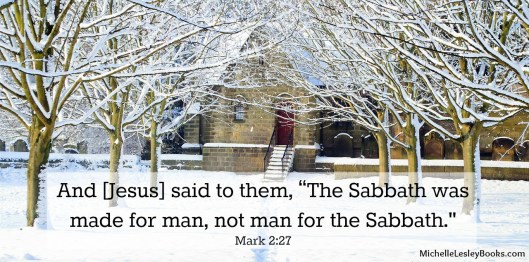
Earlier this week in The Ten,ย we studied the fourth Commandment: “Remember the Sabbath day and keep it holy.” We discovered that, while God’s intention for the Israelites was simply to abstain from working at their jobs, housework, and commerce in order to rest and worship Him, the Pharisees later came along and added all kinds of micro-managing rules defining “work.” So by the time Jesus came on the scene, things like picking (“harvesting,” according to the Pharisees) and eating grain as you walked along, and performing miracles of healing were considered “work”- thus breaking the Sabbath. But these were man-made laws, not God’s law. It was oppressive and robbed people of the joy of worship God intended His people to bask in each week. “The Sabbath was made for man,” Jesus said, “Not man for the Sabbath.”
mark-2-27

I can’t help but wonder if these “Real Christians will be at church on Christmas Day,” pronouncements aren’t similar. God has made no law for Christians that we must be at church on Christmas Day – or any other particular day – or we’re sinning. And, as for the churches who once every several years cancel services or shift their Sunday service to Christmas Eve, God has made no law that churchesย must meet on Sunday every single week or they’re in sin. What God has said for New Testament Christians is:

And let us consider how to stir up one another to love and good works, not neglecting to meet together, as is the habit of some, but encouraging one another, and all the more as you see the Day drawing near.
Hebrews 10:24-25

“Not neglecting to meet together.” Reminiscent of the paucity of Old Testament explanations of what constituted Sabbath work, God doesn’t give a definition of this phrase or quantify it with a specific number of allowable and acceptable missed Sundays per year. It is left to the conscience of each individual Christian and the agreement of each local body of believers (but I can scarcely believe that aย person who is at church every week unless Providentially hindered and opts to skip the Christmas service is “neglecting” to meet with the body by any stretch of the word). But when we by-pass issues of individual conscience and church agreement, make a law where no law exists in Scripture, and judge people’s relationships with God based on our own man-made law, are we not doing exactly what the Pharisees did?

What’s of far more concern than where your body is on Sunday, December 25, is where your heart is the other 364 days of the year. Do you love the body of Christ? Are you committed to serving the Lord and your brothers and sisters all year long at the church you’re a member of? Do you faithfully attend worship each week? Then deciding to spend Christmas Sunday at home with your family (especially if you’ve already attended the Christmas Eve service the night before) is not an indication that you’re backsliding or somehow “less” of a Christian than those decrying your absence.

But what if you answered “no” to those questions? What if you skip church as many or more Sundays as you attend because you just don’t feel like going, or you signed your kid up for a soccer team that plays on Sundays, or there’s a ball game on TV, or you’d rather go shopping, or you go out of town on pleasure trips a lot of weekends? What if your general attitude toward church is, “Meh, I’ll go when I feel like it and have nothing better to do.”?

That is much more problematic than skipping church the years Christmas falls on a Sunday. That’s an indicator that you need to examine your heartย to discover whether or not you’re in the faith. To love Christ is to love His bride, the church. People who are genuinely regenerated love the church. As a general rule, theyย want to be at church worshiping, serving, learning, growing, and fellowshipping with their brothers and sisters in Christ.

Why, between 2011 and 2016 haven’t I seen and heard these same folks who are judging Christians about Christmas church attendance speaking out equally as boldly, and in the same numbers, about people being sporadic in their attendance and uncommitted to the body the remaining Sundays of those years? As Christians, we celebrate Christ’s incarnationย every Sunday, not just when Christmas falls on a Sunday. Are those other Sundays somehow less important?

One day, out of the thousands that comprise your life span, is inconsequential. The Bible does not say that simply staying home from church on Sunday, December 25, is a sin. What’s important is pursuing Christ, hungering for holiness, and loving and serving the churchย every day, not just when Christmas Sunday rolls around.