“In this unique documentary, produced entirely in Israel, a Christian and a Mormon sit down to dialogue about one of the most important questions of faith: How do we know if a prophet is speaking the truth? Listen in on their fascinating discussion and follow along as they travel throughout the Holy Land in search of the facts. They will put Biblical prophets and Mormon prophets to the test in order to find out if their predictions actually took place in history. If even one prediction fails to come true, then that prophet fails the test!”
First John 4:1 says, “Beloved, do not believe every spirit, but test the spirits to see whether they are from God, for many false prophets have gone out into the world.” How do Mormonism’s prophecies stack up to the Bible’s prophecies? Watch as both are put to the test and find out!
If you are considering commenting or sending me an e-mail objecting to the fact that I warn against certain teachers, please click here and read this article first. Your objection is most likely answered here. I won’t be publishing comments or answering emails that are answered by this article.
This article is kept continuously updated as needed.
I get lots of questions about particular authors, pastors, and Bible teachers, and whether or not I recommend them. Some of the best known can be found above at my Popular False Teachers tab. The teacher below is someone I’ve been asked about recently, so I’ve done some research on her.
Generally speaking, in order for me to recommend a teacher, speaker, or author, he or she has to meet three criteria:
a) A female teacher cannot currently and unrepentantly preach to or teach men in violation of 1 Timothy 2:12. A male teacher or pastor cannot allow women to carry out this violation of Scripture in his ministry. The pastor or teacher cannot currently and unrepentantly be living in any other sin (for example, cohabiting with her boyfriend or living as a homosexual).
b) The pastor or teacher cannot currently and unrepentantly be partnering with or frequently appearing with false teachers. This is a violation of Scripture.
c) The pastor or teacher cannot currently and unrepentantly be teaching false doctrine.
In some cases, I am not very familiar with the teachers I’m asked about (there are so many out there!) and have not had the opportunity to examine their writings or hear them speak, so most of the research I do involves items a and b (although in order to partner with false teachers (b) it is reasonable to assume their doctrine is acceptable to the false teacher and that they are not teaching anything that would conflict with the false teacher’s doctrine). Partnering with false teachers and women preaching to men are each sufficient biblical reasons not to follow a pastor, teacher, or author, or use his/her materials.
Just to be clear, “not recommended” is a spectrum. On one end of this spectrum are people like Nancy Leigh DeMoss Wolgemuth and Kay Arthur. These are people I would not label as false teachers because their doctrine is generally sound, but because of some red flags I’m seeing with them, you won’t find me proactively endorsing them or suggesting them as a good resource, either. There are better people you could be listening to. On the other end of the spectrum are people like Joyce Meyer and Rachel Held Evans- complete heretics whose teachings, if believed, might lead you to an eternity in Hell. Most of the teachers I review fall somewhere in the middle of this spectrum (leaning toward the latter).
If you’d like to check out some pastors and teachers I heartily recommend, click the Recommended Bible Teachers tab at the top of this page.
Lifeway Women Not Recommended
Lifeway Women is the women’s division of Lifeway Christian Resources, an entity of the Southern Baptist Convention. Lifeway Christian Resources is an online store selling Christian books, Bible studies, and other materials for use by churches and individual Christians. Lifeway Women, as the name implies, not only sells books and other materials created specifically for women, it is also the platform for Lifeway’s women’s conferences, online Bible studies, a podcast, blog articles, women’s ministry resources and women’s leadership resources.
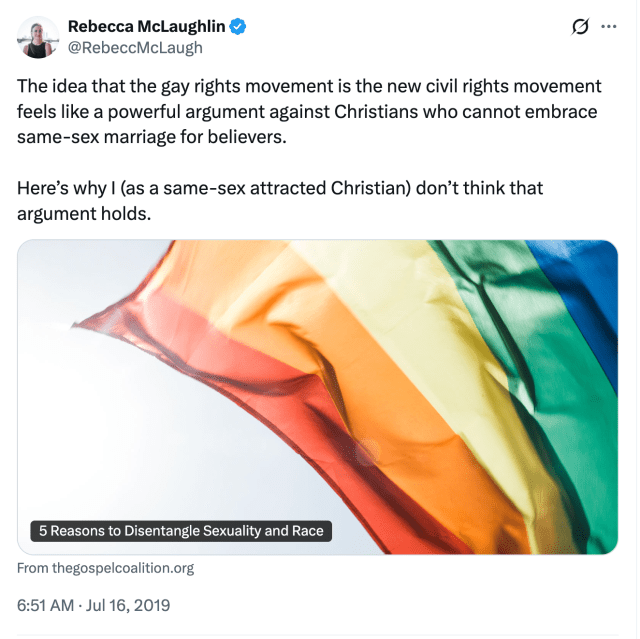
Lifeway Women’s prototypical women’s author and speaker – the type of woman they recruit to write Bible studies, create resources, and speak at their women’s conferences – preaches to men, partners with false teachers, and teaches false doctrine. Some of them are also woke, such as Jackie Hill Perry and Elizabeth Woodson. At least one of them – Kristi McLelland – held the office of “Teaching Pastor” at her church at the time Lifeway Women signed her (and continues to preach there regularly). Until quite recently, Rebecca McLaughlin – who identifies as a “same sex attracted Christian” – was also one of Lifeway Women’s platformed authors (her articles and other media are still posted and her books are still for sale, but she’s no longer listed under “Lifeway Women Authors”).
I haven’t researched and written about all of Lifeway Women’s authors and speakers, but I’ve written about enough of them to see that they all fit the template. Here are the current Lifeway Women authors and speakers I’ve written about, explaining the biblical issues with each:
As I said, these all fit the template of the prototypical teacher Lifeway Women recruits for their stable of authors and speakers. There’s no reason to believe that the remaining speakers and authors don’t fit the same template. At the very least, they’ve demonstrated a disqualifying lack of discernment by signing on with Lifeway Women and affiliating with the false teachers listed above.
So, although it pains me to say this as a lifelong Southern Baptist, if you need a quick way to rule out materials or events you’re vetting without doing hours of research on someone you’re not familiar with, I would recommend avoiding any author, speaker, or conference promoted by Lifeway Women.
If you’d like to hear Amy and me discuss this issue in greater detail, listen in to this episode of A Word Fitly Spoken, Cussing, Profanity, and OMG.
(You can also read the transcript at this link if you’re more of a reader than a listener!)
Why is it bad for Christians to cuss? Why are certain words considered “bad words”?
For every kind of beast and bird, of reptile and sea creature, can be tamed and has been tamed by mankind, but no human being can tame the tongue. It is a restless evil, full of deadly poison. With it we bless our Lord and Father, and with it we curse people who are made in the likeness of God. From the same mouth come blessing and cursing. My brothers, these things ought not to be so. James 3:7-10
Ouch. Our mouths can really get us into trouble, can’t they? We can lie, boast, and say all kinds of hurtful things to others. And one way that God definitely did not intend for Christians to use our mouths is to use profanity or vulgar speech.
But why? What makes one string of four letters good and noble, such as “love,” “pray,” or “holy,” while another string of four letters is cause for washing out mouths with soap and more restrictive movie ratings?
It’s because of the meaning attached to the word. Human beings don’t deal with words as random assemblages of letters. Human beings deal with words in terms of meaning. And God doesn’t want the meanings that come out of our mouths to point people away from Him, but, rather, to represent Him well. We can see this in the instructions He gives us about the things we say:
Let no corrupting talk come out of your mouths, but only such as is good for building up, as fits the occasion, that it may give grace to those who hear. Ephesians 4:29
Let there be no filthiness nor foolish talk nor crude joking, which are out of place, but instead let there be thanksgiving. Ephesians 5:4
Let the words of my mouth and the meditation of my heart be acceptable in your sight, O Lord, my rock and my redeemer. Psalm 19:14
If you’re a Christian who uses foul or vulgar language, have you ever stopped to think about why you do that? What is the motivation of your heart for saying those words? Is it Christlike? Do you think Jesus would use that kind of language? When you say those words do they point people to or away from Christ? What impression does it give people of Christians, the church, and Christ when they hear you cussing? Think about the definitions of those words. When you say those words, what definition pops up in the mind of the person who hears you? Is it something good, pure, honorable, etc.?
But when you come right down to it, swearing is really not a disease to be treated, but a symptom of another disease- a heart infiltrated by worldliness. Luke 6:45 tells us:
The good person out of the good treasure of his heart produces good, and the evil person out of his evil treasure produces evil, for out of the abundance of the heart his mouth speaks.
It’s important to remedy the outward behavior of filthy language, but that only comes from having a heart that is filled with the good treasure of Christ.
For those who would like to attempt to argue that the Bible actually supports Christians using profanity, please click here for an excellent resource, and also listen to (or read the transcript of) the podcast episode linked at the beginning of this article, where we dealt with this unbiblical idea at length.
If you have a question about: a Bible passage, an aspect of theology, a current issue in Christianity, or how to biblically handle a family, life, or church situation, comment below (I’ll hold all questions in queue {unpublished} for a future edition of The Mailbag) or send me an e-mail or private message. If your question is chosen for publication, your anonymity will be protected.
Persecution. It’s a hot topic in pop-evangelicalism these days in the wake of Pastor James Coates’ arrest in Canada (please don’t forget to pray for him, his family, and his church).
Though Pastor Coates’ arrest was heartbreaking, one good thing that has come out of it is that the online discussion about it has pulled back the curtain on just how much biblical ignorance is running rampant out there among professing Christians on the issue of persecution.
In a way, it’s understandable. American citizens (and many citizens of other Westernized countries as well) alive today have grown up with the guarantee of freedom of religion, codified in our Constitution. Until the last ten years or so, finding the proverbial needle in the haystack would have been much easier than finding an American who had experienced actual Christian persecution at the hands of her government.
To us, the persecution of Christians has always been something that happened thousands of miles away in far off, uncivilized, unsophisticated lands. “That could never happen here,” we mused thankfully, and promptly pushed the matter out of our thoughts.
But it can happen here. It’s already happening here. And it will increasingly continue to happen here.
And so, it’s a good thing that the issue has come to the forefront now, while we still have time to develop a biblical theology of persecution and prepare to act on it.
Let’s examine four popular misunderstandings about persecution, and what the Bible has to say about it.
1. The degree of persecution does not equal the definition of persecution.
“That’s not persecution. Persecution is being burned on sticks.”
I forget what the “that” was in this comment I recently saw on social media, but the “burned on sticks” part stuck in my memory. Whatever the “that” was, it some sort of unpleasantness aimed at a Christian for his faith, but it was much less intense than being burned on sticks.
But that diminished intensity doesn’t mean “that” wasn’t also, in fact, persecution. It only means “that” was less painful, less inconvenient, less life-altering, less terrifying persecution than the persecution of being burned on sticks.
I think maybe people don’t understand the difference between the definition of persecution and the degree of severity of persecution. Persecution is like stealing. Taking a paper clip from your office isn’t as severe as embezzling millions of dollars, and doesn’t garner as severe a consequence, but both are, qualitatively, and, definitionally, stealing. When you take something that isn’t yours, without permission that’s stealing, regardless of the value of what you take, and regardless of the consequences that follow.
The Bible doesn’t give a cut-and-dried definition of Christian persecution – i.e. there’s no one verse that specifically says, “Persecution is _____,” – rather, we glean the definition from looking at examples of it in Scripture. And, actually, if we look at it on a spiritual level rather than a temporal, tangible, earthly level, the definition of Christian persecution is rather simple: Christ is always right. Satan is always wrong. Any time Satan opposes Christ, that’s persecution.
Christ is always right. Satan is always wrong. Any time Satan opposes Christ, that’s persecution.
If you are obediently following God’s Word, standing with Christ and His Word, and you face opposition for that – regardless of the official reason given for the opposition (more about that in a sec) – you’re being persecuted, whether it’s somebody responding to your Christian worldview Facebook post with an “angry face” emoji or somebody executing you for sharing the gospel.
The Bible says in 2 Timothy 3:12:
Indeed, all who desire to live a godly life in Christ Jesus will be persecuted.
If the definition of persecution is being “burned on sticks” – martyrdom – then this verse of Scripture isn’t true. Millions of Christians living godly lives in Christ Jesus have lived and died without being martyred. Yet this verse says all will be persecuted. Since we know this verse of Scripture is true, that means persecution has to include lesser forms of mistreatment of Christians.
We should never say that somebody calling you a booger head for being a Christian is as bad as, painful as, or difficult as being burned at the stake, but both are, qualitatively, persecution, just in different degrees of severity.
2. We must think about persecution on a spiritual level, not a tangible level.
For we do not wrestle against flesh and blood, but against the rulers, against the authorities, against the cosmic powers over this present darkness, against the spiritual forces of evil in the heavenly places.
Ephesians 6:12
We’ve simply got to wrap our minds around this concept if we’re going to properly understand persecution.
There is an entire, real spiritual realm that we cannot see, hear, or touch. And in that realm, Satan and his minions are constantly rebelling against God and attempting to, for lack of a better word, “attack” God and thwart His purposes.
And what better way to really stick it to God than by using His own Creation against Him? People made by God in His image. People He loves so much that He sacrificed His only Son for them.
Because we can’t see Satan and his demons, he “puts on flesh” by using his children – his slaves – to do his bidding.
So when we see, for example, governmental officials placing restrictions on the church and giving Covid as the reason, we’re not seeing reasonable, uninfluenced people altruistically doing what’s best to protect others. That’s just the deceptive window dressing Satan wants us to see. That’s his sleight of hand to distract us from what’s really going on in the spiritual realm: he’s attempting to attack God and His people and thwart God’s plan for the church. And he’s using God’s own creation – people and government- to do it.
In this whole debate about Pastor Coates and whether or not he should have obeyed the government’s Covid regulations, and whether or not he should have gone to jail for refusing to obey them, and whether or not his imprisonment is actually persecution, one of the things Christians are failing to grasp is that, in God’s economy, the government has no right or authority to place any restrictions on the church in the first place.
In God’s economy, the government has no right or authority to place any restrictions on the church in the first place.
Stop myopically looking at one itty bitty little tree, and back up and look at the whole forest: God is King of the Universe. He purchased the church with the blood of His Son. He founded it. He owns it. He is the head of it and rules over it.
The government is God’s servant. A servant has no right to override his master’s commands:
God commands us to meet together in person1. His servant, the government, has no right to say otherwise or to punish people who are obeying God by gathering rather than man by not gathering.
God says: proclaim the gospel to the wholecreation and make disciples of them, come, allwho are thirsty, and whosoever willmay come. He casts out no one who comes to Him.
His servant, the government, has no right to issue an edict that only a select few may enter the church to serve the Lord with gladness, come into His presence with singing, enter His gates with thanksgiving, and His courts with praise, when God has said, “Make a joyful noise to the Lord, all the earth.” God does not place capacity limits on who may come into His church. The government certainly has no right to do so.
Open your spiritual eyes, sisters. Look beyond what you can see in this tangible realm, and grasp the bigger picture. This isn’t about what your physical eyes can see. Persecution is about spiritual warfare.
3. Satan is a deceiver.
Have you ever heard the old saying, “The greatest trick the devil ever pulled was convincing the world he didn’t exist.”2? Well, it’s true and he pulls that trick on various levels with various people. It’s not just on the macro level with atheists or lost people who are convinced Satan is just a mythological character. There’s also the micro level of the sleepy-eyed Christian who has forgotten that Satan is the underlying inspiration for every unholy act in the world. (And we’re all prone to that forgetfulness from time to time.)
That’s why Satan doesn’t march right up to Christians and say, “Hi, I’m the Prince of Darkness. Wouldn’t you like to sin against God today?”. He’s smarter than that. He knows if he presents himself to you as what he really is, and sin as what it really is, you’d see right through him and stay away from him.
There may come a point in time in the West at which the government clearly and overtly says, “Christianity is against the law, and if you’re a Christian, you’ll be executed.”
But that time is not now. That’s the last leg of the race for Satan. And you don’t get to the last leg of the race without first having stretched, put on your running shoes, and run the first, second, and third leg of the race. And that’s where we are right now: at the beginning of the race.
At the beginning of the race, Satan has to con you into believing there are good reasons for the havoc he’s wreaking on the church, and he’ll even disguise himself as an angel of light and dress up his reasons in the costume of Christian-ese to do it. And that’s exactly what he has done as he has persecuted God’s church with Covid regulations3:
It’s for your safety…
It’s for the safety of others…
It’s loving your neighbor…
The Bible says you have to obey the government, no matter what…
And…
James Coates wasn’t arrested for preaching, he was arrested refusing to obey Covid regulations.
Again, put on your spirit realm thinking cap and your spiritual eyeglasses and see what’s really going on here. Satan doesn’t give a flying flip about Covid regulations, or the virus itself, or how many people it kills or doesn’t kill. His mission (though futile) is to destroy God’s church, and to oppose, rebel against, and attempt to thwart God’s plans and purposes at every turn. And he will use anything he can get his hands on to do that – especially deception that veils what he’s really doing.
Don’t believe me? What capital crime did the Roman government officially charge Jesus with and execute Him for? It wasn’t for preaching or being a “Christian”. It was for insurrection. Because in Rome’s eyes, there was only one King of the Jews, and it wasn’t Jesus.
And what about the riot in Ephesus? When the Ephesian business men grabbed Gaius and Aristarchus, they didn’t say, “We’re about to beat you senseless because you’re Christians.” Nope, it was, “It’s the economy, Stupid.” They were riled up at the Christians because they were losing money.
And when Paul was arrested in Acts 21, the reason given was inciting a riot, not his beliefs or practices as a Christian.
And when Shadrach, Meshach, and Abednego were thrown into the furnace, the capital charge was not: “These men worship the one true God,” The official charge was that they refused to obey the king’s unbiblical law – which as the governmental “servant of God” he had no right to make in the first place, nor to punish God’s people when they obeyed Him rather than man. Selah.
Need I go on? Search your Bible. Search the nightly news. You’ll find many instances in which Satan sets the stage with elaborate props of perfectly logical sounding reasons why God’s people are being attacked, while backstage, he’s singing second verse, same as the first – I hate God and I want to kill what He loves.
He wants you to think pastors are being arrested and fined and sanctioned because of Covid regulations, or that Christian businesses and organizations that won’t get on board with the government’s sexual perversion agenda (let the reader understand) are violating anti-discrimination laws, but that’s not the real reason. They’re being arrested and fined and sanctioned because Satan wants to obliterate the church.
If you are walking in obedience to the Lord and you face opposition or restriction, that’s persecution, regardless of the “official” reason given.
4. Knowing the consequences ahead of time doesn’t mean it’s not persecution.
“James Coates had been warned multiple times that he was violating Covid regulations and he kept doing it, so he can’t cry ‘persecution’ now that he has to pay the piper.”
Um…seriously? Have you ever read your Bible? Persecution is not defined by whether or not you know what the consequences for your actions will be ahead of time. I would even argue that most victims of persecution in the Bible knew what they were in for, and they chose to obey God rather than evil men anyway.
The Apostles had already been beaten and imprisoned for preaching the gospel, so they certainly knew they were in for more of the same when they went out and preached again.
Persecution is when Satan attempts to attack God and His people. It has nothing to do with whether or not the Christian being attacked knows what consequences his actions will bring.
Knowing the consequences ahead of time and obeying God anyway doesn’t mean you aren’t being persecuted, it means you’re a Christian.
There’s a lot of misinformation floating around out there about Christian persecution. If you’re a genuinely regenerated Christian, you will face some level of persecution at some point in your life. That’s a promise from Scripture. It’s important to be prepared for that so you can respond in a godly and obedient way, because responding to persecution by refusing to bow to man over God and doing so with a holy, humble, honored attitude is a testimony to the world, and an encouragement to your brothers and sisters, that Jesus Christ is King, and that He alone is worthy to rule and to reign.
1The Greek word for “church” in the New Testament is ekklesia. It literally means a gathering or an assembly. The church, is, by definition, a gathering together – in person – of “the called out ones” – Christians. Watching a church service online is a blessing when you are temporarily Providentially hindered from being there in person, but it is not the same as going to church, as we are commanded, and it is not a biblical substitute for going to church as we are commanded. It is not church at all, because where there is no gathering, there is no church.
2Quote attributed to 19th century French poet, Charles Baudelaire
3Please understand, I’m not saying that if you have to stay home from church temporarily to stay healthy that you’re automatically deceived or unsaved. Remember, we’re talking about the long term, big picture of Satan’s agenda here, not individual trees in the forest.
Why are COVID restrictions on gathering size persecution, but fire codes limiting gathering size are not? Glad You Asked (~23:21) at A Word Fitly Spoken
I did not have an opportunity, before I wrote this article, to listen to James Coates’ last sermon before he was arrested, but he does a much better job of explaining the government’s roles and responsibilities, and exegeting Romans 13 than I ever could. Please give it a listen:
Keep a sharp lookout, for you do not know when I will come, at evening, midnight, early dawn, or late daybreak. Don’t let Me find you sleeping.
Today’s Movie Time is a double whammy: evangelical pop culture and homework. A Thief in the Night was my generation’s Left Behind. It’s the reason Christians my age, who grew up in church experience a split second of terror when we walk into the house and it’s unexpectedly empty. (Did the rapture happen and I didn’t make it?)
So grab your Bible and your popcorn and experience Christianity of yesteryear. Look up the passages that are mentioned in the movie and read them in context. Does the movie rightly handle those passages? Do you agree or disagree with this eschatology? Why? Are movies like this helpful, or do they just scare people into becoming false converts?
And most importantly, whatever way you think the Lord is coming back, He is coming back. Are you ready?
For you yourselves are fully aware that the day of the Lord will come like a thief in the night. 1 Thessalonians 5:2
Bonus!
Check out this review / reaction to A Thief in the Night from my friend, Pastor Keith Foskey: