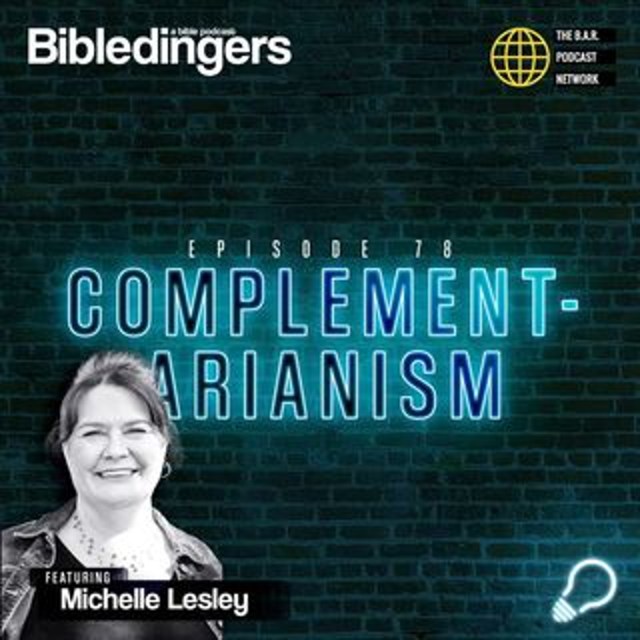
Don’t worry, this episode was not about complementing Arians! :0)
It was so great to sit down and chat with my new friends Ryan and Nick over at Bibledingers recently!
We talked about all things complementarian – the biblical foundation for the complementarian position, the Scriptures egalitarians twist to try to justify their position, godly women in the Bible, and the crucial roles women play in the church and the home. The guys even had some great words of wisdom for all you husbands out there!
Listen in here or check out episode 78 of Bibledingers on your favorite podcast platform!
Be sure to visit the Bibledingers website for blog articles, videos, gear, and all the Bibledingers’ social media links. Subscribe and follow!
Articles / resources mentioned or touched on in the episode:
Got a podcast of your own or have a podcasting friend who needs a guest? Need a speaker for a women’s conference or church event? Click the “Speaking Engagements” tab in the blue menu bar at the top of this page, drop me an e-mail, and let’s chat!
Good morning, readers. It is an honor and a joy to serve you in Christ. Welcome to all the newbies and to you seasoned veterans of the blog.
Because some of y’all are new, you aren’t yet aware of all of the resources here to help you. Or maybe you’ve been around a while and haven’t noticed something that might be helpful. Let’s remedy that!
Second, be sure to familiarize yourself with all of the tabs in the blue menu bar at the top of the page. That’s where I keep the info I’m most frequently asked about.
Third, there’s a search bar at the bottom of every page (and one in the blue menu bar at the top of every page) which might help you find what you need.
And finally, let me get you new readers some answers to the questions several of you have asked. Some of you long time friends may have missed these along the way, so I hope they’ll be helpful to you, too!
[Instagrammer asks a question in the comments or DMs me a question]
I love my Instagram followers! Most of you are very sweet and kind, and you ask some really smart questions!
But a lot of you a) don’t seem to know that I have a blog, and b) aren’t familiar with how I use Instagram and how I do correspondence. I totally get that. A lot of you are new and Instagram seems to have a high turnover, and a much higher “hit or miss” with posts than other social media platforms. (Plus, I’m a weirdo and don’t use Instagram the way most influencers do. I mainly use it to tell you what’s on the blog each day.)
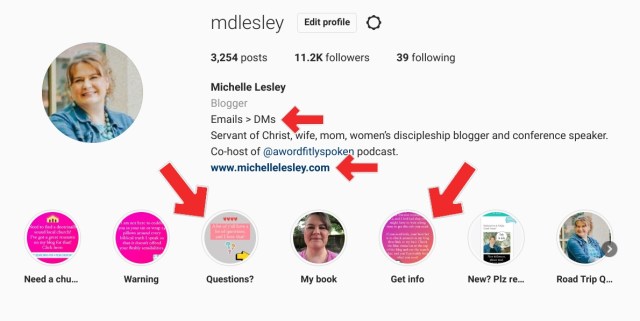
So, let me try to help. If you’ve commented or DM’d me a question and I haven’t answered, I would encourage you to watch “Questions” and “Get Info” in my highlights. (In fact, you might want to watch “Need a church?” “Warning,” and “New?” too.)
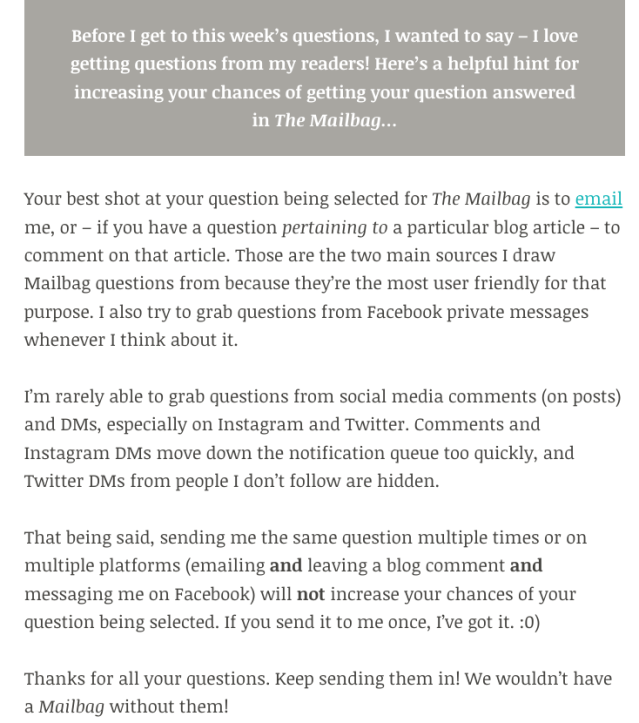
This is included in the “Questions?” highlight from a Mailbag article. I think it will be helpful to all of my social media and blog followers.
I’m in the market for a new Bible. What would you recommend? I really appreciate your ministry!
Thank you so much for your kind words. And thank you to all my followers who take a moment to encourage me with your comments. As you might imagine, and have probably witnessed, I catch a lot of flak via email and social media from people who don’t like or misunderstand things I’ve said and written. The encouragement is greatly needed and appreciated.
God bless you, I wanted to reach out to see if you do Bible studies or if you know any through Zoom with other ladies.
It depends on what you mean by “do Bible studies”. If you’re asking whether or not I teach Bible studies in a video or livestream format, the answer is no, for two reasons. First, at the moment, I don’t have time. Second, I really think you should be meeting in person with a small group for Bible study – ideally with women from your own church and with oversight from your pastor. I understand there are situations in which that isn’t possible, but that is the ideal I want to encourage women toward. God’s plan is the in person assembling of the local church, not Zoom.
I do write Bible studies, though. They are all free, all suitable for groups or individuals, and all designed to teach you how to study or teach straight from the text of Scripture. If you’re new to that idea, I would encourage you to find a friend or a small group of friends, pick one of my studies, and work through it together.
You can find all of my studies and more helpful resources at the Bible Studies tab in the blue menu bar at the top of this page.
And speaking of Bible studies…
Are your Bible studies able to print off?!
Yes. Click the “Bible Studies” link above for all the info and instructions.
Can you recommend a good daily devotional book for a 17-year-old girl? Our granddaughter is having surgery in a few days and I was hoping to send her a little get well soon package and I would like to include a devotional.
What a blessing to have a godly grandma! I’m sorry, but, on principle, I don’t recommend what I call “canned” Bible studies and devotionals. I recommend that Christians read and study straight from the text of Scripture. (You can read more about why at the “Bible Studies” link above, and in my article The Mailbag: Can you recommend a good Bible study for women/teens/kids?.)
May I make a suggestion? Instead of a devotional, how about a new Bible? Or perhaps you could find a small “for those recovering from illness/surgery” gift book of selections from the Psalms, or a “coffee table” type book that is mostly artwork or photography, accompanied by Bible verses. There are also “Bibles” that are Psalms and Proverbs only. (Just make sure all of these books use a reliable translation of Scripture.) If you want to go a little higher tech, consider an iTunes gift card so she can download her favorite (doctrinally sound) Christian music, or a subscription to AGTV.
The women’s group of the church that we are attending will be doing a Priscilla Shirer simulcast. I have read your article about Ms. Shirer and have decided to abstain from attending the event. How do I lovingly but truthfully tell the women in this group why I am refusing to attend and why I feel this is not someone whom we should be promoting? (unless of course, Ms. Shirer has changed her stance since your article was written). My husband and I believe [our pastor] to be of sound doctrine [but] I am certain that he is oblivious to P. Shirer. [I] hope that you can help me “find the right words” to discuss this with those involved.
I am so sorry this is happening in your church. I have been in exactly that situation, so I know what it’s like.
Here are a couple of articles I think will be of help:
Just a note to all of my readers on the “unless she ‘has changed her stance since your article was written'” part: You’ll notice at the top of my article on Priscilla it says, “This article is kept continuously updated as needed.” (I think I’ve remembered to put this at the top of all of my articles on particular teachers? If I missed one, let me know.) Translation: “Yes, I originally wrote this article in 2015, but I go back and update it – fix links, add or delete info, etc. – whenever I feel it’s necessary.”.
If any teacher I’ve ever written an article about genuinely gets saved, repents of her false teaching, etc., I promise you, unless I’m somehow Providentially hindered, you will hear about it from me ASAP. That is not something I’m going to neglect to update you on (and rejoice with you about!) immediately. In the meantime, you can safely assume that the information in my articles is still accurate and applicable and that the teacher is either still status quo with the info in the article, or has gotten worse.
I have several Bible apps, and recently you gave info in one of your mailbags that YouVersion app is not recommended, and knowing now what I didn’t know then, I uninstalled it. I did find it easy to navigate and the search capability was good, but I no longer want anything to do with it. If you could kindly lead me to one that is as user friendly, I need an app that you recommend that is as simple as me. Lol
Our church has a mixed adult Sunday school. My conviction has been silence as I do not want the appearance of teaching men. I am discouraged as most of the responses in the hour of teaching is from the women in the group even though our church only allows men to be in teaching positions. I would genuinely like to hear your thoughts on this. I have appreciated your podcast and website information.
I know it can be discouraging when it seems like men are being less manly or exhibiting less leadership than we would hope. I would encourage you to kindly talk to your pastor or elders about your concerns and ask for some insight as well.
In this particular situation, it may be wise to answer fewer questions, or make fewer comments than you normally would, not because you would be teaching (or even giving the appearance of teaching), but because it might give the men more space to get a word in edgewise. If this dynamic is really problematic, I wonder if it might be helpful to split the class into a men’s class and a women’s class. Perhaps that way the men would feel more comfortable contributing. Maybe that’s something you can discuss with your pastor or elders.
I’ve explained why women answering questions and participating in the discussion in a co-ed Sunday School / Bible study class isn’t teaching men or a violation of Scripture in my article Rock Your Role FAQs #4.
If you have a question about: a Bible passage, an aspect of theology, a current issue in Christianity, or how to biblically handle a family, life, or church situation, comment below (I’ll hold all questions in queue {unpublished} for a future edition of The Mailbag) or send me an e-mail or private message. If your question is chosen for publication, your anonymity will be protected.
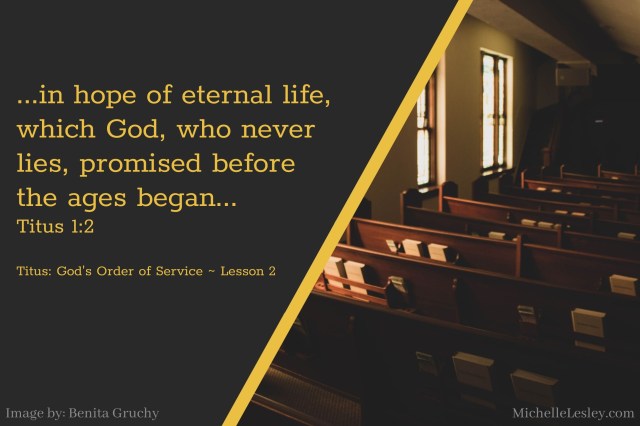
Welcome, ladies! Just a reminder, please do not skip Lesson 1 (link below). Not only will it answer any questions you may have about the study itself, but if you want to study Titus properly, you must do the background work contained in Lesson 1.
1. Review your notes from last week’s introductory lesson. What are some things to keep in mind as you begin to study the text of Titus today?
As we study the book of Titus, I will sometimes refer to the author as Paul (e.g. “What was Paul teaching pastors in v.6?”) and, often, as God (e.g. “How does God encourage church members in v.7?”). I don’t mean for this to be confusing. My purpose is two-fold: 1) To combat the popular false teaching that anything a biblical author wrote that we don’t like was simply that author’s human opinion, not God’s, 2) To constantly remind us that all Scripture was breathed out by God, not fallible humans, and, as Christians, we are obligated to believe and obey every word of it. If you’re confused, it might help to think of it this way: God is the author of Titus; Paul is the writer of Titus.
2. Examine verses 1-3. Recall from the introductory lesson which genre of biblical literature Titus is (Law? Prophecy? Poetry? etc.). Today, when we write a letter, especially a business letter, we normally close it with our signature and credentials. For example:
Sincerely,
Joe Smith Acme Widgets, Inc. Vice President of Doohickeys – Southeastern Division
In first century culture, the style was to open the letter with one’s name and credentials. Compare verses 1-3 with these greetings of other epistles. What are some similarities and differences you notice?
Even our abbreviated modern signatures/credentials, like the example above, give the reader some very important information about the person writing the letter. What type of information can you glean about “Joe Smith” from the signature/credentials above? In what ways is it similar to the type of information in verses 1-3?
Go back to verses 1-3, and break them down. What information do you learn about Paul from his opening signature/credentials?
Who is the letter from? (1a)
What is his position, and why is he qualified to write this letter? (1a, 3b)
What are his three general purposes for this letter? (1b, 2a)
By Whose authority does he write this letter? (2-3)
What is his view of God’s nature and character, God’s authority, and his relationship to God? (1-3)
3. Let’s go back (see #2 above) to God’s three general purposes for having Paul write this letter. Explain each of these purposes in your own words. How do each of these purposes apply to pastors and elders today?
You’re obviously not a pastor or an apostle, training pastors, or leading a church, but as you’re discipling your children or other women or children in the church, are there biblically appropriate ways in which you can apply each of these purposes? How do you disciple them…
for the sake of their faith
in their knowledge of the truth, which accords with godliness, and
in the hope of eternal life?
4. Revisit verses 1-3 and meditate on the vastness and depth of the faith, the truth, the hope of eternal life, and God’s sovereignty these verses describe. Then consider Paul’s statement, “the preaching with which I have been entrusted by the command of God our Savior”. Do you think Paul felt the weight of that responsibility? Do you feel a similar weight of responsibility when discipling your children or other women and children?
5. Examine Paul’s greeting in verse 4. To whom is this epistle addressed? What is Paul’s relational dynamic with Titus? Notice the picture God paints of that relational dynamic. He doesn’t characterize it as a “master (Paul) / slave (Titus)” relationship or “boss / employee” or even “teacher / student,” but as what? Why do you think that is? What does that metaphor indicate about Paul? About Titus? How does this connect back to Paul’s authority and credentials (see #2 above) for writing this letter?
Go back to verses 1-2. Is it fair to say that this epistle is also addressed to the church? Why or why not?
Why does God use the metaphor of family (“my child in the faith,” “brothers and sisters,” today, we even speak of “my church family,” etc.) in Scripture to characterize the church? Do you have a “true child in the faith” relationship with someone? How does that relationship compare to Paul’s relationship with Titus?
How does “Grace and peace from God the Father and Christ Jesus our Savior” set the tone for the letter, reiterate Paul’s God-given authority in writing the letter, and reference part of the Trinity?
6. Take a look at v.5. Why did Paul leave Titus in Crete? What does Paul mean by “put what remained into order”? What’s a phrase we might use in today’s vernacular to say the same thing? Why did Titus need to appoint elders “in every town”? (You might want to review your notes from lesson 1 – link above.) How would appointing elders have given the churches in Crete structure and order?
Homework
Orderliness. Structure. Hierarchy. This is a major underlying theme of the book of Titus. Spend some time before our next lesson meditating on God’s orderliness, and the structures and hierarchies He has set up in nature, the family, the church, government, etc. Why is orderliness important to God? Why does He think orderliness is so necessary for us that He built it into the fabric of the universe? Jot down your thoughts. Make a list of at least five verses or passages of Scripture that talk about orderliness, structure, or hierarchy. Consider these verses and your thoughts on God’s orderliness in relationship to the church. Why is it important to God that our churches be orderly? Is your church orderly? Does it need to be more orderly? How could it be more orderly according to Scripture?
A little lagniappe post for this week! Judging from some of the social media comments I’ve been getting lately, it’s time to run this friendly refresher again. Enjoy! :0)
Originally published September 24, 2019
I post a lot of memes on my social media pages, mostly Facebook and Instagram. I usually post four Bible verse memes every weekday morning on Facebook and other miscellaneous memes at various times on all my social media platforms. Over the course of the last couple of years, I’ve gotten some critical comments about a few of these memes, which, I think, stem mostly from misconceptions people have about what a meme is and the general understanding of the function of memes on social media. I’d like to try to clear up some of those misconceptions today.
Memes- Definition and Function
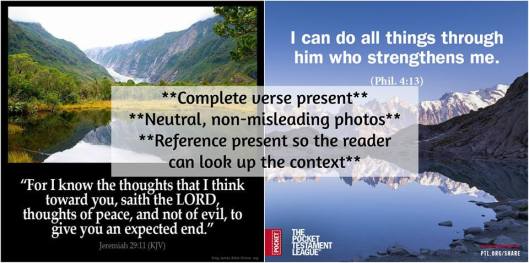
A meme is simply a picture with words superimposed on it (usually a couple of sentences, max), like the ones in the collage above, that you see on social media. The function of a meme is to convey a brief thought, quote, or joke. Memes are not books, articles, theses, or even long Facebook posts. They are not meant to exhaustively cover every aspect of the thought they present. Reading a meme is kind of like eating one grape (or even reading one verse of Proverbs!). The grape is good and nutritious in and of itself, but it is not: a bunch of grapes, a full meal, a well-balanced diet, or the buffet at Golden Corral. It is simply a grape. Appreciate it for what it is and don’t criticize it for not being something it isn’t.
Bible Verse Memes (BVMs)
The criticism I most often receive about Bible verse memes (a picture with a Bible verse on it) is that the verse is not in context. Of course it’s not in context. That’s the nature of a meme- it contains only a brief thought or quote (which is why you don’t usually see an extraordinarily long verse {like Esther 8:9} on a meme, either).
BVMs are not meant to be a Bible study, sermon, or exegesis of a passage of Scripture. The daily BVMs I post are to jog your memory about passages you’ve already studied or to pique your interest in studying the passage surrounding the verse on the meme. When I post a BVM, I do my best to make sure of three things: a) the meme contains a whole, not partial, verse, b) the meme contains the reference so you can look up the context for yourself, c) the picture that goes with the verse does not suggest a misleading meaning to the verse.
Interestingly, the only verses I seem to receive the “out of context” criticism about are Jeremiah 29:11 and Philippians 4:13. (Shouldn’t we want all Bible verses to be in context?) I’m fully aware that many Christians out there, and even false teachers, use these verses out of context. The fact that many people misunderstand or twist these verses to fit their own agendas does not negate the fact that these are still Holy Spirit-breathed portions of the Bible. I refuse to surrender these verses to those who abuse them by declining to post them. God’s Word is God’s Word, and even one verse can stand on its own, qualitatively, as the Word of God. The reader is the one who has the responsibility to look up those verses and understand and use them in context.
Christian Quote Memes
Going back to the grape illustration, the thing to remember is that a meme is not meant to exhaustively cover every aspect of the thought it presents. If I post a meme that says, “The grass is green,” that does not mean:
Only grass is green
Everything in the world is green
There aren’t other things in the world that are other colors
I hate things that aren’t green
Grass should never be mowed, fertilized, watered, etc.
Grass can’t be other colors because you could dye it or set it on fire
Also, simply stating that the grass is green does not obligate me to explain photosynthesis, suggest landscaping techniques, or debate zoysia versus Kentucky bluegrass. There’s certainly a time and a place to go into detail about issues (which I do every day on the blog), but it is also okay to make simple, true, stand alone statements without having to comment on every intricate aspect of the topic.
People Pictured in Memes
This is something you kind of have to get a feel for through exposure to memes, but I’ll do my best to explain.
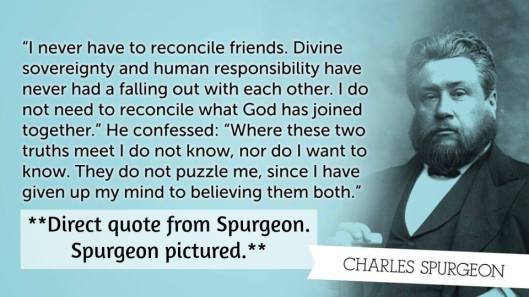
Sometimes a meme uses a picture of a person because the words on the meme are a direct quote from that person. Other times, the words on the meme poke fun at or allude to the person pictured. Still other times, the words on a meme have nothing to do with the beliefs, personality, or actions of person pictured in the meme, rather, that picture was selected because of the look on the person’s face, the way he is posed, etc.
If you’re confused as to whether or not the person in the picture is being quoted, you can always Google the quote to find out. If you’re familiar with the person in the picture and know he would never say the words on the meme, it’s fair to assume the words are either poking fun at/alluding to the person in the picture, or that the picture was chosen for the visible appearance of the person, not for his beliefs, personality, actions, etc.
I can’t speak for everyone who shares memes, but the rule of thumb for my social media pages is that you will never see me positively quoting or promoting the beliefs of someone who’s well known to be a false teacher or otherwise theologically aberrant by biblical standards. So if you see a meme on my page that contains a picture of a famous false teacher, a non-Christian actor, politician, etc., it should be a given that I am not promoting his or her false beliefs. The meme is making another point, which you will need to glean from context or ask politely about.
Attribution
Except for BVMs, I create most of the memes I share. But with regard to BVMs and other memes I haven’t created, I see them – shared by a friend or a page I follow – in my social media timeline and I share them, just like you do. Most of the time I don’t share them immediately. They sit in my file for days, weeks, or even months before I get around to sharing them.
At that point, I usually can’t remember where I found them, so I can‘t type out a caption crediting the person who made it (if I even know). (If you design memes and you want credit for them, my advice is to watermark the meme with your name or website.) So, if you see me share a meme with no attribution, I’m not in any way trying to plagiarize it or claim that I made it any more than you would be if you shared a meme like that. All of the memes I create are watermarked with my website address (see collage above). If you see me share one that doesn’t have my website on it, you can safely assume I did not create it.
“I don’t get it.” and “What you should have said was…”
Often, when a theological meme is metaphorical or a brief quote, you may not initially grasp its meaning. My advice? Re-read it more carefully and keep thinking about it. Think about what the Bible says compared to what the meme says. If you’ve made a good faith effort to think things through and you still don’t get it, share the meme on your social media page and ask others what they think it means (then, be sure to listen only to your doctrinally sound, spiritually mature friends!).
Many of my memes are designed to make you use critical thinking skills and ponder the related Scriptures rather than spoon feed you something obvious. That’s why I don’t write a fourteen sentence explanation of everything I mean and don’t mean on a meme. That’s what blog posts and Bible studies and podcasts are for. Going back to our grape illustration: A meme is a grape, not a textbook on the horticulture of grapes. Use the brain God gave you and ponder the grape rather than demanding an encyclopedia article on grapes.
Sharing
I’m frequently asked by social media followers if they may have permission to share a meme (or an article, post, etc.) I’ve posted.Yes! I’m honored that you would want to. Sharing is the nature of social media. Generally speaking, you do not need to ask permission to share something that a public figure has posted publicly on social media. We like it when you share our stuff. It gets our material out to more people. And since my material is sound doctrine, the Bible, and the gospel, I want to get it out to as many people as possible. Consider this blanket permission to everyone who might ever want to share something of mine: Share away! No need to ask permission! :0)
The only thing you can’t do when sharing is to remove attributions (for example: cropping out the watermark of my web address on the memes I create) in order to intentionally present my work as your own or someone else’s. That’s called plagiarism, which is a fancy word for lying and stealing. And those are sins. But simply sharing a public post, attributions in tact, with your social media friends is not plagiarism, and you don’t need to ask permission.
I hope this helps clear up any misunderstandings you may have about any of the memes I post on social media. Memes are just little nuggets that are meant to be humorous or thought provoking. Let’s let them be what they are, not expect them to be what they’re not.
1The oldest memes on that board (the ones toward the bottom) are still watermarked with my old web address (MichelleLesleyBooks.com). I’m in the process of editing them to reflect my current web address (MichelleLesley.com), and re-releasing them. I’m totally fine with you sharing a meme watermarked with the old address, but if there’s one you want to share that you need edited to the new address before you share it for whatever reason, just let me know, and I’ll fix it as fast as I can.
If your theology pretty much matches up with mine (as outlined in my “Welcome” and “Statement of Faith” tabs in the blue menu bar at the top of this page) and you’d like to contribute a guest post, drop me an e-mail, and let’s chat about it.
Note from Michelle: (Update: 2024) At the time Melissa wrote this article for my blog, her theology was doctrinally sound. Unfortunately, since that time, she has has adopted some unbiblical beliefs which I cannot endorse. However, because this article is practical advice, rather than biblical/theological in nature, I have chosen to leave it up on the blog. I hope it will help you as you minister to family, friends, and church members.
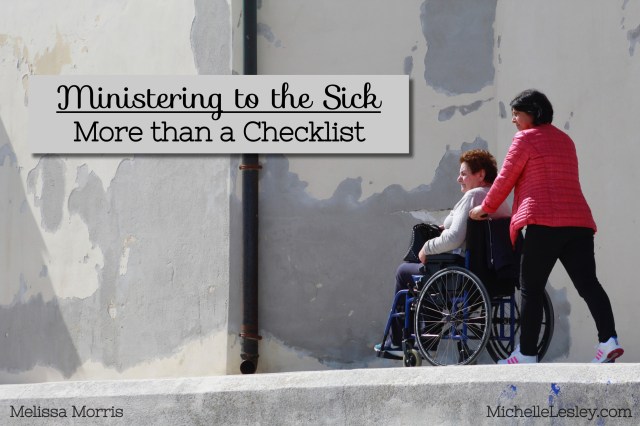
Ministering to the Sick: More than a Checklist by: Melissa Morris
Someone gets sick. Someone has surgery. Someone is going through cancer treatments. Until ten years ago when I had my own life threatening/life changing illness, I was guilty (unintentionally) of treating these opportunities as a checklist to be done and not really considering the person. Make a meal, give them a call, drop them off at the doctor – I mean, what’s wrong with that? People should be thankful that we care enough to be involved, right?
As the body of Christ, we have a huge responsibility to help out when illnesses occur. In the midst of all of the chaos, there is a person who has had his or her world turned upside down by a diagnosis or a surgery. People are individuals and so are diagnoses and treatment plans. There’s not only the physical side of sickness, there are also the emotional, mental and spiritual aspects to consider. It shouldn’t be a “fill in the blank” approach, it should be based on the individual.
Instead of treating our ministry as “one size fits all”, what are some things we need to consider to effectively and practically minister to someone experiencing an illness?
Cancer treatments and doctor’s appointments
It’s more than giving someone a ride.
When my mom found out she had cancer, we needed help getting her to and from the cancer center. We live 45 minutes from the hospital where she would be receiving her treatments. She had radiation treatments five days a week for six weeks.
We had several people volunteer to take her, and it soon became evident that not everyone fully comprehends that it’s more than a ride.
When providing cancer patients with a ride to treatments, it’s important to understand several things. They are weak, before and after the treatments. Whatever the extent of the disease they are fighting, it is wreaking havoc on their bodies. They may be experiencing pain, nausea, vomiting, bathroom issues, and more. Therefore, they may need physical assistance walking, going to the bathroom, carrying their things and staying hydrated. When you offer to give someone a ride to treatments and you are the only one with them, they are expecting some things from you. Please understand that it’s more than dropping them off at the door of the hospital, coming back to pick them up, and dropping them off at the door when you get them home, especially if you are leaving them alone.
What can you do?
Remember that it’s not about you. You may be tempted to take the opportunity, especially if you are making a long trip, to do some shopping or errands while you wait. While this is not entirely wrong, there are some things you need to consider.
Walk with them to the office where they are receiving their treatments. Make sure they don’t need a wheelchair or some sort of assistive device to get them there.
Check with them and see if they would be more comfortable if you waited for them in the waiting room before you go off to run errands. Sometimes it makes a patient feel better if they know someone is close by. The staff there might also need you to be available if there is an emergency or the patient needs something.
If you do leave the patient, make sure you arrive back in a timely manner so that they don’t have to wait for you when they are done.
When you arrive back at their home, make sure they get inside safely and have everything they need before you leave them. Help them get comfortable, get something to eat or drink, go to the bathroom, etc. It might be awhile before someone gets home to be with them.
Don’t plan anything else that day – there will be times when the person receiving the treatments might need extra care. For example, there were times when my mom went for radiation and she was dehydrated. This required her to go to the medication oncology lab and receive fluids before they would send her home. This could take a couple of hours.
Taking Food/Other Items
I live in the South, and I’m a Baptist. We treat any and every illness with food. There’s a special joy in preparing someone a dish and delivering it to them. There’s also the comfort you feel in receiving a meal from someone and you know that they prepared it with love. You sure don’t feel like cooking when you’re going through an illness.
It seems like an easy thing to do, but when I experienced surgery and a colostomy, my diet completely changed. We received so many wonderful, heartfelt meals, but to my dismay, there were many things that I wasn’t allowed to eat anymore. Some people come home with a new diagnosis of diabetes. Some have food allergies. Cancer patients might be experiencing nausea and vomiting/diarrhea. So, what can we do to make our meal ministry more effective?
I know we like the element of surprise, but to make it easier on everyone, it would be best to call and ask if the person has any dietary restrictions. It doesn’t do much good to take someone a meal they can’t eat, no matter how good it might taste.
If they can’t have certain things, consider taking prepackaged food items that they can easily put together themselves, but still ask for preferences and restrictions. Some examples:
Crackers
Canned meat/soups/fruits/vegetables (I know that fresh fruits and vegetables are ideal, however, when someone is recovering from an illness, they may not feel like eating a lot at one time. The fresh food might spoil before they can eat it. Prepackaged and canned allows for the person to use the food when it benefits them).
Sandwich meats and bread
If you live in an area that provides meal delivery from restaurants, offer to pay for their orders for a specified amount of time.
Offer to grocery shop for them and help put items away when you deliver the groceries.
Offer to prepare and refrigerate simple items that can be microwaved or warmed up easily.
There are other items that might be needed that we might not think about.
They also might need you to run errands for them, to the post office or to pick up prescriptions. Whatever the need may be, communicate with the person so that your efforts can be beneficial to them.
Visits
I love to talk. In fact, after I had major surgery, the nurses told my mom that I would sleep all night from the anesthesia. I woke up at midnight and talked all night long!
But as much as I love to talk, when I was recovering, I wanted to rest. I had been in the hospital for ten days, not knowing if I was going to make it back home or not. I was discharged home with IV antibiotics around the clock for seven more days. I had nurses coming in daily for wound care and colostomy training. I didn’t get much sleep in the hospital, and, for a while, I wasn’t getting much sleep at home.
Before visiting, call the person and see what a good time might be to show up. As I was talking with Michelle about this article, we discussed that the old theory is to “just show up”. I had people show up to see me that I would have enjoyed visiting with, but I was either sleeping or having a visit from the nurse. If the person recovering has a caregiver, that caregiver might be taking an opportunity to rest while the patient is resting.
What do I say? (or NOT say)
Some people said some crazy things to me and to my mom while we were dealing with recovery/cancer treatments.
My mom had a pastor who she thought a lot of visit her the day after she found out her initial diagnosis but before we found out the extent of the disease process. He seemed in a bad mood when he got there, preoccupied and distracted. My mom shared with him that she wasn’t afraid, that she had lived 67 years (at the time) and if the diagnosis was not good, she’d had a wonderful life and she was ready to meet Jesus. He looked up at her and rudely said, “Well, you might only have 67 more days, have you ever thought about that?”
A friend of my mom’s from church came to see her and pray with her. As they talked, this “friend” said, “Well, Pat, you know you have this cancer because you have sin in your life.”.
I woke up extremely depressed one day, so I actually reached out to someone I thought was a close friend via text and said I needed someone to talk to. Five days later, I got a text back that said, “Hope you found someone to talk to.”.
Don’t be that person – if you’re in a bad mood, visit another day, and as I was taught, if you can’t say something nice (or encouraging), don’t say anything at all. When I worked in healthcare, we were taught to leave our personal lives outside the door when we came to work, because they would be there for us to pick up when we went home.
What else?
I never realized until I became disabled how many things there are around the house that need to be done.
Cleaning
Laundry
Yard work/mowing
Errands
Taking care of the kids
There might be adaptations that need to be made to the home, or adaptive equipment put in place (grab bars, a handicap toilet, etc.)
The person might need help with bathing and dressing for a while, and this might not be something insurance covers. I needed daily wound care and my insurance only covered three days a week. I was blessed to have nurses in my life that covered the other four days. If you are a nurse or a C.N.A., you could offer your time and services. Even if you’re not, you can be trained in some instances to help with certain medical issues.
One of the biggest issues many deal with is the financial strain not working can put on a person. If the illness ends up being a permanent disability, it can take years (it took 3½ for me) to receive benefits through Social Security. I would hate to think where I would have been had the Lord not given me a wonderful mother and a few anonymous donors to make it through. Even with those things, I had to sell my car, and some of my instruments and sound equipment just to get medication and colostomy supplies. People may also need help filling out applications for assistance, disability, or in-home services.
Some of the things from our previous lists can carry over if the illness becomes a permanent disability.
Whatever the situation, keep this one thing in mind: be available. If you can’t meet the need of the person, help seek out someone who can.
It is my prayer that this will assist you in more effectively serving those in your community. And remember, somebody can’t do everything, but everybody can do something.
Melissa is a retired long term care/hospice social worker/bereavement counselor. Compelled to give up her career due to illness, she now spends her time raising her two cousins, singing and writing songs, and traveling to different churches and organizations sharing music and laughter.