Church

Throwback Thursday ~ Is It Really All Our Fault?

Originally published July 15, 2016
all our fault

“If the church would just _________,
the world would flock to us.”

“The world is in the state it’s in because
the church has fallen down on the job.”

Over the past few years, I’ve been hearing and reading statements like these more and more frequently. But are they true? Is the world really in such sad shape as a result of the failings of the church?

Yes!…and…no.

It is absolutely true that the visible church – everything that wears the label “church” or “Christian,” whether or not it’s biblical Christianity – has a lot to be ashamed of. Westboro. TBN. Homosexual church leaders and members. Pastors caught in adultery. Child molestation scandals. Female “pastors.” All manner of demonic behavior masquerading as “worship,” blasphemously attributed to the “Holy Spirit.”

Even churches with an orthodox statement of faith – which, to onlookers, seem to be doing fine, biblically – water down the gospel in the name of being seeker sensitive, use materials produced by false teachers, invite false teachers to speak at their conferences, fail to evangelize, place women in unbiblical positions of leadership, have pastors and teachers whose main form of teaching is eisegesis and pandering to felt needs, fail to provide for the needs of their members and their surrounding community, focus on fun and silliness in their youth and children’s ministries instead of Scripture and holiness, allow members to gossip, backbite, and exercise selfishness, fail to practice church discipline, make their worship services into irreverent entertainment-fests, have “pastors” who are little more than stand up comedians, and have largely biblically ignorant congregations.

Some churches are spiritually healthier than others, but nobody’s getting out of this one with clean hands. Even the healthiest church is doing something wrong in some little nook or cranny. And as Christ’s bride, it is incumbent upon us, whenever we discover those nooks and crannies, to repent, set things right, and do things biblically as we move forward.

Christ loved the church and gave himself up for her, that he might sanctify her, having cleansed her by the washing of water with the word, so that he might present the church to himself in splendor, without spot or wrinkle or any such thing, that she might be holy and without blemish. Ephesians 5:25b-27

That’s Christ’s vision of the church. A vision all churches fall woefully short of. And when the church fails in any area, it does contribute to the downhill slide of the world, because it is not being the city on the hill Christ wants it to be, and it is producing individual Christians (or false converts) who aren’t being the salt and light Christ wants them to be.

But is it fair to lay all the world’s woes and sinfulness at the doorstep of the church? Is it really true that if we would just clean up our act in this area or on that issue that we’d magically see an influx of pagans begging, “Sirs, what must I do to be saved?”

No, it isn’t.

The world isn’t steeped in sin because of the failings of the church. The world is steeped in sin because of the Fall.

Look back over history. The world was vicious and depraved long before the church ever came on the scene. And, for that matter, long before God set apart and established Israel as His chosen people. (Hello? The ante-diluvian world? Sodom and Gomorrah? Ancient Egypt? Baal and Molech worship?)

Examine any era in the last two millenia when you think the church was doing a better job than it is now and take a look at the society that church was situated in. The New Testament church? It was surrounded by a world of war, oppression, torture, debauchery, sexual deviance, slavery, misogyny, poverty, famine, and child abuse.

The head of the church, Jesus Christ, spent over thirty years physically present on this earth. We know He conducted His ministry perfectly. Not once did He fail to preach the gospel or provide for people’s needs or fall short in any other way. He even went so far as to lay His life down for the sin of the world. And what impact did that have on His immediate society? Did all the Pharisees repent and temple worship was restored to godliness? No. Did Rome stop ruling the world with an iron fist? No. Did acts of sedition and perversion and persecution suddenly disappear? No. In fact, some of those things actually got worse during and after Jesus’ time.

Just like He prophesied.

You see, Jesus didn’t say, “Be more like Me and the world will come running,” or “The church can solve the ills of the world.” He said:

If you were of the world, the world would love you as its own; but because you are not of the world, but I chose you out of the world, therefore the world hates you. John 15:19

Indeed, all who desire to live a godly life in Christ Jesus will be persecuted, while evil people and impostors will go on from bad to worse, deceiving and being deceived. 2 Timothy 3:12-13

The more the church and individual Christians look and act like Christ, the more world will hate, persecute, and ostracize us.

The church is not going to fix all the evils of society. And it’s not fair to lay that burden of responsibility – one that even Jesus’ earthly ministry didn’t accomplish – on believers who genuinely love their Savior and want to serve Him. Holding out the stick and carrot of a utopian world to the church – if only we’ll get our act together – does nothing but breed hopelessness, despair, and futility in the pews.

Does the church have a lot of repenting to do? Yes. Are there right hands we need to chop off and right eyes we need to gouge out in order to facilitate obedience to Christ? You bet. Should we be exponentially more proactive and passionate about preaching the gospel and meeting the needs of a lost and dying world? Absolutely.

But we do not do those things because we’re failing the world. We do those things out of love for and faithfulness to Christ. Christ is our goal, not a changed world. Christ is the prize we’re to fix our eyes on, not a society that behaves itself. Christ is the finish line we press toward, not domestic tranquility and morality.

Christ.

Because if it’s the church’s job to set the world right, we’re doomed. The world sins because the world is made up of sinners. And the world will continue to sin – even if every church on the planet suddenly becomes perfect – because the world is made up of sinners. But if the church’s highest attainment is love for Christ, faithfulness to Christ, and obedience to Christ, then we are successful in God’s eyes regardless of what the world around us looks like.

Let’s be faithful and trust God to handle changing the world.

Judges Bible Study

Judges ~ Lesson 9

Previous Lessons: 1, 2, 3, 4, 5, 6, 7, 8,

Read Judges 9

Questions to Consider

1. Go back to lesson 3 (link above) and review your answer to the first part of question 5, Israel’s pattern of sin and repentance in 2:16-23. How does today’s passage fit this pattern? How does today’s passage fit the theme verse of Judges (21:25), “In those days there was no king in Israel. Everyone did what was right in his own eyes.”?

2. Briefly review lesson 8 (link above) to set the scene for this weekโ€™s passage.

3. Read 1-2. Who were Jerubbaal and Abimelech? (1) Was Gideon’s son supposed to rule over the people? (2) Who was supposed to rule over them? Before you read any farther in chapter 9, think about this: The book of Judges is a case study of what happens when people reject God’s authority over their lives in favor of their own authority over their lives. How has that worked out in Judges so far? How do you think that’s going to work out for Abimelech and the people of Shechem in Chapter 9?

How did that work out for you before you got saved? Consider that every time you sin, even as a Christian, you are rejecting God’s authority (His commands in His Word) in favor of your own (“I’ll do what I want.”). How does that work out for you, even as a Christian?

4. Read 3-21. Who was Baal-berith? (4) Explain (16-20) the parable Jotham told in 7-15. What was the message he was trying to get across to the people of Shechem and to Abimelech? Had the people of Shechem “dealt well with Jerubbaal and his house and have done to him as his deeds deserved”? (16)

Compare Jotham’s courage and actions (16-21) to his father Gideon’s courage and actions. Consider Jotham’s (21) and Gideon’s actions to protect themselves and minimize danger to themselves at the hands of evil men while / after doing the right and godly thing. Does this indicate cowardice or prudence? Why?

5. Read 22-57. Summarize, in your own words, the plot line of this story. How does God’s justice bookend (23-24, 57) this story and point to God as the perfectly just judge? How does this story drive home the point that God should have been the One to rule over the people? That they should have submitted to His rule and authority instead of trading it for their own rule and authority?

The “Tower of Shechem” (46) and the “strong tower” of Thebez (51) were reinforced, military towers. Many fortified cities of the time built these towers for the exact purpose we see in this passage – so that, if the city were under siege, its leaders (and often the majority of the town, see verses 49, 51), could lock themselves into it and, hopefully, survive the onslaught. Those inside the tower had the advantage of height and could shoot (arrows) or throw things (53) down onto the enemy. Those attacking the tower had the disadvantage of being exposed in an open area. How does this knowledge help you better understand passages like these?

Compare 52-54 – Abimelech’s shame over a woman killing him – with God crediting women – Deborah and Jael – instead of Barak, with the victory over Sisera (lesson 5, link above). Does Abimelech’s shame help you get even more of a sense that the story of Deborah is not a “girl power” story but a “man up” story?

What was the “curse of Jotham ” (20) mentioned in verse 57?

6. “Bible trivia” question: Where else in Scripture is the event in 52-54 described, and why is it mentioned there? (Check your answer here.)


Homework

Verse 23 says that “God sent an evil spirit”. Does this indicate that God somehow approves of evil or that God instigates sin or forces people to sin? Consider how evil Abimelech and the leaders of Shechem already were and how many evil spirits were already hard at work in their lives and this situation. How can you tell from the text that this particular evil spirit mentioned in verse 23 was not inciting anything that was against the will of Abimelech or the men of Schechem?

Look up the cross-references for verse 23. Since God is completely sovereign over every aspect of the universe, can evil spirits (demons) go anywhere or do anything without God permitting them to do so? Think about all of the demons that must be at work in the world today. Are any of them acting outside of God’s control? Upon comparing verse 23 and its cross-references, can you see how these references to God “sending” an evil spirit are simply pulling back the curtain a bit on the spiritual realm to give us a glimpse of how God specifically uses a particular evil spirit in a particular situation?


Suggested Memory Verse

Church

Servanthood

Originally published July 26, 2016brush-629657_1280

When we think about “ministry” or “serving the church,” we often – sometimes exclusively – think about Paul’s preaching, and forget about things like Jesus washing the disciples’ feet, the seven men who served the widows (Acts 6:1-6), the generous givers in Corinth (2 Corinthians 9), the Shunamite who provided a room for Elisha (2 Kings 4:8-10).

Ministry and servanthood are often dirty and unglamorous jobs that nobody else wants to do, but they’re filling a need. When you clean up the church kitchen after a fellowship meal, you are doing ministry. When you sit with a church member at the hospital, you are doing ministry. When you take a turn in the nursery, you are doing ministry. When you pray for your church, you are doing ministry. When you mow the church grounds or fix the leaky baptistery or watch someone’s child so she can keep an appointment, you are doing ministry. You’re not going to be applauded for doing these things. Few, if any, will even notice that they’ve been done, and some of those folks will complain about the way you did it.

And that’s OK, because ultimately, we aren’t doing it for them. We’re serving Christ (Colossians 3:23-24).

Notice the kinds of ministry Jesus commends believers for at the final judgment (Matthew 25:31-40). Not teaching dozens or preaching to hundreds or singing to thousands (though those things are certainly needful and commendable when done biblically), but providing food, drink, and clothing to needy brothers and sisters in Christ, welcoming strangers into the church, visiting sick or imprisoned church members. It’s the little, personal, one on one, taking care of each other’s needs that Christ praises.

“Truly, I say to you,” our King will say, “as you did it to one of the least of these my brothers, you did it to me.” (Matthew 25:40)

May we all get out of the mindset that the spotlight is the only route to ministry, put on our grungy clothes, roll up our sleeves, get down on our hands and knees, and do the dirty, lowly work of servanthood.

Mailbag

The Mailbag: Potpourri (Confessing past sin… Too much Calvinism?… “Fake it til you make it”)

Welcome to another โ€œpotpourriโ€ edition of The Mailbag, where I give short(er) answers to several questions rather than a long answer to one question.

I like to take the opportunity in these potpourri editions to let new readers know about my comments/e-mail/messages policy. Iโ€™m not able to respond individually to most e-mails and messages, so here are some helpful hints for getting your questions answered more quickly. Remember, the search bar (at the very bottom of each page) can be a helpful tool!

Or maybe I answered your question already? Check out my article The Mailbag: Top 10 FAQs to see if your question has been answered and to get some helpful resources.


I confessed and repented of a certain sin after I got saved, but my husband doesn’t know about it. Do I need to confess that sin to my husband in order to receive God’s blessings or be considered a Proverbs 31 wife? And should he also confess his past sins to me? By the way, my husband is a pastor.

What a beautiful heart you have – wanting to be clean before the Lord and wanting to please Him!

There might be a few very specific scenarios in which it would not be wise to bring up a past sin to your husband, but, generally speaking, in a Christian marriage yes, you should be able to talk to your husband about your past sins (and he should also be able to discuss his past sins with you). But not to get God’s blessings or to be a Proverbs 31 wife.

Marriage is about trust. In the same way that Christian husbands and wives should trust each other enough to feel comfortable being physically naked around one another, we should also trust each other enough to feel comfortable “baring it all” when it comes to our past sins.

It sounds like this is a sin you simply haven’t told him about, but it should go without saying that you should not be lying to him about it or trying to cover it up. Those are direct sins against him, and if you’re doing that, you definitely need to confess and repent to him.

All of that being said, there can be more helpful / wise ways and times to talk to your husband about your past sin and less helpful / wise ways and times to talk to him about it, and you may want to get some help figuring that out from someone who can be more objective about it than you can.

Normally, I would suggest setting up an appointment with your pastor to get some pastoral counsel about it, but since your husband is your pastor, I would suggest locating an ACBC certified Biblical Counselor (not the same thing as a “Christian counselor/therapist”) who is not a member of your church (you don’t want your husband to be embarrassed or make it difficult for the counselor to sit under her pastor’s leadership) and set up an appointment.

Some denominations offer counseling services to pastors and their families, so you may want to contact your denominational leadership to find out about that. (I’m not sure what to tell you about other denominations, but if you’re Southern Baptist, contact your local SBC association or state convention.)


Hello! I found your website while trying to see if a Christian singer was a false teacher. I started reading over your beliefs to make sure that you werenโ€™t a false teacher (I donโ€™t mean that in a rude way, itโ€™s just that I have to be really careful especially since I am only a teenager). I agree with everything except Calvinism. I was just wondering if our beliefs would still align enough to where your positions on whether or not people are false teachers would align with my beliefs. I can always ask my parents afterwards, but I just wanted to know basically if you talk about or reference Calvinist beliefs a lot. Thank you!

Wow. Just, WOW. Honey, your parents must be so proud of you. I know I would be if you were my daughter. I am thrilled – hear me: THRILLED – that you checked me out to make sure I’m not a false teacher before reading my stuff. Do you know how many adults don’t do that before following people? Most of them. I wish I had been as discerning as you are when I was your age.

Calvinism is not a factor when I sit down to evaluate whether or not someone is a false teacher, so that isn’t something you would need to worry about. In fact, there are some people on both my Popular False Teachers page and on my Recommended Bible Teachers page about whom I have no idea whether or not they’re Calvinists. There are even Calvinists I recommend against (such as Matt Chandler), or decline to proactively recommend (such as John Piper). I will say this, though – and, understand, this is a very general statement – having studied dozens of teachers, I find that those who adhere to Calvinism / Reformed theology are less likely, on the whole, to be false teachers than non-Calvinists.

I guess it depends on what you mean by talking about or referencing Calvinism “a lot”. From my perspective, I hardly ever mention it directly, but I’m sure it does come across indirectly in some of the terminology I use and the way I handle Scripture.

This is kind of humorous, but, probably about once a month or so, I get a message or an email from somebody saying, “Why don’t you talk about the false teaching of Calvinism?” or “I see you recommend John MacArthur. Don’t you know he’s one of those [gasp!] Calvinists?”. So I guess I’m not exactly beating people over the head with it if they didn’t know and I have to tell them straight out, “Yeah, I’m a Calvinist, too.”

I don’t know, I’m probably not the most objective person to answer this question. Let’s turn it over to my regular readers and you can see what they have to say in the comments section.

Readers – do you think I talk about
Calvinism “a lot” on the blog?

Answer in the comments, and help out this charming and discerning young lady.


Could you tell me where Scripture teaches โ€œfake it till you make itโ€ ?

โ€œfake it โ€™til you make itโ€. A phrase easier said than done. But where stands it written? I would say this is not true. Michelle I trust your wisdom and knowledge, but this phraseโ€ฆnot so much. I asked sarcastically where I could find it in Scripture knowing itโ€™s not written. I was hoping to have a response to my previous email, but no reply as yet. Godโ€™s word is based on truth not feelings. Trusting feelings when it comes to โ€œfake it โ€™til you make itโ€ I find is not sound wisdom. Allowing the Holy Spirit to change me is trusting in Him not myselfโ€ฆwhether itโ€™s fear or feelings.

These two comments (from the same commenter) were left on my article Fear Not: 9 Biblical Ways to Trade Worry for Trust regarding the phrase “fake it til you make it” in this paragraph:

Those worries may start creeping in, but you donโ€™t have to set the table and turn down the bed for them. Push them right out of your mind, slam the door behind them, and say (out loud is helpful), โ€œNo. Iโ€™m not going to worry. Iโ€™m going to trust the Lord.โ€ Youโ€™ll still feel worried at first, but โ€œfake it โ€™til you make it.โ€ Your feelings will eventually follow.

I’d like to address two issues regarding these comments, first the commenter’s attitude, then the content.

Attitude: First, I did not receive an email from you about this, so I can only assume “email” in your second comment actually refers to your first comment. However, if you had sent me an email, you would have to have obtained my email address here, where I clearly state (in bold type, no less):

I regret I am unable to answer most e-mails
unrelated to speaking engagements…”

So if you had emailed me, you shouldn’t have expected a reply at all, much less on your timetable.

Since you commented, you should have read – in large font directly above the comment box:

“Before commenting please see the ‘Welcome’ tab in the blue menu bar at the top of this page. Comments are handled manually, so there will be a delay before approved comments are posted.”

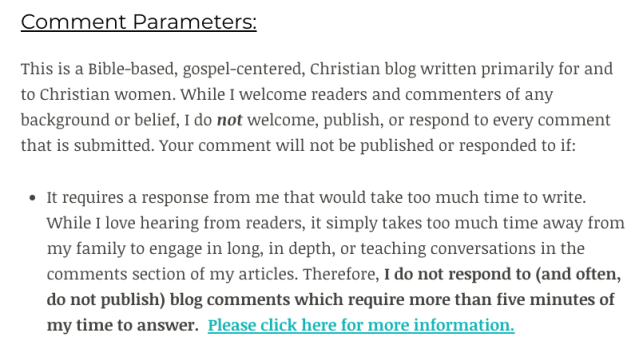
So, a) you should have expected some sort of delay, and b) if you had clicked on the Welcome tab as instructed, you would have seen this:

The “Please click here…” hyperlink goes to an article further explaining my email and comments policy and why emails and many comments usually go unanswered. I have bent over backwards to make it clear to my readers that I can’t answer most correspondence and why, even though I really wish I could.

Furthermore, you sent your first comment three weeks ago and your second comment a week later. To give you a little perspective, the first question I answered in this article was sent in almost a year ago. The second one, a month ago. Some people don’t get their questions answered for months. Others never get their questions answered, because I simply don’t have enough hours in the day to get to everyone’s questions. I hate that, but that’s just the way it has to be.

Not realizing your initial question was sarcastic, I had saved it in order to answer it in a Mailbag article, but I’ll be honest, when I got your second comment, my gut level reaction was to just delete both of them. Being impatient, demanding, and snarky when you’re asking someone else to do something for you (i.e. answer your question) is neither becoming of a Christian nor very effective.

But since I had already decided to address the content of your question, I decided to go ahead and do that and also add the part about your attitude as a teaching moment for you and anyone else to whom it might apply.

Content: I thought most people in my audience would be familiar with the phrase “fake it til you make it” (and, indeed, in the four times this article has run on my blog, you’re the only one who has commented objecting to it), but I can see where it might not be the clearest wording in the world, especially for people who aren’t familiar with the common usage of the phrase.

No one who has read the entire article could surmise that I was saying that “Godโ€™s word is based on feelings,” or that I was saying people should “[Trust] feelings when it comes to ‘fake it โ€™til you make it’โ€. (I’m not really even sure what that means since the theme of that paragraph, that section, and the entire article is that we should not trust or be controlled by our feelings.)

“Youโ€™ll still feel worried at first, but ‘fake it โ€™til you make it.’ Your feelings will eventually follow,” simply means that we should obey Scripture (in this case the Scriptures that tell us to trust God) regardless of how we feel about it and trust God to eventually line our feelings up with His Word. I thought that was clear from the context, but if it was not, I sincerely apologize. I have added a footnote to the article with this explanation in case it’s unclear to any other readers.

UPDATE (9/8/21)

I received what I thought was a very gracious response from this reader. With her permission, I share it here:

Dear Michelle,

โ€œfake it โ€˜til you make itโ€โ€ฆhereโ€ฆ

I ask your forgiveness. I had no intention of appearing impatient, nor demanding, nor snarky. Thank you for your very frank response and clarifying your answer to my question.

I am grateful for the knowledge and wisdom God has given you. My question was sincere as were my comments. And again Iโ€™m sorry if you took them as you did, as I had no intention to raise your ire in responding. I did indeed read the โ€œwelcomeโ€, and again didnโ€™t expect a response from your busy schedule and many emails you receive.

My heart was to speak as one sister to another. I have been told this phrase before. Words have consequences, and quite honestly for me, as I filter words and phrases through Godโ€™s Word, I am reminded to speak truth in love, not snarky, or demanding. We can all learn to be effective in our walk with the Lord by not jumping to conclusions that are incorrect, being teachable and gracious.

Blessings on you and your ministry.


If you have a question about: a Bible passage, an aspect of theology, a current issue in Christianity, or how to biblically handle a family, life, or church situation, comment below (Iโ€™ll hold all questions in queue {unpublished} for a future edition of The Mailbag) or send me an e-mail or private message. If your question is chosen for publication, your anonymity will be protected.

Judges Bible Study

Judges ~ Lesson 8

Previous Lessons: 1, 2, 3, 4, 5, 6, 7,

Read Judges 8

Questions to Consider

1. Go back to lesson 3 (link above) and review your answer to the first part of question 5, Israel’s pattern of sin and repentance in 2:16-23. How does today’s passage fit this pattern? How does today’s passage fit the theme verse of Judges (21:25), “In those days there was no king in Israel. Everyone did what was right in his own eyes.”?

2. Briefly review lesson 7 (link above) to set the scene for this weekโ€™s passage.

3. Remember that the Bible didnโ€™t have chapter and verse markings when it was originally written. Judges 8:1 picks up in the middle of a story. Back up and read 7:24-8:3, and the first part of chapter 8 will make more sense. 

Describe in your own words whatโ€™s going on here. What happened? (7:24-25) What did the men of Ephraim think should have happened – why were their noses out of joint? (8:1 – think about the ego of men as it relates to covering themselves in the glory of battle, and the fact that Ephraim was called up in the middle of the battle). 

How did Gideonโ€™s reply (8:2-3) appease the Ephraimites? (Think about the gleaning / harvest comparison, the military glory of killing the enemyโ€™s leader, and the reference to Abiezer.) Explain the wisdom of Gideonโ€™s reply.

4. Read 4-17. Just for reference, which Midianite leaders had Gideon already captured and put to death, and which Midianite leaders was he now pursuing? (8:5)

Think about the intensity of hospitality in Israel at that time – the kind of hospitality that compelled Israelites to take in even strangers as overnight guests. Also consider the strong sense of brotherhood that existed among the 12 tribes of Israel. Look at the words and actions of the men of Succoth and Penuel through that lens and describe how dastardly they were. 

As judge, was Gideonโ€™s response justified? Did he act out of personal retaliation, or out of meting out justice, and to set an example for Israel for the future? What is the common, underlying principle between Gideon disciplining the men of Succoth and Penuel and New Testament church discipline? When thereโ€™s โ€œsin in the camp,โ€ why is it necessary for that sin to be rooted out from among Godโ€™s people? What are the benefits of dealing with it biblically? What are the potential consequences of letting it fester?

5. Read 18-21. How does this wrap up the story of the battle against the Midianites?

Notice the theme of manhood and masculinity that saturates this passage. Examine each verse and what it says about what makes a man a man. Do any or all of these ideas line up with what Scripture says about being a godly man? Which Scriptures about godly manhood do these ideas bring to mind? How would the portrayal of manhood in this passage stack up against Jesusโ€™ portrayal of godly manhood?

6. Read 22-35. Why did the men of Israel want Gideon to rule over them? (22) Was Gideon the one who saved them from Midian? Who was? How does this explain Gideonโ€™s response in verse 23?

What was an ephod? Why do you think Gideon made an ephod? How did Gideon compromise between the end of verse 23 and the beginning of verse 24? How does compromising on Godโ€™s rule and reign always lead to idolatry? Notice how idols bookended Gideonโ€™s life. He started by tearing one down and ended by setting up another. 

When you see someone singled out and named in a seemingly random piece of information like Abimelech is in 30-31, keep an eye out for that person and/or piece of information in a future passage (we saw this in lesson 5).

โ€œThe people of Israel did not remember the Lord their God who had delivered them from [their enemies]โ€ฆโ€ (34) โ€œDo this in remembrance of Me.โ€ – Jesus, referring to the Lordโ€™s Supper (Luke 22:19). How prone are we to forgetting the Lord our God who delivered us from the Enemy through Christ? How does the Lordโ€™s Supper, the gathering of the saints, and the proclamation of the Word help us to remember?

Israel idolized Gideon. They idolized the ephod. And as soon as Gideon died, they idolized Baal-berith. Gideon risked his life to tear down Israel’s idols, and yet fell into idolatry himself at the end of his life.

Think back to lessons 6 & 7 (links above) and the lengths God went to in order to send the message loud and clear to Gideon and to Israel that He alone is God, that He alone saves, and that He alone was to get the glory for the victory over Midian. Why didnโ€™t they get it? 

Do passages like this ever pierce your heart? Do you ever wonder if there’s something youโ€™re just not getting even though God has gone to great lengths in Christ and His Word to make it loud and clear to you? Spend some time in prayer asking God to help you avoid the failure of Gideon and the Israelites, to open your eyes to any areas of your life in which youโ€™re not getting it, and to help you obey and stay faithful to Him.


Homework

Think about the words and actions of the men of Succoth and Penuel in light of what the New Testament teaches and shows us about Christian hospitality and care. What is one tangible way you can help provide for a brother or sister in Christ this week? Go do it.


Suggested Memory Verse