Mailbag

The Mailbag: Vaxxers, Anti-Vaxxers, and the Health of the Body


I was wondering if you could help me work through this issue: some people at my church did not vaccinate their children. While I do see that people have very strong opinions about this issue, it creates a hazardous situation for some of the members. For example, a young expecting mom can not come and worship because she could contract measles from an unvaccinated child and put her unborn baby at risk. (Not a hypothetical, these are the doctor’s orders. She should not be around unvaccinated children.) The same goes for newborn babies and their families. I am wondering if I should speak to the pastor about this issue, since I believe that the anti-vaxxers act unlovingly towards those who cannot come and attend church until their children are vaccinated. However, I fear that it would cause division and divert the focus from Christ to political or medical issues.

To vaccinate, or not to vaccinate? It’s a tough issue to discuss these days. I have a strongly held position on vaccinations. I’m not going to share it because as you’ve aptly pointed out, that would do nothing but cause division and divert the focus of this article and my ministry from Christ and His Word to a far less important issue. I will say, though, that, my personal position on vaccinations aside, I miss the “good old days” – like 30 years ago – when this wasn’t an issue that had Christian women practically scratching each other’s eyes out. We really should be ashamed of that regardless of which side of the issue we’re on. As sisters in Christ, we can, and should, do better.

I’m not a medical professional, so if you clicked on this article looking for me to say, “Vaxxers/Anti-Vaxxers are right because…science,” I’m sorry, but you’re going to be disappointed. (You’ll also be disappointed if you came here to argue your position in the comments section. I won’t be posting argumentative or inflammatory comments from either side.) My priority is to address the biblical side of how individual Christians and our churches should approach this issue.

Being godly and obedient to Scripture is exponentially
more important than your stance on vaccinations.

So let’s take a look at some biblical principles involved in the vaccination issue:

Is your stance on vaccinations an idol?

How strongly do you feel about vaccinating compared to how strongly you feel about evangelizing the lost? How much time do you spend talking about vaccinating compared to how much time you spend discussing Scripture with others? How much reading have you done about vaccinating compared to how much you read your Bible? Has your stance on vaccinations ever caused you to sin in thought, word, or deed?

Making decisions about your child’s health is, of course, important. But it is not anywhere near as important as the things of God, and it is certainly not more important than the things of God. Prayerfully reflect on the portion of your heart, soul, mind, and strength you invest in the vaccination issue. If it’s more heart, soul, mind, and strength than you invest in studying your Bible, prayer, evangelism, or attending and serving your church, then the vaccination issue has become an idol for you. Repent.

You shall have no other gods before me. Exodus 20:3

And you shall love the Lord your God with all your heart and with all your soul and with all your mind and with all your strength. Mark 12:30

Do you trust God’s sovereignty?

God is sovereign over life and death, sickness and health. The reason you are alive and reading this article is that it is not God’s will for you to be dead right this minute. If it were, you would be.

Think of all the stories you’ve heard of people who were practically religious about wellness, healthy eating, and exercise who dropped dead out of the blue in their 30’s or 40’s. Now think about the people who have lived into their hundreds. When the newspaper interviews them and asks about the secret to longevity, the centenarian inevitably responds with something about eating eggs and bacon and drinking a few beers every day. You can do everything “right” and still die young, and you can do everything “wrong” and live longer than most people. Even if the pregnant woman isn’t exposed to measles at church, she could be exposed at work, the store, the park, the post office, a restaurant, even her own husband or her other children could bring it home. And even if she is exposed, it’s not a foregone conclusion that her unborn child will be harmed. God is the one who decides all of that, not our own actions.

Should we be good stewards of our health and our bodies? Of course. Christians are to be good stewards of everything God gives us. But beyond being a good steward and making decisions as wisely as possible, the life and health of your child is in God’s hands, right where it belongs. If it is within God’s plan for your child to be healthy, your child will be healthy. If it is within God’s plan for your child to have an illness or disability, your child will have an illness or disability. And there’s nothing you can do about that except praise God in whatever situation He sends your way.

And let’s consider why we’re being good stewards and making wise decisions. Sometimes, without our even realizing it, fear of what might happen causes us to think that if we can get all our ducks in a row just right, we can ward off anything bad happening. It’s kind of a superstitious or even a prosperity gospel (“If I just do all the right things to appease God, He’ll protect me from what I fear.”) way of thinking.

Superstitious worry and fear are not to be our motive for stewardship and wise decision-making. Our motive should be honoring and obeying God in every aspect of our lives and then trusting the outcome to Him. There are health concerns with vaccinating and there are health concerns with not vaccinating. Whichever choice you make, you must trust God with the outcome of your child’s health, rather than trusting in your decision, the experts, studies, statistics, etc.

Trust in the Lord with all your heart, and do not lean on your own understanding. In all your ways acknowledge him, and he will make straight your paths. Proverbs 3:5-6

And he said, “Naked I came from my mother’s womb, and naked shall I return. The Lord gave, and the Lord has taken away; blessed be the name of  Lord.” Job 1:21

What’s love got to do with it?

major problem in the church today is that everybody thinks she gets to define what Christian love is. And most of the time that individualized definition is selfish or worldly or both. If Sister A says something or does something Sister B doesn’t like, Sister B accuses Sister A of being unloving.

No way. We don’t get to mishandle God’s Word and use it as a weapon or tool of manipulation against our brothers and sisters. That is wrong. If we’re going to accuse someone of being unloving, we’d certainly better make sure we’re using the Bible’s definition of love, not the world’s and not our own. And the Bible nearly always addresses the issue of Christian love not from the  perspective of, “Is my sister in Christ being loving to me?” but “Am I being as loving to my sister as Christ is to me?” John 15:12-14 is Jesus’ example to us of this:

This is my commandment, that you love one another as I have loved you.
Jesus’ instruction to the disciples is to give love, not to concern themselves with whether or not they’re receiving enough love from the other eleven.

Greater love has no one than this, that someone lay down his life for his friends. You are my friends if you do what I command you.
Who is about to lay down His life here? Jesus. And who are His friends? The disciples. Jesus is teaching them to focus on laying their lives down for others, not to expect others to lay down their lives for them.

The fact of the matter is that we’ve got to demonstrate selfless love to others even when they’re not demonstrating that kind of love to us.

By not vaccinating, are anti-vaxxers being unloving to fellow church members who can’t be around unvaccinated children? Are vaxxers being unloving toward anti-vax church members by accusing them of being unloving for not vaccinating their children? We need to be very careful here. The Bible does not address vaccinations, which means it’s not a sin to vaccinate and it’s not a sin not to vaccinate. That puts vaccinations in the category of adiaphora, or Christian liberty, to work out our own salvation and follow our own, biblically informed, consciences. It is a sin to violate your own conscience. So, if a sister in Christ has prayerfully searched the Scriptures and made a decision about vaccinations that is in keeping with her conscience, and you are insisting she do something that violates her conscience (or you’re saying she’s unloving for refusing to violate her conscience), who is the one who’s really being unloving here?

Which is greater, our love for our position on vaccinations or our love for brothers and sisters in Christ who hold the opposite position?

…work out your own salvation with fear and trembling, for it is God who works in you, both to will and to work for his good pleasure. Do all things without grumbling or disputing, that you may be blameless and innocent, children of God without blemish in the midst of a crooked and twisted generation, among whom you shine as lights in the world, Philippians 2:12b-15

And this commandment we have from him: whoever loves God must also love his brother. 1 John 4:21

Are you dying to self?

The Christian life is a continuous act of crucifixion of the flesh and denial of self. There is no point in our journey with Christ at which we can sit down, cross our arms and say, “I’ve been serving others non-stop. Now it’s time for somebody to serve me.”. (I’m embarrassed at how many times I’ve had this attitude myself.)

How does that work itself out in the context of this reader’s question? The pregnant woman does everything she can to love and serve her anti-vaxx brothers and sisters while protecting her unborn child. She looks for a workaround in which she bears the burden of making sacrifices, not the anti-vaxxers. At the same time, the anti-vax church members do everything they can to love and serve the pregnant woman while maintaining what they believe is the wisest decision for their children’s health. They look for a workaround in which they bear the burden of making sacrifices, not the pregnant woman. (Every decision we make comes with responsibilities. Christian anti-vaxxers, part of your responsibility when you choose not to vaccinate is not only to protect your child, but also to protect, as far as you’re reasonably able, anyone your child might infect.)

Do nothing from selfish ambition or conceit, but in humility count others more significant than yourselves. Let each of you look not only to his own interests, but also to the interests of others. Philippians 2:3-4

So then, brothers, we are debtors, not to the flesh, to live according to the flesh. For if you live according to the flesh you will die, but if by the Spirit you put to death the deeds of the body, you will live. Romans 8:12-13

Are you thinking outside the box?

Outside the world of math, there is rarely only one solution to a problem. (And even inside the world of math there are some problems which have several possible solutions!) It’s probably not the case that the only choices in this situation are that either the anti-vaxxers keep their children at home (or vaccinate them) or the pregnant woman has to stay home. Your idea of going to your pastor is spot on. Just make sure you’re going to him with the attitude of, “Could we meet together as a church body and brainstorm a workable solution to this issue? I’m willing to make sacrifices,” rather than, “Please tell those anti-vaxxers how wrong they are and make them vaccinate their children or stay home.” (Not saying you would have that latter attitude, just making a comparison.)

Is your sanctuary large enough that if the pregnant woman sat on the far end of one side and the unvaccinated children sat on the far end of the other side that they would be far enough apart to keep her from exposure to the measles? (She would need to discuss this with her doctor.) Does your church have more than one worship service (two a.m. services or an a.m. and a p.m.)? An agreement could be reached in which the pregnant woman comes to one service and the unvaccinated children come to the other service. Does your church have a baby cry room/nursing room (a room fussy children can be taken to so they don’t disrupt the service and/or in which moms can nurse babies, that has the sermon “piped in” via video or speaker)? Could something be worked out where the pregnant woman and the unvaccinated children take turns “attending” the worship service in this room each week? If your church doesn’t have a room like this, could one be rigged up? If no other solution can be worked out, and it actually does boil down to someone having to stay home from church, could the pregnant woman and the unvaccinated children take turns staying home from church?

These are just some possible solutions off the top of my head. If the vaxxers and the anti-vaxxers will all come together in an attitude of self-sacrificial love (and, what an incredible opportunity for a pastor to lead his people through putting this into practice) and the desire to serve one another, surely something can be worked out. (And let’s keep in mind, this is only a temporary situation until the baby is born and is old enough to be vaccinated himself. It’s not going to last forever.)

In the body of Christ, no issue is an “us vs. them” issue. It’s always a “we’re all in this together” issue.

I therefore, a prisoner for the Lord, urge you to walk in a manner worthy of the calling to which you have been called, with all humility and gentleness, with patience, bearing with one another in love, eager to maintain the unity of the Spirit in the bond of peace. There is one body and one Spirit—just as you were called to the one hope that belongs to your call— one Lord, one faith, one baptism, one God and Father of all, who is over all and through all and in all. Ephesians 4:1-6

Has your church ever faced this issue?
How was it addressed and worked out?


If you have a question about: a Bible passage, an aspect of theology, a current issue in Christianity, or how to biblically handle a family, life, or church situation, comment below (I’ll hold all questions in queue {unpublished} for a future edition of The Mailbag) or send me an e-mail or private message. If your question is chosen for publication, your anonymity will be protected.
1&2 Timothy Bible Study

1 & 2 Timothy: Lesson 1- Introduction

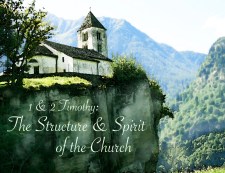
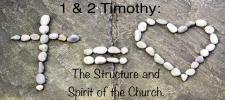
Welcome to our new study, 1 & 2 Timothy: The Structure and Spirit of the Church!

What is God’s plan for the church? How did He intend for it to be structured and run, and what is His vision for us, His people, as we worship Him and love and care for one another? For the next several weeks we’ll work our way through the books of 1 & 2 Timothy, one of God’s “policy and procedure manuals” for the church, to learn about its organizational skeleton as well as the spirit of its people.

Many thanks to those who worked so hard on their entries for our title pic contest. You ladies were very creative and did some beautiful work! 


Cheryl Toepfer                             Becky McGraw


Patti Green                                    Terri Mobley

In the end, I had such a hard time figuring out how to capture the theme I had in mind for the study – bouncing from one thought to another and discontent with every idea that popped into my mind – that I decided to design the title pic myself. (If there’s a chance I might end up dissatisfied, I’d rather be dissatisfied with my own work than the work of one of you lovely ladies!)

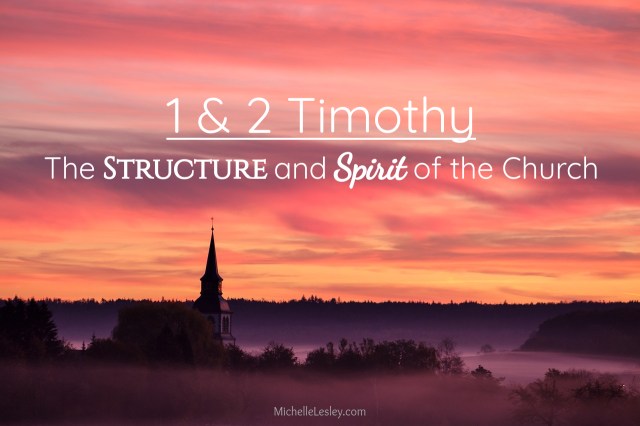
My thought is that the sunrise in this photo conveys the idea of the dawn of the church in history, when 1 & 2 Timothy were written. As the light of God’s instruction “rises” upon the church as they read through these epistles, it clears away the surrounding fog of uncertainty about God’s will and His ways for His people. Also, I really like the colors. :0)

If you’re new to using my Bible studies, just a few housekeeping items and helpful hints:

The studies I’ve written (you can find all of them at the Bible Studies tab at the top of this page) are like “training wheels”. They’re designed to teach you how to study the Bible for yourself and what kinds of questions to ask of the text so that, when you get the hang of it, you won’t have to depend on other people’s books and materials – even mine – any more. To that end, I do not provide answers for the study questions in the studies I’ve written.

My studies are meant to be extremely flexible and self-paced so that you can use them in the way that works best for you. You can do an entire lesson in one day or work on the questions over the course of the week (or longer). You do not need to feel obligated to answer all (or any) of the questions. If the Holy Spirit parks you on one question for several days, enjoy digging deep into that one aspect of the lesson. If He shows you something I haven’t written a question about that captures your attention, dive in and study it! Those are ways the Holy Spirit speaks to us through His Word. This is your time to commune with the Lord, not a school assignment or work project you are beholden to complete in a certain way by a certain deadline.

I will post a new lesson on the blog every Wednesday, so there is nothing to sign up for or commit to. Simply stop by the blog each week, or subscribe to the blog via e-mail to have the lessons delivered to your inbox.

With our last study (Imperishable Beauty) I “beta tested” a Facebook discussion group specific to that study. It was enthusiastically received, but after the first couple of weeks, there was virtually no participation. So with this study, I’ve decided not to put in the extra work of admin-ing a discussion group. You are welcome to form and admin your own discussion group if you like. I will also post the lessons on my own Facebook page each week, and anyone who would like to discuss the lesson can do so in the comments section of those posts.

I use hyperlinks liberallyThe Scriptures for each lesson will be linked either at the beginning of the lesson or in the lesson questions. Whenever you see a word in red, click on it, and it will take you to a Scripture, article, or other resource that will help as you study.

All of the studies I’ve written are suitable for groups or individuals. You are welcome to use them as a Sunday school or Bible study class curriculum (for free) with proper attribution.

You are also welcome to print out any of my Bible studies (or any article I’ve written) for free and make as many copies as you’d like, again, with proper attribution. I’ve explained more about that in this article (3rd section).


Introduction to 1 Timothy

Before we begin studying a book of the Bible, it’s very important that we understand some things about that book. We need to know…

Who the author was and anything we might be able to find out about him or his background.

Who the audience of the book is: Jews or Gentiles? Old Testament Israelites or New Testament Christians? This will help us understand the author’s purpose and approach to what he’s writing.

What kind of biblical literature we’re looking at. We approach books of history differently than books of wisdom, books of wisdom differently than books of prophecy, etc.

What the purpose of the book is. Was it written to encourage? Rebuke? Warn?

What the historical backdrop is for the book. Is Israel at war? At peace? In exile? Under a bad king? Good king? Understanding the historical events surrounding a piece of writing help us understand what was written and why it was written.

When the book was written. Where does the book fall on the timeline of biblical history? This is especially important for Old Testament books which are not always arranged in chronological order.

So this week, before we start studying the actual text of the book of 1 Timothy, we need to lay the foundation to understanding the book by finding the answers to these questions.

Read the following overviews of the book of 1 Timothy, taking notes on anything that might aid your understanding of the book, and answer the questions below:

Bible Introductions: 1 Timothy at Grace to You

Overview of the Book of 1 Timothy at Reformed Answers

Book of 1 Timothy at Got Questions

1. Who wrote the book of 1 Timothy? How do we know this?

2. Approximately when was 1 Timothy written? What is the geographical setting of the book of 1 Timothy? Here are some maps (scroll down to “1 Timothy”) that may be helpful as you study through the book of 1 Timothy.

3. Who is the original, intended audience of the book of 1 Timothy? Describe the historical setting (historic events, politics, sociology of the time, etc.) of 1 Timothy.

4. Which genre of biblical literature is the book of 1 Timothy: law, history, wisdom, poetry, narrative, epistles, or prophecy/apocalyptic? What does this tell us about the approach we should take when studying this book versus our approach to books of other genres?

5. What is the theme or purpose of the book of 1 Timothy?

6. What are some of the major topics of instruction in the book of 1 Timothy? How do these topics relate to the theme of 1 Timothy?

7. What are some ways 1 Timothy points to and connects to Jesus?

8. What else did you learn about 1 Timothy or the setting of this book that might help you understand the text of the book better?

Take some time in prayer this week to begin preparing your heart for this study. What are some ways your pastor and church could be encouraged by the instruction of 1 Timothy? What might you learn that could make you a healthier church member? Do you have any areas that need improvement when it comes to the way you serve God or your brothers and sisters in Christ? Ask God to grow you in those areas as we study together 1 & 2 Timothy: The Structure and Spirit of the Church.

Answering a Fool, Mailbag

The Mailbag: Answering a Fool #2


Answer a fool according to his folly,
lest he be wise in his own eyes.
Proverbs 26:5

There’s a lot of foolishness masquerading as Christianity these days. Occasionally, I get e-mails, messages, and comments showcasing this type of foolishness. It needs to be biblically corrected so these folks can stop “being wise in their own eyes,” repent, and believe and practice the truth of Scripture. From time to time, I’ll be sharing those messages in The Mailbag with a biblical corrective, not only so the e-mail/message writer can be admonished by Scripture, but to provide you with Scriptures and reasoning you can use if you’re ever confronted with this kind of foolishness.


(This reader’s remarks {in blue} are reprinted in full.)

I read your piece on Priscilla Shirer and it’s simple – you’re a White woman who knows nothing about Black Christianity or Black people in general.

How dare you suggest that there’s such a thing as white Christianity or black Christianity or any other kind of Christianity defined by race or culture? Have you never read the New Testament? The Apostles taught time and again that the gospel unites – not divides – us, because they were establishing the church in a place that had all kinds of ethnic and cultural divisions. Shame on you for trying to reinstitute division in rebellion against Christ’s command that His people are to dwell in unity!

There is neither Jew nor Greek, there is neither slave nor free, there is no male and female, for you are all one in Christ Jesus. Galatians 3:28

Behold, how good and pleasant it is when brothers dwell in unity! Psalm 133:1

Finally, all of you, have unity of mind, sympathy, brotherly love, a tender heart, and a humble mind. 1 Peter 3:8

I appeal to you, brothers, by the name of our Lord Jesus Christ, that all of you agree, and that there be no divisions among you, but that you be united in the same mind and the same judgment. 1 Corinthians 1:10

There is one body and one Spirit—just as you were called to the one hope that belongs to your call— one Lord, one faith, one baptism, one God and Father of all, who is over all and through all and in all. Ephesians 4:4-6

Furthermore, how dare you assume that I know nothing about black people? You don’t know me or anything about me. You are stereotyping me according to your own bigotry, assumptions, and prejudices against white people, and you’re stereotyping black people by assuming that all black people have the same worldview as you, and you’re putting race above Christianity by making this a racial issue instead of making this a biblical issue.

I have evaluated Priscilla Shirer the same way I’ve evaluated every other teacher on this blog – not according to race, but according to the Bible. You are the one who has come along and cast aspersions on me because I’m white and therefore supposedly unqualified to evaluate a teacher who happens to be black. Frankly, if I were Priscilla Shirer, I would be outraged that someone would suggest I should be held to a different standard than white teachers because of the color of my skin.

We already [sic] handling Mrs. Shirer, no need to put yourself in our lane and comment when you clearly know nothing about our ways or conduct.

Just for the sake of argument, I’m going to meet you on your own racial terms for a minute. If by “handling” you mean rebuking Priscilla for her false doctrine and insisting she teach sound doctrine, then your so-called “black Christianity” is not “handling” Priscilla Shirer, it is rewarding her.

Since you read my article, I’m sure you noticed that T.D. Jakes – who has to be one of the most (if not the most) popular, high profile, and influential black “pastors” in America – invited Priscilla to his “church” in 2016 to present her with the “Lady of Destiny” award. The audience was filled with other black evangelicals cheering Priscilla on, including her mother, Lois Evans, and her father, Tony Evans (another extremely popular, high profile, and influential black pastor) who also celebrated this “success” (Lois Evans’ word) of Priscilla’s on Instagram. How in the world can this type of thing be called “handling” her?

Furthermore, Priscilla has been teaching false doctrine since at least the early 2000s. How much longer is it going to take “black Christianity” to “handle” her?

Now I’m going to step out of the “lane” of racialism and back into the lane of biblical Christianity:

If you are a genuinely regenerated Christian, you and I (and every other Christian of every other race) are in the same lane, with the same ways, and the same conduct, because our lane, ways, and conduct are not dictated by race, they’re dictated by something that transcends race – the Bible. If you’re allowing your lane, ways, and conduct to be dictated by race instead of Scripture, you’re sinning by making an idol out of race (because anything that we prioritize above God and His ways, as revealed in His Word, is idolatry) and you need to repent.

I say this out of love so you don’t say something else and be seen as possibly prejudiced. I don’t expect a repost. That’s cool, but I do expect at least a double take when opining on us POC [people of color] in the future.

If you’re a Christian, you have no right to “expect” me to do anything but be obedient to Christ and His Word – just like I expect you to be. Just like I expect Priscilla to be. I will not degrade and disrespect the teachers I evaluate by drawing lines of racial distinction and suggesting that black teachers be held to a different standard, or “handled” differently than teachers of other races. That would be reason for people to see me as prejudiced. I will continue to judge teachers, not on the color of their skin, but on the content of their character and their teaching, and whether or not that character and teaching align with rightly handled Scripture. As Jesus Himself said:

Do not judge by appearances, but judge with right judgment. John 7:24

You are not saying any of this out of love. At least you’re not saying it out of biblical love, because biblical, Christian love would never falsely accuse, belittle, and slander a sister in Christ as you have done to me. Biblical love – love for Christ and His church – would never seek to divide Christians over race. Biblical love would never redefine Christianity according to race instead of defining it according to Scripture. Never.

Biblical love knows there’s only one color that matters. It’s the color that unites us together in one heart, mind, spirit, and family – the red, rich, royal blood of Christ.


If you have a question about: a Bible passage, an aspect of theology, a current issue in Christianity, or how to biblically handle a family, life, or church situation, comment below (I’ll hold all questions in queue {unpublished} for a future edition of The Mailbag) or send me an e-mail or private message. If your question is chosen for publication, your anonymity will be protected.
Speaking Engagements

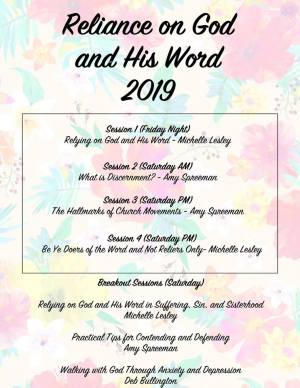
Reliance on God and His Word Conference Audio


It was my joy, recently, to speak at the Reliance on God and His Word conference at Princeton Bible Church.

PBC was so kind to record audio of the main sessions of the conference:

I hope you’ll enjoy my two sessions…

Relying on God and His Word


Be Ye Doers of the Word and Not Reliers Only


You can also listen at PBC’s website and hear Amy Spreeman’s wonderful sessions as well!

If your church is ever in need of a speaker for a women’s event, I’d love to come share with your ladies as well. Click here for more information.

Obedience, Sanctification

Throwback Thursday ~ When God Says No

Originally published May 19, 2017

When I was sixteen years old, I was convinced God was calling me to be the next Sandi Patty…I wanted God to use me- to put me on a stage every night in front of thousands of people so I could sing to them about Him…Somehow, it never occurred to me to care what God thought about all this or what He might want to do in my life. If I thought about it at all, I just assumed He was on board with my plans. Like, how could He not be, right?¹

There’s much ado about dreaming big dreams for God in modern evangelicalism. Think of the biggest thing you want to do for God and then “step out on faith” and make it happen. Sometimes we’re even told God is offended if our dreams aren’t big enough. It means we don’t have enough faith. It means we don’t believe God – or love Him – enough.

Or does it?

If you study through the books of 1 and 2 Samuel, you’re going to get to know Saul and David pretty well. And as you observe and compare their words, their behavior, and their interactions with God, a major theme that jumps out is obedience to God’s word versus doing what’s right in your own eyes.

Saul was an “I did it my way,” kind of guy. Time and again, he looked out for number one. Tried to build up his own kingdom. Did what he thought was best.

In 1 Samuel 15, God told Saul to utterly destroy the Amalekites. Everything. Every living creature and all their stuff. All means all.

But Saul had big dreams. So, he destroyed all the worthless stuff and all the people, but he saved the king and all the valuables. He disobeyed God’s clear word in favor of what he wanted to do.

Here’s the interesting part, though. When Samuel showed up and said, “Why did you disobey the Lord?” Saul said, not once, but twice, “I did obey the Lord.”

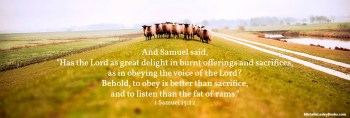
Why? Because Saul was going to offer some of those sheep he spared in a grand and showy sacrifice to the Lord. He was going to “do great things for God” and, in his mind, that was far better and more glorious than simple obedience to God’s explicit command.

By contrast, God says David was “a man after my heart, who will do all my will.” David sought the Lord and obeyed His words.

But David had a dream, too. He loved God deeply and wanted to do something big to honor Him.

“See now, I dwell in a house of cedar,” David said, “but the ark of God dwells in a tent.” David wanted to build a grand and glorious house for God.

It was a good dream. A dream that stemmed from godly motives. A dream that was, in reality, part of God’s plan.

But God said, “No.” Because it wasn’t God’s plan for David.

Sometimes there are things we want to do for God in life or in ministry because our hearts are fairly bursting with love for Him. Nothing small or insignificant will suffice – we want to do great things for Him because He has done so many great things for us.

Can I just tell you – that heart is what is most precious to God, not whatever it is you can dream up to do for Him. Every parent who’s ever received a clay ashtray or a bedraggled dandelion from her five year old knows this. We love the heart of our child who wants to show her love for us, even if the gift itself isn’t quite right.

And just like you would have to tell your five year old no if she wanted to demonstrate her love for you by having the family skip church on Sunday so she could cook you a four course brunch, God sometimes has to say no to the things we want to do for Him because those things – even though motivated by love for Him – conflict with His word, are out of sync with His timing, or aren’t His specific plan for us, personally.

It might be your heart’s deepest desire to serve God as the perfect Proverbs 31 wife…and God says no by declining to provide you with a husband. Maybe it’s always been your dream to raise a house full of children in the nurture and admonition of the Lord…and God says no by preventing you from bearing or adopting children. “I’ve always loved to tell people about Jesus,” you think, “Surely He’s calling me to be a pastor.”…and God says no in His word because that’s not His plan for Christian women.

God said no to David, too. It wasn’t the right time. It didn’t fit with what God was trying to accomplish in Israel at that moment. And David wasn’t the right man for the job. God had other things He wanted David to do.

How did David respond when God said no? Did he push forward with his own plans and build the temple anyway? Spend the rest of his life sulking or angry at God? Turn away from God all together?

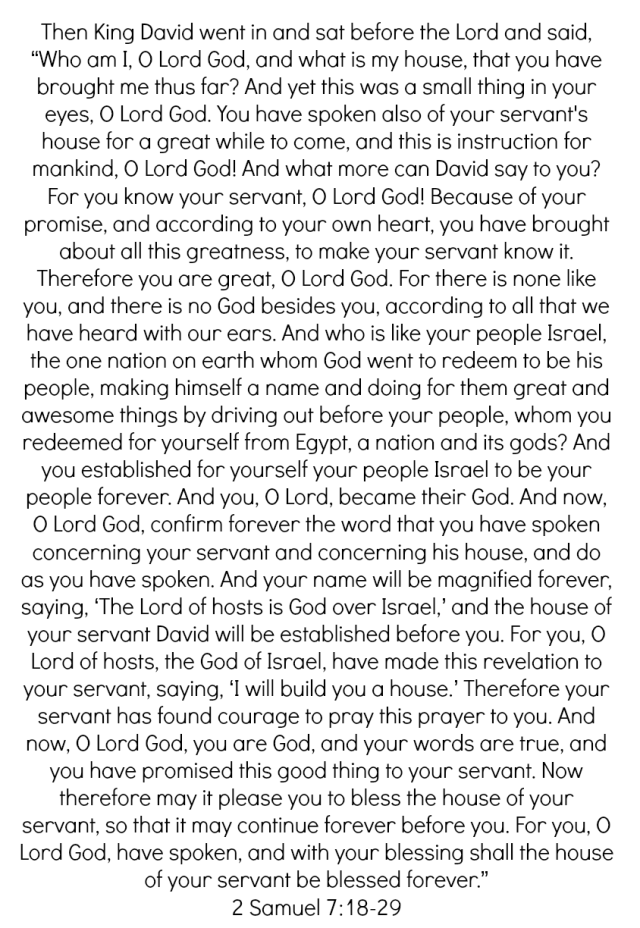
No. David responded with humility that God would use him in any way, joy over God’s love and blessings, and thanksgiving for God’s plans and promises.

That’s what a heart that truly loves God does. It obeys Him. It finds joy in any task He might bring our way. It is thankful and humbled that God takes any notice of us whatsoever and lavishes His grace and mercy upon us by allowing us to do what He wants us to do.

God didn’t allow David to build the temple. God didn’t allow me to become a top Christian recording artist. Maybe there’s something God isn’t allowing you to do. Will you joyfully obey Him in the things He does have planned for you? Will you be thankful and humbled that He desires to use you as part of His good plans and purposes even if those plans and purposes don’t match your own?

May we all follow David’s example – and the Greater David’s example – by saying, meaning, and living out, “Not my will but Thy will be done,” even when God says no.


Additional Resources:

How do I move on after God says “no”?