Mailbag

The Mailbag: Help! There’s a pushy lady at my church!

There is a lady in my church who has become very involved in a certain form of parachurch Christian ministry. She is extremely gung ho about it and pressures church members to participate. She has also organized a conference, bringing in speakers from the national level of the ministry.ย The elders/pastors approved it, but there is some disagreement about bringing in outside speakers, charging attenders so much for tickets, and the fact that it is mainly drawing people from outside our church who are already involved in this ministry, not necessarily discipling our own church members, yet our church members bear the work of the conferences.

We, her friends, have watched her continue to insistently push this ministry agenda. She freely admits to being pushy and asks us to keep her accountable, but she continues to push and becomes frustrated when challenged. I have met with her one on one and discussed this, and she now avoids me. I guess my question is, is it right/OK for me to now keep my distance from her? Is it OK for a woman to push a ministry agenda in the church?

Every once in a while a situation arises at church that leaves you feeling like, “Church is great…except for the people.” I’ve felt that way many times over the years, and I’m certain many people have felt that way about me. Personality conflicts at church can be difficult to deal with, but they’re a great “homework assignment” from God that – if we approach them biblically – can help grow us and the other person in Christlikeness. Let’s take a look at some of the aspects of this reader’s situation.

Doctrinal clarity on the ministry:
I think the first question on the minds of many of those reading this article is going to be, “What kind of parachurch ministry is this?”. Because, if it’s a ministry that centers around false doctrine or is led by false teachers, that’s your answer right there.

I edited out references to the particular ministry the woman is involved in a) to protect my reader’s anonymity and b) because the reader assures me the issue isn’t the ministry itself, it’s the agenda pushing. I’m very familiar with this specific parachurch ministry. It’s doctrinally sound. The situation would be similar to someone getting very involved in pro-life ministry, for example.

Doctrinal clarity on the behavior:
From what the reader has described in her e-mails, the woman’s behavior, while annoying and possibly concerning, does not sound like it has reached the level of actual sin. The parachurch ministry is doctrinally sound, and she thinks it would be beneficial to her church. She has received approval from church leadership. It doesn’t sound like she’s being deceptive in any way or doing anything the Bible clearly prohibits; she’s just very excited about this ministry and wants others to be as excited and on board as she is. That’s not sin, it’s just off-putting to others who aren’t interested. We need to be clear on the biblical fact that just because somebody does something that aggravates us doesn’t necessarily mean it’s sin. And if it’s not sin, it shouldn’t be treated as though it were. (I’m not saying the reader is doing that, just a general concept all of us should be mindful of.)

Church leadership:
If this woman is bringing in conferences, speakers, and other events that utilize the church facility, she’s not doing it without the approval of the pastor and/or someone in leadership. What that means is, as much as other church members may not like it, the buck stops with the pastor/elders, and they have given their approval to the activities thus far. If they are having a problem with this woman being pushy with them, it is their responsibility as pastors and elders to sit down with her and put a stop to that. If the pastor/elders are aware of, and have a problem with ticket prices, church members doing all the work, and the other problems you mentioned, it is their job to address that. I understand your concerns, dear reader, and having dealt with people like this before, I certainly empathize, but if you insert yourself between this woman and the elders – regarding her pushiness with them or issues it’s their responsibility to address – you run the risk of becoming pushy yourself and stepping in where you don’t belong.

If you think the pastor and elders are unaware of pertinent information regarding this situation, talk to your husband about it, and pray together for wisdom as to if and how you, he, or both of you should approach them with the information, remembering that, as a godly wife, you need to respect and defer to your husband’s decision. If the pastor and elders receive the information and continue to approve the parachurch ministry conferences and activities, then your disagreement is with the pastor and elders, not the woman pushing the agenda.

Body parts:
You’ve asked if it’s OK for a woman to push a ministry agenda in the church. No, it’s not. It’s not OK for men to do so either. First Corinthians 12 compares church members to the various parts of the body. While “The eye cannot say to the hand, ‘I have no need of you,'” neither can the hand say to the eye, ear, nose, foot, mouth, etc., “You have to be a hand, just like me.”

It is absolutely fine to be excited about a ministry or a project at church and to invite and encourage people to participate in it, but crossing the line from inviting and encouraging to pressuring and badgering is not appropriate, biblical, or loving. It puts your brothers and sisters in the awkward position of either having to knuckle under and do something they don’t really want to do in order not to hurt your feelings, or having to say no and run the risk of hurting your feelings. It ends up making the decision to serve in a particular ministry all about you, the pushy person, rather than about whether or not God wants that person in that ministry at this time. And not only should we not be basing our decisions about whether or not to serve on pleasing man rather than on pleasing God, it is unloving and unkind to back a brother or sister into a corner, forcing them into a no-win situation. If you love your brothers and sisters in Christ, you’ll want them to serve because they’re convinced God wants them to serve, not because you want them to serve.

Woman to woman:
As far as your personal relationship with this woman goes, it sounds like you have tried to reach out to her and help her, which is commendable. We all have weaknesses, and it sounds like this lady’s weakness might be lack of self-awareness and social skills. Sometimes, no matter how gently and lovingly we approach someone about a personal issue, she will get defensive or avoidant. Maybe she just needs some time to settle down. People rarely stay at fever pitch about something forever.

Is it OK for you to keep your distance from her? Well, I don’t think you need to proactively pursue spending time with her, but I also don’t think you should avoid any of your normal church activities that would bring you into contact with her. And, of course, you should be kind and loving to her when you see her in passing. If she continues to press you about the ministry whenever she sees you, there’s nothing wrong with politely changing the subject or excusing yourself. And if she wants to know what’s going on, just kindly and lovingly be honest with her. For example: “Jane, I’m so glad you’ve found a ministry you’re excited about and enjoy, but it’s just not my cup of tea. Maybe we could talk about other things when we get together?”

Sanctification:
As I said in the beginning of this article, personality conflicts in the church aren’t easy to deal with, but if we submit to God and His Word in the situation, they can be very sanctifying.

When I have to deal with a Christian I find difficult it helps me to remember a few things. First, this is a sister in Christ, made in the image of God. God knit her together in her mother’s womb, breathed the breath of life into her, and bled and died on a cross for her sins just like He did for me. We areย allย sinners, and weย allย have various personality issues that sometimes rub others the wrong way. Second, for every person I run into who bugs me, there are probably a dozen who are buggedย by me. I’m not any better than the person I’m dealing with just because I don’t bug people the same way she does. I also try to keep in mind that Jesus had to deal with a lot of difficult people during His earthly ministry. And, while I frequently fail, I do my best to follow His example of how to treat people.

The people we’re in membership with at our local church are our family. Every family has a crazy grandma or a know it all uncle or a cousin who constantly drops the ball. But we don’t just give up on family because they annoy us. Pray – daily and fervently – for those crazy, annoying, frustrating, challenging brothers and sisters at your church. Pray that God will help you love them the way they need to be loved. Consider setting aside some time to just sit and listen to them pour out their hearts. Many people act out simply because they feel invisible, lonely, and unheard. Be patient with them. Be kind. Do something unexpectedly generous and loving for them. Exercise forbearance. Find a way to help. Scripture after Scripture shows us it’s God’s will for us to love the unlovely, just like we want others to love us when we’re unlovely. This is one of the reasons why we’re in the church.


If you have a question about: a Bible passage, an aspect of theology, a current issue in Christianity, or how to biblically handle a family, life, or church situation, comment below (Iโ€™ll hold all questions in queue {unpublished} for a future edition of The Mailbag) or send me an e-mail or private message. If your question is chosen for publication, your anonymity will be protected.
Church

Twelve Songs for Reformation Day

Reformation Day, October 31, is the annual observance of the anniversary of the Protestant Reformation. Celebrate the day with these songs showcasing each of the Five Solas of the Reformation, or use them as a guide for your Reformation Sunday worship set. (I’ve also compiled the videos below into a YouTube playlist entitled Reformation Day.) Soli Deo Gloria!

Sola Scriptura

Scripture alone – not church traditions, the teachings of man, or extra-biblical revelation – is what we base our beliefs and worship practices on.

O Word of God, Incarnate

The B-I-B-L-E

Sola Fide

We are not saved by good works, by by faith alone.

On Faith Alone I Stand

Let Us Plead for Faith Alone – Sola Fide

Sola Gratia

We are saved by God’s grace alone, not by any merit or righteousness of our own.

Grace Alone

Grace Greater Than Our Sin

Solus Christus

There is salvation in no other name but that of Christ alone.

In Christ Alone

The Church’s One Foundation

Soli Deo Gloria

To God alone be the glory for our salvation!

Soli Deo Gloria

Glorious is Thy Name

๐ŸŒท๐ŸŒท๐ŸŒท๐ŸŒท๐ŸŒท

Reformation Hymn

A Mighty Fortress is Our God

What’s your favorite Reformation Day song?

Additional Resources:

Reformation Hymns by Scott Aniol


I have not exhaustively vetted these musicians and songwriters. please make sure to examine against Scripture any of them you choose to follow and make sure they are doctrinally sound.

Mark Bible Study

Mark: Lesson 24

Previous Lessons: 1, 2, 3, 4, 5, 6, 7, 8, 9, 10, 11, 12, 13, 14, 15, 16, 17, 18, 19, 20, 21, 22, 23

Mark 16

When the Sabbath was past,ย Mary Magdalene,ย Mary the mother of James, andย Salomeย bought spices, so that they might go and anoint him.ย 2ย And very early on the first day of the week, when the sun had risen, they went to the tomb.ย 3ย And they were saying to one another, โ€œWho will roll awayย the stone for us from the entrance of the tomb?โ€ย 4ย And looking up, they saw that the stone had been rolled backโ€”it was very large.5ย Andย entering the tomb, they saw a young man sitting on the right side,ย dressed inย a white robe, andย they were alarmed.ย 6ย And he said to them,ย โ€œDo not be alarmed. You seek Jesus of Nazareth, who was crucified. He has risen; he is not here. See the place where they laid him.ย 7ย But go, tell his disciples and Peter thatย he is going before you to Galilee. There you will see him,ย just as he told you.โ€ย 8ย And they went out and fled from the tomb, for trembling and astonishment had seized them, and they said nothing to anyone, for they were afraid.

[Some of the earliest manuscripts do not include 16:9โ€“20.]

9ย [[Now when he rose early on the first day of the week,ย he appeared first toย Mary Magdalene,ย from whom he had cast out seven demons.ย 10ย She went and told those who had been with him,ย as theyย mourned and wept.ย 11ย But when they heard that he was alive and had been seen by her, theyย would not believe it.

12ย After these thingsย he appeared inย another form to two of them, as they were walking into the country.13ย And they went back and told the rest, but they did not believe them.

14ย Afterwardย he appearedย to the eleven themselves as they were reclining at table, and he rebuked them for theirย unbelief andย hardness of heart, becauseย they had not believed those who saw him after he had risen.15ย And he said to them,ย โ€œGo into all the world andย proclaim the gospel toย the whole creation.ย 16ย Whoever believes and isย baptizedย will be saved, butย whoeverย does not believe will be condemned.ย 17ย Andย these signs will accompany those who believe:ย in my name they will cast out demons;ย they will speak in new tongues;18ย they will pick up serpents with their hands; and if they drink any deadly poison, it will not hurt them;ย they will lay their handsย on the sick, and they will recover.โ€

19ย So then the Lord Jesus,ย after he had spoken to them,ย was taken up into heaven andย sat down at the right hand of God.ย 20ย And they went out and preached everywhere, whileย the Lord worked with them and confirmedย the messageย by accompanying signs.]]


The Holy Bible, English Standard Version. ESVยฎ Permanent Text Editionยฎ (2016). Copyright ยฉ 2001 by Crossway Bibles, a publishing ministry of Good News Publishers.


Questions to Consider

1. Jesus was crucified and buried on a Friday afternoon. What day did the women go to the tomb to anoint His body? (2) Why did they wait until Sunday instead of going on Friday evening or Saturday? (1) How does verse 1 say the women obtained the spices? Would they have been able to purchase them or do the work of anointing Jesus’ body on the Sabbath? What was the purpose of anointing a dead body with spices?

2. Read verses 1-5, focusing on the women’s actions and conversation. Do their words and behavior indicate that they expected Jesus to be dead or alive? Why would they not have expected His resurrection since He prophesied it multiple times?

3.ย Why was there a stone sealing the entrance to Jesus’ tomb? (3-4) Compare what Pilate and the chief priests believed about Jesus’ resurrection, and their subsequent actions, with what the women believed about Jesus’ resurrection, and their subsequent actions. How did the unbelief of the two groups differ?

4. Even though Jesus had prophesied his resurrection many times, the women didn’t have much of a frame of reference for someone rising from the dead. How does God sending the angel to explain things to them (5-7) instead of scolding them for their failure to grasp the situation demonstrate His mercy and understanding of their human frailty? What was their emotional reaction (8) to all these events? In light of the recent events of the crucifixion, and the actions of people such as Pilate and the Jewish leaders, explain why the women might have reacted (8) the way they did.

5. Imagine the book of Mark ends with verse 8. Who and what is the focus of the last chapter of Mark’s gospel? Why is Jesus’ resurrection crucial to the Christian faith, and to you personally as a Christian?

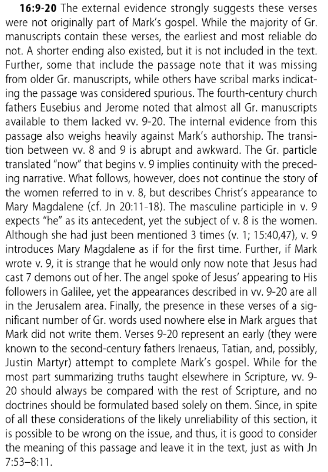
6. What does the notation between verses 8 and 9 mean? Read the following note on verses 9-20 from the MacArthur Study Bibleยน

What evidence does Dr. MacArthur cite that Mark may not have written verses 9-20 and that it may have been added later? Does this in any way mean that the Bible is unreliable or inerrant? What are some precautions Dr. MacArthur suggests we should take with 9-20, and how should we handle this text comparatively?

7. Compare verses 9-20 with Matthew 28, Luke 24, and John 20, and any cross references (on 9-20) your Bible lists. Is there anything in verses 9-20 that isn’t mentioned elsewhere in Scripture? Is it “safe” to believe everything in 9-20 that matches up with other Scripture?

8. What has been the most important thing you’ve learned from our study of the book of Mark?


ยนJohn MacArthur,ย The MacArthur Study Bible, English Standard Version, (Wheaton, IL:ย Crossway, 2010), p.1464-1465

Homework

Read the following resources on the ending of Mark:

The Fitting Ending to Mark’s Gospelย by John MacArthur

The Ending of Mark by Robert Stein

Should Mark 16:9-20 be in the Bible? at Got Questions?


Suggested Memory Verse

And he said to them,ย โ€œDo not be alarmed. You seek Jesus of Nazareth, who was crucified. He has risen; he is not here. See the place where they laid him.
Mark 16:6

Mailbag

The Mailbag: Should churches use praise teams?


I question the use of praise teams. I have noticed the singers chosen are always very attractive as well as being very talented. I also notice they seem to be performers instead of leaders of worship. It seems the majority of churches that use praise teams are in the process of transitioning into the emergent church movement. I would appreciate your thoughts.

Okie dokie, let’s start off with some definitions and caveats. In the interest of full disclosure, my husband is a minister of music. We have usually served at smaller traditional churches (100-120ish in attendance on Sundays), some with only choirs, some with only praise teams, and some with both. I have always sung in those choirs and praise teams.

If you’re not familiar with praise teams, a praise team is a group of about four to eight singers – usually headed up by a worship leader or minister of music – that stand toward the front of the stage and do what choirs used to do: lead (by example) the congregation in singing. Some churches (usually the more traditional ones) use a choir and praise team. Some (the more contemporary ones, or small traditional churches that can’t support a full choir) use only a praise team. In more contemporary churches, the praise team, worship leader, guitar, drums and other instruments are often lumped together as a single entity – the worship “band”.

When pastors, elders, ministers of music, and others in church leadership are trying to decide what should or should not be included in the worship service, the first place they need to go is the Bible. If the practice in question is either specifically commanded or prohibited by Scripture, it’s quick and easy to make a decision. We do the things required by Scripture (such as baptism and the Lord’s Supper) and we don’t do the things prohibited by Scripture (such as women preaching or the worship of other gods). (If your church isn’t doing the “do’s” or is doing the “don’ts,” it isn’t a church. You need to find a real church – a biblical one – pronto.)

Your pastor and other leaders should also examine their motives for wanting to implement (or do away with) a particular practice. In the case of starting a praise team: Are we doing this because we want to look cool and attractional to the outside world? Is it a wiser stewardship of our music budget to switch to a small praise team instead of a large choir? How will a praise team make our worship service more God-glorifying? Not only should the practice itself line up with Scripture, but the leaders’ motives for implementing the practice should line up with Scripture.

As church members, when we take a look at what’s going on in the worship service at our church, we also need to make the Bible our first stop. First we need to examine whether or not the practice in question is biblical. If the practice in questionย is biblical (or at least isn’t unbiblical), we need to look at another passage of Scripture:

Obey your leaders and submit to them, for they are keeping watch over your souls, as those who will have to give an account. Let them do this with joy and not with groaning, for that would be of no advantage to you.
Hebrews 13:17

I think a lot of Christians forget this principle of authority in the church. Church isn’t Burger King where you can “have it your way” and you get to gripe all over the place when you don’t like something. If your pastor and other leadership are godly, biblically trustworthy men and they implement something that’s in line with scriptural principles, but rubs your personal tastes and preferences the wrong way, trust them, support them, submit to them, and give it a chance without complaining.

There’s nothing in the Bible that either prohibits or commands praise teams, so if your church leadership implements one, and their reasons line up with Scripture, that’s not ungodly or sinful in and of itself. It’s a decision each individual pastor has to prayerfully make as he seeks to do what is best, wisest, and most godly for his particular church.

That being said, let’s take a look at some of your more specific concerns:

“I have noticed the singers chosen are always very attractive…”
This may be the case in your church or churches you have watched on TV, but I can assure you it’s not the case in every church that uses a praise team. My own church “beta tested” a praise team in our traditional (choir and hymns) service several months ago. Because most of the people who attend that service (including the choir from which the praise team was chosen) are older, the praise team was of the middle aged to senior citizen demographic. I didn’t think any of them were unattractive because they’re my church family and I love them, but they weren’t 18 year old supermodels either. And I’ve seen plenty of other praise teams made up of people who are average looking, older, overweight, disabled, etc.

“…as well as being very talented.”
Maybe I’m misunderstanding what you mean here, but I’m not seeing the problem, either biblically or logically, with people who are talented in a certain area serving the church in that area. If you were going to put together a rotation of people to cook the fellowship meal prior to your midweek service, would you recruit the people in your church who are known to be good cooks or the ones whose casseroles everyone avoids at the monthly potluck? Do you ask people who can’t balance their own checkbooks to serve on the finance committee? If you’re putting together a music team, you want people who are talented and skilled in music, not the ones who are tone deaf, have no rhythm, and can’t read music. There’s biblical precedent for using people with certain talents to serve in certain capacities in God’s house.

“I also notice they seem to be performers instead of leaders of worship.”
I appreciate your use of the phrase “seem to be.” It’s extremely subjective and unfair to make a judgment call on whether a person is “worshiping” or “performing” based solely on his appearance, facial expression, and singing style during his time on the stage. The minister of music needs to be pastoring the praise team (this is why we need to have pastoral ministers of music instead of lay “worship leaders”) toward spiritual maturity in selecting, rehearsing, and ministering to them. He needs to ensure that the people on his team are genuinely regenerated Believers who exemplify humility and the desire to serve Christ and His church, not people who see singing on the praise team as merely a stepping stone to an appearance on The Voice.

“It seems the majority of churches that use praise teams are in the process of transitioning into the emergent church movement.”
That has not been my experience, but I don’t doubt that that’s true for some churches that use praise teams. But praise teams are not the linchpin on which churches turn to apostasy. There are hundreds, maybe thousands, of perfectly doctrinally sound churches that use praise teams and have no intention of going emergent. And, there are doctrinally unsound “churches” heading toward becoming emergent that also happen to use praise teams. It’s the doctrine and theology of the church, and its view of and fidelity to Scripture, that causes a church to either strive toward being a biblical church or becoming apostate, not whether or not it uses a praise team.

In summary, there is nothing patently unbiblical about praise teams themselves. The fact that some doctrinally unsound churches use them should no more preclude doctrinally sound churches from using them than doctrinally unsound churches having small groups should preclude doctrinally sound churches from having small groups. Personality, spiritual, and doctrinal issues affecting a praise team should be dealt with biblically in the same way these issues are dealt with in other groups in the church. Whether or not to have a praise team is an issue the pastor of each church must study Scripture and pray about and decide for himself. It’s not something we can biblically make a blanket statement for or against.


If you have a question about: a Bible passage, an aspect of theology, a current issue in Christianity, or how to biblically handle a family, life, or church situation, comment below (Iโ€™ll hold all questions in queue {unpublished} for a future edition ofย The Mailbag) or send me anย e-mail or private message. If your question is chosen for publication, your anonymity will be protected.

Christian women, Church

8 Theses for Women of the Modern Day Reformation

October 31, 2017, marks the 500th anniversary of the beginning of the Protestant Reformation, and because I’m all theme-y and whatnot, I’m in the midst of a fantastic book called Reformation Women by Rebecca VanDoodewaard who I dearly wish were on social media so I could shamelessly fangirl her and make a general nuisance of myself by asking too many questions. Normally, I would actually finish a book before slobberingly commending it to you, but in case you like being all theme-y and whatnot too, and because time is of the essence, I’m throwing caution to the wind and telling you:

Get this book. Now. You’re welcome.

Normally, when we read about the Reformation, we’re reading about great preachers and leaders like Luther, Calvin, Zwingli, and Hus, but preaching was not the only work of the Reformation. And that’s one of the things that has captivated me about Rebecca’s book. All of the women included therein were strikingly courageous, tireless laborers, who contributed greatly  to the success of the Reformation, and they did it all while coloring inside the lines of biblical womanhood – doing vital work godly women are uniquely equipped by Christ to do. They opened their homes as a refuge to scores of Protestants (often including those aforementioned notable preachers and other integral leaders) fleeing for their lives from Catholic marauders. They set up prison ministries and fed and clothed the poor. They nursed their communities through the Plague. Those who were queens and princesses used their power to protect Reformers and change persecutory laws. Those who were married to pastors and leaders helped in their ministries and edited their books and papers. And they wrote. Poetry. Position papers. Booklets. Letters. What a happy discovery (for me, anyway) to find sisters of the quill from so long ago.

All of these women were strikingly courageous, tireless laborers, who contributed greatly  to the success of the Reformation, and they did it all while coloring inside the lines of biblical womanhood.

But these great ladies were not our only foremothers in the faith. For as long as God’s people have been God’s people, God’s people have rebelled and needed to be reformed. In fact, that’s the entire, overarching theme of the Old Testament- the need for Israel to reform from its idolatry. And all along the way we see faithful women like Deborah, Jael, Esther, Jehosheba, Jedidah, Huldah, Samson’s mother, and others willing to buck the trend of sin and rebellion and point the way back to God and holy living by their deeds and the example of their lives.

The New Testament gives us extraordinary examples such as the women who ministered to Jesus during His earthly ministry, stood by Him at the cross, and were the first ones at His tomb. Priscilla, Lydia, Dorcas, Eunice, Lois, Phoebe and other believing women soon followed, all lending their aid in their own unique ways to reforming dead, legalistic Judaism into biblical Christianity.

All of these great women of God, serving Him through thousands of years as only godly women can, laying the foundation with their blood, sweat, and tears, for the church we know today.

But have we “arrived”? Is the need for women to work for reform in the church a fast fading dot in the rear-view mirror of modern day evangelicalism? Judging from the articles I read and the e-mails I receive about the problems in the church, the answer to that question would be a big, fat “no.”

Perhaps armies of the Catholic “church” no longer hunt down fleeing Protestants. And, maybe Nero isn’t using Christians as torches for his garden parties any more (although there are certainly areas of the world where our brothers and sisters in Christ face similar threats every day). But the stealth, guerrilla warfare Satan has been waging against the Western church in recent decades might be even more damaging. Certainly, it’s more diffuse and wider spread. Instead of raping the bride of Christ, Satan has chosen instead to seduce her. Why forge an enemy when you can woo a lover?

Instead of raping the bride of Christ, Satan has chosen instead to seduce her. Why forge an enemy when you can woo a lover?

False teachers. Word of Faith heresy. The New Apostolic Reformation. Abuse in the church. Biblical illiteracy. “Lone Ranger” Christians. Idolatry. Irreverence in the sanctuary.

It is easy to see why the heart of the Protestant Reformation was Semper Reformanda– “always reforming.” The work of fighting for sound doctrine, biblical worship, and pure hearts and hands never, never, never ends.

So what does it look like to be a woman of the modern day Reformation? What can we church ladies do to help turn the tide of apostasy in Christendom? Permit me to nail eight theses to the door of your church.

What does it look like to be a woman of the modern day Reformation? What can we church ladies do to help turn the tide of apostasy in Christendom? Permit me to nail eight theses to the door of your church…

1.
Realize You Can’t Change the World

None of the women named earlier in this article changed the world or the entire church. Not a single one of them. In fact some of them brought about great changes in their locales that were overturned in the years after their deaths.

The problems facing the church today are overwhelming. You’re one person. You can’t fix everything (and God doesn’t expect you to). Maybe you can’t even fix everything in your own church. But what you can do is determine to be faithful to Christ and His Word in your sphere of influence. Bloom where you’re planted. “Brighten the corner where you are“, as the old gospel song says. You can’t do everything, but what’s something you can do?

2.
Color Inside the Lines

One of the major problems plaguing the church today is Christian women who rebel against God’s word by stepping outside the boundaries God has drawn for women in the family and the church. Don’t shoot yourself in the foot by following suit in your zeal to reform. There’s plenty of work to be done by godly women – work that we’re better equipped for than men – without violating Scripture.

3.
Mind Your Demeanor

No, we shouldn’t be wishy washy milksops or mealy-mouthed shrinking violets. But we also shouldn’t be loud-mouthed harpies, brashly marching into hell with a water pistol (just trust my own failures on this one). We need to be velvet-covered bricks: soft on the outside, firm on the inside. We should attain to all the Christlike virtues of demeanor: patience, kindness, compassion, mercy, and grace mingled with an unyielding stand on Scripture and an uncompromising commitment to Christ. For some of us, the former comes easier. For some of us, the latter. But we must seek that godly balance as we go about the work of the Kingdom.

4.
Serve the Local Church

If you have rejected the mere idea of local church membership and think you’re going to bring about change from the outside as an unchurched (or functionally unchurched) writer, speaker, or Christian celebrity, you’re part of the problem, not part of the solution. The church is God’s plan for Christianity, not evangelical gurus. Do whatever you have to do to find a doctrinally sound one, join it, and get to work serving.

The church is God’s plan for Christianity, not evangelical gurus.

5.
Pray

When it comes to the church, fixing what’s broken doesn’t rest on your shoulders. Spiritual problems require spiritual solutions, and only God can bring those about. You can defend Scripture til you’re blue in the face or explain all day long why someone is a false teacher, but only God can lift the veil and enlighten the eyes of the heart. Be faithful in your efforts, but be more faithful in prayer. Like the persistent widow, grab hold of the Lord on behalf of the church and don’t let go.

6.
Teach Other Women

In my experience, the number one way false doctrine enters the church is through women’s ministry and women’s “Bible” study. You want to work for reform in the church? Work on reforming your church’s women’s ministry. Explain to your sisters why that divangelista is a false teacher. Request Bible study classes that study the actual Bible. Volunteer to organize the next women’s conference or retreat and schedule doctrinally sound speakers. Teach a women’s or girls’ Sunday School class. Transform the church by transforming the hearts and minds of women.

Transform the church by transforming the hearts and minds of women.

7.
Help

The book of Exodus tells the story of Israel’s battle with Amalek. When Moses held up his arms, Israel prevailed. When he let down his arms, Amalek prevailed. Eventually, Aaron and Hur came alongside Moses and held up his arms for him so that Israel could win the battle. Who was more important to Israel’s victory in this story- Moses or Aaron and Hur? If you answered “both,” you’re correct. Israel couldn’t have won without Moses holding up his hands, but Moses couldn’t have held up his hands without Aaron and Hur. Most of the women of the Old Testament, New Testament, and Protestant Reformation who effected godly change among God’s people were not Moseses. They were Aarons and Hurs. What can you do to hold up the arms of your pastor, your elders, your husband, your church?

8.
Stand

Make sure you know your Bible backwards, forwards, and upside down in context. Know right from wrong, the biblical from the unbiblical. Learn what God’s word says, and stand. Don’t back down. Do it with a godly demeanor, but do it. Refusing to budge from the truth of Scripture might cost you your “church”. It might cost you your family and friends. It might cost you your job, your reputation, and your finances (as we’ve seen in recent years with Christians in the business world who have refused to cave to the homosexual agenda). But as our brothers and sisters who went to the fiery stake, the dank prison cell, and the gallows would tell you, fidelity to God’s Word is worth it. Loyalty to Christ is worth anything it might cost you. Stand.

As our brothers and sisters who went to the fiery stake, the dank prison cell, and the gallows would tell you, fidelity to God’s Word is worth it. Loyalty to Christ is worth anything it might cost you. Stand.

Whether your women’s ministry is using a book by a false teacher, there’s a faction of backbiters in the church that needs to be quelled, or your pastor is overwhelmed and needs some help, there’s something in your church that you can pray about, help with, or work on to help it move toward spiritual health. The church needs discerning, biblically knowledgeable, mature Christian women to step up and fight ungodliness whenever and wherever we’re able. Will you be a courageous laborer in the modern day Reformation?

The church needs discerning, biblically knowledgeable, mature Christian women to step up and fight ungodliness whenever and wherever we’re able. Will you be a courageous laborer in the modern day Reformation?