Mailbag

The Mailbag: Potpourri (Female officiant, JMac attack, Google 101…)


Welcome to another “potpourri” edition of The Mailbag, where I give short(er) answers to several questions rather than a long answer to one question. I also like to take the opportunity in these potpourrri editions to let new readers know about my comments/e-mail/messages policy. I’m not able to respond individually to most e-mails and messages, so here are some helpful hints for getting your questions answered more quickly. Remember, the search bar can be a helpful tool!


I noticed you’ve written lists of recommended teachers and false teachers. Just curious if you could help in the same way with Contemporary Christian music and artists.

I took a stab at that in my article False Doctrine in Contemporary Christian Music. I will add any CCM artists I stumble across in the future that I think need to be warned against or recommended, but I’m afraid that article is going to be the extent of any “list” of doctrinally sound or unsound Christian musicians. It’s not an issue I research much, and CCM isn’t a music genre I enjoy listening to. I’m really more of a podcast gal. I would, however, highly recommend the Additional Resources I’ve listed at the end of that article as well as the comments section.


I was recently invited to a wedding where the officiant will be a female “pastor”. I’m not close to the bride, but I honestly can’t bear the thought of attending even if we were close. Your thoughts, please?

This is really less of a biblical question than it is an etiquette question. Fortunately for all of us, I have read a lot of Miss Manners in my day :0)

Since you’re not close to her, that makes things a lot easier than if it were a family member or close friend. If the invitation contains an RSVP card, you can just send it back with “regrets” or “will not attend” (or whatever) marked and not say anything else about it.

If it’s a situation like she’s a co-worker you see face to face frequently and she asks point blank if you’re coming, you could say something, like “I’m so sorry, but I have a conflict that prevents me from attending.” It’s not necessary to go into any further detail.

If she’s pushy and presses you about it, you could either say something like, “I’m sorry, it’s personal,” or you could kindly, gently, and briefly get into the actual theology of why a woman shouldn’t be serving in the position of pastor, explain that this conflicts with your beliefs as a Christian, and that you wouldn’t feel comfortable attending. Ask God to give you wisdom as to what is the best approach with this particular person.

Just bear in mind, a social invitation isn’t a subpoena and it’s really nobody’s business why you won’t be attending.


Can a church use Hillsong or Bethel/Jesus Culture music in the worship service as long as the lyrics of the particular songs that are selected don’t conflict with the Bible?

If I were queen of the evangelical world and it were up to me to make a binding law about this, my answer would be no. No church would use any music by any heretical organization or doctrinally unsound musician. I briefly addressed my reasons for this in my article False Doctrine in Contemporary Christian Music:

It’s imperative for churches to be discerning about the CCM they use in worship. If Jane Churchmember hears a CCM song in church and likes it, she’s likely to Google the song (probably right there in church- I’ve done it!), find out who sings it, and begin following that artist. Worship pastors who use CCM have a responsibility to vet the artists who perform the songs they select for the worship service to make sure they’re not sending Jane into the arms of a heretic. Additionally, music costs money, and you don’t want your church’s offerings supporting false doctrine.

I think the principles and Scriptures in this article generally apply to this question as well: Four Reasons Why It Matters Who We Share, Pin, and Re-Tweet


Today on Facebook, I saw a post saying John MacArthur is a false teacher. Can you enlighten me please? After being part of your blog and being more discerning of who I read, I’m bummed. I even purchased the John MacArthur ESV Study Bible on your recommendation and also read the Grace To You blog.

Let me start by saying this: Just because someone (including me) says a certain teacher is a false teacher doesn’t mean you should automatically believe her.

I can assure you that John MacArthur is not a false teacher. In fact, he is one of the finest and most doctrinally sound teachers out there today, and I highly recommend him. But you shouldn’t just blindly take my word for that any more than you should just blindly take the word of the Facebook post you saw that says he is a false teacher. You shouldn’t believe anything in Christianity because a person says so, but because the Bible says so. Every Christian should be discerning about every sermon she listens to, every book she reads, and every pastor or teacher she follows, including the pastor at her own church. We must each practice biblical discernment for ourselves, comparing everything to rightly handled Scripture and discarding anything that doesn’t match up to what the Bible says in context.

I’m not familiar with the Facebook page you mentioned by name in your e-mail, but my guess is that it is a group that incorrectly and unbiblically believes that Reformed theology (or Calvinism) is false doctrine. John MacArthur is a Calvinist, so naturally they believe he is a false teacher. They’re judging his sound doctrine by their own false doctrine. That’s what people who hold to false doctrine do. Extreme anti-Calvinists believe Calvinists are false teachers, New Apostolic Reformationists believe doctrinally sound cessationists are false teachers, Catholics believe that Protestants are false teachers, and so on. It helps to know what kind theology (or false theology) someone is coming from when he labels a person as a false teacher.

I would encourage you to do the biblical work of discernment for yourself. Compare John MacArthur’s materials to Scripture and be convinced by God’s written Word whether or not you should follow him.

Here are a couple of articles I think you will find helpful on this issue:

Clinging to the Golden Calf: 7 Godly Responses When Someone Says You’re Following a False Teacher

Is She a False Teacher? 7 Steps to Figuring it Out on Your Own


You had this Google result that talks about Kelly Minter supporting gay marriage:

I have searched the Internet and your website and I can’t find it. I’m thinking of doing her Bible study on Nehemiah but don’t want to do it if this information is true so I need to see her exact quote myself in order to decide.

This is the first time I’ve received a question like this, but it concerns me that a lack of understanding of how Google works might lead someone to think I’ve said something I haven’t, and if there are others out there who are drawing the same kinds of conclusions as this reader just because they need a little help understanding the mechanics of Google, I’m glad to give a little tutorial.

It looks like you may have Googled something like “Does Kelly Minter support homosexual marriage?” but didn’t click on my article that popped up.
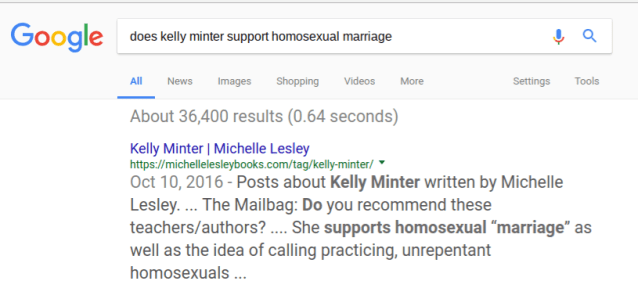
(Here’s the top result I got when I Googled the phrase “Does Kelly Minter support homosexual marriage”.)

When you Google something, Google pulls the key words from your search and that’s what it displays in boldtype in the result. You have to click on the article and read it to get the full picture.

Here is the direct link to my article that contains information about Kelly Minter. My article doesn’t say Kelly Minter supports homosexual marriage, but there is another teacher in the article who does. Your Google result pulled Kelly Minter’s name from the section on her and the “supports homosexual marriage” phrase from the section on Rachel Held Evans.

To my knowledge, Kelly Minter does not support homosexual marriage, however, I would still urge you not to use her materials for the reasons given in the article. Just because someone doesn’t support homosexual marriage doesn’t mean everything else she’s teaching is biblical, and this is certainly the case with Kelly Minter. Her materials would be detrimental to your spiritual growth. I would strongly recommend that you simply pick up the Bible and study it for yourself rather than relying on someone else’s book.

You might find the “Popular False Teachers” tab, “Recommended Bible Teachers” tab, and “Bible Study” tab (all at the very top of this page) helpful.


If you have a question about: a Bible passage, an aspect of theology, a current issue in Christianity, or how to biblically handle a family, life, or church situation, comment below (I’ll hold all questions in queue {unpublished} for a future edition of The Mailbag) or send me an e-mail or private message. If your question is chosen for publication, your anonymity will be protected.

Mailbag

The Mailbag: False Doctrine in Contemporary Christian Music

This article is kept updated as needed.

I’ve noticed that false doctrine is not just restricted to sermons, conferences, and Bible studies, but that I have to watch out for it in the contemporary Christian music (CCM) I listen to as well. Are there any CCM groups, artists, or songs I should avoid? Can you recommend any specific doctrinally sound artists or groups?

You’re absolutely right that we need to be careful about what we listen to that wears the label “Christian.” There is a lot of beautiful, doctrinally sound, theologically rich music of all genres out there, and there’s a lot of junk as well.

I’d like to offer a couple of caveats before diving into the answer for this question:

1. I plead extreme ignorance when it comes to CCM. With rare exception, it’s not a genre I enjoy, I don’t listen to it, and the worship service I attend uses “traditional” (mostly hymns) music, so I’m not often exposed to it. I’m all in favor of doctrinally sound CCM for those who like that genre, it’s just not my personal cup of tea or an area I research.

So, in this article I’m going to tell you what little I know, point you to people and resources better equipped to answer this question, and lean heavily on you discerning CCM listeners for help (more on that in a bit).

2. There is lousy theology in every genre of music. There are lousy hymns, lousy Christian rap, lousy CCM, lousy gospel, lousy Southern gospel, etc. This question was asked specifically about CCM, so that’s what the answer is going to focus on. It’s not a debate about hymns or exclusive psalmody versus CCM.

3. Depending on music from currently popular musicians is a lot like depending on Bible studies from currently popular evangelical authors. The majority of them aren’t doctrinally sound, and even the few that are seem to be apostatizing at an alarming rate. My recommendation to churches? Either go back to using tried and true doctrinally sound hymns, sing the Psalms, or find some talented musicians and lyricists in your own (doctrinally sound) church and put them to work writing songs for your worship service.


Why is it important to be discerning about Christian music? Because the music we use in church and listen to at home teaches us theology, and it sticks in our memories (which is why a lot of Scripture memory programs set Bible verses to music to help with memorization). You probably couldn’t recite verbatim a quote from last Sunday’s sermon, but I’ll bet you know the lyrics of a lot of songs by heart. It’s important that those lyrics contain good theology.

It’s imperative for churches to be discerning about the CCM they use in worship. If Jane Churchmember hears a CCM song in church and likes it, she’s likely to Google the song (probably right there in church- I’ve done it!), find out who sings it, and begin following that artist. Worship pastors who use CCM have a responsibility to vet the artists who perform the songs they select for the worship service to make sure they’re not sending Jane into the arms of a heretic. Additionally, music costs money, and you don’t want your church’s offerings supporting false doctrine.

Now, every time I address the subject of being discerning about worship music and that churches should not use worship music from heretical sources (such as Bethel, Hillsong, and Elevation, see below) someone who’s defending using music from these heretical sources will invariably pipe up with this well worn canard1:

Well, [insert name of hymn writer here] wrote lots of perfectly biblical hymns, but he had some theological problems too, and you’re not recommending we get rid of all of his hymns.

Well, first of all, maybe we should more closely examine the theology of some of our most prolific hymnists and stop using their music because of what they believed. Quick – off the top of your head, name the three we should start with…

…And that’s what separates the errant hymnist from Bethel, et al. Most Christians, even those who prefer hymns over CCM, could probably not name three people who wrote hymns, let alone tell you anything about their theology. But if you ask the average Christian to name three top Christian artists, she could rattle them off in a second.

Most hymn writers have been dead for up to hundreds of years. They don’t have Facebook pages you can follow, nobody’s playing their stuff on KLOVE, they’re not on tour to promote their latest album, they don’t have thousands of followers worldwide, and their music is in the public domain, so your church isn’t financially supporting them or their work. If you wanted to follow their errant theology, you’d have to hit the books to research and study it. Contemporary musicians’ theology is only a click away on YouTube, social media, live streamed concerts and conferences, and on their web sites. Nobody is following dead hymnists’ false doctrine, but hordes are following contemporary musicians’ heresy.

🔴Artists to Avoid
Cory Asbury
Audrey Assad (Catholic)
Ray Bolz (homosexual)
Bethel Music
Lauren Daigle
Elevation Music
Charity Gayle
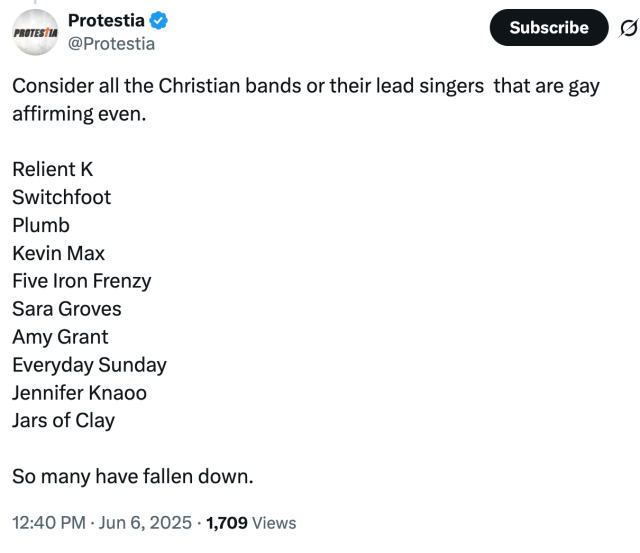
Amy Grant (homosexuality affirming)
Hillsong
Jesus Culture
Kari Jobe

Jennifer Knapp (homosexual)
Brandon Lake (close ties with Bethel, Maverick City Music {see below})
Matt Maher (Catholic)
Maverick City Music (woke, homosexuality affirming, partners with Elevation)
Nichole Nordeman (Nichole has extensive ties to a plethora of false teachers and was recently very vocal in her support of Jen Hatmaker’s embrace of homosexuality in the church.)
Michael Tait
Phil Wickham (in the NAR camp, close ties to Bethel)

These from Protestia.

And anyone else who closely associates with any of the above (performing together, co-writing songs, Bethel Music produces their albums, etc.)

Let’s Talk About the Worship Music at the [Charlie Kirk] Memorial Service… with Dawn Hill

🟡Artists I Don’t Proactively Recommend (i.e. Use Caution or Avoid)

Casting Crowns has toured with Hillsong. Hillsong – not CC – pulled out of their 2022 tour due to the scandals with Brian Houston.

CityAlight is the music ministry of St. Paul’s Anglican Church, which occasionally allows women to preach and has a few ties to Hillsong (covering Hillsong songs, also this video was recorded at Hillsong studios, see info. section).

Selah member, Todd Smith, is the husband of Angie Smith.

Shane and Shane uses mostly Bethel, Hillsong, and Elevation music (along with music by other problematic artists) in their Worship Initiative ministry. They have also performed with Bethel.

Doctrinally Sound Artists:
The Corner Room
Keith and Kristyn Getty
Hymnology
Indelible Grace Music
Brian Sauvé
Sovereign Grace Music

*(January 2021- Keep an eye on the Gettys. They’re still doctrinally sound as far as I know, but over the past couple of years, they have been platforming some biblically problematic personalities at their events. Jon Harris discusses this on the Russell Fuller reveals more, The Getty’s invited who?, & SEBTS prof. takes on The Gospel Coalition episode of Conversations that Matter, ~28:04)

There are probably many others that belong on all three of these lists, but those are the only names I personally know to give you.

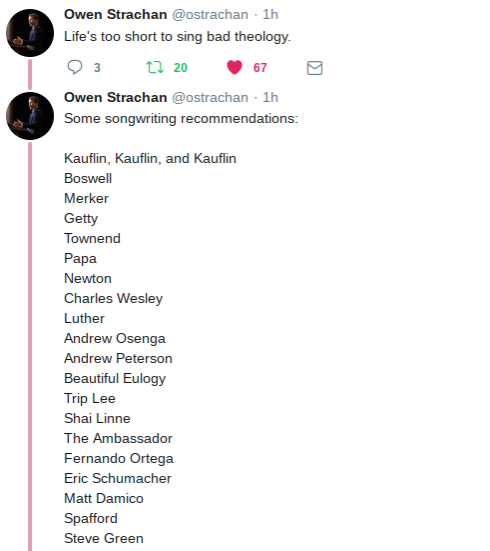
Owen Strachan recently made some recommendations of songwriters, though they’re not all contemporary, on Twitter: (others also responded with suggestions, click here to see):

(I’m not familiar with all of these, but in case you need their first names to look them up: Bob Kauflin, Stuart Townend, Matt Papa, John Newton, Martin Luther, Horatio Spafford.)

You will, of course, need to vet for yourself the theology and associations of any musician or group you decide to follow. It’s not quite the same as vetting a teacher or pastor, but several of the principles in my article Is She a False Teacher? 7 Steps to Figuring it Out on Your Own can be adapted for vetting musicians. Additionally, I would recommend three things when deciding whether or not to listen to someone:

1. Look up the lyrics of about half a dozen of her latest songs and examine the lyrics against Scripture. It’s helpful to look at the words in front of you without hearing the music so you can really think about them without being emotionally influenced by the music. Are they biblical?

2. Look to see who the artist associates with and admires. The easiest way to do this is to check their Facebook and Twitter feeds. Do you see scads of re-tweets and shares of posts from false teachers? Is she on tour with, co-writing songs with, or having her albums produced by a musician you know should be avoided?

3. Go to the artist’s web site, and examine her statement of faith (if she has one) and the venues she’ll be playing. Does she frequently play at places like Bethel? Lakewood? The Potter’s House? Is she the worship leader at a lot of conferences featuring false teachers? You might also want to look at her bio to see if she mentions her home church. If she’s a member of a church headed up by a false teacher, that’s definitely a red flag.

Below you’ll find some helpful additional resources relating to specific songs, artists, and the CCM industry. I’d also like to solicit the help of you discerning listeners of CCM:

Are there CCM songs or artists you would recommend avoiding due to biblically demonstrable sin or false doctrine? Please comment below with the exact name of the artist/song, the reason to avoid said artist/song, and a link(s) providing lyrics and/or objective support for your reason.
Unsubstantiated accusations will not be published.
Are there doctrinally sound artists you would recommend? Please comment with the name of the artist (and preferably a link to his/her web site) below.


1From my article The Mailbag: Should Christians Listen to Reckless Love?


Additional Resources

Why Your Church Should Stop Playing Bethel, Hillsong, Elevation, and Jesus Culture

The Mailbag: “I Speak Jesus,” Charity Gayle, and How to Vet Christian Music

Let’s talk about the worship music at the memorial service… at The Lovesick Scribe

The Discernment in Music Archive at Faithful Stewardship

Sound in Worship by Justin Rea

Christian Music Review from Reformed Fellowship Church

Worship Song Ratings by Sandy Simpson

What’s So Bad About Christian Radio by Gabe Hughes

Psalms, Hymns, and Spiritual Songs: Putting Popular Church Music to the Test by Gabe Hughes

In Response to Putting Popular Church Music to the Test by Gabe Hughes

Psalms, Hymns, and Spiritual Songs (vol. 2) by Gabe Hughes

Once Again, Critiquing the Most Popular Praise and Worship Songs by Gabe Hughes

Let’s Talk About the Worship Music at the [Charlie Kirk] Memorial Service… with Dawn Hill


If you have a question about: a Bible passage, an aspect of theology, a current issue in Christianity, or how to biblically handle a family, life, or church situation, comment below (I’ll hold all questions in queue {unpublished} for a future edition of The Mailbag) or send me an e-mail or private message. If your question is chosen for publication, your anonymity will be protected.
False Doctrine, False Teachers

Hillsong’s Theology of Music and Worship

c3banner1_fftf

Does your church use Hillsong music? Do you buy their songs or listen to them on the radio? Ever really sat down and compared the words you’re singing or hearing to Scripture?

If not, this episode of Fighting for the Faith will be eye-opening. Listen in as Chris Rosebrough, Steve Kozar, and Amy Spreeman examine the lyrics of several popular Hillsong anthems for biblical theology. They’ll also give you a behind the scenes look at what goes into planning a Hillsong-esque worship set. And you’ll hear from Geoff Bullock, one of the “founding fathers” of Hillsong music, about why he left Hillsong and his regrets about the songs he wrote while there. Hear more of Geoff’s story here and below:


Click below to listen to this fascinating episode of Fighting for the Faith:

Heresy Hiding in Plain Sight

Church

Axiom Questions, I’ll Tell You No Lies

axiomsWhy do churches do church the way churches do church?

Ever thought about that? Moreover, have you ever thought about why churches take for granted that they have to do certain things or do things a certain way? Is there an unspoken assumption at your church that you have to have a sermon outline in the bulletin (or for that matter, that you have to have a bulletin), that Vacation Bible School is a non-negotiable event, or that the deacons absolutely must wear ties when serving the Lord’s Supper? Has it gone on for so long that now “it goes without saying”?

Don’t get me wrong- sermon outlines and bulletins can be very helpful, VBS is a great outreach, and I’m in favor of more men wearing ties to church, period. And I’m not talking about irrefutable biblical truths, either, such as, “faith in Christ is the only way of salvation,” or “God created the world,” or “women are not to instruct or hold authority over men in the church.” What I’m trying to get at here is that there are lots of church practices, preferences, and philosophies that we take as axiomatic. We never question them. We just assume they’re true. We act on them as though they’re immutable laws of physics or something. And every once in a while, somebody notices this and wants to change things up.

When it’s an axiom that’s been around for a few decades, the people who hold to that particular ideal are often chided (sometimes deservedly, sometimes not) by those who are pressing for changes. They’re called “inflexible” or “enslaved to tradition.” They’re labled as the “We’ve never done it that way before,” or “We’ve always done it this way,” people.

But have we ever stopped to think that, in many cases, the changes people seek to make today are the outmoded preferences of tomorrow? Often, we’re not making the church better or more biblical, we’re just adding a new premise here or trading one axiom for another there. Like rearranging deck chairs on a cruise ship. Or the Titanic.

Let’s take a look at some of those new axioms that have materialized over the last couple of decades and are now assumed to be a “given” when it comes to ecclesiology.

1. Pastors need to “cast vision,” and churches need a vision/mission statement.
No, they don’t. Christ is the head of the church, the CEO, if you will. Therefore, He is the only one whose place it is to have a vision for the church and to set a mission statement for it. And He has already done that for us. It was one of the last items on His agenda before leaving earth. It’s called the Great Commission:

And Jesus came and said to them, “All authority in heaven and on earth has been given to me. Go therefore and make disciples of all nations, baptizing them in the name of the Father and of the Son and of the Holy Spirit, teaching them to observe all that I have commanded you. And behold, I am with you always, to the end of the age.” Matthew 28:18-20

2. Churches have to be attractional.
Should you invite people to church? Absolutely. Should you be kind and welcoming to visitors? Of course. But that’s not what “attractional” means these days. Attractional means assimilating church into the culture so that lost people will think it’s a cool and groovy place and will flock through the door in droves. That’s why you see pastors coming out onto a stage and giving a Tonight Show-esque monologue while dressed like a teenager at a concert, churches playing music that sounds like what you hear on the radio (sometimes music that is on the radio) accompanied by bands that mimic whichever artist is popular at the moment, no choirs, no pews, no crosses, no pulpits, no hymnals, but a Starbucks in the lobby. Everything a sinner is used to in his daily life. Everything that will make him perfectly comfortable.

Where is this model of doing church found in the Bible? If you answered, “nowhere,” you’d be correct. The church, by definition, is made up of believers. Christ Himself is what is attractional to people who have genuinely been born again. And when we meet together, we have one purpose: to worship and grow in Him. The Bible never tells the church to make itself look like the world to bring lost people into the church. Christ tells us, believers, the church, to go out and make disciples, to go out into the highways and byways and urge the lost to trust Christ so that His house might be filled…with believers.

3. Church should be fun.
Nope, not going to find that one in the Bible either. Worshiping Christ should bring us the deepest joy we can fathom, but that’s not the same thing as rock concert, bouncy house, stand up comedian, outlandish props and gimmicks, music video back up dancers, cash and prizes giveaway, “fun”. Church should be joyful, welcoming, warm, and pleasant. It should also be reverent, solemn, and, often, serious. Worshiping Christ, handling and learning His word, partaking of communion and baptism– these are not frivolous things, and the climate of the church should reflect that.

4. When it comes to the size of a local church, bigger is not only better, but more spiritual.
I see articles from denominational leaders and church growth gurus all the time that start with the presupposition that if your church isn’t constantly growing until you’ve reached thousands in attendance and have to go multi-site, you need to get on that problem, pronto. Or that if your attendance numbers are “stuck” around the 200 or 300 mark, it’s a crisis that needs to be addressed. Pastor, you need to do something about that. It’s assumed that you want to do something about that.

Says who? Says people who have made a lot of money selling church growth materials and want to make more, that’s who. The fact of the matter is, mega churches are the exception, not the rule. The average size of a church in the U.S. is 186 people, and 94% of church goers attend a church of under 500 members.

There are many perfectly legitimate and biblical reasons why a local church might be small. Smaller churches foster intimacy in fellowship, accountability in discipleship, and make it easier for pastors to shepherd individuals and small groups. Certainly, a church should welcome any newcomers wishing to join and should seek to minister to the surrounding community, but if zeal for the gospel is in place, there is no shame in being a small church.

5. Our worship music has to be contemporary.
Why? No, really. Why does it have to be pop-contemorary style? Because we’ll lose or fail to attract young people? First of all, there are plenty of young people who, believe it or not, like hymns and traditional worship music. Why aren’t we concerned about alienating them? What about the older people who like hymns? What about the young people who like country music, or classical music, or rap, or screamo, or death metal, or opera? How come we don’t cater to any of their musical preferences (assuming that’s the basis on which you choose the genre of worship music) during the worship hour?

Up until the early ’80’s or so, when you went to church, you expected to sing hymns out of a hymnal. There’s nothing wrong with adding new songs here and there to the church’s repertoire, but there is something wrong with trying to replicate what’s going on in the world in order to entice lost people into the church. When people go to a funeral they expect to hear funeral music. When they go to a fais do do they expect to hear Cajun music. And have you seen how incensed people get when somebody tries to put a fresh spin on the National Anthem? It’s perfectly all right for church music to sound churchy. We don’t need to apologize for that.

6. Leaving a church (or deciding not to join one) because you don’t like contemporary worship music is selfish, petty, and reeks of spiritual immaturity.
Really? I thought you just said we had to use contemporary music to get young people to join and keep them from leaving. Are they selfish, petty, and spiritually immature for having their music preference catered to? Why don’t they have to suck it up and sing hymns? Would you go to a church that used only a genre of music you hate, like rap or opera? Does that make you selfish, petty, and spiritually immature?

It’s time we stopped shaming people for wanting to leave a church that has changed to a genre of music or a worship style that they hate. There will be times in every church when a particular song (or maybe even several) is sung that you don’t like. That’s normal no matter which genre your church uses. But music is a huge part of our worship services, and if, even after making an effort to embrace the music, you are so distracted by the genre that you’re incapable of focus on Christ, you need to go to a church- a doctrinally sound one, mind you – where you can worship.

We make a lot of assumptions about the way we should do church. Maybe it’s time to start questioning some of them.

What are some other church axioms you’ve noticed?

Church, Complementarianism, Worship

Six Questions for a Potential Church

church questions1

Have you ever had to look for a new church? Even with recommendations from godly friends, it can be hard to know which churches and pastors are doctrinally sound, and, of those doctrinally sound churches (because you certainly don’t want to go to one that isn’t doctrinally sound), which ones would be a good fit for your family.

There are lots of great articles out there with good, probing questions you should ask about the theology and doctrine of a church you’re considering. (I would recommend this one, this one, and this one. Also, make sure you understand these doctrinal issues and that the church you’re considering lines up with Scripture on these issues.) However, there are times when the answers to these types of questions don’t give you the whole picture of what is actually going on in a church on a day to day basis. In other words, sorry to say, a church can give you all the right answers on paper (or on their web site), but their practices don’t mirror those answers. Additionally, there are some non-doctrinal issues that are important to know about that questions about soteriology, baptism, biblical inerrancy, etc., won’t give you the answers to.

My husband and I are currently looking for a new church for our family. Since we are Southern Baptist and somewhat familiar with the handful of Southern Baptist churches we’re looking at, we already know the answers to the most important questions (the inspiration of Scripture, the divinity of Christ, the way of salvation, etc.) But I want to zoom in a little more on the finer points of belief and practices of these churches, so here are some questions I might ask the pastor of the church we would potentially join.

1.
Which Christian authors have had the biggest impact on
your life, beliefs, and ministry?

When I ask this question (and look over the pastor’s shoulder at the titles on his bookshelf), I’m listening for the names of authors and pastors, living or dead, that I know are committed to sound biblical doctrine. If I hear a name like Joyce Meyer, TD Jakes, Andy Stanley, Steven Furtick, Perry Noble, Rick Warren, Beth Moore, or any Word of Faith or New Apostolic Reformation personality, I’m going back to ask more probing doctrinal questions. If I hear multiple names like those, I’m outta there.

2.
Are you/this church complementarian or egalitarian?

Now you may not be familiar with those terms but any Christian pastor should be. It is a current issue in evangelicalism, and it’s part of his job to stay abreast of such things. I’m not looking for a pastor to be an expert on this topic, but he should be familiar with the terms and have a working understanding of the issues at play as well as the applicable Scriptures, and he should embrace and practice complementarianism as the biblical position.

Because I have been given the right “on paper” answer to this question in the past only to find out later that the church’s practices didn’t match up with its profession, I will probably ask the follow up question: “In what positions of leadership are women currently serving? Do any of them hold authority over men or instruct men in the Scriptures?” If I hear that women are (or would be allowed to in the future) teaching co-ed adult Sunday School classes, giving instruction during the worship service, serving on committees in which they hold biblically inappropriate authority over men, etc., that’s problematic.

3.
Can you give me some examples, from any time during your career as a pastor, of church discipline issues that have arisen and how you have handled them?

I’m looking for three things here. First, what does this pastor think constitutes a church discipline issue? If he thinks it’s necessary to discipline a female church member for wearing pants instead of a skirt, that’s an issue, because he’s disciplining someone who’s not sinning. If he doesn’t think it’s necessary to discipline church members who are unmarried yet cohabiting, that’s an issue because he’s not disciplining people who are sinning. Church discipline should only be exercised over unrepentant sinful behavior.

Second, is he afraid to exercise church discipline? Generally speaking, someone who has been a pastor for many years and has never handled a church discipline issue is either woefully ignorant of the biblical requirement of a pastor to rebuke those in sin, or he is afraid to rock the boat because he might get fired. Both of these are huge red flags.

Third, how does he exercise church discipline? Does he follow the steps outlined in Matthew 18 and other Scriptures with a heart to see the church member repent and be reconciled to Christ and the church body? Is he harsh and condemning? Is he firm enough in his resolve to carry all the way through to disfellowshipping a church member if necessary?

4.
How much oversight do you (or an associate pastor or elder)
have over the women’s ministry at this church?

With this question, I’m trying to find out how much the pastor knows about what’s actually going on inside the women’s ministry (if they have one) and how much responsibility he takes to make sure all teaching and activities are in line with Scripture. Does he research and approve all teaching materials before a women’s Bible study commences? Does a women’s ministry director have complete autonomy over all materials and activities? Are all of the women in leadership positions in the women’s ministry godly and spiritually mature? Would any of the women’s ministry leadership raise a stink if someone showed them from Scripture that a Bible teacher whose materials they use or a women’s ministry activity they enjoy is unbiblical?

5.
Does the music ministry at this church follow a
minister of music model or a concert model?

There’s nothing wrong with Christian concerts per se, but my husband and I feel strongly (notice, I did not say “the Bible says”) that the worship service is not the place for one. We believe that a minister of music, preferably one who is ordained to the ministry, should lead and take responsibility for the church’s worship in a pastoral role. He should be trained in the Scriptures, preferably at seminary, in order to rightly handle and apply them to the music portion of the worship service and other music programs. He should also be trained in music theory and conducting so that he is able to lead in the practical aspects of music.

By contrast, we do not believe that making the music portion of the service like a concert, in which a band gets up and plays in a dark room with a laser light show and a smoke machine and the congregation can sing along if they want to, if they happen to know the songs, and if they are able to follow the ad libbing of the lead singer, is conducive to worship. We believe this tends to make the worship band into entertainers and the congregation into spectators, whereas the minister of music model fosters an atmosphere of “we’re all pulling together to do the work of worship as a unified body.”

This is not about contemporary music versus hymns, it is about one worship model versus another. It is our conviction (again, not a biblical mandate, but our strongly held conviction) after more than two decades in music ministry ourselves, that the minister of music model – regardless of the genre of worship music used – is the one most conducive to strong, biblical congregational worship. So this is something we’re going to want to know about, even though it is not necessarily a doctrinal issue.

6.
Do you preach topically or expositorily or both?

Topical preaching is when the pastor selects a topic to preach on (parenting, money, etc.) and uses biblical passages that apply to that topic to form his sermon. Pastors who preach expositorily usually preach through a book of the Bible from beginning to end before moving on to the next book.

Both are valid forms of preaching as long as God’s word is rightly handled and applied. However, it has been my experience that pastors who preach exclusively topically have more of a tendency to lift Bible verses out of their context in order to make them fit the topic they’re preaching. This is usually not as much of an issue for pastors who preach expositorily because they are simply preaching the Word, verse by verse, in its context.

Additionally, expository preaching gives church members a better understanding of Scripture and how it fits together, and exposes them more thoroughly to a wider range of biblical truth than exclusively topical preaching does. Therefore, I am looking for a pastor whose preaching style leans mostly towards expository, but who isn’t afraid to preach topically if he believes the church needs instruction on a certain topic.

So, those are some of the questions I’m thinking about asking. What questions would you ask when considering a new church?


For more resources on finding a new church, or what to look for in a church, click the Searching for a new church? tab in the blue menu bar at the top of this page.