Guest Posts, Sanctification

Guest Post: God Is Not an Experience

If your theology pretty much matches up with mine (as outlined in the “Welcome” and “Statement of Faith” tabs) and you’d like to contribute a guest post, drop me an e-mail at MichelleLesley1@yahoo.com,
and let’s chat about it.

rachel williams god experience

God Is Not an Experience
by Rachel Williams


Lysa TerKeurst recently posted this on social media: “I want to stop thinking of reading my Bible as an item on my Christian checklist & really experience God instead.” It was splashed across a pretty picture of a stylish woman sitting on a bench reading her Bible, and within a matter of hours, dozens of women I know had shared the picture with a remarks like, “amen,” “me, too,” and, “my heart’s desire.”

lysa t

Sisters, God is not an experience.

Disney World is an experience. Child birth is an experience. Living through a natural disaster is an experience. But God is not an experience.

God is holy. God is righteous. God is Creator, loving, personal, immutable, perfect, just. But He is not an amusement park ride waiting for us to hop on and try.

In Scripture, the word “experience” is used only in concrete fashion; it ties into things that people actually taste, touch, see, hear, or smell. It is a word used to describe people’s lives here on earth, and it has nothing to do with their relationships with God, unless it is describing judgment. “Experiencing” God is not a scriptural idea, at all. But let’s go ahead and look at how people “experienced” God in the Bible:

When the prophets of Baal “experienced” God on Mt. Carmel in I Kings 18, it was in the form of fire from heaven. They reacted by falling on their faces in fear. When Job “experienced” God in Job 38-41, his response was to retract all of his previously spoken words (and there were a lot of them), and repent in dust and ashes (Job 42:6). When Isaiah “experienced” God in a vision of the throne room of Heaven, he responded by saying, “Woe is me, for I am ruined! Because I am a man of unclean lips, and I live among a people of unclean lips; For my eyes have seen the King, the Lord of hosts” (Isaiah 6:5). Isaiah was convinced he was going to drop dead because he had seen God in a vision.

Oh, I hear you arguing that I’m using “Old Testament God” examples. So what about Jesus?

In Acts, when Saul is on the road to Damascus, and Jesus appears to him to convert him, his reaction is to fall to the ground in fear (Acts 9:4). When Jesus is having dinner with Mary, Martha, and Lazarus, Mary falls at His feet and washes them with costly perfume and her hair (John 12). At the death of Jesus, a Roman soldier became very frightened and recognized who Jesus really was – the Son of God (Matthew 27: 54). In Revelation, toward the end of his vision, John sees Jesus, and John, who had walked with Jesus as His most beloved disciple and knew Him incredibly well, falls down at the feet of the angel showing him the vision.

People fell to their faces when they “experienced” Jesus, too, especially near to and after His death.

God Himself says in Isaiah, “And there is no other God besides Me, a righteous God and a Savior; There is none except Me. Turn to Me and be saved, all the ends of the earth; For I am God, and there is no other. I have sworn by Myself, the word has gone forth from My mouth in righteousness and will not turn back, that to Me every knee will bow” (Isaiah 45:21-23).

I question whether anyone truly wants to experience God. The Bible says no one can see Him face to face and live. I imagine what they really mean is that they want to hear from God, but Hebrews 1:1-2 tells us that, “In the past God spoke to our forefathers through the prophets at many times and in various ways, but in these last days he has spoken to us by his Son.”

God only speaks to us through His scriptures now, He does not speak to us audibly. If you want to know God, you actually need to read your Bible; you need to study the Scriptures, which is the exact opposite of what Mrs. TerKeurst was suggesting in her cute little meme. Second Timothy 3:16-17 promises that “all Scripture is God-breathed and is useful for teaching, rebuking, correcting and training in righteousness, so that the man (woman) of God may be thoroughly equipped for every good work.” Where do we find the Truth of God? In His Word.

Knowing God is simply a matter of knowing His Word. Reading His Word tells you His thoughts, gives you guidance, and explains His plans for you (Matthew 28: 19-20 is His plan for every believer, by the way). There is no “experience” that you are missing out on when you choose to read your Bible, pray, and read your Bible some more.

Sisters, reading your Bible? That is experiencing God.


Additional Resources:

Leaving Lysa: Why You Shouldn’t Be Following Lysa TerKeurst or Proverbs 31 Ministries

Weak Women and the Idolatry of Personal Experience


Christian women, Podcast Appearances

Echo Zoe Radio Podcast Interview

logo


Last week, I had the pleasure of sitting down and chatting with my friend Andy Olson as his guest on the Echo Zoe Radio podcast.

Click here to listen in

as we talk about women’s ministry, Bible study, discernment, and plenty of other great topics. And don’t forget to subscribe to the podcast and follow Echo Zoe on Facebook and Twitter!

Christian women, Ministry

Mary and Martha and Jesus and Women’s Ministry

You remember the story. Jesus comes to Mary and Martha’s house. Martha’s Pinteresting up the place while Mary sits at Jesus’ feet to listen to Him teach. Martha gripes to Jesus that Mary should help her and Jesus says no because it’s better for her to listen to Him than fold napkins into the shape of swans or whatever. Moral of the story- Martha needs to relax and not let other things distract her from Jesus.

That’s a good, true, and important takeaway from this passage, and one that we would all do well to heed.

But did you ever stop to think that Mary and Martha aren’t the main characters in this story? Jesus is. Jesus is the main character in every Bible story, so our primary focus should always be on Him: what He said and did and was like.

Did you ever stop to think that Mary and Martha aren’t the main characters in this story? Jesus is.

What was Jesus teaching that day at Mary and Martha’s house? The passage doesn’t tell us the topic He was speaking about, but we are privy to a very important lesson He imparted through the scenario with Mary and Martha. A lesson about the way God loves and values women.

Remember how women were generally regarded at that time? They didn’t have much more value than livestock, furniture, or a man’s other possessions. They were considered intellectually inferior, they weren’t formally educated, and their legal and social standing were often tenuous at best. They could not go beyond the Court of the Women at the temple for worship. There was even a traditional prayer Jewish men recited in which they thanked God for not making them a woman, a Gentile, or a slave. Women were low man on the totem pole, so to speak.

And that’s where we find Martha. She wasn’t doing anything wrong that day. In fact, in her culture, she was doing everything right. If anything, Mary would have been the one viewed as being in the wrong because the teaching was for the men, and it was the women’s job to bustle around taking care of all the hospitality duties. Martha knew this. Mary knew this. Jesus knew this. Everyone else present knew this. Martha must have wondered why someone hadn’t yet shooed Mary out of the living room and into the kitchen. So her statement to Jesus in verse 40, “Lord, do you not care that my sister has left me to serve alone? Tell her then to help me,” was probably not just, “I need another pair of hands,” but also a bit of, “Mary is forgetting her place. This isn’t what proper women do.”

Oh yes, it is.

Whatever else He might have been lecturing about that day, that was one of the lessons Jesus taught Mary, Martha, the rest of their guests, and Christendom at large.

Women aren’t second class citizens in the Kingdom of God. We are precious and valuable to Him. He has important, worthwhile work for us to do – His way – in the body of Christ. And He wants us trained in His Word in order to carry out that work.

How did Jesus teach that lesson?

First, He allowed Mary to stay and receive His teaching (39). (We see this echoed in God’s instruction to the church in 1 Timothy 2:11: “LET a woman learn…”) It hadn’t slipped Jesus’ mind that she was sitting there. He could have told her to leave, but He had no intention of doing so. Jesus wanted Mary there. He wanted to teach her and to have her learn God’s word from Him.

Next, when someone tried to take Mary away from hearing and being trained in God’s word, Jesus – God Himself – answered with a resounding NO. This “will not be taken away from her,” Jesus said. Mary, and Martha too (41), could arrange centerpieces or turn a cookie into a work of art any time or never. But this, the teaching of God’s Word, was urgent. Vital. Jesus didn’t want either of them to miss it by focusing on the trivial things they thought they should be pursuing.

And He doesn’t want us to miss it either, ladies.

Jesus pulled women out of the craft room and into the study. Is the women’s ministry at your church trying to pull them back?

Jesus pulled women out of the craft room and into the study. Is the women’s ministry at your church trying to pull them back?

Is the women’s events page on your church’s web site filled exclusively with painting parties, fashion shows, ladies’ teas, and scrapbook sessions?

Does your women’s ministry do canned “Bible” studies authored by women who offer nothing but personal stories, experiences, and false doctrine?

Are the Marys in your church who want to sit at the feet of Jesus and hear His word rightly handled and taught being scolded by the Marthas for not staying in their place and embracing the banality the women’s ministry is doling out?

Are the Marys in your church who want to sit at the feet of Jesus and hear His word rightly handled and taught being scolded by the Marthas for not staying in their place and embracing the banality the women’s ministry is doling out?

Is this it? Is this all women are good for in the church- fluff and false doctrine?

Jesus didn’t think so.

Let’s have our women’s ministries train women in the full scope of biblical womanhood. Let’s be serious students of God’s Word by picking it up and studying it like mature women. Let’s get equipped to teach and disciple other women who are babes in Christ. Let’s share the gospel with the lost. Let’s learn how to train our own children in the Scriptures and be the ones to raise the bar for what the kids at our church are being taught. Let’s roll up our sleeves and get our hands dirty ministering to those who are ill, in prison, lonely, poor, elderly, considering abortion, experiencing crisis; who have wayward children, problems in their marriages, a parent with Alzheimer’s, or have lost a loved one.

Is this it? Is this all women are good for in the church- fluff and false doctrine?

Women are worth more and capable of more than the bill of goods they’re being sold by “Christian” retailers suggests. More than cutesy crafts and fairy tales masquerading as biblical teaching. Let’s put the “ministry” – ministry of the Word and ministry to others – back in “women’s ministry.”

Women are worth more and capable of more than the bill of goods they’re being sold by “Christian” retailers suggests.

Guest Posts

Guest Post: How to Survive a Wimpy Women’s Ministry

If your theology pretty much matches up with mine (as outlined in the “Welcome” and “Statement of Faith” tabs) and you’d like to contribute a guest post, drop me an e-mail at MichelleLesley1@yahoo.com,
and let’s chat about it.
Kim Wine Wimpy Womens Ministry

How to Survive a Wimpy Women’s Ministry
by Kim Wine

Vanessa was excited to attend the weeknight women’s ministry event. A new friend had recently invited her to their annual women’s conference. Vanessa’s own church was extremely small and had no women’s ministry, so she was excited to attend an event that would edify her and train her in righteousness through the Word of God. She walked in with joyful expectation of tools to help her in her spiritual growth.

Upon entering the event, Vanessa was given her itinerary. The day was filled with craft projects, networking activities, and tips on how to create a more hospitable home environment. Vanessa maintained an optimistic attitude, still looking forward to the keynote speaker. Unfortunately, Vanessa left weeping, feeling discouraged and disappointed and even emptier than she felt when she walked in the event. The speaker delivered a highly motivating speech that “empowered” women and made them feel loved and accepted and “at peace” with God and each other…. And it was woefully devoid of Scripture, the gospel, or any mention of sin or repentance.

Maybe you’re like Vanessa and have experienced something similar? Have you walked away from women’s events at churches and wondered “what on earth just happened? Wasn’t I supposed to know more about my Lord at the end?” How do we change the culture of women’s ministry in today’s churches? I believe the solution lies in the discernment developed in the lives of both the ministry leader and the participant. Both participants and leaders must have a discerning mind and heart about what they’re allowing to be taught.

The Participant

Let’s assume you’re just like Vanessa. You don’t feel led by the Lord to be a women’s ministry leader, but you’re desperately hungry for more from your women’s ministry. What do you do to encourage your leader to be discerning in the teaching choices she makes?

1. Become discerning yourself. It is your responsibility to be knowledgeable about the Word of God. No one else is responsible to spoon-feed you. (1 John 2:27) You have the Holy Spirit indwelling you to remind you of the things you have learned (John 14:26), but you must learn them first in order to recall them.

2. Be an active participant. (Hebrews 10:23-25) You may not like what’s going on in your women’s ministry. Tea parties and testimonies may be the last thing you want to spend your time doing. But as long as the teaching you are receiving isn’t heretical (of course you shouldn’t stick around for false teaching), being active is the only way to develop a good relationship with your ministry leader. Ladies, I realize this is a hard one. I don’t like wasting my time and I’m sure you don’t either. But developing relationships takes your presence. It is not a waste of time to form a relationship that could give you future opportunity to disciple another woman to more depth and discernment.

3. Become a trusted friend of your women’s ministry leader. Take her to coffee and get to know her with no agenda. Be a support for her. Offer to help with events. You just might find out you both have the same heart for depth and discernment and you’re striving for the same goals. Maybe she’s working toward the same things you long for as well.

4. Be patient and consistent. It takes a while to turn a whole ship around. Give her time and space to work toward something new. Depth and discernment could be something the women in your church are unfamiliar with. As long as you’re seeing growth – even if it’s incremental – stay plugged in and be her biggest cheerleader. Show her that you can be trusted. And gently, as the Lord opens doors in your relationship with your leader, make good suggestions about teachers, authors, and materials.

The Women’s Ministry Leader

If you have been given the task of leading women, you have been given a very critical role in the life of your church. Women are very easily deceived by false teaching. (2 Timothy 3:6-7) Your job is to be a second line of defense after your pastor to protect these women. Don’t take it lightly. What can you do to train your women to be discerning?

1. Bring in great speakers. Only allow speakers who saturate your women in the Truth of the Word of God. Do not allow women to hear false teaching. Test your speakers against the Word of God. (1 John 4:1) Testimonies are empowering and emotional. But testimonies can never edify like the pure milk of the Word of God. (1 Peter 2:2) Make sure your speaker is faithful to the text.

2. Spend more time on Scripture than you do on activities. Make the Word of God the central part of your ministry. Women should be able to come to any event scheduled and know that whatever the activity is, it will be secondary to the Word of God. Teach your women to crave the Word by making it the main course of every event. Always. Be consistent with this and you will start to see your women change from the inside out

3. Schedule and attend sound Bible studies within your church. Leaders, if you want your women to learn to be discerning, you must offer in-depth Bible study. You may not be able to commit to being the teacher, but you can assign a godly, mature woman to teach the study. Maybe someone like Vanessa? If you are not the teacher, make it a priority to attend at least one of the women’s studies within your church. You must lead by example. The women in your church will take their cues about what’s important from two people – their pastor’s wife, and the women’s ministry leader. Be a great example so that you can echo Paul when he told others to follow his example. (1 Corinthians 11:1, 1 Corinthians 4:16, Philippians 3:17)

4. Get involved in the women’s lives. In order to discern where your women are spiritually, you must know them well. Make yourself available for the ladies. Be approachable. If you see someone struggling, ask her how you can pray for her. Just be there. You are not going to know what to offer your women if you don’t really know your women. Acts 2:43-47 gives us a beautiful picture of the church simply “doing life” together. Emulate that in your women’s ministry.

Whether you are a participant or a leader, you can make a huge difference in the women’s ministry of your church. Be consistent. Be faithful. And, by all means, be discerning. Then teach others to replicate the pattern.

I know there are many godly women reading this post who have been “in the trenches” of women’s ministry leadership for many years. Please comment any other insight you have that would help edify our women’s ministries.


Kim Wine is a Bible study teacher and speaker whose passion is to teach women how to study the Word for themselves. She is the Women’s Ministry Director at Glory Books, a Bible study equipping website. She also co-hosts the Women’s Hope Podcast each Wednesday at Glory Books, which offers biblical solutions for tough women’s issues. You can read more from Kim on her personal blog. Connect with Kim on TwitterFacebook, or by emailing womenshope@glorybooks.org.


ALTHOUGH I DO MY BEST TO THOROUGHLY VET THE THEOLOGY OF THE BLOGGERS WHO SUBMIT GUEST POSTS, IT IS ALWAYS POSSIBLE FOR THINGS TO SLIP THROUGH THE CRACKS. PLEASE MAKE SURE ANY BLOGGER YOU FOLLOW, INCLUDING ME, RIGHTLY AND FAITHFULLY HANDLES GOD’S WORD AND HOLDS TO SOUND BIBLICAL DOCTRINE.

Wednesday's Word

Wednesday’s Word ~ Titus 2

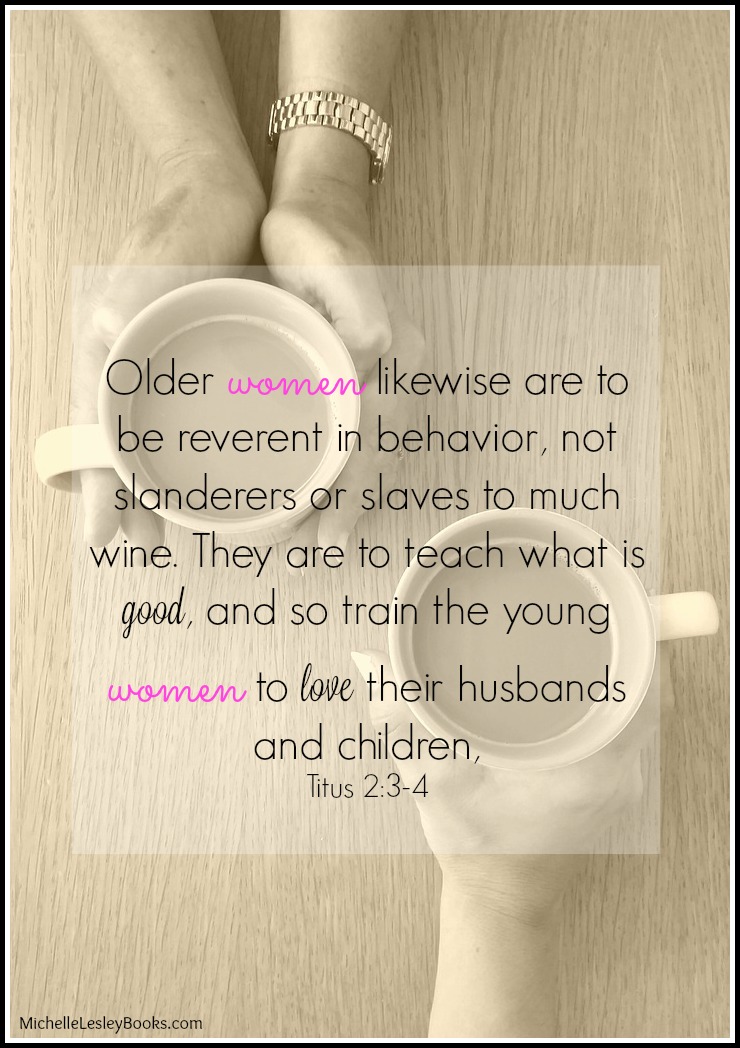
titus 2 3 4

Titus 2

But as for you, teach what accords with sound doctrine. Older men are to be sober-minded, dignified, self-controlled, sound in faith, in love, and in steadfastness. Older women likewise are to be reverent in behavior, not slanderers or slaves to much wine. They are to teach what is good, and so train the young women to love their husbands and children, to be self-controlled, pure, working at home, kind, andsubmissive to their own husbands, that the word of God may not be reviled. Likewise, urge the younger men to be self-controlled. Show yourself in all respects to be a model of good works, and in your teaching show integrity, dignity, and sound speech that cannot be condemned, so that an opponent may be put to shame, having nothing evil to say about us. Bondservants are to be submissive to their own masters in everything; they are to be well-pleasing, not argumentative, 10 not pilfering, but showing all good faith, so that in everything they may adorn the doctrine of God our Savior.

11 For the grace of God has appeared, bringing salvation for all people, 12 training us to renounce ungodliness and worldly passions, and to live self-controlled, upright, and godly lives in the present age, 13 waiting for our blessed hope, the appearing of the glory of our great God and Savior Jesus Christ, 14 who gave himself for us to redeem us from all lawlessness and to purify for himself a people for his own possession who are zealous for good works.

15 Declare these things; exhort and rebuke with all authority. Let no one disregard you.


The Holy Bible, English Standard Version Copyright © 2001 by Crossway Bibles, a publishing ministry of Good News Publishers.


Questions to Consider:

1. Who wrote the book of Titus? Who was the audience of the book of Titus? Which genre of biblical literature is Titus (history, poetry, epistle, etc.)? What is the theme of Titus? If you have a few minutes, read the whole book – all three chapters (the longest of which is 16 verses) – of Titus.

2. In verses 2-12 Paul addresses character attributes that certain people are to display. Who are the people, and what are the attributes he mentions for each? What are the similar or dissimilar attributes these people are to display? How does the word “likewise” (3,6) connect similar attributes?

O____ M__ (2):

O____ W____ (3):

Y____ W____ (4-5):

Y____ M__ (6):

T____ (“yourself”) (7-8):

B________ (9-10):

A__ P____ (11-12):

3. Verses 3-5 outline two very important roles for older and younger women in the church. What is the role of older women? Younger women? Examine the things older women are to teach and younger women are to learn. What are some practical ways you can carry out these instructions in your life and in the church as an older or younger woman?

4. How can we apply Paul’s instructions to “bondservants” (9-10) to our lives today? What can we learn from these verses about being a godly employee?

5. What do verses 5, 8, 10, and 14, tell us is the reason for believers to be people of godly character? What is the main idea of this chapter?