Celebrity Pastors, Discernment, False Teachers

Living Proof You Should Follow Beth (No) Moore

If you are considering commenting or sending me an e-mail objecting to the fact that I warn against false teachers, please click here and read this article first. Your objection is most likely answered here. I won’t be publishing comments or answering emails that are answered by this article.


This article is kept continuously updated as needed.


Discerning the False Teachers: Beth Moore Part 1 and Part 2 are episodes of the A Word Fitly Spoken podcast with Michelle Lesley and Amy Spreeman based on this article if you’d like to listen to an audio version.
Beth Moore is easily the world’s best known women’s Bible study author and teacher in the world. With her down home charm, endless energy, and stunning smile, she has captured the hearts of millions with her humor and storytelling style of teaching.

In forty years of ministry, Beth has written dozens of books. She also gives numerous Living Proof Live conferences every year and has a radio show and a television show on TBN, both called Living Proof with Beth Moore (canceled as of Dec. 2024).

Beth truly seems to care about her followers and her passion about the issues of sexual abuse and racism have endeared her to many inside and outside the church.

As beloved and likable as she is, it would be so much easier and more pleasant to jump on the Beth Bandwagon than to have to warn against her as a false teacher. But as Christians, no matter how much we love a certain teacher, our highest love and loyalty must always be to Christ and His Word first, which means we must reject anything – even a beloved teacher – that is at odds with Him and the Scriptures. Beth Moore’s teaching and behavior conflicts with Scripture in several ways. For these reasons it is my sad duty to recommend that you not follow Beth Moore or receive any teaching from her or anyone connected to Living Proof Ministries.

Beth Moore preaches to men

Sunday Morning Worship Service – 12/3/23 – Beth Moore | DukeChapel | December 3, 2023

(Screenshot)

Duke Chapel website: Sunday Service with Guest Preacher Beth Moore | Screenshot

TC Welcomes Beth Moore | Beth Moore | Transformation Church | August 14, 2022

(Screenshot)

Transformation Church website: TC Welcomes Beth Moore | Screenshot

There are dozens, if not hundreds, of videos on YouTube featuring Beth Moore’s preaching and Bible teaching which clearly show men in the audience. Beth Moore has, for quite a while, been teaching (screenshot) and preaching to men as well as women. First Timothy 2:12 clearly forbids this.

For those who would try to defend her by saying, “She can’t help it if men come to her conferences,” or “Co-ed conference preaching isn’t ‘in the church’ so it’s OK,” Beth not only preaches to men at conferences and other parachurch events, she is no stranger to preaching Sunday morning sermons to the entire congregation (including men) in churches (see links and videos above and the Additional Resources section at the end of this article). In addition to the videos above of two of her Sunday morning sermons, the screenshot below refers to Beth preaching the Mother’s Day Sunday morning service at the Tomball, Texas campus of her (now former) home church, Bayou City Fellowship, on May 12, 2019 (read more here).

(And to those who would attempt to defend the trend of women preaching the Sunday sermon on Mother’s Day, let’s be clear about something. The Bible doesn’t say women are prohibited from preaching except on Mother’s Day. Mother’s Day didn’t even exist when Scripture was written. Scripture makes the blanket statement that women are not to preach to, teach Scripture to, or exercise authority over men in the gathering of the Body. Period.)
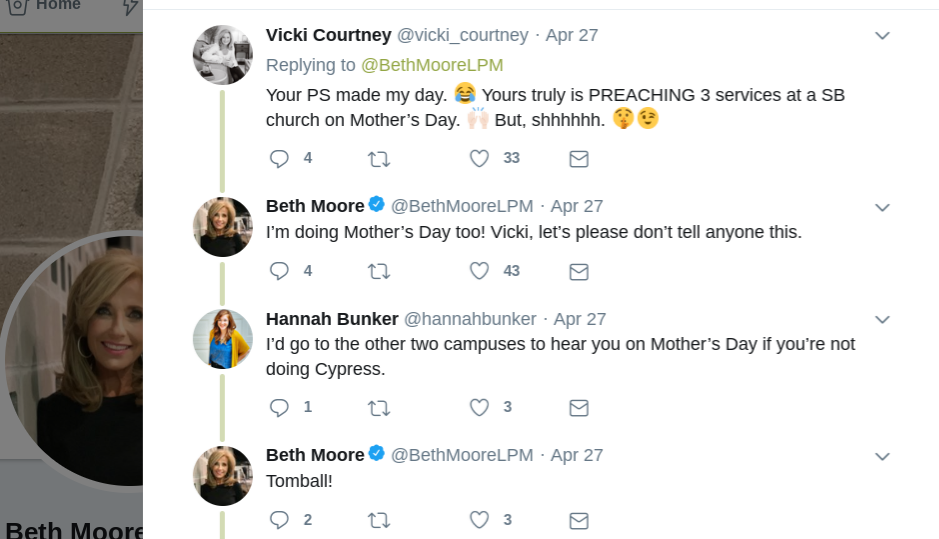
Here (in a continuation of the preaching on Mother’s Day kerfuffle), Beth admits to having preached in multiple Southern Baptist worship services over her 40 year career (she has also preached in many non-SBC churches) and seems to proudly defend her sin of doing so, while simultaneously boasting of her track record of obedience, by saying it “only” happened fifteen times.
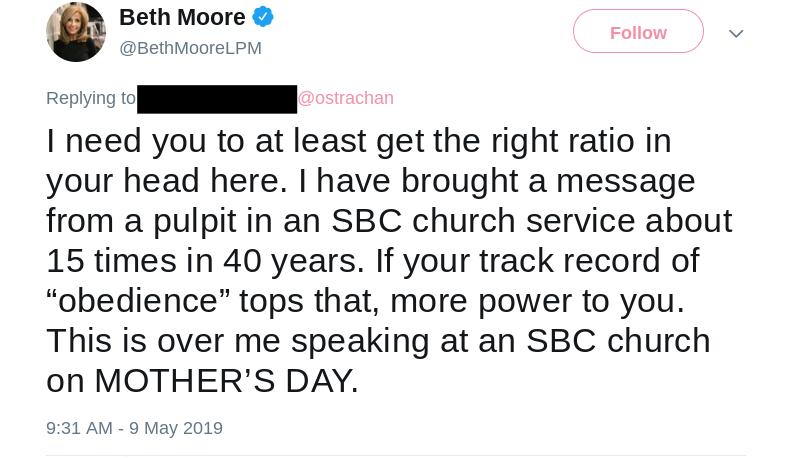
It’s a bit confusing. Is Beth saying preaching to men is a sin and we should be grateful she “only” did it fifteen times? If so, this is not how we handle sin. We do not boast like the Pharisee about how few times we have sinned and how obedient we are, we grieve over even one sin, repent, and cry out with the publican, “God be merciful to me, a sinner!”. Also if Beth is saying it’s a sin, why is she defending the fact on Thursday, May 9, that she is still planning to preach on Sunday, May 12? Why isn’t she instead confessing her plan to sin, humbly repenting, and announcing that she will not preach on Sunday?

If Beth is saying preaching to men is not a sin, why is she defending herself as only having done it fifteen times? Why didn’t she do it far more than only fifteen times over 40 years? Why not proudly enumerate all the times and places she has preached? Why have we not heretofore heard about these fifteen preaching events, as we hear about all her other speaking events, if it was OK for her to preach? Why didn’t she list the Mother’s Day event in question on her website alongside all her other speaking engagements? Why didn’t she talk it up on social media as she does with other speaking engagements? Why didn’t the church she’s speaking at excitedly advertise that she would be speaking as other venues do when she speaks?

Beth seems to know that preaching to men is a sin, but is trying to defend the fact that she does so.

Beth Moore partners with,
and is being influenced by, false teachers

Scripture is quite clear that we are to have nothing to do with false teachers, especially when it comes to ministry. But Beth has been surrounding herself with false teachers for decades.
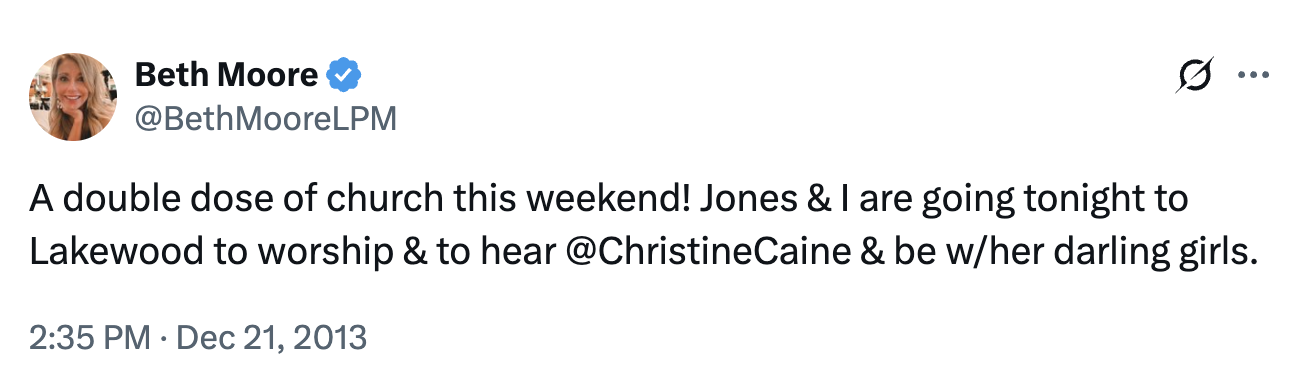
Beth Moore tweeted this in December 2013. “Lakewood” is prosperity preacher Joel Osteen’s church. Christine Caine also preaches to men (as she did at Lakewood that night) and originally hails from the leadership team of Word of Faith (prosperity gospel) church, Hillsong.

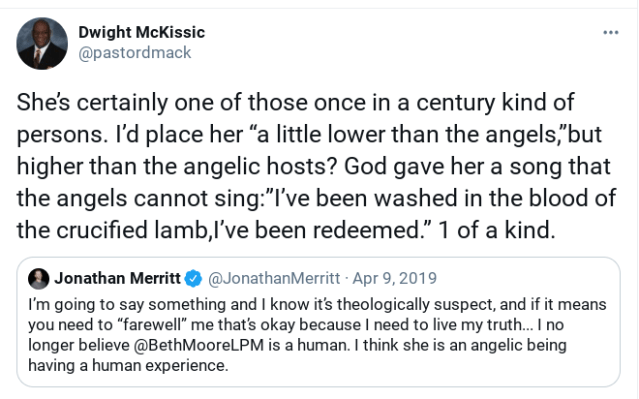
One need only peruse Beth’s Twitter feed to see other false teachers she allows herself to be influenced by: Matthew Vines, Rachel Held Evans, Christine Caine, Andy Stanley, and more (including Jen Hatmaker and Jonathan Merritt – see An Open Letter to Beth Moore below).
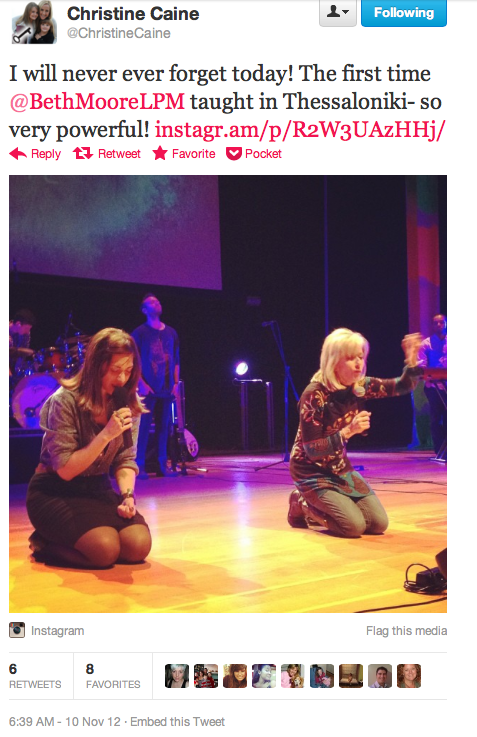
Screen Shot 2012-11-11 at 7.10.17 AM

Beth Moore at Hillsong Conference 2017 | Hillsong Teachings Now | March 9, 2018

(Screenshot) As you can see in the screenshot and in the video below, not only is Beth preaching at a Hillsong conference, it’s a co-ed conference, so she’s once again preaching to men.

At the 0:50 mark Beth says, “I’ve gotten to serve at three different ‘Colours’…”. She’s referring to Colour Conference, Hillsong’s annual women’s conference, which seems now to have been replaced by the co-ed Hillsong Conference at which she is preaching in the video above.

Beth Moore has been a featured speaker at Hillsong‘s Colour Conference for women several times (2012, 2014, 2015), and at the 2017 Hillsong Conference which is co-ed. Until scandals over recent years forced Hillsong to scale back its media empire, Beth even had her own page at the Hillsong church website and was featured multiple times on the Hillsong channel. She was also a featured speaker at the Be the Change conference with Christine Caine and Lisa Bevere in 2012.

In 2014, Beth began an ongoing partnership with Joyce Meyer, regularly appearing on her television show and serving as one of two main speakers (the other was Christine Caine) at Joyce’s 2016 women’s conference. See the “Additional Resources” section at the end of this article for other false teachers Beth joins with.

In 2015, Beth launched her own show on TBN, which is sometimes jokingly called the โ€œTotal Blasphemy Network,โ€ due to the fact that nearly all of their programs feature or are hosted by some of the worst of the worst false teachers, mostly those of the New Apostolic Reformation variety. (On December 11, 2024, Beth announced she was breaking with TBN and would henceforth be releasing content on her YouTube channel and Living Proof app.)

The pictures below were posted by former head โ€œpastorโ€ of Hillsong, Brian Houston, on his Facebook page on March 8, 2019 after he interviewed Beth for his TBN television show โ€œLetโ€™s Talk, with Brian Houstonโ€.

Brian Houston and Beth Moore
Laurie Crouch, Beth Moore, Matt Crouch (President of TBN),
Brian Houston, Victoria Osteen, Joel Osteen

On April 8, 2019, Beth appeared with Laurie Crouch (daughter-in-law of the late Paul and Jan Crouch) and Victoria Osteen on the TBN program, Praise.

Beth Moore, Victoria Osteen: Encouragement to Moms on Mother’s Day (Full Episode) | Praise on TBN | May 8, 2021

(Screenshot)

Beth Moore claims to receive direct,
personal, extra-biblical revelation from God
Beloved, I am convinced one of our severest needs is pure rest. Not only sleep, but refreshment and recreation. Recently God spoke to me about capturing what He and I are calling โ€œSabbath moments.โ€ Like many of yours, my schedule right now is particularly tough, and I see no time in the near future for a number of days off. God spoke to my heart one Saturday morning while I was preparing for Sunday school: โ€œMy child, in between more intense rests, I want to teach you to take Sabbath moments.โ€ I wasnโ€™t certain what He meant. Just that morning God confirmed His desire for me to drive all the way to the other side of Houston to the medical center to visit a patient with brain cancer. I was very thankful for the privilege of visiting this patient, but I knew in advance it would be tough emotionally and far from restful.
Excerpted from Beth Mooreโ€™s The Beloved Disciple

Aside from the fact that itโ€™s unbiblical in and of itself for Beth to claim that God is talking to her, God is not inventing new teachings besides the ones He has already given us in Scripture. And this โ€œSabbath momentsโ€ teaching is found nowhere in Scripture. Passages like 2 Timothy 3:16-17 and 2 Peter 1:3 explain that Scripture is sufficient to teach us everything we need pertaining to life and godliness.

Additionally, notice that Beth says โ€œI wasnโ€™t certain what He meant.โ€ When you have a few hours, go grab your Bible and look up every single passage about God actually speaking to somebody. Did any of them ever say, โ€œI wasnโ€™t certain what He meant.โ€? Absolutely not. When God speaks to someone, He is completely, perfectly clear about what His message means.
What God began to say to me about five years ago, and Iโ€™m telling you it sent me on such a trek with Him, that my head is still whirling over it.

He began to say to me, โ€Iโ€™m gonna tell you something right now, Beth; and boy, you write this one down. And you say it as often as I give you utterance to say it: โ€˜My Bride is paralyzed by unbelief. My Bride is paralyzed by unbelief.โ€™โ€ And He said, โ€œStartinโ€™ with you.โ€
Excerpted from Beth Mooreโ€™s โ€œBelieving Godโ€ video (below)

The infamous “hairbrush story” in which Beth claims God told her to go up to a stranger in the airport and brush his hair.

In her blog article It’s Hunting Season for Heretics, Beth defends herself against those calling her to repent of believing and teaching extra-biblical revelation with this comment, displaying either her confusion or ignorance about God’s Word and His authority:

“Nothing equates with the Scriptures: no word of knowledge, no prophetic message, no insight, no revelation, no dream, no vision. Nothing. That doesnโ€™t mean they canโ€™t be valid. The New Testament says they can. But they must never supplant or be placed on the same level with the Scriptures.”

This makes absolutely no sense whatsoever. First of all, where – in context and rightly handled – does the New Testament say this, as she claims? It can’t. All of the dreams, visions, prophecies, etc. in the Bible from God to His people became Scripture once they were written down, and we know that all Scripture is breathed out by God. Know what that means? God Himself equates all of these types of revelation with Scripture.

When God speaks, God speaks. He doesn’t speak authoritatively in Scripture and non-authoritatively or less authoritatively outside of Scripture. Doing so would make Him imperfect and, thus, not God. People who claim to receive “words of knowledge, prophetic messages, insights, revelations, dreams, and visions” claim that these extra-biblical revelations are God speaking to them. If this is true, and this really is God speaking, then His spoken word to them is “on the same level as Scripture”. (And I won’t even go into the instances in which these folks, including Beth Moore, have said God has told them something that conflicts with Scripture or that God told them something was going to happen and it didn’t. I guess God just gets it wrong sometimes?) If it is not true, and it really isn’t God speaking to them, then why are we listening to them and why are they saying that their own ideas and imaginings are God speaking to them?

These are just a few of the numerous examples of Beth Moore supposedly receiving personal, direct revelation from God. Pick up any of her books or watch any video of her teaching, and count how many times she says, “God told me…” or “God said…” or โ€œI thinkโ€ฆโ€ or โ€œI believeโ€ฆโ€ or bases her teaching on a personal experience, story, or what God supposedly spoke to her rather than teaching what Godโ€™s all-sufficient word clearly says.

Beth Moore refuses correction

Beth preaching (to men, once again) at the 2014 Awaken Now conference.

Scripture teaches that the wise humble themselves and receive biblical correction. But in this video, Beth Moore preemptively strikes out at anyone who sees and hears what she will soon be teaching or doing and finds it to be in conflict with Scripture. Do you notice she does not quote or read a single passage of Scripture to back up what she is saying? Notice how many times she says “I believe…” This is all based on her own subjective ideations.

Instead of taking a step back and honestly evaluating where she is wrong on the biblical issues she has been called to account for, Beth Moore frequently doubles down as in this blog post striking out against people calling her a heretic or a false teacher for “disagreement” or “getting something wrong.” My comment to her on this article was:

At the end of this same blog post, in response to comments like mine calling her to repent for her false doctrine, Beth later wrote an addendum, the gist of which was, “I’m still right and anybody who disagrees with me is wrong.” This just further illustrates her inability to accept correction and her tendency to double down when reproved.

Another example of Beth’s refusing to accept correction (technically, it wasn’t even correction, but a request for her to clarify her position on homosexuality) came during 2019’s “Open Letter to Beth Moore” debacle (*see below).

Beth Moore is heading toward
affirming homosexuality

In the summer of 2019, five women bloggers and Bible teachers and I, published An Open Letter to Beth Moore. It was subsequently signed by over 500 additional Christian women. The letter was merely a request for clarification of Beth’s views on homosexuality since she maintains public, adulatory friendships with well known homosexuality-affirming evangelicals such as Jen Hatmaker and Jonathan Merritt, and since she has been virtually silent on the issue of homosexuality in recent years while not hesitating to speak out on other heinous sins.

For two and a half weeks, *Beth ignored the letter, slandered the signers of the letter, and refused to make her position on homosexuality clear in any venue. It was then discovered that Beth had biblically addressed the sin of homosexuality in her book Praying God’s Word, but had later removed this section from the book because she felt she had “exceeded Scripture”. Finally, Beth wrote a blog post explaining why she had removed this passage and making a biblical statement on human sexuality, yet still not declaring homosexuality to be a sin. (You can read more about this series of events in my articles Questions about the Open Letter to Beth Moore and An Open Letter to Beth Moore โ€“ Timeline of Events.)

A few weeks after Beth’s blog post, on her LifeWay-sponsored TBN television show, in an episode entitled Staying Afloat on the Fellow Ship – Part 4, Beth admitted she had been looking into the arena of same sex attracted (SSA) Christianity
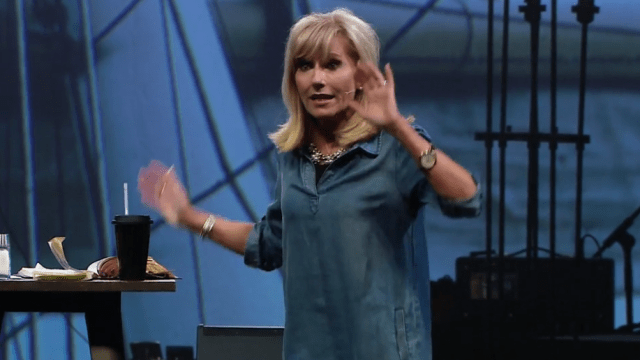
Though Beth’s words may not sound problematic to some, Elizabeth Prata explains in her article Listen carefully to what she is saying in this videoโ€ฆ, exactly why Beth’s remarks signal her trajectory toward acceptance of homosexuality:

In her latest lesson video on unity and fellowship, Moore used many phrases and code words that indicate her stance toward same sex attraction, homosexuality, and their attendant issues, is aligned with the aforementioned folks she was supposed to be ministering to in love by warning against these very things.

Moore makes it sound as if homosexuals are doing Jesus a favor by choosing celibacy. Homosexually attracted people are no different in their sin than…any other flavor of sexual sin…touting their โ€œtremendous sacrificeโ€ makes it seem as if they are.

I believe this video and Mooreโ€™s recent handling of the homosexuality issue means Moore seems to be readying herself to โ€˜come outโ€™ as it were, of affirming homosexuals in some way as believers.

Beth Moore is “going woke” and progressive

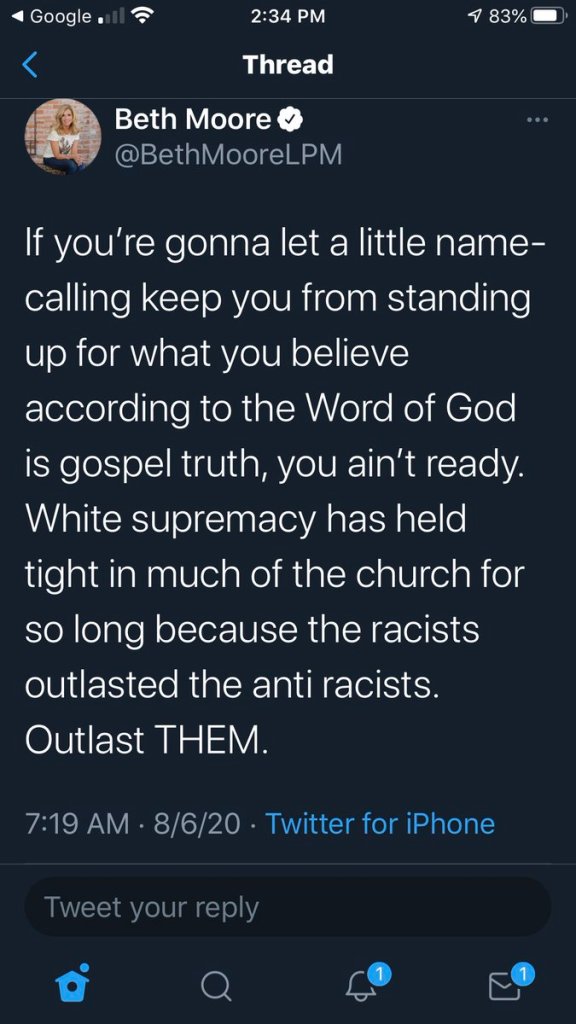
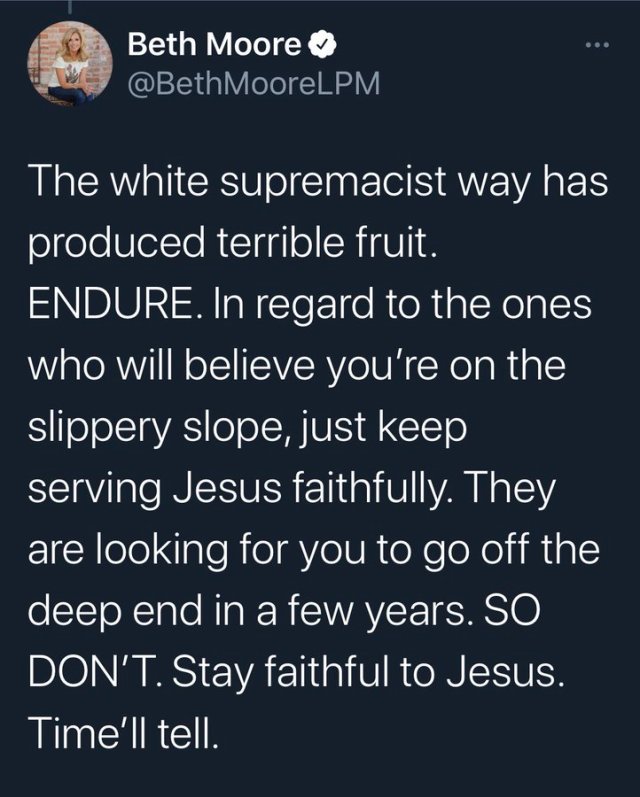
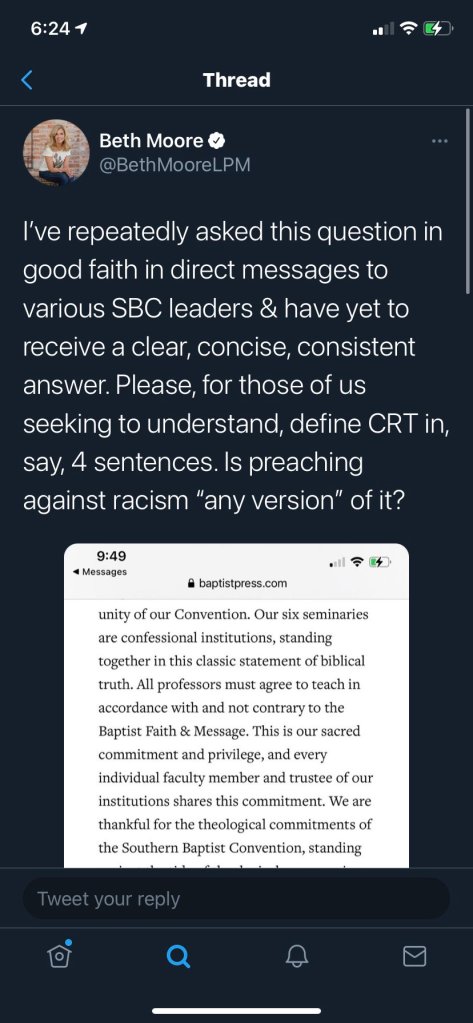
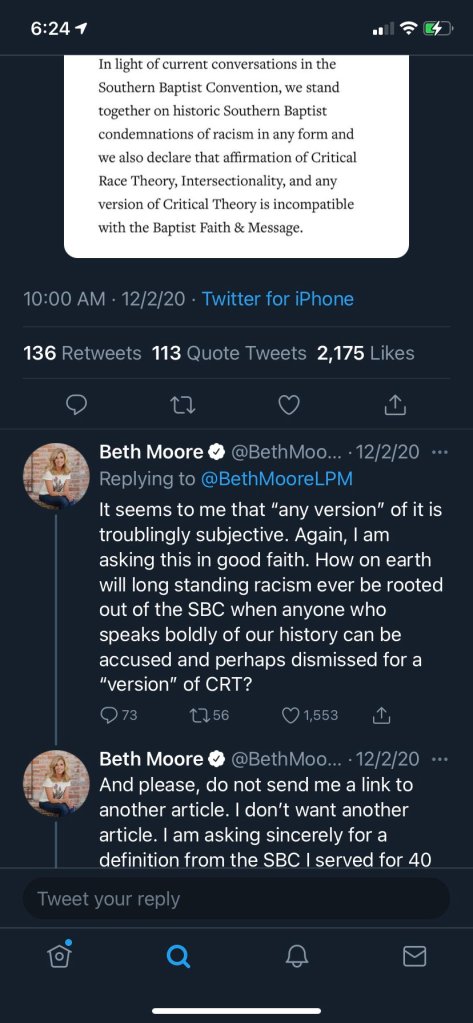
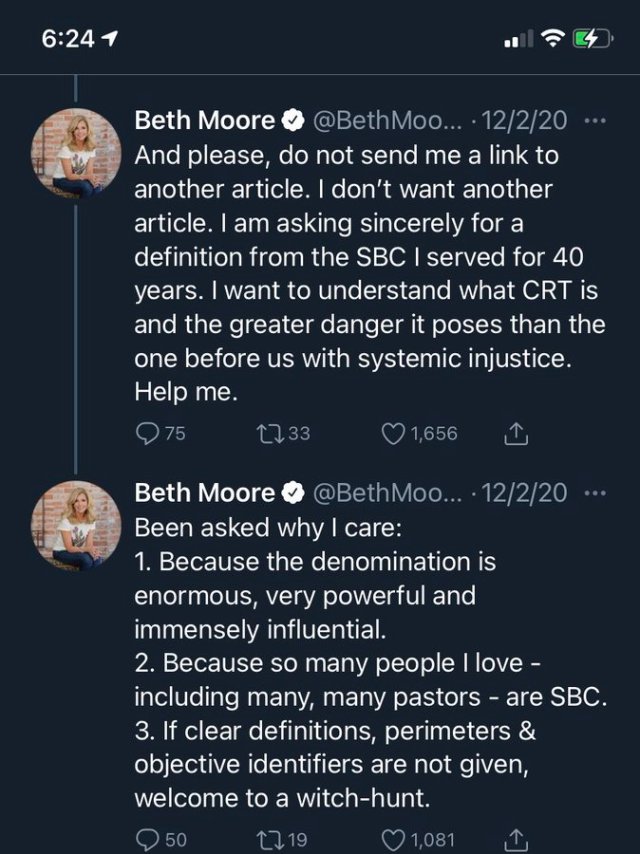
Itโ€™s difficult to give a precise definition for what โ€œwokeโ€ means, but generally speaking, itโ€™s basically what you see playing out in race relations in the U.S. right now: Critical Race Theory. White privilege. Reparations. Oppression. Repent of and renounce your whiteness. White peopleโ€™s racism is so deep seated weโ€™re not even conscious of it. White power, white privilege, and racism are inextricably embedded in politics, education, religion, economics- every single system in existence. It is a paradigm through which social justice issues are viewed and addressed, and โ€œwokeโ€ means youโ€™ve finally been โ€œawakenedโ€ to these supposed truths. In addition to racial issues many would also include more general social justice issues such as illegal immigration, poverty, etc., under the banner of โ€œwokenessโ€.

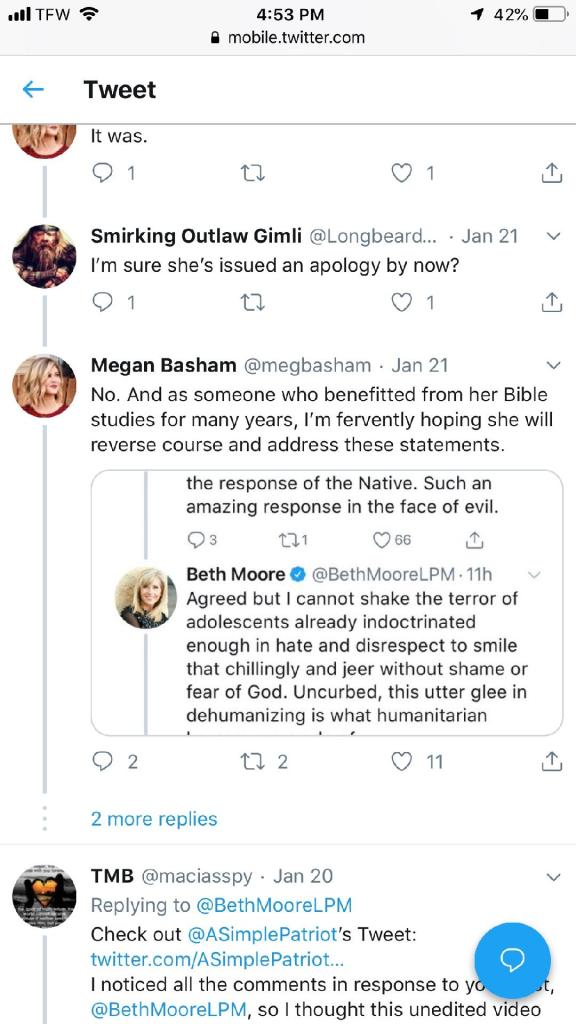
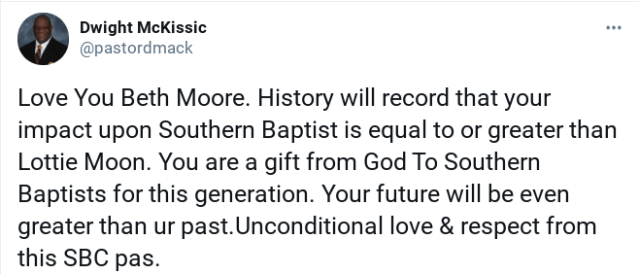
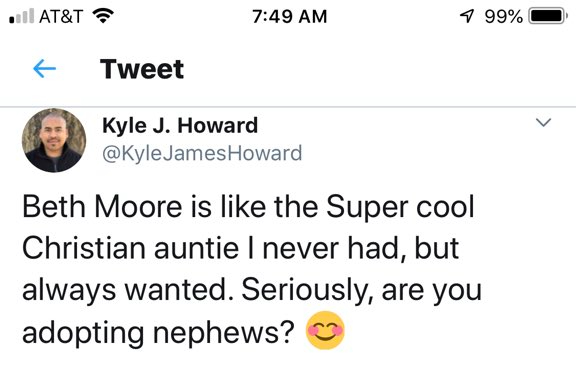
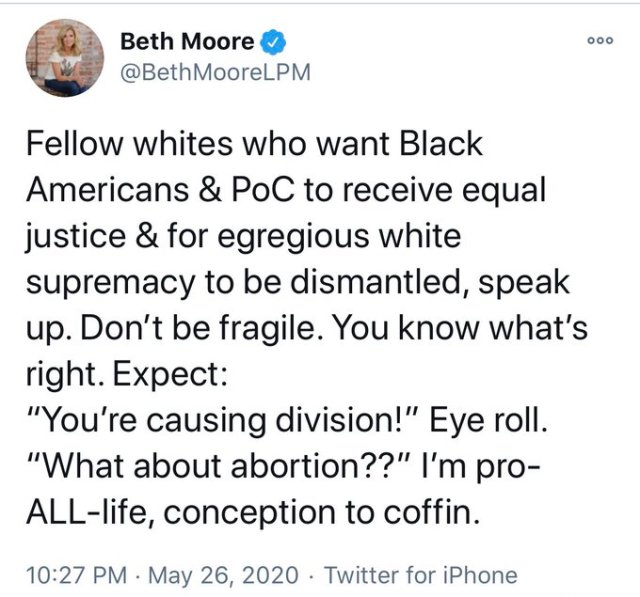
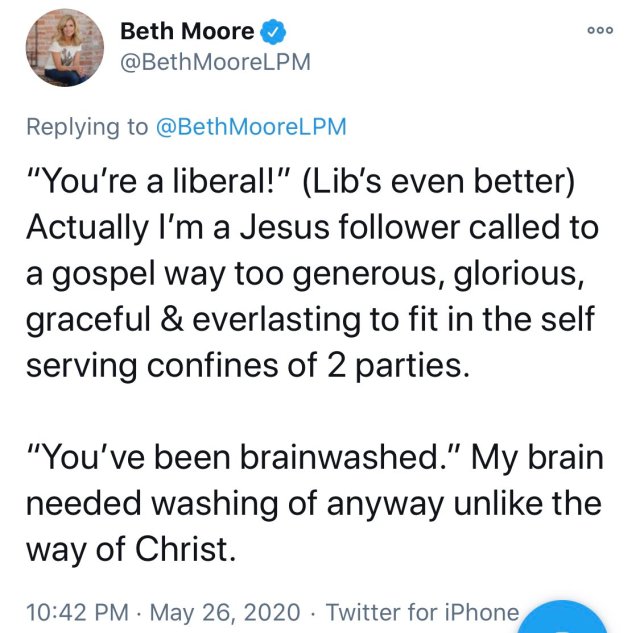
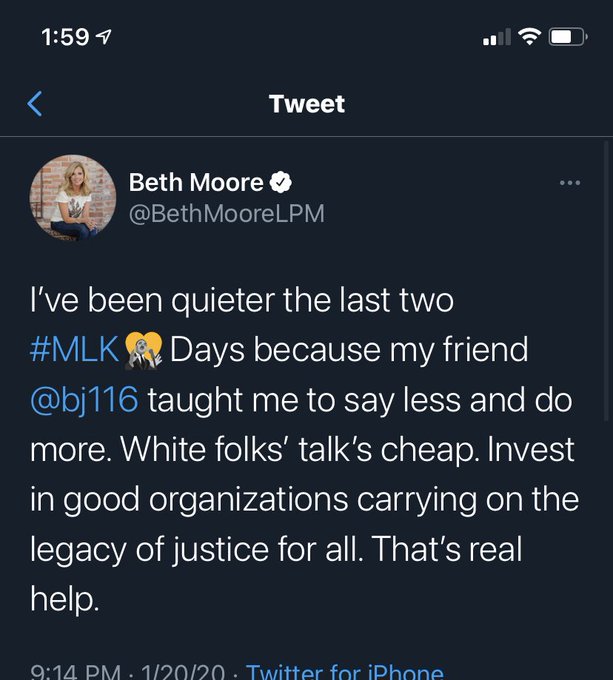
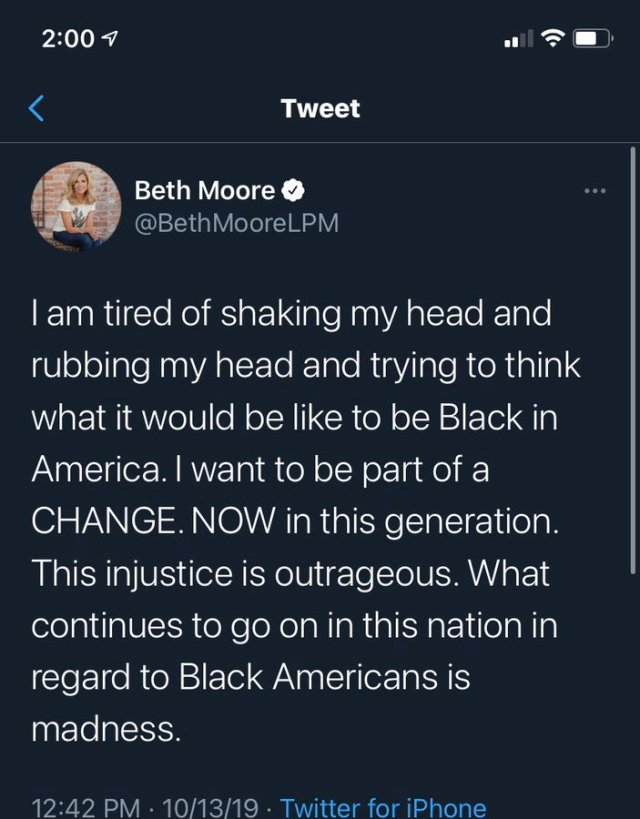
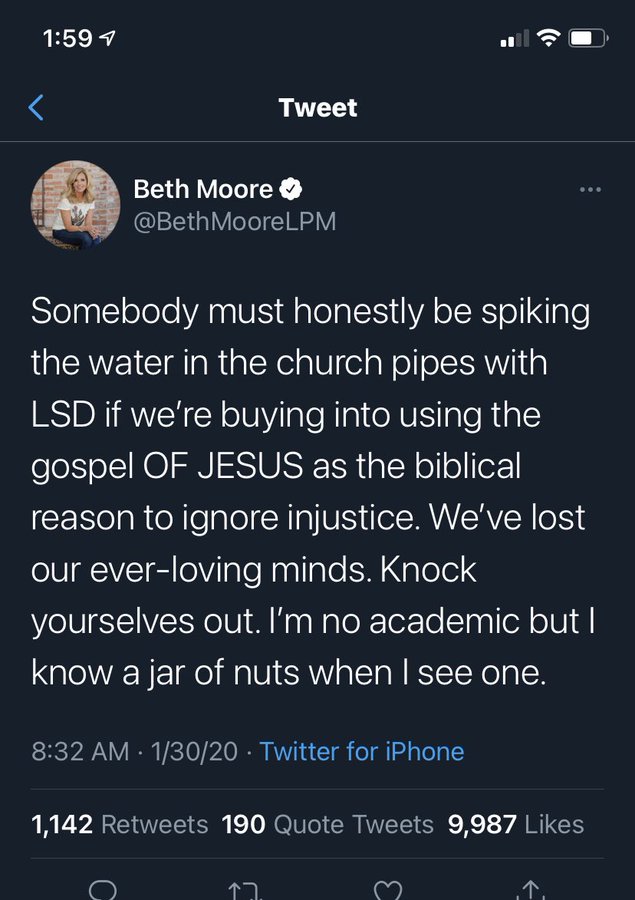
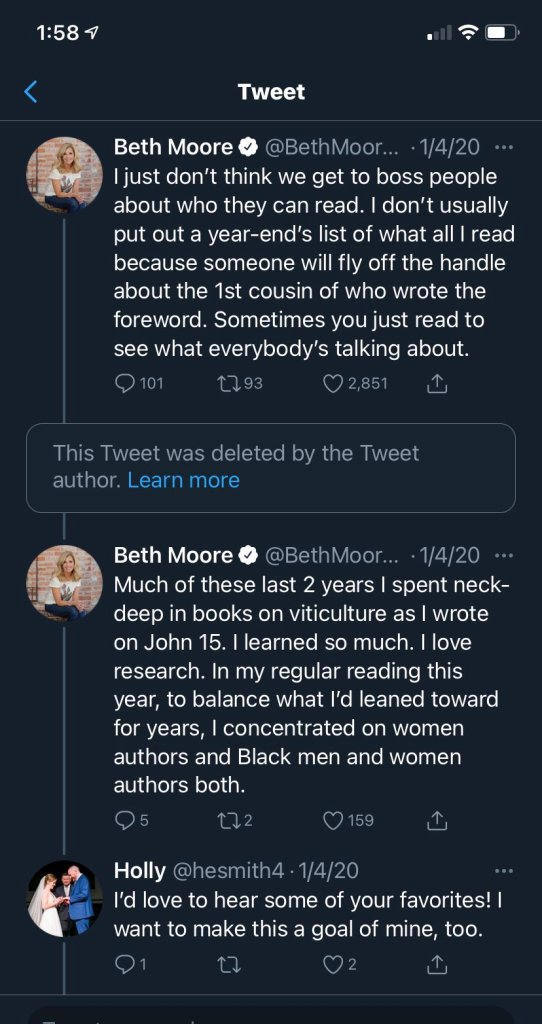
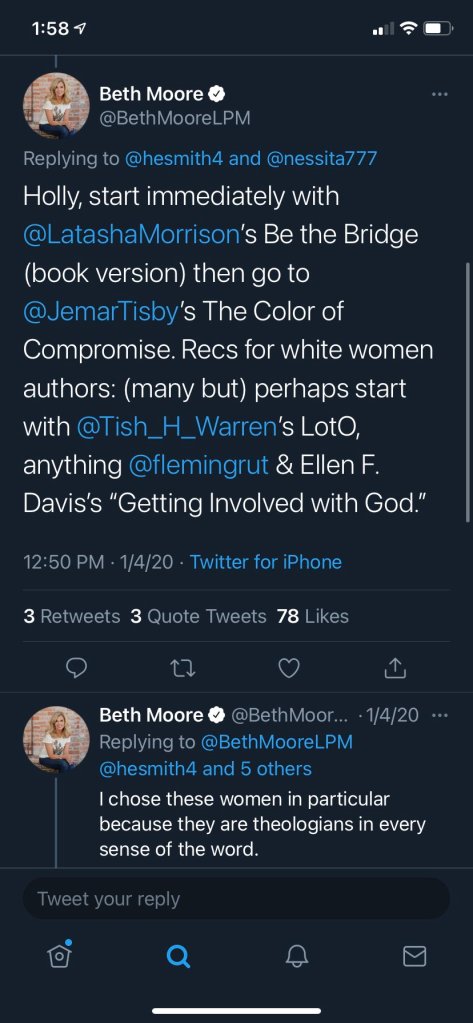
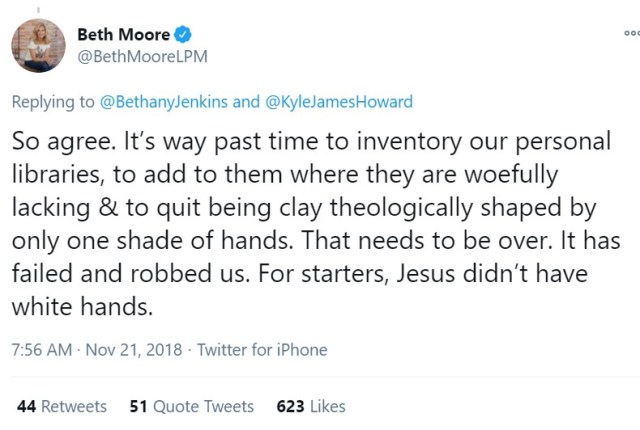
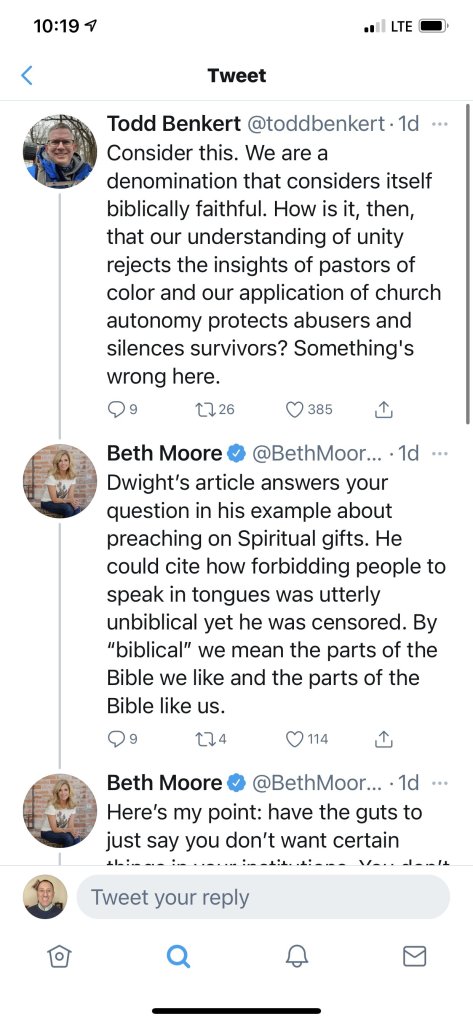
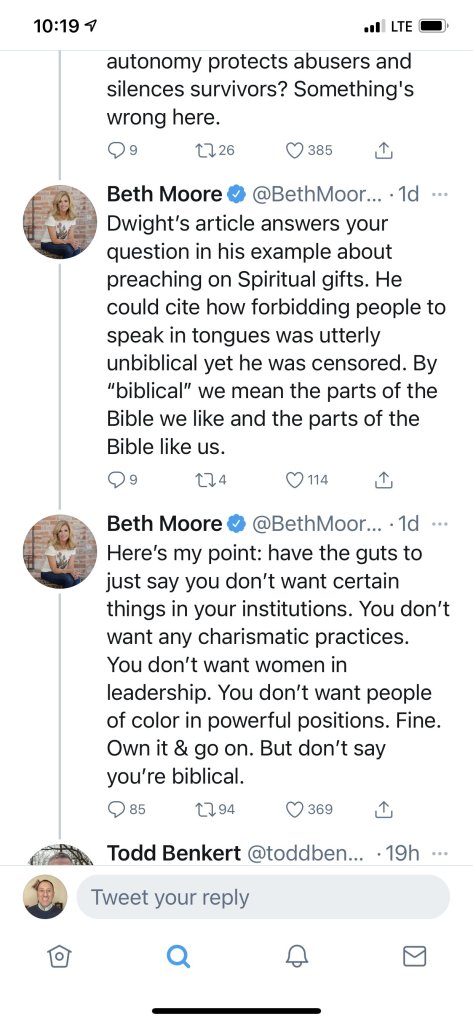
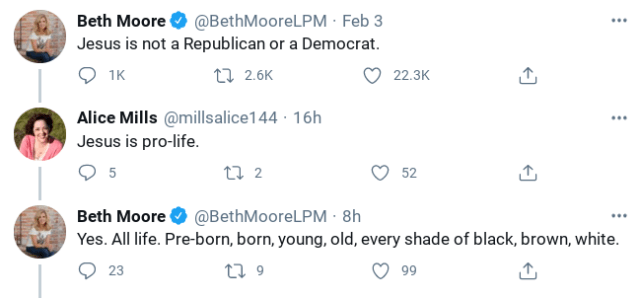
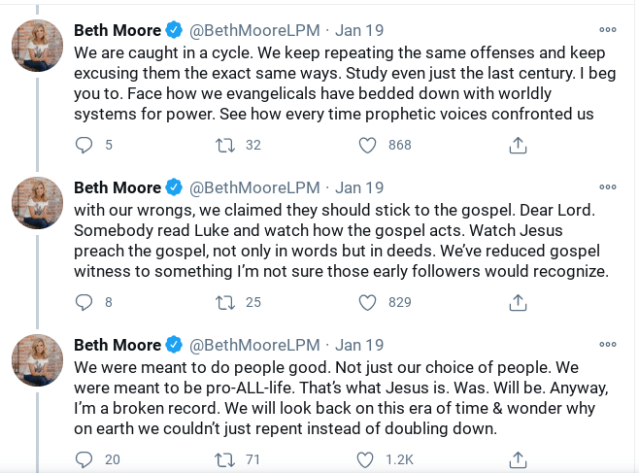
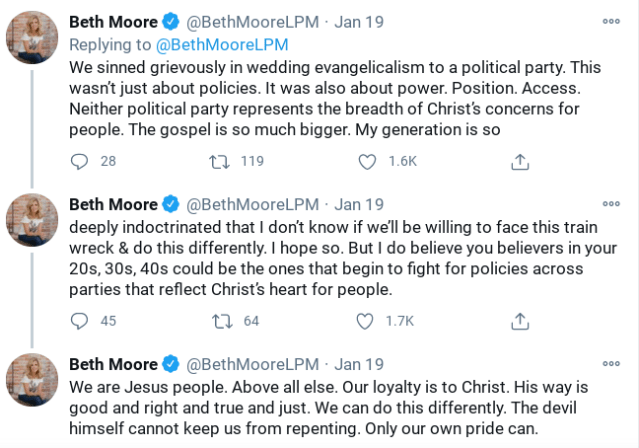
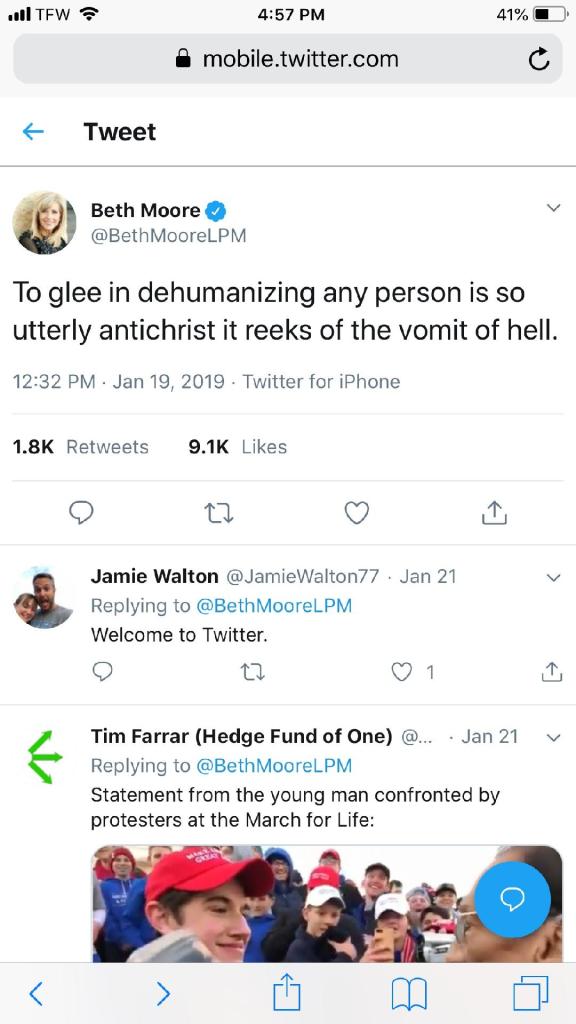
Over the past few years, Beth has been on more and more of a woke trajectory. Many of her tweets on Twitter indicate this, and she has not only befriended several who are leaders in the evangelical woke stream, she has also publicly praised them, recommended their books, and yoked with them in ministry, which is a violation of Scripture. Some of these include Jemar Tisby, Dwight McKissic, Charlie Dates (pastor of Progressive Baptist Church, where Beth has preached the Sunday sermon), โ€œracial trauma counselorโ€ Kyle J. Howard, and LaTasha Morrison, to name a few. Youโ€™ll also notice in the slideshow below that Beth now subscribes to the progressive โ€œpro-all of lifeโ€ version of โ€œpro-lifeโ€ โ€“ that in order to truly consider yourself โ€œpro-lifeโ€ you must also be pro-illegal immigration, pro-CRT, pro-intersectionality, and so on. In other words, you must be โ€œpro-โ€ anything and anyone liberals claim are being wronged or oppressed, regardless of whether or not it may be illegal or unbiblical.
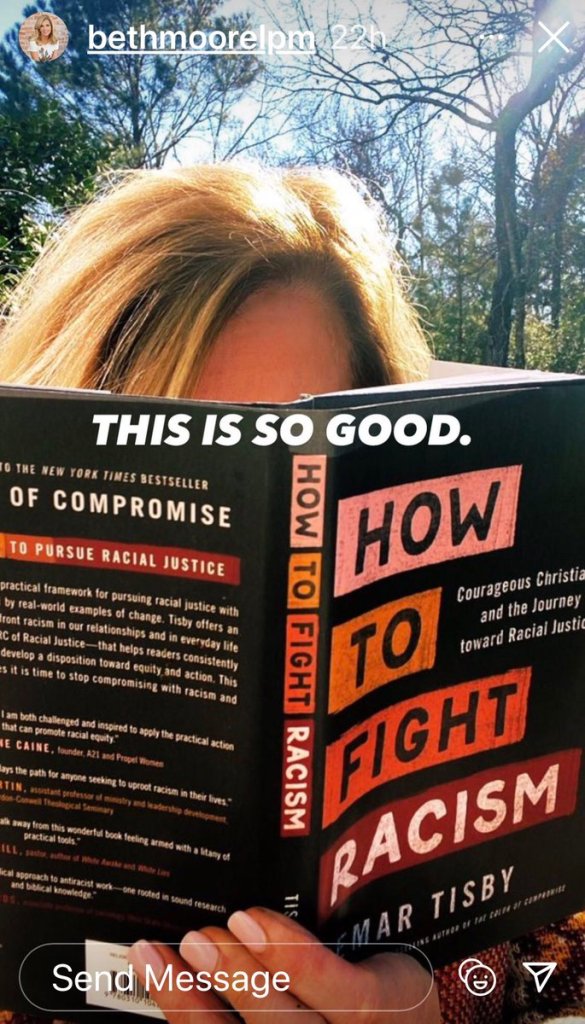
Here’s Beth’s black square on Instagram for “Black Out Tuesday”.

Link / Screenshot

Here, Beth recommends Jemar Tisbyโ€™s The Color of Compromise and LaTasha Morrisonโ€™s Be the Bridge. A couple of quotes from Morrisonโ€™s book:

โ€œWe wonโ€™t be agents of reconciliation until, like Ezra and Daniel, we take on the guilt and shame of our community and let it propel us toward confession.โ€ p. 78

โ€œJesus didnโ€™t just come to restore individual people; he came to break down systems of oppression, to provide a way for his kingdom to appear on earth as it is in heaven. He came so that we, his followers, could partner with him in restoring integrity and justice to broken systems, broken governments, and ultimately, broken relationships.โ€ p. 180-181

Link / Screenshot

Beth Moore uses intentionally and
purposefully deceptive language

Beth often craftily couches her statements about controversial issues in such a way as to give her plausible deniability if sheโ€™s ever called on something she needs to back out of. In other words, her statements are just vague or non-committal enough to convince her followers who want to believe sheโ€™s biblical into thinking sheโ€™s not saying what sheโ€™s actually saying. And at the same time if someone she’s accountable to says, โ€œThis statement contradicts Scripture,โ€ she has enough wiggle room to say โ€œThatโ€™s not what I meant. I meant something else.โ€ A couple of the things I’ve mentioned in previous sections above are very good examples of this.

Let’s revisit the Motherโ€™s Day 2019 preaching incident. Take a look at the conversation again:
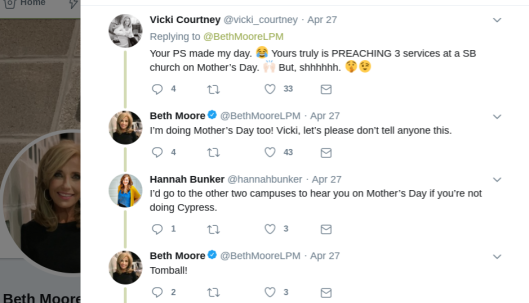
Instead of coming right out and clearly announcing โ€œIโ€™m preaching the Sunday morning sermon at my church,โ€ Bethโ€™s response to Vicki was, โ€œIโ€™m doing Motherโ€™s Day too!โ€. Several people in that tweet thread asked her if that meant she was preaching the sermon, and she ignored them. 

That leaves reasonable doubt for Bethโ€™s fans who actually understand that women preaching is wrong to think, โ€œWell maybe she just means sheโ€™s giving her personal testimony or saying a few words of welcome and sheโ€™s not actually preaching the sermon.โ€ Whereas people who know Bethโ€™s history of preaching to men would know she means that sheโ€™s preaching the Sunday sermon. Do you see what I mean about this example of deceptive language? Sheโ€™s announcing sheโ€™s preaching but wording it in such a way that people can choose to believe sheโ€™s not.

Another example of Beth’s “wiggle room wording” is the final response she gave in the Open Letter to Beth Moore discussed above. Hereโ€™s what she said in her blog post that was supposed to put an end to the questions and definitively state her position:

I hold firmly to a traditional Christian sexual ethic and continue to believe the Bible sets apart marriage as a covenant between a man and a woman. But I also believe that Scripture clearly teaches that all sex outside of marriage is contrary to Godโ€˜s will.

It’s not a bad statement on sexuality in general, and Beth’s followers who are undiscerning or don’t know their Bibles well probably thought it clearly said she thinks homosexuality is a sin. Which is exactly what she wants them to believe she said. But it doesnโ€™t say that. 

She still does not plainly say, โ€œHomosexuality is a sin that must be repented of.โ€ She didnโ€™t even use the word โ€œhomosexualityโ€ or other synonymous terms in this statement. And thereโ€™s still enough wiggle room in this statement that it leaves the door open for her, in the future, to validate homosexual orientation, identification, lust, or anything short of sexual acts or homosexual “marriage”.

She also added a Bible verse to back up this statement, Galatains 5:19-20:

Now the works of the flesh are evident: sexual immorality, impurity, sensuality, idolatry, sorcery, enmity, strife, jealousy, fits of anger, rivalries, dissensions, divisions, envy, drunkenness, orgies, and things like these. I warn you, as I warned you before, that those who do such things will not inherit the kingdom of God.

Again, to the average, church going Beth Moore follower who thinks sheโ€™s perfectly biblical, this sounds like Beth is pointing to the Bible and saying homosexuality is a sin. And thatโ€™s what she wants those people to think sheโ€™s saying. But she doesnโ€™t want her homosexual followers to think sheโ€™s saying that. 

Thatโ€™s why Beth intentionally chose a verse that does not use any form of the word โ€œhomosexuality,โ€ even though she is undoubtedly familiar with the ones that do, for example 1 Corinthians 6:9-10.

For those of us who are familiar with Galatians 5:19 and the Greek behind it, we already know that โ€œsexual immoralityโ€ covers all sexual activity outside the monogamous heterosexual marriage bed, which does include homosexuality. Therefore, many of Bethโ€™s followers from a conservative church background will take her quotation of this passage in Galatians 5 to mean, โ€œYes, I agree with the Bible that homosexuality is a sin.โ€

However, Beth also has many homosexual and homosexual affirming followers*, many of whom likely subscribe to the โ€œgay Christianโ€ movementโ€™s idea that the verses in the Bible that condemn homosexuality are only speaking of homosexual temple prostitution and assorted other perversions, not loving, faithful, monogamous homosexual โ€œmarriagesโ€ or relationships.

*Take some time and let that sink in. How many doctrinally sound pastors, churches, and high profile Christians who clearly teach that homosexuality is a sin have homosexual and affirming followers or members? Go to the end of this article and note just how many homosexual and affirming followers Beth has and ask yourself why that is.

People who believe all of these errant ideas about homosexuality are not going to to see the term โ€œsexual immoralityโ€ as applying to supposedly faithful homosexual relationships, so they will see Bethโ€™s remarks as saying that she considers โ€œsexual immoralityโ€ a sin, but not that that term includes supposedly โ€œmoralโ€ homosexual relationships.

This use of language is intentionally and purposefully deceptive. Itโ€™s not an accident. Itโ€™s not being loving and kind. Itโ€™s speaking with the forked tongue of the devil. If that sounds harsh to you, I would encourage you to get out your Bible and consider how Satan craftily uses language in the Garden with Eve or when heโ€™s tempting Jesus. Then compare Satan’s shrewd use of language to Beth’s. Sheโ€™s being deceptive because sheโ€™s trying to keep all of her followers happy – the average evangelical woman whoโ€™s at church every Sunday and at the womenโ€™s Beth Moore Bible study class every Tuesday and the โ€œgay Christiansโ€ and those who affirm them. 

Christians are truth speakers. We speak the truth lovingly and kindly, but we speak it directly and clearly. We let our yes be yes and our no be no. We donโ€™t use language like itโ€™s an abstract painting that can mean whatever the person taking it in wants it to mean.

A final note that’s semi-related to Beth’s deceptive use of language: Many of Beth’s unbiblical statements, positions, behavior, attacks on others, etc., as you may have noticed from the links above, take place on Twitter, and occasionally, Instagram. If you only read Beth’s books, attend her conferences, watch her videos, or follow her on Facebook, you most likely aren’t going to see these kinds of things.

That, too, is purposeful and intentional. She is playing to her demographics. As many with online ministries have discovered, older, more conservative evangelicals generally tend to use Facebook. Younger, more progressive evangelicals generally tend to use Twitter, Instagram, and other more “cutting edge” social media platforms. Beth isn’t going to take a chance on offending the middle-aged and older women who follow her on Facebook (or aren’t on social media at all and only know her through her books and conferences), but she can get away with her more progressive comments on other platforms.

Beth Moore’s ministry produces rotten fruit

Beware of false prophets, who come to you in sheep’s clothing but inwardly are ravenous wolves. You will recognize them by their fruits. Are grapes gathered from thornbushes, or figs from thistles? So, every healthy tree bears good fruit, but the diseased tree bears bad fruit. A healthy tree cannot bear bad fruit, nor can a diseased tree bear good fruit. Every tree that does not bear good fruit is cut down and thrown into the fire. Thus you will recognize them by their fruits.
Matthew 7:15-20

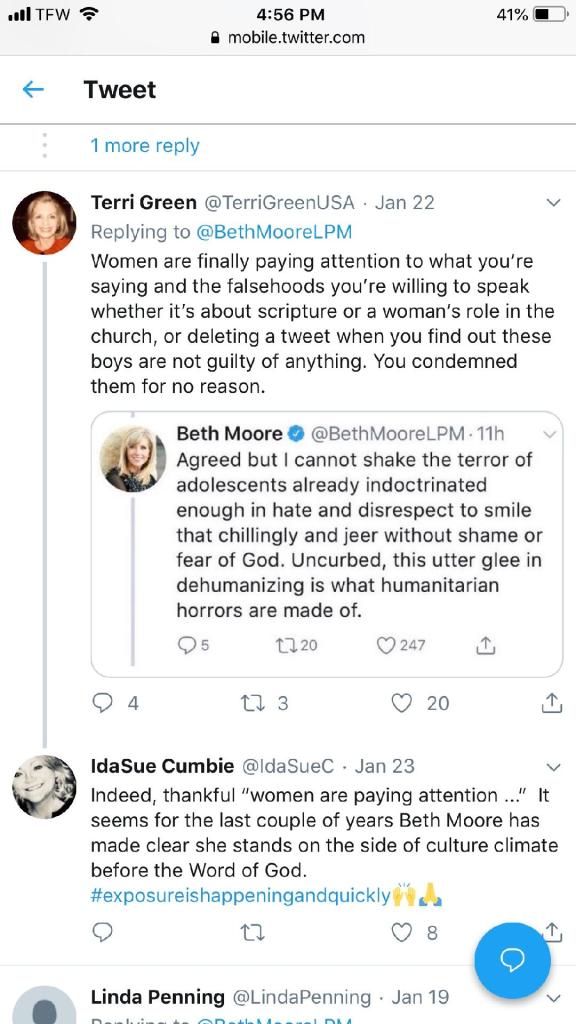
Beth’s followers and supporters are the fruit of her ministry. Are they good fruit or bad fruit? Is she a healthy tree or a diseased tree? Would a godly, doctrinally sound teacher have multiple followers who are homosexuals and homosexuality-affirming? Who rebel against the Bible’s teaching on gender roles? Who blithely blaspheme, spew profanity, and threaten Believers who object to Beth’s sins and false teaching? Who slander and make false accusations against Believers, and display every opposite of the Fruit of the Spirit?

Scroll down to the end of the “Saturday, July 6” section of An Open Letter to Beth Moore โ€“ Timeline of Events for comments from Beth’s homosexual and homosexuality-affirming followers, and examine Beth’s X (Twitter) threads for more examples of ungodly comments from her followers.


Additional Resources:

My articles and resources:

Beth Moore’s wild unbiblical teachings: Michelle Lesley interview on Doreen Virtue’s Videocast

After Thought Podcast Guest Appearance Part 1, Part 2: The Open Letter to Beth Moore

The Rapp Report Podcast Guest Appearance: The Open Letter to Beth Moore and Complementarianism

Theology. Driven. Podcast Guest Appearance: Beth Moore, the SBC, and Christian Women

The Mailbag: What did you think of Beth Mooreโ€™s โ€œA Letter to My Brothersโ€?

The Mother of All Rebellions: Having a Woman Preach on Mother’s Day


Articles and resources from others:

Disclaimer: The specific links below are provided and endorsed as evidence pertaining to this article only. I do not endorse any of these sites in so far as any of them might deviate from Scripture or conflict with my beliefs as outlined in the โ€œWelcomeโ€ or โ€œStatement of Faithโ€ tabs at the top of this page.

Overviews/Series – Multiple Theological Problems with Beth Moore:

Critiques of Beth Moore (long version) by Elizabeth Prata

Critiques of Beth Moore (newest) by Elizabeth Prata

Articles on Beth Moore by Elizabeth Prata

Why Beth Moore Does Not Teach in Our Church by Pastor Tedd Mathis

An Interview with Susan Heck on Beth Moore at Justin Peters Ministries

The Beth Moore Cornucopia of False Doctrine, Mysticism, and Impassioned Frenzy by Steven Kozar

Beth Moore at Fighting for the Faith podcast archives

Beth Moore at Fighting for the Faith YouTube channel

The Fundamental Problem of Beth Moore at Voice of Reason Radio

Preaching to Men:

Beth preaches the Sunday morning sermon at Transformation Church, June 2019 (see Chris Rosebrough’s brief critique of this sermon here)

Beth Moore vs. Owen Strahan at WWUTT Podcast
(Related links):
โ€ขMichelle Lesley’s Twitter thread on Beth’s Sunday sermon preaching
โ€ขBeth Moore’s Twitter response to Midwestern Seminary professor Owen
Strahan’s article on biblical complementarianism

โ€ขThe Mother of All Rebellions: Having a Woman Preach on Mother’s Day

Beth Moore Goes off Like a Bottle Rocket by Gabe Hughes

How Beth Moore Is Calling Down Pentecostal Fire at Charisma (Please note, this is an article praising Beth for doing unbiblical things and is provided only for evidence of such. Charisma promotes all sorts of false doctrine, and I definitely do not recommend or endorse it.)

Beth Moore preaches the Sunday sermon at Bayou City Fellowship Church: Mother’s Day 2016 (As with many other online evidences confirming Beth’s various sins, this has been deleted, but Beth confirmed in her own blog post, Just Something Silly I Wrote On Behalf of Moms on May 9, 2016 (Mother’s Day was May 8 that year) that she preached the Sunday sermon.)

Beth Moore preaches the Sunday sermon at Louie Giglio’s Passion City Church

Partnering with False Teachers

(If you aren’t sure why the teachers I’ve mentioned below, or in the body of the article are false teachers, I’ve written articles like this one on many of them. Click the Popular False Teachers & Unbiblical Trends tab in the blue menu bar at the top of this page.)

Andy Stanley Weighs in on Beth Moore at Wretched

Beth with Priscilla Shirer on Instagram (It would be impossible to document the hundreds of times Beth and Priscilla have done conferences together, endorsed one another’s books and materials, spent time together as friends, etc. As Beth says in the caption below: “That woman in that picture with me is one of the dearest people on this earth to me. I mean it. Weโ€™ve been in one anotherโ€™s lives almost 20 years now. She occupies a spot in my heart all to herself.”)

(Screenshot)

Beth Moore, Christine Caine march around Dallas hospital in prayer during Priscilla Shirer surgery at The Christian Post

Beth Moore, Priscilla Shirer, Lisa Harper at Living Proof Ministries with Beth Moore

Beth Moore and Jennie Allen / IF: Gathering

Beth speaks at Christine Caine’s Propel conference

Beth platforms Jackie Hill Perry at her Living Proof Live event

Beth on Jen Hatmaker’s podcast (twice)

Beth on Chrystal Evans Hurst’s podcast

Rick Warren, Beth Moore, and Kay Warren Discuss Why Churches Must Address Sexual Abuse at Kay Warren’s blog

Unbiblical Teaching and Misuse of Scripture/Book Reviews

A Typical Beth Moore Study by Gabriel Hughes

Videos on Beth Moore at Fighting for the Faith

Beth Moore โ€“ False Teacher at The King’s Dale

“Breaking Free” from Beth Moore and Her “Try Hard” Theology by Lisa Nunley at Sola Sisters (This blog is now defunct. I no longer recommend the current Sola Sisters “ministry”, found primarily on social media.)

Theology…More or Less With Beth by Sarah Flashing at Midwest Christian Outreach

Biblical reviews of Beth Moore simulcasts and other materials by Chapter 3 Ministries

Why We (Still) Warn Against Beth Moore at Things Above Us

Beth Moore Is Using Marxist, Feminist, Social Justice Talking Points Instead of Scripture at The Western Journal

Book Reviews:

So Long, Insecurity: Youโ€™ve Been a Bad Friend to Us by Beth Moore at The King’s Dale

Breaking Free: Discover the Victory of Total Surrender at The King’s Dale

Beth Moore’s “Breaking Free” at The Watchman’s Bagpipes

Jesus the One and Only at The King’s Dale

Praying Godโ€™s Word: Breaking Free from Spiritual Strongholds at The King’s Dale

Beth Moore- A review of โ€œStepping Upโ€ at …Say What?

Old Testament, Sunday School

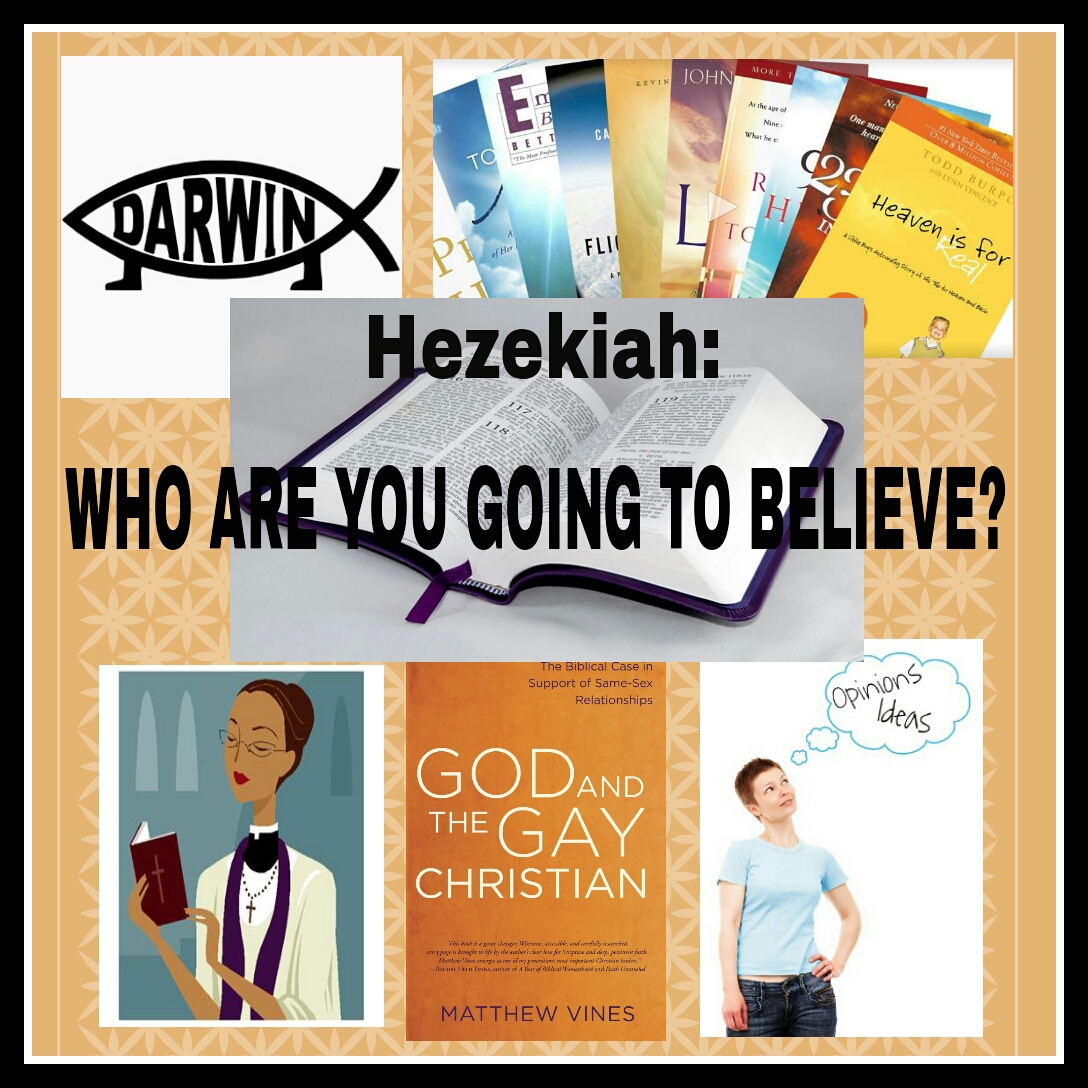
Hezekiah: Who Are You Going to Believe? ~ Sunday School Lesson ~ 8-3-14


Hezekiah
Photos courtesy of: Stickerish.com, WUTT on YouTube.com, and Amazon.com

These are my notes from my ladiesโ€™ Sunday School class this morning. Iโ€™ll be posting the notes from my class here each week. Click here for last week’s lesson.

Through the Bible in 2014 ~ Week 31 ~ July 27- Aug. 2
Isaiah 44-66, 2 Kings 18:9-21:26, Psalm 46, 80, 135
Hezekiah: Who Are You Going to Believe?

2 Kings 18:1-8
This first part of the chapter sets the stage for everything we subsequently learn about and from Hezekiah. Even though he had a despicable, idolatrous example for a father (King Ahaz), Hezekiah somehow turned out to be a godly man and king. Could it have been the way his mother raised and taught him? Possibly. (The Zechariah mentioned in v. 2, is not the prophet in the book of the same name.) It could also have been one of the priests or Levites brought in to train him as part of his childhood education. Scripture doesn’t tell us specifically, but we should never discount the importance of a godly mother or teachers, and we should strive to take hold of every opportunity we have to impact children’s lives for Christ.

At any rate, Hezekiah was off to a good start. Notice that this passage talks much more about Hezekiah’s relationship with the Lord than his actions for the Lord. It says, “he did what was right in the eyes of the Lord” (3), “he trusted in the Lord,” (5). He held fast to the Lord, did not depart from the Lord, and kept the Lord’s commandments (6). “And the Lord was with him.” (7)

His actions followed his faith: he tore down idol worship paraphernalia, rebelled against the king of Assyria, and struck down the Philistines.

9-12
This passage continues to set the stage by reminding us that during the first few years of Hezekiah’s reign in Judah, the king of Assyria captured Samaria (capital of Israel) and carried Israel away to Assyria because they had rebelled against God.

13-16 (2 Chronicles 20:12)
Sennacherib (king of Assyria after Shalmaneser, who had captured Israel) wasn’t wild about Hezkiah rebelling against him, so he attacked Judah and captured all the stronghold cities except Jerusalem (the capital), which was next on the hit list.

What was godly, faithful Hezekiah’s response. Did he pray? Seek out Isaiah or another prophet or priest for godly counsel? No. Here, Hezekiah showed us an example of what we are not to do. Before, we read that Hezekiah did what was right in God’s eyes. Here, he simply reacted to his circumstances in the way that was right in his own eyes, the way that was most expedient and practical. It was exactly what his father and others before him had done when they became vassals of Assyria or other kings. Instead of following in their footsteps, he would have done better to pray as his predecessor Jehoshaphat did:

“O our God, will you not execute judgment on them? For we are powerless against this great horde that is coming against us. We do not know what to do, but our eyes are on you.โ€ (2 Chron.)

What determines our response?
When we face an impossible situation like Hezekiah did, we have two options: we can let our circumstances dictate our response, or we can let God’s word dictate our response. Hezekiah didn’t consult God’s word. So, since he didn’t know what God would have him do in this situation, his only remaining option was to let circumstances dictate his response.

17- 37 (Isaiah 30:7, 10:5-6)
What happened? The 11 tons of silver and 1 ton of gold that Hezekiah sent Sennacherib, king of Assyria weren’t good enough for him. So Senaccherib sent his goon squad over to make Judah an offer it couldn’t refuse.

The Rabshakeh (commander) did his best to demoralize and talk Hezekiah’s men into surrendering. Notice that he didn’t really have to lie to them very much. Much of what he said was actually true:

Egypt was weak and would be of no help in fighting off Assyria (21,24). In fact, Isaiah had already told them this (Is. 30).

Even if Assyria herself supplied Judah with horses for battle, Judah was still too weak to defeat even the weakest of Assyria’s troops, so Egypt certainly wouldn’t be of any help. (23-24)

Whether the Rabshakeh knew it, or was just boasting and stumbled on the truth, Assyria was to be God’s arm of wrath against his people (25). Judah knew this because Isaiah had already told them (Is. 10)

From man’s point of view, and in his own flesh, Hezekiah would lose this battle and the people would be carried off to captivity in Assyria (29-32).

The false gods of the other nations had not been able to save them from Assyria (33-35).

But the truth was mixed with falsehood and fallible human wisdom:

The Rabshakeh didn’t know that the places of idol worship that Hezekiah had torn down were to false gods, not the true God. (22)

God might have been against Judah, but he wasn’t with Assyria (25).

The Lord is trustworthy and able to defeat any enemy (30, 32b, 35).

Hezekiah’s officials delivered the message to him. Would he believe the Rabshakeh? Would he react the way he did last time?

19:1-7
Hooray for Hezekiah! This time, he responded the right way. The first thing he did was to grieve before God and head to His house to pray (1). The second thing he did was to send his staff to Isaiah to seek God’s word. (2-4).

And what was God’s word? Do not be afraid; this dude’s going down. (6-7)

8-13
The Rabshakeh left and went back home only to find Sennacherib fighting with one kingdom and under impending attack from another. So, just to let Hezekiah know he hadn’t forgotten about him, Sennacherib sent another threatening message: “I may be busy right now, but I’m still coming for you. And don’t forget– none of the gods of these other countries saved them and your God isn’t going to save you.”

Hezekiah had a choice to make. Who was he going to believe, the Rabshakeh or God? The Rabshakeh had said a lot of stuff that was true. He even said that God had sent him. It would have made sense to listen to him, do what he said, and surrender.

14-34
But that’s not what Hezekiah did. He again turned to the Lord in prayer. While he was praying, Isaiah heard from the Lord, who reiterated and expanded on his earlier promise: God would defeat Assyria in this battle, and would even give Hezekiah a sign that confirmed His word.

35-37 Even though it seemed reasonable to believe Sennacherib, and even though he had talked about God sending him, Hezekiah chose to believe God’s word. He believed God’s word even though the situation seemed impossible. Even though he was scared. Even though it didn’t make sense.

Who are we going to believe?
God calls us to do the same thing as believers. We encounter a lot of situations these days in which people say things that seem to be reasonable, might even be true, and tell us they come to us in the name of the Lord:

“Pastors” and “theologians” who tell us that evolution or homosexuality or abortion or female pastors/teachers (of men) are OK with God, or that the Bible isn’t infallible.

Christians who tell us about trips to Heaven they have taken or “God told me ______” even when it conflicts with Scripture.

But no matter how strong the evidence might appear to be or how convincing the argument, it all comes down to this question:

Who are we going to believe?

Are we going to believe fallible, sinful human beings, or are we going to believe God’s word, even when it’s hard, even when we don’t fully understand it?

For Christians, SCRIPTURE ALONE is our final authority for what to believe, think, and do. It doesn’t matter what we (or someone else) have personally experienced, what our feelings or opinions are, what science says, what conventional wisdom says, or what political correctness says. God’s word stands, and let the chips fall where they may.

Sanctify them in the truth; your word is truth. John 17:17

This Godโ€”his way is perfect; the word of the Lord proves true; he is a shield for all those who take refuge in him. Psalm 18:30


Bible, Bible Study, Christian women, Women

You’re Not as Dumb as You Think You Are: Five Reasons to Put Down that Devotional and Pick Up the Actual Bible

Bible Five Reasons

As a women’s Bible study author and teacher, I have the unique privilege of talking to women from all kinds of backgrounds about their spiritual lives. I can’t tell you how many times I’ve had women share with me that they didn’t grow up in church, or they grew up in a church that “didn’t allow” them to read the Bible, and now they have to use a Bible study or devotional book in their quiet time or they’re afraid they won’t be able to understand the Bible. My heart goes out to these ladies because they desperately want to learn from God’s word, but somewhere along the way, someone or something has convinced these perfectly intelligent women–I haven’t met a dumb one, yet– that they’re not good enough or smart enough for God’s word.

As Colonel Potter used to say:

ColPotter MM

Ladies, you are not dumb. God created you smart enough to understand the Bible, and He created the Bible to be understandable. He loves you and wants you to read, embrace, and apply His word to your life. So don’t be afraid to throw that Daily Bread out the Open Windows of your Upper Room and read a chapter out of your Bible instead. Why?

1. Because you need spiritual nutrition, not mind candy.
The other day I was asked my opinion of a popular women’s daily devotional web site. I read a few of the devotions, and the basic format of what I found was a Bible verse (or worse, part of a Bible verse) followed by an inspiring or poignant personal story. Frequently, the Bible verse had little or nothing to do with the story. There’s nothing wrong with reading a good story, but that’s not the same thing as studying God’s word. Other “Bible” studies are built largely on the author’s opinions. You’ll find that I think… or I believe… far outnumber God’s word says… (quoted verbatim, in context, and with a chapter/verse reference). Still others are basically advice or “life tips” books.

Don’t let the fact that a book, magazine, or website bills itself as a “Bible study” or a “devotional” fool you. If all you’re reading is the author’s unsubstantiated opinions, advice, or anecdotes from her (or someone else’s) life, you are studying her story, not God’s story.

There are many good, doctrinally sound studies out there that can be a fine supplement to your regular study of God’s word, and there are many more “Bible studies” and devotionals that are merely feel-good stories, or worse, contain teaching that actually conflicts with the Bible. But how will you know the difference if you don’t know what God’s word says by reading it?

If you don’t know enough of what God’s word says to use it as your measuring stick for other books, you’ll end up doing the same thing a child would do when offered anything in the world that he wants to eat. He’ll choose what looks and tastes good (which might be candy or it might be poison) instead of what’s good for him. When you pick up a Bible study or devotional, you might not know what you’re getting, but when you pick up your Bible, you can be sure you’re getting the very words of God, and that’s what your spirit needs to feed on to grow up healthy.

2. Because King James has been dethroned.
No disrespect intended. The King James Version of the Bible is a good translation, and the language is beautiful, but if you have trouble with 1611 English, it’s not the only game in town anymore. Some of our modern translations (please note: that’s translations not paraphrases) are actually more accurate than the KJV because thousands more biblical manuscripts have been discovered since it was first published, allowing translators to be more precise. Two of these, which I highly recommend, are the New American Standard Bible (NASB) and the English Standard Version (ESV).

If you can read books, recipes, magazines, instructions, and Facebook (good heavens– if you can decipher certain Facebook posts, you can comprehend anything), and understand them, there is a Bible translation out there that you can understand. You can even check most of them out for free at BibleGateway.com.

3. Becase the Holy Spirit promised to help you.
I always find it heartwarming to hear someone say, “Before I was saved, I read the Bible, but it didn’t make any sense to me. But now when I read it, I get it!” What changed? The Holy Spirit now lives inside that person. He convicts us of sin, leads us to love the things of God, and shapes us to be more like Christ. One of the ways He does that, according to 1 Corinthians 2:14-15, John 14:26, and 1 John 2:27 and other passages, is that He helps us understand and apply God’s word to our lives.

Before you start reading your Bible, take a moment to pray, confess and repent of your sin, and ask the Holy Spirit to help you understand and obey His word. He’ll do it, because He keeps His promises.

4. Because you can get by with a little help from your friends.
 
While the Holy Spirit illumines our understanding of the Scripture, it’s both immediate and a process, so sometimes, you’ll run across a verse that stumps you, a word you don’t understand, or passages that seem to conflict with each other. Fortunately, the Holy Spirit is/was at work helping other godly men and women to understand the Scriptures, too, and one of the ways He can help you is through their study and hard work.

Cross References:
Take a look at your Bible. See any little superscript numbers or letters in the text? Find the corresponding letter/number, and you’re likely to see the reference for another related Bible verse. Look it up. Clear passages of Scripture interpret unclear passages, and it will probably shed some light on what you’re finding confusing.

Study Bibles:
I almost hesitate to recommend study Bibles because there are so many shoddy ones out there, but if you can find a good one they are extremely helpful. Good study Bibles contain the entire text of the Bible plus notes and explanations on most of the verses. They also often contain historical, cultural, and background information on each book and author, maps, charts, glossaries, etc. As to the shoddy ones, generally speaking, stay away from “theme” Bibles (the Bible for teachers, for athletes, for petroleum engineers who eat waffles for breakfast–yes, I’m kidding– the environmental Bible, the NASCAR Bible, the Duck Dynasty Bible– no, I’m not kiding), and from any Bible whose title contains a televangelist’s name (such as the Bibles T.D. Jakes, Joyce Meyer, and Joel Osteen have put out).

For my “hard copy” Bible, I use and strongly recommend the MacArthur Study Bible. It is my understanding that the Lutheran Study Bible and the ESV Study Bibleย are also very good, although I have not personally had a chance to check them out myself. And there are some phenomenal (and free!) study Bible apps out there. I absolutely LOVE the Faithlife Study Bibleย and the Bible study app from Olive Tree. And check out this article from Tim Challies: What Makes a Really Good Study Bible?.

Commentaries, Dictionaries, and Bible Study Helps
Commentaries are a Bible scholar’s written explanation of Scripture. Bible dictionaries will help you with definitions of certain words and phrases. And there are many other notes, outlines, and other Bible study helps you can use to better your understanding of Scripture. The resources page at BibleGateway.com contains several of these, including Matthew Henry’s commentary (my favorite). The Christian Classics Ethereal Library (CCEL) has a treasure trove of thousands of resources to help you study. And Logos Bible Software has a great free app that has dozens of resources.

5. How badly do you really want this, anyway?
Nobody ever won a medal at the Olympics by practicing her sport for five minutes a day. Edison didn’t invent the light bulb by messing around in his garage for a few hours on the weekend. And, despite the titles of some Christian books, nobody ever grew to spiritual maturity by spending five minutes a day reading a devotional.

Think about the things you spend your time on. Work, cooking, cleaning, TV, social media, novels… If asked, we would probably all say that our relationship with Christ is more important than any of these things, but do our day planners reflect that?

Anything worth having is worth investing time and effort into. It’s worth working at it and sharpening your skills. And nothing–nothing–is more worthwhile than growing closer to Christ. Is Christ worth some time and effort to you?

So, ladies, this is probably going to sound strange coming from a women’s Bible study author, but you don’t need my book, or anybody else’s, to study the Bible. Just pick up the Scriptures, pick a book, start reading at the beginning, and keep going until you get to the end. People did that for thousands of years before Bible studies hit the scene. They did just fine, and you can too.

Book, Christian women, Jacob

4th of July Sale!

Image

Now through Sunday, July 6, theย Kindleย andย Nookย versions of Jacob areย just 99 cents! (Click the hyperlinks here, or click on the “Books” tab above.)

This would be a great opportunity to order a summer Bible study for your women’s small group or Sunday school class. It’s a much less expensive way (especially for small churches on a limited budget) to do a women’s Bible study than ordering a $15 workbook for everybody. ย And, with the free Kindle Reading App,ย you don’t even have to have a Kindle. Jacob can be downloaded to your smart phone, computer, or tablet.

Please consider ordering through Amazon Smileย and selecting “International Mission Board of the Southern Baptist Convention” as your charitable organizaion. When you do, a portion of your purchase will be donated to the IMBย to help carry the gospel around the world!

Order your copies today– this is a limited time offer!

Easter, Forgiveness, Gospel, Old Testament, Salvation, Sunday School, Types and Shadows, Women

Easter with the King: The Story of Nabal, Abigail and David ~ Sunday School Lesson ~ 4-20-14

sunday school

These are my notes from my ladiesโ€™ Sunday School class this morning. Iโ€™ll be posting the notes from my class here each week. Click here for last week’s lesson.

Through the Bible in 2014 ~ Week 15 ~ Apr. 13-19
1 Samuel 18-31, Psalm 11, 59,7,27,31,34,52,56,120,140-142,17,35,54,63,18
Easter with the King: The Story of Nabal, Abigail and David


Since the whole Bible points to Jesus, the whole Bible tells the story of the gospel. Even the Old Testament. Even the story of David, Abigail, and Nabal.

1 Samuel 25:2-42

flock of sheep in israelFilthy Rich (2)
3000 sheep/1000 goats was definitely rich (even today it wouldnโ€™t be too shabby). While cattle are more valued in our culture for their meat, milk, and leather, sheep and goats were more valued in Israel for these, and also for sacrifices. Sheep and goats were Israelโ€™s โ€œpantry on the hoof.โ€

I Pity the Fool (3)
The name โ€œNabalโ€ means โ€œfool.โ€ As we have seen throughout the OT, names werenโ€™t just random labels. They told something about the personโ€™s character or life, where he was from, who he was related to, etc. Sometimes names were changed to reflect life circumstances: Ben-oni (son of my sorrow) to Benjamin (son of the right hand- Genesis 35:18), Naomi (pleasant) to Mara (bitter- Ruth 1:20), Simon (God has heard) to Peter (rock- Matthew 16:18).

It seems odd, even by Israelโ€™s standards, to name an infant โ€œfool,โ€ but we have no way of knowing whether this was the case or whether he acquired this name later in life after earning it by his behavior.

โ€œAbigailโ€ means โ€œMy father is joy.โ€

An Offer You Canโ€™t Refuse? (4-13, Deuteronomy 22:1-4, 18:7, 21:11, 15:7-8, Leviticus 19:10, 23:22)
This incident hits our Western ears as odd or inappropriate, even presumptuous or akin to extortion, but Middle Eastern hospitality etiquette and neighborliness, not to mention Godโ€™s Law was, and still is, much different from ours in many cases.

Nabal did not ask David to guard his shepherds and flocks. Indeed, he probably didnโ€™t even know David was doing so unless the shepherds told him when they brought the sheep in for shearing. (And since โ€œone cannot speak to himโ€ {17} maybe they didnโ€™t.) David, however, when he met up with the shepherds, took it upon himself, out of his own good will, to look out for them. Maybe he had sympathy for them because he had also been a shepherd.

michael-corleoneDavid and his men likely put their lives on the line numerous times protecting Nabalโ€™s livelihood. And he didnโ€™t do it with an โ€œI scratch your back; you scratch mineโ€ attitude, thinking he would later demand pay from Nabal. He also didnโ€™t take advantage of the shepherds (such as extorting sheep/goats in exchange for protection) while they were with him. David was obeying the spirit of all those โ€œgood neighbor lawsโ€ we read about (ex: Deuteronomy 22:1-4). The law is not just โ€œdonโ€™t harm your neighbor,โ€ but also, โ€œdo good to your neighbor.โ€

Remember, these shepherds were alone out in the wilderness with the flocks. There was no police force or army to protect them from raiding bands of Philistines. If the Philistines saw a thousand goats and 3000 sheep and wanted them, they just took them and captured or killed the shepherds. No legal redress, no sheep insurance. Nabalโ€™s entire portfolio was at stake. You would think once he found out what David had done โ€“for free and out of the goodness of his heartโ€”Nabal would be extremely grateful. But was he? Nope.

Davidโ€™s men arrived, explained themselves, and asked politely for whatever food Nabal could spare (kind of hard to make groceries when youโ€™re on the run living in caves). They did not demand his best, and they did not demand he provide enough for their entire company of 600 men. They had even come on a feast day when Nabal was celebrating his wealth, should have been in a good mood, and should have had plenty of extra food on hand. And notice this telling little phrase, โ€œthey said all this to Nabal in the name of David, and then they waited.โ€ (9) Now hereโ€™s one way Middle Eastern culture is similar to Southern culture. If someone was standing there telling you about all those nice things he had done for you, how long would it take before you gleefully interrupted him and offered him everything under the sun in thanks? Well, Middle Easterners arenโ€™t as shy about interrupting as we are, and furthermore, they would take it as the highest insult if you didnโ€™t take everything they offered.

Not Nabal, though. First, he pretended not to know who David was. Pretty ridiculous, since Davidโ€™s conquests were well known throughout Israel (18:7, 21:11- even outside Israel), not to mention the fact that he was next in line for the throne. Next, he insulted Davidโ€™s men by accusing them of lying about working for David. Of course, if he had been interested in finding out whether or not that was true, he could have brought his shepherds in and asked them if these were the guys who had protected them.

Davidโ€™s men went back and reported what had happened. Davidโ€™s immediate response was for everyone to โ€œstrap on his sword.โ€ It seems like kind of an extreme response to us, but we have to keep a few things in mind. First, the Law. Nabal was breaking both the letter and the spirit of it. While there was no specific law covering a band of mighty men coming to you and asking for food on a feast day, there were laws about taking care of people who were hungry and poor, such as the gleaning laws (Leviticus 19:10, 23:22).

Deuteronomy 15:7-8 says: โ€œIf among you, one of your brothers should become poor, in any of your towns within your land that theย Lordย your God is giving you,ย you shall not harden your heart or shut your hand against your poor brother,ย butย you shall open your hand to him and lend him sufficient for his need, whatever it may be.โ€

When we read through Ruth, we saw Boaz doing a great job of fulfilling this law for Ruth and Naomi. Here, Nabal is showing the exact opposite of Boazโ€™s kindness and generosity.

Second, Nabalโ€™s actions showed disregard and ingratitude for Godโ€™s provision and blessing. God blessed Nabal with wealth and protected that wealth (through David) without Nabal even knowing about it. Do we see any evidence that Nabal was humbled that God should do such a thing for him, or thankfulness to God for what He had provided? No. We see only selfishness, stinginess, and a blatant disregard for God as sovereign provider.

Finally, Davidโ€™s response was likely an answer to Nabalโ€™s accusations. โ€œHe wants to know who David is? He wants to know whether or not my men are lying? Well, letโ€™s go show him the answer to his questions and see if he changes his tune.โ€

The Go-Between (14-31, John 12:14-15)
Abigail was quite a remarkable woman. This was not the first time Nabal had acted this way. He had a long standing history of being harsh and worthless (โ€œson of Belialโ€ is also applied to Satan in 2 Corinthians). And here, Abigail was going behind his back and defying him. This was no small thing for any wife in Israel. But for Abigail, it could have meant a beating or worse when Nabal found out. Itโ€™s possible she was even risking her life. And for what? To save him. Without his knowledge that she was saving him. Without his knowledge that he even needed saving.

Why in the world would Abigail want to save someone who was probably making her life a living hell? She could have just let David and his men handle Nabal. Certainly he would have www-St-Takla-org--abigail-entreats-mercygotten what he deserved. But she stepped in because it was the right thing to do. It was right to obey God by providing for David and his men. It was even right to protect her husband from his own foolishness and bringing Davidโ€™s wrath down upon himself. But even more, she did it because she loved God, and maybe even her husband, too.

She sent the gift on ahead (19) to appease Davidโ€™s wrath, then presented herself to him on Nabalโ€™s behalf. Notice that she got down off her donkey (23). Kings rode donkeys. Rich people and people of high standing rode donkeys. She left her wealth and position behind and got as low as she could get, bowing down, humbling herself, and submitting herself to David. For Nabal.

Then Abigail did something even more remarkable. She said (24-25), โ€œOn me alone, my lord, be the guilt. Please let your servant speak in your ears, and hear the words of your servant.ย Let not my lord regardย this worthless fellow, Nabal, for as his name is, so is he.โ€ Sheโ€”a completely innocent party to Nabalโ€™s sin (25)โ€”voluntarily takes on the guilt and consequences of his sin. (Is this starting to sound familiar?) In v. 28, she asked David to โ€œPlease forgive the trespass of your servant.โ€ It wasnโ€™t her trespass, but Nabalโ€™s. She was asking forgiveness for him.

The Kingโ€™s Response (32-35)
David blessed Abigail, not just for her prudence and godliness, but also because she had satisfied his wrath and kept him from exercising it on Nabal. Her gift was sufficient, and David granted her petition to extend forgiveness to Nabal.

Happily Ever After (36-42)
Well, except for Nabal. Abigail had to tell Nabal what she had done. Sheโ€™d been gone for a while and had taken quite a bit of food out of the house. No sense trying to cover it up. Hopefully Nabal would be grateful she saved him from certain death. When she told him, did he repent? Humble himself? The text doesnโ€™t say that he did. It says โ€œhis heart died within him.โ€ Itโ€™s generally believed this means that Nabal had a stroke (especially since it further says that he โ€œbecame as stoneโ€ and lived for ten more days). Did he become enraged at what Abigail had done, and this physical exertion contributed to a stroke? We canโ€™t know for certain. What seems unlikely is that he genuinely repented, because God โ€œstruck Nabal and he died.โ€ As weโ€™ll see later with David, while we usually do suffer the consequences of our sin, God shows mercy and forgiveness to the repentant.

David was thankful he had not taken matters into his own hands and that God had handled the situation. Justice had been served. And for her faithfulness, Abigailโ€”who considered herself the lowliest of servants, only fit to wash the feet of other servantsโ€”ascended to the position of Queen. Back on her donkey where she belonged, exalted out of humility to sit at the right hand of the king.

The Backstage Gospel (Psalm 14:1, Philippians 2:6-8, 9-11)
Often, in stories like this, the characters arenโ€™t just playing themselves, theyโ€™re playing out the parts of the gospel.

As with Nabal, God blessed His people richly with life, family, provisions, and all kinds of other blessings she wasnโ€™t even aware of. The people didnโ€™t ask God to do these things. God, the Good Shepherd, did these things for them out of the goodness of His own heart, the same way David had done for Nabal. But, as with Nabal the fool, โ€œTheย foolย says in hisย heart, โ€˜There is no God.โ€™ They are corrupt, they do abominable deeds, there is none who does good.โ€ (Ps. 14) The same way David presented himself to Nabal and told him what he had done for him, God, over and over, reminded Israel of the way He had protected and provided for them. But just as Nabal rejected David, so, Israel rejected God, and rebelled against Him in favor of their own sin and selfishness. And, like David, Godโ€™s wrath was inflamed.

Enter Jesus. Just as Abigail intervened on behalf of Nabal, Jesus intervened on behalf of Israel and all mankind. Just like Abigail, He laid down His life to save us. Before we ever knew Him. Before we ever knew we needed saving. Why? Why would He even want to save us Nabals? He could have let God exercise His wrath on us. We certainly deserve it. But in the same way that Abigail acted in love and in doing what was right, Jesus loved His Father and us enough to fulfill righteousness and to bring God glory by staying His hand of wrath.

In the same way that Abigail got down off her donkey, leaving behind all prestige and humbling herself to the lowest position possibleโ€”a servant only worthy of washing other hp-crossshadowservantsโ€™ feetโ€” Jesus โ€œthough he was inย the form of God, did not count equality with Godย a thing to be grasped,ย butย emptied himself, by taking the form of aย servant [one who washed other servantsโ€™ feet],ย being born in the likeness of men.ย And being found in human form, he humbled himself byย becoming obedient to the point of death,ย even death on a cross.โ€ (Phil. 2:6-8) And for whom? Us Nabals. โ€œOn me alone, my Lord, be the guilt,โ€ Jesus said, even though, like Abigail, He was completely innocent. He voluntarily took on the guilt and consequences of our sin when He died in our place on the cross, and He did it to win forgiveness for us.

Jesus sent this offering of His life for the atonement of our sin on ahead of Himself to the Father, and Godโ€™s wrath was satisfied. Jesusโ€™ offering was sufficient, and God granted His petition to extend forgiveness to the likes of us. And just as David picked Abigail up from her humility and she ascended to the position of queen, Jesus ascended to sit at the right hand of the King, and โ€œGod hasย highly exalted him [Jesus] and bestowed on himย the name that is above every name,ย so that at the name of Jesusย every knee should bow,ย in heaven and on earth and under the earth,ย andย every tongue confess that Jesus Christ isย Lord, to the glory of God the Father.โ€ (Phil. 2:9-11)

This story didnโ€™t have a happy ending for Nabal, because Nabal didnโ€™t repent and submit himself to God. Nabal ended up taking the guilt and consequences for his sin himself (death) instead of gratefully humbling himself and being thankful for the gift of Abigailโ€™s intervention and Davidโ€™s forgiveness. But the rest of us Nabals can have a happy ending. Jesus has paid the price for our sin with His death, burial, and the resurrection we celebrate today. He completely satisfied the wrath of God on our behalf. It is finished. Forgiveness has been purchased with His blood. If we will humble ourselves, repent of our sin, and accept the beautiful gift of forgiveness God is extending to us at the request of His Son, we can be reconciled to God now and live happily in the ever after.