Faith, Sin

Throwback Thursday ~ The “Forbidden Fruit” Fallacy

Originally published February 20, 2015

You’ve heard the old adage: “forbidden fruit is sweeter.” When people use this phrase, what they mean is that if you tell someone he can’t have or do something, he’s going to want to have or do it all the more just because it’s forbidden.

I heard this little cliché several times last week on blogs, on Facebook, in discussion groups, etc., in reference to the deluge (yes, I contributed to it) of Christian blog and press articles decrying the movie Fifty Shades of Grey, and discouraging Christians from attending. Apparently – and I can see where they’re coming from, a little, I guess – some folks felt that the strong, repetitive, and biblical stand against Fifty Shades turned it into a piece of forbidden fruit that a) actually informed Christians (who would have been otherwise oblivious) that this movie even existed (Really? People are tech savvy enough to be on Facebook, Twitter, and blogs, but they were completely unaware of this movie? Ok, I suppose it’s possible.) and b) made Christians want to go see the movie because of its verboten status. The implication was that, if Christians went to see this movie, it was the fault – at least in part – of Christian writers who had warned against it.

Seems reasonable, right?

Until, that is, you start looking at this line of thinking a little more closely through the lens of Scripture.

Pop quiz: What does the phrase “forbidden fruit” allude to?
a) prunes
b) Snow White’s poisoned apple
c) the fruit of the tree of the knowledge of good and evil in Eden

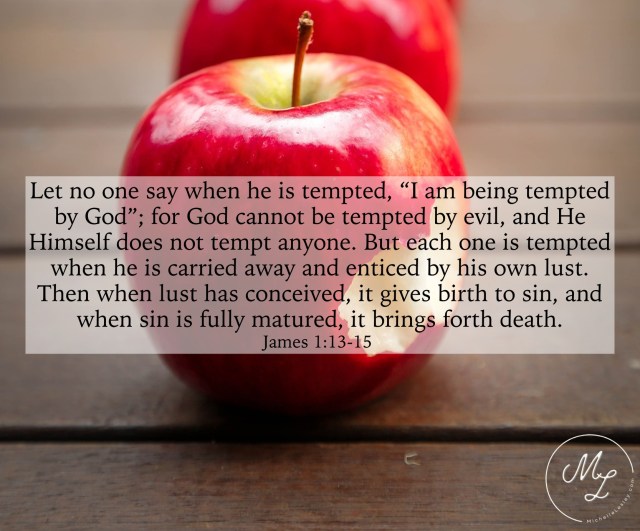
Please tell me you answered “c,” because, if you didn’t, I might have to sit down and cry. When God put Adam in the Garden way back in Genesis 2, He said, “You may surely eat of every tree of the garden, but of the tree of the knowledge of good and evil you shall not eat, for in the day that you eat of it you shall surely die.” (2:16-17) Fruit. Forbidden. Boom.

Notice that God is the One who forbade Adam from eating this fruit. God’s way, throughout the entirety of Scripture, is to warn the people He loves of the dangers and consequences of sin, not to remain silent and keep His fingers crossed that they don’t stumble into a pit. God didn’t stick the tree in the middle of the Garden and say to Himself, “Gee I hope Adam doesn’t notice this tree and eat from it, but I’m not going to mention it to him because I’m scared that I’ll make him aware that it exists, and that he’ll want to eat from it just because I said he can’t.” Uh uh. God pointed it out and said, “No.”

God’s way, throughout the entirety of Scripture, is to warn the people He loves of the dangers and consequences of sin, not to remain silent and keep His fingers crossed that they don’t stumble into a pit.

And let’s take a gander at something else in this story. What caused Adam and Eve to eat from the tree? Was it God telling Adam not to eat from it? No. If that was all it took, why don’t we find Adam eating the fruit immediately after God told him not to? Why didn’t Eve immediately eat from the tree upon learning from Adam of God’s prohibition against it?

Because the warning is not what led them to sin.

We don’t see Eve lay a finger on that fruit until Satan enters the picture. He tempted her, and she gave in to sin.

It wasn’t God’s fault for putting the tree there. It wasn’t God’s fault for warning them. It was Adam’s fault and Eve’s fault for being disobedient.

And giving in to sin is still our fault today. If you went to see Fifty Shades of Grey, it’s not God’s fault for allowing the movie to exist. It’s not some Christian blogger’s fault for making you aware of the movie or warning you not to see it. It’s your fault. You were tempted. You gave in to sin. (The good news is that if you will repent, God will graciously forgive you.)

As Christians we are to be imitators of God. “Whoever says he abides in him ought to walk in the same way in which he walked.” (1 John 2:6) That means that when we see sin that could easily ensnare our brothers and sisters, we don’t turn our heads. We don’t mind our own business. We don’t keep our mouths shut to be polite. We do the same thing God did time after time in the Bible. We run into the fray to rescue those we love.

When we see sin that could easily ensnare our brothers and sisters, we don’t turn our heads. We don’t mind our own business. We don’t keep our mouths shut to be polite. We run into the fray to rescue those we love.

And we are not to blame if there are those who choose to charge headlong into sin rather than heed the alarm we sound.

Parenting

Do You Trust God with Your Kids?: 8 Ways to Parent Your Children Like God “Parents” You

The world can be a scary place if you have kids. There’s the danger of online predators luring kids into meeting them in person. Kids can take inappropriate pictures of themselves or their peers only to have those pictures spread around on the web. Porn sites abound. Drugs and alcohol seem to be easy for kids to come by. There are kidnappers and sex traffickers and child molesters lurking where you least expect them, even in the church. And, society would have us believe, every teenager is having sex.

It’s a blessing from God that there are so many ways to protect our kids. There are all kinds of software locks and blocks and filters you can put on your electronics in order to keep your kids safer when it comes to technology. There are phone apps that allow you to track your child’s location, and do it yourself drug testing kits, and breathalyzer attachments you can put on your car to keep your child from driving drunk. And then there are the more “analog” precautions of keeping the family computer in a common room, scrolling through your child’s phone log every day and asking about each call or text, banning sleepovers, and never letting her spend time alone with friends.

Certainly, we should use wisdom about the activities we let our kids take part in. Maybe some of those locks, blocks, and filters, or restrictions on places she can go and people she can see would be a wise idea for your family, especially if your child has proved herself untrustworthy with the freedom you’ve already given her.

But, increasingly, as I hear Christian parents in a near frenzy about installing multiple security measures on their electronics or the car and making all kinds of restrictions on activities with friends – not to clamp down on a rebellious child, but to prevent children from getting into trouble who have never showed any signs of rebellion – I have to wonder, what’s the foundational mindset here?

Are we putting these safety measures in place because we’ve prayed about it and  believe it’s reasonable, godly wisdom, or are we putting these safety measures in place out of the fear of evil, or because we trust devices and restrictions more than we trust God and our kids? For the Christian, it’s not that it’s wrong or bad to take precautions – indeed, God doesn’t want us to be careless or foolish – it’s the motivation for the precautions we take that we need to examine.

Do we really trust God with our kids, or are we taking matters into our own hands out of fear?

Trusting God can be scary. We can’t see Him, hear Him, or touch Him, and He never promised us a life free from difficult or painful circumstances. It’s much easier and more comforting to our flesh to trust something tangible. Something that guarantees us it’ll do what we want it to do. It reminds me of an event that took place toward the end of King Asa’s life in 2 Chronicles 16.

Asa was one of the good kings of Judah. He “did what was good and right in the eyes of the Lord his God. He took away the foreign altars and the high places and broke down the pillars and cut down the Asherim and commanded Judah to seek the Lord, the God of their fathers, and to keep the law and the commandment.” (2 Chronicles 14:2-4) But one day, Baasha, king of Israel, came up against Judah. Did Asa cry out to the Lord, trusting Him to help, as he had years before when the Ethiopian army came out against him? No. Asa’s response was to gather up a truckload of silver and gold from the palace and the temple and bribe the king of Syria to break his covenant with Israel and attack them. Instead of fully trusting in the Lord and seeking His help and guidance, Asa took matters into his own hands and attempted to protect Judah with his own strength.

We love our children. We don’t want to see them hurt or fall into sin. We want to do whatever we can to protect them. Those are all good and godly desires of the heart. But we must make sure we are seeking and trusting God and His ways first instead of acting upon our fears and relying on our own strength.

What are God’s ways? How does He “Father” us? How can we imitate our Heavenly Father as we parent?

1. God makes clear that He is the Father and we are the children.
Throughout Scripture, God is crystal clear that He is the one in charge. He made us, He sets the rules, He provides for us, He protects and cares for us, He knows what’s best for us. Because of all this, He instructs us, our responsibility is to be obedient children.

Do you and your children understand that you are the parent? That you are in charge and that they are to obey? That you make the rules and they are to follow them? Are the roles of parent and child clearly defined in your home with a godly authority structure in place?

2. God spells out what He expects from us.
The Bible is chock full of explicit commands. Sometimes God tells us what to do. Sometimes He tells us what not to do. Often, He explains why He is telling us to do or not do a certain thing. We can always rest assured that all of His commands are for our own good, the good of others, and the glory of God, and that they flow out of His great love for us. But God never accepts excuses for disobedience. He expects us to obey.

Have you thoughtfully and prayerfully developed rules for the online and offline activities your child participates in? Have you sat her down and lovingly explained the rules to her, answering any questions she might have? Does she have a clear understanding of what the rules are and how to obey them? Does she grasp your expectation that she will obey the rules without excuses?

3. God warns us of the consequences and dangers of disobedience and the blessings of obedience.
God doesn’t hide the unpleasant truth from us that the wages of sin is death. In fact, He gives us enough of a description of that eternal death to help us understand that we don’t want to go there. He explains that He disciplines those He loves in order to keep them away from sin and harm. But God also reminds us of the blessings of obedience – that it will help us flourish, grow in joy, and bring glory to God.

Have you warned your child of the consequences for disobeying your rules about her activities? Do you carefully and consistently enforce those consequences? Have you explained to her that the reason there are disciplinary consequences for her disobedience is to protect her from danger and sin? It’s neither necessary nor appropriate to go into all of the specific, terrifying details of child trafficking or the disgusting elements of pornography, but our children must have an age-appropriate understanding of the very real dangers that are out there.

And it’s just as important to explain the blessings of obedience to your child: she won’t have to live in fear or in shame, she’ll be protecting her purity for marriage, her health, or her life, her parents will trust her, and she’ll be acting in a way that’s pleasing to God. Maybe you’ll even be more inclined to give her extra privileges.

4. God doesn’t give the consequences before the sin.
Look at what Jesus said in Matthew 5:29-30 with regard to lust:

If your right eye causes you to sin, tear it out and throw it away. For it is better that you lose one of your members than that your whole body be thrown into hell. And if your right hand causes you to sin, cut it off and throw it away. For it is better that you lose one of your members than that your whole body go into hell.

Jesus doesn’t tell us to gouge out an eye or cut off a hand as a precaution to prevent lust that has not taken place. He tells us to respond to sin with an appropriate consequence.

Is there any way you might be “maiming” your child to prevent her from committing sin – especially sin she’s never shown an interest in or temptation to? Maybe it’s time to reconsider that rule or restriction? Conversely, do you have a child who struggles with a particular sin? She may need your love and your help mortifying that sin by “gouging out the eye” of the internet or “cutting off the hand” of that destructive friendship.

5. God wants our obedience to be motivated by our love for Him.
God doesn’t want us to obey Him because we have an unbiblical view of Him as a mean old ogre and we’re terrified of Him. He also doesn’t want us to obey Him in order to get something from Him, to impress others, or just to go through the motions. God wants us to want to obey Him because we love Him.

Have you fostered an environment of sacrificial love for your children in your home? Do you lay down what you want or how you feel to do what’s best for them? Do you invest time in them, pouring the gospel into them, teaching them God’s Word, and demonstrating that we obey Christ because we love Him? Do you take time to talk and play with your children? Do you tell them you’re proud of them? Discipline them and say no when necessary? Are you generous with hugs, “I love you’s”, and encouragement? Do you encourage them to develop their talents and skills? Having parents who love their children in a godly way doesn’t guarantee obedience, but it does encourage it.

6. God doesn’t micromanage every move we make.
At least not the way humans sometimes micromanage. Have you ever noticed that there are no commands in the Bible like, “Thou shalt wear blue socks every Tuesday,” or “Thou shalt not stay up past 11:38 p.m.”? Regulating every little thing we do isn’t God’s way. He loves us and cares for us, He tells us what He expects from us and the consequences of obeying and disobeying Him, and then He gives us space within those parameters to make decisions that are aligned with His will as revealed in His Word. As long as we’re not violating any of His principles or commands and we’re exercising godly wisdom, it’s fine with Him if we want to wear red socks on Tuesday or stay up until midnight.

Our children need space to make decisions within the confines of the rules we’ve set up, especially children who haven’t given us any reason not to exercise reasonable trust in them. Nitpicking, checking, regulating, and hovering over every little move your child makes is smothering and frustrating to her. It says, “I don’t trust you to do what’s right without constant monitoring from me.”

7. God allows us to fail.
I once read the biography of a girl who went blind. She enrolled in a life skills class at a school for the blind to learn how to navigate the world. During orientation, her counselor showed her around the common room of the dorm she was staying in. The counselor took her hand, placed it on the protruding mantel of the fireplace and said, “This is a sharp corner. You’ll need to watch out for it.” The girl gasped, “That’s dangerous! Why don’t you put some padding on it?”. The counselor replied, “You need to learn to be careful and aware of your surroundings. Nobody’s going to pad the sharp corners of the world for you.”

God doesn’t pad the sharp corners of the world for us, either. He doesn’t put us in a protective little bubble where we’ll never be hurt or fail or sin. He gives us everything we need for life and godliness in His Word and allows us to obey or disobey Him. Even when we fail, give in to temptation, and sin.

Consider that your child needs to learn the skill of facing and resisting temptation on her own. Give her enough age appropriate, situation appropriate freedom to do that – and to fail at it and repent – in the spiritual safety of your home. One day you won’t be there to put a lock on the computer. God will hold her responsible for her own sin. Will your child have developed the spiritual strength to say no to temptation when there’s nobody to stop her?

8. God is always there.
He’s not a “helicopter parent,” but He’s always there to listen to us, help us, nurture us, and be our Wonderful Counselor and Everlasting Father.

If you are a parent, job one is not your career, it’s parenting. Generally speaking (yes, there are sometimes exceptions and exigent circumstances), that means, Mom, your primary vocation is to raise your own children. Don’t just assume you have to work outside the home. Pray fervently for God to make a way for you to raise your children. Be creative and look for ways to get out of the workforce and get home. Slash every possible expense. Move. Eat at home. Home school instead of private school. Sell a vehicle. Bargain hunt. Find a way to earn money from home. Make the effort. Your children don’t just need any random person to raise them, they need you.


Are we imitating our Heavenly Father in the way we parent? Do we cry out to Him for wisdom in the rules and restrictions we set for our children, trusting Him to help us and to protect our children? Or do we live in fear of what might happen, worrying and trying to protect our children in our own strength?

As much as we’d like to sometimes, we can’t build walls around our children to protect them from every sin or from anything bad ever happening to them. That is not how God deals with us. He loves, cares, and provides for us. He disciplines us appropriately when we need it. He clearly spells out what He expects from us. He warns us of the dangers and consequences of disobedience and teaches us the blessings of obedience. It’s then up to us to decide whether we love Him enough to obey Him, or if we’d rather go our own way.

Do we parent our children like God “parents” us?

Basic Training

Basic Training: 5 Ways to Face Tests and Trials Biblically

For more in the Basic Training series, click here.
Your car breaks down and you don’t have the money to get it fixed.

Your child develops a behavior problem, and you have no idea how to help her.

Somebody royally messed something up at work and now you have to figure out how to fix it.

You’re smack dab in the middle of a tenuous situation at church instigated and exacerbated by THAT lady.

Anybody who tells you, “Come to Jesus and all of your problems will be over,” is selling something. The Christian life is not a stroll through a flowery meadow with never a bump in the road. In fact, sometimes it’s just one big pile of poo after another.

The truth is, if you come to faith in Christ, you’re going to continue to have some of the same kinds of general “that’s life” poo that you had before. People at work will keep messing up. Your child will still pour nail polish on your new white rug (Why do you have a white rug if you have children?). Your neighbor will back into your fence (again) and drag her feet about fixing it (again).

So what’s the point of coming to Christ if you’re just going to keep having problems?

Because the point of coming to Christ is not for Him to make all your problems disappear, it’s for Him to redeem you from your sin and propitiate God’s wrath against you. That’s why the symbol of Christianity is a cross, not a magic wand. So how does God want us to face those tests and trials of life in a biblical, Christian way?

1.
Recognize God’s Purpose in Testing You

There are scads of blessings and benefits that come along with repentance and faith in Christ, and one of them is that poo now has a purpose. (I sense some of you have had enough of the word poo. OK, moving on…)

What is the purpose of all these aggravations, sorrows, and worrisome circumstances that keep coming your way?

Count it all joy, my brothers, when you meet trials of various kinds, for you know that the testing of your faith produces steadfastness. And let steadfastness have its full effect, that you may be perfect and complete, lacking in nothing.
James 1:2-4

Not only that, but we rejoice in our sufferings, knowing that suffering produces endurance, and endurance produces character, and character produces hope,
Romans 5:3-4

Besides this, we have had earthly fathers who disciplined us and we respected them. Shall we not much more be subject to the Father of spirits and live? For they disciplined us for a short time as it seemed best to them, but he disciplines us for our good, that we may share his holiness. For the moment all discipline seems painful rather than pleasant, but later it yields the peaceful fruit of righteousness to those who have been trained by it.
Hebrews 12:9-11

Those difficult situations we face in life – whether they come as a consequence of our sin, a consequence of our Christlikeness, or simply a consequence of living in a post-Fall world – are the tools God uses to make us more like Jesus. Obediently bearing up during hard times develops steadfastness and maturity, endurance, character, and hope, holiness, peace, and righteousness.

You want those Christlike characteristics, don’t you?

I do too. But I’ll be honest – my flesh is not crazy about the fact that God often pulls a chisel out of His toolbag instead of a feather duster. And once again, we’re back to the cross versus the magic wand. We want God to “abracadabra” us into Christlike character. God points us to the cross.

2.
Look at Tests and Trials Through Jesus’ Eyes

…let us run with endurance the race that is set before us, looking to Jesus, the founder and perfecter of our faith, who for the joy that was set before him endured the cross, despising the shame, and is seated at the right hand of the throne of God.
Hebrews 12:1c-2

Jesus was not some crazy masochist who enjoyed being beaten, mocked, nailed to a cross, and having the wrath of God poured out on Him for our sin. That was not fun. It was not pleasant. It was such a unique kind of awfulness that a whole new word had to be invented to describe it: excruciating. It was such a horrifying specter that it caused Jesus to sweat blood as He prayed in Gethsemane, “My Father, if it be possible, let this cup pass from me.”

God does not require you to enjoy pain, suffering, inconvenience, stress, or aggravation any more than He required Jesus to enjoy it. What Jesus did was to focus on “the joy set before Him” – the results of His suffering and the great and glorious things it would accomplish – to help Him endure the suffering. That’s what God wants us to pattern our approach to suffering after – Jesus. We don’t look at the circumstance itself. We look past the circumstance to how God is going to be glorified, how He’s going to grow us in Christlikeness, what we’re going to see Him do in answer to prayer, and whom He might save as a result of the circumstance. We look at the finish line. The winner’s circle. We focus on those things to help us get through the pain and exhaustion.

3.
Remember the Nature and Character of God

Or which one of you, if his son asks him for bread, will give him a stone? Or if he asks for a fish, will give him a serpent? If you then, who are evil, know how to give good gifts to your children, how much more will your Father who is in heaven give good things to those who ask him!
Matthew 7:9-11

God is not some nasty bully sitting up there in Heaven arbitrarily messing your life up for His own personal entertainment like a kid setting ants on fire with a magnifying glass on a sunny day. He’s your Father. He loves and cares for you. Like any good parent, He wants what He knows is good for you more than He wants you to be fat and happy. He’s in complete control of what happens or doesn’t happen to you.

If something unpleasant comes into your life, go back to what you know to be true of God. God is not trying to harm or punish you. He has sovereignly allowed or caused this thing to happen because He is your Father who loves you and wants to do something good for you. He wants to work in your heart and life for your benefit, the benefit of others, and to glorify Himself through this circumstance.

4.
Don’t Worry

Yeah, right. If you’re anything like me, your first thought when faced with a problem is “Oh no. I’ll never get through this one. What if this happens? What if that happens?” Suddenly, in your mind, you’re ten miles down the road in Armageddon-land.

God does not sovereignly put circumstances into your life to give you a platform for worrying. It is never God’s will for you to worry. It is always God’s will for you to trust Him. If you’re worrying about your circumstances, you are not doing God’s will. God puts difficult circumstances into our lives to give us the opportunity to exercise our “trust muscles”. Worrying is just another way of saying, “God, I don’t trust you in this. I don’t believe you’re in control in this situation. I’ve got to be the one to figure this out and handle it.” If God is big enough and powerful enough to save you, He is big enough and powerful enough to carry you, protect you, provide for you, comfort you, and reassure you through whatever He places in your path. Trust Him.

(And a special note to my fellow Reformed brothers and sisters – as I preach this to myself – if anybody shouldn’t worry, it’s us. We are the “God is sovereign over everything” people! It is utterly ridiculous to believe that God is sovereignly in control of every aspect of salvation, that He providentially foreordains the activity of every atom of the universe, and then turn around and worry that He can’t or won’t handle something as measly as a repair bill or a surly co-worker.)

Trust in the Lord with all your heart,
and do not lean on your own understanding.
Proverbs 3:5

Fear Not: 9 Biblical Ways to Trade Worry for Trust

5.
An Opportunity for Obedience

In the same way that God doesn’t place situations in your life as an opportunity to worry but as an opportunity to exercise trust in Him, He does not place situations in your life in which you have no choice but to disobey Him, but rather, as opportunities to stretch, trust Him, and obey His Word in spite of how difficult it might be. Anybody can be obedient when things are awesome. Obedience during the hard times is what grows you.

No temptation has overtaken you that is not common to man. God is faithful, and he will not let you be tempted beyond your ability, but with the temptation he will also provide the way of escape, that you may be able to endure it.
1 Corinthians 10:13

In your struggle against sin you have not yet resisted to the point of shedding your blood.
Hebrews 12:4

In all your ways acknowledge him,
    and he will make straight your paths.
Proverbs 3:6

Commit your way to the Lord; trust in him, and he will act.
Psalm 37:5

Can’t find a doctrinally sound church nearby? Yes, that’s difficult, but God is not OK with you sitting down and resigning yourself to disobeying Him by giving up the search just because it’s hard. No man will step up and lead at church? They might be disobeying God, but we ladies don’t have God’s permission to violate His Word by teaching or exercising authority over the men of the church just because it would be a lot more convenient to do so.

Convenience, comfort, and smooth sailing are not the be all end all of life. The character that God wants to build in you, the glory He wants to bring Himself, the good He wants to do to others through your obedience during hard times is far more important. But you’ll never experience those amazing things if you take the easy way out by sinning. Have you stood against sin to the point of bloodshed? Have you prayed that God would provide you a way to resist temptation and obey Him? Are you committing your way to the Lord and trusting Him to work everything out? If you want God to accomplish His purposes through the sticky situations of your life, you’ve got to stand firm and obey Him no matter how great the challenge.

Basic Training: Obedience: 8 Ways To Stop Making Excuses and Start Obeying Scripture


We may not like difficult situations very much, but for those of us who know Christ, we can rejoice in knowing that God has a purpose for them. The highest purpose – to make us more like Jesus. He does that for us because He loves us. And while we might still wish for Him to bop us with a magic wand and instantly make us patient or steadfast or peaceful, God created us, and He knows that suffering and difficulties are the best way to accomplish those things. So just as Christ endured the cross for the joy set before Him, we can endure any difficult situation God blesses us with, knowing that He’s doing it for our good and His glory. And that’s definitely something to rejoice about.

Basic Training, Obedience

Basic Training: Obedience: 8 Ways To Stop Making Excuses and Start Obeying Scripture

For more in the Basic Training series, click here.

So whoever knows the right thing to do and fails to do it, for him it is sin. James 4:17

Excuses, excuses.

We’ve all got them. We’ve all used them.

“The dog ate my homework.”

“I was going to, but…”

“I’d like to, but I can’t, because…”

Sometimes there are legitimate reasons we can’t take part in certain earthly activities. Time conflicts: If a birthday party and a wedding are scheduled for the same date and time, you obviously can’t be in two places at once. Financial constraints: Maybe you’d really like to attend that conference, but there’s no money in the budget. Prioritized responsibilities and loyalties- you’d like to travel as much as you did when you were single, but now that you have a family, taking care of them comes first.

Those aren’t really excuses, though, they’re reasons – totally understandable ones – that you can’t do something. But we’re so much in the habit of explaining why we can’t do something in the day to day logistical realm that it never occurs to us that this isn’t right when it comes to the things of God. When God’s word tells us to do something, we are to obey it, not make excuses about why we can’t.

Most Christians seem to grasp this concept when it comes to one of the “big” commands. Take abortion, for example. We know that abortion is a sin regardless of the circumstances, even when those circumstances are huge and scary. We reach out to pregnant women with the gospel and with practical help so that they won’t commit that sin. We love the homosexual who wants to come to Christ but is being pulled the other direction by her lifestyle, living arrangements, and loved ones, by compassionately providing for her needs while holding firm to the biblical gospel that says she must turn from her sin in repentance if she wants to be saved.

But when it comes to the “little” commands like…

…submitting to your husband

…being a faithful, active member of a local church

…refraining from teaching men or holding authority over them in the church

…refusing to be anxious about anything

…lots of those same Christians (including me) who are so clear that abortion and homosexuality are sins requiring repentance regardless of the circumstances, have at the ready, all kinds of excuses and reasons and circumstances to offer up as to why we can’t obey God’s word.

“I just don’t think my husband’s decision is the right way to go.”

“A church hurt me in the past, so I’m done with church.”

“None of the men in my church will step up and lead, so I have to.”

“I’m in a really bad situation. I can’t help it if I’m constantly stressing about it.”

Uh uh. No excuse for disobedience that we can come up with is going to wash with God. There is never any acceptable reason or excuse to say, “I can’t,” when it comes to a command of Scripture. God expects us to be obedient. So how can we move from excuses to obedience?

1. Understand that obedience to Scripture is not “legalism” or being a “Pharisee”

As much as pop evangelicalism would like us to believe it, obedience to Scripture is not legalism, nor is someone acting like a Pharisee if she’s teaching that all Christians should obey Scripture. Legalism is when you think obeying God’s commands will save you, make up for your sin, or somehow make you right with God through your own fleshly efforts. Pharisee-ism is making up your own bibley-sounding laws – usually ones that are related to Scripture, but more restrictive than Scripture – and insisting that others adhere to them or they’re not saved, not as good of a Christian as you are, etc. That’s not what we’re talking about here. We’re talking about rightly handling God’s word in context, understanding what His commands to Christians actually are, and joyfully submitting to them in obedience.

2. Embrace what Scripture says about obedience:

So whoever knows the right thing to do and fails to do it, for him it is sin. James 4:17

Teaching them to observe all that I have commanded you. Matthew 28:20a

So you also, when you have done all that you were commanded, say, “We are unworthy servants; we have only done what was our duty.” Luke 17:10

And Samuel said, “Has the Lord as great delight in burnt offerings and sacrifices, as in obeying the voice of the Lord? Behold, to obey is better than sacrifice, and to listen than the fat of rams. For rebellion is as the sin of divination, and presumption is as iniquity and idolatry.” 1 Samuel 15:22-23a

If you love me, you will keep my commandments. John 14:15

And by this we know that we have come to know him, if we keep his commandments. Whoever says, “I know him,” but does not keep his commandments is a liar, and the truth is not in him, but whoever keeps his word, in him truly the love of God is perfected. By this we may know that we are in him: whoever says he abides in him ought to walk in the same way in which he walked. 1 John 2:3-5

For this is the love of God, that we keep his commandments. And his commandments are not burdensome. 1 John 5:3

Scripture says that Christians seek to obey God’s word, and when we don’t, we’re sinning.

3. Know that there are no commands of Scripture followed by asterisks

“You shall not murder…unless…” “Do not worry…except in circumstances X, Y, or Z, then it’s acceptable.” “If no men will step up and teach that co-ed Sunday School class, it’s OK if a woman teaches it.” Nope. You will not find a command of Scripture that contains exceptions or caveats. When God says “do” or “don’t”, He means it. He means it for you. He means it for everybody. He means it if it’s difficult or inconvenient. He means it regardless of your circumstances.

4. Realize that God is sovereign over your circumstances

God controls everything in this universe. Nothing happens anywhere that He hasn’t either allowed or caused. Translation: you’re in the circumstances you’re in because God either put you there or allowed you to be there. Everybody has some sort of situation in her life that makes obedience to Scripture difficult or inconvenient. Do you think God intends for everyone to use those circumstances that He sovereignly decided to allow or put into their lives as an excuse to disobey Him? Adam and Eve tried that. Did God accept their excuses? Isn’t blaming your disobedience to Scripture on the circumstances you’re in just another way of saying it’s God’s fault you’re being disobedient? That if God had just created you differently or put you in a different set of circumstances, you’d obey, but since He didn’t, you have no choice but to disobey?

5. Ask yourself, “Do I really want to obey?”

When we really want to do something, we find a way or die trying. Be honest- have you checked out every single church you can get to and explored every available resource and option for finding a church before giving up and saying you can’t attend church? Have you actually tried submitting to your husband even when you think he’s making a boneheaded decision? Is anybody at your church going to die if all of the women refuse to teach men and that co-ed class is disbanded? Are you so willing to obey Christ that you’ll do whatever you have to do in order to find a way to obey Him?

6. Consider that this might be a test

Remember taking pop quizzes when you were in school? Unless you were a child genius, you probably don’t look back on them fondly. They were unpleasant. Hard. Sometimes scary because so much was riding on them. Maybe you were like a lot of students who could easily answer questions on the subject matter while studying, but went blank during the quiz because of the fear and pressure.
The testing of our faith can be a lot like those pop quizzes. We know the test is coming, but we’re never quite sure when. We’re supposed to be studying the Textbook and asking the Teacher for help every day so we’ll be prepared. But when the test comes, we have to take it. There’s no opting out and saying, “If this test weren’t happening I’d be able to obey easily.” Of course you would! It’s easy to obey God when it’s convenient and everything’s going your way, but obeying when it’s difficult or inconvenient pushes you. Stretches you. It reinforces what you’ve learned, reaffirms your commitment to Christ, and refreshes your trust in God. Don’t give up in the middle of the test. Hang on to Christ, hang in there, and…

Count it all joy, my brothers, when you meet trials of various kinds, for you know that the testing of your faith produces steadfastness. And let steadfastness have its full effect, that you may be perfect and complete, lacking in nothing. James 1:2-4

7. Look to Christ as your example

Christians are supposed to “walk in the same way He walked” (1 John 2:5b). Christ is the perfect example of someone who determined to obey God regardless of His circumstances. Just look at everything He went through. Don’t you think He was awfully hungry after fasting for 40 days in the wilderness? Wouldn’t it have been extraordinarily easy to strike down every Pharisee who got on His nerves? Couldn’t He have decided the cross was just too much and that redeeming mankind wasn’t worth the trouble?

Consider him who endured from sinners such hostility against himself, so that you may not grow weary or fainthearted. In your struggle against sin you have not yet resisted to the point of shedding your blood. Hebrews 12:3-4

Jesus gave up His body – His life – in order to obey God. Are we willing to give up whatever it costs us to walk in the same way He walked?

8. Remember that God has promised to help you

What an amazing God we serve who doesn’t just give us a bunch of rules to follow and leaves us to figure it out on our own! The Holy Spirit is right there, indwelling His people, always ready to help, guide, strengthen, and comfort. First Corinthians 10:13 says:

No temptation has overtaken you that is not common to man. God is faithful, and he will not let you be tempted beyond your ability, but with the temptation he will also provide the way of escape, that you may be able to endure it.

God isn’t going to put you into a situation in which you have no choice but to disobey Him. Jesus proved that with His own life. Have you asked God to provide you with a way to obey Him? The Bible tells us that when we pray for things in accordance with God’s will, He will give those things to us. It is definitely in God’s will for you to resist temptation and obey Him, so it is His delight to answer when you ask Him for a way to do that.
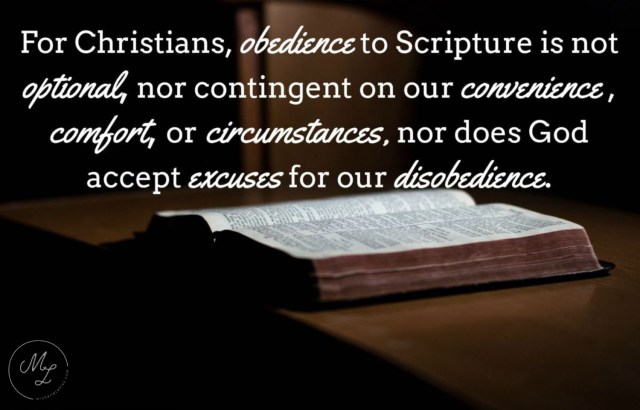
Ladies, obedience to Christ is not optional. We don’t get to pick and choose which of God’s commands to Christians we want to obey and which ones are OK to let slide. He expects us to follow after Christ, who obeyed to His last breath, His last drop of blood. And He promises to help us, even when obeying Him is hard. Let’s stop making excuses and start looking for ways to submit to, and obey, God’s word.

Mark Bible Study

Mark: Lesson 13

Previous Lessons: 1, 2, 3, 4, 5, 6, 7, 8, 9, 10, 11, 12

Mark 9:30-50

They went on from there and passed through Galilee. And he did not want anyone to know, 31 for he was teaching his disciples, saying to them, “The Son of Man is going to be delivered into the hands of men, and they will kill him. And when he is killed, after three days he will rise.” 32 But they did not understand the saying, and were afraid to ask him.

33 And they came to Capernaum. And when he was in the house he asked them, “What were you discussing on the way?” 34 But they kept silent, for on the way they had argued with one another about who was the greatest. 35 And he sat down and called the twelve. And he said to them, “If anyone would be first, he must be last of all and servant of all.” 36 And he took a child and put him in the midst of them, and taking him in his arms, he said to them, 37 “Whoever receives one such child in my name receives me, and whoever receives me, receives not me but him who sent me.”

38 John said to him, “Teacher, we saw someone casting out demons in your name, and we tried to stop him, because he was not following us.” 39 But Jesus said, “Do not stop him, for no one who does a mighty work in my name will be able soon afterward to speak evil of me. 40 For the one who is not against us is for us. 41 For truly, I say to you, whoever gives you a cup of water to drink because you belong to Christ will by no means lose his reward.

42 “Whoever causes one of these little ones who believe in me to sin, it would be better for him if a great millstone were hung around his neck and he were thrown into the sea. 43 And if your hand causes you to sin, cut it off. It is better for you to enter life crippled than with two hands to go to hell, to the unquenchable fire. 45 And if your foot causes you to sin, cut it off. It is better for you to enter life lame than with two feet to be thrown into hell. 47 And if your eye causes you to sin, tear it out. It is better for you to enter the kingdom of God with one eye than with two eyes to be thrown into hell, 48 ‘where their worm does not die and the fire is not quenched.’ 49 For everyone will be salted with fire. 50 Salt is good, but if the salt has lost its saltiness, how will you make it salty again? Have salt in yourselves, and be at peace with one another.”


The Holy Bible, English Standard Version. ESV® Permanent Text Edition® (2016). Copyright © 2001 by Crossway Bibles, a publishing ministry of Good News Publishers.


Questions to Consider

1. Today’s lesson is the culmination of Mark 9. Briefly review the first half of Mark 9 in lesson 12 (link above). Where was the “there” that “they went on from”? (30) Why did Jesus not want anyone to know He was passing through Galilee? (30-31)

2. Compare verses 31-32 with Mark 8:31-33 and Mark 9:9-10. Between Mark 8 and 9, how many times has Jesus taught some or all of the disciples about His impending death and resurrection? Why do they still not understand? Was it because they had no frame of reference the concept of resurrection? Because they didn’t understand why anyone would kill Jesus? Because of their incorrect expectations of what Messiah would do (review questions 7 and 9 in lesson 11 {link above})? Why do you think the disciples were afraid to ask Jesus to clarify things? (32)

3. Consider verse 34 in light of the disciples’ lack of understanding in 31-32. How might their understanding of, and focus on, Christ’s impending death, burial, and resurrection have changed the disciples’ conversation? How should focusing on the gospel change your conversation- the people you’re willing to talk to, the words you use, and the topics of your discussions with people? How do verses 34-35 reveal Christ’s omniscience?

4. Which two types of people does Jesus use as illustrations of humility in verses 35-36? What are the characteristics of a servant that demonstrate humility? A young child? How do humble Christians show these characteristics of a servant or a child in their daily lives?

5. What does it mean to receive someone (37), cast out demons (38) or do anything in Jesus’ name? Does it simply mean to tack the words “in Jesus’ name” on to the end of whatever you’re saying or doing?

When John says the exorcist “was not following us” (38), does he mean that this man was not a believer in Christ (i.e. not a “Christ-follower”), or does he mean that the man was not accompanying Jesus and the disciples on their itinerant journeys through Israel? Is it possible for someone who is not a Believer to do anything in Jesus’ name? Compare verses 39-40 with these passages. Is there any middle ground when it comes to being with or for Jesus and being against Him? Examine your own heart- are you with Christ or against Him? How can you tell?

6. What does God think of those who tempt, entice, or deceive others into sinning? (42) How does this verse help us understand how seriously God views sin?

7. Examine verses 43-47. Does sin originate in your hand, your foot, or your eye? Where does sin originate, which then tempts you to sin with your hands, feet, or eyes? Is Jesus speaking literally in these verses, or is He employing hyperbole? What is the main idea Jesus is trying to get across in these verses? Is sin really as big a deal as Jesus is making it out to be in this passage? Why? (48-49)

8. In the ancient world, salt was an important, but hard to get, commodity. It was used for flavoring, to preserve meat, and for other purposes– even in the temple. Think like a first century Jew or Gentile about salt- what would Jesus’ words in verses 50-51 have meant in your culture? How do these verses apply to Christians today?


Homework

Look back over verses 43-47, and think about the sins you’re tempted to commit: things you do (hands), places you go (feet), things you watch or view (eyes). Choose a sin you particularly struggle against. Is it something you do or see, or is it somewhere you go?

What is one practical step you could take to “cut off” or “tear out” that temptation before you fall into sin again? For example, maybe you need to stop watching a certain TV show, take a different route home from work to avoid a tempting place, or stop hanging out with that person who’s a bad influence on you. Prayerfully implement that step this week.


Suggested Memory Verse

“Whoever causes one of these little ones who believe in me to sin, it would be better for him if a great millstone were hung around his neck and he were thrown into the sea.”
Mark 9:42