Church, Servanthood

New FREE Resource for Churches: The Servanthood Survey

Over the last few months I’ve been asked more than once, “How can pastors help women find a biblical place of service in the church?”. And each time I’ve been asked, my heart’s desire to create a resource to help pastors get people serving in the church has increased, which resulted in The Servanthood Survey.

The Servanthood Survey takes church members desiring to serve through a brief study of the Scriptures describing what biblical servanthood is, the value of servanthood to God and to the church, following Jesus’ example and teaching on servanthood, the biblical parameters God has placed on certain roles in the church, and prayerful consideration of how God has designed and equipped the individual for service.

The survey can be used with men or women, and even teens or children desiring to serve their local Body. I envision it being sent home with a church member to work through and pray about, followed up by a meeting with the pastor (or whoever assigns positions of service in your church) to discuss the church member’s responses and potential place of service. But churches could also integrate the survey into their new member classes, create a mini (2-4 weeks?) class around the survey, work through it during midweek services, or whatever works best for that particular church.

The survey itself is also meant to be tweaked for use by each individual church. You may not like the way I worded something or you might like to add something (you’ll see at the end, you’ll need to add a sheet with a list of opportunities for service for your particular church). To that end, I’ve made the survey available as a Google Doc as well as providing the text below so you can copy, paste, and edit it in a way that works for your church.

You may notice that my name and website do not appear on the survey. That’s intentional. This is my gift to you to take, make your own, and use as a tool in your church. (I would ask that you please not credit me or include my website on the document if you modify the theology of the survey.)

I hope you’ll find this to be a useful tool for helping the men and women of your church to get plugged in and serve the Body.

The Servanthood Survey

Every Christian who’s able should be serving in the local church. This survey is designed to help you find a place of service in our church. It will help you understand the biblical concept of servanthood and to consider which place of service God may be leading you to as you think about the ways He has uniquely gifted and equipped you.

What is biblical servanthood?

Unfortunately, in Christian culture today, the concept of servanthood has been lost or abandoned in favor of the desire for notoriety. Our flesh wants to be recognized, applauded, and patted on the back for what we do in the church. But what does the Bible teach about serving?

Jesus is our ultimate and perfect example of servanthood:

Read Matthew 20:25-28

  • How does Jesus contrast His followers (26) with Gentiles (the lost) (25)?
  • What does Jesus say is the way to “greatness” in the Kingdom of God? (26-27)
  • What is the example Jesus set for us regarding servanthood, and how does He say we can follow His example? (28)

Read John 13:1-17

In a culture in which people often went barefoot or wore sandals and public sanitation was not what it is today, foot washing was a dirty, sometimes disgusting, task. Because it was a job nobody wanted, and considered beneath the dignity of more highly positioned servants, foot washing was usually assigned to the lowest ranked servant in the household.

  • Who took on the task and the position of lowest ranked servant in this passage? (3-4)
  • Why was Peter upset when Jesus tried to wash his feet? (6,8) How did Peter normally view and think of Jesus (see Matthew 16:15-16) that would have caused him to be appalled that Jesus would lower Himself in such a way?
  • What was the “example” (15) Jesus gave, and how should we carry out His example? (14)
  • Who do the “servant” and “messenger” represent in verse 16? The “master” and “the one who sent him”? What does verse 16 mean?
  • Look closely at verse 17. What is the difference between “knowing” and “doing” these things? What is the consequence “if you do them”?

Prayerfully examine and compare your heart attitude about serving in the church to what Jesus taught and demonstrated in these two passages:

  • Compare your willingness to Jesus’ willingness. His humility to your humility. What He taught about lowliness and serving in anonymity to your thoughts and attitudes about serving in lowliness and anonymity.
  • Is your heart’s desire to fill a “spotlight” position in the church because you crave recognition and praise from others?
  • Do you desire to be “first” and “great” in the eyes of others, or in the eyes of God?
  • Jesus’ regular ministry was teaching, not foot washing. Are you willing to pitch in and do whatever needs to be done at the moment even if it’s a thankless task, a dirty job, or “not your ministry”?

Knowing Our Roles

When Jesus came to earth, God had a special, well-defined role of service for Him. He was to live a sinless life, teach, perform miracles, die on the cross for our sins, and rise again. He was not to be a husband, father, chief priest, scribe, farmer, or soldier. One of the ways Jesus obeyed God was by staying within the parameters God had set for Him and joyfully and robustly fulfilling His role without coveting the roles of others or complaining about the role God had assigned Him.

God has also assigned certain roles of service in the church to certain people. We must be sure to follow Jesus’ example by joyfully embracing, and robustly fulfilling, the role He has given us and not coveting the roles of others. 

Read 1 Corinthians 12:12-31

  • What does this passage teach us about the value of each church member’s service to the Body?
  • Is it right for any church member to look down on anyone else’s role of service? (21) Is it right for us to look down on our own “lowly” role of service and be jealous of someone else’s more “prestigious” role of service? (15-17)
  • Who arranges members – and, consequently, their roles of service – in the Body? (18) Did He do so arbitrarily or with purpose? (18)  What does that tell us about the importance of obeying God by staying in the role He has assigned us?
  • What is the effect when we embrace the role God has assigned to us and encourage others in the role God has assigned to them? (25)

Most roles of service in the church are open to many Christians. But in the same way there are good reasons we wouldn’t allow a five year old to drive the church van or a man to chaperone the girls in their sleeping quarters at youth camp, God has good reasons that He restricts certain people from serving in a few specific roles, and that He requires certain people to step up and fill certain roles.

Read 1 Timothy 3:1-13, Titus 1:5-9, 1 Timothy 2:12-15, and Titus 2:3-5

God requires that certain biblically qualified men to step up and take on the leadership of the church as pastors, elders, and deacons. 

  • What are the qualifications for each of these offices in the 1 Timothy 3/Titus 1 passages?
  • Is every Christian man qualified to serve in these roles? What are some things from these passages that would disqualify a man from serving in one or more of these roles?
  • Must every man who is biblically qualified serve in one of these offices? (1 Timothy 3:1) What would be some reasons a biblically qualified man might not or should not serve in one of these offices? Should a man who is biblically qualified give serious prayerful consideration to serving in one of these offices?
  • Is a godly man’s service to the church any less valuable if he does not serve in one of these roles? (You may wish to review 1 Corinthians 12:12-31)

God requires that women who are mature in the faith train up younger women and children in godliness. However, as we have seen in the 1 Timothy 3/Titus 1 passages, He has restricted the offices of pastor, elder, and deacon to biblically qualified men. First Timothy 2:12-14 shows us that women are also restricted from carrying out two of the functions of these offices: preaching and teaching the Bible to co-ed/men’s groups in the church setting, and exercising teaching or non-teaching authority over co-ed/men’s groups in the church setting. This means that our church will place qualified men in any position of service which requires preaching or teaching the Bible to men, and/or holding authority over men.

  • Recalling 1 Corinthians 12:12-31, does God’s restricting these few church offices/functions to biblically qualified men mean that He values the service of women or men who don’t serve in these roles any less than He values the service of men who do serve in these roles? Should we value their service less?
  • What are some ways you see men and women serving in our church which do not require them to preach/teach the Bible to men or exercise authority over men? Explain the importance of a few of these roles of service and their value to the church.

Read Matthew 5:29-30

Everyone sins, and everyone deals with different temptations to sin. If there are certain roles of service in our church that would tempt you to sin, it is not wise for you to serve in that position of service. For example, if you struggle against the temptation to steal, we want to lovingly help you avoid that temptation by not making you our church treasurer.

  • What does Jesus say we should do with things that tempt us to sin?
  • Prayerfully consider your areas of weakness and temptation. Are there any areas in our church in which you feel it would be unwise for you to serve?
  • Have you ever been convicted of a crime? Are there any areas in our church in which it would be illegal or violate your probation for you to serve?

If you’re struggling to embrace the role in the church that God has assigned to you, prayerfully examine your heart to discover why that might be. Compare the way Jesus embraced the role God assigned Him with your heart attitude about embracing the role God has assigned you.

Suited to Serve

God has created each human being with unique talents, abilities, and interests, and gives Christians spiritual giftings for service (see Romans 12:3-8). This is one of the ways He equips us for ministry in the church. While we should always be ready to pitch in and help whenever a need arises, most of the time, God does not assign people long term roles of service that go against the grain of the way He wired them. However, there are times when we serve in a capacity we think we’ll hate, and we end up loving it, discovering giftings and abilities we never knew we had!

Take some time to prayerfully consider your character traits, interests, abilities, experience, talents, and gifts that may help match you up with a place of service in our church:

  • Have you ever worked on a task or project that gave you the sense that, “This is what God put me on this earth to do,” or brought you great joy? Describe that task or project. Would others objectively look at the results and say you did a good job? Is there a way you could serve our church by doing that same thing or something similar?
  • What kinds of things do unbiased people (not close friends/family) tell you you’re good at and encourage you to pursue? 
  • Make a list of ten categories of work you enjoy and are good at (ex: organizing, working with children, repair work, writing, hospitality, etc.). Is there a way you could serve our church in one of these capacities?
  • Are you willing to give a role of service a try even if you’re inexperienced in that area or it’s not your favorite area?
  • When looking out across the landscape of our church, do you think, “Somebody needs to do something about _______,”? Pray about the possibility that God has put this need on your heart because He is moving you to do something about it, help someone else do something about it, or facilitate (provide finances, materials, a meeting place, etc.) someone else doing something about it.


Prayerfully look over the attached list of roles of service needing someone to fill them. Is there a certain role God seems to be leading you to or that you believe would be a good fit for the way God has created and equipped you? Is there a need you see in our church that’s not on the list that God has placed on your heart to fill? Make an appointment with the pastor, elder, or other appropriate leader and discuss the role of service you would like to take on.

(Churches using the survey: You will need to attach your own list of specific opportunities for service available in your particular church HERE.)


Additional Resources

Servanthood
Let Me Count the Ways: 75 Ways Women Can Biblically Minister to Others

Rock Your Role: Jill in the Pulpit
Rock Your Role FAQs

Obedience, Sanctification

Throwback Thursday ~ When God Says No

Originally published May 19, 2017

When I was sixteen years old, I was convinced God was calling me to be the next Sandi Patty…I wanted God to use me- to put me on a stage every night in front of thousands of people so I could sing to them about Him…Somehow, it never occurred to me to care what God thought about all this or what He might want to do in my life. If I thought about it at all, I just assumed He was on board with my plans. Like, how could He not be, right?¹

There’s much ado about dreaming big dreams for God in modern evangelicalism. Think of the biggest thing you want to do for God and then “step out on faith” and make it happen. Sometimes we’re even told God is offended if our dreams aren’t big enough. It means we don’t have enough faith. It means we don’t believe God – or love Him – enough.

Or does it?

If you study through the books of 1 and 2 Samuel, you’re going to get to know Saul and David pretty well. And as you observe and compare their words, their behavior, and their interactions with God, a major theme that jumps out is obedience to God’s word versus doing what’s right in your own eyes.

Saul was an “I did it my way,” kind of guy. Time and again, he looked out for number one. Tried to build up his own kingdom. Did what he thought was best.

In 1 Samuel 15, God told Saul to utterly destroy the Amalekites. Everything. Every living creature and all their stuff. All means all.

But Saul had big dreams. So, he destroyed all the worthless stuff and all the people, but he saved the king and all the valuables. He disobeyed God’s clear word in favor of what he wanted to do.

Here’s the interesting part, though. When Samuel showed up and said, “Why did you disobey the Lord?” Saul said, not once, but twice, “I did obey the Lord.”

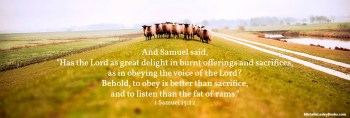
Why? Because Saul was going to offer some of those sheep he spared in a grand and showy sacrifice to the Lord. He was going to “do great things for God” and, in his mind, that was far better and more glorious than simple obedience to God’s explicit command.

By contrast, God says David was “a man after my heart, who will do all my will.” David sought the Lord and obeyed His words.

But David had a dream, too. He loved God deeply and wanted to do something big to honor Him.

“See now, I dwell in a house of cedar,” David said, “but the ark of God dwells in a tent.” David wanted to build a grand and glorious house for God.

It was a good dream. A dream that stemmed from godly motives. A dream that was, in reality, part of God’s plan.

But God said, “No.” Because it wasn’t God’s plan for David.

Sometimes there are things we want to do for God in life or in ministry because our hearts are fairly bursting with love for Him. Nothing small or insignificant will suffice – we want to do great things for Him because He has done so many great things for us.

Can I just tell you – that heart is what is most precious to God, not whatever it is you can dream up to do for Him. Every parent who’s ever received a clay ashtray or a bedraggled dandelion from her five year old knows this. We love the heart of our child who wants to show her love for us, even if the gift itself isn’t quite right.

And just like you would have to tell your five year old no if she wanted to demonstrate her love for you by having the family skip church on Sunday so she could cook you a four course brunch, God sometimes has to say no to the things we want to do for Him because those things – even though motivated by love for Him – conflict with His word, are out of sync with His timing, or aren’t His specific plan for us, personally.

It might be your heart’s deepest desire to serve God as the perfect Proverbs 31 wife…and God says no by declining to provide you with a husband. Maybe it’s always been your dream to raise a house full of children in the nurture and admonition of the Lord…and God says no by preventing you from bearing or adopting children. “I’ve always loved to tell people about Jesus,” you think, “Surely He’s calling me to be a pastor.”…and God says no in His word because that’s not His plan for Christian women.

God said no to David, too. It wasn’t the right time. It didn’t fit with what God was trying to accomplish in Israel at that moment. And David wasn’t the right man for the job. God had other things He wanted David to do.

How did David respond when God said no? Did he push forward with his own plans and build the temple anyway? Spend the rest of his life sulking or angry at God? Turn away from God all together?

No. David responded with humility that God would use him in any way, joy over God’s love and blessings, and thanksgiving for God’s plans and promises.

That’s what a heart that truly loves God does. It obeys Him. It finds joy in any task He might bring our way. It is thankful and humbled that God takes any notice of us whatsoever and lavishes His grace and mercy upon us by allowing us to do what He wants us to do.

God didn’t allow David to build the temple. God didn’t allow me to become a top Christian recording artist. Maybe there’s something God isn’t allowing you to do. Will you joyfully obey Him in the things He does have planned for you? Will you be thankful and humbled that He desires to use you as part of His good plans and purposes even if those plans and purposes don’t match your own?

May we all follow David’s example – and the Greater David’s example – by saying, meaning, and living out, “Not my will but Thy will be done,” even when God says no.


Additional Resources:

How do I move on after God says “no”?

Mark Bible Study

Mark: Lesson 15

Previous Lessons: 1, 2, 3, 4, 5, 6, 7, 8, 9, 10, 11, 12, 13, 14

Mark 10:32-52

And they were on the road, going up to Jerusalem, and Jesus was walking ahead of them. And they were amazed, and those who followed were afraid. And taking the twelve again, he began to tell them what was to happen to him, 33 saying, “See, we are going up to Jerusalem, and the Son of Man will be delivered over to the chief priests and the scribes, and they will condemn him to death and deliver him over to the Gentiles. 34 And they will mock him and spit on him, and flog him and kill him. And after three days he will rise.”

35 And James and John, the sons of Zebedee, came up to him and said to him, “Teacher, we want you to do for us whatever we ask of you.” 36 And he said to them, “What do you want me to do for you?” 37 And they said to him, “Grant us to sit, one at your right hand and one at your left, in your glory.” 38 Jesus said to them, “You do not know what you are asking. Are you able to drink the cup that I drink, or to be baptized with the baptism with which I am baptized?” 39 And they said to him, “We are able.” And Jesus said to them, “The cup that I drink you will drink, and with the baptism with which I am baptized, you will be baptized, 40 but to sit at my right hand or at my left is not mine to grant, but it is for those for whom it has been prepared.” 41 And when the ten heard it, they began to be indignant at James and John. 42 And Jesus called them to him and said to them, “You know that those who are considered rulers of the Gentiles lord it over them, and their great ones exercise authority over them. 43 But it shall not be so among you. But whoever would be great among you must be your servant, 44 and whoever would be first among you must be slave of all. 45 For even the Son of Man came not to be served but to serve, and to give his life as a ransom for many.”

46 And they came to Jericho. And as he was leaving Jericho with his disciples and a great crowd, Bartimaeus, a blind beggar, the son of Timaeus, was sitting by the roadside. 47 And when he heard that it was Jesus of Nazareth, he began to cry out and say, “Jesus, Son of David, have mercy on me!” 48 And many rebuked him, telling him to be silent. But he cried out all the more, “Son of David, have mercy on me!” 49 And Jesus stopped and said, “Call him.” And they called the blind man, saying to him, “Take heart. Get up; he is calling you.” 50 And throwing off his cloak, he sprang up and came to Jesus. 51 And Jesus said to him, “What do you want me to do for you?” And the blind man said to him, “Rabbi, let me recover my sight.” 52 And Jesus said to him, “Go your way; your faith has made you well.” And immediately he recovered his sight and followed him on the way.


The Holy Bible, English Standard Version. ESV® Permanent Text Edition® (2016). Copyright © 2001 by Crossway Bibles, a publishing ministry of Good News Publishers.


Questions to Consider

1. In verse 32, why would the disciples and others following Jesus have been “amazed” and “afraid” that He was heading to Jerusalem? (Hint- Examine verse 32 in light of Mark 8:31. Where was the “headquarters” of the elders, chief priests, and scribes located?) Why do you think he took the Twelve aside to explain things instead of telling the whole crowd? (32)

2. Re-read verses 32-34 as though you were one of the disciples, then as though you’re a first century Gentile. How would you understand and respond to what Jesus is saying here? How might a disciple’s understanding and response have differed from a Gentile’s? How many times is this now, in Mark, that Jesus has predicted His death and resurrection?

3. Examine verses 35-45. What did James and John have to already believe about who Jesus was, His authority, position, etc., in order to make the request they made in verse 37? How was this request a demonstration of their knowledge of and faith in Christ and their ignorance (38-40) at the same time? What might have motivated them to make this request?

4. In verse 38, is Jesus talking about a literal drink and cup and a literal water baptism, or is this a metaphor for what He has just explained to the disciples in verses 33-34? When James and John replied, “We are able,” (39) do you think they were speaking more out of haughtiness, loyalty to Christ, or ignorance of what the “cup” and “baptism” would entail? How might the other 10 disciples have answered that question? (41) Considering some of the things that happened to both James and John during the church era, what did Jesus’ statement to them in verse 39 mean?

5. Summarize in your own words the main point Jesus was trying to get across to the disciples in verses 42-45. What would it have meant to first century Jews and Gentiles – for whom servants and slavery was a normal part of daily life – to hear that humility, self-abasement, and serving others is what God considers great? In what ways – then and now – is this the complete opposite of the world’s mindset? In what ways has the worldly mindset (of being “great” or “first”) crept into the church? How does 1 John 2:15 fit in this situation? In what practical ways, in your church or individually, could you follow Jesus’ example that He “came not to be served but to serve”? In addition to giving His life for our sins, what are some ways Jesus served others during His earthly ministry?

6. Study verses 46-52. Consider Bartimaeus’ social status as a blind beggar. (46,48) What did Bartimaeus have to offer Jesus for his healing? How do Jesus’ words and actions toward lowly Bartimaeus demonstrate what He taught the disciples in verses 42-45? In Lesson 14 (link above) we saw another group of people rebuked and sent away from seeing Jesus as Bartimaeus was. Who were those people? How does Jesus usually respond in the gospels when the disciples try to send away those they think aren’t important enough to see Jesus or would bother Him? What does Jesus’ compassion and willingness to be associated with the lowly tell us about the nature and character of God?

7. What were some things Bartimaeus already knew about Jesus that caused him to call out to Jesus? What else (51) might Bartimaeus have heard about Jesus that motivated him to approach Him? What are some adverbs (timidly, loudly, tentatively, persistently, etc.) you could use to describe the way Bartimaeus cried out and came to Jesus? (47-48,50-51) Why did Bartimaeus call Jesus “Son of David” (47-48)? How did this indicate Bartimaeus’ faith (52) that Jesus was the Messiah? Did Bartimaeus do any of the work of his healing, or did Jesus do all the work? How did Bartimaeus’ response to his healing (52) serve as proof of his faith?

8. What are some of the aspects of Bartimaeus’ story in 46-52 that serve as a reflection of the way Christ saves sinners? Think about Who initiates salvation (46, 49), how the sinner comes to Christ as a blind beggar with nothing to offer Him (46), hearing the gospel, understanding who Jesus is and what He can do for sinners (47-48), Christ’s call (49) and the sinner’s response (50), our confession of faith in Christ to save us (51), the fact that salvation is totally dependent on, and performed by, Christ- we contribute nothing (52), and our response to God graciously saving us (52).

9. Compare and contrast the way Bartimaeus came to Christ with the way the rich young ruler came to Christ in Lesson 14 (link above). How were their social statuses different? How were their needs similar? In what attitude of heart did each approach Christ? How did each respond to Christ? Do you know anyone who has responded to the gospel like the rich young ruler did? Like Bartimaeus did? What about your own response to Christ’s call to salvation- was it more like the rich young ruler or Bartimaeus?


Homework

Go to the website of one of the larger U.S. Christian retailers (LifeWay, Mardel, Parable, etc.) and examine their book selection in light of verses 42-45. Are there more books on leadership, success, growing a large ministry, etc., or more books that would seem to match what Jesus is teaching in this passage: servanthood, anonymity, humility, thankless work? Think of one anonymous way you could serve your church, a neighbor, a co-worker, a family member, or a friend this week, and follow in Christ’s footsteps of serving rather than being served.


Suggested Memory Verse

“For even the Son of Man came not to be served but to serve, and to give his life as a ransom for many.”
Mark 10:45

Obedience, Sanctification

When God Says No

When I was sixteen years old, I was convinced God was calling me to be the next Sandi Patty…I wanted God to use me- to put me on a stage every night in front of thousands of people so I could sing to them about Him…Somehow, it never occurred to me to care what God thought about all this or what He might want to do in my life. If I thought about it at all, I just assumed He was on board with my plans. Like, how could He not be, right?¹

There’s much ado about dreaming big dreams for God in modern evangelicalism. Think of the biggest thing you want to do for God and then “step out on faith” and make it happen. Sometimes we’re even told God is offended if our dreams aren’t big enough. It means we don’t have enough faith. It means we don’t believe God – or love Him – enough.

Or does it?

If you study through the books of 1 and 2 Samuel, you’re going to get to know Saul and David pretty well. And as you observe and compare their words, their behavior, and their interactions with God, a major theme that jumps out is obedience to God’s word versus doing what’s right in your own eyes.

Saul was an “I did it my way,” kind of guy. Time and again, he looked out for number one. Tried to build up his own kingdom. Did what he thought was best.

In 1 Samuel 15, God told Saul to utterly destroy the Amalekites. Everything. Every living creature and all their stuff. All means all.

But Saul had big dreams. So, he destroyed all the worthless stuff and all the people, but he saved the king and all the valuables. He disobeyed God’s clear word in favor of what he wanted to do.

Here’s the interesting part, though. When Samuel showed up and said, “Why did you disobey the Lord?” Saul said, not once, but twice, “I did obey the Lord.”

Why? Because Saul was going to offer some of those sheep he spared in a grand and showy sacrifice to the Lord. He was going to “do great things for God” and, in his mind, that was far better and more glorious than simple obedience to God’s explicit command.

By contrast, God says David was “a man after my heart, who will do all my will.” David sought the Lord and obeyed His words.

But David had a dream, too. He loved God deeply and wanted to do something big to honor Him.

“See now, I dwell in a house of cedar,” David said, “but the ark of God dwells in a tent.” David wanted to build a grand and glorious house for God.

It was a good dream. A dream that stemmed from godly motives. A dream that was, in reality, part of God’s plan.

But God said, “No.” Because it wasn’t God’s plan for David.

Sometimes there are things we want to do for God in life or in ministry because our hearts are fairly bursting with love for Him. Nothing small or insignificant will suffice – we want to do great things for Him because He has done so many great things for us.

Can I just tell you – that heart is what is most precious to God, not whatever it is you can dream up to do for Him. Every parent who’s ever received a clay ashtray or a bedraggled dandelion from her five year old knows this. We love the heart of our child who wants to show her love for us, even if the gift itself isn’t quite right.

And just like you would have to tell your five year old no if she wanted to demonstrate her love for you by having the family skip church on Sunday so she could cook you a four course brunch, God sometimes has to say no to the things we want to do for Him because those things – even though motivated by love for Him – conflict with His word, are out of sync with His timing, or aren’t His specific plan for us, personally.

It might be your heart’s deepest desire to serve God as the perfect Proverbs 31 wife…and God says no by declining to provide you with a husband. Maybe it’s always been your dream to raise a house full of children in the nurture and admonition of the Lord…and God says no by preventing you from bearing or adopting children. “I’ve always loved to tell people about Jesus,” you think, “Surely He’s calling me to be a pastor.”…and God says no in His word because that’s not His plan for Christian women.

God said no to David, too. It wasn’t the right time. It didn’t fit with what God was trying to accomplish in Israel at that moment. And David wasn’t the right man for the job. God had other things He wanted David to do.

How did David respond when God said no? Did he push forward with his own plans and build the temple anyway? Spend the rest of his life sulking or angry at God? Turn away from God all together?

No. David responded with humility that God would use him in any way, joy over God’s love and blessings, and thanksgiving for God’s plans and promises.

That’s what a heart that truly loves God does. It obeys Him. It finds joy in any task He might bring our way. It is thankful and humbled that God takes any notice of us whatsoever and lavishes His grace and mercy upon us by allowing us to do what He wants us to do.

God didn’t allow David to build the temple. God didn’t allow me to become a top Christian recording artist. Maybe there’s something God isn’t allowing you to do. Will you joyfully obey Him in the things He does have planned for you? Will you be thankful and humbled that He desires to use you as part of His good plans and purposes even if those plans and purposes don’t match your own?

May we all follow David’s example – and the Greater David’s example – by saying, meaning, and living out, “Not my will but Thy will be done,” even when God says no.


Additional Resources:

How do I move on after God says “no”?

Ministry, Throwback Thursday

Used by God

When I was sixteen years old, I was convinced God was calling me to be the next Sandi Patty (if you’re under 40, she was the Kari Jobe of my day). I had been singing solos and in church choirs since I was in the second grade. I was taking professional voice lessons and spent my first year of college as a vocal performance major.

Not to toot my own horn here, but, while I’m not the greatest singer in the world, certainly not even in the top 10 percent, I’m also not one of those people you see during the audition rounds of American Idol who makes you want to conduct a nationwide manhunt for every person who ever lied to this poor soul and told her she could sing just so you can beat all of them senseless with a pitch pipe.

But anyway…

I had a modicum of talent, and I wanted to put it to work doing “great things for the Lord.” I wanted God to use me- to put me on a stage every night in front of thousands of people so I could sing to them about Him.

Paragon of adolescent spiritual maturity that I was, it somehow never occurred to me to care what God thought about all this or what He might want to do in my life. If I thought about it at all, I just assumed He was on board with my plans. Like, how could He not be, right?

It somehow never occurred to me to care what God thought about all this or what He might want to do in my life. If I thought about it at all, I just assumed He was on board with my plans. Like, how could He not be, right?

Because even in my day, that was the subtle message that was coming from the pulpit (and Christian media) and landing in the pew: If you really love Jesus and prove it by walking faithfully with Him, He’s going to use you to do some big, fat, awesome thing for Him. You’ll be the next David or Esther or Paul or Mary, and your name will go down in history just like theirs did. You’ll be famous, dahling.

Only I’m not really sure where Christian preachers, authors, and entertainers got this idea, because it sure as heck isn’t in the Bible.

The Bible knows nothing of the idea that we can behave our way into getting God to “use” us in some big way.

The Bible knows nothing of the idea that we can behave our way into getting God to “use” us in some big way. Quite the opposite, in fact. Take a look at some of the “big names” in the Bible and what they were up to when God drafted them.

Noah- just a godly guy trying to survive a sin sick world

Moses- on the lam for murder and hanging out in the desert with a bunch of sheep

Paul- Christian-killer

David- more sheep

Gideon- just trying to feed his family

Peter- gone fishin’

Abraham- even more sheep

Were some of these guys walking faithfully with the Lord? Absolutely. But they were walking faithfully simply because they loved the Lord and desired to please Him, not with the goal of getting God to do some big thing in their lives. In fact, most of them were downright shocked when God showed up and revealed His plans for them.

They were walking faithfully simply because they loved the Lord and desired to please Him, not with the goal of getting God to do some big thing in their lives.

And have you ever noticed that God doesn’t just use “good guys,” or guys who eventually become “good guys”? Ever read the story of Samson? Going strictly by his words and behavior mentioned in Judges 14-16, the dude comes off as a self-centered, slobbering ball of lust with anger management issues. Yet, knowing all about him before he was even born, God said He would use Samson to “…begin to save Israel from the hand of the Philistines.”

And what about Pharaoh? In Exodus 9:16, God says to Pharaoh, “But for this purpose I have raised you up, to show you my power, so that my name may be proclaimed in all the earth.” The plagues…the parting of the Red Sea…I’d say God used Pharoah for His glory in a pretty big way.

God can use anybody He wants for any purpose He wants, and He’s not at the mercy of their behavior in doing so.

God can use anybody He wants for any purpose He wants, and He’s not at the mercy of their behavior in doing so.

What do we mean when we say we want to be “used by God,” anyway? I think what we often have in mind is something awesome, something grandiose. Something that will bring us fame, fortune, and glory. I’ve never heard someone say she wanted God to use her for His glory like God used Job.

Or, for that matter, Jesus.

What do we mean when we say we want to be “used by God,” anyway?

The greatest event in the universe, the one that brought God more glory than any other phenomenon in the history of ever, was also the most excruciating moment of sorrow and suffering eternity has ever known: the crucifixion of Christ for our sin.

When we say we want God to use us, we want the stupendous, not the suffering. The crown, not the cross. Yet it is often in suffering that God is most glorified. So, just whose glory is it we’re seeking, again?

When we say we want God to use us, we want the stupendous, not the suffering. The crown, not the cross. Yet it is often in suffering that God is most glorified.

If you live your life clamoring after God to make you an Esther or a Paul, or a Sandi Patty or a Billy Graham, you are almost certainly going to be disappointed. And not just because there are only a handful of “big name” God-followers out there compared to the nameless millions who have followed Him faithfully in obscurity, but because being used by God in some big, ostentatious way is not what He calls us to clamor after.

When you stand in front of God on the Day of Judgment, He’s not going to say, “Well done. You did some phenomenal things for Me that people are still talking about!” He’s going to say, “Well done, good and faithful servant.”

Faithful servants aren’t out to change the world, they just obey. They go where they’re told to go. They do what they’re told to do. And they do it to honor their masters.

For servants of Christ, most of the time that means getting up every day and doing the same humble tasks over and over for a lifetime: cooking meals, going to work, changing diapers, serving the church, cleaning the house. You know, servant stuff, all done to the glory of God. This is what God calls us to.

God doesn’t call us to seek to be used, He calls us to seek to be faithful.

“So you also, when you have done all that you were commanded, say, ‘We are unworthy servants; we have only done what was our duty’.”

Luke 17:10

The famous people mentioned in this article are mentioned for frame of reference purposes only – because they are recognizable names with large platforms in evangelicalism – not because I’m recommending you follow them. I am aware of the biblical issues with each of them.


Originally published (in another publication) April 9, 2015