Biblical Womanhood Bible Study, Reformation Day

Imperishable Beauty: RefHERmation Day Bonus Lesson

Previous Lessons: 1, 2, 3, 4, 5, 6

Happy Reformation Day!

For those of us working through this study in real time*, today is Reformation Day. I recently commended (again) to my readers Rebecca VanDoodewaard’s excellent book, Reformation Women, and I thought, “What better way to celebrate Reformation Day and biblical womanhood than to combine the two?”. So, today, we’re going to take a look at some women in Reformation history and in biblical history who exemplified biblical womanhood by influencing others toward godliness.

(*If you’re behind in your lessons, it’s OK to use this week as a catch up week and save today’s lesson for another day.

*If you’re working through this study or teaching it to a class at a later date you may want to skip this lesson, use it as supplementary or bonus material, or leave it for the end of the study.)


Choose any of the women below and read their stories (click on their names). Then consider the following questions:

1. In what ways did this woman exemplify biblical womanhood in her culture, context, circumstances, family situation, or church?

2. Which godly character traits or Fruit of the Spirit were especially obvious in her life, words, and actions?

3. Which Scripture passages come to mind as you read this woman’s story? In what ways did she live these Scriptures out (or fail to live them out)?

4. Are there any instances of sin in this woman’s story? If so, how can you learn from what she did wrong and avoid this sin in your own life?

5. How does this woman set a godly example that you can apply to your own life?

6. In what ways did this woman point someone to Jesus, serve the Kingdom, or help God’s people?

Women of the Bible

Esther

Ruth

Abigail

Deborah and Jael

Miriam

Mary

Priscilla

Lydia

Dorcas

Women of the Reformation

Catherine dโ€™Bourbon

Jeanne Dโ€™Albret

Marguerite de Navarre

Katharina Schutz Zell

Anna Adlischweiler

Anna Reinhard

Katharina von Bora Luther


Homework

Think of some ways you can bloom where God has planted you to serve your family, your church, and the Kingdom as a woman of the modern day Reformation.

Church

Twelve Songs for Reformation Day

Reformation Day, October 31, is the annual observance of the anniversary of the Protestant Reformation. Celebrate the day with these songs showcasing each of the Five Solas of the Reformation, or use them as a guide for your Reformation Sunday worship set. (I’ve also compiled the videos below into a YouTube playlist entitled Reformation Day.) Soli Deo Gloria!

Sola Scriptura

Scripture alone – not church traditions, the teachings of man, or extra-biblical revelation – is what we base our beliefs and worship practices on.

O Word of God, Incarnate

The B-I-B-L-E

Sola Fide

We are not saved by good works, by by faith alone.

On Faith Alone I Stand

Let Us Plead for Faith Alone – Sola Fide

Sola Gratia

We are saved by God’s grace alone, not by any merit or righteousness of our own.

Grace Alone

Grace Greater Than Our Sin

Solus Christus

There is salvation in no other name but that of Christ alone.

In Christ Alone

The Church’s One Foundation

Soli Deo Gloria

To God alone be the glory for our salvation!

Soli Deo Gloria

Glorious is Thy Name

๐ŸŒท๐ŸŒท๐ŸŒท๐ŸŒท๐ŸŒท

Reformation Hymn

A Mighty Fortress is Our God

What’s your favorite Reformation Day song?

Additional Resources:

Reformation Hymns by Scott Aniol


I have not exhaustively vetted these musicians and songwriters. please make sure to examine against Scripture any of them you choose to follow and make sure they are doctrinally sound.

Calvinism/Arminianism, Mailbag

The Mailbag: What is Reformation Day?

The Protestant Reformation. Outside of biblically recorded events and the closing of the canon of Scripture, it is arguably the most important event in church history, and one of the most important events in world history as well, yet many Christians today are unaware of this landmark incident in their heritage which birthed the Protestant church.

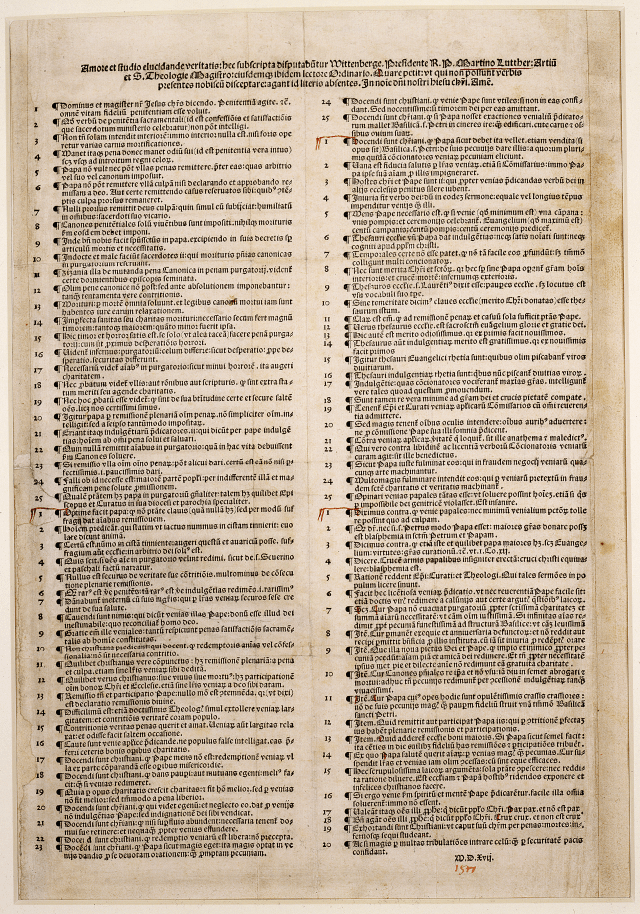
The year was 1517. A monk named Martin Luther gripped his hammer and nailed a list of biblical grievances against the Roman Catholic Church to the door of Castle Church in Wittenberg, Germany, much like we might post a notice to a community bulletin board today. These 95 Theses protested the Catholic Churchโ€™s unbiblical policy of selling indulgences,  part of an effort to raise funds for the building of St. Peterโ€™s Basilica in Rome. The Catholic Church had created the idea of the Treasury of Merit, sort of a โ€œbank accountโ€ of merit deposited by Christ, Mary, the saints, and others as a result of their good works. When church members sinned, they could purchase an indulgence, which was akin to asking the Church to โ€œtransfer fundsโ€ from the Treasury of Merit to the sinnerโ€™s account. The indulgence basically excused the sinner from a certain amount of time in purgatory and/or temporal punishment for that sin.

In addition to protesting the sale of indulgences, Lutherโ€™s 95 Theses called the Catholic Church to conform to Scripture by abandoning its unbiblical practices and teachings regarding the doctrines of salvation, religious authority, the nature of the church, and the essence of Christian living.

Lutherโ€™s calls for reform spread quickly throughout Europe, inspiring the likes of church fathers Ulrich Zwingli (Zurich), John Calvin (Geneva), and John Knox (Scotland) to join the effort in their own locales. As they worked to address the issues raised in Lutherโ€™s document, these men codified what we know today as the โ€œFive Solas of the Reformation,โ€ the basis of Protestant church doctrine. The five solas are:

1. Sola Scripturaโ€“ Scripture alone is the basis for all church doctrine, belief, and practice. (2 Timothy 3:16-17)

2. Sola Gratiaโ€“ Salvation is by grace alone. It is an unmerited gift of God based solely on His goodness, not our own (because we donโ€™t have any). (Ephesians 2:8-9)

3. Sola Fideโ€“ Salvation is through faith alone. Faith is a gift bestowed by God. We are saved only by placing that faith in Christโ€™s finished work on the cross, not by doing good works or by any other attempts to earn salvation. (Ephesians 2:8-9)

4. Solus Christusโ€“ Salvation is found in Christ alone. As Acts 4:12 says, โ€œAnd there is salvation in no one else, for there is no other name under heaven given among men by which we must be saved.โ€

5. Soli Deo Gloriaโ€“ God saves man for Godโ€™s glory alone, and Believers are to live our lives to glorify Him alone. (Romans 11:36)

One of Lutherโ€™s most cherished ideals, from which we still benefit today, was that common people should have access to both the Scriptures and worship services in their own language. Prior to the Reformation, the Bible was only available in Latin. Likewise, all masses and other church services were conducted in Latin. Luther translated the Bible into German, and was later followed by William Tyndale, Myles Coverdale, David Brainerd, and others who translated the Bible into various languages.

On Reformation Day, we commemorate the work, zeal, and sacrifices of Luther and the other reformers. Reformation Day is observed on October 31.


Additional Resources:

Why do we celebrate Reformation Day? – A Word Fitly Spoken

What are the 95 Theses of Martin Luther? – Got Questions

Why Weโ€™re Protestant: The Five Solas of the Reformation and Why They Matter by Nate Pickowicz

Luther: In Real Time (podcast)-  Ligonier Ministries

Reformation Resources to Feed your Heart and Mind– G3 Ministries

Calvinism/Arminianism, Throwback Thursday

Throwback Thursday ~ What is Reformation Day?

Originally published at
Satisfaction Through Christ
on October 10, 2014.

reformation day

The Protestant Reformation. Outside of Biblically recorded events and the closing of the canon of Scripture, it is arguably the most important event in church history, and one of the most important events in world history as well, yet many Christians today are unaware of this landmark incident in their heritage which birthed the Protestant church.

The year was 1517. A monk named Martin Luther gripped his hammer and nailed a list of biblical grievances against the Roman Catholic Church to the door of Castle Church in Wittenberg, Germany, much like we might post a notice to a community bulletin board today. These 95 Thesesย protested the Catholic Churchโ€™s unbiblical policy of selling indulgences, ย part of an effort to raise funds for the building of St. Peterโ€™s Basilica in Rome. The Catholic Church had created the idea of the Treasury of Merit, sort of a โ€œbank accountโ€ of merit deposited by Christ, Mary, the saints, and others as a result of their good works. When church members sinned, they could purchase an indulgence, which was akin to asking the Church to โ€œtransfer fundsโ€ from the Treasury of Merit to the sinnerโ€™s account. The indulgence basically excused the sinner from a certain amount of time in purgatory and/or temporal punishment for that sin.

In addition to protesting the sale of indulgences, Lutherโ€™s 95 Theses called the Catholic Church to conform to Scripture by abandoning its unbiblical practices and teachings regarding the doctrines of salvation, religious authority, the nature of the church, and the essence of Christian living.

95Thesen

Lutherโ€™s calls for reform spread quickly throughout Europe, inspiring the likes of church fathers Ulrich Zwingli (Zurich), John Calvin (Geneva), and John Knox (Scotland) to join the effort in their own locales. As they worked to address the issues raised in Lutherโ€™s document, these men codified what we know today as the โ€œFive Solas of the Reformation,โ€ the basis of Protestant church doctrine. The five solas are:

1. Sola Scripturaโ€“ Scripture alone is the basis for all church doctrine, belief, and practice. (2 Timothy 3:16-17)

2. Sola Gratiaโ€“ Salvation is by grace alone. It is an unmerited gift of God based solely on His goodness, not our own (because we donโ€™t have any). (Ephesians 2:8-9)

3. Sola Fideโ€“ Salvation is through faith alone. Faith is a gift bestowed by God. We are saved only by placing that faith in Christโ€™s finished work on the cross, not by doing good works or by any other attempts to earn salvation. (Ephesians 2:8-9)

4. Solus Christusโ€“ Salvation is found in Christ alone. As Acts 4:12 says, โ€œAnd there is salvation inย noย one else, for there isย noย other nameย under heaven given among men by which we must be saved.โ€

5. Soli Deo Gloriaโ€“ God saves man for Godโ€™s glory alone, and Believers are to live our lives to glorify Him alone. (Romans 11:36)

One of Lutherโ€™s most cherished ideals, from which we still benefit today, was that common people should have access to both the Scriptures and worship services in their own language. Prior to the Reformation, the Bible was only available in Latin. Likewise, all masses and other church services were conducted in Latin. Luther translated the Bible into German, and was later followed by William Tyndale, Myles Coverdale, David Brainerd, and others who translated the Bible into various languages.

On Reformation Day, we commemorate the work, zeal, and sacrifices of Luther and the other reformers. Reformation Day is observed on October 31.