Holidays (Other), Reformation Day

The Mailbag: What is Reformation Day?

Reformation Day is Friday, October 31.

Originally published October 10, 2014

The Protestant Reformation. Outside of biblically recorded events and the closing of the canon of Scripture, it is arguably the most important event in church history, and one of the most important events in world history as well, yet many Christians today are unaware of this landmark incident in their heritage which birthed the Protestant church.

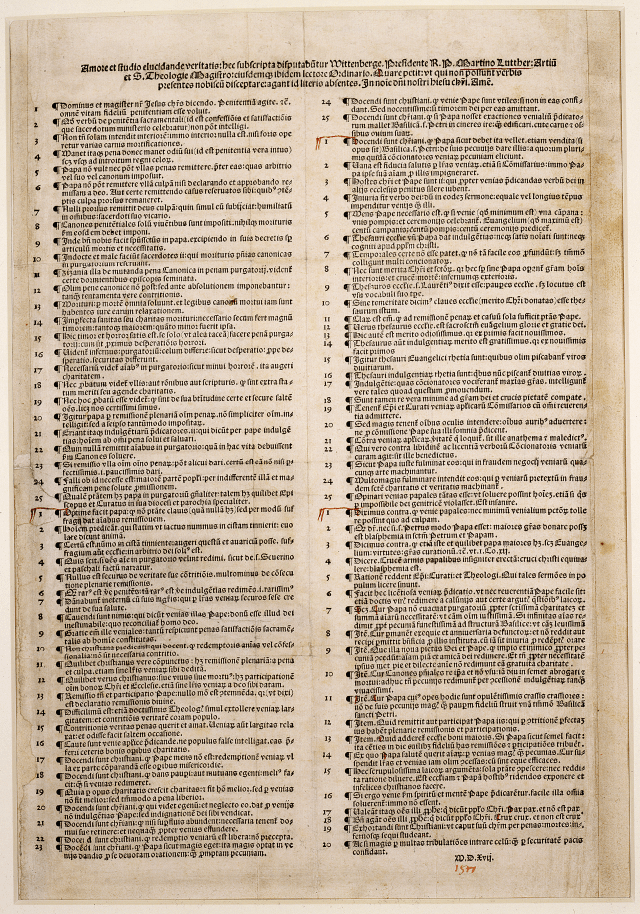
The year was 1517. A monk named Martin Luther gripped his hammer and nailed a list of biblical grievances against the Roman Catholic Church to the door of Castle Church in Wittenberg, Germany, much like we might post a notice to a community bulletin board today. These 95 Theses protested the Catholic Churchโ€™s unbiblical policy of selling indulgences,  part of an effort to raise funds for the building of St. Peterโ€™s Basilica in Rome. The Catholic Church had created the idea of the Treasury of Merit, sort of a โ€œbank accountโ€ of merit deposited by Christ, Mary, the saints, and others as a result of their good works. When church members sinned, they could purchase an indulgence, which was akin to asking the Church to โ€œtransfer fundsโ€ from the Treasury of Merit to the sinnerโ€™s account. The indulgence basically excused the sinner from a certain amount of time in purgatory and/or temporal punishment for that sin.

In addition to protesting the sale of indulgences, Lutherโ€™s 95 Theses called the Catholic Church to conform to Scripture by abandoning its unbiblical practices and teachings regarding the doctrines of salvation, religious authority, the nature of the church, and the essence of Christian living.

Lutherโ€™s calls for reform spread quickly throughout Europe, inspiring the likes of church fathers Ulrich Zwingli (Zurich), John Calvin (Geneva), and John Knox (Scotland) to join the effort in their own locales. As they worked to address the issues raised in Lutherโ€™s document, these men codified what we know today as the โ€œFive Solas of the Reformation,โ€ the basis of Protestant church doctrine. The five solas are:

1. Sola Scripturaโ€“ Scripture alone is the basis for all church doctrine, belief, and practice. (2 Timothy 3:16-17)

2. Sola Gratiaโ€“ Salvation is by grace alone. It is an unmerited gift of God based solely on His goodness, not our own (because we donโ€™t have any). (Ephesians 2:8-9)

3. Sola Fideโ€“ Salvation is through faith alone. Faith is a gift bestowed by God. We are saved only by placing that faith in Christโ€™s finished work on the cross, not by doing good works or by any other attempts to earn salvation. (Ephesians 2:8-9)

4. Solus Christusโ€“ Salvation is found in Christ alone. As Acts 4:12 says, โ€œAnd there is salvation in no one else, for there is no other name under heaven given among men by which we must be saved.โ€

5. Soli Deo Gloriaโ€“ God saves man for Godโ€™s glory alone, and Believers are to live our lives to glorify Him alone. (Romans 11:36)

One of Lutherโ€™s most cherished ideals, from which we still benefit today, was that common people should have access to both the Scriptures and worship services in their own language. Prior to the Reformation, the Bible was only available in Latin. Likewise, all masses and other church services were conducted in Latin. Luther translated the Bible into German, and was later followed by William Tyndale, Myles Coverdale, David Brainerd, and others who translated the Bible into various languages.

On Reformation Day, we commemorate the work, zeal, and sacrifices of Luther and the other reformers. Reformation Day is observed on October 31.


Additional Resources:

Why do we celebrate Reformation Day? – A Word Fitly Spoken

What are the 95 Theses of Martin Luther? – Got Questions

Why Weโ€™re Protestant: The Five Solas of the Reformation and Why They Matter by Nate Pickowicz

Luther: In Real Time (podcast)-  Ligonier Ministries

Reformation Resources to Feed your Heart and Mind– G3 Ministries

Guest Posts, Holidays (Other), Reformation Day

Guest Post: The Reformation – An Invitation to the Gospel

If your theology pretty much matches up with mine (as outlined in the โ€œWelcomeโ€ and โ€œStatement of Faithโ€ tabs) and youโ€™d like to contribute a guest post, drop me an e-mail at MichelleLesley1@yahoo.com,
and letโ€™s chat about it.

The Reformation: An Invitation to the Gospel
by Matt Shown

For most, October 31 is about costumes and candy. But something far more frightening and weighty is also celebrated on that day. October 31 is Reformation Day. On October 31, 1517, a hammer strike would echo through centuries – in fact, the echo is still reverberating today. In 1517, Martin Luther would nail his ninety-five theses to the church door in Wittenberg, Germany sparking the Protestant Reformation that shaped Christian history.

The Reformers sought to bring the church back under the authority of Godโ€™s Word. This wasnโ€™t to say tradition had no value, but rather that the sole โ€œGod-breathedโ€ authority for any believer was not the word of Popes or councils, but the words of the Bible. The Reformers echoed the conviction of Jesus when He responded to the Sadducees in His day, โ€œHave you not read what was said to you by God?โ€ (Matthew 22:31). The words on the pages of Scriptures were Godโ€™s very Word- God breathed and sufficient to equip believers to do every good work (2 Timothy 3:16-17). Sola Scriptura – that Scripture alone is the supreme authority for faith and practice was the formal, or foundational, principle that sparked the Reformation.

But there was a second principle – a material principle- that dealt with the content of the gospel. This material principle was called sola fide. Sola fide was the confession that faith alone was the way in which mankind can be in right relationship with God. By grace alone through faith alone in Jesus Christ alone mankind can be justified, which means to be set in a right relationship with God. Romans 4:5 tells us, โ€œAnd to the one who does not work but believes in him who justifies the ungodly, his faith is counted as righteousness.โ€ John 3:16, the most popular verse in the Bible, reminds us, โ€œFor God so loved the world, that he gave his only Son, that whoever believes in him should not perish but have eternal life.โ€

Many misunderstand what sola fide means because we misunderstand what faith is. Faith is not a blind leap into the dark. Faith isnโ€™t separate from repentance of sin (Mark 1:15). Faith isnโ€™t simply beliefs in our head, but transformation of our head, heart, and will. Biblical faith is conviction rooted in assurance (Hebrews 11:1, Romans 4:21). It isnโ€™t the empty profession that James 2 illustrates. Faith isnโ€™t walking an aisle at church on Sunday and walking in darkness Monday through Saturday. Saving faith is conviction rooted in assurance that Godโ€™s Word is true. It is marked by a transformation of self (2 Corinthians 5:17).

Jesus illustrates saving faith in parable about a tax collector and the Pharisee. Luke tells us he told this parable to those who trusted in themselves that they were righteous, and we may be surprised what self-righteousness looks like. Both men entered the temple to pray, and the Pharisee gave lip service to Godโ€™s grace, โ€œGod, I thank you that I am not like other men, extortioners, unjust, adulterers, or even like this tax collector. I fast twice a week; I give tithes of all that I getโ€ (Luke 18:11-12). He recognizes Godโ€™s grace, yet ultimately found hope in his own works. While the tax collector displays reverence toward God by bowing his head and praying a simple prayer, โ€œGod, be merciful to me, a sinner!โ€ The Pharisee recognizes Godโ€™s grace, the tax collector relied on it. It was the one who relied on Godโ€™s grace, through faith, that went home justified, not the man who simply gave lip service to grace while trusting in himself.

This is an illustration of why the Reformation matters. The church was making men into Pharisees rather than into justified tax collectors. The message of the Reformation was to cease simply recognizing grace, and to instead rely on it. The message was a confession of mankindโ€™s ungodliness, Godโ€™s incomprehensible holiness, and the sufficiency of Jesusโ€™ cross and empty tomb to save!

The Reformation is an opportunity to, by faith alone, rely on Godโ€™s grace. It is an opportunity to trust the promises of God in His Word because the Bible is enough for us. It is an opportunity to let go of unbiblical traditions and to embrace the apostolic traditions found in the pages of Godโ€™s Word. The Reformation is an invitation to the reader who may not have assurance of their relationship with God. It is an invitation to assurance through faith in Jesus Christ.

โ€œHow can I be right with God?โ€ There is no more important question. It is that question that ignited the Reformation and it is a question all of us must answer.


Matt Shown has served as a bi-vocational pastor and church revitalizer for the past 4 1/2 years. He loves God’s Word, good preaching, and Mac N Cheese. He is married to his incredible wife Dana. Matt received his Master of Divinity degree from the Southern Baptist Theological Seminary. He blogs at http://www.ShowntheWay.Wordpress.com.

Biblical Womanhood Bible Study, Reformation Day

Imperishable Beauty: RefHERmation Day Bonus Lesson

Previous Lessons: 1, 2, 3, 4, 5, 6

Happy Reformation Day!

For those of us working through this study in real time*, today is Reformation Day. I recently commended (again) to my readers Rebecca VanDoodewaard’s excellent book, Reformation Women, and I thought, “What better way to celebrate Reformation Day and biblical womanhood than to combine the two?”. So, today, we’re going to take a look at some women in Reformation history and in biblical history who exemplified biblical womanhood by influencing others toward godliness.

(*If you’re behind in your lessons, it’s OK to use this week as a catch up week and save today’s lesson for another day.

*If you’re working through this study or teaching it to a class at a later date you may want to skip this lesson, use it as supplementary or bonus material, or leave it for the end of the study.)


Choose any of the women below and read their stories (click on their names). Then consider the following questions:

1. In what ways did this woman exemplify biblical womanhood in her culture, context, circumstances, family situation, or church?

2. Which godly character traits or Fruit of the Spirit were especially obvious in her life, words, and actions?

3. Which Scripture passages come to mind as you read this woman’s story? In what ways did she live these Scriptures out (or fail to live them out)?

4. Are there any instances of sin in this woman’s story? If so, how can you learn from what she did wrong and avoid this sin in your own life?

5. How does this woman set a godly example that you can apply to your own life?

6. In what ways did this woman point someone to Jesus, serve the Kingdom, or help God’s people?

Women of the Bible

Esther

Ruth

Abigail

Deborah and Jael

Miriam

Mary

Priscilla

Lydia

Dorcas

Women of the Reformation

Catherine dโ€™Bourbon

Jeanne Dโ€™Albret

Marguerite de Navarre

Katharina Schutz Zell

Anna Adlischweiler

Anna Reinhard

Katharina von Bora Luther


Homework

Think of some ways you can bloom where God has planted you to serve your family, your church, and the Kingdom as a woman of the modern day Reformation.

Church

Twelve Songs for Reformation Day

Reformation Day, October 31, is the annual observance of the anniversary of the Protestant Reformation. Celebrate the day with these songs showcasing each of the Five Solas of the Reformation, or use them as a guide for your Reformation Sunday worship set. (I’ve also compiled the videos below into a YouTube playlist entitled Reformation Day.) Soli Deo Gloria!

Sola Scriptura

Scripture alone – not church traditions, the teachings of man, or extra-biblical revelation – is what we base our beliefs and worship practices on.

O Word of God, Incarnate

The B-I-B-L-E

Sola Fide

We are not saved by good works, by by faith alone.

On Faith Alone I Stand

Let Us Plead for Faith Alone – Sola Fide

Sola Gratia

We are saved by God’s grace alone, not by any merit or righteousness of our own.

Grace Alone

Grace Greater Than Our Sin

Solus Christus

There is salvation in no other name but that of Christ alone.

In Christ Alone

The Church’s One Foundation

Soli Deo Gloria

To God alone be the glory for our salvation!

Soli Deo Gloria

Glorious is Thy Name

๐ŸŒท๐ŸŒท๐ŸŒท๐ŸŒท๐ŸŒท

Reformation Hymn

A Mighty Fortress is Our God

What’s your favorite Reformation Day song?

Additional Resources:

Reformation Hymns by Scott Aniol


I have not exhaustively vetted these musicians and songwriters. please make sure to examine against Scripture any of them you choose to follow and make sure they are doctrinally sound.

Christian women, Church

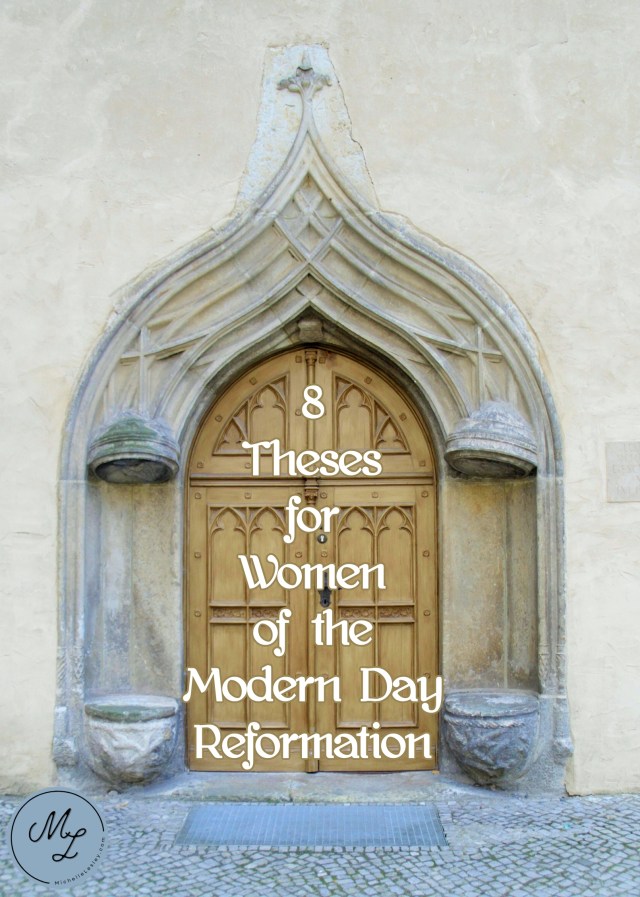
8 Theses for Women of the Modern Day Reformation

October 31, 2017, marks the 500th anniversary of the beginning of the Protestant Reformation, and because I’m all theme-y and whatnot, I’m in the midst of a fantastic book called Reformation Women by Rebecca VanDoodewaard who I dearly wish were on social media so I could shamelessly fangirl her and make a general nuisance of myself by asking too many questions. Normally, I would actually finish a book before slobberingly commending it to you, but in case you like being all theme-y and whatnot too, and because time is of the essence, I’m throwing caution to the wind and telling you:

Get this book. Now. You’re welcome.

Normally, when we read about the Reformation, we’re reading about great preachers and leaders like Luther, Calvin, Zwingli, and Hus, but preaching was not the only work of the Reformation. And that’s one of the things that has captivated me about Rebecca’s book. All of the women included therein were strikingly courageous, tireless laborers, who contributed greatly  to the success of the Reformation, and they did it all while coloring inside the lines of biblical womanhood – doing vital work godly women are uniquely equipped by Christ to do. They opened their homes as a refuge to scores of Protestants (often including those aforementioned notable preachers and other integral leaders) fleeing for their lives from Catholic marauders. They set up prison ministries and fed and clothed the poor. They nursed their communities through the Plague. Those who were queens and princesses used their power to protect Reformers and change persecutory laws. Those who were married to pastors and leaders helped in their ministries and edited their books and papers. And they wrote. Poetry. Position papers. Booklets. Letters. What a happy discovery (for me, anyway) to find sisters of the quill from so long ago.

All of these women were strikingly courageous, tireless laborers, who contributed greatly  to the success of the Reformation, and they did it all while coloring inside the lines of biblical womanhood.

But these great ladies were not our only foremothers in the faith. For as long as God’s people have been God’s people, God’s people have rebelled and needed to be reformed. In fact, that’s the entire, overarching theme of the Old Testament- the need for Israel to reform from its idolatry. And all along the way we see faithful women like Deborah, Jael, Esther, Jehosheba, Jedidah, Huldah, Samson’s mother, and others willing to buck the trend of sin and rebellion and point the way back to God and holy living by their deeds and the example of their lives.

The New Testament gives us extraordinary examples such as the women who ministered to Jesus during His earthly ministry, stood by Him at the cross, and were the first ones at His tomb. Priscilla, Lydia, Dorcas, Eunice, Lois, Phoebe and other believing women soon followed, all lending their aid in their own unique ways to reforming dead, legalistic Judaism into biblical Christianity.

All of these great women of God, serving Him through thousands of years as only godly women can, laying the foundation with their blood, sweat, and tears, for the church we know today.

But have we “arrived”? Is the need for women to work for reform in the church a fast fading dot in the rear-view mirror of modern day evangelicalism? Judging from the articles I read and the e-mails I receive about the problems in the church, the answer to that question would be a big, fat “no.”

Perhaps armies of the Catholic “church” no longer hunt down fleeing Protestants. And, maybe Nero isn’t using Christians as torches for his garden parties any more (although there are certainly areas of the world where our brothers and sisters in Christ face similar threats every day). But the stealth, guerrilla warfare Satan has been waging against the Western church in recent decades might be even more damaging. Certainly, it’s more diffuse and wider spread. Instead of raping the bride of Christ, Satan has chosen instead to seduce her. Why forge an enemy when you can woo a lover?

Instead of raping the bride of Christ, Satan has chosen instead to seduce her. Why forge an enemy when you can woo a lover?

False teachers. Word of Faith heresy. The New Apostolic Reformation. Abuse in the church. Biblical illiteracy. “Lone Ranger” Christians. Idolatry. Irreverence in the sanctuary.

It is easy to see why the heart of the Protestant Reformation was Semper Reformanda– “always reforming.” The work of fighting for sound doctrine, biblical worship, and pure hearts and hands never, never, never ends.

So what does it look like to be a woman of the modern day Reformation? What can we church ladies do to help turn the tide of apostasy in Christendom? Permit me to nail eight theses to the door of your church.

What does it look like to be a woman of the modern day Reformation? What can we church ladies do to help turn the tide of apostasy in Christendom? Permit me to nail eight theses to the door of your church…

1.
Realize You Can’t Change the World

None of the women named earlier in this article changed the world or the entire church. Not a single one of them. In fact some of them brought about great changes in their locales that were overturned in the years after their deaths.

The problems facing the church today are overwhelming. You’re one person. You can’t fix everything (and God doesn’t expect you to). Maybe you can’t even fix everything in your own church. But what you can do is determine to be faithful to Christ and His Word in your sphere of influence. Bloom where you’re planted. “Brighten the corner where you are“, as the old gospel song says. You can’t do everything, but what’s something you can do?

2.
Color Inside the Lines

One of the major problems plaguing the church today is Christian women who rebel against God’s word by stepping outside the boundaries God has drawn for women in the family and the church. Don’t shoot yourself in the foot by following suit in your zeal to reform. There’s plenty of work to be done by godly women – work that we’re better equipped for than men – without violating Scripture.

3.
Mind Your Demeanor

No, we shouldn’t be wishy washy milksops or mealy-mouthed shrinking violets. But we also shouldn’t be loud-mouthed harpies, brashly marching into hell with a water pistol (just trust my own failures on this one). We need to be velvet-covered bricks: soft on the outside, firm on the inside. We should attain to all the Christlike virtues of demeanor: patience, kindness, compassion, mercy, and grace mingled with an unyielding stand on Scripture and an uncompromising commitment to Christ. For some of us, the former comes easier. For some of us, the latter. But we must seek that godly balance as we go about the work of the Kingdom.

4.
Serve the Local Church

If you have rejected the mere idea of local church membership and think you’re going to bring about change from the outside as an unchurched (or functionally unchurched) writer, speaker, or Christian celebrity, you’re part of the problem, not part of the solution. The church is God’s plan for Christianity, not evangelical gurus. Do whatever you have to do to find a doctrinally sound one, join it, and get to work serving.

The church is God’s plan for Christianity, not evangelical gurus.

5.
Pray

When it comes to the church, fixing what’s broken doesn’t rest on your shoulders. Spiritual problems require spiritual solutions, and only God can bring those about. You can defend Scripture til you’re blue in the face or explain all day long why someone is a false teacher, but only God can lift the veil and enlighten the eyes of the heart. Be faithful in your efforts, but be more faithful in prayer. Like the persistent widow, grab hold of the Lord on behalf of the church and don’t let go.

6.
Teach Other Women

In my experience, the number one way false doctrine enters the church is through women’s ministry and women’s “Bible” study. You want to work for reform in the church? Work on reforming your church’s women’s ministry. Explain to your sisters why that divangelista is a false teacher. Request Bible study classes that study the actual Bible. Volunteer to organize the next women’s conference or retreat and schedule doctrinally sound speakers. Teach a women’s or girls’ Sunday School class. Transform the church by transforming the hearts and minds of women.

Transform the church by transforming the hearts and minds of women.

7.
Help

The book of Exodus tells the story of Israel’s battle with Amalek. When Moses held up his arms, Israel prevailed. When he let down his arms, Amalek prevailed. Eventually, Aaron and Hur came alongside Moses and held up his arms for him so that Israel could win the battle. Who was more important to Israel’s victory in this story- Moses or Aaron and Hur? If you answered “both,” you’re correct. Israel couldn’t have won without Moses holding up his hands, but Moses couldn’t have held up his hands without Aaron and Hur. Most of the women of the Old Testament, New Testament, and Protestant Reformation who effected godly change among God’s people were not Moseses. They were Aarons and Hurs. What can you do to hold up the arms of your pastor, your elders, your husband, your church?

8.
Stand

Make sure you know your Bible backwards, forwards, and upside down in context. Know right from wrong, the biblical from the unbiblical. Learn what God’s word says, and stand. Don’t back down. Do it with a godly demeanor, but do it. Refusing to budge from the truth of Scripture might cost you your “church”. It might cost you your family and friends. It might cost you your job, your reputation, and your finances (as we’ve seen in recent years with Christians in the business world who have refused to cave to the homosexual agenda). But as our brothers and sisters who went to the fiery stake, the dank prison cell, and the gallows would tell you, fidelity to God’s Word is worth it. Loyalty to Christ is worth anything it might cost you. Stand.

As our brothers and sisters who went to the fiery stake, the dank prison cell, and the gallows would tell you, fidelity to God’s Word is worth it. Loyalty to Christ is worth anything it might cost you. Stand.

Whether your women’s ministry is using a book by a false teacher, there’s a faction of backbiters in the church that needs to be quelled, or your pastor is overwhelmed and needs some help, there’s something in your church that you can pray about, help with, or work on to help it move toward spiritual health. The church needs discerning, biblically knowledgeable, mature Christian women to step up and fight ungodliness whenever and wherever we’re able. Will you be a courageous laborer in the modern day Reformation?


The church needs discerning, biblically knowledgeable, mature Christian women to step up and fight ungodliness whenever and wherever we’re able. Will you be a courageous laborer in the modern day Reformation?