Wednesday's Word

Wednesday’s Word ~ Isaiah 64

is 64

Isaiah 64

Oh that you would rend the heavens and come down,
    that the mountains might quake at your presence—
as when fire kindles brushwood
    and the fire causes water to boil—
to make your name known to your adversaries,
    and that the nations might tremble at your presence!
When you did awesome things that we did not look for,
    you came down, the mountains quaked at your presence.
From of old no one has heard
    or perceived by the ear,
no eye has seen a God besides you,
    who acts for those who wait for him.
You meet him who joyfully works righteousness,
    those who remember you in your ways.
Behold, you were angry, and we sinned;
    in our sins we have been a long time, and shall we be saved?
We have all become like one who is unclean,
    and all our righteous deeds are like a polluted garment.
We all fade like a leaf,
    and our iniquities, like the wind, take us away.
There is no one who calls upon your name,
    who rouses himself to take hold of you;
for you have hidden your face from us,
    and have made us melt in the hand of our iniquities.

But now, O Lord, you are our Father;
    we are the clay, and you are our potter;
    we are all the work of your hand.
Be not so terribly angry, O Lord,
    and remember not iniquity forever.
    Behold, please look, we are all your people.
10 Your holy cities have become a wilderness;
    Zion has become a wilderness,
    Jerusalem a desolation.
11 Our holy and beautiful house,
    where our fathers praised you,
has been burned by fire,
    and all our pleasant places have become ruins.
12 Will you restrain yourself at these things, O Lord?
    Will you keep silent, and afflict us so terribly?

The Holy Bible, English Standard Version Copyright © 2001 by Crossway Bibles, a division of Good News Publishers.

Questions to Consider:

1. Who is speaking, and who is being spoken to in this chapter? Summarize in a sentence or two the thrust of what is being said.

2. What type of discourse is this chapter? Is it a historical narrative? A hymn of praise? A prayer? A genealogy? A lament?

3. What is the reason, given in verses 5 & 9, that God is angry?

4. What are some of the things verses 10-12 say that Israel has suffered as a result of her sin? What is God’s ultimate goal in allowing Israel to suffer?

5. Is God still angered over sin today? (Romans 1:18) What solution to God’s wrath over our sin does He offer us? (John 3:36, Romans 5:9, 1 John 1:9)

Wednesday's Word

Wednesday’s Word ~ Jeremiah 23

1937485_824377827603153_712723081626384146_n

Jeremiah 23:

“Woe to the shepherds who destroy and scatter the sheep of my pasture!” declares the Lord. 2 Therefore thus says the Lord, the God of Israel, concerning the shepherds who care for my people: “You have scattered my flock and have driven them away, and you have not attended to them. Behold, I will attend to you for your evil deeds, declares the Lord. 3 Then I will gather the remnant of my flock out of all the countries where I have driven them, and I will bring them back to their fold, and they shall be fruitful and multiply. 4 I will set shepherds over them who will care for them, and they shall fear no more, nor be dismayed, neither shall any be missing, declares the Lord.

5 “Behold, the days are coming, declares the Lord, when I will raise up for David a righteous Branch, and he shall reign as king and deal wisely, and shall execute justice and righteousness in the land. 6 In his days Judah will be saved, and Israel will dwell securely. And this is the name by which he will be called: ‘The Lord is our righteousness.’

7 “Therefore, behold, the days are coming, declares the Lord, when they shall no longer say, ‘As the Lord lives who brought up the people of Israel out of the land of Egypt,’ 8 but ‘As the Lord lives who brought up and led the offspring of the house of Israel out of the north country and out of all the countries where he had driven them.’ Then they shall dwell in their own land.”

Lying Prophets
9 Concerning the prophets:

My heart is broken within me;
all my bones shake;
I am like a drunken man,
like a man overcome by wine,
because of the Lord
and because of his holy words.
10 For the land is full of adulterers;
because of the curse the land mourns,
and the pastures of the wilderness are dried up.
Their course is evil,
and their might is not right.
11 “Both prophet and priest are ungodly;
even in my house I have found their evil,
declares the Lord.
12 Therefore their way shall be to them
like slippery paths in the darkness,
into which they shall be driven and fall,
for I will bring disaster upon them
in the year of their punishment,
declares the Lord.
13 In the prophets of Samaria
I saw an unsavory thing:
they prophesied by Baal
and led my people Israel astray.
14 But in the prophets of Jerusalem
I have seen a horrible thing:
they commit adultery and walk in lies;
they strengthen the hands of evildoers,
so that no one turns from his evil;
all of them have become like Sodom to me,
and its inhabitants like Gomorrah.”
15 Therefore thus says the Lord of hosts concerning the prophets:
“Behold, I will feed them with bitter food
and give them poisoned water to drink,
for from the prophets of Jerusalem
ungodliness has gone out into all the land.”

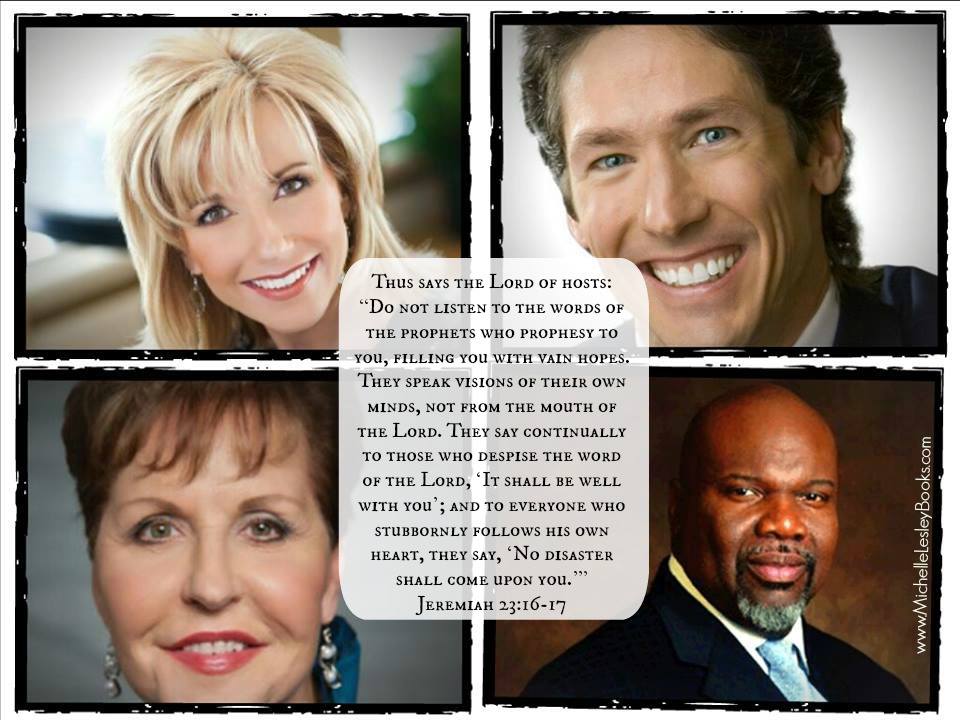
16 Thus says the Lord of hosts: “Do not listen to the words of the prophets who prophesy to you, filling you with vain hopes. They speak visions of their own minds, not from the mouth of the Lord. 17 They say continually to those who despise the word of the Lord, ‘It shall be well with you’; and to everyone who stubbornly follows his own heart, they say, ‘No disaster shall come upon you.’”

18 For who among them has stood in the council of the Lord
to see and to hear his word,
or who has paid attention to his word and listened?
19 Behold, the storm of the Lord!
Wrath has gone forth,
a whirling tempest;
it will burst upon the head of the wicked.
20 The anger of the Lord will not turn back
until he has executed and accomplished
the intents of his heart.
In the latter days you will understand it clearly.

21 “I did not send the prophets,
yet they ran;
I did not speak to them,
yet they prophesied.
22 But if they had stood in my council,
then they would have proclaimed my words to my people,
and they would have turned them from their evil way,
and from the evil of their deeds.

23 “Am I a God at hand, declares the Lord, and not a God far away? 24 Can a man hide himself in secret places so that I cannot see him? declares the Lord. Do I not fill heaven and earth? declares the Lord. 25 I have heard what the prophets have said who prophesy lies in my name, saying, ‘I have dreamed, I have dreamed!’ 26 How long shall there be lies in the heart of the prophets who prophesy lies, and who prophesy the deceit of their own heart, 27 who think to make my people forget my name by their dreams that they tell one another, even as their fathers forgot my name for Baal? 28 Let the prophet who has a dream tell the dream, but let him who has my word speak my word faithfully. What has straw in common with wheat? declares the Lord. 29 Is not my word like fire, declares the Lord, and like a hammer that breaks the rock in pieces? 30 Therefore, behold, I am against the prophets, declares the Lord, who steal my words from one another. 31 Behold, I am against the prophets, declares the Lord, who use their tongues and declare, ‘declares the Lord.’ 32 Behold, I am against those who prophesy lying dreams, declares the Lord, and who tell them and lead my people astray by their lies and their recklessness, when I did not send them or charge them. So they do not profit this people at all, declares the Lord.

33 “When one of this people, or a prophet or a priest asks you, ‘What is the burden of the Lord?’ you shall say to them, ‘You are the burden, and I will cast you off, declares the Lord.’ 34 And as for the prophet, priest, or one of the people who says, ‘The burden of the Lord,’ I will punish that man and his household. 35 Thus shall you say, every one to his neighbor and every one to his brother, ‘What has the Lord answered?’ or ‘What has the Lord spoken?’ 36 But ‘the burden of the Lord’ you shall mention no more, for the burden is every man’s own word, and you pervert the words of the living God, the Lord of hosts, our God. 37 Thus you shall say to the prophet, ‘What has the Lord answered you?’ or ‘What has the Lord spoken?’ 38 But if you say, ‘The burden of the Lord,’ thus says the Lord, ‘Because you have said these words, “The burden of the Lord,” when I sent to you, saying, “You shall not say, ‘The burden of the Lord,’” 39 therefore, behold, I will surely lift you up and cast you away from my presence, you and the city that I gave to you and your fathers. 40 And I will bring upon you everlasting reproach and perpetual shame, which shall not be forgotten.’”


The Holy Bible, English Standard Version Copyright © 2001 by Crossway Bibles, a division of Good News Publishers.


Questions to Consider:

1. What is the purpose of the book of Jeremiah? Which genre(s) of biblical literature (prophecy, epistle, narrative, wisdom, etc.) is the book of Jeremiah? What is the historical backdrop for this book?

2. Who are the “shepherds” in 1-4? Compare these shepherds to the “thieves and robbers,” “strangers,” and “hired hands” (false teachers), the gatekeeper (faithful pastors; also here), and the Good Shepherd (Jesus; also here) in John 10. What have they done that they should not have done? What have they failed to do that they should have done?

3. Who is “the righteous Branch” (5) and “the Lord is our righteousness” (6)?

4. How does this chapter of Jeremiah point us ahead to Jesus’ first and second coming? Take note of all of the instances in this chapter in which God says, “I will” do thus and so, such and such will happen, and “the days are coming when…”. Which of these things were accomplished in Jesus’ first coming, and which will be accomplished when He comes back?

5. Make a chart with the following columns and fill it out as you start at the beginning of chapter 23 and work your way through to the end:

False prophets characterized:

Things false prophets say:

How God says things should or will be:

God’s true word characterized:

God characterized:

God’s judgment on false prophets:

How God’s people should respond to false prophets:

Do you see any similarities between the false prophets of Jeremiah’s day and the false teachers of today? What do today’s false teachers promise and “prophesy”? Does God characterize today’s false teachers the same way as the false prophets of Jeremiah’s day, and will He judge them the same way? What should be our (the church, and individual Christians) response be to false teachers today?

Evangelism, Old Testament, Sunday School, Types and Shadows

Dem Bones ~ Sunday School Lesson ~ 9-14-14

Dem BonesThese are my notes from my ladies’ Sunday School class this morning. I’ll be posting the notes from my class here each week. Click here for last week’s lesson.

Through the Bible in 2014 ~ Week 37 ~ Sep. 7-13
Ezekiel 35-48, Joel
Dem Bones

And beginning with Moses and all the Prophets, [Jesus] interpreted to them in all the Scriptures the things concerning himself. Luke 24:27

The most beautiful thing about the Old Testament is that Jesus’ fingerprints are all over it. The imagery and symbolism displaying His life and the gospel pop out from the least expected places to surprise and delight us. And at the same time we see the “far,” New Testament application, of Old Testament passages, we can also see the “near,” or immediate application the passage has for the Bible characters the story is literally happening to. It’s like getting two lessons in one.

Ezekiel 37:1-14

Something Old
God sent this vision to Ezekiel the night before the messenger came with word of the fall of Jerusalem. The people of Israel were devastated and fearful, and this vision was meant to comfort and reassure them.

The valley (1) represented the areas of the world to which Israel and Judah had been (or would shortly be) exiled. As the skeletons were scattered all over the valley, so God’s people were scattered in various parts of the world.

The bones (2-3, 11) are a picture of death. With exile impending, Israel felt that all hope was dead and gone. The fact that the bones in the valley were “very dry” means that they had been there for quite a while, just as Israel would be in exile for seventy long years. It was the death of life as they knew it.

The prophecy (4-10, 12-14, Jeremiah 3:12, Isaiah 54:8, Psalm 30:5) this time, after so many prophecies of God’s coming wrath, was a prophecy of hope and restoration. God would breathe the breath of life and hope back into Israel. He would raise them up out of the grave of those pagan lands and resurrect them to a new life back in the Promised Land.

Go, and proclaim these words toward the north, and say, “‘Return, faithless Israel, declares the Lord. I will not look on you in anger, for I am merciful, declares the Lord; I will not be angry forever. (Jer.)

In overflowing anger for a moment I hid my face from you, but with everlasting love I will have compassion on you,” says the Lord, your Redeemer. (Is.)

For his anger is but for a moment, and his favor is for a lifetime. Weeping may tarry for the night, but joy comes with the morning. (Ps.)

What a kind and compassionate God! He justly executes judgment, but graciously forgives sin when His people repent.

Something New
The first layer of our lesson today was the “near” application– the literal, immediate application to Israel. From that, we’ve learned that God will not tolerate idolatry, that He is patient with His children, but does discipline them, and that He is merciful and forgiving towards Israel.

The second layer of the story is the “far,” or New Testament layer. It takes those attributes of God and redemption that we’ve just learned about in Israel’s story and shows us how Jesus “fleshed them out.”

The valley (1) could be anywhere. People are scattered over the whole earth just the way the bones were scattered across the valley.

The bones (2-3, 11, Ephesians 2:1-2a, John 15:16; 6:44, Hebrews 11:6, Romans 6:23) are people who are still dead in sin and have never come to repentant faith in Jesus Christ.

Let’s take a look at Ephesians 2:

And you were dead in the trespasses and sins in which you once walked.

Prior to salvation, we are spiritually dead. Just like a corpse can’t move, act, think, or decide, we can’t do anything to choose God (Jn. 15), or please Him (Heb.), or decide on our own to get saved (Jn. 6).

And not only are we spiritually dead during our time on earth, but eternal death awaits us when our earthly lives are over (Rom.). Without Christ, we are born dead, live dead, and die unto eternal death.

Gives you kind of a hopeless feeling (like the Israelites had) doesn’t it?

The prophecy (4-10, 12-14, Matthew 13:57, John 11:25-26; 3:6-7; 16:7; 20:22, 2 Timothy 3:16, Romans 6:4, Ephesians 2:4-7, 2 Corinthians 1:22)
Just like God sent the prophet Ezekiel -“Son of Man” (God calls him this 93 times)- to his people with the good news of the hope of new life, He sent His Son -also called the “Son of Man” (87 times in the New Testament)- the greatest prophet (Matt.), not just to proclaim the good news of new life, but to become that good news by giving His life on the cross so that we might not die, but live.

Verse 6 says: And I will lay sinews upon you, and will cause flesh to come upon you, and cover you with skin, and put breath in you, and you shall live, and you shall know that I am the Lord.”

At Lazarus’ tomb, “Jesus said to her, “I am the resurrection and the life. Whoever believes in me, though he die, yet shall he live, and everyone who lives and believes in me shall never die. Do you believe this?” (Jn. 11)

Just as Ezekiel prophesied to the bones (7-10) and they were born again from the dead, Jesus preached, “You must be born again.” (Jn. 3:7). And just as the bodies in verse 8 were fully fleshed out but had no spirit in them, Jesus said, “That which is born of the flesh is flesh, and that which is born of the Spirit is spirit.” (Jn. 3:6)

Ezekiel prophesied to the breath and it entered the dead bodies and brought them to life. You may have a footnote in your Bible on the word “breath” in verse 5, 6, 9, or 10 that says “or spirit.” The Hebrew (the Old Testament was written in Hebrew) word ruah is the same for “breath” or “spirit.”

In John 16, Jesus prophesied to His disciples that the Holy Spirit would come and fill them: “Nevertheless, I tell you the truth: it is to your advantage that I go away, for if I do not go away, the Helper will not come to you. But if I go, I will send him to you.”

And in John 20: “…he [Jesus] breathed on them [the disciples] and said to them, “Receive the Holy Spirit.”

Interestingly, the Greek (the New Testament was written in Greek) word pneuma means both “spirit” and “breath.” You probably recognize this Greek word as the root of our English word “pneumonia,” a disease of the lungs, or “breath.” The branch of theology that deals with the study of the Holy Spirit is called pneumatology. When 2 Timothy 3:16 says, “All Scripture is inspired by God…” the word translated “inspired” is theopneustos, or God (theo) breathed (pneustos). It is not until the Holy Spirit, the breath of life, enters us that we are “raised to walk in newness of life.” (Rom.)

As God said to Israel in verses 13-14, “And you shall know that I am the Lord, when I open your graves, and raise you from your graves, O my people. And I will put my Spirit within you, and you shall live, and I will place you in your own land. Then you shall know that I am the Lord; I have spoken, and I will do it, declares the Lord.”

so He says to us in Ephesians 2, “But God, being rich in mercy, because of the great love with which he loved us, even when we were dead in our trespasses, made us alive together with Christ—by grace you have been saved— and raised us up with him and seated us with him in the heavenly places in Christ Jesus, so that in the coming ages he might show the immeasurable riches of his grace in kindness toward us in Christ Jesus.”

“and who has also put his seal on us and given us his Spirit in our hearts as a guarantee.” (2 Cor.)

Something Borrowed, Just for You
We have seen the “near” application to the Israelites, and the “far” application to the gospel, so what is the “now” application for us? What can we “borrow” from this passage to do in our own walk with the Lord?

We are to follow in the footsteps of Ezekiel and Jesus and preach (share) the gospel of the resurrection to new life to dry, dead bones, and pray God to do His mighty work of raising sinners from the dead.

Can these bones live? Oh, Lord God, You know.

Evangelism, Gospel, Old Testament, Sunday School

Watching and Warning with Ezekiel ~ Sunday School Lesson ~ 9-7-14

EzekielThese are my notes from my ladies’ Sunday School class this morning. I’ll be posting the notes from my class here each week. Click here for last week’s lesson.

Through the Bible in 2014 ~ Week 36 ~ Aug. 31- Sep. 6
Ezekiel 16-34
Watching and Warning with Ezekiel

Well, Ezekiel is still prophesying (and he’ll still be prophesying until Saturday :0) God is still sending out the same message through him. Again and again, God chastises His people, trying to shake some sense into them so they will repent and turn back to Him. Not because He wants to exercise judgment on them but so “they will know that I am the Lord.” (That phrase is used 74 times in the book of Ezekiel.) No one could say God was unfair because He didn’t warn them of His coming judgment or that He hadn’t given them enough time or that he hadn’t been clear.

Ezekiel 33:1-16

What’s a Watchman?
As we’ve talked about in the past, large or important cities normally fortified themselves against their enemies by constructing a tall, thick wall (sometimes an inner and an outer wall as we saw with Jericho) around the perimeter. These are great for keeping the enemy out once they get there, but not so great for being able to see whether or not the enemy is coming in the first place. We’re talking low visibility. So they would often build high watchtowers at various intervals around the city wall (sometimes outside the wall in a field or on a hill, but fairly close to the city). A watchman would be stationed in the watchtower, and it was his job to alert the higher ups that the enemy was approaching, a messenger was arriving, etc. To be good at his job, he needed good eyes. He needed to be able to discern a messenger from an enemy. He needed to stay alert and vigilant. He needed to act quickly and decisively. He needed to be able to rapidly and clearly convey an urgent message to the right person at the right time. And if he failed even once in any of these duties, he could likely kiss his life goodbye.

33:1-9- Ezekiel: Israel’s Spiritual Watchman (Matthew 23:37a)

If we’ve learned anything from studying these prophetic books, we’ve learned that being a prophet was not some cushy job. Most of the time, God did not have good news for His people, and most of the time, the people did not want to hear it. Jesus even said,

“O Jerusalem, Jerusalem, the city that kills the prophets and stones those who are sent to it!” (Matt.)

But Israel needed a watchman, and God said, “Ezekiel, you’re it.” (7)

Every time God had a message of warning for the people, Ezekiel was to faithfully proclaim it without delay. He was not to hold back from speaking harsh truths to scary people just because he was afraid. If the person Ezekiel was speaking to chose to reject God’s message, that was on that person’s head (9). But if Ezekiel kept his mouth shut, he was being just like that watchman on the wall who didn’t do his job right, and God would hold him accountable for the death of the intended hearers, who would still die in their sin (8).

33:10- What Was the Warning? (Ezekiel 18:4)
What was the warning? It was the warning to repent before God’s coming judgment. Verse 10 gives us a small glimmer of hope that maybe, just maybe God’s message was getting through to a few people:

“Surely our transgressions and our sins are upon us, and we rot away because of them.”

EXACTLY. Israel’s sin and transgressions are bringing God’s wrath upon her. That is what has caused all this calamity and the continuing sermons of doom from His prophets. As God had already told the people back in chapter 18, “The soul that sins shall die.” (18:4). But the story doesn’t end there.

33:10-16- Good News!
Look at the people’s hopelessness in verse 10:

How then can we live?

Their sin has done them in, and now they’re coming to grips with a horrifying reality: they have transgressed a holy God. They recognize that they deserve any punishment God wants to dole out and that He will be justified in pouring out His wrath upon them. What hope could they possibly have?

They have the hope of a God who is not only perfectly just, but rich in mercy and forgiveness and grace. A God who has “no pleasure in the death of the wicked, but that the wicked turn from his way and live.” (11)

“Turn back, turn back from your evil ways, for why will you die, O house of Israel?” (11) He pleads with them. This God who pleads with them now, and has been for nearly 800 years, is not the cruel, selfish, and vindictive god some portray Him as, but the tender, compassionate Father who will move heaven and earth to keep His children from destroying themselves.

Turn away from your evil ways and turn to My mercy and forgiveness, and you will live, He says. “None of the sins that he has committed shall be remembered against him.”

But remember, it’s your repentance and reliance on my mercy that saves you, God tells them. Don’t think you can get by on your past good deeds. “…if he trusts in his righteousness and does injustice, none of his righteous deeds shall be remembered, but in his injustice that he has done he shall die.”

None of the people are so bad that God won’t save them and none of them are so good that they don’t need God to save them.

Following in Ezekiel’s Footsteps
Although we’re not prophets, God has given us a similar charge to the one he gave Ezekiel. We, too, who have the good news of the gospel are to be spiritual watchmen for all those in our circle of influence. We have God’s word, we know what it says, and He has commissioned us to carry that message to people. Like the watchman, we need to stay alert and vigilant for opportunities to share the gospel. We often need to act quickly and decisively to share the gospel before the moment slips away. We need to be able to clearly convey the urgent message of salvation to the right person at the right time. And we need to take this duty deadly seriously.

What? A Warning?
Sometimes when people present the gospel, they do it by using what salesmen call a “hook,” a promise of what the product will do for the person or how it will make his life better. “Want to go to Heaven when you die?” “Jesus will make your life awesome!” But that’s not our message. Jesus isn’t a product we’re trying to convince people to buy.

Like Ezekiel, our first job is to warn people that they have broken God’s law, and that the penalty for breaking His law is God’s wrath, an eternity in hell. God doesn’t just automatically forgive everybody when they die (that’s a false teaching called Universalism). And, just like Ezekiel told the people, you can’t get by on your own good deeds. The warning always has to come first. People don’t know they need to flee to safety if they don’t know they’re in danger.

Our Good News
But as soon as the person we’re sharing with begins to feel like the Israelites– Surely our transgressions and our sins are upon us, and we rot away because of them. How then can we live? (10) –we have the unbelievable privilege of telling them the beautiful news of God’s mercy and grace for sinners like you and me:

As I live, declares the Lord God, I have no pleasure in the death of the wicked, but that the wicked turn from his way and live; turn back, turn back from your evil ways, for why will you die? (11)

None of the sins that he has committed shall be remembered against him. He has done what is just and right; he shall surely live. (16)

How could we ever keep such wonderful news to ourselves?

Top 10

Top Ten: Favorite Passages from Isaiah

Top 10 Isaiah


1. Isaiah 53:2-5
2 For he grew up before him like a young plant,
    and like a root out of dry ground;
he had no form or majesty that we should look at him,
    and no beauty that we should desire him.
3 He was despised and rejected by men;
    a man of sorrows, and acquainted with grief;
and as one from whom men hide their faces
    he was despised, and we esteemed him not.
4 Surely he has borne our griefs
    and carried our sorrows;
yet we esteemed him stricken,
    smitten by God, and afflicted.
5 But he was pierced for our transgressions;
    he was crushed for our iniquities;
upon him was the chastisement that brought us peace,
    and with his wounds we are healed.

2. Isaiah 40:8 
The grass withers, the flower fades,
    but the word of our God will stand forever.

3. Isaiah 9:6 
For to us a child is born,
    to us a son is given;
and the government shall be upon his shoulder,
    and his name shall be called
Wonderful Counselor, Mighty God,
    Everlasting Father, Prince of Peace.

4. Isaiah 64:6 
We have all become like one who is unclean,
    and all our righteous deeds are like a polluted garment.
We all fade like a leaf,
    and our iniquities, like the wind, take us away.

5. Isaiah 55:6-9
“Seek the Lord while he may be found;
    call upon him while he is near;
7 let the wicked forsake his way,
    and the unrighteous man his thoughts;
let him return to the Lord, that he may have compassion on him,
    and to our God, for he will abundantly pardon.
8 For my thoughts are not your thoughts,
    neither are your ways my ways, declares the Lord.
9 For as the heavens are higher than the earth,
    so are my ways higher than your ways
    and my thoughts than your thoughts.

6. Isaiah 53:6 
All we like sheep have gone astray;
    we have turned—every one—to his own way;
and the Lord has laid on him    the iniquity of us all.

7. Isaiah 30:18 
Therefore the Lord waits to be gracious to you,
    and therefore he exalts himself to show mercy to you.
For the Lord is a God of justice;
    blessed are all those who wait for him.

8. Isaiah 49:13
Sing for joy, O heavens, and exult, O earth; break forth, O mountains, into singing! For the Lord has comforted his people and will have compassion on his afflicted.

9. Isaiah 44:22
I have blotted out your transgressions like a cloud and your sins like mist; return to me, for I have redeemed you.

10. Isaiah 7:14
Therefore the Lord himself will give you a sign. Behold, the virgin shall conceive and bear a son, and shall call his name Immanuel. 

The Holy Bible, English Standard Version Copyright © 2001 by Crossway Bibles, a division of Good News Publishers.

Those are some of my favorites.
Do you have a favorite verse from Isaiah?