

Ezra Bible Study

Ezra: Lesson 1

ezra study

Welcome to our brand new Wednesday’s Word Bible study! Over the next several weeks, we’ll be studying the book of Ezra. Many of us feel like our knowledge of the Old Testament – particularly the post-exilic writings – could use some beefing up, and Ezra is a perfect book to study for that purpose.

But is Ezra relevant to us as Christians today? As we study, I think you’ll find the answer to that question is a resounding yes. Second Timothy 3:16-17 reminds us:

All Scripture is breathed out by God and profitable for teaching, for reproof, for correction, and for training in righteousness, that the man of God may be complete, equipped for every good work.

God’s people are God’s people, B.C. or A.D. We love God, love His word, and struggle with many of the same sins. And, of course, God Himself never changes.

So let’s roll up our sleeves and start digging in, shall we?

Introduction to the book of Ezra:

Before we begin studying a book of the Bible, it’s very important that we understand some things about that book. We need to know…

Who the author was and anything we might be able to find out about him or his background.

Who the audience of the book is: Jews or Gentiles? Old Testament Israelites or New Testament Christians? This will help us understand the author’s purpose and approach to what he’s writing.

What kind of biblical literature we’re looking at. We approach books of history differently than books of wisdom, books of wisdom differently than books of prophecy, etc.

What the purpose of the book is. Was it written to encourage? Rebuke? Warn?

What the historical backdrop is for the book. Is Israel at war? At peace? In exile? Under a bad king? Good king? Understanding the historical events surrounding a piece of writing help us understand what was written and why it was written.

When the book was written. Where does the book fall on the timeline of bibical history? This is especially important for Old Testament books which are not always arranged in chronological order.

So this week, before we start studying the actual text of the book of Ezra, we need to lay the foundation to understanding the book by finding the answers to these questions.

Read the following overviews of the book of Ezra, taking notes on anything that might aid your understanding of the book, and answer the questions below:

Ezra at Grace to You

Overview of the Book of Ezra at Reformed Answers

Book of Ezra at Got Questions

1. Who wrote the book of Ezra? What was his profession? His background and lineage? What do these things tell us about his position in society, his knowledge of Scripture, his approach to writing, or anything else about him?

2. Who is the intended audience of the book of Ezra?

3. Which genre of biblical literature is the book of Ezra: law, history, wisdom, poetry, narrative, epistles, or prophecy/apocalyptic? What does this this tell us about the approach we should take when studying this book versus our approach to books of other genres?

4. What is the theme or purpose of the book of Ezra?

5. Who are the leaders and significant personalities in the book of Ezra?

6. What is the historical backdrop of the book of Ezra? When did the events of the book of Ezra take place on the timeline of biblical history (ex: before the Flood, during the period of the judges, during or after the exile, etc.)? What are the historical events immediately surrounding the events of the book of Ezra? Where do the events take place? (Sometimes, a good Bible map like this one or this one can be helpful.)

7. What else did you learn about Ezra or the setting of his book that might help you understand the text of the book better?
Wednesday's Word

Wednesday’s Word ~ Haggai 1

haggai 1 4

Haggai 1

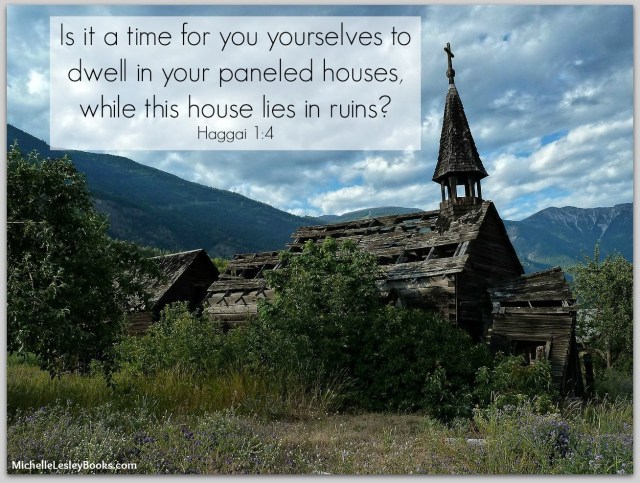
In the second year of Darius the king, in the sixth month, on the first day of the month, the word of the Lord came by the hand of Haggai the prophet to Zerubbabel the son of Shealtiel, governor of Judah, and to Joshua the son of Jehozadak, the high priest: “Thus says the Lord of hosts: These people say the time has not yet come to rebuild the house of the Lord.” Then the word of the Lord came by the hand of Haggai the prophet, “Is it a time for you yourselves to dwell in your paneled houses, while this house lies in ruins? Now, therefore, thus says the Lord of hosts: Consider your ways. You have sown much, and harvested little. You eat, but you never have enough; you drink, but you never have your fill. You clothe yourselves, but no one is warm. And he who earns wages does so to put them into a bag with holes.

“Thus says the Lord of hosts: Consider your ways. Go up to the hills and bring wood and build the house, that I may take pleasure in it and that I may be glorified, says the Lord. You looked for much, and behold, it came to little. And when you brought it home, I blew it away. Why? declares the Lord of hosts. Because of my house that lies in ruins, while each of you busies himself with his own house.10 Therefore the heavens above you have withheld the dew, and the earth has withheld its produce.11 And I have called for a drought on the land and the hills, on the grain, the new wine, the oil, on what the ground brings forth, on man and beast, and on all their labors.”

12 Then Zerubbabel the son of Shealtiel, and Joshua the son of Jehozadak, the high priest, with all the remnant of the people, obeyed the voice of the Lord their God, and the words of Haggai the prophet, as the Lord their God had sent him. And the people feared the Lord. 13 Then Haggai, the messenger of the Lord, spoke to the people with the Lord‘s message, “I am with you, declares the Lord.” 14 And the Lord stirred up the spirit of Zerubbabel the son of Shealtiel, governor of Judah, and the spirit of Joshua the son of Jehozadak, the high priest, and the spirit of all the remnant of the people. And they came andworked on the house of the Lord of hosts, their God, 15 on the twenty-fourth day of the month, in the sixth month, in the second year of Darius the king.

The Holy Bible, English Standard Version Copyright © 2001 by Crossway Bibles, a publishing ministry of Good News Publishers.

 Questions to Consider:

1. What is the purpose of the book of Haggai? Which genre(s) of biblical literature (prophecy, epistle, narrative, wisdom, etc.) is the book of Haggai? What is the historical backdrop for this book?

2. What was the people’s position on rebuilding the temple? (2) Did God agree with them? What did God say about the priority of rebuilding the temple? (3-4) Read Acts 7:48-50. If God doesn’t need a building to live in, why was it so important to Him, and to the people, that they rebuild the temple? What are the two reasons God gave for rebuilding the temple? (8)

3. List the negative consequences the people experienced for neglecting to rebuild the temple. (6,9,10-11) What reason did God give for sending these negative consequences (9), and what was their intended purpose? What does God mean when He says, “Consider your ways,” in verse 5? In verse 7?

4. What were the two ways the people responded to the prophecy? (12) What were the two ways God responded back to them? (13-14) How is this similar to God’s response to our repentance? How would the words “restoration” and “reconciliation” apply in both this passage and in our repentance today?

5. What does this passage teach us about prioritizing our relationship with Christ, and our obedience to His word, above all other temporal concerns and activities? What can we learn about the negative consequences of sin? Has God ever used the negative consequences of sin to get your attention and draw you to repentance? What is God’s response to our repentance and obedience?