Uncategorized

The Word on Wednesdays

Hi ladies! I hope you enjoyed our most recent Bible study, Judges, and that you’re looking forward to our new study as much as I am.

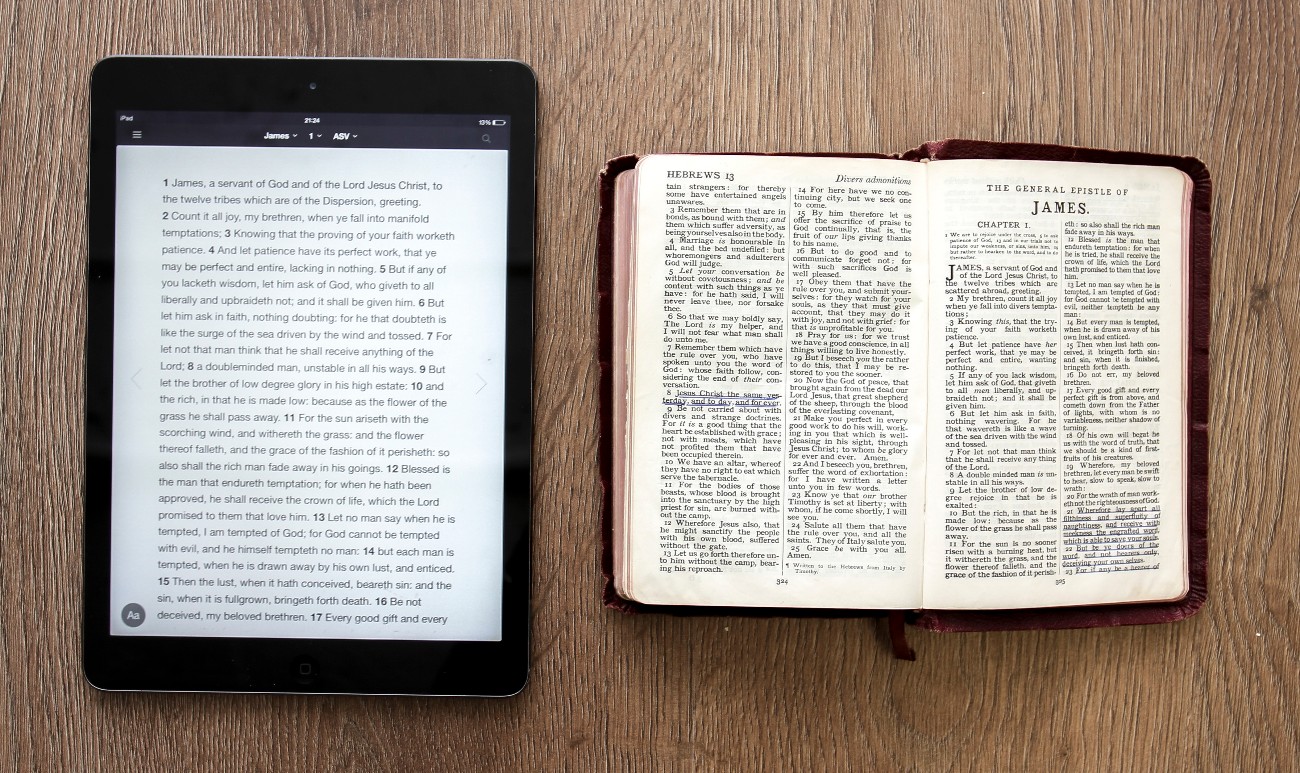
I’ll be taking a break for a few more weeks getting ready for our new study. I hope you’ll enjoy it and that it will edify you as you seek to grow in Christ and His Word. (The picture above does not mean we will be studying James. :0) Stay tuned, and keep an eye on the blog on Wednesdays.

In the meantime, I’ll be posting some articles from the archives that I think you’ll find helpful as we make our way toward our next study. Here is this week’s article:

Wednesday’s Word

Wednesday is Bible study day here on the blog. In my Wednesday’s Word Bible study series you’ll find miscellaneous, one lesson Bible studies from each book of the Bible. One chapter of Scripture followed by study questions. This sampler series demonstrates that there’s nothing to be afraid of when approaching those “lesser known” books and that every book of the Bible is valuable and worth studying.

Wednesday’s Word ~ Mark 1

1 The beginning of the gospel of Jesus Christ, the Son of God.

2 As it is written in Isaiah the prophet,

“Behold, I send my messenger before your face,
    who will prepare your way,
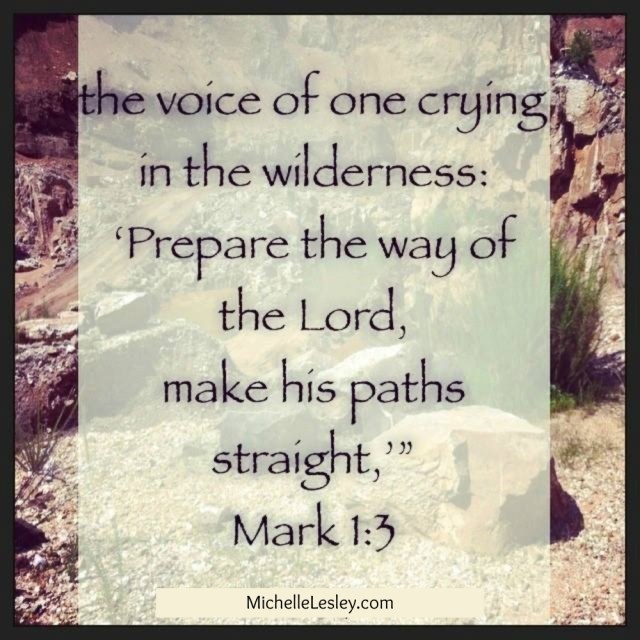
3 the voice of one crying in the wilderness:
    ‘Prepare the way of the Lord,
    make his paths straight,’”…Continue Reading

Bible Study

How to Study the Bible- and How Not To!

Originally published December 31, 2020

It’s almost the new year! Are you making a resolution to start having a personal, daily Bible study time? Would you like to improve on the way you study your Bible? Maybe you’re looking for a Bible reading plan, or maybe you’re just looking to change things up a little?

If that sounds like you, give a listen to this December 2020 episode of A Word Fitly Spoken:

How to Study the Bible – and How Not To!

Amy and I discuss what our own Bible study times look like, plus some other helpful methods and resources. We also discuss false doctrine and false teachers to avoid as you’re studying your Bible.

This episode is a great way to kick off the new year. And don’t forget to subscribe to A Word Fitly Spoken on your favorite podcast platform!

Additional Resources:

Bible Study Resources (how to study the Bible)
Bible Studies
Bible Reading Plans for the New Year- 2022

Popular False Teachers & Unbiblical Trends

Judges Bible Study

Judges ~ Lesson 18- Wrap Up

Previous Lessons: 1, 2, 3, 4, 5, 6, 7, 8, 9, 10, 11, 12, 13, 14, 15, 16, 17

Wrap Up

Questions to Consider

1. Was there anything new God taught you in this study that particularly impacted you? What was it, and why was it so significant?

2. How is your walk with the Lord different after this study than it was before?

3. What are the reasons for, and the consequences of, “Everyone did what was right in his own eyes”? What are the implications of this mindset and posture of heart for God’s people, both individually and as the church, today?

4. What did you learn about idolatry and syncretism from this study, and how can you apply this to the church and Christian organizations?

5. What did this study teach you about trusting and obeying God?

6. Have there been any passages or concepts in this study that God used to convict you of disobedience and lead you to repentance? How will you walk differently in this area from now on?

7. What did this study teach you about the character of those who lead God’s people?

8. What have you learned about God and His nature and character from this study?


Homework

Spend some time in prayer this week asking God to show you how to put into practice one thing you learned from this study.

Recite all of your memory verses from this study. Which one is most meaningful to you right now?

Judges Bible Study

Judges ~ Lesson 17

Don’t forget to come back next week for our wrap up lesson!

Previous Lessons: 1, 2, 3, 4, 5, 6, 7, 8, 9, 10, 11, 12, 13, 14, 15, 16

Read Judges 21

Questions to Consider

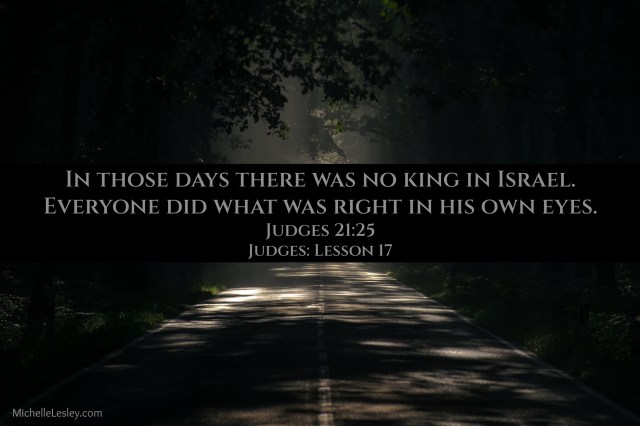
1. Go back to lesson 3 (link above) and review your answer to the first part of question 5, Israel’s pattern of sin and repentance in 2:16-23. How does today’s passage fit this pattern? How does today’s passage fit the theme verse of Judges (21:25), “In those days there was no king in Israel. Everyone did what was right in his own eyes.”?

2. Chapter 21 is a continuation of the story that began in chapter 19. Briefly review lessons 15 & 16 (links above) to refresh your memory.

3. Read all of chapter 21.

4. Explain 1-15 in your own words. What is taking place in this passage? What transpired at Mizpah (1,18)? (hint: use your cross references) Why was there “one tribe lacking in Israel”? (3,6) Which tribe was it, and why was it “lacking”? (3,6, chapter 20) If there were no Benjaminite women left for the Benjaminite men to marry and none of the other Israelite tribes would give their daughters to the Benjaminite men for wives (7), what would have happened to Benjamin as a tribe? Why was it imperative that the Benjaminite men marry women from among the tribes of Israel? Why couldn’t they just marry a woman from a neighboring country?

5. In the law, God explained why He didn’t want Israel marrying foreign wives. What was His reason? Think about all the idolatry we’ve seen in the book of Judges. Which seemed to be more important to Israel in chapter 21, the letter of the law (the outward behavior of not marrying foreign wives), or the heart of the law (the inward heart condition of loving God and rejecting idolatry)?

Recall Jesus’ teaching in the Sermon on the Mount: “You have heard it said that [letter of the law], but I say to you [heart of the law].” Was Jesus saying that obedience in our external behavior – such as (for the Israelites) obeying the command not to marry foreign wives – wasn’t important? Where does our outward obedience flow from? From God’s perspective (a perspective we should attain to), is mere outward, behavioral conformity to the law true obedience to Him?

Compare the Old Testament’s prohibition on God’s people marrying unbelievers to the New Testament’s prohibition on God’s people marrying (or closely yoking with) unbelievers.

6. We live in a very individualistic society. Old Testament Israel was a very corporate society. How does this impact and explain Israel’s grief and compassion (2,3,6,15) over the potential loss of the tribe of Benjamin, even though they had recently been at war with, and killing, the Benjaminites?

Compare the Old Testament corporate perspective in this passage with the New Testament corporate perspective of the church in 1 Corinthians 12. Make the connection between Judges 21:2,3,6,15 and 1 Corinthians 12:26. Why did God design His people to be interdependent – to need each other?

7. Explain in your own words what is happening in verses 16-25. What does verse 22 mean?

Did telling and allowing the Benjaminites to snatch the women (22) let Israel and Shiloh off the hook for the vow (18) since they weren’t technically “giving our daughters to them”? Were they truly keeping the vow, or was this yet another letter of the law versus heart of the law situation? What about the laws against coveting and stealing – were those laws being kept or broken in this situation?

When it comes to sin, does God ever let people off on a technicality? Is someone who looks for loopholes in God’s commands a person whose obedience is motivated by her love for the Lord, or someone who loves sin and wants to “get away with” as much of it as possible? Do you ever play games like this with God’s commands?

8. Do you notice anything in chapter 21 indicating that God instructed Israel to do any of the things they did, or that He approved of any of these things? Did Israel inquire of the Lord about the lack of wives for the Benjaminite men, or did they take matters into their own hands? Think about how Sarai took matters into her own hands to have a son, when God’s plan was for Him to provide her with a son. Could not the same God who miraculously provided an offspring for Abraham have also miraculously provided wives for Benjamin? How does taking matters into our own hands, especially by sinning, a) demonstrate a lack of trust in God and His ways, and b) never turn out as well as trusting God and His ways does?

9. How would you respond to this statement? “Living by doing what is right in your own eyes (25) gives you an inconsistent spiritual framework that puts you in the position of looking in moral indignation upon one sin while committing another to ‘correct’ it.”

Compare verse 4 to verse 25. Do our outward actions of worship (4) mean anything if our hearts aren’t right with God (25)?


Homework

Review your answers to question 5, above. Are there any areas of your life in which you are being externally, behaviorally obedient to God, but that outward conformity to the requirements of Scripture isn’t motivated by love for God or the heart of the law?

For example: Do you give your offerings or attend church reluctantly or resentfully rather than giving generously and cheerfully, or attending eagerly because you love the Lord and His people?

Think it over and repent of any areas in which your obedience is not a natural outflow of your heart. Choose one of these areas, and over the next week, do a deep dive into the Word on that particular issue. Why does God want you to do or not do that behavior? What should be the posture of your heart that leads to outward obedience on that issue? Ask God to change your heart so your outward behavior will be rightly motivated and will be a joy rather than a burden.


Suggested Memory Verse

Judges Bible Study

Judges ~ Lesson 16

Previous Lessons: 1, 2, 3, 4, 5, 6, 7, 8, 9, 10, 11, 12, 13, 14, 15,

Read Judges 20

Questions to Consider

1. Go back to lesson 3 (link above) and review your answer to the first part of question 5, Israel’s pattern of sin and repentance in 2:16-23. How does today’s passage fit this pattern? How does today’s passage fit the theme verse of Judges (21:25), “In those days there was no king in Israel. Everyone did what was right in his own eyes.”?

2. Chapter 20 is a continuation of the story that began in chapter 19. Briefly review lesson 15 (link above) to refresh your memory.

3. Read 1-6. What does it mean that the men of Israel assembled “to the Lord”? (1) Why had the Levite dismembered his concubine and sent her body parts to each of the tribes of Israel?

No doubt what the men of Gibeah did to the concubine was heinous (5), but how did they have access to her in the first place? (Notice the Levite leaves out that part of the story.) What has the Levite’s sin of using his concubine – someone vulnerable and weaker than himself, someone he should have been protecting – as a piece of expendable property to protect himself led to? Trace this story back to its roots: explain how this entire story would have turned out differently if the Levite had played the man and defended and protected the concubine. Go even further back: would this story have even taken place if the Levite had followed God’s plan for marriage and was the husband of one wife instead of committing adultery with the concubine? How does this demonstrate the principle that sin begets sin?

Contrast the way the Levite treated this woman with a) the way God loves and values women and b) the way God wants men, especially husbands, to treat, love, and value women / their wives.

4. Read 8-17. Consider all the evil and sin we’ve seen one or more of God’s people commit in the book of Judges thus far. Has it been mostly “vertical” (directly against God) sin or mostly “horizontal” (directly against other people) sin? Which is worse? We’ve reached the climax of the book of Judges. Israel at long last sees the depravity of sin and is moved to action. What sin finally moves them – their own vertical sin of idolatry or someone else’s horizontal sin against the concubine, the Levite, and the community? Why is it easier to see and rightly respond to someone else’s sin rather than our own sin? Why do we often see horizontal sin as worse than vertical sin? How did the Israelites not see that their outrage and grief over the men of Gibeah’s sin was nothing compared to God’s outrage and grief over their sin of idolatry? How is it God’s grace to us to show us our sin against Him by letting us see one person’s sin against another?

Did Israel immediately go in and destroy the whole tribe of Benjamin? What was Israel’s initial demand? (13a) What was Benjamin’s response? (13b) What happened – how did things escalate – as a result of Benjamin’s covering for the men of Gibeah’s sin, refusing to hold the men accountable, and refusing to deal with sin in the camp in a biblical way? How does this compare to church discipline situations today? What effect does it have on a church when sin in the camp is ignored, covered up, and not dealt with in a biblical way? In what ways do we often put practical concerns ahead of doing things God’s way in situations like these?

5. Read 18-28. How many times did Israel inquire of the Lord in this passage? Compare their first (18), second (23), and third (26-28) inquiries. Why and how did each inquiry intensify? Were they demonstrating a worldly sorrow or a godly sorrow over their sin? Does this scenario remind you of this passage? How?

Verse 18 is the first place we’ve seen God present (see question 4 in lesson 15, link above) with His people in quite a long time. What has been standing between Israel and God, and what is the first thing He deals with when He “shows up”? Explain why sin is always the first thing that has to be dealt with and biblically resolved in any church’s or individual’s relationship with God.

Consider what happens to Israel in 18-28 in light of what Hebrews 12:5-11 says about discipline. How did God apply painful discipline to Israel in 18-28? Were they “trained by it,” and did this discipline “yield the peaceful fruit of righteousness” for them?

6. Read 29-48. Revisit the second part of question 4. What did Benjamin lose – practically / temporally and spiritually – by covering for the men of Gibeah’s sin, refusing to hold the men accountable, and refusing to deal with sin in the camp in a biblical way? Who actually defeated Benjamin? (35)

7. What did this chapter teach you about sin, sinners, and the nature and character of God?


Homework

Think about the most outrageous sin someone has committed against you or that you’ve seen committed against another person. Now compare that sin, and your grief and outrage over it to your own sin against God. How is it God’s grace to us to show us our sin against Him by letting us see or experience one person’s sin against another? How is our sin against God exponentially worse than one person’s sin against another? List three ways this should inform how you think about your own sin against God, and three ways this should inform how you think about others’ sin against you. Is there any way you’ve been sinning against God that you need to repent of? Is there anyone you need to forgive for sinning against you?


Suggested Memory Verse