Wednesday's Word

Wednesday’s Word ~ Ecclesiastes 3

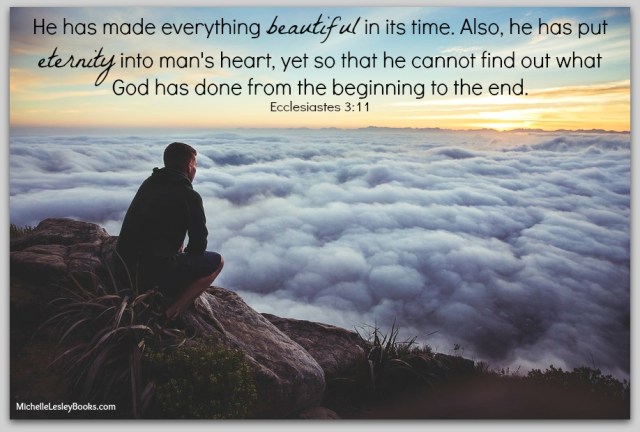
ecc 3 11

Ecclesiastes 3

For everything there is a season, and a time for every matter under heaven:

a time to be born, and a time to die;
a time to plant, and a time to pluck up what is planted;
a time to kill, and a time to heal;
a time to break down, and a time to build up;
a time to weep, and a time to laugh;
a time to mourn, and a time to dance;
a time to cast away stones, and a time to gather stones together;
a time to embrace, and a time to refrain from embracing;
a time to seek, and a time to lose;
a time to keep, and a time to cast away;
a time to tear, and a time to sew;
a time to keep silence, and a time to speak;
a time to love, and a time to hate;
a time for war, and a time for peace.

What gain has the worker from his toil? 10 I have seen the business that God has given to the children of man to be busy with. 11 He has made everything beautiful in its time. Also, he has put eternity into man’s heart, yet so that he cannot find out what God has done from the beginning to the end. 12 I perceived that there is nothing better for them than to be joyful and to do good as long as they live; 13 also that everyone should eat and drink and take pleasure in all his toil—this is God’s gift to man.

14 I perceived that whatever God does endures forever; nothing can be added to it, nor anything taken from it. God has done it, so that people fear before him. 15 That which is, already has been; that which is to be, already has been; and God seeks what has been driven away.

16 Moreover, I saw under the sun that in the place of justice, even there was wickedness, and in the place of righteousness, even there was wickedness. 17 I said in my heart, God will judge the righteous and the wicked, for there is a time for every matter and for every work. 18 I said in my heart with regard to the children of man that God is testing them that they may see that they themselves are but beasts. 19 For what happens to the children of man and what happens to the beasts is the same; as one dies, so dies the other. They all have the same breath, and man has no advantage over the beasts, for all is vanity. 20 All go to one place. All are from the dust, and to dust all return. 21 Who knows whether the spirit of man goes upward and the spirit of the beast goes down into the earth? 22 So I saw that there is nothing better than that a man should rejoice in his work, for that is his lot. Who can bring him to see what will be after him?

The Holy Bible, English Standard Version Copyright © 2001 by Crossway Bibles, a publishing ministry of Good News Publishers.

 Questions to Consider:

  1. Who wrote the book of Ecclesiastes? What is the theme of chapter 3?
  1. How would you summarize verses 1-8? What are some of the ways the New Testament says Christians should respond to joyful or difficult circumstance in our lives and in the lives of others?
  1. What does it mean that God has “put eternity into man’s heart”? (11) What does the remainder of verse 11 mean? How might the idea in this part of verse 11 connect with these other passages?
  1. What can we learn from verses 14-22 about God’s absolute sovereignty, supremacy, authority, and control over the world and the events that take place in it? Make a list of all the things, beings, and events from these verses that God is sovereign over. How can contemplating God’s sovereignty in these areas help us to have a proper, humble view of ourselves compared to Him?
  1. Taking verses 12-22 into consideration, why do verses 12, 13, and 22 encourage man to “be joyful,” “take pleasure,” and “rejoice” in his toil and work? What is the alternative? How does this relate to what the New Testament says about being joyful in work or difficulties? What impact might your joy have on an unbeliever?
Old Testament, Sanctification, Sunday School

Solomon: A Season of Discontent ~ Sunday School Lesson ~ 6-22-14

Solomon: A Season of Discontent

These are my notes from my ladies’ Sunday School class this morning. I’ll be posting the notes from my class here each week. Click here for last week’s lesson.

Through the Bible in 2014 ~ Week 25 ~ June 15- 21
Psalm 134, 146-150, 1 Kings 9-11, 2 Chronicles 8-9,
Proverbs 25-29, Ecclesiastes 1-12

Solomon: A Season of Discontent

Bill Gates had nothing on Solomon. Solomon was beyond wealthy, he was the wisest man that ever lived, and he reigned during a time of peace and prosperity. Why would he throw all that away?

1 Kings 10-11:11, Ecclesiastes 2:1-11

Solomon Had It All- 1 Kings 10
Fame and Reputation (1-2)-
Solomon’s reputation was global. He was so compellingly renown that the Queen of Sheba –1200 miles away– had not only heard of him and his accomplishments, but felt driven to make the long and arduous trip to see him for herself. And she was only one of many nobles who made such visits (24-25). He was a rock star of rock stars. Everybody wanted to see him.

Praise and Admiration (3-8)-
The queen (and presumably most other nobles who visited him) heaped praise and admiration upon Solomon for his wisdom (4), his personal prosperity (4-5), his support staff (5), and the offerings he made at the temple (5). “Gushing” would be a good word. Who wouldn’t love that?

A Godly Testimony (9, Matthew 5:16)-
The queen (and presumably most other nobles who visited him) attributed all of Solomon’s superlatives to the blessing of God. His riches, wisdom, etc., were not just to make him famous and comfortable, they were primarily to glorify God by making people aware that God was the one responsible for all these blessings.

In a similar way, Jesus tells us to “let your light shine before others, so that they may see your good works and give glory to your Father who is in heaven.” (Matthew 5:16) The light we shine is not our own riches or wisdom or opulence, but the riches, wisdom, and opulence of Christ, so that they will give glory to God and be saved.

Swag (10ff)-
4.5 tons of gold and a never equaled abundance of spices from one visitor (10) and plenty of gifts from other visitors (25). 25 tons of gold a year (14). Hundreds of golden shields for his soldiers (16-17). A one of a kind gold and ivory throne (18-20). All gold drinking vessels (21). Silver was not considered anything (21), it was common as stone (27). Horses, horsemen, chariots (26-29).

There was nothing obtainable that Solomon didn’t have plenty of. He wanted for nothing and had the finest of everything.

10488228_10152528115630761_7265997141602537076_n

Vanity- Ecclesiastes 2:1-11, 3:11
Often we carry around the thought: If I just had ______, I’d be happy. A new car, a better job, a husband, better health, more friends. But Solomon had everything he could have possibly wanted, and yet he said it was all vanity (pointless, empty, meaningless). Why?

Because, as 3:11 tells us, God “has put eternity into man’s heart.” We were created by God, for God, and for the things of God. Before Adam and Eve sinned, nothing seemed meaningless or boring or dissatisfying to them. “Wanting more out of life” didn’t even exist as a concept. And ever since they got kicked out of the Garden, we’ve been trying to claw our way back in. We try to get there through money or relationships or success, but none of those things will satisfy our craving for Eden, because we weren’t created for stuff. We were created for fellowship with God, and nothing less will do.

Trashing the Treasure- 1 Kings 11:1-11, Deuteronomy 17:17, 2 Corinthians 10:5
So, if Solomon was so wise and knew that joy and contentment are only found in God, why didn’t he just find joy and contentment in God instead of throwing everything away by disobeying God, worshiping idols he knew were false?

Because of sin.

If we go back to the beginning of Solomon’s reign in chapter 3, we see that “Solomon loved the Lord, walking in the statutes of David his father.” (3) We see him humbling himself in complete dependence on God (7-9). As we walk through the subsequent chapters, we see Solomon’s increasing wisdom, wealth, accomplishments, and praise by men. Maybe he doesn’t feel quite so humble or dependent on God anymore. Along the way, he’s gathering 700 wives and 300 concubines. Foreign wives and concubines, whom God had explicitly told Israel not to intermarry with (2).

Deuteronomy 17:17 says, “And [the king] shall not acquire many wives for himself, lest his heart turn away, nor shall he acquire for himself excessive silver and gold.”

Gradually, through the years Solomon had disobeyed this command over a thousand times. And every time he disobeyed it, he drove the wedge between himself and God just a little bit deeper, until he finally turned away from God to idols.

Solomon didn’t just wake up one morning and suddenly decide to turn from a life of loving and walking with the Lord to a life of idol worship. Sin crept in and Solomon said yes to it time and time again until it completely pushed God out of the picture.

This is the way Satan works in our lives as well. You don’t just wake up one morning and decide to have an affair. It starts with an attraction– a lustful or covetous thought that you entertain instead of killing and repenting of. It moves on to flirting, then a deeper than appropriate friendship, then an emotional attachment, and then an affair. All along the way, we continue saying yes to sin, and no to God, until, finally, we push God out of the picture. This is why it is so important to “take every thought captive to obey Christ,” (2 Cor.) because every sin starts with a wayward thought. We must turn from even the thought of sin, lest it snowball and end up controlling us.

I Can’t Get No Satisfaction
Yes, you can, if you’re a believer. What can Solomon’s story teach us?

  • Preach the gospel to yourself, often. Remember the sin Christ saved you from, what it cost Him, and His great mercy, grace, and forgiveness.
  • Don’t entertain “small” sins. They grow into bigger and bigger sins.
  • Walk in repentance. We’re going to sin, but when we do, we need to turn from it immediately and ask God’s forgiveness.
  • Don’t buy the lie that stuff or circumstances or accomplishments will fulfill us. We need to stay in God’s word, stay in prayer, and stay in fellowship with the church to learn to find our contentment in Christ.