Wednesday's Word

Wednesday’s Word ~ 1 Chronicles 21

1 chron 21 241 Chronicles 21

Then Satan stood against Israel and incited David to number Israel. So David said to Joab and the commanders of the army, “Go, number Israel, from Beersheba to Dan, and bring me a report, that I may know their number.” But Joab said, “May the Lord add to his people a hundred times as many as they are! Are they not, my lord the king, all of them my lord’s servants? Why then should my lord require this? Why should it be a cause of guilt for Israel?” But the king’s word prevailed against Joab. So Joab departed and went throughout all Israel and came back to Jerusalem. And Joab gave the sum of the numbering of the people to David. In all Israel there were 1,100,000 men who drew the sword, and in Judah 470,000 who drew the sword.But he did not include Levi and Benjamin in the numbering, for the king’s command was abhorrent to Joab.

But God was displeased with this thing, and he struck Israel. And David said to God, “I have sinned greatly in that I have done this thing. But now, please take away the iniquity of your servant, for I have acted very foolishly.” And the Lord spoke to Gad, David’s seer, saying, 10 “Go and say to David, ‘Thus says the Lord, Three things I offer you; choose one of them, that I may do it to you.’” 11 So Gad came to David and said to him, “Thus says the Lord, ‘Choose what you will: 12 either three years of famine, or three months of devastation by your foes while the sword of your enemies overtakes you, or else three days of the sword of the Lord, pestilence on the land, with the angel of the Lord destroying throughout all the territory of Israel.’ Now decide what answer I shall return to him who sent me.” 13 Then David said to Gad, “I am in great distress. Let me fall into the hand of the Lord, for his mercy is very great, but do not let me fall into the hand of man.”

14 So the Lord sent a pestilence on Israel, and 70,000 men of Israel fell. 15 And God sent the angel to Jerusalem to destroy it, but as he was about to destroy it, the Lord saw, and he relented from the calamity. And he said to the angel who was working destruction, “It is enough; now stay your hand.” And the angel of the Lord was standing by the threshing floor of Ornan the Jebusite. 16 And David lifted his eyes and saw the angel of the Lord standing between earth and heaven, and in his hand a drawn sword stretched out over Jerusalem. Then David and the elders, clothed in sackcloth, fell upon their faces. 17 And David said to God, “Was it not I who gave command to number the people? It is I who have sinned and done great evil. But these sheep, what have they done? Please let your hand, O Lord my God, be against me and against my father’s house. But do not let the plague be on your people.”

18 Now the angel of the Lord had commanded Gad to say to David that David should go up and raise an altar to the Lord on the threshing floor of Ornan the Jebusite. 19 So David went up at Gad’s word, which he had spoken in the name of the Lord. 20 Now Ornan was threshing wheat. He turned and saw the angel, and his four sons who were with him hid themselves. 21 As David came to Ornan, Ornan looked and saw David and went out from the threshing floor and paid homage to David with his face to the ground. 22 And David said to Ornan, “Give me the site of the threshing floor that I may build on it an altar to the Lord—give it to me at its full price—that the plague may be averted from the people.” 23 Then Ornan said to David, “Take it, and let my lord the king do what seems good to him. See, I give the oxen for burnt offerings and the threshing sledges for the wood and the wheat for a grain offering; I give it all.” 24 But King David said to Ornan, “No, but I will buy them for the full price. I will not take for the Lord what is yours, nor offer burnt offerings that cost me nothing.” 25 So David paid Ornan 600 shekels of gold by weight for the site. 26 And David built there an altar to the Lord and presented burnt offerings and peace offerings and called on the Lord, and the Lord answered him with fire from heaven upon the altar of burnt offering. 27 Then the Lord commanded the angel, and he put his sword back into its sheath.

28 At that time, when David saw that the Lord had answered him at the threshing floor of Ornan the Jebusite, he sacrificed there. 29 For the tabernacle of the Lord, which Moses had made in the wilderness, and the altar of burnt offering were at that time in the high place at Gibeon, 30 but David could not go before it to inquire of God, for he was afraid of the sword of the angel of the Lord.


The Holy Bible, English Standard Version Copyright © 2001 by Crossway Bibles, a division of Good News Publishers.


Questions to Consider:

  1. Verse 1 says that Satan “incited” (other reliable translations say “moved,” “urged,” and “provoked”) David to sin by numbering Israel. Did David have a choice in the matter? Was he forced to sin? What are some ways you can resist Satan when he tempts you?

2. First Corinthians 10:13 says God will always provide us a way of escape from temptation. What was one way of escape God provided to David? (3)

3. What was David’s response to God’s wrath over his sin- did he attempt to justify himself or did he repent? (8) Even though God would be pouring out His wrath on Israel, which attribute of God did David focus on and depend on in making his choice? (13)

4. How did David’s sin as a leader affect those under his authority? (14) Why is it extremely important for Christians in leadership (in the home, at work, at church, etc.) to walk in obedience to the Lord? Can you think of an example of how your sin has affected those around you or under your authority? What should you have done differently in that situation?

5. What were David’s first (16) and second (26) responses to God staying His hand? Did God accept David’s worship and forgive him? Why did David insist on paying Ornan for the site and materials for the sacrifice? (23-25) Is it really a sacrifice if it doesn’t cost you anything?

Gospel, Old Testament, Salvation, Sin, Sunday School, Types and Shadows

Boldly Approaching the Throne: Shimei ~ Sunday School Lesson ~ 5-25-14

sunday school

These are my notes from my ladies’ Sunday School class this morning. I’ll be posting the notes from my class here each week. Click here for last week’s lesson.

Through the Bible in 2014 ~ Week 21 ~ May 18-24
1 Chronicles 21-22, 2 Samuel 19-24, Psalm 26, 40-42, 57-58, 61-62, 64, 5, 38, 95, 97-99, 30, 108-110
Boldly Approaching the Throne: Shimei

Background:
As we read last week in 2 Samuel 12, while David repented of his sin with Bathsheba and God forgave him and did not punish him with death, there were still many consequences that naturally followed as a result of his sin. God said to David in 12:11, “Behold, I will raise up evil against you out of your own house.” We have seen that vividly fulfilled through the actions of two of his sons: Amnon, who raped his sister Tamar, and Absalom, who murdered Amnon and then attempted a coup. In chapters 13-19, we saw Absalom endear himself to the people and begin trying to take David’s throne by force. David gathered those who were loyal to him and fled Jerusalem. Finally, Joab, commander of the army, killed Absalom, and David returned to Jerusalem and was restored to the kingship. Today, we are taking a look at Shimei, the two very different ways he approached the throne (David), and the types and shadows in his story that show us Jesus and ourselves.

2 Samuel 16:5-13

The First Bold Approach: Curses!
Shimei was a member of Saul’s extended family. Even though Saul had repented to David a few times, he was ultimately David’s enemy. Saul had tried to murder David several times, and David had spent years on the run from him. Shemei took this family enmity upon himself and also considered David to be an enemy of Israel since David had taken Saul’s place as king, and because of the sins Shemei perceived David to have committed.

Notice that, while some of the things Shemei said were swearing-294391_640 (1)accurate [“you are a man of blood” (7-8- God Himself had said this. It was the reason He gave for David not building the temple. But God was referring to David being a warrior, not a murderer, as Shemei implied.), “the Lord has avenged you” (8- probably referring to the deaths of Abner, Ishbosheth, and Uriah- we know that what was happening was due to the Bathsheba incident), and “the Lord has given the kingdom into the hand of your son Absalom” (8- they didn’t yet know that this was only true temporarily)], the way and context in which he said these things was twisted, and didn’t correctly represent everything that had happened.

It’s not a coincidence that Shimei was throwing rocks at David and his men (sometimes you’re in danger just because of who you’re hanging around with!), nor were the rocks primarily a weapon of convenience. David was guilty of adultery and murder. What was the penalty for these crimes? Death. How was it usually carried out? Stoning.

Shemei only spoke and acted only from his own viewpoint and opinions. Though he claimed to understand what God was doing with David, Shimei did not know God and never brought out what God had said in His word about David rightfully being king, or God’s forgiveness, or God’s rejection of Saul. In Shemei’s eyes, he was right and David was wrong. As a result, he rejected and rebelled against David. It was treason– a crime, ironically, worthy of the death penalty.

Son of David
Can you think of another King, established by God, who was rejected and cursed by His enemies–enemies who thought they knew what God was really up to? How about Jesus? Let’s take a look at some of the things in this story that foreshadow the life of Christ.

v.5- Who’s your daddy? (John 8:44)
Shimei was of the house of the enemy, Saul, who had tried numerous times to murder David. When the Pharisees were plotting to kill Jesus, He said to them, “You are of your father the devil, and your will is to do your father’s desires. He was a murderer from the beginning,”

v. 5-8- Haters gonna hate (Isaiah 53:3, Matthew 27:38-44)
Shemei cursed David continually and leveled false and twisted accusations against David. Isaiah tells us, Jesus “was despised and rejected by men.” We see throughout the gospels that the Pharisees ignored what Scripture said about the Messiah and falsely accused Jesus of things like breaking the Sabbath, breaking Levitical laws (such as touching lepers and dead bodies), and blasphemy (claiming to be God). Finally, at the cross, we see them (much like Shimei did to David) hurling abuse at Jesus.

v. 6-
Stoned
Shemei attempted to execute David for a capital crime. The Pharisees, via the Roman government, executed Jesus for a capital crime (blasphemy). Interesting fact: if it had not been against Roman law for the Jews to execute criminals themselves, Jesus would have been executed by stoning. The important difference to remember here between David and Jesus is that David was guilty. Jesus was not.

fog-258224_640Left and Right (Luke 23:33, John 15:18-20)
Shimei was not just trying to execute David, but also the criminals (in his eyes – guilty by association) on his right and on his left. Jesus was executed between two criminals, “one on His right, and one on his left.

We can also look at David’s mighty men as Jesus’ disciples, and, by extension, us. As I mentioned earlier, sometimes you can be in danger just because of who you hang out with, and Jesus made this clear in John 15. He said that if the world hates us or persecutes us to remember that it is because of Him.

v.9-10- Off with his head (John 18:10)
Abishai wanted to take off the head of David’s enemy. Peter, less of a swordsman than Abishai, I’m sure, attempted to take off the head of one of Jesus’ enemies. Neither David nor Jesus allowed his enemy to be beheaded.

v. 10-11- God’s will (Isaiah 53:10, Matthew 26:39, Galatians 3:13)
David wasn’t sure whether or not God was cursing him through Shimei. Jesus knew “it was the will of the Lord to crush him; he has put him to grief.” When Jesus asked in the garden for God to “let this cup pass” from Him, God said no. “Cursed is everyone who hangs on a tree,” Galatians tells us. It was God’s will for Christ to be cursed for us.

v. 12- The reward (Philippians 2:8-10)
David hoped God (lit.) “will look upon my affliction” and repay him with good for this cursing. God did repay Jesus with good for being cursed on the tree of Calvary for our sake:

And being found in human form, he humbled himself by becoming obedient to the point of death, even death on a cross. Therefore God has highly exalted him and bestowed on him the name that is above every name, so that at the name of Jesus every knee should bow, in heaven and on earth and under the earth, and every tongue confess that Jesus Christ is Lord, to the glory of God the Father.

v. 13- Forbearance (Isaiah 53:7)
David did not retaliate or even speak to Shimei, but bore his cursing patiently as he walked along the road. Jesus did the same with those who lashed out at Him as He walked the road to the cross:

“He was oppressed, and he was afflicted, yet he opened not his mouth; like a lamb that is led to the slaughter, and like a sheep that before its shearers is silent, so he opened not his mouth.”

v.14- Crossing over Jordan (Luke 23:43)
The Jordan River was the last hurdle the Israelites had to conquer before entering the Promised Land. “Crossing over Jordan” is often used as a metaphor in songs (especially spirituals, e.g. “Wayfaring Stranger”) for dying. After David’s “near death experience” he wearily came to the Jordan and refreshed himself. King Jesus reached the “Jordan” weary from the cross, and “refreshed Himself” later that day in Paradise.

She-you, She-me, Shemei
If David represents Jesus in this story, who does Shimei represent? Us. Before we were saved, we were Shemei, born into the house of the enemy. We only saw things from our own sinful perspective. Even though we might have thought we had this God thing all figured out, we didn’t know Him and were unable to see or understand His ways. While we might not ever have literally said anything bad about the Lord as Shimei did with David, our sin rained curses down on Christ and made false accusations against Him. We lived our lives in rebellion against, and rejection of, the King. It was treason– a crime worthy of the eternal death penalty. But Jesus, in His kindness, mercy, and grace, bore it patiently and did not strike back at us.

2 Samuel 19:16-17a, 18b-23

The Second Bold Approach: Taking His Life in His Hands
The first time Shimei approached David, it was in arrogance and self-righteousness. This time, he humbles himself. The first time he approached David, Shimei didn’t see him as king. This time, Shimei knows David is the king. Shimei knows all about a king’s power, the power over life and death. Shimei isn’t throwing stones now; he’s throwing himself at David’s feet. He isn’t cursing; he’s repenting. Pleading, even. “Please don’t hold me guilty. Please don’t take what I did and said to heart.” He’s no longer accusing David of sin, he’s confessing and taking responsibility for his own sin without making excuses. All he can hope for is David’s mercy.

Abishai is right in wanting to put Shimei to death. He deserves it. The law demands it. Abishai knows it. David knows it. Shimei knows it. But even though Shimei– the one worthy of death—had tried to kill David (whom God had said would not die 12:13)—David extends mercy, grace, and pardon to him. David knows he’s king and knows the extent of his power, and he uses that power to forgive.

David and Shimei, Jesus and Me
As with Shimei, God awakens us to the fact that we have sinned against an all powerful King, the holy God of the universe. Now we know He’s the King. We know about God’s power—the power over life and death, and eternal life and death. Instead of approaching Him in arrogance and self-prayerrighteousness as Shimei did with David at first, we humble ourselves. We throw ourselves at Christ’s feet in repentance. “Please don’t hold me guilty. Please don’t take what I did and said to heart.” We confess our sin and take responsibility for it with no excuses. All we can hope for is Christ’s mercy. We deserve death. God’s law demands it. We know it, and God knows it. But even though we—the ones worthy of death—put Jesus on the cross with our sin, He extends mercy, grace, and pardon to us. Jesus knows He’s the King and knows the extent of His power, and He uses that power to forgive.

Forgiveness, Obedience, Old Testament, Sin, Sunday School

David’s Sin: You da Man! ~ Sunday School Lesson ~ 5-18-14

sunday school

These are my notes from my ladies’ Sunday School class this morning. I’ll be posting the notes from my class here each week. Click here for last week’s lesson.

Through the Bible in 2014 ~ Week 20 ~ May 11-17
1 Chronicles 19-20, 2 Samuel 10-18, Psalm 20, 65-67, 69-70, 32, 51, 86, 122, 3-4, 12-13, 28, 55
David’s Sin: You da Man!


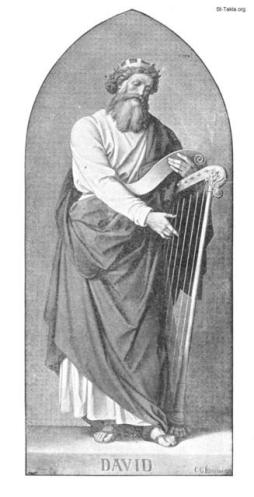
www-St-Takla-org--david

How could David, a man after God’s own heart (1 Samuel 13:14), sink to the level of committing adultery and murder? What was he thinking? How did he respond to being confronted by Nathan? What can we learn about how to deal with our own sin?

2 Samuel 11, 12:1-15, Psalm 51

2 Samuel 11- Setting the Stage for Sin

v. 1- “But David remained at Jerusalem.”
As we’ve read about David’s previous battles, where did we always find David when the fighting was going on? Back at the palace? No. He was out there with his men, leading things. This time, he was somewhere he wasn’t supposed to be. Can you think of a time when you were somewhere you knew you shouldn’t have been, which led to temptation?

v. 3- Eliam and Uriah: Mighty Men (2 Samuel 23:34, 39)
Both Eliam and Uriah were part of David’s mighty men. These weren’t just nameless, faceless Joe Blows in his army, but part of his inner circle who had been with him through thick and thin with fierce loyalty.

v. 4- The paternity test
Lest there be any question that maybe this was Uriah’s baby after all, verse 4 makes clear that the reason David saw Bathsheba bathing was that she was cleansing herself after “that time of the month.” David took her afterwards and Uriah was miles away at the battle, so only David could have been the father.

v. 8- Making Whoopee
(If you don’t know what that means, you’re not old enough to remember “The Newlywed Game” from the 1960s-70s. YouTube it.) “Go down to your house and wash your feet.” Since washing was done right before bed, this idiom meant for Uriah to go home and enjoy “knowing” his wife in the biblical sense.

thv. 9-13- A man of valor
Uriah, possibly inspired by David’s past honorable leadership, acted more valiantly and loyally here than his king did.

v. 4, 26- A willing participant?
Notice that this passage doesn’t tell us anything about what Bathsheba was thinking or feeling about all this. Remember, David was the king. You didn’t say no to the king if you wanted to live, especially if you were a woman. And furthermore, she knew he was “God’s anointed.” Surely such a man wouldn’t lead her to do anything wrong, would he? So, even if Bathsheba had been attracted to David, there was some level of coercion and advantage taking going on here on David’s part. Verse 26 makes a special point of telling us that she lamented over her husband. She loved him. David didn’t just sin with Bathsheba, he also sinned against her.

v. 27- Evil
I think in this case, the HCSB captures this verse better than the ESV (my preferred/usual translation): “The Lord considered what David had done to be evil.” That pretty much sums up what David had done, and it sums up our sin in God’s eyes as well. Evil.


2 Samuel 12:1-15- A Guilty Verdict

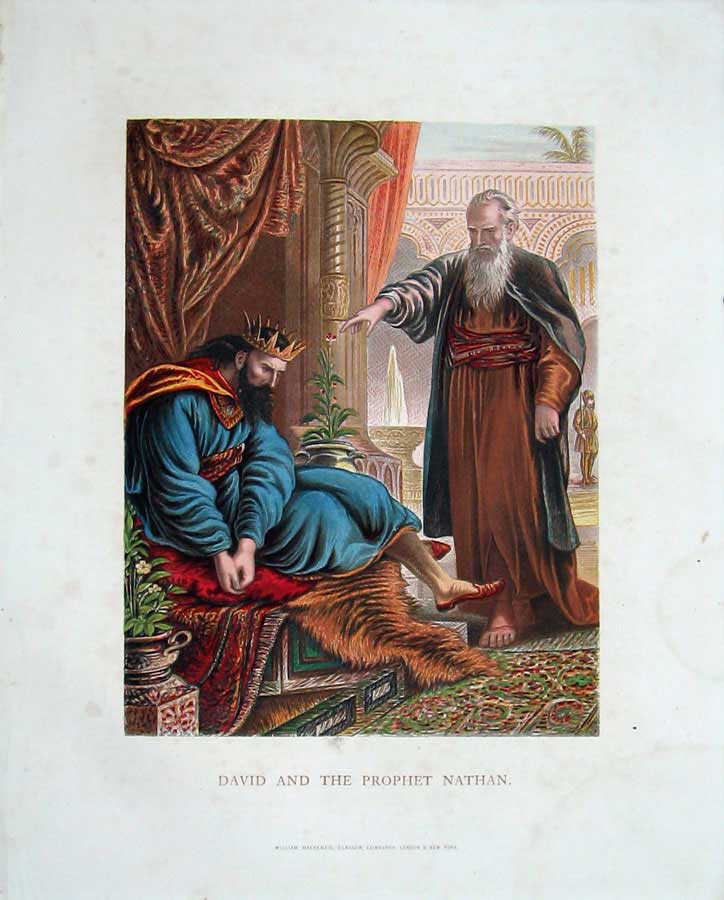
v. 1- Confronathan
Nathan wasn’t just a prophet; he was David’s friend and adviser. God sent him to confront David about his sin, and gave him the wisdom and the words to do it in exactly the right way.

v.1-4- The cast of characters
The rich man represented David. The poor man represented Uriah. The lamb represented Bathsheba. What do you think the traveler represented?

v. 4- Leaving out the welcome mat for temptation (1 Corinthians 10:13)
The traveler represented David’s temptation. Temptation is a lot like a visit from a traveling salesman. It comes and goes, it shows up unexpectedly, and it always tries to get you to spend more than you want to on something that seems fabulous but never lives up to the hype. When temptation rang David’s doorbell, he flung open the door and welcomed it in as an invited guest. As new creatures in Christ, we don’t have to do that. 1 Corinthians 10 says God will always provide a way for us to escape temptation.

One of those ways of escape is to not be home to answer the door. As I mentioned earlier, David wasn’t even supposed to be home when that temptation came around. He was supposed to be out on the battlefield with his troops. One way to avoid temptation is to be where you’re supposed to be and not be where you’re not supposed to be.

v. 4- Offering sacrifices to the idol of self
We also see in verse 4 that the rich man not only refused to send the traveler away and welcomed him in, but he also slaughtered a lamb to feed the traveler. The Israelites did slaughter lambs for food, but what else did they slaughter lambs for? Sacrifices.

David didn’t just welcome temptation in, he sacrificed for it. He was no longer sacrificing to honor God, but to gratify his own selfish desires. He sacrificed things that belonged to him—his integrity, his morals, his reputation, his example to his people, and his relationship with God. But he also sacrificed Bathsheba and Uriah who did NOT belong to him.

What are some ways we might sacrifice things, or others, for sin?

v. 5-6- The log in his eye (Matthew 7:3-5)
Isn’t it interesting how we can so clearly see the sin of others while simultaneously being blind to our own sin? “Why do you see the speck that is in your brother’s eye, but do not notice the log that is in your own eye?” (Matt. 7:3)

“He had no pity.” David never considered how his actions would affect Uriah and Bathsheba. He only thought about himself. Temptation and sin blind us to what we’re doing to ourselves, others, and God.

v. 7ff- Faithful are the wounds of a friend (Proverbs 27:6, Galatians 6:1-2, John 15:13)
Nathan was acting in three roles here. He was David’s friend, his brother in the Lord, and the man of God, and he loved David in all three capacities by showing him his sin. In the same way, we are to love our friends, our sisters in Christ, E1221909136and those under our spiritual leadership or influence. We care enough about them to help them out of sin, even at the risk of the relationship (Gal. 6)

Nathan confronted David wisely. Remember, David was the king—he could do (and had done) whatever he wanted to do, and he had already killed one man. Nathan knew this going in. Nathan also acted lovingly, boldly, and firmly. His commitment to what God had told him to do was greater than the love of his own life (John 15) or the love of his relationship with David. How often do we look the other way to keep the peace or preserve a relationship with someone instead of obeying what God has told us to do?

v. 7-9- Against Thee, Thee only…
I, I, I, I… Notice how many times God refers to Himself in these three verses? He is making it clear—and David gets the message as we will see in Psalm 51:4—that it is primarily God against whom David has sinned. Though others may be casualties or collateral damage (as Uriah and Bathsheba were), when we sin, we set ourselves up as enemies of God and wage war against Him.

v. 8- Gimme, gimme (Hebrews 13:5)
If all God had blessed him with had not been enough, God would have given him more. The fact that God had not given him more shows us that God had given David exactly what He wanted him to have. But David was not content with all the blessings God had given him. He selfishly wanted things God didn’t want him to have.

v. 9-10- Hatred for God’s word = Hatred for God
“Despised” and “evil”- When we sin, no matter how “small” it is, we are showing hatred for God’s word. Hating God’s word is evil. Notice in v. 9, “you have despised the word of the Lord,” and in v. 10, “you have despised me.” To despise God’s word is to despise God Himself.

v. 11-12- Public discipline for private sin? (Numbers 32:23)
Why did God discipline David publicly when he had sinned privately?

First, David had not sinned completely privately. Many people knew at least part of what he had done: the servants he sent to take Bathsheba in the first place (4), the servants who were in the house at the time(s) of the affair, Joab, likely several of the soldiers serving directly under Joab and with Uriah, probably the messenger who brought word of Uriah’s death, Nathan, and of course, Bathsheba herself. And you can bet that a lot of those people didn’t keep what they knew to themselves. “Your sin will find you out,” (Num. 32) is certainly true, especially for sins of this magnitude.

With all those people knowing what David had done, how would it reflect on God if He disciplined David privately? It would look as though God had given him a pass, that certain, special people were above God’s law. That’s how things were for kings of pagan nations. Israel and Israel’s God were different, not like the other nations. Furthermore, it would have diminished God’s justice in the eyes of Israel if God disciplined David privately and Israel couldn’t see it. How could they trust His justice if it looked like His justice was inconsistent?

Second, David was famous, highly visible. Like it or not, he set an example for the people. When he did right, it was a good example. Here, he did wrong and it was a bad example. Through his actions and God’s visible discipline, the people learned what not to do in their own lives.

v. 13- Admission of guilt
David didn’t try to justify his sin or retaliate against Nathan. It is precisely because he was a man after God’s own heart that he simply and humbly confessed, “I have sinned.”

v. 13-14- God’s merciful forgiveness
Because David confessed his sin and repented of it, God mercifully forgave him. While David had said the “rich man” should die for his sin (5), and David was guilty of crimes deserving the death penalty, God removed that penalty from him. The consequences of his sin would remain (the death of the baby), but the punishment was taken away.

1176199_570889419639205_1633472194_n

Psalm 51- Repentance and Restoration

Have mercy on me, O God,
    according to your steadfast love;
according to your abundant mercy
    blot out my transgressions.
Wash me thoroughly from my iniquity,
    and cleanse me from my sin!

For I know my transgressions,
    and my sin is ever before me.
Against you, you only, have I sinned
    and done what is evil in your sight,
so that you may be justified in your words
    and blameless in your judgment.
Behold, I was brought forth in iniquity,
    and in sin did my mother conceive me.
Behold, you delight in truth in the inward being,
    and you teach me wisdom in the secret heart.

Purge me with hyssop, and I shall be clean;
    wash me, and I shall be whiter than snow.
Let me hear joy and gladness;
    let the bones that you have broken rejoice.
Hide your face from my sins,
    and blot out all my iniquities.
Create in me a clean heart, O God,
    and renew a right spirit within me.
Cast me not away from your presence,
    and take not your Holy Spirit from me.
Restore to me the joy of your salvation,
    and uphold me with a willing spirit.

Then I will teach transgressors your ways,
    and sinners will return to you.
Deliver me from bloodguiltiness, O God,
    O God of my salvation,
    and my tongue will sing aloud of your righteousness.
O Lord, open my lips,
    and my mouth will declare your praise.
For you will not delight in sacrifice, or I would give it;
    you will not be pleased with a burnt offering.
The sacrifices of God are a broken spirit;
    a broken and contrite heart, O God, you will not despise.

Do good to Zion in your good pleasure;
    build up the walls of Jerusalem;
then will you delight in right sacrifices,
    in burnt offerings and whole burnt offerings;
    then bulls will be offered on your altar.

Obedience, Old Testament, Sovereignty of God, Sunday School

David and God’s Big Picture ~ Sunday School Lesson ~ 5-11-14

sunday school

These are my notes from my ladies’ Sunday School class this morning. I’ll be posting the notes from my class here each week. Click here for last week’s lesson.

Through the Bible in 2014 ~ Week 19 ~ May 4-10
1 Chronicles 13-18, 2 Samuel 5:11-9, Psalm 1-2, 15, 22-25, 47, 68, 89, 96, 100-101, 105, 132, 29, 33, 36, 39, 50, 53, 60, 75
David and God’s Big Picture

2 Samuel 7/1 Chronicles 17
This passage is the institution of the Davidic covenant: God’s promise to establish the throne of David forever through the eventual birth and reign of Jesus. God, in His sovereignty, had a plan that David was part of. A plan with farther reaching impact than just David’s life. But God’s call on David’s life was the same as His call on our lives: to love and serve Him faithfully wherever He has put us.

crown-and-thorns

2 Samuel 5:12
Right from the beginning of David’s reign, he recognized two very important things about his life that we should also recognize:

1. God is sovereign (1 Samuel 16:1-13, 1 Peter 2:9).
It was God who had made David king over Israel, not anything intrinsically worthy in David himself. Remember that when God chose David to be king back in 1 Samuel 16, David was just a shepherd in his late teens or early 20s. Nothing special. Just an average guy. In fact, God told Samuel not to pay attention to outward signs of “specialness” in David’s older brothers. He had his own reasons for choosing David.

In the same way, when God calls us out of darkness and into His marvelous light (1 Pet.) for salvation, it’s not because there’s anything intrinsically good in us. In fact, everything’s bad about us because we are drenched in sin. But for His own reasons, whatever they are, God has called us out to save us.

2. David’s life was not his own (1 Corinthians 6:19-20, Matthew 20:28)
The second half of this verse does not say that “David knew… that the Lord had…exalted his kingdom” so David would be happy or comfortable or have a life of purpose. God established David’s kingdom “for the sake of His people Israel.” While God certainly blessed David along the way, God is about God. His main objective is His plans, His purposes, and His glory, not our happiness and contentment. This, of course, doesn’t mean He doesn’t care about us individually—far from it!

blurry-sky-cross1 Corinthians tells us our lives are not our own because we were bought with a price (the blood of Christ). We no longer belong to Satan, slaves of our sinful natures, living to gratify our own desires, pawns in his plan of trying to thwart God’s will. We belong to God to use as He sees fit for His plans and purposes.

One of the pitfalls of the American mindset is that it has taught us to focus on ourselves as individuals, often to the exclusion of what is good for our neighbors, our community, our state, nation, and world. We think in terms of “my rights,” “my enjoyment,” and “How will this affect me?” (Just so you know, I’m not a communist or a socialist when it comes to government. I’m just talking about this “me-centered” mentality.) This crosses over into our Christian lives. We often get so focused on our own lives, what we think God is or isn’t doing in them or with them, and how whatever He is doing is affecting us personally, that we forget that God has a huge plan for the entirety of human history and the universe. Whatever He’s up to right now may be about someone else, not you or me. We need to be more aware of God’s “big picture.”

As with David, God gives us our authority and circles of influence for the good of others, to bless them and serve them, even as Jesus came, not to be served but to serve, and to give His life for others (Matt. 20). The good news is that when we are on board with this, we get something much better than fleeting things like earthly happiness and comfort. We get eternal joy, peace, and a glimpse of the glory of God as we obey and cooperate with His plan.

You can’t always get what you want (2 Samuel 7:1- 7, 1 Samuel 13:14)
Because our lives are not our own, cooperating with God’s big picture plans sometimes means that we don’t get to do what we want to do, even if what we want to do is good and godly.

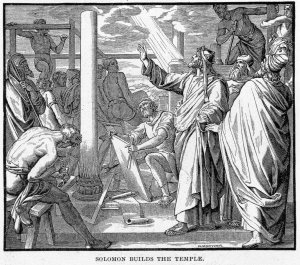
www-St-Takla-org--110--Solomon-Builds-the-Temple-3David was a “man after God’s own heart.” He loved the Lord and wanted to thank and honor Him by building Him a temple. What he wanted to do was an honorable and worshipful thing, and the motives of his heart were pure. But that was not the role God wanted David to play in the unfolding of His plan, nor was it the right time. The person God wanted to fulfill that part of His plan, at a later time, was Solomon.

As we discussed last week, seeking godly counsel is an important part of making godly decisions. David did this by consulting Nathan, the prophet. However, praying and asking for God’s guidance and wisdom is also essential before taking on something like building a temple, and both David and Nathan neglected to do so.

Graciously, even though they hadn’t come to God, God came to Nathan and explained things. God pointed out that in all this time, He had never asked anyone to build Him a permanent house. God had been just fine in a tent up to this point, and would be just fine until He decided it was time for Solomon to build the temple.

Sometimes, even if something is godly and part of God’s plan, He wants someone else to do it.

But you can always get what you need (2 Samuel 7:8-17, Luke 2: 26-33)
What David needed and what we need, is to be faithful and obedient to God wherever He has placed us. This doesn’t mean God will necessarily have us in the same place all our lives (though He might). After all, He took David from shepherd to warrior to king. But David served God faithfully in each of those positions for as long as God had him in those positions.

Ultimately, the role God wanted David to play in His plan was to be the king through whom God initiated the Davidic Covenant. Though David sought to build God a house, it was God who would build David a house (11, Luke 2). It would be an eternal house, first through his descendants who would be temporal kings, and, finally, through the Messiah, Jesus, who would reign forever and whose kingdom would know no end.

David’s Response (2 Samuel 7:18-29)

Humility (18-20)
David was overwhelmed by the fact that, though he wanted to do something big for God, God was going to do something big through him.

Exaltation (21-24)
David again recognized that it was God’s sovereignty that brought all this about, not his own awesomeness (21). He praised God’s greatness, holiness, and superiority to all else (22). He recounted God’s mighty deeds of the past and how He glorified Himself through His chosen people, Israel (23-24)

I’m in! (25-29)
David didn’t express doubt or hesitate to jump in with both feet. He didn’t whine that what he really wanted to do was build the temple. He embraced God’s plan obediently and joined in thankfully and wholeheartedly.

David glorified God for His “macro” plan (25-26) – the coming of the Messiah and everything leading up to it – and also for His “micro” plan (27-29) – realizing that if he cooperated with God’s plan, he and his family would be blessed along the way. Notice that David (29) did ask for God to bless his house and descendants, but not for personal/family gain. He asked that God would bless his family to fulfill and cooperate with God’s plan.

When God places us in any situation, whether blessing or hardship, our response should mirror David’s. We should be obedient to God, never stepping outside of His word to pursue things He doesn’t want for us, even if they seem godly. And, with humility and praise, we should embrace God’s plan, cooperating with Him joyfully.

What about all the non-Davids? (Exodus 12:37, Mark 7:37, 1 Thessalonians 4:9-12)
Sometimes when we read the Bible, we come to stories like David, Moses, Joshua, Noah, and Paul, and we can get the impression that God calls everyone to do great big things for Him as part of his plan. We tend to forget that when the Israelites left Egypt, there were likely 1.5 to 2 million of them. And only one Moses. By David’s time, there were likely several million Israelites. And only one David. What about the millions of Israelites who were born, grew up, got married, went to blue collar jobs every day, and died, having the-israelites-withoutlived lives of quiet faithfulness to God but never having had God make a covenant with them or being called to kill a giant or part a sea? Did God love them less? Value their love for Him less?

Why does God use some people in big, visible, fame-creating ways, and some in invisible ways? The answer, as is often the case when we’re dealing with God is, “I don’t know.” That’s one of the things that makes Him God and us not God. It’s his business, not ours. We trust that He does all things well (Mark 7) and that when He says that we are to “live quietly, and to mind your own affairs, and to work with your hands” (1 Thess. 4), He means it, and that lives of quiet faithfulness are precious in His eyes.


God has a plan. All of us who are His children have a part to play in that plan. Our part, whether big and visible or quiet and invisible, is to love and trust Him more each day and live obediently and faithfully wherever He places us.

Sunday School, Trust

Looking Into the Mirror of Christ ~ Sunday School Lesson ~ 4-27-14

sunday school

These are my notes from my ladies’ Sunday School class this morning. I’ll be posting the notes from my class here each week. Click here for last week’s lesson.

Through the Bible in 2014 ~ Week 17 ~ Apr. 20-26
Psalm 121, 123-125, 128-130, 6, 8-10, 14, 16, 19, 21, 43, 45, 49, 84-85, 87, 73, 77-78,
2 Samuel 1-4, 1 Chronicles 1-5
Looking Into the Mirror of Christ

What is the purpose of a mirror? It’s for seeing what we look like on the outside. As women, we often look in the mirror to make sure our hair is behaving, to see that our make up is straight, to find out how we look in a certain outfit. But we MH900442449also look into “mirrors” to see what we look like on the inside. Often, the mirrors we turn to in times of trouble or use to measure our self worth—how many friends we have, what others say or think about us, what we think about ourselves, whether people feel sorry for us or compliment us, even the number of “likes” we get on a Facebook status—are like the mirrors in an amusement park fun house. We never get a true reflection of who we are on the inside because the mirror itself is distorted. The only way to get a true reflection is to take our eyes off the distorted mirrors and put them on the perfect mirror of Christ and His word.

Background
We usually think of the book of Psalms as having been written by David, but, in fact, of the 150 psalms, David wrote 73, 50 are anonymous (some possibly written by David), and the others were written by other authors. Psalms was the “hymnal” of biblical times, and, indeed, there are churches even today whose only worship songs are psalms set to music. As with our own worship music, Psalms covers a variety of topics from creation to the attributes and mighty works of God to laments and requests from God. Today, we’re going to take a look at some of the more personal psalms from different authors in which the psalmist is crying out to God about his own situation.

Psalm 121, 123

What kind of mirror does the psalmist hold up? (121:1-2, 123:1-2)
When we look into a regular mirror, we see ourselves reflected back. When we look into one of those fun house mt-haunted-mansion-nathan-timmirrors I mentioned, we see a distorted image of ourselves reflected back. But there’s another kind of mirror we can look into. Have you ever been on the “Haunted Mansion” ride at Disney World? At one point in the ride, you find yourself facing a mirror, but what you see reflected back is a hologram (a “ghost”) of one of the people who used to live there.

Where does the psalmist direct us to look in these two passages? To the Lord. Where do we find the Lord? In the mirror of His word. When we look into the mirror of the Word, what do we see? Ourselves? No. Kind of like that “Haunted Mansion” mirror, we see the Lord reflected back in all of His goodness and glory. Our eyes are not to be on ourselves – whether we measure up, whether we’re important enough or good enough or worthwhile human beings— but on the Lord.

What do we notice about the Lord’s reflection?

The Lord is sufficient in all things (121:2-4, 123:1)
He made heaven and earth (121:2), so He is all powerful (omnipotent) and capable of rightly handling all situations. He neither sleeps nor slumbers (121:3-4), so He is all knowing (omniscient). He is aware of and involved in every aspect of life. He is “enthroned in the heavens” (123:1). What is the rank of someone who is “enthroned”? A king. A king has sovereign jurisdiction over every inch of his kingdom. He has the final word in all things, and no one outranks him. What comprises God’s kingdom? The universe. He has perfect, final, and sovereign jurisdiction over every inch of the universe, and no one outranks Him. He is complete and sufficient. This is why we need only look to Him for all things, including a right view of ourselves.

Because He is sufficient in all things, the Lord is our help, stability, protection, provider, and mercy for the needs of our souls (121:1, 3, Psalm 62:2, 121:5-8, 123:2-4)

The Lord is our help (121:1). Notice that the psalmist does not qualify that statement. It is blanket, all encompassing. The Lord is our help in all situations. Others may turn away or be incapable when we need help. He will not.

The Lord is our stability (121:3). While the storms of life may rage around us and try to blow us over, He holds us firmly to Himself, the rock of our salvation (62:2). People are not stable. They can let us down and fail to be there for us. God will not.

The Lord is our eternal protector (121:5-8). He keeps us through the difficult times. Notice that the psalmist does not say that God will do away with the sun, the moon, evil, or even death, but that God will be our shade, he will protect from destruction by the sun and moon, and that He will keep our lives. He will keep our going out and coming in – every step we take—from this time forth and forever more. People are not capable of preserving us in this way, but God is.

The Lord is our provider (123:2). Just as an earthly slave would look to his master to provide everything: food, shelter, clothing, health care, etc., we are to look to and depend on our kind and gracious Master who never fails to provide us with all we need. It is not the job of friends or family to provide us with self worth or fulfill our need for emotional support. That is God’s job, and He does it perfectly. That is why we look to Him for those things.

The Lord is our mercy (123:2-4). God sees all aspects of our lives, and He alone is able to provide us with merciful relief from difficult situations, or merciful grace to see us through those situations. And He’s not only capable of doing so, He will do so. Notice (2) that the psalmist doesn’t say “our eyes look to the Lord…hoping, perchance, that He might have mercy,” but “till He has mercy.” The psalmist is confident that it is God’s intention to show mercy. People cannot alleviate our circumstances or carry us through them, nor would they always be willing to do so even if they could, in fact, sometimes the people we would look to in difficult times can actually be the cause of those difficult times (4). Only God can mercifully take away or see us through tough situations.

As we can see, people are often undependable or incapable of giving us what we need emotionally, and completely unable to provide for our spiritual needs. This is why God’s word never directs us to look to the mirror of ourselves or to others for our inner needs or fulfillment, but rather to the mirror of His word and the reflection of Christ. Only God is capable of being, and wants to be, our sufficiency in all areas of life. We must look to God and depend on Him for these things.

Psalm 77

In times of trouble, we look back to the mighty deeds of God in the past.
The first nine verses of this psalm are a lament. Asaph doesn’t explain exactly what’s going on in his life—and maybe that’s beneficial to us because we can all relate to what he’s feeling here regardless of the specific circumstances—but he’s going through a really gut-wrenching time.

Where does Asaph turn? He starts out determined to cry out to the Lord over his situation. He knows in his mind that the Lord “will hear me” (1), but as he begins to pray, he takes his eyes off the Lord, begins to focus on the problems themselves (3- I moan…my spirit faints), and gets overwhelmed. Notice that when he looks back to the mirror of better circumstances (5) or happier times (6- “my song in the night”) or looks to himself (6- let me meditate in my heart) for the solution to his troubles, he only despairs more (7-9).

Finally, Asaph realizes that the only thing that will help is to focus on the Lord Himself (9- His hand), His power (9- “Right hand” is a metaphor for strength), and His deliverance in years gone by (9- the years). He looks into the mirror of God’s steadfast faithfulness.

Asaph doesn’t just recount the details (11- deeds) of what God has done in the past, he also recalls that God’s works evoke a sense of wonder (11,14) for both those who witnessed them and those who think back on them. And Asaph doesn’t merely recall and regurgitate the details of these deeds, he ponders them. He meditates on them (12). He turns them over and over in his mind, considering how they reflect God’s might (12, 14), His holiness, greatness, and superiority to other gods (13). Asaph thinks about how God redeemed His people (15) and would redeem him from his troubles, God’s 1185602_570889882972492_1155182179_npower over nature (16-18) and His power over Asaph’s situation. And even though Israel couldn’t see God Himself, He still led them (19-20), the same way he would lead Asaph, though unseen. If God was powerful enough to redeem Israel, have power over nature, and lead Israel, He was powerful enough to handle Asaph’s situation.

When we face difficult times, Asaph sets a great example for us. We look not to ourselves, others, or circumstances, we look to God, determined to cry out to Him. We ponder His wonder, holiness, power, and greatness. We look at what He has done in the past in His word and in our own lives, knowing that if He was powerful enough to handle those situations, He is powerful enough to handle the present one. We remember that as God has been faithful in the past, He will continue to be faithful in the future.

Psalm 130

There is hope in the Lord (1 John 1:9)
Finally, we turn to the Lord, because in Him, and in no other, is hope.

There is hope of His forgiveness (2-4). When we cry out to God for mercy, He has promised to forgive us (1 John). With Christ, we do not have to stand hopeless and condemned in our sin.

There is hope in His word (5). Not only can we find hope in God’s great and mighty deeds from the past in His word, but we can also find hope in the attributes of God described by the Bible (His goodness, holiness, mercy, compassion, etc.), and in the promises He has made in His word (He will provide, He hears our prayers, He will never leave us, etc.), because we know He will never break them. We cannot find this kind of perfect hope in others.

There is hope because the Lord is trustworthy (5-6). “I wait,” the psalmist says, “more than the watchmen for the morning.” The watchmen knew the morning was coming. How much more does the psalmist know that the Lord will answer him with hope?

There is hope in God’s steadfast love and His plentiful redemption (7-8). The psalmist wasn’t hoping for fleeting things like riches or temporary happiness. He was looking at the big picture. The spiritual picture: God’s eternal love and His redemption from sin. This is our hope as well.

As we face difficult times, like the psalmist, we must keep our eyes focused on the Lord as He is reflected in the mirror of His word, not on our own reflection or the way others reflect us. The Lord is the only one powerful enough to give us the help, stability, protection, provision, and mercy to meet the needs of our souls. Others will let us down, but as we look to God’s faithfulness in the past, we find hope for the present and the future.