Colossians Bible Study

Colossians: Lesson 4

Previous Lessons: 1, 2, 3

Colossians 2

For I want you to know how great a struggle I have for you and for those at Laodicea and for all who have not seen me face to face, that their hearts may be encouraged, being knit together in love, to reach all the riches of full assurance of understanding and the knowledge of God’s mystery, which is Christ, in whom are hidden all the treasures of wisdom and knowledge. I say this in order that no one may delude you with plausible arguments. For though I am absent in body, yet I am with you in spirit, rejoicing to see your good order and the firmness of your faith in Christ.

Therefore, as you received Christ Jesus the Lord, so walk in him, rooted and built up in him and established in the faith, just as you were taught, abounding in thanksgiving.

See to it that no one takes you captive by philosophy and empty deceit, according to human tradition, according to the elemental spirits of the world, and not according to Christ. For in him the whole fullness of deity dwells bodily, 10 and you have been filled in him, who is the head of all rule and authority. 11 In him also you were circumcised with a circumcision made without hands, by putting off the body of the flesh, by the circumcision of Christ, 12 having been buried with him in baptism, in which you were also raised with him through faith in the powerful working of God, who raised him from the dead. 13 And you, who were dead in your trespasses and the uncircumcision of your flesh, God made alive together with him, having forgiven us all our trespasses, 14 by canceling the record of debt that stood against us with its legal demands. This he set aside, nailing it to the cross. 15 He disarmed the rulers and authorities and put them to open shame, by triumphing over them in him.

16 Therefore let no one pass judgment on you in questions of food and drink, or with regard to a festival or a new moon or a Sabbath. 17 These are a shadow of the things to come, but the substance belongs to Christ. 18 Let no one disqualify you, insisting on asceticism and worship of angels, going on in detail about visions, puffed up without reason by his sensuous mind, 19 and not holding fast to the Head, from whom the whole body, nourished and knit together through its joints and ligaments, grows with a growth that is from God.

20 If with Christ you died to the elemental spirits of the world, why, as if you were still alive in the world, do you submit to regulations— 21 “Do not handle, Do not taste, Do not touch” 22 (referring to things that all perish as they are used)—according to human precepts and teachings? 23 These have indeed an appearance of wisdom in promoting self-made religion and asceticism and severity to the body, but they are of no value in stopping the indulgence of the flesh.


The Holy Bible, English Standard Version Copyright © 2001 by Crossway Bibles, a publishing ministry of Good News Publishers.

Questions to Consider:

1. A great little heremeneutical rule of thumb is that when you see the word “therefore” in the text, you look at the previous verses to find out what it’s “there for”. The same could be said of the word “for” at the beginning of verse 1. Paul is continuing a thought here that started in the last verses of chapter 1. Read back a few verses and summarize his entire thought in your own words. What else do we know about the church at Laodicea? (1)

2. What are some things Paul hopes to accomplish, via this epistle, in the churches at Colossae, Laodicea, and others? (2-7) What is the main goal of Paul’s teaching in this epistle? (4) What is the “therefore” in verse 6 “there for”?

3. Recall that the Colossian church was made up of both Jews and Gentiles, and that the Colossian Heresy Paul was combating with this epistle contained both Jewish and Gentile false doctrine. Examine the terms “philosophy” and “human tradition” (8) Do these seem to describe Jewish or Gentile teachings? What about “circumcision” (11-13), “food and drink,” “festivals,” and “Sabbath”? (16) How can Christians and the church avoid being deceived by false doctrine regardless of its source? (6-7, 19)

4. The Judaizers taught that Christians had to follow the Old Testament Mosaic law. What were some of those laws? (11, 16, 21-22) What did Paul tell the Colossians about the Old Testament law and why Christians are not bound by it? (17, see these verses also) How does Paul describe the “circumcision” Christians now receive? Who performs this new “circumcision” and what is “cut away”? (11) On which “body part” of a Christian is it performed? Compare these verses to Deuteronomy 10:16, 30:6. How do all of these passages show that physical circumcision was only to be an outward sign of circumcision of the heart? What is the New Testament outward sign of circumcision of the heart? (12) How does Paul tell the Colossians to respond to the Judaizers’ pressure? (16)

5. Examine verses 20-22. What do believers die to in Christ? Are we to go back to worldly teachings and beliefs, as though we have not died to them, and continue to follow their unbiblical rules and regulations? If we are to be dead to these things, what are we to live to? Compare this passage to Galatians 3:1-9. How would these passages have demonstrated to Jewish believers that keeping Old Testament law was not required of them or of Gentile believers? Does your own church have any rules or teachings that Scripture does not require of Christians? What does following man made rules accomplish? (23)


Homework:

Do you see the similarities between the Judaizers’ teachings and the modern day teaching of the Hebrew Roots Movement? Has anyone ever asked you why you don’t keep Old Testament law? List three teachings from the first two chapters of Colossians that you could use to persuade a friend not to follow the Hebrew Roots Movement or to explain why you’re free to eat lobster and wear poly-cotton blends.

Mailbag

The Mailbag: Is it OK for Christian men to read Christian women’s blogs?

mailbag

As a man, am I not to read or seek to understand anything from your blog because a woman wrote it? (1 Timothy 2:12)

While other female bloggers might answer differently, as far as my personal position goes, the short answer to your question is no. Generally speaking, it’s not biblically problematic for a Christian man to read my blog because the blogosphere is not the gathering of the church body, and I’m not in any position of spiritual or practical authority over male readers (or even female readers for that matter). Additionally, when I write, I’m writing to instruct and edify women, not men. Male readers are sort of “eavesdropping” or “listening at the door.”

But I would encourage male readers to examine their motives for reading my blog. I have a number of godly male readers, including several pastors, who read my blog for a variety of reasons: they’re interested in a female perspective on various church and biblical issues, they want to use my perspective to better understand and help their wives or female church members, their wives or female church members read my blog and they’re keeping tabs on me to make sure those ladies are taught properly, they don’t have time to vet a certain Christian teacher, so they use my information on false and sound teachers as a resource, and there are those who are friends, whom I’ve asked to keep up with my blog so they can offer me correction as needed.

My thought is that any of those (or similar) reasons are fine and don’t even fall under the spirit of 1 Timothy 2:12, much less the letter. What I do feel would fall under the spirit of that passage would be a man seeking biblical instruction from me for his own personal walk with the Lord. For example- I run a Bible study for women every Wednesday on the blog, and the archives of my previous studies are under the “Bible Studies” tab at the top of this page. On my part, I’d feel scripturally uncomfortable if a man were using that as the basis for his quiet time rather than using something written by a man, or just studying his Bible. (By the way, if you’re looking for some godly male preachers and teachers, check the “Recommended Bible Teachers” tab at the top of this page.)

I guess the questions I would ask myself if I were a male reader are: What are my reasons for reading this? Is my motivation to receive instruction in Scripture that should really be coming from a male teacher or straight from God’s word? Is my conscience clear, based on God’s word, to go ahead and read this? How can I best honor God and His word in this situation?

I’ve written more extensively on this topic (and related topics) in these articles:

Adam 3.0: Meanwhile, Back in the Garden, It’s Deja Vu All Over Again

Are Female Bloggers Violating Scripture by “Teaching” Men?

Rock Your Role FAQs (#2)


If you have a question about: a well known Christian author/leader, a Bible passage, an aspect of theology, a current issue in Christianity, or how to biblically handle a family, life, or church situation, comment below (I’ll hold all questions in queue {unpublished} for a future edition of The Mailbag) or send me an e-mail or private message. If your question is chosen for publication, your anonymity will be protected.

Prayer, Top 10

Top 10 Ways to Pray for Your Pastor

Do you pray for your pastor regularly? I hope you do. Being a ministry wife myself, I’ve gotten to know oodles of pastors over the years. The old joke that a pastor only works an hour a week couldn’t be farther from the truth. Ministry is hard. In the midst of the joys it brings, it’s long hours, lots of stress, and dealing with sometimes stubborn (and sometimes downright mean) sheep. In fact, I’ve often said it’s ministry, not the Peace Corps, that’s “the toughest job you’ll ever love.” Here are ten ways you can pray for your pastor.

1. Pray that he will excel at his job.
Ask God to help your pastor “hold firm to the trustworthy word as taught, so that he may be able to give instruction in sound doctrine and also to rebuke those who contradict it.” (Titus 1:9) This is the Bible’s main job description for pastors. Pray that yours will fulfill it well.

2. Pray that he will be a good Berean.
Pray that God will help your pastor prioritize vetting the theology of anyone he quotes in the sermon, whose reference materials he uses when studying, or whose materials the church is considering using.

3. Pray that God will protect his time.
Weddings, funerals, outreach events, meetings, even fixing the leaky toilet in the men’s room- they all take up a pastor’s most precious commodity: time. And time, particularly uninterrupted time, is what it takes to adequately study and prepare sermons and whatever Bible studies he might teach. Pray that God will provide your pastor with the time he needs (and good time management skills) to attend to study, sermon prep, and all his other pastoral duties.

4. Pray for rest.
There are some pastors out there who are working upwards of 60-80 hours a week, but even a 40 hour week of ministry can be exhausting. Pray that God will help your pastor to get the rest he needs and that he will sleep well.

5. Pray for his areas of pastoral weakness.
Some pastors are really good at preaching but are poor administrators. Some are great at marriage counseling but stink at hospital visits. Pray that God will strengthen your pastor in his areas of ministerial weakness, whatever those might be.

6. Pray for wisdom in difficult church circumstances.
The roof of the sanctuary was damaged in the storm and the church can’t afford to have it fixed. A couple everyone thought was married turns out to be living together and needs to be confronted about their sin. Even if it’s something you don’t know about, your pastor is probably dealing with some sort of difficult church situation. Pray that God will give him the wisdom to make the best and most godly decisions possible and carry them out in a biblical way.

7. Pray for his personal walk with the Lord.
Does your pastor have time to get alone with the Lord for his personal relationship with Christ? Maybe he’s struggling against a particular sin or striving to be more committed to prayer. Pray that God will grow your pastor in Christ as an individual.

8. Pray for his joy.
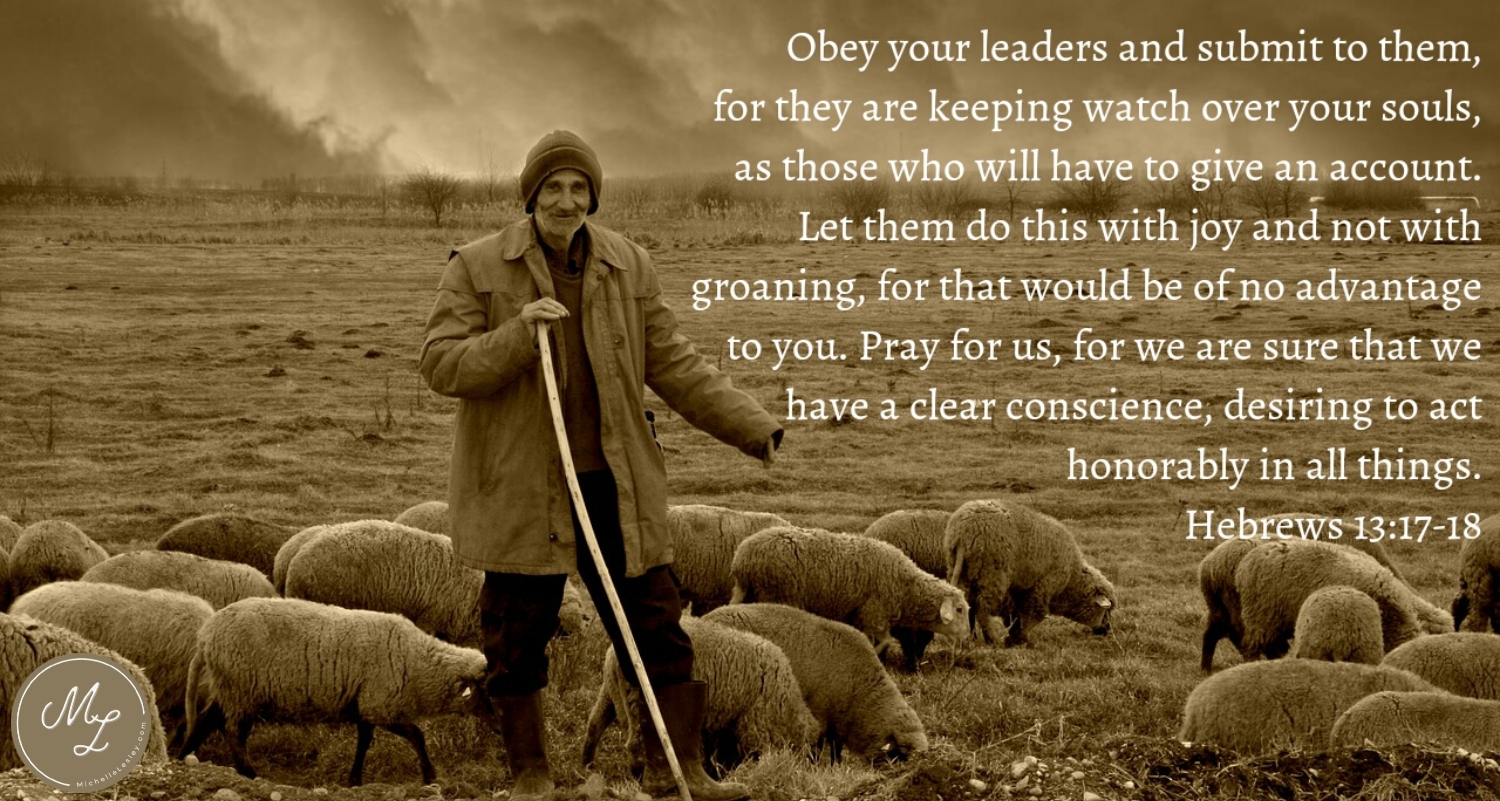
Hebrews 13:17 says: “Obey your leaders and submit to them, for they are keeping watch over your souls, as those who will have to give an account. Let them do this with joy and not with groaning, for that would be of no advantage to you.” It does the church no good to have a pastor who groans at dealing with his sheep because they’re stiff-necked and contrary. Pray that God will make your pastor’s job a joy by praying for the spiritual health and submission of your church.

9. Pray for your pastor’s family relationships.
Before he’s your pastor, he’s her son, her husband, their brother, their father. Pray that God would help your pastor have the time he needs to spend with his family, and to be a godly husband, father, and loved one.

10. Pray about how you can help your pastor.
Pastors have a lot on their shoulders. Is there any way you could take something off your pastor’s plate and allow him to focus on the things only he can do? Could you fix that leaky toilet, teach that class, fill that volunteer slot, counsel that sister, vet that proposed small group study? Could you at least offer him a word of encouragement on a regular basis? Ask God to show you ways you can help out your pastor.

Our pastors need our prayers.
What are some other ways we can pray for them?

Colossians Bible Study

Colossians: Lesson 3

Previous Lessons: 1, 2

Colossians 1:15-29

He is the image of the invisible God, the firstborn of all creation. 16 For by him all things were created, in heaven and on earth, visible and invisible, whether thrones or dominions or rulers or authorities—all things were created through him and for him. 17 And he is before all things, and in him all things hold together. 18 And he is the head of the body, the church. He is the beginning, the firstborn from the dead, that in everything he might be preeminent. 19 For in him all the fullness of God was pleased to dwell, 20 and through him to reconcile to himself all things, whether on earth or in heaven, making peace by the blood of his cross.

21 And you, who once were alienated and hostile in mind, doing evil deeds, 22 he has now reconciled in his body of flesh by his death, in order to present you holy and blameless and above reproach before him, 23 if indeed you continue in the faith, stable and steadfast, not shifting from the hope of the gospel that you heard, which has been proclaimed in all creation under heaven, and of which I, Paul, became a minister.

24 Now I rejoice in my sufferings for your sake, and in my flesh I am filling up what is lacking in Christ’s afflictions for the sake of his body, that is, the church, 25 of which I became a minister according to the stewardship from God that was given to me for you, to make the word of God fully known, 26 the mystery hidden for ages and generations but now revealed to his saints. 27 To them God chose to make known how great among the Gentiles are the riches of the glory of this mystery, which is Christ in you,the hope of glory. 28 Him we proclaim, warning everyone and teaching everyone with all wisdom, that we may present everyone mature in Christ. 29 For this I toil, struggling with all his energy that he powerfully works within me.


The Holy Bible, English Standard Version Copyright © 2001 by Crossway Bibles, a publishing ministry of Good News Publishers.


Questions to Consider:

1. At the end of lesson 2 (link above), we saw that Paul gave a brief recap of the gospel (13-14). How was that a good introduction to the passage we’re looking at today? What is the overall theme of today’s passage?

2. Jehovah’s Witnesses use verse 15 to support their idea that Christ was a created (non-eternal) being. Is that what this verse means? What sort of ideas would the term “firstborn” have brought to the minds of first century Jews (and even gentiles)? Verse 15 says that Christ is the firstborn of all creation. Verse 18 says that He is the firstborn from the dead. How do these two positions of Christ “bookend” His supremacy over every aspect of the universe?

3. List the specific roles Christ plays in creation in verses 15-17. Why would it have been important for Paul to emphasize Christ’s role in creation? What did this (as well as verse 19) indicate to his audience about Christ’s deity and His relationship with God the Father?

4. As previous verses emphasized Christ’s deity, what are the references to His humanity in verses 19 and 22? Part of the heresy that was creeping into the Colossian church was elements of mysticism that would later morph into gnosticism. How would the proper Christology Paul was trying to teach them – including Christ being 100% God and 100% man simultaneously (the hypostatic union) – combat that heresy? Why is it important that we, as Christians, believe that Christ was both fully God and fully man? How would it affect Christ’s work on the cross if he had been less than God or less than human? How might understanding the hypostatic union better help you to love Christ more?

5. What do verses 24-29 tell us about Paul’s relationship with and care fo the Colossian church? What was his goal for this church? (28-29) Is this the goal of the leadership at your church? How can verse 28 guide us as we seek to make disciples today? Do we put the same effort and energy into discipleship that Paul did? (29)


Homework:

Read back through the tenets of gnosticism (link in #4). Are there any sort of gnostic beliefs in the church today? Write down some ways biblical Christology (the study of who Christ is, what He did, and why) could combat these false beliefs.

Christian women, Church

Pastoral Propriety with Church Ladies, and 7 Ways Women Can Help

dancing-893206_1280

Yesterday, I read a fantastic article for pastors entitled The Pastor and Inappropriate Interactions with Women in the Church. (I’ll give you the gist of it, but it’d be better if you would take a second and read it. It’s not long. I’ll wait.) It’s not about pastors having affairs, it’s about inappropriate interactions with women at church: full frontal hugs, emotionally intimate conversations, and such.

I thought it was great advice to pastors, and, while the onus really is on pastors themselves to make sure their behavior toward women in the church is appropriate, there’s no reason women have to make it difficult for them, right? So what can we ladies do to help out our pastors and other brothers at church?

1. Oh, man. Remeber that pastors and Christian brothers are men. No matter how godly they are, they’re subject to all the same temptations as other men, including temptations to lust, touch inappropriately, and even commit adultery. Don’t be lulled into some idyllic complacency that your pastor doesn’t struggle in this area and you don’t have to mind your P’s and Q’s.

2. Trade hugs for handshakes. Maybe you’re just a huggy person in general. You probably don’t mean anything more by hugging a man at church than you do by hugging a woman. But what might it mean or feel like to the man you’re hugging? Maybe that’s something he struggles with. How about offerning a handshake or a pat on the shoulder instead?

3. What Not to Wear. Dress modestly. Yeah, I went there. I’m not going to get into inches of skirt length and all that, just serve your brothers by keeping the girls and the gams sufficiently under wraps. If in doubt, wear something else. If you look like you’re going clubbing instead of to church, wear something else. If it would be too tight or revealing to wear to a funeral without people talking behind your back, wear something else. Sometimes your husband, father, or brother can offer a helpful opinion. They have more experience at looking through a man’s eyes and thinking with a man’s brain than you do.

4. (Don’t) Call me on the line. Don’t exchange personal or numerous phone calls, e-mails, texts, or private social media messages with men. Brief, businesslike, back and forths when absolutely necessary due to mutual projects, meetings, etc., at church are fine, but even those can grow into something inappropriate if you’re not careful.

5. Flirty is for floozies. There’s a fine line between friendly and flirtatious. Locate it and stay on the right side of it.

6. None on one. Do not, under any circumstances, meet alone behind closed doors with your pastor or any other man. That includes your pastor’s office, and it includes pastoral counseling. If he doesn’t insist on another person being present or leaving the door of his office open to a common area where others are around, then you insist on it. Don’t meet in public (a coffee shop, restaurant, etc.) alone with your pastor or any other man, either. That looks like a date to most people.

7. The welcome mat chat. Don’t enter a man’s home if his wife isn’t there, and don’t invite a man inside if your husband isn’t home. Maybe you and the pastor’s wife are friends. You’re out running errands and happen to find yourself in her neighborhood, so you drop by to say hello. It turns out she isn’t home, but her husband is. Keep it to a brief exchange of pleasantries on the porch and go finish your errands. You never know who might be passing by seeing your car in the driveway, but not the pastor’s wife’s car.

Those are just a few of the thoughts I had about some safeguards and precautions we can take to help out our pastors and Christian brothers as well as protect our own hearts and reputations. What say you, ladies (and gentlemen- want to give us the benefit of your experience and wisdom?)? Any other ideas?