On today’s Testimony Tuesday,
several sisters in Christ share their stories.
From Facebook:
Cheryl’s Story Words are powerful, and when they are well intended, but off-base, they can cause massive damage.
About 25 years ago we lost two of our three babies to a genetic disease. When the second of the two was still with us, (they died 4 years apart), a well-intentioned person came to encourage us, and told us, “If you have enough faith, your baby will live”.
Those words were a hook that dragged me through years and years of torment. “If I have enough faith, then…” My baby died, so it became MY FAULT because I didn’t have sufficient faith. It also made God someone who couldn’t be pleased. How much faith DOES one need to get a miracle, and how do you get it?? It was a huge can of worms.
Two decades later, I broke down into a major depression that nearly ended my life, but God led me to safe counsel, and I was truly, finally healed from carrying that horrible guilt and grief all those years.
Words are powerful. Use wisdom because sometimes Satan uses well-intentioned words as bait that have lies wrapped in them.
Anonymous I was going to a charismatic church and the pastor started promoting and giving Rick Warren’s book Purpose Driven Life out to all the new Christians. I was very concerned since I don’t agree with Warren’s teaching so I made an appointment to meet with the pastor and his wife (who is a co-pastor). They didn’t agree with my concerns at all and even mentioned during the conversation that they like Joel Osteen! I knew then that it was time for me to leave that church. I started attending a Baptist church and have left the Word of Faith doctrine completely. Feeling very blessed to be where I am now!
Deby’s Story Submission has gotten a bad rap in our society. It is not being a doormat or being mentally or a physically abused submission. It is submitting as if to Christ. My husband was not a believer and now he is. It was hard for me not to nag him about things, I had to trust God and put my husband in God’s hands and his will. Sure I made some mistakes along the way but eventually in God’s timing not mine, he called my husband to the faith.
Catherine’s Story When I was first married, I was the unsaved and my dearest husband was the Believer. You have no idea what that man of mine had to put up with in the first 2 years of our marriage before the Lord got a hold of my heart and I was made to look at my own depravity, sinful desires, and all-around foolishness. I am a fortunate woman that my husband stuck around for that conversion, and I know that too was part of a Sovereign Lord’s plan and one that I cannot thank Him enough for. After 32 years of marriage, I have not “arrived”. I look back on those first couple years and I’m humbled by what the study of God’s Word and the sanctification that the Spirit works in a person’s life has done to change me so completely.
Ladies, God is still at work in the hearts and lives of His people, including yours! Would you like to share a testimony of how God saved you, how He has blessed you, convicted you, taught you something from His word, brought you out from under false doctrine, placed you in a good church or done something otherwise awesome in your life? Private/direct message me on social media, e-mail me (MichelleLesley1@yahoo.com), or comment below. Try to be brief (3-4 paragraphs or less) if possible. I’ll select a few to share on the blog another time. Let’s encourage one another with God’s work in our lives!
There are a lot of godly people out there who have read a lot of books, listened to a lot of teachers, know a lot of Scripture, and been through a lot of experiences. Harness their knowledge and share your own.
And I thought- what better way to demonstrate and make use of thinktanking than to enlist the help of my blog and social media readers to answer the questions of fellow readers that have me stumped or that I’m unable to research at the moment?
So today, I’m sharing a few of those questions and asking my readers to help answer them in the comments section. (I’ll chime in a little, but I’ll mostly be relying on your answers.)
To the “Askers”
Please keep in mind that I have readers from all sorts of doctrinal schools of thought, and varied levels of discernment and spiritual maturity, who may be answering your questions. While I’ll do my best to weed out any false doctrine/false teachers before posting their answers, you must do the work of comparing everything to Scripture before believing it or using it as a biblically trustworthy resource.
To the “Answerers”
To answer a question, scroll all the way down to the bottom of the page and answer in the comment box. If you’re new to the blog or have never read the comment parameters in the Welcome tab, please do so before answering. Answers violating these parameters will not be published. Please make clear which question you’re answering. Helpful hint- more people will read your answer if you keep it fairly brief. Links to useful, biblical resources are encouraged. Your answer might be edited for length or doctrine.
All set? Here we go!
1. Do you know of any doctrinally sound resources for visually impaired people?
As far as books, descriptive videos, etc., I just don’t know. I can tell you that Bible Gateway has a page of audio resources, including audio Bibles (click the drop down- I’d recommend ESV, NASB, HCSB/CSB, or NKJV. You’ll want to avoid NIV and MSG.) and devotionals (listen discerningly, some of these may not be doctrinally sound).
Any readers out there familiar with biblical resources for our visually impaired friends?
2. Can you recommend any doctrinally sound “Christian living” (relationships, modesty, stewardship, suffering, etc.) books or materials specifically geared toward college-aged (late teens-early 20s) young adults?
Though I have no doubt they’re out there, I’m not familiar with any of the books/materials specifically written for this age group.
Which young adult books or materials would you recommend?
3. Do you know of any doctrinally sound books or resources in Russian or Latvian?
Bible Gateway has Bible translations in a variety of languages including Russian, but I cannot speak to how accurate any of them are. I know that prolific, doctrinally sound authors like John MacArthur and R.C. Sproul have had their books translated into many languages, so I would suggest checking the Grace to You and Ligonier online stores or possibly e-mailing them for more information. Beyond that, I have no idea.
Anybody experienced in Russian/Latvian or know a missionary in that area who could make a good recommendation?
4. Can you recommend a doctrinally sound church in any of the following areas:
Harrisonburg, Virginia
Wichita, Kansas
The United Kingdom (this reader is also looking for “any faithful teachers, bloggers, charities, businesses in the UK.”)
Each of these readers has already been directed to the Searching for a new church? tab at the top of this page. It contains several good church search engines (including churches pastored by Master’s Seminary grads). This is a request for recommendations of churches, ministries, etc., you’re personally familiar with.
5. “I home school, and we participate in Classical Conversations. I’ve noticed some problems with my CC group: unruly children/lack of discipline, and some concerning unbiblical beliefs and practices. Are these problems that are common in other CC groups?”
I home school, and, while I have friends who participate in CC, we don’t, and I’m not very familiar with it. My guess is that there are going to be similar problems in any home school group (or, for that matter, any group that involves parents and children).
Home schooling readers- any input here?
If you have a question about: a Bible passage, an aspect of theology, a current issue in Christianity, or how to biblically handle a family, life, or church situation, comment below (I’ll hold all questions in queue {unpublished} for a future edition of The Mailbag) or send me an e-mail or private message. If your question is chosen for publication, your anonymity will be protected.
The beginning of the gospel of Jesus Christ, the Son of God.
2 As it is written in Isaiah the prophet,
“Behold, I send my messenger before your face, who will prepare your way, 3 the voice of one crying in the wilderness: ‘Prepare the way of the Lord, make his paths straight,’”
4 John appeared, baptizing in the wilderness and proclaiming a baptism of repentance for the forgiveness of sins.5 And all the country of Judea and all Jerusalem were going out to him and were being baptized by him in the river Jordan, confessing their sins.6 Now John was clothed with camel’s hair and wore a leather belt around his waist and ate locusts and wild honey.7 And he preached, saying, “After me comes he who is mightier than I, the strap of whose sandals I am not worthy to stoop down and untie.8 I have baptized you with water, but he will baptize you with the Holy Spirit.”
9 In those days Jesus came from Nazareth of Galilee and was baptized by John in the Jordan.10 And when he came up out of the water, immediately he saw the heavens being torn open and the Spirit descending on him like a dove.11 And a voice came from heaven, “You are my beloved Son; with you I am well pleased.”
12 The Spirit immediately drove him out into the wilderness.13 And he was in the wilderness forty days, being tempted by Satan. And he was with the wild animals, and the angels were ministering to him.
14 Now after John was arrested, Jesus came into Galilee, proclaiming the gospel of God,15 and saying, “The time is fulfilled, and the kingdom of God is at hand; repent and believe in the gospel.”
16 Passing alongside the Sea of Galilee, he saw Simon and Andrew the brother of Simon casting a net into the sea, for they were fishermen.17 And Jesus said to them, “Follow me, and I will make you become fishers of men.”18 And immediately they left their nets and followed him.19 And going on a little farther, he saw James the son of Zebedee and John his brother, who were in their boat mending the nets.20 And immediately he called them, and they left their father Zebedee in the boat with the hired servants and followed him.
1. Briefly review the background and setting of the book of Mark from lesson 1 (link above).
2. What two titles does Mark ascribe to Jesus in verse 1? What does the word “Christ” mean, and why is it an important title for Jesus? What does it mean that Jesus is the “Son of God“?
3. How many times does Mark use the word “immediately” in chapter 1? How might the repeated use of this word have given Mark’s audience – first century Gentiles – a sense of urgency about Jesus’ mission and their need for salvation? Does it give you a sense of urgency about these things as you read?
4. What was John the Baptist’s mission as prophesied by Isaiah? (2-3) How did John “flesh out” that mission? (4) How did John’s message of repentance and the baptism of repentance help “prepare the way of the Lord” – “prime the pump” or get people’s hearts ready – for the gospel Jesus would preach? (5, 7-8) What can we learn about John’s character from this passage?
5. How does John’s message of repentance preceding Jesus’ message of the gospel demonstrate that repentance is a crucial aspect of saving faith in Christ? (1-15) Would God have sent John to preach the message of repentance if He did not consider it a vital part of salvation? What does Mark indicate was the theme of the message Jesus preached? (15) Some people say repentance is not necessary for salvation- that only belief in Jesus is necessary. Did Jesus consider repentance to be part of the gospel? (15)
6. Examine verses 9-11. Since Jesus was without sin, why did He take part in a baptism of repentance? How does Jesus’ baptism set an example for believers to follow Him in being baptized? How does this passage reveal the Trinity (God the Father, God the Son, God the Holy Spirit) to us? How does this passage refute the false teaching of modalism/Sabellianism and show us that God is one God in three Persons?
7. Who led Jesus to the place where He would be tempted by Satan? (12) Can we surmise from this that it was God’s plan for Jesus to undergo temptation? Why?
8. What two main characteristics did Simon and Andrew, and James and John, have in common? (16,19) Today, we might call them “blue collar” or “rednecks”- why do you think Jesus chose simple, uneducated fishermen as His first followers? (16-20) What message might this have sent first century Gentiles hearing, for the first time, about Jesus and His disciples? What did Jesus mean when He said He would make them “fishers of men”? (17) Considering what you know about them from the rest of the New Testament, did Simon, Andrew, James, and John become fishers of men?
9. What is the overall theme, purpose, or main idea of Mark 1:1-20?
Homework
Imagine yourself as a first century Gentile in a polytheistic society. You have little, if any, knowledge of the God of the Jews or the Old Testament, but you’re curious about this Jesus and why some of your Jewish and Gentile neighbors have begun to worship Him. Make a list of five to ten questions you’re going to want answered about Jesus so you can decide whether or not you want to worship Him, too.
Keep your list of questions handy as we study Mark. As you discover the answers to each question, write them down. Be reminded of who Jesus is and why He is worthy of your faith, worship, and obedience. Share what you’ve discovered with an unbelieving friend who needs to know Jesus.
Suggested Memory Verse
Now after John was arrested, Jesus came into Galilee, proclaiming the gospel of God,and saying, “The time is fulfilled, and the kingdom of God is at hand; repent and believe in the gospel.” Mark 1:14-15
If you are considering commenting or sending me an e-mail objecting to the fact that I warn against false teachers, please click here and read this article first. Your objection is most likely answered here. I won’t be publishing comments or answering emails that are answered by this article.
I get lots of questions about particular authors, pastors, and Bible teachers, and whether or not I recommend them. Some of the best known can be found above at my Popular False Teachers tab. Below are some others I’ve been asked about recently, so I’ve done a quick check (this is brief research, not exhaustive) on each of them.
Generally speaking, in order for me to recommend a teacher, speaker, or author, he or she has to meet three criteria:
a) A female teacher cannot currently and unrepentantly preach to or teach men in violation of 1 Timothy 2:12. A male teacher or pastor cannot allow women to carry out this violation of Scripture in his ministry. The pastor or teacher cannot currently and unrepentantly be living in any other sin (for example, cohabiting with her boyfriend or living as a homosexual).
b) The pastor or teacher cannot currently and unrepentantly be partnering with or frequently appearing with false teachers. This is a violation of Scripture.
c) The pastor or teacher cannot currently and unrepentantly be teaching false doctrine.
I am not very familiar with the women and ministries listed below and have not had much of an opportunity to examine their writings or hear them speak, so most of the “quick checking” I did involved items a and b (although in order to partner with false teachers (b) it is reasonable to assume their doctrine is acceptable to the false teacher and that they are not teaching anything that would conflict with the false teacher’s doctrine).
Just to be clear, “not recommended” is a spectrum. On one end of this spectrum are people like Nancy Leigh DeMoss Wolgemuth and Kay Arthur. These are people I would not label as false teachers because their doctrine is generally sound, but because of some red flags I’m seeing with them, you won’t find me proactively endorsing them or suggesting them as a good resource, either. There are better people you could be listening to. On the other end of the spectrum are people like Joyce Meyer and Rachel Held Evans- complete heretics whose teachings, if believed, might lead you to an eternity in Hell. Most of the teachers I review fall somewhere in the middle of this spectrum (leaning toward the latter).
Jill Briscoe- Not recommended. “Jill has written more than 40 books, traveled on every continent teaching and encouraging, served on the boards of Christianity Today and World Relief, and now acts as Executive Editor of a magazine for women called Just Between Us. Jill can be heard regularly on the worldwide media ministry called Telling the Truth.”
When I began my research of Jill a few months ago, there was a “live chat” feature on her web site, Telling the Truth, and I had a lengthy exchange with a kind and polite representative of the ministry named Elizabeth who answered several questions for me. A couple of brief excerpts from our chat:
Jill is on the boards of Christianity Today and World Relief, and she is an executive editor of the women’s ministry “Just Between Us,” – so her doctrine would most likely line up with much of the doctrine of those organizations.
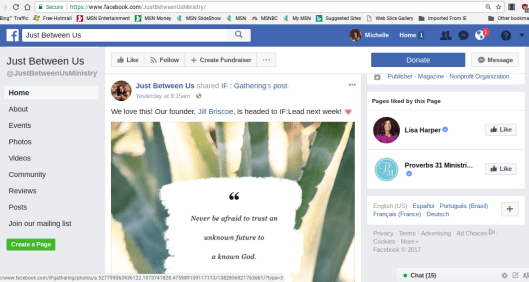
Christianity Today is such an “anything goes” theological train wreck that it’s often derisively dubbed Christianity Astray. I’m not saying Jill agrees with every article they publish, but, word to the wise, don’t ever tell people you’re trying to convince you’re doctrinally sound that your doctrine lines up with Christianity Today. Here’s the closest thing I could find to a statement of faith for World Relief. There is zero mention of the gospel or evangelism, but can you count how many times the word (social) “justice” is used? Just Between Us has a brief, if generic, statement of faith. What’s there (which is not much) is doctrinally sound, but a quick look at JBU’s Facebook page tells another story. Neither Lisa Harper nor Proverbs 31/Lysa TerKeurst are doctrinally sound, and we also learn that Jill will be a featured speaker at IF:Gathering’s IF:Lead conference.
Screenshot: 9/22/17
Some additional insight into Jill’s theology can be found in this excerpt from her book, God’s Front Door. Jill “writes several short dialogues with the Father” (in a “Jesus Calling-ish” style) to help readers cope with life issues large and small. It is unclear whether or not she also directs the reader to Scripture for help in dealing with life’s problems, but that is where Christians should find guidance, not in someone’s fictionalized dialogues with God.
[Jill] does speak to audiences which include men, though it is under the authority of the leadership of those churches and groups, and also under the authority of her husband, Stuart.
Elizabeth also e-mailed me a copy of the “form letter” e-mail Stuart sends out when questioned about Jill preaching to men. It’s too long to reprint here, but basically his stance is that 1 Timothy 2:12 was a prohibition that applied only to the theologically ignorant women of Paul’s day and is no longer applicable. In addition to that error, the Bible nowhere says women may preach to men if they’re doing so “under their husband’s/a pastor’s/a church’s authority”.
Lauren Chandler- Not recommended. Lauren’s primary claim to fame is that she is married to Matt Chandler, pastor of The Village Church, author, and speaker. Lauren is an author, conference speaker, singer and songwriter, and sometimes leads worship at TVC. Because her speaking engagements are infrequent and she has only authored one book, information on her doctrine and teaching are sparse. I have no reason to believe her doctrine deviates significantly from Matt’s, which could be characterized as generally doctrinally sound Reformed Charismatic. I also have no reason to believe she preaches to men, as all of her speaking events I’ve been able to locate have either been women’s events or marriage conferences with her husband.
The reason I would not recommend you follow Lauren Chandler is her lack of discernment in partnering with and being influenced by false teachers. As worship leader at TVC, Lauren has selected music by Bethel and Israel Houghton (Joel Osteen’s former worship leader). She has guest blogged for Priscilla Shirer. Here, she publicly declares her desire to meet Christine Caine, which is something she will be able to cross off her bucket list later this week when she appears alongside her (as well as false teachers Ann Voskamp, Bianca Olthoff {below}, Jennie Allen, Rebekah Lyons, and female “pastor” Jeanne Stevens) at IF: Gathering 2018. In fact, Lauren has become an annual fixture at IF:Gathering (2013-2017).
In addition to appearing with Ann Voskamp at various IF: Gatherings, Lauren proudly appeared with her (as well as Rebekah Lyons and another female “pastor”) at this 2014 conference. Ann Voskamp wrote the foreword for Lauren’s book, an endorsement for Lauren’s book, and wrote about their friendship on her blog. In this interview, Lauren lists Ann Voskamp’s One Thousand Gifts as one of the three books that has “most profoundly shaped how you serve and lead others for the sake of the gospel”.
Beth Moore is another major influence on Lauren. Lauren participates in small group Beth Moore “Bible” studies. Last summer, LifeWay Women partnered Beth and Lauren in a joint summer Bible study event. In the video promo, Beth speaks about her personal friendship with Lauren (which is evident in their Twitter interactions) and Matt and the time their families have spent together. Beth wrote an endorsement for Lauren’s book. In this interview, when asked, “Who is a great female leader or writer that you look up to/read?” Lauren answered, “I truly love Beth Moore…”.
When false teachers have this much influence on someone’s teaching and ministry, she is not someone you should be following or receiving teaching from.
Rachel Hollis- Not recommended. Rachel is a self-made lifestyle blogger, podcaster, and author. Aside from calling herself a Christian and scattering references to “faith” and God through her writing like a few sprinkles on a poisonous cupcake, Rachel is, at best, extraordinarily biblically ignorant, and, at worst, not saved. Her “theology” is basically anything goes (any religion, any sin you want to participate in {except the ones she doesn’t like, like “judging”}, any dream you want to pursue, etc.), no gospel, entrepreneurial self-help. The best way to grasp her self-idolizing teaching is to read these excellent, doctrinally sound reviews of her best-selling “Christian” book (it’s marketed in the Christian genre and published by a Christian publisher) Girl, Wash Your Face by Rebekah, Alisa, Elizabeth, Summer (Part 1,2,3), and Challies, and listen to the Girl, Check Your Theology episode of Theology Gals. You can also check out reviews of Rachel’s second book, Girl, Stop Apologizing, by Theology Gals and Jen Oshman. These godly ladies (and gentleman) do a praiseworthy job of comparing Rachel’s ideas with Scripture and demonstrating the multiple ways Rachel’s books, and her ideology, are decidedly not biblical.
In addition to the multiple, egregious theological errors Rachel teaches…
Rachel and her husband host a weekend couple’s conference called Rise Together. You’ll notice I didn’t say “marriage conference”. That’s because it is open to “everyone in a romantic relationship” including unmarried couples and couples of “every orientation” (read: homosexual). Fortunately, the $1795 per couple price tag for tickets will deter many from attending.
Rachel and (feminist, pro-homosexuality) Jen Hatmaker are friends. Jen is the author of Rachel’s favorite book: “…this book really did fundamentally change the way I view the world around me and the way I choose to live my life.” Jen has appeared at Rachel’s Rise Conference, Rachel has appeared on Jen’s podcast (in which Jen promoted Rachel’s book), and they’ve connected on a number of other occasions and projects. After getting a feel for Rachel’s “theology”, I thought, “I’ll bet she’s a pretty big Oprah fan.” Yep, that too.
Unless you’re someone who’s a student of discernment and you need a lot of practice (like, a LOT) comparing unbiblical ideas to Scripture, I would recommend you stay far, far away from Rachel Hollis and her materials.
¹I am recommending only these individual resources from these sites
Chrystal Evans Hurst- Not recommended. “Chrystal is a gifted writer, speaker, and worship leader….the eldest child of Dr. Tony and Lois Evans…Chrystal has recently co-authored a book, Kingdom Woman: Embracing Your Purpose, Power, and Possibilities, with her dad.” Tony Evans (see above) is not someone a doctrinally sound woman would co-author a book with. Priscilla Shirer, Chrystal’s sister, wrote the foreword for Chrystal and Tony’s book as well as Chrystal’s first book, She’s Still There. It would seem that Chrystal approves of Priscilla’s and Tony’s unbiblical theology and they approve of hers (which, logically, would mean her theology either agrees with or doesn’t significantly contradict theirs).
Besides Priscilla, Chrystal has numerous ties to false teachers: Chrystal was a featured speaker at Lysa TerKeurst’s conference, She Speaks 2017, is a staff speaker for Lysa’s Proverbs 31 Ministries, and has written several devotions for the Proverbs 31 web site. Chrystal and Christine Caine were the featured speakers at Desperate for Jesus 2017 at Chrystal’s home church (Oak Cliff Bible Fellowship, pastored by her father). Here and here, Chrystal recommends a Joyce Meyer book. Lisa Harper was a recent guest on Chrystal’s podcast. Chrystal was a featured guest on the Jesus Calling podcast. Chrystal has positively retweeted Jen Hatmaker (who is pro-homosexuality).
Brenda Leavenworth- Not recommended, however, not having evidence to the contrary, I do not believe Brenda is a false teacher. “Brenda is the Women’s Ministry Director at Reliance Church,” which is a Calvary Chapel church. She is the author of Far Above Rubies, a study of biblical womanhood from Proverbs 31 and supplementary series of workshops on cooking, hospitality, organization, etc., corresponding to each chapter of the study. Brenda also “teaches courses in Proverbs 31 and Women’s Ministry for the Calvary Chapel Bible College.”
I appreciate that Brenda seems to be very involved in her home church, prioritizing ministry there over outside ministry. Reliance Church’s statement of faith, as stated on their web site, seems to be doctrinally sound. I’m also intrigued by the concept of the Far Above Rubies study/workshops, and would be interested in reading/attending it myself.
I did not find any personal or speaking event connections between Brenda and any known false teachers, nor do I see any online evidence that she teaches men. Besides the fact that I haven’t had the opportunity to read or listen to her teaching, the two red flags holding me back from endorsing her are:
The current Calvary Chapel conflict. For years, Calvary Chapel has generally had a reputation for being a doctrinally sound mini-denomination. However, over the last few years, several of its member churches have cut ties with CC due to decisions by those in CC leadership to move toward less doctrinally sound teachings and practices than they have previously upheld. I have no idea whether or not Brenda is in agreement with any or all of these decisions made by CC leadership, but the fact remains that she teaches at the CC college and is an active member of a CC church. You can read more about the issues with Calvary Chapel here.
Vetting of resources. The women’s ministry resources page of Reliance Church’s website recommends resources by Francis Chan, Lysa TerKeurst, John Maxwell, and Hillsong. Sometimes people are unaware of the doctrinal problems with the resources and teachers they recommend, and this may be the case with Brenda, but teachers and leaders are held to a higher standard. It is not biblically appropriate for those in positions of leadership to recommend materials by people who teach or behave in ways contrary to Scripture, and I cannot recommend someone who does.
Leslie Ludy- Cautiously and tentatively recommended pending further information (please see remarks by “Leslie A” in the comments section). “Leslie Ludy is a bestselling author and speaker with a passion for helping women become set apart for Christ. She and her husband, Eric, are the authors of twenty-one books…Leslie is the director of Set Apart Girl and Set Apart Motherhood.” She also spearheads an annual women’s conference, writes and oversees Set Apart Girl magazine, and hosts a weekly podcast.
I’ve put a bit more time than usual into researching Leslie, because, while there have been a few vague questions raised about her here and there, I find her to be generally doctrinally sound, and I wanted to make sure I wasn’t missing something. As far as I can tell, Leslie ministers and speaks only to audiences of women. I have found no connections between her and any known false teachers. I have read several of Leslie’s articles (I especially appreciated this one), have listened to two or three dozen of her podcasts, and have read through the doctrinal statements on the various websites she and her husband, Eric, run. Though there are a few points of theology on which I do not necessarily agree with the Ludys, I have not, at this point, found anything I would classify as false doctrine or anything that would suggest I should warn women away from Leslie.
Bianca Olthoff- Not recommended. Bianca works as “Chief Storyteller” for the A21 Campaign, false teacher Christine Caine’s human trafficking organization. A perusal of her calendar page shows her speaking at Pray, Love, Lead at Saddleback (Rick Warren’s “church”), IF Gathering, Thrive (Lysa TerKeurst & Ann Voskamp), Bethel- Redding, Elevation (Steven Furtick), and numerous other conferences with false teachers and female “pastors,” at least one of which is being held at a “church” pastored by a woman. Bianca believes she receives extra-biblical revelation from God about people at her conferences needing healing. She also has several Sunday speaking engagements at churches, some of which, undoubtedly, will have her preaching to men. (This video indicates she is preaching the Sunday sermon, which means she’s preaching to men, and here she admits to teaching God’s word to men.)
Wellspring Group- Not enough online information for a recommendation or warning. Wellspring Group is a parachurch workshop ministry. According to their website, “We long to see lives, marriages, families and churches transformed so broadly and radically that it actually changes the leadership culture of the church, both here in North America and also around the world. We dream of… Overflowing Transformation.” I did not see anything overtly unbiblical on Wellspring’s web site, and many of their objectives and descriptions of their teachings sound biblical and gospel-centered. I did not discover any ties between Wellspring and known false teachers. However, I did note several red flag-raising buzzwords on the site which gave me pause.
One of these buzzwords was “spiritual formation.” Some churches and ministries innocently, and ignorantly, use the term “spiritual formation” as a trendy new synonym for the word “discipleship,” and their “spiritual formation” classes are just as doctrinally sound as if they called them “discipleship” classes. If this is the way in which Wellspring is using the term, that’s not a problem, other than the confusion it causes. The confusion comes in because of the unbiblical spiritual formation movement, which centers around mysticism, works righteousness, contemplative prayer, and other unbiblical doctrines and practices. If Wellspring incorporates these things into its workshops, I definitely do not recommend it.
If you have the opportunity to attend a Wellspring workshop, I would urge you to proceed with caution and – as with any other Christian event or teacher – be a good Berean and compare everything you hear to Scripture.
Update: After reading this article, one of my readers who has personal experience with Wellspring Group wrote in and shared her thoughts. If everything she says is accurate, I certainly would never recommend Wellspring Group. You can read her review of the program here.
I truly regret that I’m unable to give a wholehearted endorsement to all of these women and ministries. I’m sure they’re all perfectly nice people who, in their own hearts, have only the best of intentions, but Christian leaders and teachers have a grave responsibility to Christ and to their listeners to teach sound doctrine and walk in obedience to Scripture. Please understand that this is not a personal attack on any of these women or ministries, only answers to readers’ questions about whether or not I recommend them and their materials.
If you have a question about: a well known Christian author/leader, a Bible passage, an aspect of theology, a current issue in Christianity, or how to biblically handle a family, life, or church situation, comment below (I’ll hold all questions in queue {unpublished} for a future edition of The Mailbag) or send me an e-mail or private message. If your question is chosen for publication, your anonymity will be protected.
Welcome to our new study- Mark: God’s Good News for the Gentiles. “Tell me the story of Jesus,” Fanny Crosby wrote in her timeless hymn, and that’s just what the Gospel of Mark does. From John the Baptist’s preparing the way of the Lord to Jesus’ triumph over the grave, we’ll be examining the story of Jesus, up close and personal, over the next few months.
Let’s get started!
Introduction to the book of Mark:
Before we begin studying a book of the Bible, it’s very important that we understand some things about that book. We need to know…
Who the author was and anything we might be able to find out about him or his background.
Who the audience of the book is: Jews or Gentiles? Old Testament Israelites or New Testament Christians? This will help us understand the author’s purpose and approach to what he’s writing.
What kind of biblical literature we’re looking at. We approach books of history differently than books of wisdom, books of wisdom differently than books of prophecy, etc.
What the purpose of the book is. Was it written to encourage? Rebuke? Warn?
What the historical backdrop is for the book. Is Israel at war? At peace? In exile? Under a bad king? Good king? Understanding the historical events surrounding a piece of writing help us understand what was written and why it was written.
When the book was written. Where does the book fall on the timeline of biblical history? This is especially important for Old Testament books which are not always arranged in chronological order.
So this week, before we start studying the actual text of the book of Mark, we need to lay the foundation to understanding the book by finding the answers to these questions.
Read the following overviews of the book of Mark, taking notes on anything that might aid your understanding of the book, and answer the questions below:
1. Who wrote the book of Mark? What was his relationship to Paul? Peter? What is an amanuensis? Does this term describe Mark?
2. What is the approximate date Mark was written? About how long after Jesus’ ascension was this?
3. Who is the intended audience of the book of Mark? What evidence is there that this was the case?
4. Which genre of biblical literature is the book of Mark: law, history, wisdom, poetry, narrative, epistles, or prophecy/apocalyptic? What does this this tell us about the approach we should take when studying this book versus our approach to books of other genres?
5. What is the theme or purpose of the book of Mark?
6. Who are the main characters in the book of Mark? Was Mark one of the twelve apostles? Does Mark make an appearance in his own book?
7. Where do the events in the book of Mark take place? Where was Mark when he wrote this book? (Sometimes, a good Bible map like this one and this one can be helpful.) What was the political situation in this area at the time Mark was writing his gospel?
8. What else did you learn about Mark or the setting of this book that might help you understand the text of the book better?