Mark Bible Study

Mark: Lesson 2

Previous Lessons: 1

Mark 1:1-20

The beginning of the gospel of Jesus Christ, the Son of God.

As it is written in Isaiah the prophet,

“Behold, I send my messenger before your face,
    who will prepare your way,
the voice of one crying in the wilderness:
    ‘Prepare the way of the Lord,
    make his paths straight,’”

John appeared, baptizing in the wilderness and proclaiming a baptism of repentance for the forgiveness of sins. And all the country of Judea and all Jerusalem were going out to him and were being baptized by him in the river Jordan, confessing their sins. Now John was clothed with camel’s hair and wore a leather belt around his waist and ate locusts and wild honey. And he preached, saying, “After me comes he who is mightier than I, the strap of whose sandals I am not worthy to stoop down and untie. I have baptized you with water, but he will baptize you with the Holy Spirit.”

In those days Jesus came from Nazareth of Galilee and was baptized by John in the Jordan. 10 And when he came up out of the water, immediately he saw the heavens being torn open and the Spirit descending on him like a dove. 11 And a voice came from heaven, “You are my beloved Son; with you I am well pleased.”

12 The Spirit immediately drove him out into the wilderness. 13 And he was in the wilderness forty days, being tempted by Satan. And he was with the wild animals, and the angels were ministering to him.

14 Now after John was arrested, Jesus came into Galilee, proclaiming the gospel of God, 15 and saying, “The time is fulfilled, and the kingdom of God is at hand; repent and believe in the gospel.”

16 Passing alongside the Sea of Galilee, he saw Simon and Andrew the brother of Simon casting a net into the sea, for they were fishermen. 17 And Jesus said to them, “Follow me, and I will make you become fishers of men.” 18 And immediately they left their nets and followed him. 19 And going on a little farther, he saw James the son of Zebedee and John his brother, who were in their boat mending the nets. 20 And immediately he called them, and they left their father Zebedee in the boat with the hired servants and followed him.


The Holy Bible, English Standard Version. ESV® Permanent Text Edition® (2016). Copyright © 2001 by Crossway Bibles, a publishing ministry of Good News Publishers.


Questions to Consider

1. Briefly review the background and setting of the book of Mark from lesson 1 (link above).

2. What two titles does Mark ascribe to Jesus in verse 1? What does the word “Christ” mean, and why is it an important title for Jesus? What does it mean that Jesus is the “Son of God“?

3. How many times does Mark use the word “immediately” in chapter 1? How might the repeated use of this word have given Mark’s audience – first century Gentiles – a sense of urgency about Jesus’ mission and their need for salvation? Does it give you a sense of urgency about these things as you read?

4. What was John the Baptist’s mission as prophesied by Isaiah? (2-3) How did John “flesh out” that mission? (4) How did John’s message of repentance and the baptism of repentance help “prepare the way of the Lord” – “prime the pump” or get people’s hearts ready – for the gospel Jesus would preach? (5, 7-8) What can we learn about John’s character from this passage?

5. How does John’s message of repentance preceding Jesus’ message of the gospel demonstrate that repentance is a crucial aspect of saving faith in Christ? (1-15) Would God have sent John to preach the message of repentance if He did not consider it a vital part of salvation? What does Mark indicate was the theme of the message Jesus preached? (15) Some people say repentance is not necessary for salvation- that only belief in Jesus is necessary. Did Jesus consider repentance to be part of the gospel? (15)

6. Examine verses 9-11. Since Jesus was without sin, why did He take part in a baptism of repentance? How does Jesus’ baptism set an example for believers to follow Him in being baptized? How does this passage reveal the Trinity (God the Father, God the Son, God the Holy Spirit) to us? How does this passage refute the false teaching of modalism/Sabellianism and show us that God is one God in three Persons?

7. Who led Jesus to the place where He would be tempted by Satan? (12) Can we surmise from this that it was God’s plan for Jesus to undergo temptation? Why?

8. What two main characteristics did Simon and Andrew, and James and John, have in common? (16,19) Today, we might call them “blue collar” or “rednecks”- why do you think Jesus chose simple, uneducated fishermen as His first followers? (16-20) What message might this have sent first century Gentiles hearing, for the first time, about Jesus and His disciples? What did Jesus mean when He said He would make them “fishers of men”? (17) Considering what you know about them from the rest of the New Testament, did Simon, Andrew, James, and John become fishers of men?

9. What is the overall theme, purpose, or main idea of Mark 1:1-20?


Homework

Imagine yourself as a first century Gentile in a polytheistic society. You have little, if any, knowledge of the God of the Jews or the Old Testament, but you’re curious about this Jesus and why some of your Jewish and Gentile neighbors have begun to worship Him. Make a list of five to ten questions you’re going to want answered about Jesus so you can decide whether or not you want to worship Him, too.

Keep your list of questions handy as we study Mark. As you discover the answers to each question, write them down. Be reminded of who Jesus is and why He is worthy of your faith, worship, and obedience. Share what you’ve discovered with an unbelieving friend who needs to know Jesus.


Suggested Memory Verse

Now after John was arrested, Jesus came into Galilee, proclaiming the gospel of God, and saying, “The time is fulfilled, and the kingdom of God is at hand; repent and believe in the gospel.”
Mark 1:14-15

Mark Bible Study

Mark: Lesson 1

Welcome to our new study- Mark: God’s Good News for the Gentiles. “Tell me the story of Jesus,” Fanny Crosby wrote in her timeless hymn, and that’s just what the Gospel of Mark does. From John the Baptist’s preparing the way of the Lord to Jesus’ triumph over the grave, we’ll be examining the story of Jesus, up close and personal, over the next few months.

Let’s get started!

Introduction to the book of Mark:

Before we begin studying a book of the Bible, it’s very important that we understand some things about that book. We need to know…

Who the author was and anything we might be able to find out about him or his background.

Who the audience of the book is: Jews or Gentiles? Old Testament Israelites or New Testament Christians? This will help us understand the author’s purpose and approach to what he’s writing.

What kind of biblical literature we’re looking at. We approach books of history differently than books of wisdom, books of wisdom differently than books of prophecy, etc.

What the purpose of the book is. Was it written to encourage? Rebuke? Warn?

What the historical backdrop is for the book. Is Israel at war? At peace? In exile? Under a bad king? Good king? Understanding the historical events surrounding a piece of writing help us understand what was written and why it was written.

When the book was written. Where does the book fall on the timeline of biblical history? This is especially important for Old Testament books which are not always arranged in chronological order.

So this week, before we start studying the actual text of the book of Mark, we need to lay the foundation to understanding the book by finding the answers to these questions.

Read the following overviews of the book of Mark, taking notes on anything that might aid your understanding of the book, and answer the questions below:

Bible Introductions: Mark at Grace to You

Overview of the Book of Mark at Reformed Answers

Gospel of Mark – Bible Survey at Got Questions

1. Who wrote the book of Mark? What was his relationship to Paul? Peter? What is an amanuensis? Does this term describe Mark?

2. What is the approximate date Mark was written? About how long after Jesus’ ascension was this?

3. Who is the intended audience of the book of Mark? What evidence is there that this was the case?

4. Which genre of biblical literature is the book of Mark: law, history, wisdom, poetry, narrative, epistles, or prophecy/apocalyptic? What does this this tell us about the approach we should take when studying this book versus our approach to books of other genres?

5. What is the theme or purpose of the book of Mark?

6. Who are the main characters in the book of Mark? Was Mark one of the twelve apostles? Does Mark make an appearance in his own book?

7. Where do the events in the book of Mark take place? Where was Mark when he wrote this book? (Sometimes, a good Bible map like this one and this one can be helpful.) What was the political situation in this area at the time Mark was writing his gospel?

8. What else did you learn about Mark or the setting of this book that might help you understand the text of the book better?

Bible Study

Bible Book Backgrounds: Why You Need Them and Where to Find Them

It’s time for your daily Bible study. You’ve decided to study Habakkuk or Philippians or Lamentations.

When you pick up a random book of the Bible to study it, how do you know…

…what’s going on in biblical history at the time the book was written
…when the book was written and by whom
…who the intended audience was
…where, geographically, the action takes place
…cultural aspects of the period that will help you better understand allusions and customs?

Unless you’ve done a considerable amount of study in the field of biblical history and the ancient Middle East, the answer is: you probably don’t know all of those things. And, as a result, your study of the book you’ve chosen probably isn’t going to be as fully-orbed as it could be.

Not having done any advanced study in those areas myself, I learned a while back to rely on those who have, and who have taken the time to share their knowledge with the rest of us. When I study, teach, or write a study on a book of the Bible, I always start out by delving into the “story behind the story.” How?

Macro Bible Study 

Reading every book of the Bible is the best way to get a good grip on the meta-narrative of Scripture. Because the books of the Bible aren’t always arranged in order of the events they contain and because many books overlap in their events and timing, I highly recommend a chronological read-through of the Bible at least every few years.

Pay Attention to the Text

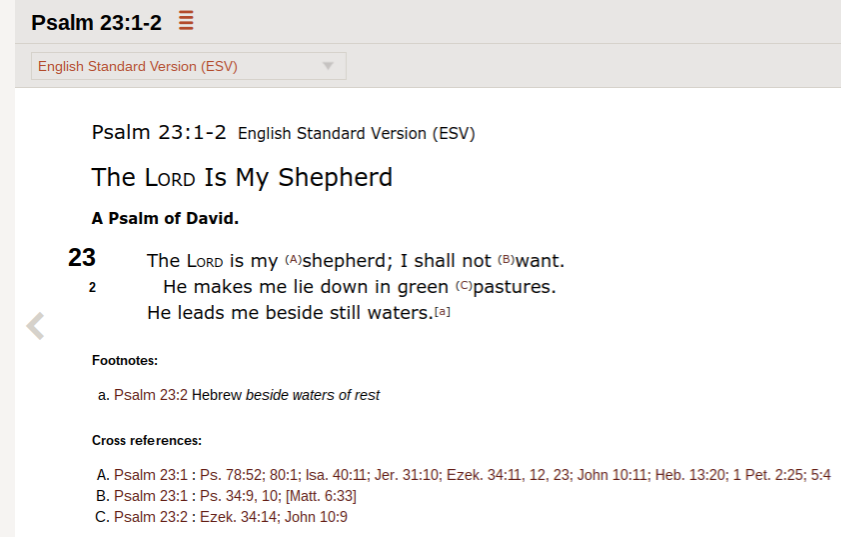
Sometimes the details you’re looking for are in the text itself. Perhaps a certain month and day are mentioned, or “during the reign of King ____.” If the text specifies a certain city or country, look it up on a good Bible map to get your bearings. Sometimes a particular custom or expression is explained as an aside, such as in 1 Samuel 9:9. Some books specify who they’re written to in the first few verses. Also be sure to use your Bible’s footnotes and cross reference notations, and look up any related verses that can bring clarity.

Footnotes explain wording.
Cross references suggest related passages.
(BibleGateway.com)

Study Bibles

There are some fantastic study Bibles out there (and also some duds you’ll want to avoid). Here are a few I highly recommend:

  • The MacArthur Study Bible Great theology, clear explanations. The only thing I would improve if I could is that I wish there were more notes on the Old Testament. (Also see “Bible Introductions” below.)
  • The Faithlife Study Bible app It’s free! Lots of great notes, articles, and diagrams, and because it’s an app, it’s got links, videos, and other great features.
  • The ESV Study Bible Super comprehensive. It’s like having a set of commentaries and the entire text of Scripture in one book.
  • The ESV Archaeology Study Bible This one is really good for getting a feel for what life, culture, and customs were like in biblical times – food, family, work, neighboring pagan nations, etc. It’s also very helpful with biblical geography.

“Bible Book Backgrounds”

This would be an overview, or survey, to read before you begin the book of Scripture you’ll be studying. I’ve found it’s helpful to use a survey of the book as a foundation and framework for subsequent study of the text.

While some commentaries contain an introduction to each book of the Bible, many do not. But I’ve found several online sites that provide helpful Bible Book Backgrounds:

Bible Introductions at Grace to You- A thorough overview of every book of the Bible, written by John MacArthur. These are the same introductions you’ll find in the MacArthur Study Bible.

Bible Book Overviews at Reformed Answers- Just put the name of the book you’re looking for in the search bar, followed by the word “overview.” You’ll also find overviews of the literary divisions of the Bible, such as an overview of the epistles, wisdom literature, etc.

Bible Surveys at Got Questions- Use the search bar to find the book survey you’re looking for. All surveys except the four gospels are entitled, “Book of ____ – Bible Survey.” You’ll find Matthew, Mark, Luke, and John as, “Gospel of ____.”

Helpful and (mostly) free Greek and Hebrew resources you might not know about at The Cripplegate- Sometimes getting some help with the original languages can also aid in your understanding of the book’s background and setting.

Dig in. Study. Search it out. Doing a “background check” on the book you’re studying is a great way to gain a deeper understanding and appreciation of God’s word.

Ruth Bible Study

Ruth: Lesson 5

Previous Lessons: 1, 2, 3, 4

Ruth 4

Now Boaz had gone up to the gate and sat down there. And behold, the redeemer, of whom Boaz had spoken, came by. So Boaz said, “Turn aside, friend; sit down here.” And he turned aside and sat down.And he took ten men of the elders of the city and said, “Sit down here.” So they sat down. Then he said to the redeemer, “Naomi, who has come back from the country of Moab, is selling the parcel of land that belonged to our relative Elimelech. So I thought I would tell you of it and say, ‘Buy it in the presence of those sitting here and in the presence of the elders of my people.’ If you will redeem it, redeem it. But if you will not, tell me, that I may know, for there is no one besides you to redeem it, and I come after you.” And he said, “I will redeem it.” Then Boaz said, “The day you buy the field from the hand of Naomi, you also acquire Ruth the Moabite, the widow of the dead, in order to perpetuate the name of the dead in his inheritance.” Then the redeemer said, “I cannot redeem it for myself, lest I impair my own inheritance. Take my right of redemption yourself, for I cannot redeem it.”

Now this was the custom in former times in Israel concerning redeeming and exchanging: to confirm a transaction, the one drew off his sandal and gave it to the other, and this was the manner of attesting in Israel. So when the redeemer said to Boaz, “Buy it for yourself,” he drew off his sandal. Then Boaz said to the elders and all the people, “You are witnesses this day that I have bought from the hand of Naomi all that belonged to Elimelech and all that belonged to Chilion and to Mahlon. 10 Also Ruth the Moabite, the widow of Mahlon, I have bought to be my wife, to perpetuate the name of the dead in his inheritance, that the name of the dead may not be cut off from among his brothers and from the gate of his native place. You are witnesses this day.” 11 Then all the people who were at the gate and the elders said, “We are witnesses. May the Lord make the woman, who is coming into your house, like Rachel and Leah, who together built up the house of Israel. May you act worthily in Ephrathah and be renowned in Bethlehem, 12 and may your house be like the house of Perez, whom Tamar bore to Judah, because of the offspring that the Lord will give you by this young woman.”

13 So Boaz took Ruth, and she became his wife. And he went in to her, and the Lord gave her conception, and she bore a son. 14 Then the women said to Naomi, “Blessed be the Lord, who has not left you this day without a redeemer, and may his name be renowned in Israel! 15 He shall be to you a restorer of life and a nourisher of your old age, for your daughter-in-law who loves you, who is more to you than seven sons, has given birth to him.” 16 Then Naomi took the child and laid him on her lap and became his nurse.17 And the women of the neighborhood gave him a name, saying, “A son has been born to Naomi.” They named him Obed. He was the father of Jesse, the father of David.

18 Now these are the generations of Perez: Perez fathered Hezron, 19 Hezron fathered Ram, Ram fathered Amminadab, 20 Amminadab fathered Nahshon, Nahshon fathered Salmon, 21 Salmon fathered Boaz, Boaz fathered Obed, 22 Obed fathered Jesse, and Jesse fathered David.


The Holy Bible, English Standard Version. ESV® Permanent Text Edition® (2016). Copyright © 2001 by Crossway Bibles, a publishing ministry of Good News Publishers.


Questions to Consider

1. Briefly refresh your memory on Deuteronomy 25:5-10 (God’s instructions for levirate marriage), and read Leviticus 25:23-28 (God’s instructions for selling and redeeming property). Compare the actions of Boaz and the other redeemer (1-10) to these two passages. Did both of them obey the law? Since Boaz is a type of Christ, how does his fulfillment of this law point us to Christ’s fulfillment of the Law? Compare Boaz’s obedience to the law in order to redeem Ruth to Christ’s obedience to the Law in order to redeem sinners.

2. Why do you think Boaz first proffered the sale of the property to the other redeemer rather than mentioning Ruth first? (3-5)

3. Compare the other redeemer’s unwillingness to bear the cost of redeeming Ruth (6) with Boaz’s willingness to endure great cost to himself to redeem Ruth (9-10). How does this point us to Christ’s willingness to empty Himself of the riches of Heaven to redeem sinners?

4. Examine verses 9-10. Would you characterize this business transaction more as an investment for financial gain or the purchase of a debt? Who stood to gain materially from this transaction, Ruth or Boaz? How? When Christ redeemed us by purchasing us with His blood, who stood to gain from that transaction, Him or us? Read these passages, and examine Christ’s purchase of our sin debt and the benefit we receive at salvation by His righteousness being imputed to us.

5. Notice the impact Ruth and Naomi’s story had on the women of the town who had been watching these events transpire. (13-17) How were Ruth’s, Naomi’s, and Boaz’s godly behavior a witness to these women of God’s goodness and faithfulness? Consider your own life. How could your godly words and actions point watching women to Christ and open a door for you to share the gospel with them?

6. Why did the women say, “A son has been born to Naomi,” (17) when Obed was Ruth’s baby? (10)

7. Compare verses 18-21 with these passages. How do the people mentioned in verses 18-21 fit into the family line of Christ? How does the story of Ruth and her family line showcase God’s sovereignty and the way – centuries in advance – He was setting events in motion and working out His plan for the coming of Christ?


Homework

Just as Ruth was living in poverty and needed someone to redeem her out of that life, someone you know is living in the poverty of sin and needs Jesus to redeem her from eternal death to eternal life. She needs Jesus to purchase her sin debt and give her the riches of His righteousness in exchange. This week, share the gospel with someone. Tell her about Jesus our Redeemer.

Bible Study, Mailbag

The Mailbag: We Want Bible Study Answers


Why don’t you provide the answers to the questions you ask in your Bible studies?

If you’ve been around the blog for any length of time you’ve noticed (I hope) that Wednesday is Bible study day. We’ve been through several books, including Jonah, Colossians, Ezra, and our current study of Ruth. We’ve done two topical studies: one on the Ten Commandments (Exodus 20:1-17) and one on assurance (1 John). And there are 66+ (every book of the Bible and then some) one lesson stand-alone studies. If you’re looking for a Bible study for group or personal use, they’re all hereand they’re all free (all I ask is that you don’t plagiarize).

The format I’ve developed for my studies is to present the biblical text, provide several study questions, and finish off with a homework assignment- action you can take to apply one of the truths of the passage to your own life.

But I intentionally refrain from providing a list of answers to the study questions. Why?

Because the purpose of my Bible studies is not for you to get the “right answers.” My goal is to demonstrate for you the kinds of questions you should be asking of any passage of Scripture you approach. The purpose is to teach you (or your small group) how to study the Bible on your own so you won’t need to depend on a “canned” study written by somebody else, even me. I’m trying to work myself out of a job. You know- teach a woman to fish rather than giving her a fish.

In my own private study time as well as in Sunday School classes and other small group Bible studies, I’ve found that diving into the text and studying it for myself – or with my group – is far more meaningful and memorable than looking at the passage through the eyes of a third party. Approaching Scripture without a “middle man” lends itself to an intimacy with God that just isn’t there otherwise. It’s the difference between a private, behind closed doors, conversation with your husband and a conversation with your husband while out on a double date with friends. You get that “double date conversation” every Sunday when your pastor preaches, but God is a personal God, and you need some time alone with Him during the week.

But I’m afraid that if I study on my own, I’ll get something wrong! What if I misunderstand Scripture and end up believing false doctrine?

Bible study is a skill. And just like every other new skill you learn, you’re probably going to make some mistakes when you’re first starting out. When you first learned to read, you pronounced some words incorrectly. When you were learning to ride a bike, you fell down a few times. But you didn’t let those mistakes stop you. You kept practicing until you learned the skill. Bible study is the same way. You probably will make some mistakes along the way. But God has provided a lot of “training wheels” to help you out:

His Goodness and Trustworthiness
God is a good God. He wants you to study His word, get to know Him, and grow in Christ. It would be evil and cruel of God to tell you this, and then lead you – His child, who wants to draw near to Him through the study of His word – into false doctrine. And God is not evil and cruel. He is good, He is a God of truth, and His word is truth. Trust Him as you open His word to study.

What father among you, if his son asks for a fish, will instead of a fish give him a serpent; or if he asks for an egg, will give him a scorpion? If you then, who are evil, know how to give good gifts to your children, how much more will the heavenly Father give the Holy Spirit to those who ask him!”
Luke 11:11-13

The sum of your word is truth, and every one of your righteous rules endures forever.
Psalm 119:160

Sanctify them in the truth; your word is truth.
John 17:17

The Holy Spirit
If you are a genuinely regenerated Believer, you are indwelt by the Holy Spirit, the author of Scripture. Because God does not contradict Himself and He does not lie, the Holy Spirit indwelling you will not lead you to believe what is contrary to the words of Scripture He inspired. Ask Him to give you wisdom and understanding as you study.

And I tell you, ask, and it will be given to you; seek, and you will find; knock, and it will be opened to you. For everyone who asks receives, and the one who seeks finds, and to the one who knocks it will be opened. What father among you, if his son asks for a fish, will instead of a fish give him a serpent; or if he asks for an egg, will give him a scorpion? If you then, who are evil, know how to give good gifts to your children, how much more will the heavenly Father give the Holy Spirit to those who ask him!”
Luke 11:9-13

When the Spirit of truth comes, he will guide you into all the truth, for he will not speak on his own authority, but whatever he hears he will speak, and he will declare to you the things that are to come. He will glorify me, for he will take what is mine and declare it to you.
John 16:13-14

Tools
God has blessed us with a number of helps for learning how to study His word, from instructions on handling the text to commentaries, Bible dictionaries, Bible atlases, and the like. Many are online and available for free. I’ve included some of those here (be sure to scroll down). And don’t forget your (doctrinally sound) pastor, elders, and Sunday School teachers as invaluable resources. I’ve never met one who wouldn’t be delighted to help someone understand a passage of Scripture.

Easter Eggs
If you’ve worked through any of my studies, you’ve probably noticed that, if you read carefully, I do provide answers to some of the study questions.

Hyperlinks– If you see a hyperlink in a question, try answering the question on your own first. Then, click the link. It will take you either to related Scriptures that will help you answer the question or to an article or resource you can read for more information.

Follow Up Questions– Each study “question” is usually a series of questions. Try to answer them one at a time. But, if you’ll notice, I sometimes provide the answer to one question in a subsequent question. For example (from Ezra, Lesson 11):

What was Israel’s hope? Compare Israel’s hope for God’s mercy and forgiveness of sin in response to true repentance with 1 John 1:9.

God loves you and wants you to dive into the treasure chest of His word. Trust Him. Use the resources He has provided. And if you fall off your bike in the process, pick yourself up, dust yourself off, and keep practicing.


Additional Resources

Bible Study resource articles

Bible Studies by Michelle Lesley

10 Simple Steps to Plain Vanilla Bible Study

You’re Not as Dumb as You Think You Are: Five Reasons to Put Down that Devotional and Pick Up the Actual Bible

10 Bookmarkable Biblical Resources for Christian Women

Rightly Dividing: 12 Do’s and Don’ts for Effective Bible Study


If you have a question about: a Bible passage, an aspect of theology, a current issue in Christianity, or how to biblically handle a family, life, or church situation, comment below (I’ll hold all questions in queue {unpublished} for a future edition of The Mailbag) or send me an e-mail or private message. If your question is chosen for publication, your anonymity will be protected.