Discernment, Mailbag

The Mailbag: Should I attend the “Bible” study to correct false doctrine?

Originally published August 21, 2017

I’ve been invited to join a ladies’ Bible study class that’s using a book by a well-known author and speaker. The woman who wrote the book is a false teacher. Should I accept the invitation and join the class in hopes of correcting the false doctrine that will be taught?

To join or not to join. I’ve been in the same situation myself, and I know many of my readers have as well. It can be a difficult decision to make. The Bible does say to avoid false teachers, but it also says they should be rebuked, and that older women are to “teach what is good, and so train the young women…that the word of God may not be reviled.”

My counsel to those who have expressed concern to me over studies by Beth Moore, Priscilla Shirer, Lysa TerKeurst, etc. taking place in their churches is to pray that God would give them wisdom as to whether they should attend the study and biblically refute all the false doctrine that comes up (the rebuking/training perspective) or whether they should decline to attend the study (the avoiding perspective), giving anyone who asks a biblical explanation as to why you won’t be participating (also, kind of rebuking/training). There are a lot of things to take into consideration as you begin working through Scripture and prayer to reach a decision.

First, where is your pastor in all of this? Why is he allowing a study to take place that uses materials authored by a false teacher? Maybe he is familiar with the author’s materials and approves of them (in which case you have a bigger issue than whether or not to attend this particular class). But maybe he’s a discerning-leaning guy who’s just not aware that this author teaches false doctrine.

Most pastors are extremely busy. They either don’t have the time or don’t know they need to make the time to vet the authors of the studies their church is using (I’m not excusing this state of affairs, I’m just saying- this is the reality we’re dealing with). And many of them simply assume that if the book comes from LifeWay (or another trusted Christian retailer), it must be OK. So, before making a decision about whether or not to attend the class, go to where the buck stops and humbly, patiently, and kindly find out where your pastor is about the issue. He might just pleasantly surprise you and cancel the class or insist that a doctrinally sound study be used instead, and your problem will be solved.

Next, if you’re married, what does your husband have to say about it? There may be a logistical conflict – he prefers you not to be out that late at night alone for safety reasons, your child has to be picked up from soccer at the time the class meets, etc. – that will immediately solve your dilemma, or there may be some other reason he doesn’t want you to attend the class. Since it’s not sinful to decline attending the class, if your husband says no, you need to respect his decision and decline to join. (You also need to discuss with your husband the issue of approaching the pastor about the study. He might prefer to be the one to talk to him, or he might prefer the two of you talk to the pastor together, rather than you approaching the pastor on your own.)

But even if your husband leaves the decision up to you, ask for his counsel and perspective. Simply by virtue of being a man, a person with his own unique thought processes, and someone who knows you well, he can add invaluable insight that can help you reach a wise decision. This was certainly the case for me when I was faced with this situation. I was leaning toward declining to attend the study, but my husband gave me a whole new perspective and encouraged me to get involved in order to be a corrective influence and godly example to the other ladies. And he was right!

If you’ve talked to your pastor and your husband and the dilemma is still before you, there are several things you need to think, pray, and study through as you’re working toward a decision:

☙Are you biblically knowledgeable enough to recognize and properly refute false doctrine? (It might help to get the perspective of your pastor, your husband, or a mature believer who knows you well and who will be honest with you.)

☙Do you have the extra time to study and make notes ahead of time so you’ll be prepared to refute, with Scripture, during class?

☙Is the study so replete with false doctrine that you’ll have to constantly be speaking up and people will just be annoyed and tune you out?

☙Does your conscience prevent you from financially supporting the false teacher by buying her book for the study?

☙Would it make a bigger impact on this particular group of ladies for you to attend and refute or to decline to attend with explanation? (Consider your influence on them, your reputation for sound doctrine among them, the dynamics of the group, etc.)

☙What will be the repercussions of your actions (whether you decide to attend or decline) on the church at large? How might your family and/or your pastor be affected?

☙Are you spiritually and emotionally prepared for the harsh backlash you will probably receive for refuting? Can you stand firm in the face of that, or will you cave?

☙Are you in the “cage stage” of discernment with a “mow ‘em down!” disposition to match, or do you have the self-control required to follow the instruction of 2 Timothy 2:24-26: to be patient, kind, and not quarrelsome? Do you understand that the goal of discernment is to humbly rescue captives, not to prove how right and knowledgeable you are?

☙Think outside the box. Is there another way to handle this situation besides attending/refuting and declining to attend? What about you (or a spiritually mature woman in your church- someone who is able to teach) offering to teach an alternative class that studies a book of the Bible?

There’s no one size fits all answer to this question. Either of these options (or another) could be biblically wise depending on the people and situations involved. Talk to your husband and your pastor. Examine what God’s Word says about false teachers. Pray for wisdom. Follow your biblically-informed conscience.


If you have a question about: a Bible passage, an aspect of theology, a current issue in Christianity, or how to biblically handle a family, life, or church situation, comment below (I’ll hold all questions in queue {unpublished} for a future edition of The Mailbag) or send me an e-mail or private message. If your question is chosen for publication, your anonymity will be protected.

Discernment Bible Study

Choose What Is Right: A Study in Discernment- Lesson 5


Previous Lessons: 1, 2, 3, 4,


False Teachers, God’s View, Our Response

Read These Passages


Questions to Consider

Throughout this study we will be looking at various passages of Scripture rather than working our way through a book of the Bible verse by verse. Because of that, we will need to be extra vigilant to rightly handle these passages in context. I will always attempt to provide the context you need for understanding these passages correctly, but if you need more clarity please feel free to read as much of the surrounding text as you need to – even the whole book, if necessary – in order to properly understand the passage presented.

1. Examine today’s passages and answer these four questions about each (if applicable):

  • How does God describe false teachers in this passage?
  • What is God’s opinion of false teachers in this passage, and what consequences will they face?
  • How does this passage describe the way people respond to and/or should respond to false teachers?
  • What is God’s opinion of people who follow false teachers, and what consequences will they face?

Using your answers to the first two questions, write a character sketch of a typical false teacher.

Using your answers to the last two questions, write out a description of the way God is generally disposed toward those who follow false teachers and how He wants us to regard and respond to false teachers instead.

2. Considering the Isaiah passage alongside 2 Timothy 4:3-4, are people who follow false teachers innocent victims of these teachers? Why or why not, according to these passages? How do these passages describe people’s disposition toward God before they start following false teachers?

3. Examine the 2 Corinthians passage. Who do false teachers disguise themselves as? (13,15) Instead of “apostles,” “workmen,” and “servants,” what words or titles do we generally use for these people today? (Hint: Think of a popular false teacher. What position or title does s/he hold?) How do false teachers characterize their work or “ministry”? (12) Rather than serving Christ, who do false teachers really serve? (15) How does verse 14 connect to Genesis 3:1-5?

4. Compare the light/darkness, and the fruit/unfruitful motifs of the Ephesians passage to verses 17-19 of the Matthew 7 passage.

How does verse 11 of the Ephesians passage refute these ideas held by some professing Christians?

  • “I know Teacher X teaches some things that are false, but I just chew up the meat and spit out the bones.” (11a)
  • “You shouldn’t warn against false teachers, you should just pray for them.” (11b)
  • “I don’t name the names of false teachers in my sermons, I only preach sound doctrine. That’s the way people learn to recognize false teachers. After all, that’s how bank tellers learn the difference between counterfeit and real money, by only familiarizing themselves with real money.” (11b, see also verse 9 of the Titus passage- Consider this: If there were counterfeiters running around your town passing fake money, what do you think the police and news media would do to alert the banks and the public so they could catch these criminals, stop them, and mete out justice to them?)

5. In the Matthew 7 passage- explain in your own words what the sheep and wolves metaphor in verse 15 means. How do the examples in verse 16 relate to the sheep and wolves metaphor in verse 15, and also to the concept of false teachers disguising themselves in the 2 Corinthians passage?

In 17-19, who are the healthy and unhealthy trees? What is the good and bad fruit of these trees? Who is the fruit of a false teacher’s ministry, and how would you characterize them? Who is the fruit of a sound teacher’s ministry, and how would you characterize them?

Think about people you know who loyally and diligently follow false teachers. Are they growing in holiness as the Bible describes it? Forsaking sin more? Growing in spiritual maturity? Increasingly exhibiting fruit of the Spirit? Studying their Bibles (not the teacher’s books and materials, but the Bible) and praying better and more frequently? Increasing in their love for and service at a doctrinally sound church? Becoming more skilled at rightly handling, understanding, and obeying God’s Word in context? These things are the fruit of a teacher’s ministry.

Christians often wonder whether false teachers knowingly teach false doctrine and deceive people, or if they’re so deceived that they actually think they’re genuine Christians teaching biblical truth. Compare 21-23 with the 2 Corinthians passage. What do you think? Could there be some of each?

6. Think back to lesson 3 (link above) and the difference between antinomianism and legalism. In the Matthew 23 passage, is Jesus rebuking the Pharisees for being antinomians or legalists?

If your pastor preached Matthew 23 to or about a specific false teacher or group of false teachers and posted the video of it on social media, what do you think non-Christians would say about him? What do you think most professing Christians would say about him? Some professing Christians think it is mean, hateful, unloving, unkind, even unChristlike to call out a false teacher or even suggest that people shouldn’t follow a certain false teacher, no matter how gently and kindly it is done. Is that true? How do you know, based solely upon Matthew 23?

7. Examine the Titus passage. Who is “he” in verse 9 (see verses 5-8)? What two things does God require of pastors and elders in verse 9? If a pastor only preaches sound doctrine and never rebukes, preaches against, or warns against false doctrine and false teachers, is it fair to say he’s only doing half his job? Why or why not? (Support your answer from rightly handled Scripture, not emotion or personal opinion.)

Consider verse 11 alongside 2 Timothy 3:6-7. What is the impact on the family when women follow false teachers and bring their false doctrine into the home?

Note the word “rebuke” in verses 9 and 13? Why are pastors to rebuke false teachers and those who follow them?

8. Sometimes Christians wonder whether or not false teachers (at least some of them) are truly born again. In today’s passages, carefully examine together 2 Corinthians 11:15, Ephesians 5:6, Matthew 7:15, 19, 21, 23, Matthew 23:15, 33, Titus 1:15-16. What do these verses indicate is the answer to that question? Think about the way Scripture describes and characterizes the life and eternity of Christians. Do these verses about false teachers match Scripture’s description and characterization of Christians?


Homework

Read my article Answering the Opposition- Responses to the Most Frequently Raised Discernment Objections. Which of the Scriptures you studied today answer some of these objections? How? Are there other objections to discernment that you’ve heard that are not on the list, but are answered by today’s passages? Which objections would you add to the list, and how would you answer them from today’s passages (and others)?


Suggested Memory Verse

Discernment Bible Study

Choose What Is Right: A Study in Discernment- Lesson 4


Previous Lessons: 1, 2, 3,


False Teachers, God’s View, Our Response

Read These Passages


Questions to Consider

Throughout this study we will be looking at various passages of Scripture rather than working our way through a book of the Bible verse by verse. Because of that, we will need to be extra vigilant to rightly handle these passages in context. I will always attempt to provide the context you need for understanding these passages correctly, but if you need more clarity please feel free to read as much of the surrounding text as you need to – even the whole book, if necessary – in order to properly understand the passage presented.

1. Do you notice the similarities between 2 Peter 2 and Jude? Click here and read the second paragraph under “Author and Date”. What might be the reason for some of the similarities?

Make a two column chart. Examine Jude and 2 Peter 2 side by side, verse by verse. (You may want to do this with two Bibles, two devices, or a split screen on your Bible app or device.) List the verses or phrases that are strikingly similar in wording and concept. What does each mean? Why might God have emphasized a particular verse or phrase by placing it in Scripture twice?

2. To what general group of people are Jude’s (v.1) and Peter’s (1:1) letters addressed? What is Jude’s (3) appeal to the church? Why is he urging them to contend for the faith (Jude 4, 2 Peter 2:1-3)? What are some of the things that happen to a church when false teachers gain a foothold?

Do these epistles apply to you as a Christian, and to the church, today? Why? Have you (or your church) ever been urged by a pastor or teacher to contend for the faith? Why do you think that admonition is so lacking in the church and from Christian teachers today?

2. How does Jude (4a) describe false teachers entering the church? How does Peter (1) say false teachers will bring in destructive heresies? Compare this characterization to the way these passages say false teachers infiltrate the church and the home. What does this characteristic of sneakiness tell you about false teachers? Why aren’t they just open and honest with Christians and the church about what they want to teach?

3. What do Jude (4, 13) and Peter (3, 17) say is the final destiny of false teachers?

Examine 2 Peter 2:4-10. Who are the godly people mentioned in this passage and how did God deal with them? Who are the ungodly who are listed, and how did God deal with each of them? Do these ungodly people include false teachers (10, Jude 8)?

What does this tell you about how God views false teachers? How He views and protects His faithful children?

4. What are Jude (8-9) and Peter (10b-11) telling us about angels, blasphemy and the glorious ones? How does this reflect the pride and arrogance of false teachers?

What are Jude (10) and Peter (12) telling us about the ignorance of false teachers? Think about how the indwelling Holy Spirit illumines Scripture to the Christian. What might be one reason false teachers do not understand Scripture or how to properly handle it?

What is the significance of Jude’s (11) comparison of false teachers to Cain? Of Jude’s (11) and Peter’s (15-16) comparison to Balaam?

Consider the imagery in Jude’s (12-13) and Peter’s (17) comparative metaphors to false teachers. What are the characteristics of each metaphor mentioned, and how do they apply to false teachers?

5. In your own words, write a brief summary of the character of false teachers according to Peter and Jude. Do you know of any pastors or teachers who could be described this way? Who, and why?

6. What does Jude (17-23) say about how we should respond to the types of teachers he and Peter are describing?


Homework

If you’d like a little extra study on these passages, check out:

Wednesday’s Word ~ Jude

Living Stones: A Study of 1 & 2 Peter ~ Lesson 11


Suggested Memory Verse

Discernment Bible Study

Choose What Is Right: A Study in Discernment- Lesson 3


Previous Lessons: 1, 2,


What Is False Doctrine?

Today’s Scripture passages are embedded in the body of the study. Please click the links in each question.


Questions to Consider

Throughout this study we will be looking at various passages of Scripture rather than working our way through a book of the Bible verse by verse. Because of that, we will need to be extra vigilant to rightly handle these passages in context. I will always attempt to provide the context you need for understanding these passages correctly, but if you need more clarity please feel free to read as much of the surrounding text as you need to – even the whole book, if necessary – in order to properly understand the passage presented.

1. Have you ever studied the book of Judges? If you have, you know this book has a very clear theme which can be found in Judges 17:6b and 21:25b. What is that theme? What does it mean to do what is right in your own eyes? Is believing what is right in your own eyes part of doing what is right in your own eyes? How and why? As Christians, how are we supposed to live and believe? What are some ways Christians (or those who claim to be Christians) today do and believe what is right in their own eyes rather than doing and believing what is right in God’s eyes?

How do we know the difference between what is right in our own eyes and what is right in God’s eyes? What is our standard for answering that question? Our authority for life and doctrine? If this is how we’re to live and believe – submitting to the truth of God’s written Word as our authority in life and our measuring stick for evaluating right actions from wrong actions, right beliefs from wrong beliefs – is it biblical to say that this is also how teachers are to teach?

2. When you get right down to the bottom line, there are two basic ways of doing and believing what’s right in your own eyes – failing to rise to the standard of God’s Word, and going above and beyond the standard of God’s Word. Not being as restrictive as God’s Word is, or being more restrictive than God’s Word is. Too much “grace” or too much “law”.

Consider this concept as applied to sex, and what the Bible says about it:

Which side of the road is the “too much ‘grace'” side? “Too much ‘law'”? Which view is the biblical view? (Notice that the biblical view is a “middle of the road” balance between the extremes of man-made “law” and “grace”. If you wander off the road you’re wandering off into darkness. The biblical view is the only one which leads to the sun (Son).)

The theological term for “too much ‘grace'” is antinomianism (also sometimes called “license” – as in, “a license to sin” – or “licentiousness”). The theological term for “too much ‘law'” is legalism (showcased in the Pharisees of Jesus’ day).

3. Antinomianism often fleshes itself out today as:

  • “I’m saved and all my sins – past, present, and future – are forgiven, so why not sin as much as I want?”
  • An “It’s no big deal!” approach to sin
  • The idea that the sin in question is actually biblical (or loving / loving your neighbor, tolerant, compassionate, “what ‘Jesus’ would do”)
  • Obeying what the Bible actually is says is legalism (“Pharisaism”).

What does the Bible say about antinomianism? What does God say about people who claim to be Believers but don’t obey Him?

What are some specific examples of antinomianism that you’ve observed in evangelicalism, in your denomination or church, in your own heart and life?

5. Legalism is most often seen today in churches or individuals who make issues of preference, conscience, or Christian liberty – which are neither prescribed nor prohibited in rightly handled Scripture – into “law”. They consider these “laws” equal to Scripture and believe that anyone who violates them is in sin. A few (generalized) examples:

What does the Bible say about legalism? What are some specific examples of legalism that you’ve observed in evangelicalism, in your denomination or church, in your own heart and life?

Would you say that antinomianism or legalism is the false doctrine most people tend towards today…

  • …in evangelicalism in general?
  • …in your denomination and / or your church?
  • …in your own heart?

6. If you believe falsely about God, sin, the gospel, etc., what impact will that have on your life and your worship?

Let’s look at some examples of unbiblical worship in Scripture. In each of these instances:

  • What was the false belief or doctrine that led these people to worship unbiblically?
  • Was this an expression of legalism or antinomianism?
  • What was God’s response to their false doctrine / false worship? How does God’s response demonstrate how seriously He takes false doctrine / false worship?

Syncretism and idolatry in the temple

Ananias and Sapphira

Nadab and Abihu

The people worship Herod

Taking the Lord’s Supper in an unworthy manner

The Pharisees’ beliefs and practices

7. Since God takes false doctrine / false worship so seriously, what is His posture toward those who teach false doctrine?

8. Some Christians believe that only aberrant soteriology – a false gospel, unbiblical teaching about how to be saved – is false doctrine. Consider these Scriptures. Is this idea biblically accurate?

9. What is false doctrine? Carefully and biblically define this term in your own words.


Homework

Today’s study includes passages from Judges and Ezekiel. You may wish to peruse the relevant parts of my Bible studies on Judges and Ezekiel. How is the state of the church today similar to the state of God’s people and the temple in Judges and Ezekiel?


Suggested Memory Verse

Discernment Bible Study

Choose What Is Right: A Study in Discernment- Lesson 2


Previous Lessons: 1,


What Is Discernment?

Read These Passages


Questions to Consider

Throughout this study we will be looking at various passages of Scripture rather than working our way through a book of the Bible verse by verse. Because of that, we will need to be extra vigilant to rightly handle these passages in context. I will always attempt to provide the context you need for understanding these passages correctly, but if you need more clarity please feel free to read as much of the surrounding text as you need to – even the whole book, if necessary – in order to properly understand the passage presented.

1. Quickly read or skim Job 1:1-34:37, especially chapters 32-33, so you’ll have the major points of the story line fresh in your mind. Summarize the story of Job to this point in your own words in a few sentences.

2. Why does Elihu feel the need to speak his piece here (ch. 32-34)? What was the false doctrine with which Job’s three friends were counseling him? What was Job’s position in response to them (32:2)?

Meditate on Elihu’s words in 34:2-4. What does each phrase of this passage teach us about discernment? How does the passage as a whole explain discernment? In your own words, what is this passage saying to us as 21st century Christians? Be sure to explore the concepts of wisdom (2), “testing words,” (3) and the corporate nature, unity, and fellowship (4) of discernment.

3. Carefully examine the two Deuteronomy passages. Which genre of biblical literature is the book of Deuteronomy (law, history, wisdom, poetry, narrative, epistles, or prophecy/apocalyptic)? Generally speaking, were the laws of Deuteronomy laws that governed the Old Testament nation of Israel or New Testament Christians and the church?

Do these two passages in Deuteronomy center on our (vertical) relationship with God, our (horizontal) interpersonal relationships (with friends, family, neighbors, etc.), or maintaining an orderly society (similar to our modern day traffic, liability, tax, etc. laws)?

Which parts of these laws no longer apply to New Testament Christians? (13:5, 18:20) Why? Carefully explain the biblical principles underlying the remainder of these passages:

  • What is God telling His people about our relationship with Him?
  • What is God telling us about how He relates to His people?
  • Why is He telling us the things in this passage?

What do these passages teach us about the nature, character, and attributes of God, and how He desires to be worshiped? Why is it vital that our worship, beliefs, and doctrine are based on truth?

What were the two ways God’s people in the Old Testament could “test the words” of these prophets “as the palate tastes food”? (13:2-3a, 18:21-22) How does this relate to the fact that God used miraculous signs and wonders to authenticate and endorse the message of His true prophets (e.g. Moses, Elijah), Jesus, and the apostles? In what ways do false teachers of today say, “Let us go after other gods.”?

How many times could a prophet prophesy falsely before the death penalty was to be imposed? (Hint: Notice the words “sign,” “wonder,” and “word” in 13:1-2 and 18:20. Are those words singular or plural?) What does this, and the fact that false prophecy/teaching was a capital offense, tell you about how seriously God takes false prophecy/teaching? Does the absence of the death penalty for false teachers in the New Testament indicate that God has changed His mind, “gone soft” on false teaching, or no longer takes it seriously?

Explain what “God is testing you” means in 13:3b. Does God test us because He doesn’t know our hearts and needs to find out whether or not we’ll pass the test?

4. Did you notice that, as we begin to address the concepts of discernment, false doctrine, and false teachers – for Christians – that we’ve started in the Old Testament rather than the New Testament? Many theologians believe the events of the book of Job took place chronologically some time between the tower of Babel and Abraham. Can you think of any instances of false teachers and false doctrine that took place before Genesis 11? What does all of this tell you about the longevity of false doctrine and false teaching?

5. Examine the Acts 17 passage. To whom did Paul and Silas first go with their message – God’s people or the pagans? (10) Upon hearing Paul and Silas’ message, what was the Berean Jews’ initial response? (11) Their subsequent action? (11) The result of their action? (12) Which came first, believing the teachers’ message or examining the teachers’ message against Scripture? Why is this order important? How can we imitate the Bereans’ response>>action>>result when we encounter a new teacher today?

What word does God use in verse 11 to describe these Jews due to their discernment? Many professing Christians today characterize discernment and discerning Christians as “critical,” “negative,” “devoid of love,” “divisive,” and so on. How does God characterize discernment and discerning Christians?


Homework

  • Consider Job’s story. How can suffering make us vulnerable to believing false doctrine, and why is it especially important that we believe sound doctrine during times of suffering? Do you know a sister in Christ who is currently in a season of suffering? How can you help her avoid being deceived by false teachers and false doctrine? Pray for her, and how you might encourage her with the truth of God’s Word, this week.
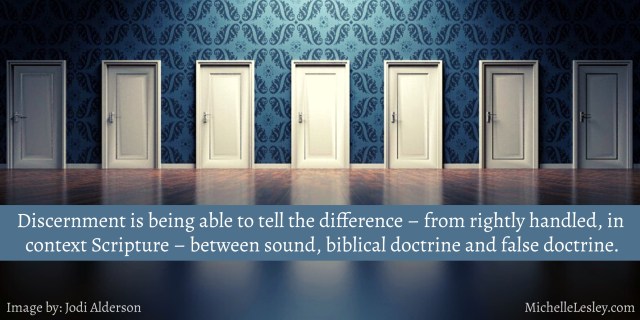
  • How do each of today’s passages fit with the definition of discernment in the image at the beginning of this lesson?

Suggested Memory Verse

(Every week of our study, you’ll see a suggested memory verse like the one above. You are welcome to grab the memory verse pic to use as your screensaver or wallpaper on your phone or computer, print it out and stick it somewhere you’ll see it frequently, or use it in any other way you wish to help you memorize the verse.)