Mailbag

The Mailbag: Potpourri (Benny repents?, Brother Lawrence, Why the Calvinist label?…)

Welcome to another โ€œpotpourriโ€ edition ofย The Mailbag, where I give short(er) answers to several questions rather than a long answer to one question. I also like to take the opportunity in these potpourri editions to let new readers know about my comments/e-mail/messages policy. Iโ€™m not able to respond individually to most e-mails and messages, so here are someย helpful hintsย for getting your questions answered more quickly.ย Remember, the search bar can be a helpful tool!

In these potpourri editions of The Mailbag, I’d also like to address the three questions I’m most commonly asked:

“Do you know anything about [Christian pastor/teacher/author] or his/her materials? Is he/she doctrinally sound?”

Try these links:ย 
Popular False Teachersย /
ย Recommended Bible Teachersย /ย search bar
Is She a False Teacher? 7 Steps to Figuring It Out on Your Own
(Do keep bringing me names, though. If I get enough questions about a particular teacher, I’ll probably write an article on her.)

“Can you recommend a good women’s Bible study?”

No. Here’s why:
The Mailbag: Can you recommend a good Bible study for women/teens/kids?
The Mailbag: โ€œWe need to stop relying on canned studies,โ€ doesnโ€™t mean, โ€œWe need to rely on doctrinally sound canned studies.โ€.

“You shouldn’t be warning against [popular false teacher] for [X,Y,Z] reason!”

Answering the Opposition- Responses to the Most Frequently Raised Discernment Objections


I saw this video making the rounds on social media. It appears as though Benny Hinn is repenting of teaching the prosperity gospel. Is this true, or too good to be true?

Briefly, it is not true, and his behavior and teaching bears this out. He has made similar claims in the past and continues to teach the same old lies from the same old pit of Hell. The YouTube video making the rounds is 4ยฝ minutes long. What it doesn’t show is that for an hour and a half prior to this 4ยฝ minute snippet Benny conducted one of his regular “healing” services.ย Furthermore, prosperity teaching is not the only heretical aspect of Benny’s theology, so even if he had repented of teaching the prosperity gospel, he would remain a heretic to avoid.

Repentance doesn’t just mean a blase admission that something is wrong. Repentance is a total change of lifestyle. If Benny were to repent, what we would see would be genuine, long lasting grief over his sin. He would step down from, and dismantle his “ministry,” cancel all of his tours, crusades, and speaking engagements, take all of his books out of print, shut down all of his online platforms and do everything in his power to scrub the internet of his false teaching (at the moment, he has said he’s planning to keep his “most popular” teachings available online for those who want them), return the money he has scammed from people, and park himself in a solid church so he can learn the gospel, be saved, and be discipled in sound doctrine.

If you’d like to believe Benny has repented, OK. Check back up on him in about six months and see if he has done any of the things above to “bear fruit in keeping with repentance.”

For the longer version of the answer to this question, see the resources below.

Benny Hinn and the Fruit of True Repentanceย at A Word Fitly Spoken

(Be sure to get and read both of Costi’s books if you haven’t already.)

WWUTT 1030 Q&A Benny Hinn, Couples Studies, Christian Fiction? at WWUTT

No, Benny Hinn Has Not Repented by Gabe Hughes

Benny Hinn’s nephew ‘encouraged’ by uncle’s rejection of prosperity gospel, calls for ‘genuine repentance’ at The Christian Post

Benny Hinn and the Fruit of True Repentanceย at Voice of Reason Radio

Benny Hinn Renounces His Selling of Godโ€™s Blessings. Critics Want More. at Christianity Today


[In your “Welcome” tab,] you describe yourself asโ€ฆโ€ฆ.A genuinely regenerated Protestant, Southern Baptist, Calvinist/Reformed Baptistโ€ฆI am just getting in on the Reformed Baptist conversation. As a Southern Baptist, why do I need to add all the other titles. Why or what did you reform? I am confused. Why canโ€™t you just be Southern Baptist?

You donโ€™t need to use a bunch of labels if you donโ€™t want to, I just want to be specific and clear to my readers what my theology is in case theyโ€™d like to know, and so they will know what to expect when they read my articles.

Reformed Baptist theology is different from Arminian (or what Southern Baptists like to call โ€œTraditionalistโ€ theology). If you are Southern Baptist and unfamiliar with Calvinism, you are most likely in a Traditionalist church (you may want to ask your pastor). I think youโ€™ll find the answers to many of your questions inย this articleย (be sure to read the additional resources at the end, too.) Iโ€™d also encourage you to read theย 1689 London Baptist Confession of Faith.

(Just a reminder to my regular readers, I don’t engage in or allow Calvinism/Arminianism debates and arguments in the comments sections of my articles or on social media. Please review my comment parameters at the “Welcome” tab at the top of this page before commenting.)


I am, for now, the choir director at my church. I lead the choir and my husband leads the congregational hymn singing. In one question I read [on your blog], I should not be doing that- the answer to the question of whether woman should serve as worship leaders or music ministers was a simple โ€œnoโ€. It would help a great deal to have an extended answer, and then Iโ€™ll know whether to tender my resignation and find another way to serve. I can happily go back to just singing in the choir. Thank you for your insight.

It’s so encouraging when I hear from women who want to do the biblical thing! Iโ€™m not sure which of my articles you were reading where I simply said โ€œnoโ€ to the question of whether or not women should serve as worship leaders, but I have addressed that question in greater length in this articleย (see #4).

Of course, this article doesnโ€™t address a womanย onlyย directing the choir, but rather, serving as the minister of music. I can see some situations in which it might be biblically OK for a woman to only direct the choir.

For example, if itโ€™s an emergency situation like the minister of music getting sick at the last moment on Sunday morning and he has been the one to lead the choir through rehearsals, explain the text of the music to them, etc., and the only person capable of stepping in and directing the choir that morning (just the choir, not the congregation) is a woman, I donโ€™t think that would be a problem. Another example: At my church, the choir occasionally does anthems that center around a tenor solo, which our minister of music (who directs the choir) will sometimes sing. He will step up to the pulpit to sing the solo, and a lady in the choir will direct the choir part of the anthem. I donโ€™t think thatโ€™s problematic, either.

Of course, you will need to pray about it and talk it over with your husband and pastor, but, for what itโ€™s worth, my thought on your situation is that if your husband isย Scripturally qualified (as well as musically qualified) to step into the pastoral role of minister of music (because men should not hold positions of leadership theyโ€™re not biblically qualified for either), and he is overseeing the choir โ€“ selecting the music, leading rehearsals, etc. (all the pastoral type things mentioned in the article), then it would not be a problem for you to simply direct them on Sunday morning. Especially if, as it sounds like might be the case, the two of you are temporarily filling in until a permanent minister of music can be found and hired. But, really, the best case scenario would be for your husband (and/or another biblically qualified man to) lead the congregation and the choir. And it would probably be a load off your shoulders!


I have a question that I haven’t been able to find a clear answer to including in your blog. Can women teach men in Bible study say on a Thursday night?

The 1 Tim 2:12-13 Scripture points to Adam being created first then Eve therefore, therefore I would deduct that women should not teach or exercise authority over a man whether it be in church, Sunday School or in a Thursday night Bible study. Am I wrong?

DING! DING! DING! You are absolutely RIGHT!ย Tell her what she’s won, Johnny! :0)

Yes, you’re correct. You’ll notice in 1 Timothy 2:11-15 that there’s no exception for any day of the week. The prohibition against women teaching men is for any day ending in a Y.

And, you didn’t say where this Thursday night Bible study is meeting, but those types of gatherings of the Body often meet in homes, and there’s no exception for meeting in a home (or anywhere else) versus meeting inside the four walls of a church building, either. When 1 Timothy was written, there were no church buildings. The church was largely meeting in people’s homes. I say “the church was meeting,” because the church is the gathering of Believers, not the building in which they meet. So it’s not OK for women to teach Scripture or preach to a co-ed gathered body of Believers, whether that’s in a church building during worship service or a smaller class or group, or at a Christian conference, retreat, parachurch event, or at a Bible study at someone’s home on a Thursday night.

You’re also correct that I’ve never addressed this specific question directly, but I have touched on it here, here (2nd question), and here (#7 – I just hopped over to this article and added home, workplace, and coffee shop Bible studies to question 7). So let me grab the salient points from those articles and put them together in a more helpful way:

“Teaching” includes any situation in the gathering of the body of Christ in which women would be giving instruction to men in the Scriptures and/or on spiritual matters (which, in a biblical church gathering, would necessarily include Scripture), whether in an official position of teacher (pastor, teaching elder, Sunday School/Bible study teacher, or other leadership position) or any other situation requiring exhorting, teaching, or explaining of the Scriptures.

We need to remember what the definition of โ€œchurchโ€ is. The church is not a building, it is a body of born again believers gathered for the purpose of worship, prayer, the ordinances, and/or the study of Godโ€™s word. Those things can take place in a church building, a home (as with the first century churches in Acts), in a campus or office building, outdoors, in a conference center, in a sports arena, or anywhere else. So, when a body of believers comes together for these purposes, regardless of the building in which they meet, or whether you call it โ€œchurchโ€ or not, they are the church, and the biblical parameters about women teaching and holding authority over men applies.

I donโ€™t mean this to sound facetious or anything, but sin is sin no matter what time of day or day of the week it takes place on.


Today, I came across a book I had purchased in the past – Practicingย the Presence of God from Brother Lawrence. Taking a quick look at the book, Iโ€™m inclined to throw it away. It reminds me of Buddhist thinking or New Age garbage. As a monk, Brother Lawrence’s Catholic theology conflicts with biblical Christianity.

Before I became a Christian, I was into New Age thinking and practices. Just reading bits and pieces of this book makes me think New Age thinking instead of what I know from the Bible. Iโ€™m going to throw it awayโ€ฆI donโ€™t see any redeeming Christian theology in it thus far. I donโ€™t want to expose anyone else to wrong theology. Just wondered if you have any thoughts on this book?

Unlike the vast majority of books I’m asked about, I have actually read this one. However, it has probably been ten years ago or more since I read it. All I remember is that it was fairly short (which is probably why I read it), and that one of his main points was keeping our thoughts focused on God at all times. And I meanย all times. Every waking moment of the day, we are to be consciously, actively thinking about God or we’re not pleasing Him. I remember trying to put that into practice. Even while doing something as mindless as washing the dishes, it was impossible and exhausting. (It did, however demonstrate to me how much of the time our brains are on auto-pilot.)

You’re correct in your assessment of the theology of the book. Brother Lawrence was a Roman Catholic mystic. Roman Catholic doctrine – as it is laid out in their own documents – is patently unbiblical, as is mysticism. Christians should not receive any sort of spiritual teaching from someone with that theological pedigree.

Thank you for throwing the book out instead of passing bad theology on to others.


If you have a question about: a Bible passage, an aspect of theology, a current issue in Christianity, or how to biblically handle a family, life, or church situation, comment below (Iโ€™ll hold all questions in queue {unpublished} for a future edition of The Mailbag) or send me anย e-mail or private message. If your question is chosen for publication, your anonymity will be protected.
Prayer Bible Study

Sweet Hour of Prayer: Lesson 2

Previous Lessons: 1

Read 1 Samuel 1

Hannah’s First Prayer

Questions to Consider

1. Are you familiar with what is going on in the history of Israel at this time? If not, use this synopsis (or another Bible Book Background) to bring you up to speed.

2. Carefully read verses 1-9. In your own words, briefly summarize the circumstances in Hannah’s life leading up to her first prayer (in 10-11).

3. Examine verses 10,15,16. What words are used to describe Hannah’s emotional and spiritual state? It has often been said that prayer shouldn’t be our last resort – that we shouldn’t wait until circumstances are desperate before we pray. Does it seem like that’s what’s going on here with Hannah, that she only turned to God as a last resort, or that this was the culmination of many prayers over the years? On what, from chapter 1, are you basing your answer? Compare 10,15,16 with 18b. How did Hannah’s emotional and spiritual state change after pouring her heart out to God? What can we learn from Hannah’s first prayer about pouring our hearts – our feelings – out to God?

4. Where did Hannah go to pray? (9-10) Why do you think it was important to her to pray at the temple? (Hint: Examine what she says about the house of the Lord and the “presence of the Lord” in 21,22,24). Could God only hear her, or would He only be willing to answer her, if she were praying in His house? True or false: God hears us better and our prayers carry more weight if we’re praying in church, or at the front of the sanctuary (at the “altar”) during a special time of the worship service, than if we’re praying at home, in the car, etc.?

5. Examine the content of Hannah’s first prayer. (11) What is Hannah praying for, and for whom? Is it OK to pray for the things our hearts long for? Why or why not?

“O Lord of hosts,” – How does Hannah start off her prayer? How does she address God? Compare this with the beginning of the Lord’s Prayer. How should this inform our own prayers?

“if you will indeed look on the affliction of your servant and remember me and not forget your servant” –ย What is Hannah seeking in this part of her prayer? Compare Hannah’s thoughts and request here with Hagar’s characterization of God as, “a God of seeing…I have seen him who looks after me.”

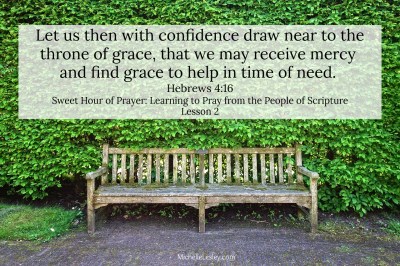
“but will give to your servant a son,” – How would you describe Hannah’s request? Is she timid and equivocating, or bold, direct, and specific? How does Hebrews 4:16 relate to this part of Hannah’s prayer?

“then I will give him to the Lord all the days of his life, and no razor shall touch his head.โ€ย – (Use your footnotes and cross references if you’re not familiar with what Hannah is talking about here.) Hannah includes a vow, or promise to God, with her prayer, which is not something we’re accustomed to doing. Most of us have probably heard the story of the guy on his deathbed who promises God that if He will just let him live, he’ll live a good life, go to church every week, etc. We’ve been taught that’s “bargaining with God” and that we shouldn’t do that. Is Hannah bargaining with God in that same sense? What, from today’s passage would lead you to say “yes” or “no”? Have you ever made a vow to God in prayer? Did you keep that vow? Why might it be wise or unwise to make a vow to God when requesting something in prayer? Look up the word “vow” in a concordance. Does vowing seem to be more of an Old Testament thing or a New Testament thing? Why do you think that is?

6. Examine verse 19. Did Hannah go in to worship the Lord before or after He answered her prayer? Was her worship an attempt to manipulate God into giving her what she wanted, a response to knowing for a fact that He was going to give her what she wanted, or was her worship simply part of who she was as someone who loved God, regardless of whether or not He gave her what she wanted? Do you worship God continuously, whether or not He gives you what you’ve asked for in prayer?

7. Read 19-20. Did Hannah and Elkanah sit idly by and wait for God to provide a miraculous conception? What did they do? If you need a job, do you pray for God to send you a job and then sit on the couch watching TV and waiting for someone to call and ask you to come work for them, or do you ask God to provide a job and then read the want ads, fill out applications, and go on interviews? Explain how God blesses and answers prayer through the normal, day to day means and methods He has established. Is it any less “miraculous” for God to answer prayer through normal means and methods than to answer prayer in extraordinary way? Why? How did Hannah honor and recognize God for answering her prayer? (20b) How was Samuel, for the rest of his life, just by virtue of his name, a testimony to God answering prayer?

8. Study 21-28. Did Hannah keep the vow she made to the Lord? Why is this important? What was Hannah’s testimony of God’s answer to her prayer? (26-28) How do you think this impacted Eli? How can it be an encouragement to your pastor and your brothers and sisters in Christ to share with them how God has answered your prayers or worked in your life? We often share prayer requests. We don’t often share God’s answers. How might sharing God’s answers to prayer encourage others to pray?


Homework

โ€ขThink about one of the aspects of Hannah’s prayer we studied today – pouring out your heart to God, honoring His name in your prayers, worship, God’s work through normal means, etc. – and apply this aspect to your own prayer life this week.

โ€ขHow has God answered a prayer or worked in your life in some way? Encourage your pastor, and share it with him!


Suggested Memory Verse

(Every week of our study, you’ll see a suggested memory verse like the one above. You are welcome to grab the memory verse pic to use as your screensaver or wallpaper on your phone or computer, print it out and stick it somewhere you’ll see it frequently, or use it in any other way you wish to help you memorize the verse.)

Prayer Bible Study

Sweet Hour of Prayer: Lesson 1- Introduction

Welcome to our new study, Sweet Hour of Prayer: Learning to Pray from the People of Scripture!

“Lord, teach us to pray,” the disciples implored Jesus. Sometimes, no matter how close we are to Christ, we can feel unsure and awkward in prayer. Am I doing it right? Using the correct words? Asking within God’s will?

Over the next several weeks we’ll take a look at the topic of prayer through the example left to us by our brothers and sisters from the Old and New Testament. As we study it is my hope that your “hour of prayer” will become sweeter and sweeter.

You may wish to review my philosophy of Bible study at the “Bible studies” tab at the top of this page. My studies are designed to teach you how to study the Bible for yourself, which is why I don’t provide answers to the questions in the lessons.

My studies are also designed to be very flexible. You may answer all, any, or none of the questions in each lesson. All of my studies are self paced, so take as long or as short of a time in the passage and with the questions as you like. If, as you’re studying the text, the Holy Spirit leads you to focus on an aspect of the passage I haven’t addressed in the questions, awesome! Park yourself there and learn what He wants you to learn. These lessons are meant to be a tool for you to use as you see fit during your personal study time, not a school project where points are taken off if you don’t complete it the way the teacher wants.

As with all of my studies and articles, I use hyperlinks liberallyThe main Scripture for each lesson will be linked at the beginning of the lesson, and there will be additional links in the lesson questions. Whenever you see a word in red, click on it, and it will take you to a Scripture, article, or other resource that will help as you study.


Introduction to Sweet Hour of Prayer

Part of my philosophy of Bible study is that our main “diet” should be systematic, expositional study of the text. In other words: pick a book of the Bible, start at the beginning, and study it through to the end. Then, pick another book and start again. This method of studying helps us understand passages in their context and correctly apply them to our lives, and helps us avoid eisegesis, taking passages out of context, and incorrectly applying them.

However, there is a place for the study of a biblical topic such as peace, sin, the family, God’s wrath, or biblical womanhood. For example: if you’re struggling to trust God because of a sudden circumstance in your life, you don’t have time to study through every book of the Bible to learn what the Bible says about trusting God. You may need to spend some time in focused study on passages from various books that deal specifically with the topic of trusting God, and that’s OK. My goal with this study is not only that you learn what the Bible has to say about the topic of prayer, but also to demonstrate how to do a topical study properly so you can do topical studies on your own when the need arises.

Normally, in the introductory lesson to my studies, we take a look at the author of the book of the Bible we’re studying, the audience he wrote it to, the historical setting of the book, and other “backstory” issues. But because this is a topical study, and we’ll be examining passages from various books of the Bible, we’ll have to briefly address those issues as needed in each lesson.

So in the introduction to this study, I’d like to address two items in your “backstory.”

Salvation

If you’re not saved, this study isn’t going to be very helpful to you, because prayer is about talking to Someone we are in right relationship with, and if you aren’t saved, you aren’t in right relationship with God.

This week, before we tackle prayer, I’d like everyone – even if you know beyond a shadow of a doubt that you’re saved – to work through the Scriptures in my article Basic Training: The Gospel. Do you understand the biblical gospel? Have you truly repented of your sin and trusted Christ as Savior? Spend some time alone with God examining your heart and life against these Scriptures. If you’re unsure whether or not you’re genuinely saved, I would encourage you to put this study aside and work through my study Am I Really Saved?: A First John Check Up first. You can’t approach God in prayer if you don’t belong to God.

Expectations and Presuppositions

What do you expect out of this study? What kinds of ideas or preconceived notions are you carrying into this study? Take some time to answer the following questions.

1. When you hear the word “prayer,” what do you think of?

2. Without looking in your Bible, jot down five or ten things you think the Bible teaches about prayer.

3. What does your church teach about prayer? Does your church hold regular prayer meetings? Is there someone in your church that you look up to as a good example of how to pray?

4. What Scriptures come to mind when you think about prayer?

5. Why are you interested in a study about prayer, and what do you hope to get out of this study?

6. What are the strengths and weaknesses of your prayer life? What are some things you’d like to improve about your prayer life?

Take some time in prayer this week to begin preparing your heart for this study. If there’s a specific issue you struggle with when it comes to prayer, ask God to teach you the truth of His Word about that issue and strengthen your prayer life in that area. Write down your prayer and review it when the study is over to see how God answered you through the study of His Word. I’m excited to have you join me in this journey of discovering what God’s Word has to say about prayer!

Sweet hour of prayer! sweet hour of prayer!
That calls me from a world of care,
And bids me at my Fatherโ€™s throne
Make all my wants and wishes known.
In seasons of distress and grief,
My soul has often found relief
And oft escaped the tempterโ€™s snare
By thy return, sweet hour of prayer!

Sweet hour of prayer! sweet hour of prayer!
The joys I feel, the bliss I share,
Of those whose anxious spirits burn
With strong desires for thy return!
With such I hasten to the place
Where God my Savior shows His face,
And gladly take my station there,
And wait for thee, sweet hour of prayer!

Sweet hour of prayer! sweet hour of prayer!
Thy wings shall my petition bear
To Him whose truth and faithfulness
Engage the waiting soul to bless.
And since He bids me seek His face,
Believe His Word and trust His grace,
Iโ€™ll cast on Him my every care,
And wait for thee, sweet hour of prayer!

Sweet hour of prayer! sweet hour of prayer!
May I thy consolation share,
Till, from Mount Pisgahโ€™s lofty height,
I view my home and take my flight:
This robe of flesh Iโ€™ll drop and rise
To seize the everlasting prize;
And shout, while passing through the air,
Farewell, farewell, sweet hour of prayer!
William Walford 1845

Uncategorized

The Word on Wednesdays

Hi ladies! I hope you enjoyed our most recent Bible study,ย 1&2 Timothy: The Structure and Spirit of the Church, which we wrapped up recently.

Iโ€™ve been taking a break on Wednesdays, getting ready for our new study. I hope youโ€™ll enjoy it and that it will edify you as you seek to grow in Christ and His Word. (The picture above does not mean we will be studying James. :0) I really had planned to start our new study last week, but I’ve had a family situation come up unexpectedly that I need to devote some time and attention to, and that has to come first. My new plan is to start our new study next week- August 28.

So, if you havenโ€™t quite finished with the 1&2 Timothy study, you can use this time to finish up, and Iโ€™ll also be posting some articles from the archives that I think youโ€™ll find helpful as we make our way toward our next study. Here is this weekโ€™s article:

sunday school

Sunday School: Chronological Study Lessons

During 2014, I led my ladiesโ€™ Sunday School class in a chronological read-through of the entire Bible. Each week I taught a lesson from that weekโ€™s reading and posted it here on the blog.

If youโ€™re using the chronological one year Bible reading plan this year, hereโ€™s the lesson that roughly corresponds with this weekโ€™s reading. (And even if youโ€™re not, I hope youโ€™ll enjoy this lesson anyway.)

Through the Bible in 2014 ~ Week 34 ~ Aug. 17-23
Jeremiah 35-50, Psalm 74, 79, 2 Kings 24-25, 2 Chronicles 36, Habakkuk
Idolatry: No Turning Back

idolatry

Background:
Israel is gone, carried off into captivity by Assyria. Judah has managed to hang on a little longer, due in part to Hezekiahโ€™s and Josiahโ€™s godliness, but, now, Nebuchadnezzar has besieged and overthrown the last of Judahโ€™s fortified cities, slaughtered the king and the nobles, and carried nearly all the citizens off to a 70 year exile in Babylon. Nebuchadnezzar left a small remnant of the poorest of the poor to continue living in Judah to work the land, and set up Gedaliah as governor over them. Gedaliah was subsequently assassinated by the Ammonites, and the remnant decided -against Godโ€™s clear instruction through Jeremiah- to go to Egypt, and to force Jeremiah to go with them. This is where we now find them in chapter 44…Continue reading.

Uncategorized

The Word on Wednesdays

Hi ladies! I hope you enjoyed our most recent Bible study,ย 1&2 Timothy: The Structure and Spirit of the Church, which we wrapped up recently.

Iโ€™ve been taking a break on Wednesdays, getting ready for our new study. I hope youโ€™ll enjoy it and that it will edify you as you seek to grow in Christ and His Word. (The picture above does not mean we will be studying James. :0) I really had planned to start our new study today, but I’ve had a family situation come up unexpectedly that I need to devote some time and attention to, and that has to come first. My new plan is to start our new study two weeks from today on August 28.

So, if you havenโ€™t quite finished with the 1&2 Timothy study, you can use this time to finish up, and Iโ€™ll also be posting some articles from the archives that I think youโ€™ll find helpful as we make our way toward our next study. Here is this weekโ€™s article:

Wednesday’s Word

Wednesday is Bible study day here on the blog. In myย Wednesday’s Word study, youโ€™ll find miscellaneous, one lesson Bible studies from each book of the Bible. One chapter of Scripture followed by study questions. This sampler series demonstrates that thereโ€™s nothing to be afraid of when approaching those โ€œlesser knownโ€ books and that every book of the Bible is valuable and worth studying.

Wednesday’s Word ~ Obadiah

obadiah 4


The vision of Obadiah.

Thus says the Lordย Godย concerning Edom:
We have heard a report from theย Lord,
ย ย ย ย and a messenger has been sent among the nations:
โ€œRise up! Let us rise against her for battle!โ€
2ย Behold, I will make you small among the nations;
ย ย ย ย you shall be utterly despised.

ย Keep reading…