Titus Bible Study

New Bible Study Kickoff and Title Pic Contest

Happy Wednesday, Ladies! It’s time to kick off our next Bible study:

…..with a fun title pic contest!

What does God think about the way His church should operate? What are the qualifications and character traits of godly pastors, elders, and church members? What is your role in the Body, and why is it so crucial? God is a God of order, and He wants the church to operate in an orderly way – to glorify Him – as we worship, work, and witness.

…that you would set in order what remains…

Titus 1:5

In 1&2 Timothy: The Structure and Spirit of the Church, we studied the first two of the pastoral epistles. Titus: God’s Order of Worship brings us to the third and final pastoral epistle. The pastoral epistles are God’s instructions via Paul to pastors Timothy and Titus – and subsequently to all pastors – about the way His church should run. Sort of a “policy and procedure manual,” if you will. But pastors aren’t solely responsible for the smooth sailing of the church. We all contribute to glorifying God by learning and robustly filling out our roles in the church in a godly and orderly way. Over the course of approximately 5-8 lessons, we’ll learn how to do that from the book of Titus.

But before we get started studying next Wednesday, how about a little fun?

You’ve probably noticed that I design a title picture for most of the Bible studies I write. Here are a few past title pics I’ve designed myself:

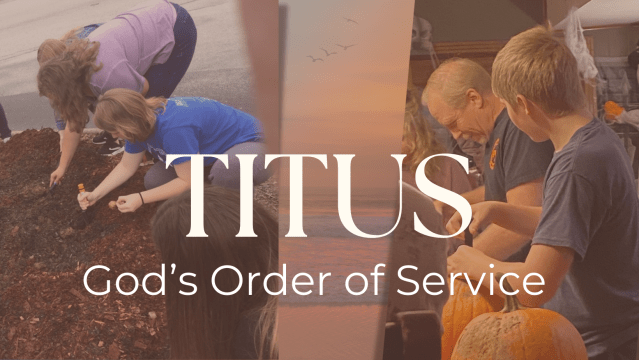
But sometimes, I like for us all to share in your creativity. Y’all have sent in some beautiful and creative entries in our past title pic contests – indeed, the title pics for The Sermon on the Mount, The Women of Genesis, Living Stones, and Imperishable Beauty, and other studies, were all designed by readers – so, once again, I wanted to get some of you involved in the design process for our new study.

You can see the rest of my Bible study title pics as well as those designed by my readers at the Bible Studies tab in the blue menu bar at the top of this page. Take a moment to look them over to get a feel for my style and the general appearance I like my title pics to portray.

If you enjoy and have a knack for photo editing, or you know someone who does, I’m accepting submissions for title pictures for the Titus study. If your submission is chosen it will be used each week of the study, and you’ll be credited (name or website) by watermark. I’d love to be able to offer a huge cash prize, but, hey, we’re small potatoes here. This is just for fun and maybe a little publicity for your site, if you have one.

Contest Guidelines

โ˜™ Ladies only. Sorry guys! :0)

โ˜™ย You must use images that don’t require attribution. Pictures you’ve taken yourself are fine, as are images from sources such as Pixabay, Pexels, Freely, Unsplash, StockSnap, or other free stock photo web sites. Please include the image source web sites you use along with your submission. (You cannot just grab and use any old picture off the internet. Photographers own their images and usually require permission, attribution, and often a fee, for their use.)

โ˜™ Title pics should be landscape (a horizontal rectangle) with a width of 2000-4000 pixels and proportionate height. I prefer JPG images, but PNG is fine, too, if necessary.

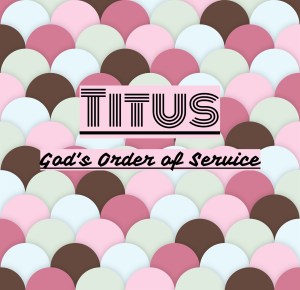
โ˜™ย Your title pic must contain the full title of the study: Titus: God’s Order of Service (Be sure to double check your spelling and punctuation. You can leave the colon after “Titus” out if “Titus” and “God’s Order of Service” are not on the same line. See my image above.).

โ˜™ย Since I use the title pic background image for each lesson’s suggested memory verse, please send a blank copy (no words on it) of the picture you’re using along with the title pic you design.

โ˜™ If your submission is selected, I’ll be glad to watermark it with your website address (please submit your picture without any watermarks) if you have one, as long as your web site doesn’t conflict with my statement of faith or my beliefs outlined in the Welcome tab.

โ˜™ย Deadline for submissions is 11:59 p.m., Monday, August 8, 2022.ย 

โ˜™ E-mail your title pic submission along with a blank copy of your image, your full name, web site address (if any), and the source(s) you used for your image(s) to MichelleLesley1@yahoo.com. You are welcome to submit as many images as you like.

โ˜™ Please don’t be offended if your submission isn’t selected. If I peruse all the submissions and I’m just not “feeling it,” I may still elect to design one of my own.

โ˜™โ˜™โ˜™โ˜™โ˜™

Feel free to share this around with friends who have an interest in photo editing. If you want to take a whack at it for fun but don’t know where to start, play around with Be Funky, PicMonkey, or Canva and see which one works best for you.

Think about – maybe even read – Titus and try to capture in your image the theme of the epistle or a key truth expressed by a certain verse.

Happy designing!

Psalm 119 Bible Study

Psalm 119: The Glory of God’s Word ~ Lesson 13 – Wrap Up

Previous Lessons: 1, 2, 3, 4, 5, 6, 7, 8, 9, 10, 11, 12

Wrap Up

Questions to Consider

1. Was there anything new God taught you in this study that particularly impacted you? What was it, and why was it so significant?

2. How is your walk with the Lord different after this study than it was before?

3. What did you learn from this study about what your relationship with, and response to God’s Word should be like?

4. What did this study teach you about obeying God’s Word?

5. What did this study teach you about the nature and character of God?

6. Have there been any passages or concepts in this study that God used to convict you of disobedience and lead you to repentance? How will you walk differently in this area from now on?

7. What did this study teach you about prayer?

8. Describe one specific, practical way you will apply to your life something you learned in this study.


Homework

Spend some time in prayer this week asking God to show you how to put into practice one thing you learned from this study.

Recite all of your memory verses from this study. Which one is most meaningful to you right now?

Psalm 119 Bible Study

Psalm 119: The Glory of God’s Word ~ Lesson 12

TOMORROW will be our wrap up lesson for Psalm 119. Don’t miss it!

Previous Lessons: 1, 2, 3, 4, 5, 6, 7, 8, 9, 10, 11

Read Psalm 119:161-176

Recall the things from the introductory lesson that you wanted to keep in mind as you study the text of Psalm 119.

Don’t forget to read in complete sentences instead of stopping at the end of each verse.

Recall the themes you’ve been noticing in Psalm 119. Watch for those themes to be repeated in today’s and future passages. You may wish to make a list of those themes to refer to throughout this study.

Questions to Consider

1. Review your notes from last week’s lesson. Does that passage relate to this week’s passage? How? Do you notice any repeated words, thoughts, or themes?

2. Write down each phrase in 161-164, 167 that follows the general pattern: “I / my [heart attitude] at Your Word, law, etc.”. Compare the posture of your heart toward God’s Word with that of the psalmist’s. Take a moment to ask God to help you stand in awe, rejoice at, etc., His Word.

Second Corinthians 13:5 tells us to test ourselves to see if we are, indeed, in the faith. The book of 1 John emphasizes the tests of obedience to the Word and love for the brethren. John 10 shows us the test of rejecting false teachers. Could the phrases you wrote down from 161-164, 167, help you test yourself regarding your love for God’s Word? Since even the finest Christian will never love God’s Word perfectly 100% of the time, what would passing the test of loving God’s Word look like? What role does God play in your ability to love His Word?

Once you’re done with this question, you might enjoy reading my article The Mailbag: I love the Bible, but I have to force myself to read it (Don’t think the psalmist didn’t feel that way sometimes, too.)

3. What kinds of things would the psalmist have considered to be “great spoil”? (162). When you get right down to it, aren’t money, jewels, gold, and silver essentially just paper, rocks, and metal? Why do they have value? Who assigns them their value? Is it ultimately our place to assign value to things? Why or why not? Do we incorrectly over or under value certain things?

Consider this statement: “It’s not our place to assign value to things. It’s God’s place. It’s our place to agree with Him and value the things to which He has assigned value.” Agree of disagree? Why? Does Scripture have intrinsic, ontological value, or assigned value, or both? Explain your answer.

4. Verse 165 is the only verse in Psalm 119 in which the psalmist uses the word “peace”. How does loving God’s Word give Believers peace? Can an unbeliever truly love God’s Word or derive real peace from it? Why not?

5. What does the psalmist mean by “all my ways are before you” (168), and why does this fact lead him to keep God’s precepts and testimonies? Ponder for a moment that all your ways are before God. In what ways does this realization make you want to better keep God’s precepts and testimonies in your own life?

6. Revisit lesson 11 (link above), question 4, and compare 169-170 to the “Give me _____ according to your_____,” verses there. What similarities do you see? Differences?

7. In question 2, the verses we looked at all dealt with the internal response of the heart toward God’s Word. How would you characterize the response to God’s word in 171-172? For a Believer, why is it; a) natural, and b) important that God’s word evokes both an internal and external response in us? How, and why, should pondering God’s Word move us to worship Him?

8. Compare the sheep motif of 176 to these passages. What is the perspective from which each of these passages is written? Is the focus of each of these passages on the individual sheep, the flock, the shepherd, etc.? Are any of these passages (or any other “sheep” or “shepherd” motif passages you can think of) written from the perspective of an individual “sheep” saying “I have gone astray” as 176 is? What does the psalmist mean when he says he has gone astray like a lost sheep, and then asks the “Good Shepherd” to seek him? How does he know he has gone astray? If he knows he has gone astray, why doesn’t he just go back? Why does he need the shepherd to seek him? What does “I do not forget Your commandments” mean in relationship to all of this? How does the Lord restore us to Himself after we sin?


Praying Psalm 119

Have you ever tried praying the psalms? I want to encourage you to try praying part of Psalm 119 back to God each week of this study. (If you’re familiar with my other studies, this will take the place of the weekly “Homework” section.)

The psalms are uniquely suited for praying back to God, both verbatim and conceptually, because they are often written as prayers – as though the psalmist is talking to God. Did you notice that about today’s passage? In which verses?

What is a concept or thought for your own life that the Holy Spirit impressed on your heart or convicted you about from today’s passage? Is there a particular verse(s), or maybe the whole passage, that you would like to pray back to God verbatim? Whatever your “prayer point” from today’s lesson, pray it at least daily until we get to the next lesson.


Suggested Memory Verse

Psalm 119 Bible Study

Psalm 119: The Glory of God’s Word ~ Lesson 11

Previous Lessons: 1, 2, 3, 4, 5, 6, 7, 8, 9, 10

Read Psalm 119:145-160

Recall the things from the introductory lesson that you wanted to keep in mind as you study the text of Psalm 119.

Don’t forget to read in complete sentences instead of stopping at the end of each verse.

Recall the themes you’ve been noticing in Psalm 119. Watch for those themes to be repeated in today’s and future passages. You may wish to make a list of those themes to refer to throughout this study.

Questions to Consider

1. Review your notes from last week’s lesson. Does that passage relate to this week’s passage? How? Do you notice any repeated words, thoughts, or themes?

2. Let’s look at a few themes in today’s passage.

The first is the theme of the psalmist’s imploring. Make a list of all the phrases in this section which indicate imploring (e.g. “Answer me, O Lord”). Who is he imploring, for what, and why? When we implore someone about something, what does our imploring indicate that we believe about that someone? What does the psalmist’s imploring God indicate he believes about God? Is his belief correct? How do we know this? Think of a time when you implored God about something. What did your imploring indicate you believed about God? Regardless of how He answered, was your belief correct? How do you know?

Our next theme is the theme of night. Which two verses in this passage contain this theme? What is “the watches of the night” (148), and what does the psalmist mean in this verse? (It may help to compare a few different translations.) What sort of picture do darkness and night paint in this passage? What is the antidote to darkness and night in this passage?

The third theme is the theme of far and near. Which verses explore this theme? In each instance, list what is far from or near to what. In what ways are far and near contrasted? In each instance of far or near, note whether the psalmist is indicating that far or near is a good thing or a bad thing. Have you experienced any of these instances in your own life? What does this teach us about salvation and the nature and character of God?

The final theme is the theme of hope. Which verse explicitly declares the psalmist’s hope? What does he hope in, and why? Make a list of other phrases in today’s passage which implicitly indicate the psalmist’s hope. Who or what does he hope in? How does this hope ease the tension of, and comfort him in his affliction? Do you have that same hope in Christ? Write out a few statements of your own hope in Christ and His Word modeled after the structure of verse 147 (e.g. “I [negative circumstance], but I hope in [characteristic of God / the Word].)

How do the themes of imploring, night, far and near, and hope relate to and inform one another in this passage?

Did you notice any other themes in today’s passage? Explore them using your cross references. How do they connect to the aforementioned themes?

3. Note the word “promise” in 148. In this context, does “promise” mean Scripture in general, a specific verse or promise, the nature and character of a God who keeps His promises, all of the above? Explain why. (Again, it may help to compare a few different translations.)

4. How many times, and in which verses, does the psalmist use the phrase “give me life according to Your…”? How does the first line of each verse inform or relate to the “give me life” part of the verse? What are the three “according to’s” in these verses?

Whenever God acts in any way, in any circumstance, explain how and why He always acts:

  • according to His promise:
  • according to His rules:
  • according to His steadfast love:

Can you think of some examples from Scripture in which we see God acting according to His promise, according to His rules, and according to His steadfast love? What about some examples from your own life?

5. Make a list of each phrase in today’s passage in which the psalmist is basically saying, “I obey Your Word.”. Do you get the sense that the psalmist is saying to God, “I obey You, therefore, You owe me X,Y, and Z.”? That God should react to his obedience as a quid pro quo? Why or why not?

Remember that, unlike Christians today, the psalmist was living under the Mosaic covenant. Under this covenant, God promised to bless Israel’s families, fields, flocks, finances, and fighting men if they obeyed Him, and to curse them in all of these areas if they disobeyed him. This was the air the psalmist breathed that informed his view of God, his relationship to God, and how he expected or anticipated that God would act in his life. Knowing this background, why do we see this repeated refrain of “I keep Your commandments,” especially when the psalmist is suffering, in today’s passage and throughout Psalm 119? What is the psalmist reminding himself of – about himself and about God – by repeating this again and again? How does “holding God to His Word” demonstrate the psalmist’s trust in God to keep His promises? Explain how the psalmist’s constant cry of “I obey Your Word” calls upon God to be God – to act in accord with His nature and character, to keep the promises He made in the Covenant, and to act within the parameters of the Covenant.

How is the psalmist’s brand of “stake my life on it, total obedience, so much so that I don’t get why God hasn’t acted yet” faith and belief different from the easy, shallow, mental assent, untested “I love Jesus” brand of belief that requires nothing of, and demonstrates nothing about the “believer,” that we see in so many professing Christians today? Which type of belief is Jesus calling us to when He says “Repent and believe the gospel,” and Paul and Silas, when they said to the Philippian jailer, “Believe in the Lord Jesus, and you will be saved.”? How is this type of “stake my life on it” belief different from both the works righteousness, “quid pro quo” type of “belief” in God and the easy / shallow type of “belief” in Jesus? How is the posture of the psalmist’s heart, and the genuinely regenerated Believer’s heart different from the posture of heart of those who subscribe to these other two forms of “belief”?


Praying Psalm 119

Have you ever tried praying the psalms? I want to encourage you to try praying part of Psalm 119 back to God each week of this study. (If you’re familiar with my other studies, this will take the place of the weekly “Homework” section.)

The psalms are uniquely suited for praying back to God, both verbatim and conceptually, because they are often written as prayers – as though the psalmist is talking to God. Did you notice that about today’s passage? In which verses?

What is a concept or thought for your own life that the Holy Spirit impressed on your heart or convicted you about from today’s passage? Is there a particular verse(s), or maybe the whole passage, that you would like to pray back to God verbatim? Whatever your “prayer point” from today’s lesson, pray it at least daily until we get to the next lesson.


Suggested Memory Verse

Psalm 119 Bible Study

Psalm 119: The Glory of God’s Word ~ Lesson 10

Previous Lessons: 1, 2, 3, 4, 5, 6, 7, 8, 9

Read Psalm 119:129-144

Recall the things from the introductory lesson that you wanted to keep in mind as you study the text of Psalm 119.

Don’t forget to read in complete sentences instead of stopping at the end of each verse.

Recall the themes you’ve been noticing in Psalm 119. Watch for those themes to be repeated in today’s and future passages. You may wish to make a list of those themes to refer to throughout this study.

Questions to Consider

1. Review your notes from last week’s lesson. Does that passage relate to this week’s passage? How? Do you notice any repeated words, thoughts, or themes?

2. As you have been studying Psalm 119, have you noticed that everything in the psalmist’s life is oriented toward God and His Word? I illustrated his God-ward orientation like this in my own notes: “Let me eat my Wheaties so I’ll have the strength to obey Your Word.” “Even when I’m brushing my teeth, I long for Your statutes.” Explain the psalmist’s desire, reflected in today’s passage, to have everything in his life: his heart, his actions, his environment, and his relationships with others, align with, be saturated with, and be enthralled with God’s Word. Compare that desire to these passages. What does it mean to glorify God in whatever we do? To desire God’s will in every circumstance? Explain the friction and tension sin – our own sin, others’ sin, and living in a fallen world – creates as it works against that desire. When and how will this conflict between sin and God’s will and His glory be resolved?

3. How is Psalm 119 – as a whole, and today in verses 132-135 – a model for our prayer life? Compare the psalmist’s prayer in this passage to the Lord’s Prayer. Would it be a right handling of God’s Word to see the Lord’s Prayer as sort of a general, condensed version of the prayers we see in Psalms, especially Psalm 119? How does this similarity in prayer from the Old Testament to the New Testament to today reflect God’s immutability – His unchanging nature?

4. Read verses 136 and 139 together. Describe the two reactions the psalmist has to others’ sin. Why does he react to others’ sin this way? List some reasons. Do you react to others’ sin (and not only sin that directly affects you) in the same way as the psalmist, and for the same reasons? What is it about our new nature in Christ that moves our hearts to view and respond to sin this way?

5. How many times are the words right, righteous, and righteousness used in 137-144? Define righteousness. Explain in your own words what each of these occurrences of right/righteous/righteousness means in this passage. Describe how the concept of righteousness “bookends” (137 & 144) this passage. Who/what is righteous? How is He/it righteous? How are we to respond to that righteousness? How does the righteousness described here help us to have confidence in God and His Word? How does it lead us to trust God and His Word?

6. Compare and contrast the reaction to sin of #4 with the righteousness of #5. How are they connected? Is it possible to have one without the other? Why or why not?


Praying Psalm 119

Have you ever tried praying the psalms? I want to encourage you to try praying part of Psalm 119 back to God each week of this study. (If you’re familiar with my other studies, this will take the place of the weekly “Homework” section.)

The psalms are uniquely suited for praying back to God, both verbatim and conceptually, because they are often written as prayers – as though the psalmist is talking to God. Did you notice that about today’s passage? In which verses?

What is a concept or thought for your own life that the Holy Spirit impressed on your heart or convicted you about from today’s passage? Is there a particular verse(s), or maybe the whole passage, that you would like to pray back to God verbatim? Whatever your “prayer point” from today’s lesson, pray it at least daily until we get to the next lesson.


Suggested Memory Verse