Social Media

Memeology 101

A little lagniappe post for this week! Judging from some of the social media comments I’ve been getting lately, it’s time to run this friendly refresher again. Enjoy! :0)

Originally published September 24, 2019

I post a lot of memes on my social media pages, mostly Facebook and Instagram. I usually post four Bible verse memes every weekday morning on Facebook and other miscellaneous memes at various times on all my social media platforms. Over the course of the last couple of years, Iโ€™ve gotten some critical comments about a few of these memes, which, I think, stem mostly from misconceptions people have about what a meme is and the general understanding of the function of memes on social media. Iโ€™d like to try to clear up some of those misconceptions today.

Memes- Definition and Function

A meme is simply a picture with words superimposed on it (usually a couple of sentences, max), like the ones in the collage above, that you see on social media. The function of a meme is to convey a brief thought, quote, or joke. Memes are not books, articles, theses, or even long Facebook posts. They are not meant to exhaustively cover every aspect of the thought they present. Reading a meme is kind of like eating one grape (or even reading one verse of Proverbs!). The grape is good and nutritious in and of itself, but it is not: a bunch of grapes, a full meal, a well-balanced diet, or the buffet at Golden Corral. It is simply a grape. Appreciate it for what it is and donโ€™t criticize it for not being something it isnโ€™t.

Bible Verse Memes (BVMs)

The criticism I most often receive about Bible verse memes (a picture with a Bible verse on it) is that the verse is not in context. Of course itโ€™s not in context. Thatโ€™s the nature of a meme- it contains only a brief thought or quote (which is why you donโ€™t usually see an extraordinarily long verse {like Esther 8:9} on a meme, either).

BVMs are not meant to be a Bible study, sermon, or exegesis of a passage of Scripture. The daily BVMs I post are to jog your memory about passages youโ€™ve already studied or to pique your interest in studying the passage surrounding the verse on the meme. When I post a BVM, I do my best to make sure of three things: a) the meme contains a whole, not partial, verse, b) the meme contains the reference so you can look up the context for yourself, c) the picture that goes with the verse does not suggest a misleading meaning to the verse.
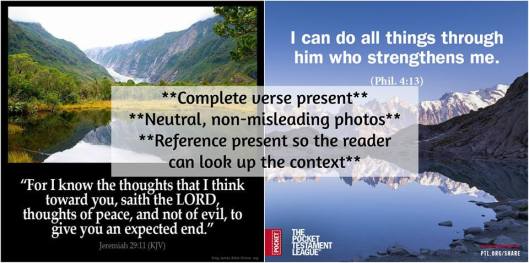
Interestingly, the only verses I seem to receive the “out of context” criticism about are Jeremiah 29:11 and Philippians 4:13. (Shouldnโ€™t we want all Bible verses to be in context?) I’m fully aware that many Christians out there, and even false teachers, use these verses out of context. The fact that many people misunderstand or twist these verses to fit their own agendas does not negate the fact that these are still Holy Spirit-breathed portions of the Bible. I refuse to surrender these verses to those who abuse them by declining to post them. Godโ€™s Word is Godโ€™s Word, and even one verse can stand on its own, qualitatively, as the Word of God. The reader is the one who has the responsibility to look up those verses and understand and use them in context.

Christian Quote Memes

Going back to the grape illustration, the thing to remember is that a meme is not meant to exhaustively cover every aspect of the thought it presents. If I post a meme that says, โ€œThe grass is green,โ€ that does not mean:

  • Only grass is green
  • Everything in the world is green
  • There arenโ€™t other things in the world that are other colors
  • I hate things that arenโ€™t green
  • Grass should never be mowed, fertilized, watered, etc.
  • Grass can’t be other colors because you could dye it or set it on fire

Also, simply stating that the grass is green does not obligate me to explain photosynthesis, suggest landscaping techniques, or debate zoysia versus Kentucky bluegrass. Thereโ€™s certainly a time and a place to go into detail about issues (which I do every day on the blog), but it is also okay to make simple, true, stand alone statements without having to comment on every intricate aspect of the topic.

People Pictured in Memes

This is something you kind of have to get a feel for through exposure to memes, but Iโ€™ll do my best to explain.

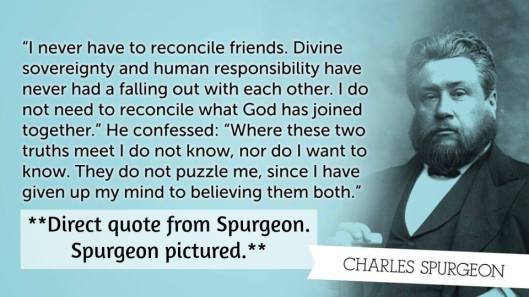
Sometimes a meme uses a picture of a person because the words on the meme are a direct quote from that person. Other times, the words on the meme poke fun at or allude to the person pictured. Still other times, the words on a meme have nothing to do with the beliefs, personality, or actions of person pictured in the meme, rather, that picture was selected because of the look on the personโ€™s face, the way he is posed, etc.

If youโ€™re confused as to whether or not the person in the picture is being quoted, you can always Google the quote to find out. If youโ€™re familiar with the person in the picture and know he would never say the words on the meme, itโ€™s fair to assume the words are either poking fun at/alluding to the person in the picture, or that the picture was chosen for the visible appearance of the person, not for his beliefs, personality, actions, etc.

I canโ€™t speak for everyone who shares memes, but the rule of thumb for my social media pages is that you will never see me positively quoting or promoting the beliefs of someone whoโ€™s well known to be a false teacher or otherwise theologically aberrant by biblical standards. So if you see a meme on my page that contains a picture of a famous false teacher, a non-Christian actor, politician, etc., it should be a given that I am not promoting his or her false beliefs. The meme is making another point, which you will need to glean from context or ask politely about.

Attribution

Except for BVMs, I create most of the memes I share. But with regard to BVMs and other memes I haven’t created, I see them – shared by a friend or a page I follow – in my social media timeline and I share them, just like you do. Most of the time I don’t share them immediately. They sit in my file for days, weeks, or even months before I get around to sharing them.

At that point, I usually can’t remember where I found them, so I can‘t type out a caption crediting the person who made it (if I even know). (If you design memes and you want credit for them, my advice is to watermark the meme with your name or website.) So, if you see me share a meme with no attribution, I’m not in any way trying to plagiarize it or claim that I made it any more than you would be if you shared a meme like that. All of the memes I create are watermarked with my website address (see collage above). If you see me share one that doesn’t have my website on it, you can safely assume I did not create it.

“I don’t get it.” and “What you should have said was…”

Often, when a theological meme is metaphorical or a brief quote, you may not initially grasp its meaning. My advice? Re-read it more carefully and keep thinking about it. Think about what the Bible says compared to what the meme says. If you’ve made a good faith effort to think things through and you still don’t get it, share the meme on your social media page and ask others what they think it means (then, be sure to listen only to your doctrinally sound, spiritually mature friends!).

Many of my memes are designed to make you use critical thinking skills and ponder the related Scriptures rather than spoon feed you something obvious. That’s why I don’t write a fourteen sentence explanation of everything I mean and don’t mean on a meme. That’s what blog posts and Bible studies and podcasts are for. Going back to our grape illustration: A meme is a grape, not a textbook on the horticulture of grapes. Use the brain God gave you and ponder the grape rather than demanding an encyclopedia article on grapes.

Sharing

I’m frequently asked by social media followers if they may have permission to share a meme (or an article, post, etc.) I’ve posted. Yes! I’m honored that you would want to. Sharing is the nature of social media. Generally speaking, you do not need to ask permission to share something that a public figure has posted publicly on social media. We like it when you share our stuff. It gets our material out to more people. And since my material is sound doctrine, the Bible, and the gospel, I want to get it out to as many people as possible. Consider this blanket permission to everyone who might ever want to share something of mine: Share away! No need to ask permission! :0)

The only thing you can’t do when sharing is to remove attributions (for example: cropping out the watermark of my web address on the memes I create) in order to intentionally present my work as your own or someone else’s. That’s called plagiarism, which is a fancy word for lying and stealing. And those are sins. But simply sharing a public post, attributions in tact, with your social media friends is not plagiarism, and you don’t need to ask permission.

If you’d like to peruse all the memes I’ve created, check out my Memes board on Pinterest.1

I hope this helps clear up any misunderstandings you may have about any of the memes I post on social media. Memes are just little nuggets that are meant to be humorous or thought provoking. Let’s let them be what they are, not expect them to be what they’re not.


1The oldest memes on that board (the ones toward the bottom) are still watermarked with my old web address (MichelleLesleyBooks.com). I’m in the process of editing them to reflect my current web address (MichelleLesley.com), and re-releasing them. I’m totally fine with you sharing a meme watermarked with the old address, but if there’s one you want to share that you need edited to the new address before you share it for whatever reason, just let me know, and I’ll fix it as fast as I can.

Guest Posts

Guest Post: Ministering to the Sick: More than a Checklist

If your theology pretty much matches up with mine (as outlined in my โ€œWelcomeโ€ and โ€œStatement of Faithโ€ tabs in the blue menu bar at the top of this page) and youโ€™d like to contribute a guest post, drop me an e-mail, and letโ€™s chat about it.

Note from Michelle: (Update: 2024) At the time Melissa wrote this article for my blog, her theology was doctrinally sound. Unfortunately, since that time, she has has adopted some unbiblical beliefs which I cannot endorse. However, because this article is practical advice, rather than biblical/theological in nature, I have chosen to leave it up on the blog. I hope it will help you as you minister to family, friends, and church members.


Ministering to the Sick: More than a Checklist
by: Melissa Morris

Someone gets sick. Someone has surgery. Someone is going through cancer treatments. Until ten years ago when I had my own life threatening/life changing illness, I was guilty (unintentionally) of treating these opportunities as a checklist to be done and not really considering the person. Make a meal, give them a call, drop them off at the doctor โ€“ I mean, what’s wrong with that? People should be thankful that we care enough to be involved, right?

As the body of Christ, we have a huge responsibility to help out when illnesses occur. In the midst of all of the chaos, there is a person who has had his or her world turned upside down by a diagnosis or a surgery. People are individuals and so are diagnoses and treatment plans. There’s not only the physical side of sickness, there are also the emotional, mental and spiritual aspects to consider. It shouldn’t be a โ€œfill in the blankโ€ approach, it should be based on the individual.

Instead of treating our ministry as โ€œone size fits allโ€, what are some things we need to consider to effectively and practically minister to someone experiencing an illness?

Cancer treatments and doctor’s appointments

It’s more than giving someone a ride.

When my mom found out she had cancer, we needed help getting her to and from the cancer center. We live 45 minutes from the hospital where she would be receiving  her treatments. She had radiation treatments five days a week for six weeks. 

We had several people volunteer to take her, and it soon became evident that not everyone fully comprehends that it’s more than a ride.

When providing cancer patients with a ride to treatments, it’s important to understand several things. They are weak, before and after the treatments. Whatever the extent of the disease they are fighting, it is wreaking havoc on their bodies. They may be experiencing pain, nausea, vomiting, bathroom issues, and more. Therefore, they may need physical assistance walking, going to the bathroom, carrying their things and staying hydrated. When you offer to give someone a ride to treatments and you are the only one with them, they are expecting some things from you. Please understand that it’s more than dropping them off at the door of the hospital, coming back to pick them up, and dropping them off at the door when you get them home, especially if you are leaving them alone.

What can you do?

  • Remember that it’s not about you. You may be tempted to take the opportunity, especially if you are making a long trip, to do some shopping or errands while you wait. While this is not entirely wrong, there are some things you need to consider.
  • Walk with them to the office where they are receiving their treatments. Make sure they don’t need a wheelchair or some sort of assistive device to get them there.ย 
  • Check with them and see if they would be more comfortable if you waited for them in the waiting room before you go off to run errands. Sometimes it makes a patient feel better if they know someone is close by. The staff there might also need you to be available if there is an emergency or the patient needs something.
  • If you do leave the patient, make sure you arrive back in a timely manner so that they don’t have to wait for you when they are done.ย 
  • When you arrive back at their home, make sure they get inside safely and have everything they need before you leave them. Help them get comfortable, get something to eat or drink, go to the bathroom, etc. It might be awhile before someone gets home to be with them.
  • Don’t plan anything else that day โ€“ there will be times when the person receiving the treatments might need extra care. For example, there were times when my mom went for radiation and she was dehydrated. This required her to go to the medication oncology lab and receive fluids before they would send her home. This could take a couple of hours.

Taking Food/Other Items

I live in the South, and I’m a Baptist. We treat any and every illness with food. There’s a special joy in preparing someone a dish and delivering it to them. There’s also the comfort you feel in receiving a meal from someone and you know that they prepared it with love. You sure don’t feel like cooking when you’re going through an illness. 

It seems like an easy thing to do, but when I experienced surgery and a colostomy, my diet completely changed. We received so many wonderful, heartfelt meals, but to my dismay, there were many things that I wasn’t allowed to eat anymore. Some people come home with a new diagnosis of diabetes. Some have food allergies. Cancer patients might be experiencing nausea and vomiting/diarrhea. So, what can we do to make our meal ministry more effective?

  • I know we like the element of surprise, but to make it easier on everyone, it would be best to call and ask if the person has any dietary restrictions. It doesn’t do much good to take someone a meal they can’t eat, no matter how good it might taste.
  • If they can’t have certain things, consider taking prepackaged food items that they can easily put together themselves, but still ask for preferences and restrictions. Some examples:

    Crackers

    Canned meat/soups/fruits/vegetables (I know that fresh fruits and vegetables are ideal, however, when someone is recovering from an illness, they may not feel like eating a lot at one time. The fresh food might spoil before they can eat it.ย  Prepackaged and canned allows for the person to use the food when it benefits them).

    Sandwich meats and bread

    If you live in an area that provides meal delivery from restaurants, offer to pay for their orders for a specified amount of time.

    Offer to grocery shop for them and help put items away when you deliver the groceries.

    Offer to prepare and refrigerate simple items that can be microwaved or warmed up easily.

There are other items that might be needed that we might not think about. 

  • Cleaning supplies.
  • Toilet paper, napkins, paper towels.
  • Hygiene items (deodorant, soap, feminine products, etc.)
  • Medications (over the counter and prescription)

They also might need you to run errands for them, to the post office or to pick up prescriptions. Whatever the need may be, communicate with the person so that your efforts can be beneficial to them.

Visits

I love to talk. In fact, after I had major surgery, the nurses told my mom that I would sleep all night from the anesthesia. I woke up at midnight and talked all night long!

But as much as I love to talk, when I was recovering, I wanted to rest. I had been in the hospital for ten days, not knowing if I was going to make it back home or not. I was discharged home with IV antibiotics around the clock for seven more days. I had nurses coming in daily for wound care and colostomy training. I didn’t get much sleep in the hospital, and, for a while, I wasn’t getting much sleep at home.

Before visiting, call the person and see what a good time might be to show up. As I was talking with Michelle about this article, we discussed that the old theory is to โ€œjust show upโ€. I had people show up to see me that I would have enjoyed visiting with, but I was either sleeping or having a visit from the nurse. If the person recovering has a caregiver, that caregiver might be taking an opportunity to rest while the patient is resting. 

What do I say? (or NOT say)

Some people said some crazy things to me and to my mom while we were dealing with recovery/cancer treatments.

  • My mom had a pastor who she thought a lot of visit her the day after she found out her initial diagnosis but before we found out the extent of the disease process. He seemed in a bad mood when he got there, preoccupied and distracted. My mom shared with him that she wasn’t afraid, that she had lived 67 years (at the time) and if the diagnosis was not good, she’d had a wonderful life and she was ready to meet Jesus. He looked up at her and rudely said, โ€œWell, you might only have 67 more days, have you ever thought about that?โ€
  • A friend of my mom’s from church came to see her and pray with her. As they talked, this โ€œfriendโ€ said, โ€œWell, Pat, you know you have this cancer because you have sin in your life.”.
  • I woke up extremely depressed one day, so I actually reached out to someone I thought was a close friend via text and said I needed someone to talk to. Five days later, I got a text back that said, โ€œHope you found someone to talk to.โ€.

Don’t be that person โ€“ if you’re in a bad mood, visit another day, and as I was taught, if you can’t say something nice (or encouraging), don’t say anything at all. When I worked in healthcare, we were taught to leave our personal lives outside the door when we came to work, because they would be there for us to pick up when we went home. 

What else?

I never realized until I became disabled how many things there are around the house that need to be done.

  • Cleaning
  • Laundry
  • Yard work/mowing
  • Errands
  • Taking care of the kids

There might be adaptations that need to be made to the home, or adaptive equipment put in place (grab bars, a handicap toilet, etc.)

The person might need help with bathing and dressing for a while, and this might not be something insurance covers. I needed daily wound care and my insurance only covered three days a week. I was blessed to have nurses in my life that covered the other four days. If you are a nurse or a C.N.A., you could offer your time and services. Even if you’re not, you can be trained in some instances to help with certain medical issues.

One of the biggest issues many deal with is the financial strain not working can put on a person. If the illness ends up being a permanent disability, it can take years (it took 3ยฝ for me) to receive benefits through Social Security. I would hate to think where I would have been had the Lord not given me a wonderful mother and a few anonymous donors to make it through. Even with those things, I had to sell my car, and some of my instruments and sound equipment just to get medication and colostomy supplies. People may also need help filling out applications for assistance, disability, or in-home services. 

Some of the things from our previous lists can carry over if the illness becomes a permanent disability.

Whatever the situation, keep this one thing in mind: be available. If you can’t meet the need of the person, help seek out someone who can.

It is my prayer that this will assist you in more effectively serving those in your community.  And remember, somebody can’t do everything, but everybody can do something.


Melissa is a retired long term care/hospice social worker/bereavement counselor. Compelled to give up her career due to illness, she now spends her time raising her two cousins, singing and writing songs, and traveling to different churches and organizations sharing music and laughter.

Mailbag

The Mailbag: Should I Sue?

Originally published March 23, 2020

I know the Bible tells us not to sue someone, but are there situations where this may be OK?

I have a long term illness caused by bad medical advice given to me by several doctors. I know there are many many others who suffer like I do from the same thing for the same reasons. Because of my illness I have lost my job, friends, and the ability to do things I used to do and enjoy.

While I have never been one to sue someone or take legal action I am considering it in this situation. I am not doing it for the money, but so that awareness can be brought about so maybe others will not go through what I am going through.

I know if I go forward it will be a difficult journey for me and may cause some disruption with the doctors who treated me. I have been praying about it and am going to look into Christian counseling as well, but I have learned a lot from following you and would like to hear what you have to say as well.

Great question. First let’s look at exactly what Scripture says about this:

When one of you has a grievance against another, does he dare go to law before the unrighteous instead of the saints? Or do you not know that the saints will judge the world? And if the world is to be judged by you, are you incompetent to try trivial cases? Do you not know that we are to judge angels? How much more, then, matters pertaining to this life! So if you have such cases, why do you lay them before those who have no standing in the church? I say this to your shame. Can it be that there is no one among you wise enough to settle a dispute between the brothers, but brother goes to law against brother, and that before unbelievers? To have lawsuits at all with one another is already a defeat for you. Why not rather suffer wrong? Why not rather be defrauded? But you yourselves wrong and defraudโ€”even your own brothers! 1 Corinthians 6:1-8

So, the Bible doesn’t make a blanket statement “not to sue,” but not to sue certain people for a particular reason. The idea Paul is trying to convey here is that Christians, of all people, ought to be able to work out their differences among themselves. We’re the people who have God-given wisdom for such things, not lost people. So, when Christians drag each other into a worldly court over something that they ought to be able to work out in godly love, humility, and repentance (or at least ought to be able to have mediated by a pastor or elders), it tarnishes the name of Christ and makes the church look foolish. It’s better to just absorb the loss than to do that. So what this passage is teaching us is that it is a poor witness to the world for Christians to sue one another rather than to work things out together.

Now, I realize this isn’t your particular situation, but I’m going to throw it out there for everybody else who’s reading. The passage above does not say this, but I think the Bible would also support the idea that, in most cases of personal grievance, Christians probably shouldn’t sue lost people either. Your neighbor accidentally planted her garden six inches over your property line? You babysat for a couple down the block and they never paid you the agreed upon amount? You had been planning a special anniversary dinner for you and your husband for weeks and the restaurant messed everything up? Try to imagine what these people might think of Christians or Christianity or your church if you sued them, and, conversely, how counter-culturally surprising it might be to them if you didn’t sue them. Would a lawsuit open or close a door for you to share the gospel with these folks? Would you be carrying out Jesus’ command to turn the other cheek, to overcome evil with good, and to repay no one evil for evil, but to bless and do what is honorable? When we make decisions like this, we need to be sure we’re putting Scripture, the name and renown of Christ and His church, and the spiritual good of the other person ahead of ourselves and any benefit we might gain. God is our provider, not the tort system. And, of course, it should go without saying that Christians should never sue others on the basis of dishonesty (ex: faking injuries after a car accident) or in an effort to greedily “get rich quick”.

However, the way our legal system and our laws work in the United States, there are, unfortunately, some instances in which a lawsuit is the legally sanctioned proper channel to go through in order to secure services or for two entities to iron out the details of a fair settlement between them, and this process carries no more ethical implications than, say, filling out a request for services form. This is often the case between insurance companies in the event of a car accident, for example. This can sometimes be the case with a business or entity that is obligated to provide you with a particular service or remuneration. It very much depends on the situation, the laws of your state, the company’s policies, etc. In a case like this, I would recommend setting up an appointment with your pastor for counseling on the biblical aspects of the situation, and consulting with a reputable (preferably Christian) attorney for legal advice.

In your case, it sounds like your goal is to prevent innocent people from suffering at the hands of negligent doctors, and a lawsuit can be one way to do that. I cannot give you a definitive yes or no as to whether or not a lawsuit would be the biblical thing to do in your case, but here are some things I would encourage you to do and consider as you prayerfully make your decision:

โ€ขPray through and consider the Scriptures I’ve linked to above as well as others that will help you examine your heart to be sure your motives moving ahead are godly, not retributive.

โ€ขIf you’re married, be sure you’re submitting to your husband regarding any action you might take.

โ€ขAssuming you’re a member of a biblical, doctrinally sound church, make an appointment with your pastor (preferably, or, barring that, a Biblical Counselor, which is different from a “Christian counselor”) for counsel on all of the biblical ramifications of filing a lawsuit and any other actions you might be considering taking. Counseling is part of his job, he can take the time to walk through all of the details with you, and it is he whom God has placed in the position of shepherding your soul.

โ€ขContact a reputable, preferably Christian, attorney (your pastor may be able to recommend one) who can explain all of the processes involved in filing a lawsuit, and might also be able to give you some more effective alternatives. Discuss all of this with your pastor and get his counsel on it.

โ€ขIs there another way to accomplish your goal of protecting and helping other victims and potential victims? What about a local ministry to others with the same illness? What if you wrote a book about your experiences? Perhaps an online ministry and information clearinghouse – a blog, website, Facebook group, etc. – that could reach even more people than a lawsuit could? Brainstorm some ideas with your pastor, husband, or close friends.

If there is any way to avoid a lawsuit while still protecting others, I would recommend exploring that possibility.

Additional Resources:

What does the Bible say about lawsuits / suing? at Got Questions?

Forbidden Lawsuits by John MacArthur

Alliance Defending Freedom


If you have a question about: a Bible passage, an aspect of theology, a current issue in Christianity, or how to biblically handle a family, life, or church situation, comment below (Iโ€™ll hold all questions in queue {unpublished} for a future edition of The Mailbag) or send me an e-mail or private message. If your question is chosen for publication, your anonymity will be protected.

Complementarianism, Rock Your Role

Throwback Thursday ~ Rock Your Role: All Things Being Equal (Galatians 3:28)

Originally published August 21, 2015

Being a church lady can be really confusing at times, am I right? There are so many questions and Scriptures to sort through and figure out. We want to serve the body of Christ in a godly way, but sometimes it’s hard to know how to go about that.

Rock Your Role is a new series I’m starting today that will examine all of the “go to” Scriptures that help us understand our role as women in the church. Some of these passages are – let’s just be honest – tough. Tough to understand. Tough to accept.

As we tackle tough passages like these, it’s important to ask ourselves a few equally tough questions, search our hearts, and answer honestly. Before reading each article in the Rock Your Role series, I’d like to ask you to prayerfully consider these questions:

1. Do I really believe God’s rightly handled, in context, written Word has the final say when it comes to what I (and the church) should believe and do?

2. If so, am I truly willing to “put my money where my mouth is” and back up that belief with action and obedience, even if I don’t initially like or fully understand a certain biblical concept or command?

3. Is this passage a tough one for me because it challenges my preconceived notions and opinions? Am I willing to put my ideas aside and hear what God’s Word has to say so I can obey it?

Ready to dive in? Let’s get started with…

There is neither Jew nor Greek, there is neither slave nor free, there is no male and female, for you are all one in Christ Jesus.
Galatians 3:28

For those of you who have been around the blog for a while, you might be surprised that I’m kicking things off with this verse. I’m about as complementarian as they come, and Galatians 3:28 is the rallying cry for egalitarians. But this verse is foundational to our understanding of the role of women in the church because it tells us who we are in Christ.

Before we zero in on verse 28, though, let’s zoom out and look at the book of Galatians as a whole. Galatians was written by Paul to the churches at Galatia to combat the false doctrine of the Judaizers- those who taught that the Gentiles must first become Jews (be circumcised and follow the Mosaic law) before they could become Christians. The Galatians were being seduced by this teaching, allowing it into their churches, and many were being drawn away from the truth of the gospel. Paul wrote to straighten them out and remind them – and us – that we are justified (saved and made right with God) through repentance and faith in Christ, not by keeping the law.

Galatians 3 is a perfect showcase for Paul’s theme of justification by faith. Take a moment and read the whole chapter now.

Paul reminds the Galatians that they were saved by faith, not works of the law, just like Abraham was. Paul explains that the law came with a curse attached for those who disobeyed it, but that Christ redeemed us from that curse. In fact, the whole purpose of the law was to teach us we can’t keep it and push us to faith in Christ as our only hope for salvation.

Wait a second. What’s all this talk about the law and faith and salvation and stuff? Isn’t this passage about women being equal to men and that they can serve in any capacity or office in the church that men can?

Wait a second. What’s all this talk about the law and faith and salvation and stuff? Isn’t this passage about women being equal to men and that they can serve in any capacity or office in the church that men can? Umโ€ฆno. No, it’s not.

Um…no. No, it’s not. And that’s where the wheels fall off of the egalitarian argument. The entirety of Galatians chapter three is about salvation by faith instead of works. It says nothing about women serving in the same roles in the church as men. Nada. Zip. Zero.

It tells us something better. Something far more precious to the women of that time – and to us – than we realize. Let’s look at verse 28 in its immediate context:

But now that faith has come, we are no longer under a guardian, 26 for in Christ Jesus you are all sons of God, through faith. 27 For as many of you as were baptized into Christ have put on Christ. 28 There is neither Jew nor Greek, there is neither slave nor free, there is no male and female, for you are all one in Christ Jesus. 29 And if you are Christ’s, then you are Abraham’s offspring, heirs according to promise.

Do you see that? We’re no longer under the guardianship of the law. Anyone can come to Christ in repentance and faith- Jew or Gentile, slave or free, male or female, all are welcome. The ground is level at the foot of the cross. No one is more important than anybody else. We are all equally saved, equally loved, equally forgiven of our sin, equally precious in God’s eyes. In a time when women were considered less important, less valuable, less intelligent, less everything than men, this would have been joyous news, indeed. It should be to us, as well.

But equality in salvation does not translate to equality in church roles. A king and a pauper might have worshiped side by side in the Galatian church, but when it came to the role of giving, the church would not have expected the same offering from the pauper as from the king. This didn’t make the king more important than the pauper, it just gave him a different area of responsibility because of who he was. Likewise, men and women are equally saved and forgiven in God’s eyes, but still fulfill different roles in the body of Christ because of who they are.

Equality in salvation does not translate to equality in church roles.

Let me illustrate this another way. My husband and I have 6 children. Each and every one of us are all equally Lesleys even though I married into the family and the rest of them were born into the family. No family member is more loved or important than another. However, we all have different roles, which come with different blessings and responsibilities. My 12 year old might not be able to drive the car, but he doesn’t have to work eight hours a day and pay bills, either. I no longer have to do homework (thank you, Lord!), but I do have to do housework. Our family would not operate in a healthy way if I tried to take on my son’s role or my husband tried to take on my role.

It’s the same way in the church. God loves, forgives, and saves each one of us equally. But he also loves us each individually. And it’s because of that individual love that He gives each of us unique roles to fill in the church so that it will operate in a healthy way. As we’ll see throughout this series, the role of women in the church is precious and vital to the well being of the body of Christ. So is the role of men. They are both equally important, yet God has specially gifted women to fulfill the roles He has designed for us just as He has specially gifted men to fulfill the roles He has designed for them.

Ladies, you have a Savior who loves and values you as a woman, and your role in the church is no less important than any man’s just because it’s different from his role. There are no second class citizens in God’s kingdom.

Ladies, you have a Savior who loves and values you as a *woman,* and your role in the church is no less important than any man’s just because it’s different from his role.

Titus Bible Study

Titus: God’s Order of Service ~ Lesson 1- Introduction

Welcome to our new study, Titus: God’s Order of Service!

What does God think about the way His church should operate? What are the qualifications and character traits of godly pastors, elders, and church members? What is your role in the Body, and why is it so crucial? God is a God of order, and He wants the church to operate in an orderly way โ€“ to glorify Him โ€“ as we worship, work, and witness.

Titus is the New Testament’s third and final pastoral epistle. The pastoral epistles are Godโ€™s instructions to pastors about the way His church should run (kind of like the weekly “order of service,” or bulletin at your church describes how that week’s worship service will run). But pastors arenโ€™t solely responsible for the smooth sailing of the church. We all contribute to glorifying God by learning and robustly filling out our roles in the church in a godly and orderly way. Over the course of approximately 5-8 lessons, weโ€™ll learn how to do that from the book of Titus.

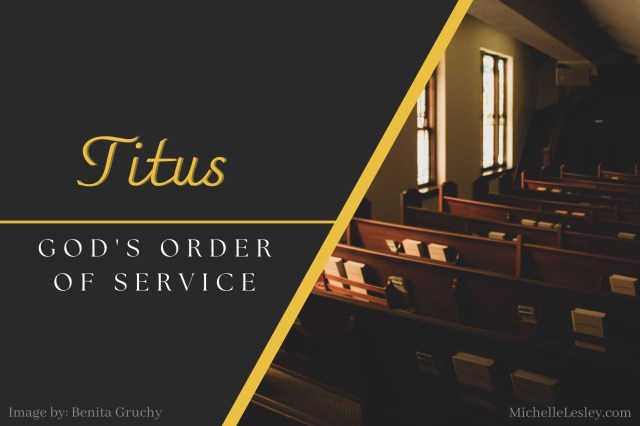
The attractive title image for our study was designed by Benita Gruchy. I liked Benita’s use of the photo of the church sanctuary because the book of Titus is about the gathered body of the church. The word “service” in the title of the study is meant both in the sense of “worship service” – our corporate worship of God – and our “serving” the church body. When I imagine brothers and sisters in Christ assembled together in the pews in that photo, that’s what I think of: worship and service. Finally, the main theme of Titus is “setting things in order” (1:5) in the church, and I thought the rows of pews, with hymnals neatly in their racks, as well as the sleek design and the lines and sections on the left side of the image evoked that sense of orderliness quite nicely. Great job, Benita!

Many thanks to all of those who worked so hard on your entries for our title pic contest. You ladies were very creative and did some outstanding work! 

There were too many entries to share all of them with you, but here are a few “honorable mentions”:

Teressa Campbell
Emily Smith
Melany Goblirsch

If you’re new to using my Bible studies, just a few housekeeping items and helpful hints:

The studies Iโ€™ve written (you can find all of them at the Bible Studies tab in the blue menu bar at the top of this page) are like โ€œtraining wheelsโ€. Theyโ€™re designed to teach you how to study the Bible for yourself and what kinds of questions to ask of the text so that, when you get the hang of it, you wonโ€™t have to depend on other peopleโ€™s books and materials โ€“ even mine โ€“ any more. To that end, I do not provide answers for the study questions in the studies Iโ€™ve written.

My studies are meant to be extremely flexible and self-paced so that you can use them in the way that works best for you. You can do an entire lesson in one day or work on the questions over the course of the week (or longer). You do not need to feel obligated to answer all (or any) of the questions. If the Holy Spirit parks you on one question for several days, enjoy digging deep into that one aspect of the lesson. If He shows you something I haven’t written a question about that captures your attention, dive in and study it! Those are ways the Holy Spirit speaks to us through His Word. This is your time to commune with the Lord, not a school assignment or work project you are beholden to complete in a certain way by a certain deadline.

I will post a new lesson on the blog every other Wednesday, so there is nothing to sign up for or commit to. Simply stop by the blog every other week, or subscribe to the blog via e-mail to have the lessons delivered to your inbox.

I use hyperlinks liberallyThe Scripture passage for each lesson will be linked at the beginning of the lesson. As you’re reading the lesson, whenever you see a word in a different color text, click on it, and it will take you to a Scripture, article, or other resource that will help as you study.

All of the studies Iโ€™ve written are suitable for groups or individuals. You are welcome to use them as a Sunday school or Bible study class curriculum (for free) with proper attribution.

You are also welcome to print out any of my Bible studies (or any article Iโ€™ve written) for free and make as many copies as youโ€™d like, again, with proper attribution. Iโ€™ve explained more about that in this article (3rd section).

From time to time I receive inquiries from men about using my studies for their personal quiet time or for teaching a co-ed or men’s Bible study class. It is my personal conviction that it is more in keeping with the spirit (though not the letter) of 1 Timothy 2:12, Titus 2:3-5, and related passages for men to use Bible study materials authored by men rather than by women. Therefore, on the honor system, I would request that men please not use my studies for personal use, or when teaching a class with male members. (Vetting the studies for your wife, daughter, or the women of your church, is, of course, fine. Encouraged, actually.)


Introduction to Titus: God’s Order of Service

Before we begin studying a book of the Bible, itโ€™s very important that we understand some things about that book. We need to knowโ€ฆ

Who the author was and anything we might be able to find out about him or his background.

Who the audience of the book is: Jews or Gentiles? Old Testament Israelites or New Testament Christians? This will help us understand the authorโ€™s purpose and approach to what heโ€™s writing.

What kind of biblical literature weโ€™re looking at. We approach books of history differently than books of wisdom, books of wisdom differently than books of prophecy, etc.

What the purpose of the book is. Was it written to encourage? Rebuke? Warn?

What the historical backdrop is for the book. Is Israel at war? At peace? In exile? Under a bad king? Good king? Understanding the historical events surrounding a piece of writing helps us understand what was written and why it was written.

When the book was written. Where does the book fall on the timeline of biblical history? This is especially important for Old Testament books which are not always arranged in chronological order.

So this week, before we start studying the actual text of the book of Titus, we need to lay the foundation to understanding the book by finding the answers to these questions.

Read the following overviews of the book of Titus, taking notes on anything that might aid your understanding of the book, and answer the questions below:

Bible Introductions: Titus at Grace to You

Overview of the Book of Titus at Reformed Answers

Summary of the Book of Titus at Got Questions

1. Who wrote the book of Titus? How do we know (or why do we not know) this?

2. Approximately when was Titus written? What is the geographical setting of the book of Titus? Here are some maps (scroll down to โ€œTitusโ€) that may be helpful as you study through the book of Titus.

3. Who is the original, intended audience of the book of Titus? Describe the historical setting (historic events, politics, sociology of the time, etc.) of Titus.

4. Which genre of biblical literature is the book of Titus: law, history, wisdom, poetry, narrative, epistles, or prophecy/apocalyptic? What does this tell us about the approach we should take when studying from this book versus our approach to books of other genres?

5. What is the theme or purpose of the book of Titus?

6. What are some of the major topics of instruction or exhortation in the book of Titus? How do these topics relate to the theme of Titus?

7. What are some ways Titus points to and connects to Jesus?

8. What else did you learn about the setting of this book that might help you understand the text of the book better?

Take some time in prayer this week to begin preparing your heart for this study. Ask God to give you wisdom both to understand the text, and to apply what you learn from Titus as a member of your own church, as we study Titus together.

Our next lesson will be two weeks from today.