
Faith, Old Testament, Parenting, Prayer, Sunday School, Trust

Meet the Parents (of Samson) ~ Sunday School Lesson ~ 4-6-14

sunday school

These are my notes from my ladies’ Sunday School class this morning. I’ll be posting the notes from my class here each week. Click here for last week’s lesson.

Through the Bible in 2014 ~ Week 14 ~ Mar. 30-Apr. 6
Judges 1-18
Meet the Parents (of Samson)

In this week’s reading, we said goodbye to Joshua and met up with a variety of Israel’s lesser known judges. We also read about three better known characters in Israel’s history, judges Deborah, Gideon, and Samson. Often, when we come to passages like this, it’s like a treasure hunt. We focus on the valuables that are in plain sight. But, if we dig just a little, we can find more gems just beneath the surface. Today, we’re taking a look at two godly people who had a profound impact on Samson’s life: his parents.

Judges 13-14

Mr. and Mrs. Manoah
It’s always interesting to me that, just as we saw last week with the two spies, some of the most faithful of God’s servants are ordinary people like you and me serving God as they go about their daily tasks. And, just as with the two spies, in many cases, we never find out their names.  Samson’s mother was just this kind of nameless, faithful servant. Though we know little about her husband, Manoah, the most important thing about him—his faith—comes through loud and clear.

Barrenness (13:2-3)
Mrs. Manoah was barren. Have you ever noticed how many “big names” in the Bible had mothers who were previously barren or who conceived miraculously? Joseph (Rachel), Samuel (Hannah), John the Baptist (Elizabeth), even Jesus (Mary), just to name a few. Things are different today, but, in manoah-wife-angel-offering the Bible, a miraculous conception was often a sign that the child would grow up to be a mighty man of God.

Barrenness was usually seen by others in the community as a curse by God or a punishment for sin (and sometimes it was: 2 Samuel 6:23). During that time in history, the only way for women to achieve status and be considered successful was by marrying and having children- particularly sons. A woman’s entire self-worth—in her own eyes, her husband’s eyes, and the eyes of her community—was at stake. So it’s easy to see why women and their husbands would have spent a great deal of time crying out to the Lord in prayer and seeking to be obedient to Him in hopes that He would grant their request for a child. We see this most clearly in the case of Hannah (1 Samuel 1), and it’s reasonable to surmise that this was likely also the case for Manoah and his wife.

Belief, Not Doubt (13:3-8)
It’s interesting that both times the angel of the Lord appeared to deliver His message, He initially appeared, not to the man, Manoah, but to the woman, his wife. Was it because she was praying at the time, or because her faith was stronger than her husband’s? This passage doesn’t tell us, so we don’t know. But, notice Mrs. Manoah’s reaction to the news that she would conceive. Did she laugh in disbelief like Sarah and Abraham did (Genesis 17:17,18:12)? Did she doubt like Zechariah (father of John the Baptist: Luke 1:18)? No, Mrs. Manoah believed. And, as a godly wife should, the first person she shared the news with and sought direction from was her husband.

Now let’s consider the reaction of Manoah to his wife’s news. Did he think her desire for a child had sent her over the edge or that she was making this up? No. He believed her without question. What does this tell us about the character, faith, and influence on her husband of Mrs. Manoah? “The heart of her husband trusted in her” (Proverbs 31:11) because she was a godly, trustworthy woman.

A Household of Faith (13)
In addition to spending time praying for a child, Mr. and Mrs. Manoah probably prayed regularly, like many other faithful Israelites, for deliverance from the Philistine oppressors, and here, we find them in prayer again.

Manoah not only trusted his wife, he had faith that the Lord would fulfill His promise. His first reaction was to believe and ask God the best way to obey Him. “And God listened to the voice of Manoah…” and answered his prayer of faith. He came back—to Manoah’s wife. Again, Manoah believed her without question and followed her out to meet the angel of the Lord.

When they met up with the angel, we see further evidence of this couple’s godliness. Though the angel had appeared and spoken twice with Mrs. Manoah, she, as a godly wife, does not take control of the situation or assert superiority over her husband. She takes a step back and, as a godly husband and leader of his home, Manoah steps up to the plate to assume the responsibility for his family and receive God’s instructions.

Manoah’s conversation with the Lord is fraught with faith. He doesn’t ask how or why they’re suddenly being blessed with a miracle child even though they’re just ordinary people. He simply accepts that it will happen. Manoah is confident that God is telling the truth and will keep His promise when he says, “When [not if] your words come true…” (12, 17). He believes God’s word that Samson will “begin to save Israel from the hand of the Philistines,” (5) when he asks about “the child’s manner of life, and…his mission” (12) so that he and Mrs. Manoah could prepare him to do so. He trusted in the www-St-Takla-org--12-Angel-Visits-Manoah-and-His-Wifecharacter of God, “the one who works wonders,” (19) and worshiped Him as such. He and Mrs. Manoah feared and trusted in God’s holiness as they fell on their faces at His departure (20).
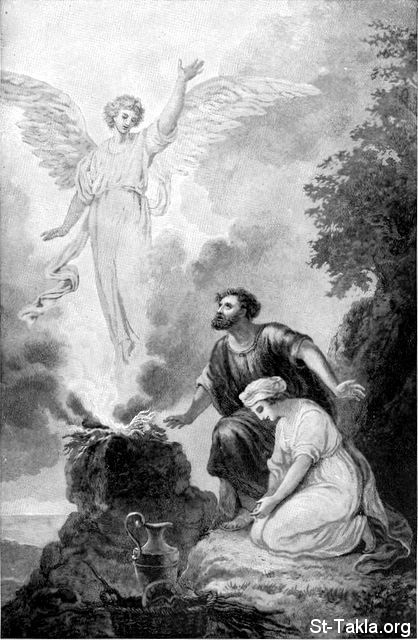
Without a total grasp of the situation (22), Manoah believed God’s word that, “no man can see Me and live” (Exodus 33:20). Only later (21) did Manoah understand that He had been speaking with the angel of the Lord (Jesus – theophany: an appearance of the pre-incarnate Christ – {“My name…is wonderful” (18)- see Isaiah 9:6}—this is how people could “see God and live” even though God had said, “you cannot see Me and live.” They could not live through seeing God the Father, but they could live through seeing God the Son. Also a piece of supporting evidence for the Trinity). Jesus, the true deliverer and judge came personally to announce the birth of this temporal deliverer and judge who would point ahead to Christ.

Finally, we come full circle to Mrs. Manoah’s quiet trust in the Lord. Even with a strong faith like Manoah had, there can be moments of confusion. How could God say to Moses –the greatest leader Israel had ever known, the friend of God!—“you cannot see My face, for man shall not see me and live,”—yet here he and his wife were, having seen Him, but somehow still unscathed? How could anyone understand this?

But Mrs. Manoah shows us that faith means trusting God’s word even when we don’t fully understand His actions. Yes, it was true that God had said that people couldn’t live through seeing Him, but it was also true that He had visited them and told them they were going to have a son who would be a deliverer for Israel. How could both of those things be true at the same time? She probably couldn’t understand it either, but she encouraged her husband to trust God even in their confusion (23). And God kept His promise (24-25)

Trusting Despite the Circumstances (14:1-10)
Kids grow up, and as broken, sinful human beings, they sometimes make foolish decisions despite being raised in a godly home. That’s what Samson seems to have done here. While the Philistines were not one of the seven nations the Israelites were specifically forbidden to intermarry with, the principle behind God’s forbidding of intermarriage with those other nations was the same for the Philistines: they were idolaters and enemies of God and His people.

As godly parents, Mr. and Mrs. Manoah tried to steer their adult son to a godly choice of a wife. They reminded him that he was one of God’s people, and surely wanted him, as a leader in Israel, to set a good example for the people. Once again, they were seeking to be faithful to God.

thInstead of honoring his parents, Samson chose poorly. Or so it seemed. Either Samson was operating solely on lust and God sovereignly used the situation to His own advantage, or Samson, moved by God, was intentionally trying to infiltrate the Philistines by marrying in. The passage doesn’t make this precisely clear to us.

And, it wasn’t clear to Samson’s parents, either. So, perhaps thinking that they could influence the girl’s family or hoping Samson would change his mind, they went along with his decision and accompanied him to meet the new in laws. Once again, though the circumstances were worrisome and hard to understand, Mr. and Mrs. Manoah trusted that the God who had already worked so many wonders in their lives could handle this situation. They had faithfully obeyed what God had asked them to do and raised Samson in a godly home. Now, they had to sit back and watch God take care of the rest. And He did. Again, God kept His promises.

And we know that for those who love God all things work together for good,
 for those who are called according to his purpose. Romans 8:28

Church, Ministry, Parenting

Anonymous Parent’s Letter to a Youth Pastor

Trevin Wax is one of my favorite bloggers. Today he wrote an absolutely awesome piece called Anonymous Youth Pastor’s Letter to a Parent. It talked about some of the struggles youth pastors go through and how we as parents of youth can support our kids’ youth pastors better. I commented that the next article should come from the parent’s perspective, and that, being a parent of youth, boy, could I write that article. One of Trevin’s readers suggested I go ahead and write it, and I thought it sounded like a fun and challenging project, so here’s the result.  (The first three paragraphs are an homage to Trevin’s letter.)

CAVEAT: This is addressed to an amalgam or “everyman” youth pastor, not to any of my kids’ youth pastors/workers past or present. In fact, some of the things I mention in the letter are things my kids’ youth pastors got RIGHT that I really appreciated.

Dear Youth Pastor,

I need to get something off my chest.

When I first put my child into your youth group, you told me how excited you were to be showing my kids what it means to love Jesus, be part of His Church, and grow as a Christian. You told me you were praying for my child and that you had his back. You had high hopes for the youth ministry.

I had high hopes too. But I must confess that I am frustrated right now because I feel like you’re working against me, not with me.

My husband and I are Christian parents doing our best to pour the gospel into our children every day.  We understand that we are the ones responsible to God for the spiritual upbringing of our children, and we take that responsibility seriously. Very seriously. And that includes what he is exposed to in youth group.

“Let no one look down on your youth” notwithstanding (update: please see my remarks regarding this reference in the comments section below), you’re 25. You know nothing about parenting a teenager. I repeat: nothing. No, the fact that you and your wife have an infant or a three year old does not qualify you as a veteran parent. I have a couple of decades of life experience and parenting on you. I remember being 25. It was that glorious time of my life when I knew everything and had fresh ideas that people in their 40s just wouldn’t understand because they had passed the “cool” stage of life.

Look deep into my eyes, Bub. I am your future.

Listen to me when I explain to you that my kids don’t need another peer. They need mature, godly leadership. Not a buddy. Not an idol to be emulated with the latest clothes from Abercrombie, the hippest glasses frames, edgy tattoos and piercings, and enough product in your hair to put bouffanted church ladies to shame.

You are not a rock star.

You’re a teacher. You’re a caretaker of young souls, and you’re influencing them for eternity. One way or the other. And one day, you’ll stand in front of God and answer for the way you led my, and other parents’, children. Makes your knees knock a little, doesn’t it? Good. It should.

So, when I drop my child off at your youth Bible study or Sunday School class, here’s what I expect. When you say you want to “show my kids what it means to love Jesus, be part of His Church, and grow as a Christian,” I expect that to mean that you will teach them the Bible. Not some watered down, comic book, MTV, “What does this verse mean to you?” version of a Bible story, but the whole counsel of God. I want you to put more time and effort into prayer and studying God’s word so you can teach it properly than you put into hooking up the oh-so-fabulous light show and making inane videos that appeal only to the basest nature of eighth grade boys.

Do you know what these kids are learning in school? If they can be expected to learn Shakespeare and higher math, you can expect them to learn sound biblical doctrine.

When you’re choosing a Bible study curriculum or DVD, or you’re looking at a Christian camp or concert to take the kids to, do your homework. Just because somebody claims to be a Christian author, speaker, pastor, or worship leader doesn’t make it true. Where is this person, doctrinally? What’s his church background and training? Listen to his sermons. Examine the lyrics of her songs. Read some of his books. Does this person rightly divide the Word of truth? Does he exalt Christ and revere God’s word? Does he call sinners- my child and the other children in your youth group- to repentance and faith in Christ, or are his sermons an exercise in navel gazing and nagging about how to be a better person?

Lead my children to serve the church. And I’m not talking about getting paid to do it, either. They’re old enough to help clean up after Wednesday night supper, help in the nursery, assist with a children’s class, serve at a senior citizens’ banquet, work at a church work day, help set up chairs and tables, etc. Over the last few years, the youth group has become the entitlement community of the church, always asking for handouts and rarely giving anything back. Let’s teach them to serve. Because the youth that serve today will be the adults that serve tomorrow.

Teach my children that a mission trip is not a glorified vacation, and that missions isn’t just feeding the hungry or building houses for the homeless. Missions is proclaiming the gospel before and after and while they’re doing those things. Teach my children how to share the gospel properly and encourage them to do it often.

Lead by example:

1. Plan ahead and be organized. If you know you’re going to need to do six fundraisers for youth camp, start them in September and space them out over a few months. Don’t wait until mid-April and have one every weekend. Show up on time. Secure your parent chaperones and drivers well in advance. Follow through on what you say you’re going to do.

2. Obey those in authority over you. Whether that means following the pastor’s instructions or obeying the speed limit and not putting 20 people in a 15 passenger van, when you flout the rules, you’re tacitly teaching my kids to do the same.

3. Be a man, not an overgrown adolescent. Boys, especially, need to see strong examples of what it means to be a godly man, and these are becoming rarer and rarer in the church. They already know how to be adolescents. Show them how to be men.

4. Prioritize safety and chaperonage. Do you know how many horror stories I’ve heard about children dying in church van wrecks on the way back from youth camp, and youth sneaking off and having sex during a lock in? I don’t want that to be my kid. I love him far more than you could ever think about loving him. Don’t be lax about keeping him safe and monitoring his whereabouts and behavior.

And, finally, my dear youth pastor, know that I love you and want to come alongside you and help in any way I can. You see, my husband used to be a youth pastor, so I know it’s a tough and often thankless job. I’m praying for you as you seek to disciple that band of crazed teenagers in the youth room.

Go with God, dear youth pastor. Go with God.

Church, Parenting, Women

Yes Sir! That’s My Baby!

*Ladies, I’m about to address one of the most volatile, polarizing issues in the church today. Everybody, it seems, has an opinion – a strong opinion—on this one. It has torn message boards apart, led to the giving and receiving of the evil eye across the pew, and caused rampant unfriending on Facebook. Dare I mention this topic that ignites such a flame within our collective bosom?

Well, after that build up, I guess I’d better.

Lemme brace myself.

And batten down the hatches.

And find something to take cover behind.

Um…it’s your baby.

funny_babies_faces_49

Well, maybe not yours in particular, but somebody’s. Somebody’s baby or small child is making a ruckus in church, and it’s distracting everybody within earshot, including the pastor, who is making a valiant attempt to continue his train of thought even though he’s not sure of his own name at the moment.

There. I said it, and I lived to tell the tale.  Whew.

Cute-Black-Babies_large

Now before you fire off an angry e-mail, let me backtrack for just a sec.  Titus 2:3-5 says that “older women” are to “teach what is good and so train the young women.” So, as much as it pains me at the age of almost 44, I’m going to put on my “older woman” hat for just a minute, because I think there’s a teaching moment here for all of us. Yes, all of us, whether your best church dress (or capris) is freshly stained with strained peas or you’ve graduated to dry clean only.

images

If you’re a young mother, I’ve been where you are. I have six wonderful children in my family ranging in age from 25 all the way down to 9, and they have all been in church from day one. My husband has been a minister of music for most of our married life. We have served in churches with and without nurseries, children’s church, cry rooms, and “piped in” sermons. (“With” was easier.) I know what it’s like to try to wrangle one or two or three or more infants and small children during a sermon and keep them quiet. There were years when I got nothing out of the sermon for weeks on end because I was so busy trying to keep Baby from squalling his guts out and Junior from scribbling in the hymnal. Believe me, I sympathize. I get it.

Your baby is adorable. I don’t even know what he looks like, but I know he’s adorable. If he’s within a ten foot radius of me, I will probably try to get my hands on him and cover him with kisses. I love babies and small children.

images (1)

I love that you want to have your children worship with you in church. That’s where they belong! I’m excited that you’ve chosen to raise them in church, and, having done so myself, appreciate the time and work it takes just to get to church clean, in one piece, and not hating each other (or at least two out of three!). And it’s great to have them in “big church” where they can start getting their feet wet learning how to sit quietly through the service. I would never say that people shouldn’t bring their munchkins into church.

So, please don’t see me as some never-been-through-it-herself, baby-hating curmudgeon, but rather an older, wiser, been-there-done-that mommy when I say:

Sometimes your child makes noise. Too much noise.

And, as much as the people around you love your child, it bothers/annoys/irritates many of them when they’re trying to hear and participate in the worship service. And that doesn’t make them bad people.

And it’s distracting to the pastor/pray-er/speaker/musician who’s currently trying to carry out his part of the worship service. And that doesn’t make him inept or unprofessional.

And it is your job as a parent –just as it was mine—to alleviate that situation, not the job of the people around you to ignore it.

funny_baby_picture_150

Most people are reasonable when it comes to a little distraction. They understand that Baby is going to fuss for the few seconds it takes you to find the pacifier he just dropped, lick the dirt off of it, and cram it back into his mouth. No big whoop. And if it is, well, those folks need to get a grip and show some understanding, or the next time they cough during the sermon, you have my permission to aim Baby over your shoulder in their general direction when he’s of a mind to spit up. (Ok, ok. Not really. That’s not a very Christlike attitude. Sorry.)

What most people find unreasonable is continuous, unabated noise from your child. Five minutes. Fifteen minutes. Thirty minutes. The entire worship service. And that’s not limited to fussing and crying. Happy babbling and talking is cute, but it can be just as loud and distracting as crying. And for someone who’s trying to focus on worship or the sermon, that’s not cute.

You need to take Baby out until you can get him quiet, and then you can bring him back in.

baby-meme-funny

Are you going to miss part of the service? Yes. But—and let me assure you, I say this to you in love –toughen up, Buttercup. That’s one of the things that happens when you become a parent—you miss out on things you want to do. You probably don’t get a full night’s sleep, trips to the bathroom by yourself, or uninterrupted conversations with other adults, either. Add this to the list. Yes, it can be discouraging, but cheer up! This, too, shall pass! You’re training your child, and it won’t be long before you will be able to sit through the whole service with him being quiet. Trust me, there are plenty of sermons on this side of Wailapalooza for you to enjoy with Junior coloring quietly at your side. You can make it!

One final aspect of this issue: church is not solely about you and your right to bring your children into the worship service (which, as I’ve said, no reasonable person who doesn’t want to get spit up on would dispute) and keep them there whether they distract people or not. I know the vast majority of moms don’t think this way, but for the tiny percentage that do, let me disabuse you of this idea right now.

Your role as a church member is not to demand your rights and have the rest of the congregation bend to them, whether you’re a young mother, a pastor, a deacon, the head of a committee, or just Joe Church Member. That is a narcissistic, selfish, unChristlike attitude. Jesus Himself said,

“For even the Son of Man did not come to be served, but to serve, and to give His life a ransom for many.” Mark 10:45

little_girl_with_Bible

Your role as a church member is to serve your brothers and sisters in Christ. So is mine. That means, if you’re sitting near me, and I see you struggling with Baby or Junior during the service, I lean over and offer to help (Pleaseletmeholdyourbaby. Pleaseletmeholdyourbaby. Pleaseletmeholdyourbaby. :0) even if I end up missing part of the service. It also means that if your child is keeping the people around you from growing deeper in their walk with Christ because they can’t hear and apply the sermon, or if he’s throwing the pastor off from being able to deliver the sermon, you serve those people by taking your child out until he’s quieted down.

If we all practice what Galatians 5:13 says, and “serve one another in love,” we’ll have a phenomenal, loving, self-sacrificing church environment for Baby and Junior to grow up in. And that will benefit us all as the family of God.

baby-graphics-funny-445479

*(NOTE: I want to reassure my friends at my own church who are young mothers that this article was NOT inspired by you! We hardly ever hear a peep out of the babies and children who sit in our worship service because we have some fantastic young parents who are in tune with their children’s and the rest of the congregation’s needs, and they serve us both beautifully. These parents and their children are a joy and a delight, and my hat is off to them!)


I just think this is a fun song :0)

Parenting

If You Like to Talk to Tomatoes…Is that Blasphemy?

Larry and Bob meet my two youngest at LifeWay’s Kid’s Day.

Have we got a show for you!

I was recently taken to task on a Christian discussion forum by a brother, –well-meaning, I’m sure– who saw the picture above on my Facebook page, and let me know in no uncertain terms that my kids should not be watching VeggieTales. If you’re at all familiar with this Christian animated kids’ show, you have already recognized its two main characters in the picture, Larry the Cucumber and Bob the Tomato, with my two youngest sons. (If you’re not familiar with VeggieTales, check out the back story here and here. You can also watch some of the videos on YouTube.)

Why the rebuke about my kids watching VeggieTales? Well, he raised some points I thought were important to consider. Maybe he’s right and you’ll agree with him. I don’t happen to, but I’m glad that, through his remarks, God gave me the opportunity to think things through.

His stance? VeggieTales is blasphemous (his word) because it waters down the Bible and doesn’t present Bible stories exactly as they appear in Scripture (for example, in “King George and the Duckie”, based on the story of David and Bathsheba, the king covets someone else’s rubber duckie rather than someone else’s wife; in “Josh and the Big Wall”, based on the story of the fall of the wall of Jericho, the enemy soldiers stand on top of the wall and drop frozen “slushee” drinks on the Israelites as they march around the wall).

Another argument was that VeggieTales never presents the Gospel, and rarely mentions Jesus, reducing the Bible to the level of Aesop’s fables. Without the Gospel, Biblical truth can turn into moralistic deism, the false belief that we can be in right standing with God solely by “keeping the commandments”, and kids may mistake this as the message of the Gospel, rather than salvation by grace alone, through faith alone, in Jesus alone.

Ok, I can see where he’s coming from, but here’s what I think:

Don’t depend on VeggieTales for your child’s salvation.

If you’re a genuinely converted Christian parent, you have a Biblical mandate to raise your children according to the Scriptures. Parents who are raising their kids in a Christian home are already teaching them the truths of the Gospel and taking them to church. They are not depending on VeggieTales or any other form of Christian children’s entertainment to teach their kids the plan of salvation. The Bible, family worship, Biblical preaching, and kids’ classes at church are the main dish with which they feed their children spiritually. VeggieTales, and the dozens of other Christian videos for kids, are like ice cream. They’re yummy and fun, and, technically, they’re part of the dairy group, so there’s a little bit of nutrition in there, but it’s an occasional treat. You don’t feed your kid ice cream three meals a day.

Parents who are not saved are, by definition, not raising their kids in a Christian home. They are likely not teaching their kids the Bible or taking them to church (and, if, for some reason they are, the kids are being taught the Gospel), and VeggieTales isn’t going to make their kids any more lost than they already are. Let’s face it, you can be a nice “good people” family or a family of meth-addicted Hell’s Angels, but without Gospel conversion, lost is lost, and VeggieTales, or the lack thereof, isn’t going to change that.

VeggieTales introduces the idea that there is a God, and He has standards of right and wrong that we need to follow.

Again, kids in a Christian home are already getting this straight from the Bible. Kids who aren’t being raised in a Christian home desperately need to be introduced to this basic concept. How can we know that we are sinners in need of a Savior unless we first know that there is a God, He has standards of right and wrong, and we have transgressed His law? Galatians 3:24 says, “Therefore the Law has become our tutor to lead us to Christ, so that we may be justified by faith.”

VeggieTales teaches kids that they were made by God.

The tagline of every VeggieTales movie is, “Remember, God made you special, and He loves you very much.” Kids in a non-Christian home might not have the opportunity to hear that anywhere else. They’ll be taught in school that they evolved from animals, not that God made them.

VeggieTales teaches positive moral concepts and encourages kids to apply these concepts to their behavior.

Unselfishness, kindness, courage, obedience, love. These are attributes that most parents, whether saved or not, want their children to attain to. As Christian parents, we teach our children that we love because He first loved us (I John 4:19), that we can be courageous because God will give us strength for whatever task He has called us to (Philippians 4:13), etc. We funnel these concepts through the message of the Gospel.

Non-Christian parents are also trying to teach their children these concepts. How can it possibly hurt their efforts for a cartoon to not only reinforce what they’re trying to teach, but also show both child and parent that these moral concepts are not the result of societal pressure to conform (as evolution teaches) but that they’re God’s idea?

Additionally, even if a child is lost, we want him to behave himself. What’s wrong with a cartoon that encourages him to share, love, be kind, or talk through disagreements instead of punching his brother in the face? SpongeBob isn’t teaching that kind of stuff.

Lord of the Beans vs. Lord of the Rings?

The Chronicles of Narnia, Lord of the Rings, Christian romances, mysteries, historical fiction. Christian fiction is one of the largest and fastest growing book genres these days. Perhaps my brother would eschew all of these as well. I would hope so, if his argument is to have any integrity whatsoever. I have read the Chronicles of Narnia series (I read all the books to my children one summer) and numerous Christian fiction books, and I can tell you that most of them don’t specifically mention Jesus, present the plan of salvation, or present Bible stories verbatim. So, if you’re going to throw out VeggieTales, you’re going to have to throw out a lot of other books and movies as well.

“I will open my mouth in parables…”

All these things Jesus spoke to the crowds in parables, and He did not speak to them without a parable. This was to fulfill what was spoken through the prophet: “I WILL OPEN MY MOUTH IN PARABLES; I WILL UTTER THINGS HIDDEN SINCE THE FOUNDATION OF THE WORLD.” Matthew 13:34-35

While nearly all of the parables Jesus told had to do with salvation (a few don’t center specifically on salvation, such as the parable of the persistent widow {prayer}), He certainly was not against the idea of the parable itself as a vehicle of conveying Biblical truth. Though He did quote Scripture, Jesus was not teaching solely by telling Bible stories verbatim. He used illustrations and told stories. Lots of them. And Jesus wasn’t the only person in the Bible to use parables. Isaiah did, Ezekiel did, and so did Nathan.


So search it out. Pray about it. Seek God for the kind of entertainment you place in front of your kids and be obedient to His leading. As for me and my house, it’s time for VeggieTales.

Faith, Parenting

Follow On

Again the next day John was standing with two of his disciples, and he looked at Jesus as He walked, and said, “Behold, the Lamb of God!” The two disciples heard him speak, and they followed Jesus. And Jesus turned and saw them following, and said to them, “What do you seek?” They said to Him, “Rabbi (which translated means Teacher), where are You staying?” He said to them, “Come, and you will see.” So they came and saw where He was staying; and they stayed with Him that day, for it was about the tenth hour. John 1:35-39

When we speak of “following Jesus” today, we mean that we follow in His footsteps figuratively. We keep His teachings. We obey Him. We submit to His leadership.

But when Jesus was physically present on earth, people were literally able to follow Him. Around. As in, walking right behind Him. Maybe even stepping on the backs of His sandals like my children do to me sometimes.

Which got me to thinking. Why do people follow other people around? And who are these people who follow other people around? And why are my children and my dog always following me around? And why does it annoy me when my children and my dog follow me around? (Ok, I haven’t figured that one out yet, but there’s some kind of a sin issue in there somewhere, I’m sure.)

Who?
First of all, you don’t usually see an adult following another adult around unless one of them is a stalker. But there are a some occasions in which it might be appropriate and legal, for example, if the person being followed is a tour guide, or if the person being followed is a seasoned employee training a new hire. Much of the time, literal followers are children. And at my house, the dog.

Why?
Why do people follow people around? Think about it– have you ever followed somebody around? Why did you do it? Do people follow you around? Why do they do it?

People generally follow another person around because:

a.) they are interested in what that person is doing,
or
b.) they want to learn from that person,
or
c.) they have no idea where they’re going and the person they’re following does. 

That’s why people followed Jesus around. They had heard that he spoke and taught as no one ever had before. They had heard about the miracles and healings. They were curious. Were the rumors true? What might they see? Would Jesus do something for them?

For some, that initial interest blossomed into a desire to sit under the tutelage of Jesus. They couldn’t get enough of His teaching, so these first century groupies followed him from speaking engagement to speaking engagement.

Certainly, none of the people who followed Jesus around had a clue as to where they were going, spiritually speaking. Jesus did. He not only knew the way to the kingdom of God, He was the Way. Who better to follow?

So why do my children and my dog follow me around?

Well, my dog follows me around because hope springs eternal in her that I will drop food on the floor, or that one miraculous day, the meal I’m cooking in the kitchen will actually be for her. She’s not interested in learning anything from me and she knows her way around the house just fine.

My children follow me around for the same basic reasons people followed Jesus around. They’re curious. They want to know what I’m doing, and they hope it will be something fun that will involve them. When they’re young, even cooking, sweeping, and folding the laundry seem interesting to them (yeah, my kids don’t get out much) and they want to learn how to do it just like Mom. When we’re in an unfamiliar place, they follow me because they don’t know how to get where we’re going, and I do.

Which makes me think.

How am I walking? Am I walking the way Jesus walked? Do I walk uprightly? Do I walk in integrity?  Do I walk blamelessly?

Do I follow Jesus so closely that by following me around, my children can learn to follow Him too?