Parenting

Homeschool Resources

With all the insanity going on in the public school system these days, the number of parents – especially Christian parents – choosing to homeschool is skyrocketing. Need somebody to point you in the right direction for suggestions, materials, and help getting started? You’ve come to the right place.

I’m a veteran homeschool mom. That means I homeschooled four of my children and they’ve all graduated and become productive, godly citizens. It also means I’m out of the day to day, “in the trenches” life of a homeschool mom. So I’m not keeping abreast of all the new curricula, methods, and programs, but since I do get questions about homeschooling from time to time, I can at least give you a little nudge in the right direction. Especially for those of you who fall into two particular categories:

  • I’d love to homeschool, but we can’t afford to live on one income.
  • I’ve decided to homeschool. How do I get started?

If that’s you, I hope these resources will help:

NOW Are You Ready to Homeschool?

at A Word Fitly Spoken

If you prefer reading, here’s our (tran)script for this episode.

Show Notes for this Episode:

School Programs Mixed With Social Marxism Spread Through America

Cultural Marxism Is Destroying America

โ€œSchools need to teach about orgasmsโ€ says NEA to UN Amy Spreeman

L.A.โ€™s Gay Menโ€™s Chorus to visit high schools (mentioned in this episode)

Women Leaving the Workplaceโ€“ Larry Burkett

A Beka Learn at Home Campaignโ€“ A Beka Books


In my 2017 article The Mailbag: Potpourri (NBCS, Homeschool resources,ย Piperโ€ฆ), I was asked…

Do you know of any good Christian homeschooling blogs?

I homeschool, so Iโ€™m asked from time to time about homeschooling resources, but to be honest, itโ€™s just not something I really read about. I recently asked my readers to recommend some good, doctrinally sound online homeschool blogs and resources, and hereโ€™s what they suggested (Please note, I haveย notย vettedย anyย of these. You will need toย do the research yourselfย to discover whether or not theyโ€™re doctrinally sound.)

โœย Family Renewal
โœย Reformed Homeschoolinโ€™ Mamas
โœย Durenda Wilsonย 
(author ofย The Unhurried Homeschooler)
โœย Half-A-Hundred Acre Wood
โœย The Kingdom Driven Family
โœย IT’s Not That Hard to Homeschool
(Formerly: Annie & Everything)


Other Homeschool Resources

Living Heritage – a G3 Homeschool Curriculum for K-12

Home School Legal Defense AssociationWith over 100,000 member families, Home School Legal Defense Association (HSLDA) is the nationโ€™s largest, most trusted homeschool advocacy organization. Weโ€™re here to advance and protect your freedom to homeschool.


A lot of families think they can’t homeschool, when, in reality, they can, they just need a little help. I hope these resources will point you toward finding the help you need so you can discover the many joys of homeschooling.

Parenting

Oh, Behave! Training Your Child to Behave in Church

โ€ฆthey all walked sedately into the church. The first clang of the bell rang out when they were on the steps.

After that, there was nothing to do but sit still till the sermon was over. It was two hours long. Almanzoโ€™s legs ached and his jaw wanted to yawn, but he dared not yawn or fidget. He must sit perfectly still and never take his eyes from the preacherโ€™s solemn face and wagging beard. Almanzo couldnโ€™t understand how Father knew that he wasnโ€™t looking at the preacher, if Father was looking at the preacher himself. But Father always did know.

Fromย Farmer Boyย by Laura Ingalls Wilderยน

A hundred and fifty-ish years ago, this is how children were expected to behave in church. I love a good sermon, but Iโ€™m not sure even I could meet those behavioral expectations, and, these days, I certainly wouldnโ€™t expect my children to. But fast forward from the 1800โ€™s to 2000’s, and think about how you may have seen some children behave in church. Itโ€™s quite a bit different from Almanzoโ€™s experience, wouldnโ€™t you say?

I donโ€™t think we need to dial things back a hundred and fifty years, though. A little fidgeting, a Bible dropped loudly on the floor, a few seconds of wailing while you frantically search for the lost pacifier, a bit of jabbering, none of these things are a big deal. But neither should a toddler be allowed to run up and down the aisles of the sanctuary for the bulk of the sermon. Eight year olds do not need to be crawling around on the floor between the pews playing with toys. Twelve year olds can reasonably be expected to stay awake, sit still, and pay attention during the service.

We expect our children to obey us (and other adults) and behave properly in a variety of places: school, the grocery store, restaurants, on their sports teams, at scout meetings. Why, when the worship service is far more important than any of these, would we not require them to act appropriately in church? And when we require them to behave themselves in all these other venues but not in church, what are we teaching them about the importance of church, reverence, God?

For the past several years, the message coming from many pastors and churches has been, “Your child is welcome in church! Don’t worry if he makes noise!”. Some pastors are known to say things like, “Never mind if your baby cries! I’ll just preach louder!”. It is absolutely true that children of all ages should be made to feel welcome and loved in church, and that the entire congregation should be patient, loving, and understanding with the occasional cry, babble, or fidget. But a few parents seem to hear this welcoming attitude toward children as, “It’s fine for your child to run wild during the sermon or scream his head off for the duration of the worship service.”. That’s not the case. Allowing your child to make noise or misbehave with no attempt to address the situation is unloving and unkind to your church family who, though patient and loving, are being distracted from worship by your child. A loving church is not license for you to shirk your responsibility to them, to God, and to your child to teach him to behave appropriately in church.

But, if youโ€™ll determine in your heart to train your child, you might be surprised at all the blessings and benefits you encounter along the way.

What is appropriate church behavior?

Thatโ€™s going to vary by age. Obviously, a three year old isnโ€™t going to sit perfectly still for thirty minutes and take sermon notes. But, believe it or not, you can start (and I would strongly recommend) training your child from infancy that church is a place where we sit still, sit quietly, listen when itโ€™s time to listen, and participate when itโ€™s time to participate.

How do I train my child?

The first and best way to train your child is by modeling proper church behavior yourself. Does he see you singing enthusiastically during the worship time? Are you checking your makeup or Facebook during prayer? Are you visibly paying attention during the sermon? Constantly talking to your husband or a friend during the service? Your child will imitate what he sees and take his cues from you as to what is acceptable behavior.

Otherwise, you train your child in church the same way you would train him in any other situation. If you were at a restaurant, and your baby was crying incessantly, you would tend to his needs at the table, or, if you couldnโ€™t, you would take him out to the lobby or outside until he calmed down. The simple act of doing so begins to plant the idea in his mind that a certain level of behavior is expected in that venue.

If your school aged child wonโ€™t sit quietly in his seat at school, the teacher administers the appropriate discipline, and, possibly, you do too, at home.

Itโ€™s the same way at church. You let your child know what is expected of him behavior-wise at church, praise him when he does well, and administer discipline when he disobeys.

A few helpful hints:

Infants and toddlers:

If your church offers a nursery, thereโ€™s no shame in making use of it. As a stay at home mom, I well remember the days when church was the only opportunity I had for a small breather from my children, for adult fellowship, and for hearing Godโ€™s word without interruption.

But if you want to have your infant or toddler in church with you, thatโ€™s great! Be sure your diaper bag is well stocked with anything you might need to keep a little one relatively still and quiet. Bottles, pacifiers, small snacks that wonโ€™t make too much of a mess, some small, soft toys (such as stuffed animals or board books- maybe even a special one thatโ€™s only for Sundays) that he can quietly play with in his lap.

Try to choose a seat on the aisle near a door in case you need to make a hasty exit. Also, try to sit somewhere where any noise your child might make wonโ€™t be picked up by the pastorโ€™s (or other) microphone.

Older children:

Sometimes well meaning Sunday school teachers serve sugary snacks or other foods/drinks that might make your child jittery. If so, it may be more difficult for him to sit quietly during church. Check out the snack situation in your childโ€™s class, and serve him a breakfast that wonโ€™t give him the fidgets.

Make a bathroom/water fountain pit stop before the service a weekly habit. If your child would benefit from running a lap or two outside before the service to work off some energy, make that part of the weekly routine as well.

Dress your child appropriately, yet comfortably for church. I still remember scratchy lace on some of my childhood Sunday dresses. And sitting up against the back of a pew or chair wearing a dress that ties in the back? Absolute torture when that knot dug into my spine. Itโ€™s kind of hard to sit still when your entire outfit is conspiring against you.

Get them started on taking notes during the sermon. Give your preschooler some crayons and paper and help him listen for something in the sermon he can draw a picture of (a sheep, Jesus, an angel, a gardenโ€ฆ).

Lower elementary aged children might enjoy taking โ€œtally markโ€ notes. Make a brief list of words your child is likely to hear during the sermon (God, Jesus, Bible, Loveโ€ฆ) and instruct him to make a tally mark next to the word any time he hears it during the sermon. Some pre-readers can even attempt this if you draw a couple of small pictures instead of words (a heart for โ€œlove,โ€ a cross for โ€œJesus,โ€ etc.) Before church starts, try to guess with your child which word will get the most marks. After church, count up the marks and see if you were right. You may even want to do your own tally mark sheet during the sermon to model for your child what you want him to do.

Some churches offer a fill in the blank sermon outline in the bulletin. This is a perfect note taking activity for older children and tweens. They can also be encouraged to turn in their Bibles to all the Scriptures the pastor mentions, copy down a verse from the text of the sermon, or write down any questions that occur to them as they listen.

And, speaking of questions, another fun activity is for each family member to write down a couple of questions, and their answers, from the sermon. Then, in the car on the way home, each person gets to ask his questions. Whoever gets the most correct answers gets to pick whatโ€™s for lunch (or bragging rights, or something else fun). Itโ€™ll keep EVERYONE paying attention, and itโ€™s a great way to reinforce and discuss the sermon.

Attend church every Sunday. Not only is it biblical to attend faithfully, but children thrive on routine, and it will be easier for them to remember how to behave if theyโ€™re learning and practicing those behavior skills weekly instead of in a โ€œhit and missโ€ fashion.

Children with Disabilities

Believe it or not, I actually do have some experience in this area. For several years, I taught at two different state schools for the deaf, working with deaf students and students with multiple disabilities. After that, I worked for a couple of years as an advisor, advocate, and service provider for disabled students at a large state university. I’m not unsympathetic to parents of children with disabilities and to the issues disabilities cause.

Since there is such a wide range of disabilities that may cause noise or behavior issues in church, I can’t offer specific suggestions that would apply to every child with a disability. So let me just offer a few general thoughts:

Like every other parent, you have to address your child’s noise and behavior in a way that’s appropriate to his age and abilities, whatever those may be. Your child’s disability does not relieve you of the responsibility to train him and address his issues as best you can. Ask and trust God to help and equip you to know and do what’s right for your child.

When it comes right down to it, in church, noise is noise, and distraction is distraction, whether it’s coming from an adult who can’t stop coughing, a baby who won’t stop crying, or your child’s particular issue. When it’s in our power to address a distraction – our own or our child’s – we should make every effort to do so.

Get some wise counsel. Ask your child’s doctor, teacher, therapist, social worker, etc. for some help. Do you have a clear picture of what your child is and isn’t capable of? Are you expecting too much or too little of him? Are there any helpful suggestions they can offer for managing his issues in church? Ask other parents of children with the same disability as your child for any tips or tricks they’ve learned. What has worked? What hasn’t worked? Ask your pastor if there’s any reasonable accommodation that could be made for your child that hasn’t been, such as adjustments to the light or sound, accessibility adjustments, piping the sermon audio into an adjacent room, etc.

Get some help. Could some of your brothers and sisters at church help out in some way? Some of the suggestions in my article Providentially Hindered: Is Your Church Taking Care of Caretakers? might help, or may be a springboard for other ideas.

Training your child to behave well in church isnโ€™t easy at times. I know. I have six children and we have raised all of them in church. But if you and your husband will invest the time and effort, everyone benefits. Your pastor will be able to preach uninterrupted. Your fellow church members will be able to worship undistracted. Once your child begins to behave himself better, you will be able to focus more on the service and be less frazzled. But most importantly, your child will develop the skills necessary for hearing and paying attention to Godโ€™s word being proclaimed, and what a blessing that will be to him now, and for the rest of his life.

What are some things that have worked well
to help your child behave in church?


ยนLaura Ingalls Wilder, Farmer Boy  (New York: Harper Collins, 1933), 90-91
This article was originally published atย Satisfaction Through Christ, and has been updated and modified.
Church, Ministry, Parenting

Throwback Thursday ~ Anonymous Parent’s Letter to a Youth Pastor

Originally published September 23, 2013

Trevin Wax is one of my favorite bloggers.1 Today he wrote an absolutely awesome piece called Anonymous Youth Pastor’s Letter to a Parent. It talked about some of the struggles youth pastors go through and how we as parents of youth can support our kids’ youth pastors better. I commented that the next article should come from the parent’s perspective, and that, being a parent of youth, boy, could I write that article. Oneย of Trevin’s readers suggested I go ahead and write it, and I thought it sounded like a fun and challenging project, so here’s the result. ย (The first three paragraphs are an homage to Trevin’s letter.)


CAVEAT: This is addressed to an amalgam or “everyman” youth pastor, not to any of my kids’ youth pastors/workers past or present. In fact, some of the things I mention in the letter are things my kids’ youth pastors got RIGHT that I really appreciated.


Dear Youth Pastor,

I need to get something off my chest.

When I first put my child into your youth group, you told me how excited you were to be showing my kids what it means to love Jesus, be part of His Church, and grow as a Christian. You told me you were praying for my child and that you had his back. You had high hopes for the youth ministry.

I had high hopes too. But I must confess that I am frustrated right now because I feel like youโ€™re working against me, not with me.

My husband and I are Christian parents doing our best to pour the gospel into our children every day.  We understand that we are the ones responsible to God for the spiritual upbringing of our children, and we take that responsibility seriously. Very seriously. And that includes what he is exposed to in youth group.

โ€œLet no one look down on your youthโ€ notwithstanding, youโ€™re 25. I love you all to pieces, but you know nothing about parenting a teenager. I repeat: nothing. No, the fact that you and your wife have an infant or a three year old does not qualify you as a veteran parent. I have a couple of decades of life experience and parenting on you. I remember being 25. It was that glorious time of my life when I knew everything and had fresh ideas that people in their 40s just wouldnโ€™t understand because they had passed the โ€œcoolโ€ stage of life.

Look deep into my eyes, Bub. I am your future.

Listen to me when I explain to you that my kids donโ€™t need another peer. They need mature, godly leadership. Not a buddy. Not an idol to be emulated with the latest clothes from Abercrombie, the hippest glasses frames, edgy tattoos and piercings, and enough product in your hair to put bouffanted church ladies to shame.

You are not a rock star.

Youโ€™re a teacher. Youโ€™re a caretaker of young souls, and youโ€™re influencing them for eternity. One way or the other. And one day, youโ€™ll stand in front of God and answer for the way you led my, and other parentsโ€™, children. Makes your knees knock a little, doesnโ€™t it? Good. It should.

So, when I drop my child off at your youth Bible study or Sunday School class, hereโ€™s what I expect. When you say you want to โ€œshow my kids what it means to love Jesus, be part of His Church, and grow as a Christian,โ€ I expect that to mean that you will teach them the Bible. Not some watered down, comic book, MTV, โ€œWhat does this verse mean to you?โ€ version of a Bible story, but the whole counsel of God. I want you to put more time and effort into prayer and studying Godโ€™s word so you can teach it properly than you put into hooking up the oh-so-fabulous light show and making inane videos that appeal only to the basest nature of eighth grade boys.

Do you know what these kids are learning in school? If they can be expected to learn Shakespeare and higher math, you can expect them to learn sound biblical doctrine.

When youโ€™re choosing a Bible study curriculum or DVD, or youโ€™re looking at a Christian camp or concert to take the kids to, do your homework. Just because somebody claims to be a Christian author, speaker, pastor, or worship leader doesnโ€™t make it true. Where is this person, doctrinally? Whatโ€™s his church background and training? Listen to his sermons. Examine the lyrics of her songs. Read some of his books. Does this person rightly divide the Word of truth? Does he exalt Christ and revere Godโ€™s word? Does he call sinners- my child and the other children in your youth group- to repentance and faith in Christ, or are his sermons an exercise in navel gazing and nagging about how to be a better person?

Lead my children to serve the church. And Iโ€™m not talking about getting paid to do it, either. Theyโ€™re old enough to help clean up after Wednesday night supper, help in the nursery, assist with a childrenโ€™s class, serve at a senior citizensโ€™ banquet, work at a church work day, help set up chairs and tables, etc. Over the last few years, the youth group has become the entitlement community of the church, always asking for handouts and rarely giving anything back. Letโ€™s teach them to serve. Because the youth that serve today will be the adults that serve tomorrow.

Teach my children that a mission trip is not a glorified vacation, and that missions isnโ€™t just feeding the hungry or building houses for the homeless. Missions is proclaiming the gospel before and after and while theyโ€™re doing those things. Teach my children how to share the gospel properly and encourage them to do it often.

Lead by example:

1. Plan ahead and be organized. If you know youโ€™re going to need to do six fundraisers for youth camp, start them in September and space them out over a few months. Donโ€™t wait until mid-April and have one every weekend. Show up on time. Secure your parent chaperones and drivers well in advance. Follow through on what you say youโ€™re going to do.

2. Obey those in authority over you. Whether that means following the pastorโ€™s instructions or obeying the speed limit and not putting 20 people in a 15 passenger van, when you flout the rules, youโ€™re tacitly teaching my kids to do the same.

3. Be a man, not an overgrown adolescent. Boys, especially, need to see strong examples of what it means to be a godly man, and these are becoming rarer and rarer in the church. They already know how to be adolescents. Show them how to be men.

4. Prioritize safety and chaperonage. Do you know how many horror stories Iโ€™ve heard about children dying in church van wrecks on the way back from youth camp, and youth sneaking off and having sex during a lock in? I donโ€™t want that to be my kid. I love him far more than you could ever think about loving him. Donโ€™t be lax about keeping him safe and monitoring his whereabouts and behavior.

And, finally, my dear youth pastor, know that I love you and want to come alongside you and help in any way I can. You see, my husband used to be a youth pastor, so I know itโ€™s a tough and often thankless job. Iโ€™m praying for you as you seek to disciple that band of crazed teenagers in the youth room.

Go with God, dear youth pastor. Go with God.


1Keep in mind that this was written in 2013. I no longer follow Trevin Wax and I don’t know much about what he’s up to these days except that he’s still with TGC, which I don’t recommend.

Christmas, Mailbag, Parenting

The Mailbag: What should we tell our kids (and grandkids) about Santa Claus?

Originally published December 4, 2017

As Christian parents, is it OK for us to tell our children about Santa Claus?

Christmastime can be so much fun when you have children. Many of us remember the excitement of Santa, the Christmas tree, and presents from our own childhood. They’re happy memories, and we want to recreate those for our children.

But as Christian parents, our first priority isn’t fun, it’s obedience to Scripture. Yet is there a way to make Christmas merry for our children while still upholding God’s Word? Is Santa patently unbiblical?

No, he doesn’t have to be, as long as he keeps his sleigh parked inside the parameters of Scripture. Let’s take a look at some of the ways Santa can be unscripturally naughty, and how godly parents can keep him nice and biblical.

Santa Claus isn’t real. If you tell your children he is, or that he is the one who brings their presents, or that he knows whether they’ve been naughty or nice, you’re lying. The Bible says that lying is a sin, period. Thereโ€™s no exception for jolly old elves who pass out toys (or for tooth fairies or Easter bunnies, either, for that matter). And not only is lying a sin, it is extraordinarily hypocritical to lie to your children about Santa Claus and then turn around later and punish them when they lie about something. Lying to your children about Santa Claus teaches them that it’s OK to lie (i.e. sin) when you want to or when it would be to your advantage.

Don’t lie to your children about Santa Claus. Tell them the truth: he’s a fun, fictional character that we can enjoy reading stories and singing songs about, just like Goldilocks or Superman or Old MacDonald. As for the presents, maybe you’d like to handle it similarly to the way my husband and I did with our children. When they were very small, my husband or I would don a Santa hat on Christmas Eve and say something like: โ€œYou know how you like to play pretend? Well, mommies and daddies like to play pretend, too, especially at Christmas! Now itโ€™s time for you to go to bed so we can pretend to be Santa Claus.โ€

Santa Claus isn’t omniscient. 

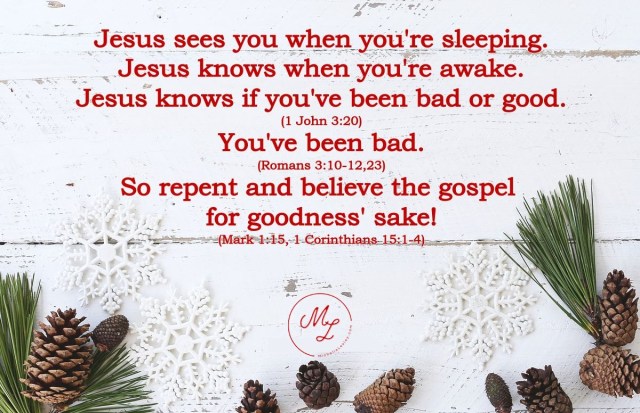
He sees you when you’re sleeping
He knows when you’re awake
He knows if you’ve been bad or good
So be good, for goodness’ sake!ยน

Uh uh. No way. Omniscience is an incommunicable attribute of God. He is the only One who has the power to see and know all things, and it is an insult and an affront to Him to even suggest that a mere mortal – let alone a fictional character – has the same power and knowledge that He has. In reverence and awe for God’s preeminence, we should never ascribe to others the things that belong to God alone.

Teach your children about the attributes of God. When you read your children stories about Santa Claus or hear Santa Claus Is Comin’ to Town on the radio, it’s a perfect opportunity to teach them about God’s omniscience and power. “Did y’all just hear that? That song said Santa Claus can see you and knows how you’re behaving. Is that true? Who is the only One who always sees you, cares for you, and knows what you’re doing and thinking? Can anybody else besides God do that?”

Santa Claus teaches works righteousness. In St. Nick’s economy, good behavior earns a reward (presents). Bad behavior earns punishment (coal). If you’ve ever shared the gospel with anybody, that will probably sound familiar. Most lost people think that’s what Christianity is. If you’re a “good person” God is happy with you and you’ll go to Heaven. Hell is the punishment for “bad people”: Hitler, murderers, and rapists. This is not what the Bible teaches, either about salvation, or about why children should obey their parents.

Teach your children the gospel.ย Again, this whole “naughty or nice” part of the Santa Claus narrative is a perfect gospel-teaching opportunity. Take advantage of it! Ask your child to be “nice” for one whole day. At bed time, take a few minutes to talk about the times she messed up and was “naughty” when she was supposed to be trying to be “nice.” Nobody can be nice and obedient all the time, no matter how hard we try. We areย all naughty – sinners with coal black hearts deserving the punishment of Hell. Jesus came and lived a life ofย perfectย “niceness” (obedience), died on the cross to take the punishment for our naughtiness, was buried, and rose again. He did that, not because we earned it with good behavior, but because of His mercy and grace. And then He gave us the greatest gift ever. A gift we naughty people don’t deserve: salvation and eternal life in Heaven. And it is because of our love and gratitude to Christ for saving us that we obey Him, not so that He will give us what we want. Indeed, the Bible tells us that the more obedient to Christ we are, the more persecution we will face.

Santa Claus doesn’t automatically have to be on the Christian parent’s naughty list. There are lots of ways to enjoy the fun of Santa and even turn him into an opportunity to teach your child biblical truth, all while being obedient to Scripture. But if Santa makes you biblically uncomfortable in some way, then by all means, don’t go against your conscience. Whichever way you decide – after prayer, study of the Scriptures, and discussing it with your spouse – do not judge other Christian parents by your personal convictions about Santa Claus.

Any advice for grandparents about Santa? Our son wants our grandchildren to believe in Santa. How do we respond to a grandchild who asks of the reality of Santa? I will not lie, but I want to keep peace with my son.

Thank you for being a godly grandma!

I think the solution to this dilemma is going to start with being a godly mom. Is your son a Believer? If so, you might want to show him all of the information above and talk to him about any Scriptures he’s violating. Let’s pray that will be convicting to him and he’ll decide to handle Santa in a godly way with your grandchildren.

But if he’s not convinced, or if he’s not a Believer, talk to him about your convictions about not lying to his children. Explain the difficult position he’s putting you in. He’s essentially asking you to choose between pleasing him by sinning (lying) or pleasing God by not sinning.

If he still won’t relent, the only solution I can see that keeps you from sinning yet doesn’t go against your son’s wishes is to put it back on him. When your grandchild comes to you and asks, “Grandma, is Santa Claus real?” you reply, “That’s a great question, but I think you should ask your mom and dad about that. How about some hot chocolate?”.

Your son made this bed. You shouldn’t have to lie in it.

Additional Resources:

Santa Pause with Justin Peters at A Word Fitly Spoken


ยนSanta Claus Is Comin’ to Town. John Frederick Coots and Haven Gillespie, 1934.

If you have a question about: a Bible passage, an aspect of theology, a current issue in Christianity, or how to biblically handle a family, life, or church situation, comment below (Iโ€™ll hold all questions in queue {unpublished} for a future edition of The Mailbag) or send me an e-mail or private message. If your question is chosen for publication, your anonymity will be protected.

Parenting, Poetry

The Prodigal’s Mom

Thereโ€™s an empty chair at the table
Where my child once used to sit
When we all broke bread together
A family whole and fit

Thereโ€™s an empty place in the photo
As his siblings celebrate
Without him again, missing him in
The memories they create

Thereโ€™s an empty stocking at Christmas
Another year far from home
Joy with tarnished edges
As the wayward one still roams

Thereโ€™s an empty place in my heart
That longs to be peaceful, content
Praying my child heeds the call of Christ
But fearing heโ€™ll never repent

And so goes the song - it goes on and on -
Of a godly motherโ€™s heart
Lifeโ€™s full of empty moments
Her prodigalโ€™s sin imparts

Until our knees and hearts are raw
We pray and pray again
A thousand tears we offer up
โ€œHow long, O Lord?โ€ and โ€œWhen?โ€

And the Father who once welcomed us home 
- For we were His prodigals too -
Says, โ€œCome and rest, and stand the test,
My grace is sufficient for you.โ€