Mailbag

The Mailbag: What Is the Unpardonable Sin?

mailbag


What is the unpardonable sin -the blasphemy of the Holy Spirit – and can a Christian, or anyone else, commit it today?

Jesus mentions the unforgiveable sin, blasphemy of the Holy Spirit, in Matthew 12:31-32:

“Therefore I tell you, every sin and blasphemy will be forgiven people, but the blasphemy against the Spirit will not be forgiven. And whoever speaks a word against the Son of Man will be forgiven, but whoever speaks against the Holy Spirit will not be forgiven, either in this age or in the age to come.”

Earlier in chapter 12, the crowd had expressed amazement at Jesus’ healing of a demon oppressed, blind and mute man, by exclaiming, “Can this be the Son of David [the Messiah]?” (23) The Pharisees, wishing to discredit Jesus, responded, “It is only by Beelzebul, the prince of demons, that this man casts out demons,” (24) attributing the work of the Holy Spirit, through Jesus, to Satan.

It is is in this context that Jesus speaks in verses 31-32 about blasphemy of the Holy Spirit (attributing the work of the Holy Spirit to Satan).

It is generally agreed upon by reputable theologians that Christians today who have been genuinely born again cannot, nor would they desire to if they could, give Satan the credit and glory for works done by God the Holy Spirit. The first resource I have listed below makes a compelling argument that no one can commit this sin today since its context was limited to the miracles done by Jesus while He was on earth.

Additional Resources:

Blasphemy Against the Holy Spirit—The “Unpardonable Sin” at Apologetics Press

What is Blasphemy of the Holy Spirit? Can A Christian Commit it? at CARM

Blaspheming the Holy Spirit, part 2 at Grace to You


If you have a question about: a well known Christian author/leader, a Bible passage, an aspect of theology, a current issue in Christianity, or how to biblically handle a family, life, or church situation, comment below (I’ll hold all questions in queue {unpublished} for a future edition of The Mailbag) or send me an e-mail or private message. If your question is chosen for publication, your anonymity will be protected.

Mailbag

The Mailbag: Eating Disorder Resources

mailbag


Do you know of any doctrinally sound resources for dealing with eating disorders in a biblical way?

This is not my area of expertise, so I asked a theologically solid friend who is a certified biblical counselor, and who was gracious enough to point me in the right direction. I have not personally read any of these resources. As with any Christian resource, read discerningly, compare everything to Scripture, and reject anything that doesn’t line up with God’s word.

Eating Disorders:
The Quest for Thinness

by Ed Welch

ed welch

Love to Eat, Hate to Eat:
Breaking the Bondage of Destructive Eating Habits
by Elyse Fitzpatrick*

love to eat

Women Helping Women:
A Biblical Guide to Major Issues Women Face
Edited by Elyse Fitzpatrick* and Carol Cornish

women helping

This is a topical discipleship book which covers a
wide variety of issues including eating disorders.

biblical-counseling-coalition

Biblical Counseling Coalition has several resources on eating disorders.
(You may also wish to use their search bar for more specific terms,
such as “anorexia,” “bulimia,” etc.)

ccef

Christian Counseling and Education Foundation
has several resources on eating disorders.
(You may also wish to use their search bar for more specific terms,
such as “anorexia,” “bulimia,” etc.)


*I am recommending only these two resources from Elyse Fitzpatrick, and no others. Concerns have come to light about her theological trajectory in recent years (which I will address in another article). These are two of her older books.


If you have a question about: a well known Christian author/leader, a Bible passage, an aspect of theology, a current issue in Christianity, or how to biblically handle a family, life, or church situation, comment below (I’ll hold all questions in queue {unpublished} for a future edition of The Mailbag) or send me an e-mail or private message. If your question is chosen for publication, your anonymity will be protected.

Mailbag

The Mailbag: What Are DNA Discipleship Groups?

mailbag


Do you have any information on DNA (Discover, Nurture, Act) groups?

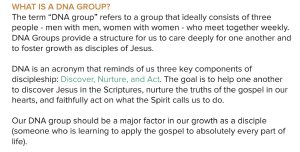
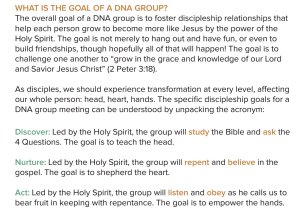
DNA groups are an accountability partner discipleship program for church members developed by Soma, a nationwide network of Reformed, gospel-centered churches. The groups usually consist of three women or three men. Groups normally meet weekly for ninety minutes to discuss the events of life and how Scripture and the gospel apply, what they’ve been learning in their personal Bible study time, and any incidents requiring repentance. The groups study Scripture together and pray with, and for, one another.

You can download and read the DNA program manual here. A couple of excerpts that help explain the program:

Screenshot_2016-05-28-22-19-55_kindlephoto-13502875

Screenshot_2016-05-28-22-16-33_kindlephoto-13561799

The DNA group concept seems like a doctrinally solid discipleship program. It demonstrates intentionality in building disciples. It is centered on the gospel, Scripture, prayer, and repentance. It encourages church members to sharpen one another and bear one another’s burdens.

A few minor things jumped out at me that I think it would be helpful for Soma to tweak and clarify just a bit.

  • Several times, the phrase “listen to the Holy Spirit,” or something similar, is used. At first, this concerned me because this is the type of language used in contemplative prayer and New Apostolic Reformation false doctrine. Reading the document in context, however, it is clear that this is not what Soma is referring to, but, rather, being led by the Holy Spirit and hearing Him speak through Scripture.
  • “Pubs” (in addition to other venues) are mentioned a couple of times as meeting places for DNA groups. I’m not aware of any definition of the word “pub” other than “bar.” If “pub” is a new slang word for coffee house, or something, it would be helpful to clarify that. If by “pub” they actually mean a bar, I would personally not endorse a discipleship group (or any individual Christian or group of Christians) meeting in a bar.
  • Evangelism is presented as “telling your story with Jesus as the hero.” It can sometimes be helpful when evangelizing to share your story of salvation, and the manual describes a way to do this which is biblically correct (emphasis on your sin and your need for a Savior, etc.). However, I think Scripture bears out that a law/gospel presentation is the primary way the gospel should be proclaimed and that “our story” should mainly be used as a supplement or addendum. That being said, every Christian should be able to verbally and cogently explain how she was saved, and the manual does show the biblical way to do this.
  • One of the steps in forming a DNA group is to “read and discuss The Story of God Summary.” The Story of God Summary (included in the manual) is basically an overview of the narrative of Scripture from Creation through the establishment of the church, and the promise of Christ’s return. I understand it would be impossible to read the entire Bible and discuss it in one or two sessions as a step in setting up a DNA group (thus, the summary), but I’m uncomfortable with the fact that – while the summary is biblically accurate – no actual Scripture is cited. I think it would be beneficial to add in some acutal passages of Scripture to flesh out the main points of the summary.

Overall, from what I’ve seen “on paper” this looks like a discipleship model that I would have no trouble recommending. I would encourage anyone interested to read the manual for further details.


If you have a question about: a well known Christian author/leader, a Bible passage, an aspect of theology, a current issue in Christianity, or how to biblically handle a family, life, or church situation, comment below (I’ll hold all questions in queue {unpublished} for a future edition of The Mailbag) or send me an e-mail or private message. If your question is chosen for publication, your anonymity will be protected.

Mailbag

The Mailbag: Can a divorced man be a pastor?

mailbag


Is it OK for pastors to be divorced?

Not just any man is qualified to be a pastor. The Bible sets forth a specific list of requirements for pastors and elders in 1 Timothy 3 and Titus 1. One of these requirements is that he must be “the husband of one wife.” Unfortunately, this phrase has sometimes been misunderstood to mean that pastors and elders must be married (which would exclude never married, divorced, and widowed men) or that pastors and elders must never have been divorced for any reason.

I pretty much agree with John MacArthur’s position in this article, which helpfully explains that the phrase “husband of one wife” actually means “a one-woman man,” not “never divorced,” or “wife required.” Unlike MacArthur, I might not say it’s “extremely rare” that it would be OK for a pastor to have a divorce in his past, maybe just “rare.”

I really think we need to look at it on a case by case basis, especially if the man was divorced for one of the two biblical exceptions: the wife’s infidelity (Matthew 5:32) or an unbelieving wife divorcing him (1 Corinthians 7:15). Although I respect an autonomous church’s right to set whatever policies it deems appropriate (as long as those policies don’t violate Scripture), I, personally, don’t think it’s right to deny a man the office due to his wife’s sin that he had no control over and may have done everything in his power to prevent.

I also think we need to look at how long ago the divorce took place and whether it happened before or after the man was saved. What about a man who was divorced 30 years ago due to one of the bibilical exceptions, but has been a godly husband to his second wife for the past 25 years? What about a man who was divorced 30 years ago, subsequently got saved, tried to reunite with his ex-wife but was rejected, married a godly woman, and has been a godly husband to her for the past 25 years? There are prohibitions against being a drunkard in the biblical qualifications, too. Would we deny a man the office, if, prior to salvation, he was a drunkard, but got saved and has been sober for 25 years? These are issues churches should work through prayerfully when considering a candidate.

A man already in the office of pastor/elder who goes through a divorce should step down for a significant period of time. If the divorce was for unbiblical reasons, he has probably disqualified himself. But even if it was for biblical reasons, he needs time to heal and to focus on helping his children. For the same reasons, I don’t think a man who has been recently divorced should be considered for the office.


If you have a question about: a well known Christian author/leader, a Bible passage, an aspect of theology, a current issue in Christianity, or how to biblically handle a family, life, or church situation, comment below (I’ll hold all questions in queue {unpublished} for a future edition of The Mailbag) or send me an e-mail or private message. If your question is chosen for publication, your anonymity will be protected.

Calvinism/Arminianism, Mailbag

The Mailbag: What is Calvinism?

mailbag


What is Calvinism?

Calvinism, or Reformed theology (most people use the two terms interchangeably) is a theological framework, drawn from Scripture, for understanding the Bible, salvation, the nature of man, and the character of God. There are five basic tenets, or “points,” of Calvinism (also known as “the Doctrines of Grace”) which are often presented via the acronym “TULIP” (Please note that these are very brief, general descriptions. See the resources below for more nuanced information and scriptural support.):

Total Depravity: Due to the Fall (Adam’s sin in the Garden of Eden), all people are sinners from birth and in need of salvation.

Unconditional Election: God sovereignly predestines certain people to salvation. tulip-1227493_960_720Whether or not a person is predestined, or “elect,” has nothing to do with her merit or good deeds. God’s reasons and criteria are known only to God. We have no way of knowing who is elect and who is not, only that people who are genuinely saved were predestined to it.

Limited Atonement: The atonement for sin that Christ made on the cross applies only to those who are, or will, in the future be, saved.

Irresistible Grace: Those who are predestined to salvation are drawn to Christ by God and will desire and accept, rather than reject, God’s offer of grace for their sin.

Perseverance of the Saints: (Sometimes called “eternal security,” or “once saved, always saved.”) Those who are truly saved will continue in the faith for the rest of their lives. Someone who “used to be a Christian” was never truly saved in the first place.

I don’t describe myself as a “Five Point Calvinist” or a “three pointer,” etc., because, while I pretty much agree with all five points (and don’t reject any of them outright), I simply think these doctrines are far more nuanced than they are often presented by Calvinists. We don’t have everything all cut-and-dried figured out about what’s going on in the mind of God about electing people. With regard to human will, we don’t know precisely what God does in a person’s heart, and how He does it, at the exact moment of regeneration. We believe what Romans 9 says about election while simultaneously believing 2 Peter 3:9, that it’s not God’s desire for anyone to perish.

And you know what? That’s OK. It’s OK to hold those things in tension while we’re here on earth. We believe what Scripture says God does, but, where the Bible is silent as to how He does it, His reasons for doing it, etc., well, we trust God and believe Scripture there, too, because it says:

The secret things belong to the Lord our God, but the things that are revealed belong to us and to our children forever, that we may do all the words of this law. Deuteronomy 29:29

So that’s where I am, theologically speaking (I’ve written a little more about it here.) I guess you could say I’m a Reformed gal who leaves room for the mysteries of the mind of God.


Additional Resources:

What are the Doctrines of Grace? at Got Questions

Calvinism at Theopedia

What is Calvinism? at Ligonier Ministries

TULIP and Reformed Theology: An Introduction at Ligonier Ministries

Why I Am a Calvinist by Phil Johnson


If you have a question about: a well known Christian author/leader, a Bible passage, an aspect of theology, a current issue in Christianity, or how to biblically handle a family, life, or church situation, comment below (I’ll hold all questions in queue {unpublished} for a future edition of The Mailbag) or send me an e-mail or private message. If your question is chosen for publication, your anonymity will be protected.