Discernment Bible Study

Choose What Is Right: A Study in Discernment- Lesson 7


Previous Lessons: 1, 2, 3, 4, 5, 6


Refuse to Heed the Shepherd and You’ll Have the Wool Pulled Over Your Eyes

Todayโ€™s Scripture passages are embedded in the body of the study. Please click the links in each question.


Questions to Consider

Throughout this study we will be looking at various passages of Scripture rather than working our way through a book of the Bible verse by verse. Because of that, we will need to be extra vigilant to rightly handle these passages in context. I will always attempt to provide the context you need for understanding these passages correctly, but if you need more clarity please feel free to read as much of the surrounding text as you need to – even the whole book, if necessary – in order to properly understand the passage presented.

1. We need a firm foundation. What is that firm foundation? First and Second Timothy and Titus comprise what are known as the “pastoral epistles”. They are God’s instructions, via Paul, to Timothy, Titus, and all other pastors about how to run the church. I often liken the pastoral epistles to a “policy and procedure manual” for the church.

Even in these three very brief epistles, God has a lot to say about sound and false doctrine, and sound and false teachers. Read these passages from the pastoral epistles (you may wish to read more of the surrounding verses for context). What is the foundation of a healthy church? How does a foundation of being intentional and purposeful to preach and teach sound doctrine protect a church against the infiltration of false doctrine and false teachers?

Meditate on Paul’s solemn charge to pastors in the 2 Timothy 4:1-2 passage. Explain exactly what he is saying in these verses. Would you liken this charge to a vow or “oath of office”? Why or why not? Put yourself in Timothy’s sandals. Do you feel the weightiness of this charge and responsibility? How so?

As Paul is preparing to leave the Ephesian church, he mentions two ways, in Acts 20:29-30, in which false teachers can infiltrate the church. What are those two ways? How does a solid foundation of sound doctrine help guard against false teachers coming into the church from the outside, and prevent those who are already church members from believing false doctrine and becoming false teachers inside the church?

2. Regarding discernment, why do we need the firm foundation of the preaching and teaching of sound doctrine? Examine these passages. (Compare the verse references to the passages from question 1. See the proximity and context?) Why, in the context of discernment, is the teaching and preaching of sound doctrine so crucial? What will happen to those who refuse to heed sound doctrine? Which adjectives does Paul use in the 1 Timothy passage to paint a picture of the deceitfulness of false teachers? How does Paul address the idea of people being deceived and departing from the faith in these passages – as a possibility or a certainty? (Hint: Look for the word “will”.)

3. How is this deception accomplished? Are these people who “depart from the faith” deceived solely by the false teachers, self-deceived, or both?

Study these passages. What do they tell us about a person’s role in her own deception? Who is taking the initiative in these two passages, the false teachers/prophets, or the people who want to follow them? In the Isaiah passage, before the people turn to the seers and prophets in verse 10, how does verse 9 describe them? What have they already turned from? In the 2 Timothy passage, before the people turn to false teachers (3b) and myths (4b), what have they already turned away from (3a, 4a)?

Compare 2 Timothy’s “they will accumulate for themselves” and “teachers to suit their own passions” (3b) with Isaiah’s 10-11. How did the people in Isaiah proactively pursue or accumulate false teachers? What were “their own passions” they wanted to suit? Are people who turn to false teachers hapless, powerless victims of those false teachers or willing participants in their own deception?

Again, what happens when you “refuse to heed the Shepherd” (Jesus, His Word, sound doctrine, etc.)? Think about the nature and definition of the word “deceived”. Do deceived people know they’re deceived?

But if every teacher out there only taught sound doctrine, would self-deceived people be able to accumulate teachers to themselves to suit their own passions? It’s kind of a symbiotic relationship, isn’t it?

Study these passages. What do all of these passages say false teachers disguise themselves as? Make a list of the words and phrases from each passage that led you to your answer:

  • 2 Corinthians 11:
  • Galatians 2:
  • 2 Peter 2:
  • Titus 1:

Think about some of the false teachers you’re aware of (or check here if you need a little help). Do any of them go by the title “False Teacher”? Introduce themselves as false teachers? Write books and give interviews as experts in the field of false teaching? What titles do they go by? What do they want to be known as?

In the 2 Corinthians passage, what does Paul say the false apostles claim? (12) Are their claims true? (13) What three words in verse 13 indicate that these men are not honest? Compare verses 14-15 with Jesus addressing the Pharisees (the false teachers of His day) in John 8:42-47. Who is the spiritual “father” of these false teachers in both passages? Who do they actually serve? Are they actually Christians, as they claim to be? What does Paul mean, “Their end will correspond to their deeds.”(15)? What will their end be? (Hint- use your cross references)

Why do you think some professing Christians believe even the most egregious false teachers are actually Christians despite what these passages teach to the contrary? Is it fair to say they are believing the false teacher’s word over God’s Word?

Compare the 2 Corinthians passage and the John 8 passage above with Genesis 3:1-7. What similarities do you see when it comes to the descriptions of Satan’s character and methods?


Homework

Read 1 & 2 Timothy and Titus. Carefully examine each passage that deals with either the need to preach and teach sound doctrine or the need to rebuke and refute false teachers or false doctrine. Why is the proactive, purposeful, and intentional teaching of sound doctrine vital to the health of the church? How does sound doctrine itself refute false doctrine? Why is it imperative to rebuke and remove unrepentant false teachers from the church?

A common argument against the public rebuke and refutation of false teachers is that, “You shouldn’t warn against them, you should just pray for them.” (see #10 here). How would you answer that argument with the passages you examined in 1 & 2 Timothy and Titus?

You may wish to refer to parts of my studies on the pastoral epistles as you study:

1 & 2 Timothy: The Structure and Spirit of the Church

Titus: God’s Order of Service


Suggested Memory Verse

Discernment Bible Study

Choose What Is Right: A Study in Discernment- Lesson 6


Previous Lessons: 1, 2, 3, 4, 5


Sheep Follow the Shepherd,
Not Strangers

Read This Passage


Questions to Consider

Throughout this study we will be looking at various passages of Scripture rather than working our way through a book of the Bible verse by verse. Because of that, we will need to be extra vigilant to rightly handle these passages in context. I will always attempt to provide the context you need for understanding these passages correctly, but if you need more clarity please feel free to read as much of the surrounding text as you need to – even the whole book, if necessary – in order to properly understand the passage presented.

1. Read John 9. Note the motifs of darkness and light, blindness and sight, night and day. What do darkness, blindness, and night represent? What do light, sight, and day represent? What is Jesus saying about Himself in v. 5? What is the spiritual truth Jesus is trying to convey in chapter 9 – to His immediate audience, and to us? In what ways does this story mirror a person being saved?

What is the spiritual parallel and significance of 8-9? In what ways do we look different to others after salvation?

Describe all of “the works of God” (3) that were displayed in the blind beggar – was it simply God’s power to heal, or was there more to this situation than that?

2. Review legalism and antinomianism in lesson 3 (link above). Which kind of false doctrine were the Pharisees displaying in chapter 9? Give some specific examples of their legalistic remarks, accusations, beliefs, etc.

Compare the works of God displayed in the blind beggar to the works of “their father, the Devil” displayed in the Pharisees. What fruit do we see from the works of God? From the works of the Devil? What is the culmination of the works of God (30-32, 35-39)? The culmination of the works of the Devil? (39-41)

3. Compare the healed man’s parents’ fearful response to the Pharisees (18-23) with the healed man’s “wild abandon” response to the Pharisees (17, 24-34). What made the difference between those two responses (35-38)? Can a false teacher have power over someone who has truly been set free in Christ? Why or why not?

4. Describe Jesus’ disposition toward the false teachers in chapter 9. Toward the repentant, victim of the false teachers? What example does this set for us regarding our own disposition toward false teachers versus our disposition toward those who are trapped in false religious systems and need the gospel?

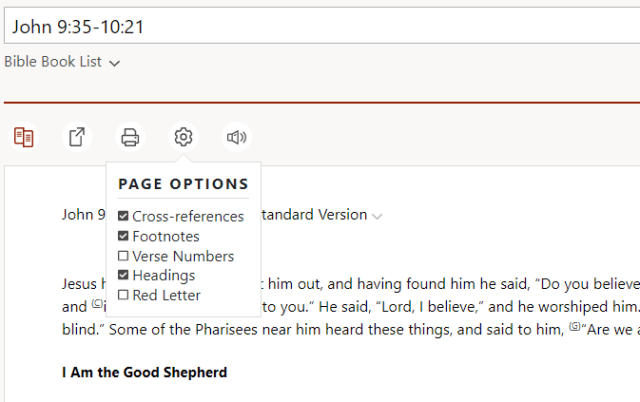
5. Read John 9:35-10:21 without chapter and verse markings. (If you’re using Bible Gateway, just click on the “page options” icon and uncheck “verse numbers”.)

Do you notice the flow from chapter 9 into chapter 10? What does that tell you about the timing and the relationship between the events and remarks in chapter 9 and Jesus’ teaching in chapter 10? (Hint: See 10:21b). How do the events of chapter 9 lay the foundation for the teaching of chapter 10?

6. Carefully study 10:1-21. What type of literary device is Jesus using to illustrate His point in chapter 10? Is Jesus using literal or figurative language in this passage?

Identify who or what each of the following represent (hint: there’s some overlap):

  • The thief/robber (1,8,10)
  • The shepherd (2)
  • The gatekeeper (3)
  • The sheep (3ff.)
  • The stranger (5)
  • The door of the sheep (7,9)
  • The good shepherd (11,14)
  • The hired hand (12,13)
  • The wolf (12)
  • The flock (16)

7. False teachers today often use the phrases “The sheep hear his voice” (3), “they know his voice” (4), “they will listen to my voice” (16), and “My sheep hear my voice” (27), from this passage to teach that Christians should hear God talking to them audibly (extra-biblical revelation). Examine all of the references to listening, hearing, and voice in this passage. Is this passage teaching that you should hear God talking to you audibly? Why not? What role does context play in your answer? If this passage is a metaphor, which uses figurative language, why would the “sheep” part of these phrases be figurative but the “voice/hear/listen” parts be literal?

Explain what Jesus means in 3b-5, 8, 16b, 27 when He says that His sheep listen to His voice and follow Him, and that they will not follow the voice of strangers. What does “knowing” Jesus and His voice (4-5, 14b) have to do with this? Think back over the message of chapter 9. How does having one’s “eyes opened” connect to this?

If genuinely regenerated Christians (Jesus’ sheep), generally speaking, do not follow false teachers (thieves, robbers, strangers), what can we reasonably conclude about people who claim to be Christians, yet whose lives are marked by a consistent trajectory of following false teachers and listening to the voice of false doctrine over a long period of time? Are these people likely to listen to and understand your voice and the voice of Scripture as you point out what is unbiblical about their favorite false teachers? (6) Why not? Thinking back over the message of chapters 9 and 10, what do they need first in order to “see the light”?

Is it possible for a genuine sheep (Christian) to wander a few steps away from the Shepherd toward a false teacher (i.e. temporarily show an interest in a false teacher or false doctrine)? What does a Good Shepherd do when a sheep wanders?

8. Explain why it is crucial for the local church to have a gatekeeper (3) who only opens the door to sound doctrine and the true Jesus of Scripture, and who chases off the thieves, robbers, and strangers (1,5) who sneak in (1)? Compare your answer to Titus 1:9-16.

9. In lesson 5 (link above) we touched on the idea of whether or not a false teacher (someone who consistently and unrepentantly teaches demonstrably false doctrine, not a doctrinally sound teacher who occasionally makes a mistake) could actually be a genuinely regenerated Christian. Notice the way this passage describes false teachers, their goals, and their effects. What inferences can you reasonably draw about a false teacher’s salvation?


Homework

  • I have heard this scenario from Christian women numerous times and experienced it myself, personally: โ€œI went to a womenโ€™s Bible study where they were using a book by __. I sat there and listened, and I just knew something was wrong. I didnโ€™t know my Bible well enough at that time to be able to put my finger on it, but I got out of there, started studying my Bible and researching this teacher, and now I know sheโ€™s a false teacher.โ€ Have you ever had an experience like that? How does the concept of sheep listening only to the Shepherd and not to strangers apply to this scenario?

Suggested Memory Verse

Discernment Bible Study

Choose What Is Right: A Study in Discernment- Lesson 5


Previous Lessons: 1, 2, 3, 4,


False Teachers, God’s View, Our Response

Read These Passages


Questions to Consider

Throughout this study we will be looking at various passages of Scripture rather than working our way through a book of the Bible verse by verse. Because of that, we will need to be extra vigilant to rightly handle these passages in context. I will always attempt to provide the context you need for understanding these passages correctly, but if you need more clarity please feel free to read as much of the surrounding text as you need to – even the whole book, if necessary – in order to properly understand the passage presented.

1. Examine today’s passages and answer these four questions about each (if applicable):

  • How does God describe false teachers in this passage?
  • What is God’s opinion of false teachers in this passage, and what consequences will they face?
  • How does this passage describe the way people respond to and/or should respond to false teachers?
  • What is God’s opinion of people who follow false teachers, and what consequences will they face?

Using your answers to the first two questions, write a character sketch of a typical false teacher.

Using your answers to the last two questions, write out a description of the way God is generally disposed toward those who follow false teachers and how He wants us to regard and respond to false teachers instead.

2. Considering the Isaiah passage alongside 2 Timothy 4:3-4, are people who follow false teachers innocent victims of these teachers? Why or why not, according to these passages? How do these passages describe people’s disposition toward God before they start following false teachers?

3. Examine the 2 Corinthians passage. Who do false teachers disguise themselves as? (13,15) Instead of “apostles,” “workmen,” and “servants,” what words or titles do we generally use for these people today? (Hint: Think of a popular false teacher. What position or title does s/he hold?) How do false teachers characterize their work or “ministry”? (12) Rather than serving Christ, who do false teachers really serve? (15) How does verse 14 connect to Genesis 3:1-5?

4. Compare the light/darkness, and the fruit/unfruitful motifs of the Ephesians passage to verses 17-19 of the Matthew 7 passage.

How does verse 11 of the Ephesians passage refute these ideas held by some professing Christians?

  • “I know Teacher X teaches some things that are false, but I just chew up the meat and spit out the bones.” (11a)
  • “You shouldn’t warn against false teachers, you should just pray for them.” (11b)
  • “I don’t name the names of false teachers in my sermons, I only preach sound doctrine. That’s the way people learn to recognize false teachers. After all, that’s how bank tellers learn the difference between counterfeit and real money, by only familiarizing themselves with real money.” (11b, see also verse 9 of the Titus passage- Consider this: If there were counterfeiters running around your town passing fake money, what do you think the police and news media would do to alert the banks and the public so they could catch these criminals, stop them, and mete out justice to them?)

5. In the Matthew 7 passage- explain in your own words what the sheep and wolves metaphor in verse 15 means. How do the examples in verse 16 relate to the sheep and wolves metaphor in verse 15, and also to the concept of false teachers disguising themselves in the 2 Corinthians passage?

In 17-19, who are the healthy and unhealthy trees? What is the good and bad fruit of these trees? Who is the fruit of a false teacher’s ministry, and how would you characterize them? Who is the fruit of a sound teacher’s ministry, and how would you characterize them?

Think about people you know who loyally and diligently follow false teachers. Are they growing in holiness as the Bible describes it? Forsaking sin more? Growing in spiritual maturity? Increasingly exhibiting fruit of the Spirit? Studying their Bibles (not the teacher’s books and materials, but the Bible) and praying better and more frequently? Increasing in their love for and service at a doctrinally sound church? Becoming more skilled at rightly handling, understanding, and obeying God’s Word in context? These things are the fruit of a teacher’s ministry.

Christians often wonder whether false teachers knowingly teach false doctrine and deceive people, or if they’re so deceived that they actually think they’re genuine Christians teaching biblical truth. Compare 21-23 with the 2 Corinthians passage. What do you think? Could there be some of each?

6. Think back to lesson 3 (link above) and the difference between antinomianism and legalism. In the Matthew 23 passage, is Jesus rebuking the Pharisees for being antinomians or legalists?

If your pastor preached Matthew 23 to or about a specific false teacher or group of false teachers and posted the video of it on social media, what do you think non-Christians would say about him? What do you think most professing Christians would say about him? Some professing Christians think it is mean, hateful, unloving, unkind, even unChristlike to call out a false teacher or even suggest that people shouldn’t follow a certain false teacher, no matter how gently and kindly it is done. Is that true? How do you know, based solely upon Matthew 23?

7. Examine the Titus passage. Who is “he” in verse 9 (see verses 5-8)? What two things does God require of pastors and elders in verse 9? If a pastor only preaches sound doctrine and never rebukes, preaches against, or warns against false doctrine and false teachers, is it fair to say he’s only doing half his job? Why or why not? (Support your answer from rightly handled Scripture, not emotion or personal opinion.)

Consider verse 11 alongside 2 Timothy 3:6-7. What is the impact on the family when women follow false teachers and bring their false doctrine into the home?

Note the word “rebuke” in verses 9 and 13? Why are pastors to rebuke false teachers and those who follow them?

8. Sometimes Christians wonder whether or not false teachers (at least some of them) are truly born again. In today’s passages, carefully examine together 2 Corinthians 11:15, Ephesians 5:6, Matthew 7:15, 19, 21, 23, Matthew 23:15, 33, Titus 1:15-16. What do these verses indicate is the answer to that question? Think about the way Scripture describes and characterizes the life and eternity of Christians. Do these verses about false teachers match Scripture’s description and characterization of Christians?


Homework

Read my article Answering the Opposition- Responses to the Most Frequently Raised Discernment Objections. Which of the Scriptures you studied today answer some of these objections? How? Are there other objections to discernment that you’ve heard that are not on the list, but are answered by today’s passages? Which objections would you add to the list, and how would you answer them from today’s passages (and others)?


Suggested Memory Verse

Discernment Bible Study

Choose What Is Right: A Study in Discernment- Lesson 4


Previous Lessons: 1, 2, 3,


False Teachers, God’s View, Our Response

Read These Passages


Questions to Consider

Throughout this study we will be looking at various passages of Scripture rather than working our way through a book of the Bible verse by verse. Because of that, we will need to be extra vigilant to rightly handle these passages in context. I will always attempt to provide the context you need for understanding these passages correctly, but if you need more clarity please feel free to read as much of the surrounding text as you need to – even the whole book, if necessary – in order to properly understand the passage presented.

1. Do you notice the similarities between 2 Peter 2 and Jude? Click here and read the second paragraph under “Author and Date”. What might be the reason for some of the similarities?

Make a two column chart. Examine Jude and 2 Peter 2 side by side, verse by verse. (You may want to do this with two Bibles, two devices, or a split screen on your Bible app or device.) List the verses or phrases that are strikingly similar in wording and concept. What does each mean? Why might God have emphasized a particular verse or phrase by placing it in Scripture twice?

2. To what general group of people are Jude’s (v.1) and Peter’s (1:1) letters addressed? What is Jude’s (3) appeal to the church? Why is he urging them to contend for the faith (Jude 4, 2 Peter 2:1-3)? What are some of the things that happen to a church when false teachers gain a foothold?

Do these epistles apply to you as a Christian, and to the church, today? Why? Have you (or your church) ever been urged by a pastor or teacher to contend for the faith? Why do you think that admonition is so lacking in the church and from Christian teachers today?

2. How does Jude (4a) describe false teachers entering the church? How does Peter (1) say false teachers will bring in destructive heresies? Compare this characterization to the way these passages say false teachers infiltrate the church and the home. What does this characteristic of sneakiness tell you about false teachers? Why aren’t they just open and honest with Christians and the church about what they want to teach?

3. What do Jude (4, 13) and Peter (3, 17) say is the final destiny of false teachers?

Examine 2 Peter 2:4-10. Who are the godly people mentioned in this passage and how did God deal with them? Who are the ungodly who are listed, and how did God deal with each of them? Do these ungodly people include false teachers (10, Jude 8)?

What does this tell you about how God views false teachers? How He views and protects His faithful children?

4. What are Jude (8-9) and Peter (10b-11) telling us about angels, blasphemy and the glorious ones? How does this reflect the pride and arrogance of false teachers?

What are Jude (10) and Peter (12) telling us about the ignorance of false teachers? Think about how the indwelling Holy Spirit illumines Scripture to the Christian. What might be one reason false teachers do not understand Scripture or how to properly handle it?

What is the significance of Jude’s (11) comparison of false teachers to Cain? Of Jude’s (11) and Peter’s (15-16) comparison to Balaam?

Consider the imagery in Jude’s (12-13) and Peter’s (17) comparative metaphors to false teachers. What are the characteristics of each metaphor mentioned, and how do they apply to false teachers?

5. In your own words, write a brief summary of the character of false teachers according to Peter and Jude. Do you know of any pastors or teachers who could be described this way? Who, and why?

6. What does Jude (17-23) say about how we should respond to the types of teachers he and Peter are describing?


Homework

If you’d like a little extra study on these passages, check out:

Wednesdayโ€™s Word ~ Jude

Living Stones: A Study of 1 & 2 Peter ~ Lesson 11


Suggested Memory Verse

Discernment Bible Study

Choose What Is Right: A Study in Discernment- Lesson 3


Previous Lessons: 1, 2,


What Is False Doctrine?

Today’s Scripture passages are embedded in the body of the study. Please click the links in each question.


Questions to Consider

Throughout this study we will be looking at various passages of Scripture rather than working our way through a book of the Bible verse by verse. Because of that, we will need to be extra vigilant to rightly handle these passages in context. I will always attempt to provide the context you need for understanding these passages correctly, but if you need more clarity please feel free to read as much of the surrounding text as you need to – even the whole book, if necessary – in order to properly understand the passage presented.

1. Have you ever studied the book of Judges? If you have, you know this book has a very clear theme which can be found in Judges 17:6b and 21:25b. What is that theme? What does it mean to do what is right in your own eyes? Is believing what is right in your own eyes part of doing what is right in your own eyes? How and why? As Christians, how are we supposed to live and believe? What are some ways Christians (or those who claim to be Christians) today do and believe what is right in their own eyes rather than doing and believing what is right in God’s eyes?

How do we know the difference between what is right in our own eyes and what is right in God’s eyes? What is our standard for answering that question? Our authority for life and doctrine? If this is how we’re to live and believe – submitting to the truth of God’s written Word as our authority in life and our measuring stick for evaluating right actions from wrong actions, right beliefs from wrong beliefs – is it biblical to say that this is also how teachers are to teach?

2. When you get right down to the bottom line, there are two basic ways of doing and believing what’s right in your own eyes – failing to rise to the standard of God’s Word, and going above and beyond the standard of God’s Word. Not being as restrictive as God’s Word is, or being more restrictive than God’s Word is. Too much “grace” or too much “law”.

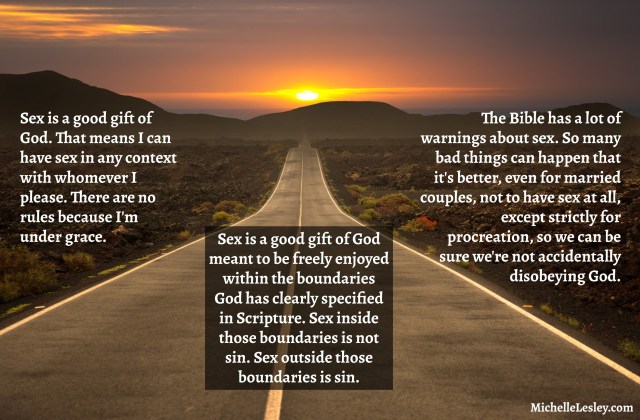
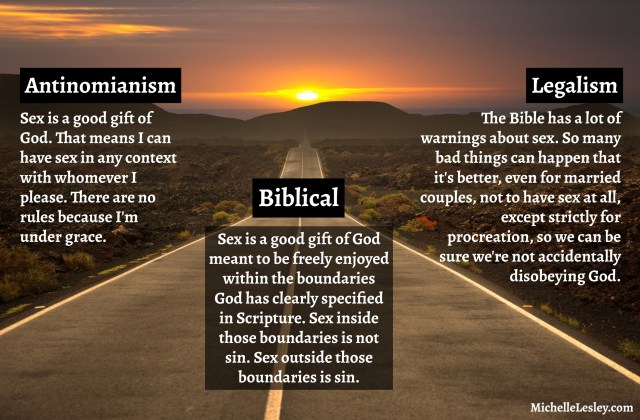
Consider this concept as applied to sex, and what the Bible says about it:

Which side of the road is the “too much ‘grace'” side? “Too much ‘law'”? Which view is the biblical view? (Notice that the biblical view is a “middle of the road” balance between the extremes of man-made “law” and “grace”. If you wander off the road you’re wandering off into darkness. The biblical view is the only one which leads to the sun (Son).)

The theological term for “too much ‘grace'” is antinomianism (also sometimes called “license” – as in, “a license to sin” – or “licentiousness”). The theological term for “too much ‘law'” is legalism (showcased in the Pharisees of Jesus’ day).

3. Antinomianism often fleshes itself out today as:

  • “I’m saved and all my sins – past, present, and future – are forgiven, so why not sin as much as I want?”
  • An “It’s no big deal!” approach to sin
  • The idea that the sin in question is actually biblical (or loving / loving your neighbor, tolerant, compassionate, “what ‘Jesus’ would do”)
  • Obeying what the Bible actually is says is legalism (“Pharisaism”).

What does the Bible say about antinomianism? What does God say about people who claim to be Believers but don’t obey Him?

What are some specific examples of antinomianism that you’ve observed in evangelicalism, in your denomination or church, in your own heart and life?

5. Legalism is most often seen today in churches or individuals who make issues of preference, conscience, or Christian liberty – which are neither prescribed nor prohibited in rightly handled Scripture – into “law”. They consider these “laws” equal to Scripture and believe that anyone who violates them is in sin. A few (generalized) examples:

What does the Bible say about legalism? What are some specific examples of legalism that you’ve observed in evangelicalism, in your denomination or church, in your own heart and life?

Would you say that antinomianism or legalism is the false doctrine most people tend towards today…

  • …in evangelicalism in general?
  • …in your denomination and / or your church?
  • …in your own heart?

6. If you believe falsely about God, sin, the gospel, etc., what impact will that have on your life and your worship?

Let’s look at some examples of unbiblical worship in Scripture. In each of these instances:

  • What was the false belief or doctrine that led these people to worship unbiblically?
  • Was this an expression of legalism or antinomianism?
  • What was God’s response to their false doctrine / false worship? How does God’s response demonstrate how seriously He takes false doctrine / false worship?

Syncretism and idolatry in the temple

Ananias and Sapphira

Nadab and Abihu

The people worship Herod

Taking the Lord’s Supper in an unworthy manner

The Pharisees’ beliefs and practices

7. Since God takes false doctrine / false worship so seriously, what is His posture toward those who teach false doctrine?

8. Some Christians believe that only aberrant soteriology – a false gospel, unbiblical teaching about how to be saved – is false doctrine. Consider these Scriptures. Is this idea biblically accurate?

9. What is false doctrine? Carefully and biblically define this term in your own words.


Homework

Today’s study includes passages from Judges and Ezekiel. You may wish to peruse the relevant parts of my Bible studies on Judges and Ezekiel. How is the state of the church today similar to the state of God’s people and the temple in Judges and Ezekiel?


Suggested Memory Verse