Complementarianism

Throwback Thursday ~ Putting on the “You Can!” of Complementarianism

Originally published October 18, 2019

It never really hit me until I started teaching the book of 1 Timothy how many instructions in the pastoral epistles pertain to women, and how weighty those instructions are. The pastoral epistles are the โ€œpolicy and procedure manualsโ€ for the church, and, far from relegating the ministry of women to nothing more than crafts and tea parties while the men do all the โ€œimportantโ€ stuff, you come away with the impression that a healthy, well-balanced church actually depends on godly women working hard to carry out the ministries that God has uniquely created and gifted us to fulfill, alongside men fulfilling their own ministries.

These epistles donโ€™t view โ€œwomanโ€™s workโ€ around the house of God as trivial or menial, but as a high and holy calling. Vital. Necessary. Honorable.

But is that the lofty perspective of the biblical role of women that the local complementarian church is conveying to its female and male members? Are we, especially those of us in womenโ€™s ministry, proactively teaching that the calling of motherhood or the task of discipling other women or serving those in need is qualitatively just as imperative and noble as the calling of pastor or elder?

Intentionally or not, the egalitarian movement has maneuvered biblical complementarians into constantly playing defense. Their offensive squad keeps moving the ball forward by offering women a no holds barred buffet of powerful and prestigious ministry positions. Our defensive line correctly and biblically pushes back with, โ€œNo, the Bible says women are not to โ€˜teach or to exercise authority over a manโ€™  in the church setting.โ€ But often, only two or three members of our offensive squad are dressed out to play, and they never get off the bench and into the game. And as any football fan knows, you have to have a good defense and a good offense if youโ€™re playing to win.

Egalitarians offer women โ€œyou can,โ€ but all too often all we complementarians have offered godly women yearning to serve is, โ€œyou canโ€™t.โ€ Where is the big, beautiful, biblical showcase of complementarian โ€œyou canโ€?

Not long ago, I was teaching a group of ladies the biblical process of putting off the old self and putting on the new self in Ephesians 4:20-32. We explored how interesting it was that every โ€œdonโ€™tโ€ in the passage was coupled with a โ€œdo.โ€ We donโ€™t just put off lying, we put on proactive truth-telling instead, and so on. Nature abhors a vacuum in the physical realm, and it would seem this is true in the spiritual realm as well. When we subtract the ungodly, we must replace it with the godly. If we donโ€™t, something will rush in to fill the void thatโ€™s been created, and that “something” isnโ€™t usually biblical or fruitful. 

So how can we shift the perspective in our churches from โ€œyou canโ€™tโ€ to โ€œyou can,โ€ and create an atmosphere, not merely of โ€œput off,โ€ but also โ€œput onโ€? How can we get our offensive team suited up, on the field, and moving the ball toward the goalpost while at the same time retaining a strong defense?

We can, so to speak, make complementarianism great again. 

As I studied 1 Timothy 5, I was struck by Paulโ€™s description of women who are โ€œtruly widows.โ€ These are women who have spent their lives being busy and intentional about the work of the Lord in their homes and in the church. They adorned themselves with the good works proper for women who profess godliness, and they were honored and revered for it by the church. I didnโ€™t come away from this passage with the feeling that these women were frustrated, oppressed, or seen as โ€œlesserโ€ by the church because they werenโ€™t allowed to teach or exercise authority over men. I came away from this passage thinking, โ€œThose women were awesome. Thatโ€™s the kind of woman I want to be.โ€

What would the climate in our churches look like if womenโ€™s ministries and the church at large recaptured that same reverential posture and purposefulness toward biblical womanhood? If, instead of teaching the biblical role of women strictly as, โ€œYou canโ€™t eat the fruit from this apple tree,โ€ we followed that admonition with a grand tour of the Garden, focusing on the delicious fruit of the pear tree, the cherry tree that needs a good pruning, the fig tree just waiting for the right woman to come along, harvest its fruit, and make some preserves, the banana tree that needs an expert in fertilizers, and the orange tree dying for someone to water it?

In my experience, what happens in churches of that climate is that – just like the godly widows of 1 Timothy 5 – women are so busy and fulfilled tending the other trees of the Garden, that they have neither the time nor the desire to go apple picking. 

May our churches strengthen themselves and grow to more robust spiritual health by proactively encouraging Christian women to joyfully throw ourselves into the godly โ€œgood works which God prepared beforehand, that we should walk in themโ€ – the biblical โ€œyou canโ€ of complementarianism.


Additional Resources

Rock Your Role: Jill in the Pulpit

Let Me Count the Ways: 75 Ways Women Can Biblically Minister to Others

Unforbidden Fruits: 3 Ways Women MUST Lead and Teach the Church

Servanthood

The Servanthood Survey

Complementarianism, Mailbag

The Mailbag: Women teaching men- Questions from a young reader

I received this very astute line of questioning from a young lady who left a comment on one of my articles. The comment and questions were rather lengthy, so I’ve broken it up into portions in order to answer it in an organized way. If you need to read the entire comment, uninterrupted, for context or ease of understanding, scroll down, reading only the portions in bold.


Hi! Just to let you know, though it may seem, I have no intention of being rude in this question, and genuinely want to know your response to this. I am only in 9th grade, so I have a lot to learn, and want to know what you think about my comment...Thank you, and I am very curious to find out what you think about my questions and things that I might have misunderstood or missed.

That’s awesome! I wish I had been thinking as deeply about these things as you are when I was in the ninth grade. And, rest assured, your questions didn’t seem rude to me at all. I’m so glad you want to learn! I hope you’ll understand that my answers aren’t meant to be rude either, although they may not be quite what you’re expecting or wanting to hear.

You didn’t mention whether or not you’re a Christian or what your church background, if any, is, so let me just start off by saying, if you’ve never been genuinely born again, my answers might not make much sense. I would encourage you, even if you’re pretty sure you’re saved, to examine the materials at the What must I do to be saved? tab in the blue menu bar at the top of this page before moving ahead.

I was just wondering, if women are not allowed to teach men, and you are a woman and this blog is public to men and women, then arenโ€™t you technically providing biblical insight and evangelizing to whatever gender is reading this to inform them of the Bible?

Nope. I’ve answered that question in detail in my article Are Female Bloggers Violating Scripture by โ€œTeachingโ€ Men?

Additionally, “evangelism” and “teaching” (“providing insight” isn’t really a biblical category) are two different, separate things. You might find our podcast episode Women Preaching the Gospel? helpful for understanding the distinction.

Also, the book of Timothy, like you said, was a letter written from Paul to Timothy, so this was just the teachings that Paul gave to Timothy as instructions for the churches, and not necessarily coming from God.

I’m afraid that’s one of the things you’ve misunderstood. This wasn’t just a letter from one human being to another. The words in 1 Timothy, just like every word of every book of the Bible are from the very lips of God Himself. Second Timothy 3:16 tells us that “All Scripture is breathed out by God.” There aren’t some parts of Scripture that are from God and others that aren’t. It all comes from God, from Genesis 1:1 to Revelation 22:21.

First and second Timothy and Titus are what we call the pastoral epistles (“epistle” means “letter”). That means they are God’s instructions, written through His human instrument, Paul, to Timothy and Titus and every pastor who came after them, about how to run the church.

I know Paul was a prophet and one argument could be that he got this information from God,

No, Paul was not a prophet, he was an apostle. And, as I discussed above, the Bible says that all Scripture is breathed out by God, so “Paul got his information from God” is the only argument that can be made, especially for Christians. Because, for Christians, the Bible is our authority on what to believe, not human arguments, opinions, and ideas.

but even prophets (besides Christ) make mistakes in their instructions to others,

I’m afraid that’s also incorrect. There’s not a single prophet in the Bible who, when speaking as a prophet to people on God’s behalf ever made one iota of a mistake about what He said. There were false prophets (who received the death penalty for saying they spoke for God when God had not really spoken to them), but none of God’s true prophets – like Isaiah, Jeremiah, Micah, Habakkuk, etc. – ever got anything wrong or “made mistakes in their instructions to others” when speaking on behalf of God.

such as Abraham, who instructed people to be stoned for certain sins,

I think you mean “Moses” here. Abraham wasn’t a prophet, and I don’t recall any instance in Scripture in which Abraham “instructed people to be stoned for certain sins”. Moses didn’t either. God did. God gave Moses the law on Mt. Sinai, and Moses wrote it down and taught it to the people.

and you can see that it was unlawful in Godโ€™s eyes

I’m sorry, but that’s incorrect as well. Since God is the One who gave the laws about stoning people for certain sins, He would never have said that someone properly obeying His law was doing something unlawful. That would be like God saying He was wrong when He made that law. And, of course we know that God is never wrong.

and you can see that it was unlawful in Godโ€™s eyes when Jesus told the priests about to stone Mary of Magdala that they should not stone her because they have sinned as well and God sees all sins as the same.

I think you’re talking about the story of the adulterous woman in Luke 7-8, right? Again, I’m sorry, but there are many things that need to be corrected here:

  • Stoning a woman caught in adultery was not “unlawful in God’s eyes”. It was lawful. God is the one who gave this law. The scribes and Pharisees correctly cited the law in 8:5.
  • Jesus wasn’t speaking to the priests, He was speaking to the scribes – experts in the law (which was an important point of this passage) – and Pharisees.
  • The text does not say the unnamed woman was Mary Magdalene.
  • Look carefully at the passage. In which verse does Jesus say “they should not stone her”? Answer: He didn’t say, “Don’t stone her.”. On the contrary, He said that they could commence with the stoning as long as whichever one of them was without sin cast the first stone.
  • He also didn’t say they couldn’t stone her because “they have sinned as well”. Every lawful stoning that has ever taken place on planet earth was carried out by sinners, because (except for Jesus) every human being is a sinner.
  • The Bible doesn’t say that God “sees all sins as the same” (In fact, we can see in the way that God deals with various sins in various ways throughout Scripture that this isn’t true.), so Jesus would never have said this nor given it as a reason that these men should not have stoned this woman.

Jesus didn’t say the law against stoning an adulteress was wrong. That would have been equal to saying God was wrong for giving that law. He didn’t tell the men not to obey the law, either. The key to understanding this story is in verses 4-7:

4 they said to him, โ€œTeacher, this woman has been caught in the act of adultery. 5 Now in the Law, Moses commanded us to stone such women. So what do you say?โ€ 6 This they said to test him, that they might have some charge to bring against him. Jesus bent down and wrote with his finger on the ground. 7 And as they continued to ask him, he stood up and said to them, โ€œLet him who is without sin among you be the first to throw a stone at her.โ€

They didn’t care about this woman or what happened to her. They didn’t care about the man who was sinning right along with her. They didn’t care that this sin wrecked the man’s and woman’s lives. They didn’t care that God’s law had been broken. They didn’t care that adultery grieves the heart of God. They didn’t care.

All of those things were just a means to an end for them. All they cared about was trying to get the advantage over Jesus. To trick Him into saying something they could use against Him so they could discredit Him or bring Him up on charges with the Sanhedrin (Jewish court). And they were using God’s precious and holy Word as a tool to accomplish this evil goal. They were blasphemously using God’s own Word against Him.

That is the entire point of this story. God’s Word is His representation of Himself to us. It is our lifeline to Him, because it is how we come to know Christ as Savior. It should be revered as high and holy, not twisted and abused for wicked purposes.

This is just one example of many things that Godโ€™s prophets have taught wrongly.

No, none of the things you’ve mentioned, nor the corrections I’ve given, have demonstrated that any true prophet of God has ever taught anything wrong when it comes to prophecy or commands of Scripture. Second Peter 1:20-21 tells us:

…knowing this first of all, that no prophecy of Scripture comes from someone’s own interpretation. For no prophecy was ever produced by the will of man, but men spoke from God as they were carried along by the Holy Spirit.

So, since times were different in the first century and women were not seen as important to men, couldnโ€™t this have been something Paul told Timothy to do based off of his own understandings culturally?

No. Again, 1 Timothy is a passage of God-breathed Scripture, not Paul’s personal human opinion. It was not based on Paul’s human understanding (see 2 Peter 1:20-21, above), culturally, or in any other way. This is God’s command to pastors, based solely on God’s reasons.

And God kindly shares those reasons with us in verses 13 and 14 of 1 Timothy 2:

11Let a woman learn quietly with all submissiveness. 12 I do not permit a woman to teach or to exercise authority over a man; rather, she is to remain quiet.

13 For Adam was formed first, then Eve; 14 and Adam was not deceived, but the woman was deceived and became a transgressor.

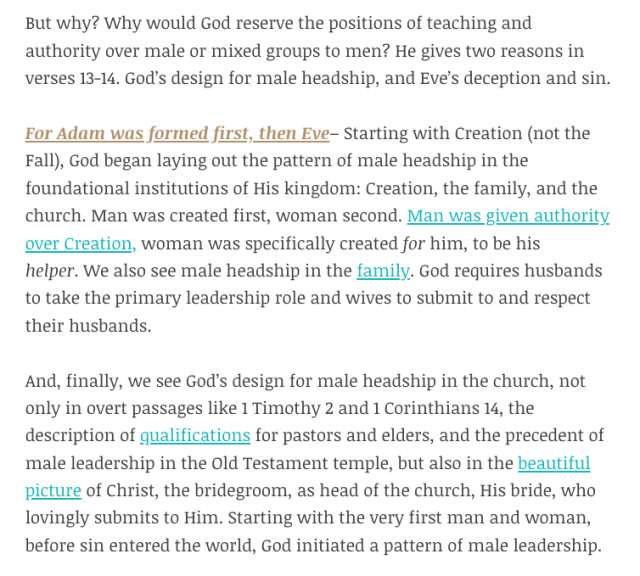
God gives us two reasons for His command that women are not to teach or exercise authority over men in the gathering of the church body: the creation order and pattern of male headship (13), and the fact that the woman was the one who was deceived into sin (14).

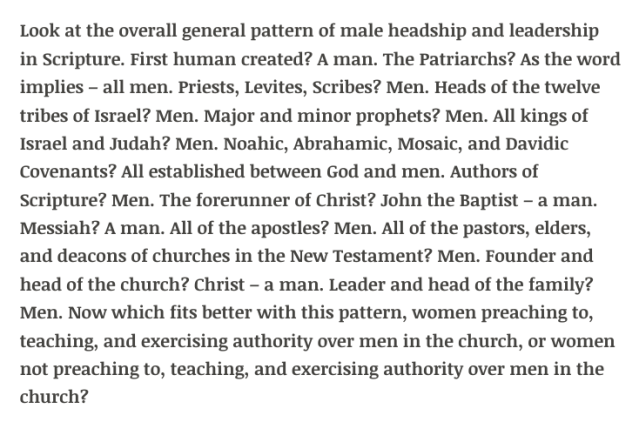
That’s why. Not culture, not Paul’s personal opinions, not because men didn’t value women at the time, not because the women in that particular church at that particular time were unruly or false teachers, not for any of the man-made theories that people have come up with. God tells us exactly why He made this rule for the church in verses 13-14. I’ve discussed this in greater detail in my articles Rock Your Role: Jill in the Pulpit and The Mailbag: Counter Arguments to Egalitarianism. Here are a few of the pertinent excerpts:

You’ve asked some really great questions here, and your reasoning skills are sharp. It was my pleasure to serve you by answering your comment. Keep asking questions, studying, and learning all God has to teach us through His authoritative, inspired, all-sufficient written Word.


If you have a question about: a Bible passage, an aspect of theology, a current issue in Christianity, or how to biblically handle a family, life, or church situation, comment below (Iโ€™ll hold all questions in queue {unpublished} for a future edition of The Mailbag) or send me an e-mail or private message. If your question is chosen for publication, your anonymity will be protected.


Complementarianism, Rock Your Role

Are Female Bloggers Violating Scripture by “Teaching” Men?

“You say that women shouldn’t teach men (1 Timothy 2:12), but what about men who read your blog or listen to your podcast? Aren’t you teaching them?”

It’s the canard that will not die. Complementarian women bloggers, authors, podcasters, and content creators are frequently asked this question, often by dissenters looking for a โ€œgotchaโ€ moment. Other times itโ€™s a genuine concern from Christian women who want to write, speak, or create, but still be in obedience to Godโ€™s Word as it speaks to the role of women. But, whatever the motivation for asking, itโ€™s a great question that needs to be answered. Biblically.

It is true that God has ordained different roles for Christian men and women. Both roles are needed and important, but different. Part of the role for women is outlined in 1 Timothy 2:11-15. Women are not to preach to or teach men in the gathering of the church or hold other positions of authority over men in the church body.

But notice that key phrase โ€œin the church.โ€ The context of all of the passages dealing with women refraining from teaching men refers to the teaching of Godโ€™s Word in the gathering together of the body of believers.

Thatโ€™s not the same thing as writing or speaking in the public square. The gathering of the church body might take place within the four walls of a church building, at a park for a Resurrection Day sunrise service, at a Christian conference, at a chapel service at a Christian college or seminary, at a Bible study in someone’s home, or a myriad of other venues, but it’s just that – a physical gathering together of the body of Christ for the purpose of worship, studying the Word, sitting under the preaching of the Word, observing the ordinances, prayer, practicing the “one anothers,” and other “churchy” things.

You’re reading this blog right now. Are you practicing the “one anothers” with anyone? Is anyone standing in front of you preaching the Word? Are you actively worshiping? Do you see an offering being taken up? Baptism? Communion? Prayer? Do you consider yourself to be attending church right now? Of course not. You’re staring at a screen reading an article. This is a blog. Not the gathering of the church.

The Greek word for “church” in the New Testament is แผฮบฮบฮปฮทฯƒฮฏฮฑ, or ekklesia. It literally means a gathering or assembly. No gathering, no church.1 And because of that, women bloggers and other content creators aren’t violating the Scriptures that prohibit them from teaching men in the gathering of the church. (And, by the way, this all applies to women on social media, too. That’s not the gathering of the church either, praise the Lord.)

When I explain this biblical distinction to the “gotcha” folks, the pushback (that’s a polite word for it) I often get is, “You’re just hypocritically splitting hairs and doing hermeneutical gymnastics to justify yourself!”. No, you’re just conflating things the Bible clearly distinguishes from one another.

Think of it this way: If I say that all sexual activity outside of marriage is sinful, but I joyfully fulfill my marital duty to my husband, am I a hypocrite? Am I splitting hairs or doing hermeneutical gymnastics? No. Because there are right and wrong contexts for sexual activity just like there are right and wrong contexts for women teaching the Bible, writing on biblical topics, and so on. The Bible has defined categories and contexts. The Bible draws lines of distinction. Conflating a biblical “do” with a biblical “don’t”? That’s what’s unbiblical.

But let’s consider something else, too. Even though Scripture doesn’t require it, most godly, doctrinally sound women bloggers and online content creators – including me – aim our content primarily at Christian women. I have set up parameters for my blog (and my book, when it was in print) and for my ministry to do everything I can to place myself under the umbrella of 1 Timothy 2:12. Look at the title of this page and my Facebook page. It specifically says “Discipleship for Christian Women“. My book was always labeled and marketed as a women’s Bible study. If youโ€™ll take a look at the โ€œWelcomeโ€ tab at the top of this page, youโ€™ll see I explicitly say that this blog is for Christian women and that Iโ€™m a complementarian. When I address the readers of this blog I nearly always address them as โ€œladies,โ€ both because my target audience is women, and also to remind the handful of men who follow me that they are not my audience; they are, in a sense, โ€œeavesdropping” on what I’m saying to women. My speaking engagements are for women only. I ask men not to use my Bible studies. I’m not really sure what more I need to do to make it clear that my blog and my ministry are for women, not men.

Don’t men bear any responsibility here? Why should the entire burden for women not “teaching” men fall on the shoulders of women bloggers and content creators? Why don’t the Christian men who are ostensibly so concerned about men consuming content from women address the men who are reading our blogs and following our platforms?

But sometimes these โ€œgotcha guysโ€ – who often have ulterior motives of undermining complementarianism – will visit my blog, claim to have learned something, and then turn around and attack me as a hypocrite for โ€œteachingโ€ them. This is akin to a man listening at the door of a womenโ€™s Sunday school class, then bursting in and saying, โ€œAha! You taught a man.โ€ To those men, I would ask a simple question- If a female blogger puts a fence around her blog and you jump over it and trespass on her property, how is she the one at fault?2

Along with Christian women, Christian men ought also to be obedient to 1 Timothy 2:12 by not seeking out female content creators for biblical instruction for themselves. While I welcome male readers – especially those who are vetting me for their wives and daughters or the women of their church, or to gain a better understanding of the issues affecting Christian women in order to lead and shepherd them better – I do not want men seeking me out for personal biblical instruction. All of my readers should look to the doctrinally sound teaching of their pastors and elders for biblical instruction. For women, my blog should only be a leisure time supplement to their sermons and classes at church.

Being a godly female blogger or content creator can be a tightrope walk. All of us have fallen off from time to time, and in those cases we ask that you extend us grace and forgiveness, knowing that we didnโ€™t do it intentionally or rebelliously. Praise God for the โ€œnetโ€ of Godโ€™s mercy and cleansing that catches us and puts us right back up on that tightrope so we can encourage and build up the lovely Christian ladies in our audience. You mean so much to each of us. We love you and want you to grow in the grace and knowledge of our Lord Jesus Christ. Thatโ€™s why we do what we do.


1This is why it is impossible to “attend church” by watching an online church service. You are not “attending church” online, you are watching other people attend church.

2Brothers, this “trespassing” metaphor is addressed to the aforementioned “gotcha guys,” not solid, complementarian brothers who have stopped by the blog to read something to help them minister to the women in their lives and churches. You are welcome here!

This article is an updated and revamped version of the original article by the same title, published on October 23, 2015.


Additional Resources

Rock Your Role – a series examining the Scriptures governing the biblical role of women in the church

Rock Your Role FAQs

Sisters Are Part of the Family of God, Too!

Women Preaching the Gospel? at A Word Fitly Spoken (on the issue of conflation)

Is it a sin for Christian women to blog? by Doreen Virtue and Jacob Tanner

Complementarianism

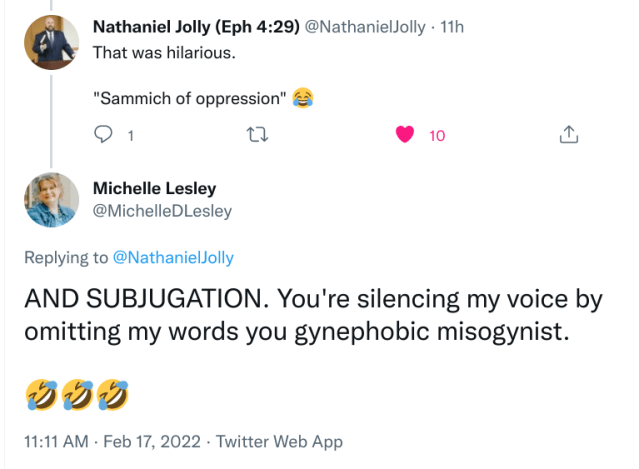
Sammiches of Oppression and Subjugation

Obviously, there are many, many serious issues in the church and world today, and if youโ€™ve followed the blog for any length of time, you know I have a good track record of dealing with those issues on a regular basis in a serious way: Bible study…the gospel…sin…obedience to Scripture…discernment…and so on.

But sometimes, as human beings, we just need a momentary break from the serious to be silly and laugh. Ecclesiastes 3:4 says that just as there is a time to weep, there is an equally valid, and righteous, and good time to laugh. Sometimes I talk to Christians who seem to believe that weโ€™re supposed to have our sense of humor amputated when we get saved, and thatโ€™s just not true. Proverbs 17:22 says:

A merry heart doeth good like a medicine: but a broken spirit drieth the bones. Proverbs 17:22

We need to laugh. We need moments of of refreshing.

If you disagree with any of that, or you just don’t like, or are easily offended by humor for whatever reason, this would be a good time to stop reading and go do something you enjoy, or tackle that “to do” list, or whatever. You’ve been warned. No complainies.

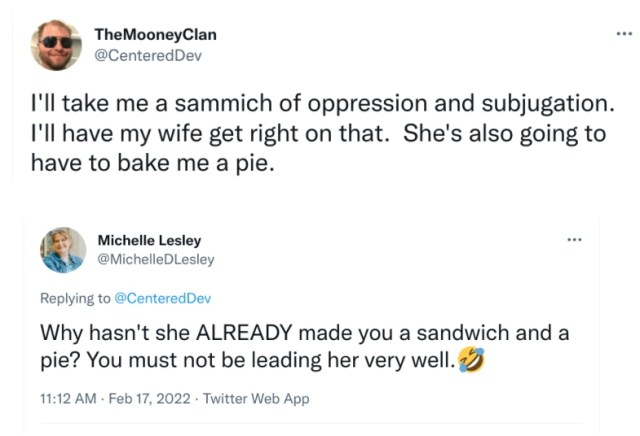
In case you’ve somehow managed to avoid them, there are feminists out there who can’t wrap their tiny little closed minds around the fact that godly women actually find joy in loving and serving our husbands and families. They seem to think – out loud, vociferously, and frequently, particularly on social media – that the only reason a woman might do such a thing is because she’s been brainwashed, downtrodden, or forced to.

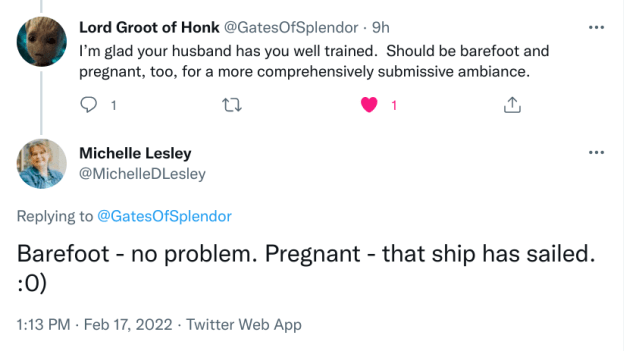
So, I did a thing on Twitter the other day, and I thought it might give you a smile…

Everything – I mean, everything – has to be caveated and explained to death these days (are y’all as sick of that as I am?)…

I kid you not, somebody asked me what my motive was for saying, “I *are* one,” instead of, “I *am* one.” Humor, my friend. Humor.

Of course, then everybody had to get in on the act. Back off, people. Can’t you tell I’m a humor professional?

Men. They’re just lost without a helper.

Leslie is usually so on the ball with these sorts of things. It’s not like her to leave out an ingredient.

I started to say, “That heifer is out of the barn,” but I’m sure that’s sexist…to somebody.

These men will never learn…

That’s right, just keep on wallowing in your wrongy-wrongness of manhood.

Yes, three slices. That’s why you’re still aspiring, honey.

Everybody’s a comedian. But since he’s a MAN, I’ll let him have the last word, as is fitting.

Now get in the kitchen and make your man a sammich of oppression and subjugation, ladies. (My husband said it was OK for me to say that. :0)

Complementarianism, Podcast Appearances

Podcast Guest Appearance – Servants of Grace

Before all the hubbub of the holidays, I had the pleasure of sitting down for a chat with Dave Jenkins of the Servants of Grace podcast.

Listen in (or watch and listen above) as we delve into the issue of women pastors and why this is such a blight on the modern day church, how the church can support women and foster Titus 2 relationships, and more!

Be sure to check out all of the materials, podcasts, and other contributors at the Servants of Grace website, and find their social media links so you can give them a follow. Also, go subscribe to the Servants of Grace YouTube channel so you’ll never miss an episode, or add it to your queue on your favorite podcast platform.

Articles / resources mentioned or touched on in the episode:

Bible Studies

Speaking Engagements

Rock Your Role: Jill in the Pulpit

Let Me Count the Ways: 75 Ways Women Can Biblically Minister to Others

The Servanthood Survey

A Word Fitly Spoken Podcast

Contact & Social Media

Searhing for a new church?


Got a podcast of your own or have a podcasting friend who needs a guest? Need a speaker for a womenโ€™s conference or church event? Click the โ€œSpeaking Engagementsโ€ tab in the blue menu bar at the top of this page, drop me an e-mail, and letโ€™s chat!