Christmas

Nativity Scenes and the Second Commandment

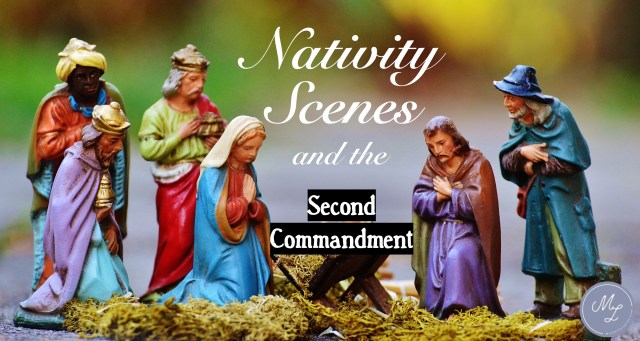
Have you ever heard someone say that nativity scenes, Christmas ornaments, Christmas pageants, and other Christmas items or activities which portray the baby Jesus (with a figurine, a doll, a live baby, pictures, etc.) break the second Commandment even though the portrayal of the baby Jesus isn’t being worshiped?

Some of my brothers and sisters in Christ believe that any representation of Jesus – be it in a manger scene, a painting, a movie, pictures of Jesus in children’s Bibles, flannelgraphs, Bible story pictures used for teaching children or on the mission field, etc. – violates the second Commandment…

You shall not make for yourself a carved image, or any likeness of anything that is in heaven above, or that is in the earth beneath, or that is in the water under the earth. You shall not bow down to them or serve them, for I the Lord your God am a jealous God, visiting the iniquity of the fathers on the children to the third and the fourth generation of those who hate me, but showing steadfast love to thousands of those who love me and keep my commandments.

Exodus 20:4-6

…whether or not that representation of Jesus is being worshiped. It is the mere act of making or displaying the representation which breaks the Commandment.

This is not something any church I’ve ever been a member of has taught, but because I’ve heard this point of doctrine from theologically sound friends I respect, I wanted to take a closer look at the pertinent Scriptures to make sure I wasn’t doing something wrong. I’ve had nativity scenes and children’s Bibles and used flannelgraphs and been in Christmas musicals that depict Jesus all my life and never gave it a second thought. But if having and doing those things conflicts with Scripture, I want to stop.

But, having examined the Scriptures in context, while I respect and admire my friends’ desire to honor the Lord by not using representations of Him, I simply don’t find that the Bible prohibits occasionally depicting Jesus in reverent, not-for-the-purpose-of-worship ways. Here’s why:

Having examined the Scriptures in context, I simply don’t find that the Bible prohibits occasionally depicting Jesus in reverent, not-for-the-purpose-of-worship ways. Here’s why…

1.

Consider the macro-context of Exodus 20. What was going on in the history and culture of Israel at that time? God was setting Israel apart from other nations as His own special possession and establishing Israel as a nation. And what was the preeminent characteristic that was to set Israel apart from the pagan nations? Israel was to be a witness to all the nations of the one true God. They were not to worship idols (which, at that time, were generally carved figures of created things). Not instead of God. Not in addition to God. Not at all. The second Commandment is a command not to worship carved figures as idols.

2.

Examine the immediate context of Exodus 20:4-6. It follows verses 1-3, which establish the supremacy of God above all other gods, and specifically state that Israel is not to worship any other gods.

3.

Take a close look at the content of Exodus 20:4-6. The passage doesn’t say anything about making a representation of God Himself. Jesus had not yet been born when this was written, so this passage could not have been talking about making a representation of Jesus. It talks about making representations of created things in the sky (planets, the sun, etc.), on the earth, and in the water, and worshiping them. And certainly, calling any graven images “God” and worshiping them as God would also be prohibited (Remember the golden calf incidents?)

4.

It would seem to me that to be consistent in saying “no representations of Jesus” folks who hold to this belief would also have to say “no representations of anything” because what Exodus 20:4 plainly says is “you shall not make for yourself…any likeness of anything.” No photographs of anything, no drawings, paintings, or sculpture of anything, no Xeroxing anything, nothing. In fact, I think that would be closer to the actual wording of the passage than “no representations of Jesus,” which, again, this passage does not mention.

5.

The cross references I found for Exodus 20:4 are Leviticus 26:1, Deuteronomy 27:15, and Psalm 97:7. All of them refer to idol worship.

6.

There are at least two occasions in the Old Testament in which God instructs Moses to make a graven figure, and both of these instances are far more conducive to actual worship of the figures than a nativity scene or a Sunday School flannelgraph.

There are at least two occasions in the Old Testament in which God instructs Moses to make a graven figure, and both of these instances are far more conducive to actual worship of the figures than a nativity scene.


The first instance – just five chapters after the second Commandment – is found in God’s instructions for the Ark of the Covenant. God instructs Moses to have the people make two cherubim (angels) for the mercy seat (lid) of the Ark. They were not to worship the cherubim (or the Ark), but the Ark was the holiest object used in Israel’s worship ceremonies. It would have been easy for the people to cross the line and worship it or the cherubim, yet God commanded the making of these not-for-worship figures to point the people to Him. (And guess what was put into the Ark right underneath those graven figures? The two tablets of the 10 Commandments, including the second Commandment.)

The second instance was when God instructed Moses to make the bronze serpent. Anyone who had been fatally snake-bitten could look up at the serpent and his life would be spared. How much more likely would an Israelite have been to worship the bronze serpent, commissioned by God and instrumental in saving his life than we are to worship a picture of Jesus in a children’s Bible? Jesus Himself said that this graven figure pointed ahead to His death on the cross, using it as an illustration of His crucifixion. Much like a nativity scene is an illustration of His incarnation.

Now, if God Himself commissioned the casting of these figures of created things, not to be worshiped, but as tools to point people to Himself, would it stand to reason that He would prohibit reverent representations of Christ that point to or teach about Him? Comparing the second Commandment with these two instances of graven figures demonstrates to us that God expects His people to be able to distinguish between using objects as tools or illustrations that point to Him and worshiping those objects.

God expects His people to be able to distinguish between using objects as tools or illustrations that point to Him and worshiping those objects.

“But if you see pictorial representations of Jesus, you’ll have those images in your mind, and they’ll pop up in your head while you’re worshiping or praying, and then you’ll be worshiping those mental pictures of Jesus, and that’s a violation of the second Commandment.”

If that’s an issue for you, then you definitely shouldn’t view representations of Jesus. But you need to understand that not everyone’s brain works that way. Sometimes when we’re singing in church, an image of my husband, or children, or a beautiful sunset, or whatever the lyrics evoke will pop up in my head. Does that mean I’m worshiping any of those things? Of course not. And for me – and others, I’m sure – any representation I’ve seen of Jesus that happens to pop into my brain is on the same level as those other things. It’s just some random thing I’ve been reminded of, not something I’m worshiping, and it flits out just as quickly as it flitted in.

“But having a pictorial representation of Jesus in your head is worshiping that image.”

No, that is definitionally not the case. Thinking of something is not the same thing as worshiping it. If it were, we’d be guilty of idol worship every time a picture of anything popped up in our brains. There’s a difference between a picture of something randomly popping up in your mind and intentional, purposeful worship.

“But depicting Jesus pictorially, in a nativity scene, or otherwise, could cause a brother or sister who does believe it’s a second Commandment violation to stumble.”

That’s absolutely true, and for that reason, those of us who have the freedom of conscience to use representations of Jesus ought to fulfill our responsibility to those brothers and sisters in Christ. As I’ve learned more about their side of the issue, I have all but eliminated using pictorial representations of Jesus on my blog, social media, etc. I don’t normally display any representations of Jesus in my home, but if I had a friend coming over at Christmas who was sensitive to this, I would certainly remove the baby Jesuses from all of my nativity scenes until she went home. My freedom of conscience comes with a responsibility of love and concern for my brothers and sisters in Christ.

My freedom of conscience comes with a responsibility of love and concern for my brothers and sisters in Christ.

In the end, this issue is an issue of Christian liberty. It is not a sin nor a violation of the second Commandment to use occasional reverent representations of Christ to point people to Him. It is also not a sin to desire to honor the Lord by refraining from using representations of Christ and finding other ways to point people to Him. Whichever side of the issue we come down on, let us make sure we are respectful and loving to those on the other side, not making a law for them where no law exists, nor accusing one side of sin or the other of legalism.


Additional Resources:

When We Understand the Text Podcast (at the 13:36 mark) with Pastor Gabriel Hughes

Christmas

Is Christmas Pagan?

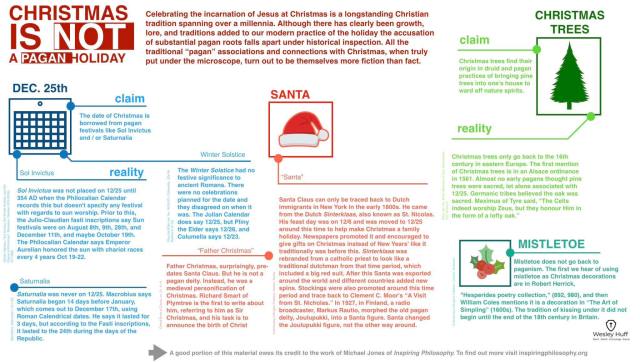
If you’re a Christian, you might have heard the anti-Christmas rumblings on social media, or maybe even in real life: Christmas has pagan origins…Santa’s elves started out as demons…the Roman winter solstice celebration of Saturnalia morphed into Christmas…Mithras…Krampus…the “naughty list” about the origins of Christmas goes on and on. Are these things true? Should Christians celebrate Christmas?

There’s an old story about a woman who made a ham every year for Christmas dinner. As she was preparing it one year, her daughter asked, “Mom, why do you cut off the end of the ham before you put it in the oven?” The woman answered, “That’s the way my mom taught me to do it.” The woman thought about her daughter’s question all day long, and finally decided to call her own mother to ask about it. When the woman got her mother on the phone, she asked, “Mom, why did you teach me to cut off the end of the ham before putting it in the oven?” The woman’s mother said, “That’s the way my mom taught me to do it.” Intrigued, the woman called her grandmother and asked once again, “Grandma, why did you cut off the end of the ham before putting it in the oven?”. Her grandmother replied, “Because I didn’t have a roasting pan large enough for a whole ham.”

Human beings are creatures of habit and tradition, so it’s always important to examine why we do the things we do. As Christians, whether it’s putting up a tree every year, a beloved hymn we’ve been singing since we could talk, or the annual church picnic, our brains should never be on autopilot, unquestioningly taking part in activities by rote.

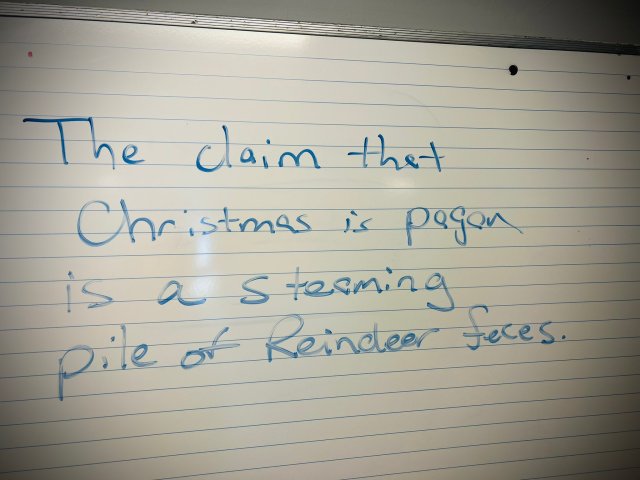
Do some aspects of the celebration of Christmas find their origin in millennia-old paganism? Possibly. But are you participating in that paganism if you put up a tree or give gifts at Christmas? Probably not. The “Christmas is pagan” lore is so ancient and uncertain that most people aren’t even aware of it. How could you possibly be participating in paganism if you’re not even aware of its existence, you have no intention of participating in it, and it has nothing to do with your reasons for celebrating?

Did you know that many of our days of the week and months of the year were originally named for pagan idols and gods? “Sun”day was originally a pagan Roman holiday, and the sun was an object of worship for many ancient peoples. Should we stop having church on Sunday because of that? Are we somehow participating in paganism by holding the Christian day of worship on an ancient pagan feast day? Of course not. Ancient pagans don’t own certain days on the calendar or any particular object or symbol. The Bible tells us, “The earth is the Lord‘s and the fullness thereof.” When godless people take a day or an object God has created and use it for evil, they are the ones in the wrong, not godly people who come after them and want to use that same day or object for a godly purpose. To say that Christians can’t use a certain day or object for celebrating Christmas because pagans used that day or object for pagan purposes is to give those ancient pagans power over Christians. Power they have no business holding.

To say that Christians can’t use a certain day or object for celebrating Christmas because pagans used that day or object for pagan purposes is to give those ancient pagans power over Christians. Power they have no business holding.

Furthermore, just because pagans used a day, an object, or a symbol for their wicked practices hundreds or thousands of years ago does not mean those days, objects, or symbols carry the same meaning today. Think about the way a mere word can change meanings in such a short time. The 1890’s were known as the “Gay Nineties.” The song, “Deck the Halls” contains the phrase “don we now our gay apparel.” The primary meaning of the word “gay” – just 100-150 years ago in our own country – was “happy, merry, or festive.” Now it means “homosexual.” But the “Christmas is pagan” folks would have us believe we’re supposed to attach centuries old definitions and foreign cultural practices surrounding Christmas and other winter observances to our 21st century American celebrations? Santa may have had demon elves hundreds of years ago in another country and culture, but in our culture today, they’re just his happy little helpers – no demonic strings attached. The meanings of cultural practices and symbols change over time.

And if anyone should understand that, it ought to be Christians. We took the cross – “the emblem of suffering and shame” to everyone in the known world at the time of its use – and turned it into a symbol of victory and triumph. The Romans wanted people to look at the cross and think, “criminal.” Today we look at the cross and think “Christ.” They wanted the cross to evoke fear. To us it means freedom. The cross used to mean humiliation. Now it reminds us to honor our glorious Savior.

The Romans wanted people to look at the cross and think, “criminal.” Today we look at the cross and think “Christ.”

Certainly, there’s no biblical requirement for Christians to observe Christmas in any way, so anyone who doesn’t want to observe the holiday doesn’t have to. Conversely, there’s nothing in the Bible that says we can’t celebrate Christmas, so Christians are free to do so as long as we aren’t violating any of the clear commands and principles of Scripture. But whatever conclusion we come to, it’s crucial that we base everything we do on God’s Word correctly applied to our actions and motivations, not supposed connections between Christmas and paganism. There are probably dozens of objects in our homes, traditions we observe, and days on the calendar that can, if we go back far enough and look hard enough, be traced back to one pagan religion or another. Don’t be ruled by that. Christians are ruled by God’s Word, not fears and superstitions.

Christians are ruled by God’s Word, not fears and superstitions.

So let’s be sure we take some time to examine our Christmastime traditions. Why do we put up a Christmas tree every year? What do we tell our children about Santa Claus? What do the words of those Christmas carols mean? Are we doing anything that conflicts with Scripture? If so, it’s incumbent upon us to stop, repent, and make sure “whether [we] eat or drink, or whatever [we] do, do all to the glory of God.” Because it’s not about what pagans did centuries ago a world away, it’s about what we’re doing today, why we’re doing it, and whether or not it glorifies God.

It’s not about what pagans did centuries ago a world away, it’s about what we’re doing today, why we’re doing it, and whether or not it glorifies God.

Scriptures to Consider:

Romans 14

1 Corinthians 10:23-33

Colossians 2:16-23

Additional Resources:

Should Christians Celebrate Christmas at Truth Be Known Podcast

No, Christmas is NOT PAGAN with Keith Foskey

Photo credit: Keith Foskey

Is Christmas Sinful to Celebrate? by Chris Rosebrough

Myths on the Myths of Santa Claus at When We Understand the Text

Other Christmas Myths at When We Understand the Text

Christmas at Got Questions

The Bible reveals Xmas day on the 25th-not from paganism by Agustin Astacio

Christmas Is Not Pagan at Christian Answers for the New Age

Christmas, Church

The 25 Churches of Christmas – Final Report

Friends, thank you so much for your recommendations!

Unfortunately, we did not reach the goal of 25 churches (meeting the parameters outlined in the article below) by Christmas, but with your help, we did get 14,ย and I was able to remove 8ย states –ย Oklahoma, Maryland, Iowa, New York, Wisconsin, Massachusetts, Delaware, and Connecticut – from the “endangered species list” (states with 2 or fewer recommendations). The 14 Churches of Christmas were:ย 

1. Village Church, Dingley, Australia
2. Christ Reformed Church, Tulsa, OK
2. Fellowship Baptist Church, Saskatoon, Saskatchewan, Canada
4. Harvest Reformed Church, Minot, ND
5. Hope Bible Church, Columbia, MD
6. Baltimore Bible Church, Baltimore, MD
7. Walsh Baptist Church, Walsh, Ontario, Canada
8. Missio Church, Ridge NY
9. Rock of Hope Church, Wisconsin Dells, WI
10. Grace Life Church of Greater Des Moines, Ankeny, IA
11. Calvary Bible Church, Westport, MA
12. Faith Fellowship Baptist Church, Brandon, Manitoba, Canada
13. Berean Community Church, Milford, DE
14. Presbyterian Church of Coventry, Coventry, CT

I’m looking forward to adding many more recommendations of doctrinally sound churches in 2019, so keep those recommendations coming!

This Christmas season, I’d like to offer you an opportunity to help me give our brothers and sisters in Christ a gift – a gift that won’t cost you a dime.

If you’ve followed me for a minute, you know I’m passionate about helping people find doctrinally sound churches to join. And if you’ve ever perused my list ofย Reader Recommended Churches, you’ve probably noticed that we have tons of listings for churches in some states, only one or two for others, and hardly any for countries outside the U.S.

What I’m hoping to do is add 25 doctrinally sound churches to the list in the states and countries that are lacking. Of course anyone is welcome to recommend a church anywhere, but in order for it to “count” toward The 25 Churches of Christmas, it needs to be a recommendation for a church:

โ›ช๏ธ in one of our U.S. states that has two or fewer recommendations (currently: Alaska, New Hampshire, North Dakota, Rhode Island, West Virginia)

OR

โ›ช๏ธ a church in any country besides the U.S.

I’ve made the list, you check it twice. If recommendations are naught, be nice and make one! :0) If you have a personal connection to a solid church that’s not on the list, comment below with:

๐ŸŽ„The full, correctly spelled name of the church
๐ŸŽ„The city and state, or city and country it’s located in
๐ŸŽ„The church’s website (please, please, please include this – it saves me a lot of time).

Think we can add 25 churches by Christmas Day? Let’s give it a shot and make it a merry Christmas for our brothers and sisters who are searching for a new church! Thanks for your help! :0)

Christmas, Church

The 25 Churches of Christmas

Friends, thank you so much for your recommendations thus far! We’ve gotten 14ย of our 25 Churches of Christmas and I’ve been able to remove 8ย states from the “endangered species list” (states with 2 or fewer recommendations). With only 2 days left, can we hope for a Christmas miracle of 14 more recommendations fitting the parameters I’ve outlined below?
Keep those recommendations coming!

This Christmas season, I’d like to offer you an opportunity to help me give our brothers and sisters in Christ a gift – a gift that won’t cost you a dime.

If you’ve followed me for a minute, you know I’m passionate about helping people find doctrinally sound churches to join. And if you’ve ever perused my list ofย Reader Recommended Churches, you’ve probably noticed that we have tons of listings for churches in some states, only one or two for others, and hardly any for countries outside the U.S.

What I’m hoping to do is add 25 doctrinally sound churches to the list in the states and countries that are lacking. Of course anyone is welcome to recommend a church anywhere, but in order for it to “count” toward The 25 Churches of Christmas, it needs to be a recommendation for a church:

โ›ช๏ธ in one of our U.S. states that has two or fewer recommendations (currently: Alaska, Connecticut, Delaware, New Hampshire, North Dakota, Rhode Island, West Virginia)

OR

โ›ช๏ธ a church in any country besides the U.S.

I’ve made the list, you check it twice. If recommendations are naught, be nice and make one! :0) If you have a personal connection to a solid church that’s not on the list, comment below with:

๐ŸŽ„The full, correctly spelled name of the church
๐ŸŽ„The city and state, or city and country it’s located in
๐ŸŽ„The church’s website (please, please, please include this – it saves me a lot of time).

Think we can add 25 churches by Christmas Day? Let’s give it a shot and make it a merry Christmas for our brothers and sisters who are searching for a new church! Thanks for your help! :0)

Christmas, Church

The 25 Churches of Christmas

Friends, thank you so much for your recommendations thus far! We’ve gotten 10 of our 25 Churches of Christmas and I’ve been able to remove 5 states from the “endangered species list” (states with 2 or fewer recommendations). I hope we can add 15 more by Christmas. Keep those recommendations coming!

This Christmas season, I’d like to offer you an opportunity to help me give our brothers and sisters in Christ a gift – a gift that won’t cost you a dime.

If you’ve followed me for a minute, you know I’m passionate about helping people find doctrinally sound churches to join. And if you’ve ever perused my list ofย Reader Recommended Churches, you’ve probably noticed that we have tons of listings for churches in some states, only one or two for others, and hardly any for countries outside the U.S.

What I’m hoping to do is add 25 doctrinally sound churches to the list in the states and countries that are lacking. Of course anyone is welcome to recommend a church anywhere, but in order for it to “count” toward The 25 Churches of Christmas, it needs to be a recommendation for a church:

โ›ช๏ธ in one of our U.S. states that has two or fewer recommendations (currently: Alaska, Connecticut, Delaware, Massachusetts, New Hampshire, North Dakota, Rhode Island, West Virginia)

OR

โ›ช๏ธ a church in any country besides the U.S.

I’ve made the list, you check it twice. If recommendations are naught, be nice and make one! :0) If you have a personal connection to a solid church that’s not on the list, comment below with:

๐ŸŽ„The full, correctly spelled name of the church
๐ŸŽ„The city and state, or city and country it’s located in
๐ŸŽ„The church’s website (please, please, please include this – it saves me a lot of time).

Think we can add 25 churches by Christmas Day? Let’s give it a shot and make it a merry Christmas for our brothers and sisters who are searching for a new church! Thanks for your help! :0)